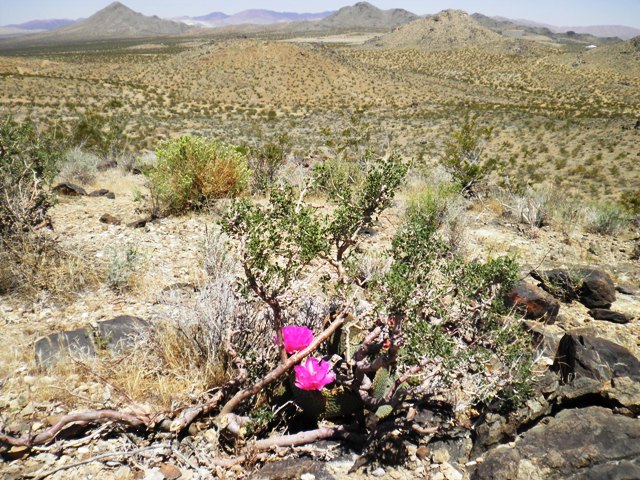
Life, Grief, and Entropy

For just a moment yesterday, while I was walking in the desert, all seemed clear to me. Well, all as related to my grief that is. I could see that things happened the way they needed to. My life mate/soul mate and I could not continue the life we’d been living. We were trapped in an untenable situation, not just because of his health and our finances, but because the place we were living was stifling us. There was nowhere to walk except a 600-yard-long road, nothing to do we hadn’t already done a hundred times, nothing to see that we hadn’t seen a thousand times, but we couldn’t leave. He was too sick to survive a move. Besides, he was comfortable where he was.

Those years of entrapment seemed to go on forever, the only changes being a continual worsening of his health, a continual increasing of his pain, and a continual deadening of my senses.

We were living a classic example of entropy. Entropy is a measure of the amount of energy that is unavailable to do work, and it tends to increase in closed systems. In other words, in a closed system, things break down and stop working. Because of his health, we could not do anything to stop the entropy of our lives. We could only endure.

And then one day, he was set free from his pain-wracked body and cancer-ridden brain. And I was set free from the horror of entropy.

It seemed to me, yesterday, that our lives worked out as they should have. That in a terrible way, we both got what we needed.

I felt at peace most of the day, but the feeling didn’t hold. Last night, the thought “But he’s dead!” hit me. And so sorrow descended once more.

I can see, though, that such moments of clarity will increase until I can finally accept that yes, he is dead, but so what? Someday, I will be dead, too. Meantime, I live to battle entropy another day.

Sundries

Sundries are articles too numerous to be listed separately, and though I am going to list each sundry individually,  none of them need a separate blog post.

First — “sundry” is an adjective meaning “various,” so the way I used it here is wrong though it feels right and fits with “sundries,” which I did use correctly, so I’m leaving “sundry” here. If you want to fight about it, it’s only fair to warn you that my adjectives are stronger than yours. (Sorry, couldn’t resist the silliness, though perhaps I should have.)

Second — I am being interviewed on Susan Whitfield’s blog today, so be sure to stop by to learn more about me. (Though you probably know everything about me since you’ve been reading this blog for a long time, right?) Cick here for: Pat Bertram’s Light Bringer on Susan Witfield’s blog

Third — I am collaborating with six other authors to write a mystery online. Residents of Rubicon Ranch are finding body parts scattered all over the desert. Who was the victim and why did someone want him so very dead? Everyone in this upscale housing development is hiding something. Everyone has an agenda. Everyone’s life will be different after they have encountered the Rubicon. Rubicon Ranch, that is. We don’t know the ending, and will not know until the story is written. So stop by and see the story as it is developing. Welcome to “Rubicon Ranch: Necropieces”

Fourth — I have a fan page on Facebook. Don’t quite know what it’s good for, but if you feel like liking the page, you are welcome do so. Pat Bertram’s Fan Page on Facebook.

Fifth — I have been blogging every day since September 25, 2011, so this is my 278th straight blog post. I originally planned to blog daily for 100 days in a row, but somehow just kept up the habit. Do you think I can keep it up for another 87 days without running out of topics?

Sixth: You can get the latest Second Wind anthology, Change is in the Wind for only $.99 cents on Smashwords. Use the coupon code FC75E when purchasing.

I think that’s a long enough list to be considered sundries. Oh, just one more point — thank you to everyone who has supported this blog and me, especially during the past couple of years. You helped me get through some hard times.

“A Spark of Heavenly Fire” is a well paced thriller

The following is a review of my novel A Spark of Heavenly Fire, and was written by Dellani Oakes.

***

Kate Cummings works in a medical clinic as a patient advocate. Since the death of her husband, she’s led a quiet, uneventful life. All that changes when a jogger in the park falls on her, hemorrhages and dies. This event is strange enough, but when the same symptoms appear in a woman at the clinic, Kate realizes that something more is going on.

At the park, Kate meets Greg Pullman, a reporter for the newspaper. He’s somewhat younger than she, but they click on many different levels. When his fiancee, Pippi O’Brian, dumps him, he finds friendship and solace with Kate.

Together, Kate and Greg begin investigating the odd circumstances surrounding the deaths of the jogger and the woman at her office. As more and more people get ill, the city of Denver finds itself under military quarantine.

“A Spark of Heavenly Fire” is a well paced thriller. Kate and Greg race against time, trying to find the cause of the outbreak as well as survive in the aftermath. The characters are 3 dimensional and believable. The reader feels a link with them, and hope that they will somehow survive.

I highly recommend “A Spark of Heavenly Fire” for anyone who likes a good mystery with a dash of romance. It’s an excellent book and I look forward to reading Pat Bertram’s other novels – “More Deaths Than One”, “Daughter Am I”, “Lightbringer” and “Grief: The Great Yearning” (non-fiction).

Look for all Ms. Bertram’s books at www.secondwindpublishing.com as well as Amazon.com, BN.com and Smashwords.com

Grief: The Twenty-Seventh Twenty-Seventh

My life mate/soul mate died of inoperable kidney cancer on the 27th of March, 2010, and today is the twenty-seventh twenty-seventh I have managed to survive. Some such dates are fading — I no longer count the days or weeks, no longer count my sad Saturdays (he died on a Saturday, and always on Saturday, I feel an upsurge of sorrow), but I am still very aware of the day of the month he died.

This twenty-seventh month marks a big change. For the first time in my long odyssey, I am more grateful for what I had with him than I am sorrowful for what I didn’t have. I can even smile when I think of him, though I don’t think of him as often as I used to. For the first two years of my grief, he consumed my thoughts. It was as if I were afraid to stop thinking of him, lest he disappear completely from life and memory. Despite that vigilance, my memories of him are fading, and while I still feel the sorrow, still feel the immense hole in my life, I am forgetting the particulars. Forgetting, even, what he looked like.

This forgetting seems like a death in itself, but I can’t keep him here by thinking of him. Though I wish with all my being that he were strong and healthy and living, he is gone. And I am not.

In recognition of this, I have put away the only two photos I have of him. I could not bear to look at the pictures for the first fifteen months after he died, but I gradually inured myself to the sight of them. For a while, the images brought me comfort, but now they only remind me of my sadness. Maybe someday I will set out the photos again; meantime, I am learning to survive without this crutch. The photos might not be a crutch so much as a reminder, or maybe simply something to talk to, but whatever these pieces of paper are, they are not him.

I am still beset by tears and fears, and there’s a chance I always will be. His death seemed to open a crack in the EveryThing, and I could almost feel the winds of eternity. Some of the wildness of my grief and the accompanying panic came from this contact with a truth I am not yet capable of understanding. I don’t know what I will become because of the experience, but even though I don’t feel any different, I know I have changed in some fundamental way.

I am weary of trying to find my way, weary of trying to work around the immense hole he left behind, weary of trying to emphasize the good in my life. Perhaps one day, I won’t have to expend so much effort to find ways and reasons to live. I will simply . . . live.

Grief: Finally Grateful

Two years and three months after the death of my life mate/soul mate, I am finally beginning to understand that this is my life and my life alone.

Sharing a life with someone might shroud the basic aloneness for a while, but after the person dies, it eventually becomes apparent that your destiny belongs only to you. (Because, obviously, if it belonged to both of you, he would still be here.)

Surviving a mate is hard on many counts. The sheer agony of his being ripped from your life leaving you feeling amputated. The bewilderment and angst that come with confronting death. The collateral losses that go along with losing a mate, such as the loss of one’s connection to the world, the loss of one’s best friend, the loss of someone to share the burden of decisions and chores. But beyond the obvious hardships are the more subtle problems of loving someone who is no longer alive, of continuing to worry about their wellbeing, of feeling bad for them that their life was cut short. (Much of my grief was for him, a posthumous empathy for his suffering and for his dreams that never came to fruition.)

I do not know the truth of his death — perhaps he is sunning himself on some cosmic beach or playing with a couple of galactic cats. Perhaps he is glad to be dead, assuming he even knows that he is. The corollary to this being my life and my life alone is that his life is his alone. Despite all that we did together, all that we shared, all that we were together, I am no longer part of his life.

In some ways, his death set me free. Our lives had become so constrained because of his illness and our financial concerns, that it trapped both of us in a world that was barely tolerable. (I was going to say that it was unbearable, but we did bear it.) His death brought an end to that world for both of us, though losing him catapulted me into the world of grief.

I am not over my grief — I never will be — but my sorrow is being assimilated into my life, and I am coming closer to an acceptance of the gift of freedom he gave me. I am still prone to tears and fears, but finally, after all these months, I am able to think of him and smile, and be grateful that he shared his life with me.

A Credo to Live By

Several years ago I created a credo defining how to live my life. I started with three points, gradually added the next four, and I thought the credo was finished. Recent exchanges on this blog reminded me of other prompts I need to add, such as being more playful and looking for my inner wild woman, and I ended up with eleven points. Eleven is an odd number, but I thought each item was an important one, and didn’t want to subtract one simply for the sake of satisfying my need for symmetry. Besides, my life is just beginning, or rather, beginning again, so chances are I’ll find more goals and reminders that I want to add.

Hey! What do you know! I just found number 12. Now I can have my credo and symmetry too.

My credo:

  1. Believe in yourself.
  2. Expect the best.
  3. Have a vision of victory and abundance.
  4. Don’t settle for a life of mediocrity.
  5. There is adventure waiting for you. Run to it. Explore.
  6. Be bold and brave.
  7. Live the life that only you can live.
  8. Be playful.
  9. Strive for spontaneity.
  10. Find your inner wild woman.
  11. Accept that you are where you are supposed to be.
  12. Embrace your destiny. It belongs to you alone.

Some of the points are easy, such as not being mediocre. Some are almost impossible for me, such as having a vision of victory and abundance since I don’t even know how to do envision those things. Some are wishful thinking, such as embracing my destiny. But . . . if I can learn to follow most of these exhortations, I could live a spectacular life.

Do you have a credo you live by?

“More Deaths Than One” will leave you breathless

The following is a review of my novel More Deaths Than One, and was written by Dellani Oakes. I didn’t bribe her into saying such nice things. I promise.

***

“More Deaths Than One” by Pat Bertram will leave you breathless—first with anticipation, finally with a contented sigh of a job well done. Set in 1988, this well crafted, fast paced novel of love and intrigue spans the globe from Denver, Colorado to Bangkok, Thailand.

Bob Stark is a quiet man. A Vietnam vet, he’s returned to the states after nearly 18 years in Thailand. He came back to his childhood home of Denver because his life in Thailand couldn’t continue. His friend and mentor, Hsiang-li, left on a personal quest to find a golden Buddha in the jungle—the place where he had to bury his wife and child after they were murdered.

Kerry Casillas works nights in the diner Bob frequents. One night, she introduces herself and they get to know one another. Soon after meeting Kerry, strange things start to happen. Bob and Kerry find themselves embroiled in a mystery far beyond their understanding.

“More Deaths Than One” is an interesting tale of one man’s journey to find the truth. The character of Bob Stark is deep and many faceted. He’s quiet, kind and resourceful, showing abilities even he didn’t know he possessed.

Kerry is a fun loving character and the opposite of Bob in many ways. She’s talkative, outgoing and imaginative. She is the perfect partner and counterpart to Bob. She, too, has hidden talents that surprise and please Bob.

The well-paced plot of “More Deaths Than One”, keeps the reader riveted, waiting to discover the many mysteries in Bob’s past. I enjoyed the fact that though I guessed at all of these secrets, I was right about only a few. Bertram truly kept me hopping as I made my way through the book. I like when a novel isn’t so predictable that I know the end before it arrives.


I Am Crying, Forever Dying

I had a grief upsurge yesterday, probably because I haven’t been grieving much and it’s been building up, but the upsurge itself was instigated by a song.

It started with my session of dance therapy (I call it that, but all I do is prance around for two or three songs in an effort to add a bit of lightness to my step and my life). The first song was “Cry Cry Cry” by Highway 101.

I wonder if he knows what he’s done to me
I’m gonna love that boy till the day I die
Till the day I do I’m gonna cry cry cry.

What a mood brightener! But I managed to get through that song dry-eyed. I even managed to get through the second song without tearing up — “You’re in My Heart” by Rod Stewart

You’re in my heart, you’re in my soul
You’ll be my breath should I grow old
You are my lover, you’re my best friend
You’re in my soul

Yikes. Not the song to cheer up a woman who has lost her mate. But the third one did me in — “Sailing” by Rod Stewart.

Can you hear me, can you hear me
Through the dark night far away?
I am dying, forever crying
To be with you, who can say.

Even worse, I found myself haunted by those words all day yesterday and into today. Oddly, though, I transposed the words, and what went around and around in my head was “I am crying, forever dying.”

Out walking in the desert today, I had a bit of a mystical revelation. (Or sunstroke. It was hot out there.) What if that’s the truth of it? We are forever dying? Not just now in this lifetime, but forever? What if life is the aberration, and dying (not death) the norm?

Some scientists say the universe is dying, that there are more stars dying out than being born. Maybe someday, when it’s all over, there will be another big bang, and the whole cycle will start again. Perhaps each cycle is a single breath of “The EveryThing.”

I guess what I’m saying is maybe life as we know it is more of a static state than dying is. With dying comes transformation.

Did I mention that it was very HOT in the desert?

Three Simple Ways to Increase Views on Your WordPress Blog

In my travels around the internet, I see a lot of blogs. There is nothing more annoying than to stop at an interesting article, want to see more by the writer, and have no other articles available to see. Many people use the standard archives widget, which is nothing more than a listing by date. What good does that do anyone? A date is not exactly a compelling reason to check out more of the blog.

In case anyone is curious what I wrote on a particular day, I do have the date widget, as you can see toward the bottom of my right sidebar, but I use a drop down box in place of a long list of dates. I also have “categories” toward the bottom of my left sidebar, but that is almost as useless. “Grief” and “writing” and “life” are almost as dull as a date. However, if you will look toward the top of my left side bar, you will see “Recent Posts” and “Top Posts.” Recent posts, obviously, are the most recent posts, and top posts are the ones that got the most views for the past forty-eight hours. This gives anyone who is interested in reading more of my articles a sampling of my writing. If you don’t use such widgets on your WordPress blog, why not? It takes only a few minutes to add the widgets.  Here’s how:

Rest the mouse cursor on the name of your blog in the top left hand corner until you get a dropdown box. Click on “widgets.” On the widget page, find “Recent Posts” and “Top Posts and Pages,” and drag them to your sidebar. If you have more than one sidebar, as I do, drag them to the sidebar where you’d like to see them featured. Title the widget if you want, or leave the title WordPress gives them, choose the number of posts you’d like to display, and click “save.” That’s it. Simple, right?

What’s even simpler is creating a page with an archive of all your posts. Supposing you have a lot of posts you are proud of and you want people to be able to see all your titles at a glance — it will take forever to list them, won’t it? Nope. Won’t take but a minute.  Here’s how:

Rest the mouse cursor on the name of your blog in the top left hand corner until you get a dropdown box.  Let the cursor rest on “new” then click “page.” Add a title to the page, then in the body of the post, write [a r c h i v e s]. Use the brackets, and don’t put spaces between the letters. I had to add spaces, otherwise you wouldn’t see the shortcode, you would only see the list of all my blog posts.

Now, the next time I visit your blog, I’ll have a reason to stay and read awhile.

Drowning in a Sea of “It”s

I’ve started going through my poor old work-in-pause. (The manuscript has been neglected so long, I can’t in all honesty say the work is in progress.) At first, I only intended to read what I’d written to plant myself in the story so I could figure out what my hero does next, but I’m appalled by the bad writing. Actually, the writing is okay, but the work is in dire need of editing. And no wonder — I wrote these chapters five years ago, long before I learned how to edit.

The worst problem I find is a copious use of pronouns, especially “it.” “It” serves only to tell a reader that the writer couldn’t be bothered to figure out a better way of saying “it,” so the writer used the placeholder word in the hopes that readers would be prescient enough to understand what “it” meant. To many “it”s make writing seem vague, because . . . well, because “it” is vague. For example:

“She’s my mother. I can’t just throw her out.” He hefted the bag of dry cat food, then paused, arrested by the image of himself pushing Isabel out the door of his apartment. As tempting as it might be, he couldn’t do it. When he was a child, she’d worked two jobs to support him, and he owed her.

I’m not sure how to replace the “it”s without causing echoes by repeating words such as “mother” and phrases such as “throw her out,” but the “it”s slapped me in the face when I was reading that passage, and that is never a good sign.

From the very next page: A chime intruded into Chet’s thoughts. It took a second for him to recognize it as the bell over the door. He seldom heard it so clearly; usually the clamor of the birds and animals drowned it out.

And this from a few pages later: He heaved his computer off the dresser top where he’d been storing it, lugged it to his office, and set it on the desk. He turned it on, ordered the lemon drops, then pulled up his plans for the refuge.

Yikes. I feel as if I’m drowning in a sea of “it”s. Maybe by the time I edit these chapters and find concrete words to replace all the “it”s, I’ll be so deeply involved in the story, I’ll have no trouble segueing into writer mode. Despite being infected by a bad case of ititis, the story deserves more than to be packed away as a work-in-pause for five more years.