How Do You Discover the Books You Want to Read?

Two-and-a-half-years ago, I took an informal poll to find out how people discover new authors. I posted the following on discussion boards on both Goodreads and Facebook:

It seems as if there are as many ways of discovering books as there are readers, but I’m curious as to how you choose the books you want to read. Do you go by reviews? By recommendations from friends? Because you’re familiar with other works by the author? Do you ever read a book because of an ad you saw? Because of a blog article? Because of a mention on a website such as Goodreads? Do you cruise book stores, libraries, or online sites like Amazon? Do you find them some way I haven’t mentioned, such as gifts, perhaps?

Admittedly, the questions were loaded, but I still got an interesting and probably quite accurate overview:

Favorite authors or previously read authors: 36
Word of mouth: 26
Blog reviews/Book websites: 26
Goodreads/Shelfari: 24
Local bookstores: 21
Amazon/B&N/other online stores: 15
Library: 13
Publisher sites/newsletters: 5
Social networking sites like Facebook: 5
Book Clubs: 5
Author appearances/writing conferences: 5
NY Times bestseller list: 5
Offline reviews: 5
Yard sales/second hand bookstores: 4
Advertising: 3
Saw the movie: 3
Oprah: 1
Free downloads: 1
Gifts: 1

Recently, I posed the questions and got similar responses (though from a much smaller group):

books by favorite authors: 8
recommendations from friends: 5
browsing in bookstores: 4
libraries: 2
imprints (the trade name under which the book is published): 1
newspaper reviews: 1
blog reviews:1
recommendations from Amazon: 1
book clubs: 1

So, even with small independent publishing houses springing up like new forest growth, and self-published books proliferating like elm tree seeds, the means of finding books are still the same. That means, if you are an author looking for a readership, you need to be everyone’s favorite author and have your readers recommend you. An almost impossible task when most people already have their favorite authors.

What about you? How do you discover the books you want to read? Or rather where. (A lot of people said they found books to read by the front cover or the blurb on the back, but I’m more curious as to where they saw the cover.)

Celebrating Twenty Weeks of Daily Blogging

On September 25, 2011, I made a vow to blog for 100 days straight without fail. I wanted to get back into the discipline of daily writing, but didn’t want to make a major commitment such as writing a novel. I figured daily blog posts would satisfy the discipline and also satisfy the part in me that needs the reinforcement of completing a project. I passed the 100 day mark without even noticing, and now I’ve been posting a blog every day for twenty weeks — 140 posts.  Surprisingly, very few are frivolous, posted just for the sake of posting something. So today, let’s forget the seriousness of my usual posts. Let’s forget that this is Saturday, my sadder day. Let’s forget that my publisher, Second Wind Publishing, has moved to a new website and I have thousands of now-dead links to update. Let’s forget all of that, and just play.

And if that isn’t any fun, here’s a jigsaw puzzle (I get such a kick out of these!)

Want more fun?

Click here to read the first chapter of: Light Bringer

Click here to read the back cover copy and an excerpt: Light Bringer

Click here to check out (and buy at $2.00 off!) Light Bringer at Second Wind Publishing’s new site: Light Bringer

Top Five Things I’ve Learned About Twitter

Twitter is a microblogging site where you post 140 characters at a time. I’ve written 100-word stories, 100,000-word novels, blog posts of various word counts, but anything that can be said in 140 characters or less almost doesn’t seem to be worth saying, so I’m having a hard time finding a home in the Twitosphere (or do I mean the Twitterverse?). Still, I am learning a few things about this twitterish world. Here are the top five things I’ve learned:

1. Tagging your tweets. You add tags to your tweets by using hash marks. For example, when I tweet this post, if I add #twitter to my tweet, people who are interested in finding out who is tweeting Twitter can search for #twitter, and discover all recent posts with that hash mark. (Okay, so you already knew that. But this is a post about things I’ve learned, and for some reason, that basic bit of twitia passed me by.)

2. Twit chats. #writechat is a group of writers who meet every Sunday on Twitter from 12:00 pm to 3:00 pm PT. You don’t need an invitation to join the discussion. (Well, maybe you do, but I crashed the party and no one complained.) All you have to do is go to your Twitter account and search for #writechat. Or you can start your own discussion group. Pick a name, add a hash mark, tell a few friends, and there you are, master of your own twit chat.

3. Trending topics. On the right sidebar of your Twitter home page, there is a list of trends. These trends are topics that are currently popular (as in right-this-very-minute popular) and are compiled from the most retweeted tweets, mostly news items. Twitterers think that they are tweeting non-mainstream news, that they are in the vanguard of a rebellion against traditional news sources, but as it turns out, the most retweeted twits and tweets come from the major media via their followers.

4. Friend or follow. Some twits like to follow everyone to get a huge following, and after you have followed them because you really don’t know what you’re doing and so you follow everyone who follows you, these twits unfollow you. Don’t you feel used? Well, no. Because you didn’t know they unfollowed you. Twitter sends you a message when someone follows you, but they don’t care if anyone unfollows you. So, here’s where you even the score: go to Friend or Follow, fill in your Twitter user name, and wait for the results. They might surprise you. You can easily unfollow your unfollowers from the site.

5. Clean your twits. Sometimes you end up with spammers or people you thought were your friends but who tweet a hundred times a day. Or you end up with a whole stream of multi-level marketers. Here’s an easy way of telling who is who. Go to: Twit Cleaner, fill in the information requested, and you get a whole list of unsweet tweeters with dodgy behavior such as those who tweet only links, those who only retweet other’s tweets, those who tweet the same links over and over again.

The main problem with cleaning your twits is that you end up with a huge discrepancy between the number of those who follow you and those you follow, and Twitter frowns on that. But whose Twitter is this? The way I figure, it’s better to follow fewer followers and get to know them, than to follow all who follow you and be inundated with the same twiddly stuff over and over again.

I’d planned to end this blog with a refutation of my bad report — Twit Cleaner told me I was guilty of dodgy behavior, that my tweets were mostly links. I was going to say that if people wanted to unfollow me because I tweeted too many links, then that is fine with me since if they’re not interested in what I tweet, they are of no use to me. Unfortunately, I just got a new report from The Twit Cleaner. They said “You’re awesome! Not very much to improve here. You’re basically already pretty great. Keep being your wonderful self.”

Thank you. I will.

Book Bits #114 – Kudos to Beauty & the Book, Roald Dahl stamps, William Gibson, Queen Elizabeth

Three reasons to read Malcolm R. Campbell‘s Book Bits #114

1. It’s the best compendium of book information orbiting the blogosphere

2. It has a link to my Pat Bertram Introduces blog where I interview Benjamin Cheah, an author from Singapore

3. It has a link to the incomparable Beth Hill’s latest article for her The Editor’s Blog.

Book Bits #114 – Kudos to Beauty & the Book, Roald Dahl stamps, William Gibson, Queen Elizabeth.

(If you would like to do an interview for my Pat Bertram Introduces blog, you can find the questions and instructions by clicking here: Pat Bertram Introduces . . . )

Writing a Book I Didn’t Know I Was Writing

In Style: Writing as the Discovery of Outlook, Richard M Eastman says: “You don’t begin to write with a complete message or experience already imagined, which is then to be wrapped in language as a means of sending it to your readers. Writing isn’t so much communication as creation. In a real sense, you don’t have an outlook on anything without first having written on it. This outlook comes into being through the dozens of tests, choices, and unexpected chances which turn up as you write on some engaging topic; and most writers agree that the final creation isn’t anything you could have precisely anticipated when you first set pen to paper.”

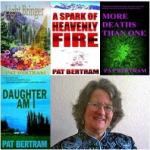
Eastman’s discovery of outlook holds true for my fiction.  I know the story when I begin, I know the ending, and I know a few important scenes, which should mean that I know the whole story, but I don’t. I am not the same, my outlook is not the same, when I finish writing the story as when I began, so the story is not exactly as I intended. The creation process itself creates the change in outlook. Writing is all about the choices we make, and continue to make, all through the creating, editing, proofing. Sometimes I find that I’ve written a book I didn’t know I was writing. A Spark of Heavenly Fire was supposed to be the story of women who could barely cope during times of prosperity when everyone else was doing just fine, but they came alive and dazzled during dark times when everyone else could barely cope. That story is still there in A Spark of Heavenly Fire, but the overriding story is the story of love in all its guises: self-less love, self-love, friendship, romantic love, parental love, obsession.  This theme of love came about through the various elemental choices I made during the course of the book, and it makes novel strong, much stronger than it would have been if it remained simply the story of women who come alive in times of hardship.

And Eastman’s discovery of outlook especially holds true for my non-fiction. I wrote a book about grief, a book I didn’t know I was writing. After the death of my life mate/soul mate twenty-one months ago, I found solace in writing about his death and my grief, in blogging about it, in writing letters to him. And now, some of those writings have coalesced into a book that people have called “exquisite,” “profound,” “raw and real.” I wrote to help me come to terms with the soulquake I experienced after he died and with my continued grief. But what the book ends up being is a great love story, the story of a love that transcends time and physical bonds. He might be dead, my love for him is still strong.

I know what you’re going to ask, but no, the book isn’t published yet, but it should be released in March 2012. I’m putting the finishing touches on the book now, adding the few photos I have to further illustrate our life, and then it heads back to my publisher so they can add a cover and get it published.

One unintended benefit of getting the book published is that afterward, this blog will not be quite so schizophrenic. Part of the time I write about writing, the rest of the time I write about grief. The book will pull both parts of this blog together, and it will become a cohesive whole. I wonder if the book will do the same for me, help pull me together somehow, bridging two very different parts of my life — the part where I once shared a life,  and the part where I’m left alone to pick up the pieces of that shattered life.

Are You Playing The Kindle Game?

People keep saying that Kindle, even more than other reading devices, has revitalized the book industry, making books affordable and reading more accessible. They say the market is expanding, that people who never read are now interested in books. But is this true? Are they interested in reading, or are they interested in playing the Kindle game, downloading books as fast as possible to fill their new toy?

One reason people always gave for not reading is that they don’t have time. Do people suddenly have huge extra blocks of time to read, to get into a book, to explore new ways of thinking and experience new ways of being? I think not. It seems that reading is now part of the multi-tasking generation, where you read while doing something else. Is this reading? People say that reading is not a solitary activity any more, that new enhanced reading apps make it social. If so, is this really reading?

The other half of the Kindle game is the author game, where selling as many books as possible, is all that matters. Whether people actually read the book is immaterial. Of course, the major publishers started this game a long time ago, this game of sales records, and now it’s been taken to the people where anyone can play. But that doesn’t mean the books being sold then or now are worth reading.

When I mentioned in a comment to a fellow blogger that Amazon was a major publisher, she corrected me and said it was a sales platform, like using WordPress. It’s a perfect analogy, and it explains an unusual phenomenon — my rapidly increasing blog rating. It always used to hang around 3,500,000 on Alexa.com, but suddenly, for no reason I could see (my readership is growing, but not enough to explain a leap in rankings), my blog began increasing in rank, and now it’s at 929,990 (out of 346 million sites). Are blogs disappearing (or falling off the scale) because people are now uploading things for Kindle that they once posted on their blogs? If so, then books are being devalued to the level of a bloggerie.

Makes me wonder if I’ll ever take up writing again.

But for now, if you are playing the Kindle game, all my books are available both in print and in ebook format. You can get them online at Second Wind Publishing, Amazon, B&N and Smashwords. Smashwords is great! The books are available in all ebook formats, including palm reading devices, and you can download the first 20-30% free.

This is the third post where I’ve been mulling over the current state of the book business. The other two are: Is the Book Business Dying? and First the Bread Wars, Now the Book Wars.

When You’ve Seen One Shopping Center . . . You’ve Seen a Mall.

I went to a mall today to do an errand for someone. This was only the second time I’ve been in a mall in over ten years, and I walked around in amazement. What did anyone want with any of that . . . stuff? What did they do with it? Why would they even want it?  I saw tons of things (several tons, actually) but not one item caught my eye.  That’s not true. Two things caught my eye — a mannequin in a store window with a huge Christmas bow in place of her head and a sign outside another store that said: The entire store is buy one get one free. Such a great sale — if I had the money to buy one store, I’d get a second absolutely free!! Did that include the merchandise,  or just the name and empty shelves? Alas, I could find no answer to my query, only blank stares

The title of this blog post came from an email that’s going around, and if you are another lexiphile (lover of words) like me, you will get a kick out of my punting this list around. (Did you catch my cleverness? Two word plays in one!! Kick and punt, and pun-ting because most of these are puns.) I can already hear your groans, either because you’ve seen these before, or because you haven’t.

Lexiphile’s list:

You can tune a piano, but you can’t . . .  tuna fish.

A dentist and a manicurist married. . . . They fought tooth and nail.

To write with a broken pencil is . . . Pointless.

When fish are in schools they sometimes . . . Take debate.

A thief who stole a calendar . . . Got twelve months.

The professor discovered that her theory of earthquakes . . . Was on shaky ground.

The batteries were given out . . . Free of charge.

A will is a . . . Dead giveaway.

If you don’t pay your exorcist . . . You can get repossessed.

With her marriage, she got a new name . .. . And a dress.

Show me a piano falling down a mineshaft and I’ll show you . .. . A-flat miner.

You are stuck with your debt if . . . You can’t budge it.

Local Area Network in Australia : . . . The LAN down under.

A boiled egg is . . . Hard to beat.

When you’ve seen one shopping center . . . You’ve seen a mall.

Police were called to a day care where a three-year-old was . . .. Resisting a rest.

Did you hear about the fellow whose whole left side was cut off? . . . He’s all right now.

If you take a laptop computer for a run you could . . . Jog your memory.

A bicycle can’t stand alone; . . .. It is two tired.

In a democracy it’s your vote that counts; in feudalism, . . . it’s your Count that votes.

When a clock is hungry . . .. It goes back four seconds.

The guy who fell onto an upholstery machine . . . Was fully recovered.

He had a photographic memory . . . Which was never developed.

Those who get too big for their britches will be . . . Exposed in the end.

When she saw her first strands of gray hair, . . . She thought she’d dye.

I wondered why the baseball was getting bigger . . . . Then it hit me.

Introducing Joylene Nowell Butler, author of “Dead Witness” and “Broken But Not Dead”

Someone left a comment on my blog the other day, then apologized for intruding where he didn’t belong. This worried me. I wondered what I had done to make anyone feel unwelcome. Then it occurred to me that I have made so many friends here that perhaps it seems like a private blog. When you talk about the important things in life (writing, grief, life itself) you connect quickly, even though the commenters might live in such mythical places as Canada, New Zealand, Australia, and Georgia (USA).

Joylene Nowell Butler was one such commenter who has now become a friend. We have never met, might never meet (though I would like to), but the connection is very real. She eased a terrible time in my life with her wisdom and sympathy, with her steadfast presence. I’m ashamed to admit, I am remiss about returning the favor and visiting her blog, A Moment At A Time On Cluculz Lake, though I intend to get over there more frequently. She has insightful posts, wonderful guests, and gorgeous photos of Cluculz Lake in Canada.

Joylene is the author of suspense thrillers Dead Witness and Broken But Not Dead. In honor of our friendship and the publication of her second book, I am gifting her with a mini blog tour.

I am interviewing her today on another of my blogs. Click here to find the interview: Pat Bertram Introduces . . . Joylene Nowell Butler, Author of “Broken but not Dead.” I always enjoy hearing (seeing) how other authors view writing and the writing life. Don’t you?

Click here to read an excerpt from: “Broken but not Dead” by Joylene Nowell Butler

More than three years ago, I posted an invitation to interview characters, and she was one of the few who took me up on my offer. It impressed the heck out of me! (That was how and where we met.) Here is that interview: Pat Bertram Introduces . . . Valerie McCormick, Hero of “Dead Witness” by Joylene Nowell Butler

Click here to read an excerpt from: “Dead Witness” by Joylene Nowell Butler

Thank you for everything, Joylene. I hope you have a fantastic New Year, filled with hope and peace and many wonders.

Dellani Oakes, A Denizen of My Online World

I’d like you to meet Dellani Oakes, a wonderful writer, great blogger, Facebook friend to thousands of readers and authors, blog talk radio host, fabulous reviewer. Hmmm. I think I listed everything. Nope — forgot to mention the most important thing of all: she’s also an indefatigable writer. Her two published novels are Indian Summeran historical romance and Lone Wolf, the first novel in a new science fiction series. Both were published by Second Wind Publishing. (Click on the title link to read the first chapter of each book.) She has 54 works in progress at last count  and a notebook with hundreds of  other ideas for short stories and novels. When asked recently how she thought of all those stories, she replied: “There are more ideas in my head than I can get written down in one lifetime. I’ll have to live forever.”

We can only hope to have her around so long!

You can meet Dellani at Dellani’s Choice, the new blog she recently started to post author interviews and reviews of books she has read. Or you can meet her at Writer’s Sanctuary, her original blog. She’s been collecting author’s book titles & their links as a holiday guide for people who want to find great gifts. So be sure to check out Writer’s Sanctuary.

Click here for an interview with: Dellani Oakes, Author of Lone Wolf

Click here for an interview with: Wil VanLipsig from Lone Wolf  by Dellani Oakes

Click here for an interview with: Manuel Enriques, Hero of Indian Summer by Dellani Oakes

Click here to friend Dellani on: Facebook. Tell her Pat sent you.

The Miraculous Resurrection of the Suspense/Thriller Writers Group on Facebook

A few days ago I talked about how when I first joined Facebook, I hadn’t a clue what to do, and how quite by accident, I became a moderator of an almost defunct writing group called the Suspense/Thriller Writers. I was trolling around the site, looking for groups that might interest me, and I stumbled on that particular group, which had but eight members. On the right sideboard was a button that said, “become a moderator of this group.” I was curious what becoming a moderator would entail, so I clicked the button. And that’s how I became the moderator of the group. To make it a viable group, rather than a typical Facebook group where people just posted book covers and other promotional bits, I decided to have weekly discussions.

We had some great discussions about improving our craft, but facebook, in it’s infinite wisdom (that is irony, in case you didn’t catch it) decided to get rid of the discussion boards. Without the discussion board and the help we offered each other, any serious discussions rapidly disappeared beneath the steady stream of self-promotion. So all we could do was post information about our books, and in doing so, we lost many of those serious about writing.

On Sunday, something miraculous happened. The members of the group began talking about what they wanted from the group and what they didn’t want. Mostly, what they didn’t want was blatant self-promotion, and especially from members who never bothered to participate in any group activities. So, we decided to limit such promotion to Saturday (and I’m hoping to make that a fun day where everyone gets together to talk about their books).

This is the first time in a very long time I’ve felt any excitement at being on Facebook. Not only did we reclaim our group, but I made new friends and reconnected to some long-time facebook friends who had disappeared from my newsfeed.

And today, something else miraculous happened. I found the link to our original discussion board!!! It’s still viable, just not linked to the group, so I don’t know if  it’s worth using, but all that great information is not lost, and losing the information worried me most of all.

So where did I find the link? Here on my blog!! I have a terrible habit of blogging about everything in my cyberworld, and once (or twice or who knows how many times!) I blogged about my facebook activities.  Three years ago exactly (well, minus one day — the post was November 14, 2008) I asked people to join the Suspense/Thriller Writers group, and listed some of the links. And darn if those links don’t still work! Wow!

So, if you’re interested in learning more about writing, meeting writers, networking, join the Suspense/Thriller Writers. All writers (and readers) are welcome. If you don’t think you write suspense, think again. Whatever genre you write, you still write suspense. Suspense at its most basic is making readers worry about what is going to happen to your characters. If they don’t worry, they have no reason to read. Besides, all genres make use of the same basic story elements: plot, characterization, scenes, description. So, see you on Facebook.

Speaking of facebook, you can friend me here: Pat Bertram, but if you want to friend me, be sure you tell me why (say you saw me on my blog or some such). I don’t friend everyone who asks, though I once did. I want to actually get to know the people I know. Also, you can “like” me here: Pat Bertram. I hope you do. “Like” me, I mean.