Making a Video Blurb

Grief: The Great Yearning is a finalist in the memoir category for the Sharp Writ Book Awards, and I need to put together a 30 second book trailer for their “awards ceremony” video. Thirty seconds isn’t long enough to do a real book trailer, so I’m doing a few photos and text pages — more like a video blurb. I found a thirty second piece of Beethoven’s music — since it’s the last completed piano piece Beethoven ever wrote, it seems fitting — and I have been working on the pages. Do you think these will work?  Is it a bit over the top with the title on each page? Do the photos fit with the theme? Any suggestions for improvement?

video[1]

video[2]

video[3]

video[4]

video[5]

video[6]

video[7]

video[8]

video[9]

Close Encounters of the Coyote Kind

SANYO DIGITAL CAMERAIn A Spark of Heavenly Fire, I had a character meeting up with a coyote as a way of showing that the character was becoming “untamed,” that she was finding her inner savage.  She went from searching for self-affirmation from the men in her life to finding affirmation in herself. But more than that, she overcame her squeamish nature to do whatever she needed to do to survive.

Although her communion with the coyote seemed a bit trite or maybe just too pointedly mystical, I couldn’t think of a better way to show the change in her. And perhaps it only seemed trite because such things do happen. Yesterday, while walking in the desert, I came across not one but three coyotes. They were far enough away that I was never in danger, but they all stopped and stared at me. I stared back. We stood there for a minute or two, then I got distracted by a noise, and when I looked for them a second later, they were gone.

Perhaps this encounter was symoblic, a way of showing me that like my character, I am becoming untamed, embracing my inner savage, willing to do whatever I need to do to survive. More probably, the coyotes had come close to civilization in an attempt to find food. Either way, it was an interesting synchronicity of life imitating art.

***

Here is the coyote excerpt from A Spark of Heavenly Fire:

She had traveled only a mile or two when she felt a presence. Someone. Something. The awareness vibrated in her body, jangled her nerve endings. She stopped. Looked around. Although she didn’t see anyone, she knew she was no longer alone.

On full alert, she walked farther, and suddenly, there he stood, silhouetted on a hill.

A coyote.

Pippi froze, afraid that if she made a single move, he would spring on her. She thought of the knife, but it didn’t give her any comfort; the knife was so small and the coyote so large.

She tried to remember what you were supposed to do in a situation like this. Look the animal in the eyes? Look past it? Look at the ground?

Too late. Her eyes locked onto the coyote’s.

As she looked into him and he looked into her, she could feel her fear draining away.

They stood motionless, staring at each other for a long time — eons. Then the coyote’s ears pricked up. He cocked his head as if listening to something in the distance.

Pippi cocked her head, too, but all she heard was a quickening breeze.

Casually, as if he had more important things to do than to stare at this insignificant human, the coyote trotted off.

He turned to give her one last look, then he was gone.

***

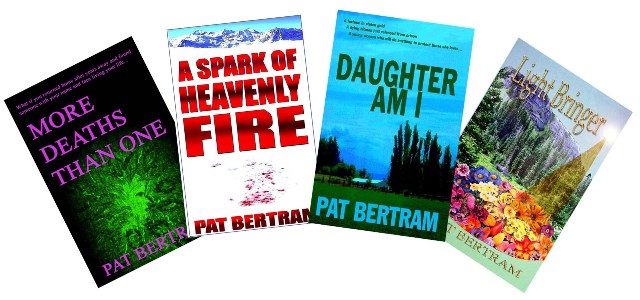
Pat Bertram is the author of the suspense novels Light Bringer, More Deaths Than One, A Spark of Heavenly Fire, and Daughter Am I. Bertram is also the author of Grief: The Great Yearning, “an exquisite book, wrenching to read, and at the same time full of profound truths.” Connect with Pat on Google+

iTunes, Anyone?

I just discovered that all of my books are available on iTunes, so if you receive a new iPhone, an iPod or any other iProduct this gift-giving season (or if you already have such a product), think of me! If you don’t have such a device, you can download a free  iTunes app for your computer — just click on any of my titles, and at the top of the page is a button to click for a free iTunes app.

A SPARK OF HEAVENLY FIRE Embodies the Essence of Christmas

Washington Irving wrote: “There is in every true woman’s heart a spark of heavenly fire, which lies dormant in the broad daylight of prosperity; but which kindles up, and beams and blazes in the dark hour of adversity.” As I read these words several years ago, I could see her, a drab woman, defeated by life, dragging herself through her days in the normal world, but in an abnormal world of strife and danger, she would come alive and inspire others. And so Kate Cummings, the hero of my novel A Spark of Heavenly Fire was born. But born into what world?

I didn’t want to write a book about war, which is a common setting for such a character-driven story, so I created the red death, an unstoppable, bio-engineered disease that ravages Colorado. Martial law is declared, rationing is put into effect, and the entire state is quarantined. During this time when so many are dying, Kate comes alive and gradually pulls others into her sphere of kindness and generosity. First enters Dee Allenby, another woman defeated by normal life, then enter the homeless — the group hardest hit by the militated restrictions. Finally, enters Greg Pullman, a movie-star-handsome reporter who is determined to find out who created the red death and why they did it.

Kate and her friends build a new world, a new normal, to help one another survive, but other characters, such as Jeremy King, a world-class actor who gets caught in the quarantine, and Pippi O’Brien, a local weather girl, think of only of their own survival, and they are determined to leave the state even if it kills them.

The world of the red death brings out the worst in some characters while bringing out the best in others. Most of all, the prism of death and survival reflects what each values most. Kate values love. Dee values purpose. Greg values truth. Jeremy values freedom. Pippi, who values nothing, learns to value herself.

Though this book has been classified by some readers as a thriller — and there are plenty of thrills and lots of danger — A Spark of Heavenly Fire is fundamentally a Christmas book. The story begins on December 2, builds to a climax on Christmas, and ends with renewal in the Spring. There are no Santas, no elves, no shopping malls or presents, nothing that resembles a Christmas card holiday, but the story — especially Kate’s story — embodies the essence of Christmas: generosity of spirit.

(Why does A Spark of Heavenly Fire begin on December 2 instead of December 1? Glad you asked that. All through the writing of the book, I kept thinking: if only people could get through the first fifty pages, I know they will like this book. So finally came my duh moment. Get rid of the first fifty pages!! With all the deletions and rewriting, I couldn’t make the story start on December 1 as I’d originally intended, but that’s okay since it didn’t end on December 25 as I had hoped. The story overgrew it’s bounds, but the symbolism still held since it ends around Easter.)

ASHFiTunes: https://itunes.apple.com/us/book/a-spark-of-heavenly-fire/id407886976?mt=11

Second Wind Publishing: http://www.secondwindpublishing.com/product_info.php?manufacturers_id=17&products_id=47&osCsid=de3fad213c6baa1c6fa9982f221c8c74

Amazon: http://www.amazon.com/Spark-Heavenly-Fire-Pat-Bertram/dp/1935171232/ref=ntt_at_ep_dpt_4

Barnes and Noble:http://www.barnesandnoble.com/w/spark-of-heavenly-fire-pat-bertram/1100632312?ean=2940015574395

Smashwords: http://www.smashwords.com/books/view/1842 (You can download the book in any ebook format, including a format for palm held reading devices!! Even better, you can download 30% absolutely free to see if you like the story.)

***

Pat Bertram is the author of the suspense novels Light Bringer, More Deaths Than One, A Spark of Heavenly Fire, and Daughter Am I. Bertram is also the author of Grief: The Great Yearning, “an exquisite book, wrenching to read, and at the same time full of profound truths.” Connect with Pat on Google+

Going with the Flow of the Story

SWhen I write fiction, whether a short story or a novel, I always need to know who the main characters are, what they want, who is trying to keep them from getting what they want, and if they are successful in their quest. In fact, the ending is so important to me, that I often write the ending somewhere in the middle of the project. By then, the characters have been developed, most of the story has been laid out, and I can see how the pieces fit and know exactly where I am going. (I just thought of something — my unfinished novel has been paused for several years now. Only part of that is a loss of focus due to the changes in my circumstance. The rest comes from a lack of inclination to continue. It is the first novel I worked on that I did not write the ending in middle. I wonder doing so would get me back on track?)

The one project I am involved with that turns this need to know the ending on its head, is the Rubicon Ranch serial I am writing with other Second Wind authors. In the first book, we postulated a murder, then each of us created a character who might have reason to want to kill the little girl. That is all we had of the story when we began to write it. We knew, of course, that the killer would be found, but we didn’t know who did it, why it was done, or how the story would be resolved. We simply took turns writing our chapters in round robin fashion, and hoped readers would forgive us if all those different POVs made the story seem disjointed at times. (Normally, when you write a novel, you get to go back and fix any problems during rewrites, but when you write a novel online, you are stuck with what you wrote.)

My character Melanie Gray is a grieving woman. We started the project just a few months after the death of my life mate/soul mate, and I couldn’t conceive of any other sort of character — at the time, grief was all I knew. To make her a widow, I had to get rid of her husband, so I killed him in an accident before the story began. That was the sole point of the accident, yet in a later chapter, the sheriff seemed to insinuate that there could be a connection between Melanie’s husband and the little girl — perhaps they had both seen something and been killed to protect it.

Well, it turned out that the two deaths were unrelated, but later the sheriff (as written by Lazarus Barnhill) told Melanie he concluded that the accident had been deliberate.

Now, during the second book, even more information about Alexander is being revealed — he had, in fact, been murdered, and the car tampered with in such a way that it had to have been done by a skilled professional.

I find that development interesting since when I created the character of the dead husband, he had a single role — to make Melanie a widow — but because of the flow of the story, the husband is developing into a character in his own right, and a nefarious one at that.

Melanie, too, is developing in response to the needs of the story, or at least to the needs of her backstory. She and her husband were the authors of a successful series of coffee table books. They’d traveled the world, he taking photos, she writing the text, so obviously she isn’t the weakling her grief makes her seem. One of the ironies of her life is that while living in places where human rights weren’t respected, she never had a problem, yet now, in the safest place she’d lived in her adult life, she is steeped in death and in trouble with the authorities. (If you’ve read any of my books, you will know that I like ironies.)

It’s a refreshing change of pace being involved in the Rubicon Ranch project. All I need to do is write my chapter when it is my turn; make sure it is consistent with what I know of the character, her background, and what has already been written; and not worry about what is coming next — just go with the flow.

***

Pat Bertram is the author of the suspense novels Light Bringer, More Deaths Than One, A Spark of Heavenly Fire, and Daughter Am I. Bertram is also the author of Grief: The Great Yearning, “an exquisite book, wrenching to read, and at the same time full of profound truths.” Connect with Pat on Google+

Desensitizing People to Violence

Clint Eastwood posted a status update on his FB profile today. No, I’m not a “friend” or a fan, don’t “like” him or “subscribe” to him, but his comment is making the rounds of FB, and it ended up on in my news feed. Several times. I found the comment interesting because of my research for More Deaths Than One, a book about mind control, and what I learned about how the military desensitized recruits to killing.

Eastwood wrote: With a lot of thought on this in light of all the shootings in the past few weeks I am very concerned that the left is now going to hit hard on pushing the 2nd Amendment over the cliff.

This is the only amendment that the ‘O’ can attack with any chance of repealing. If this, and God help us if he does, will lead to a barrage of attacks on all the amendments and socialism will be a forgone conclusion.

If anything should be shut down it should be the violent video games. Really, and I know everyone likes their electronics but these are the things that are taking kids and young people out of interacting with society and their peers.

I know I will probably take a lot of flack for that last observation but I’ve taken the flack before.

Have a great Sunday and hug your family.

I’ve written about this before, most recently in If Everyone Wants Peace, Why are there Wars? As I said, many of today’s — and yesterday’s — video games were developed by the military because studies had shown that repeated images of violence and death inured people to killing. During World War Two, as many as 85% of soldiers fired over enemies’ heads or did not fire at all. After World War Two, there was a concerted effort by the military to overcome this natural reluctance to kill, and apparently they succeeded because during close combat in Vietnam, only about 5% of soldiers failed to aim to kill. These same desensitizing “games” were later released as toys for children. Is it any wonder that many people — teens and adults — now seem desensitized to violence? They are playing games that were purposely created to foster killing.

I am not a fan of guns, though I have attended a couple of shooting clinics sponsored by a local gun club. As an author, I thought it important to know how it felt to shoot a weapon at a target. The targets we used were the round kind rather than a silhouette of a human. (Not so incidentally, those human-like targets were also created by the military to get soldiers used to firing at people.) I enjoyed learning how to shoot, but handling the pistols, revolvers, shotguns and rifles did not create in me any desire to shoot at another human being. Guns by themselves do not encourage violence or a desire to kill. Certain video games do. Sociopathic tendencies do. Psychotic characteristics do. Military think tanks do.

Author Lee Child says that we don’t write what we know, we write what we fear, and that certainly is true in my case. I fear the machinations of the powerful, deadly, and calculating men and women who control our lives behind the scenes. And I fear politicians and celebrities who use tragedies to further their own ends.

***

Pat Bertram is the author of the suspense novels Light Bringer, More Deaths Than One, A Spark of Heavenly Fire, and Daughter Am I. Bertram is also the author of Grief: The Great Yearning, “an exquisite book, wrenching to read, and at the same time full of profound truths.” Connect with Pat on Google+

Story Excerpt From “Second Helpings” ~ The Gift by Pat Bertram

Second Helpings
An Anthology of Holiday Recipes and Short Stories
From Authors of  Second Wind Publishing

Second Helpings

A perfect gift for short story lovers and food connoisseurs!

From sweet childhood remembrances to fanciful solutions of family dramas to romantic relationships that begin–or end–during the holidays, Second Helpings is an anthology of stories and memories, but most especially of recipes. Our end-of-year celebrations are occasions that bring reunions with unforgettable feasts and that one special, treasured dish. At the end of each story, vignette, reminiscence, you’ll find a recipe or collection of recipes that will make your next holiday memorable as well.

EXCERPT FROM:

The Gift
By
Pat Bertram

Monica Dryden hummed along with the Christmas carols on the radio as she pulled the chocolate chip cookies out of the oven. They were David’s favorite, and she’d baked them for him every Christmas Eve for as long as they’d been together—five years now—continuing a tradition his mother started when he was a boy.

Still humming, Monica transferred the baked goods from the cookie sheet to a plate she’d purchased for the occasion—white china with a cheerful holly border. Her family had been too poor and too indolent to do much for Christmas, so making the holidays special for David brought her extra joy.

David Hollister. Even his name seemed to promise holiday cheer.

She put the plate of cookies and a glass of milk on a tray, added a sprig of holly from the bowl in the center of the table, and bore her offerings to the living room where David watched television.

He didn’t take his eyes from the screen when she nestled against him, but he didn’t pull away either, as he sometimes did. She smiled to herself, thinking how pleased he would be with the burgundy sweater and pinstriped shirt she’d bought him.

“Do you have to do that?” David asked.

“Do what?”

“You’re humming.”

She clapped a hand to her mouth. “I’m sorry. I didn’t realize—”

“Are those chocolate chip cookies?”

“Of course.”

He clicked off the television and turned to face her. “We have to talk.” He spoke the words softly, almost kindly, but still they chilled her.

“Talk about what?” she asked warily.

“It’s not working out.”

“What’s not working out?”

“Us. We’re not right for each other. You’re too . . . predictable.”

She stared at him as if he’d spoken in an alien tongue. “Predictable? Me? You’re the one who insists on my doing the same things the same way. Remember those throw pillows I bought? You said—”

“That’s the old me. The new me wants . . . change.”

Her head snapped back as if she’d been hit. David wanted change? Since when? She opened her mouth and said the only thing that came to her stupefied mind. “Do you want me to make you a different kind of cookie?”

“This isn’t about cookies. It’s about . . .” He looked at her, expecting her to supply the words as she often did. She usually knew what he was thinking and could easily fill in his missing words, but now she couldn’t even hazard a guess.

David’s eyes shifted from side to side as if he were searching frantically for a way out of the conversation. Finally his gaze settled on his hands. “I want a divorce.”

Monica froze, then, getting control of herself, she pulled her shoulders back and lifted her chin. “You can’t have a divorce.”

He jumped to his feet and all but screamed, “I knew you’d be difficult about this. Why can’t I have a divorce?”

“We’re not married,” Monica said evenly.

He gaped at her for a moment, then a grin that broke her heart spread across his face. “That’s right. I forgot.”

Monica slumped forward, elbows on knees, head in her hands. He forgot? How was that possible? Just last week they’d talked about getting married. No . . . wait. She’d talked about getting married. He’d nodded with a faraway look in his eyes that made her think he’d been seeing their future together but apparently only meant he hadn’t been listening.

David’s voice seemed to come from a long way off. “I’ll guess I’ll be leaving.”

Monica jerked upright. “You’re leaving? But this is your apartment.” And then, all in an instant, she understood. “Who is she?”

***

Second Helpings is available in print and all ebook formats from Second Wind Publishing.

***

Pat Bertram is the author of the suspense novels Light Bringer, More Deaths Than One, A Spark of Heavenly Fire, and Daughter Am I. Bertram is also the author of Grief: The Great Yearning, “an exquisite book, wrenching to read, and at the same time full of profound truths.” Connect with Pat on Google+

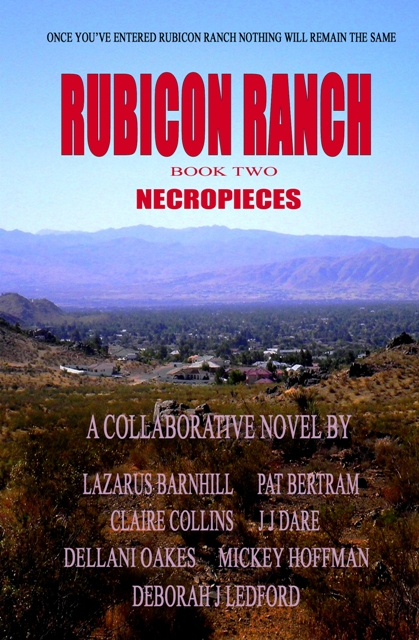
Rubicon Ranch: Necropieces — The Story Continues

Rubicon Ranch is a collaborative and innovative crime serial set in the desert community of Rubicon Ranch and is being written online by the authors of Second Wind Publishing. Seven authors, including me, are involved in the current story — Rubicon Ranch: Necropieces.

Residents of Rubicon Ranch are finding body parts scattered all over the desert. Who was the victim and why did someone want him so very dead? Everyone in this upscale housing development is hiding something. Everyone has an agenda. Everyone’s life will be different after they have encountered the Rubicon. Rubicon Ranch, that is.

Although some of the characters were introduced in Rubicon Ranch: Riley’s Story, a previous collaboration, Rubicon Ranch: Necropieces is a stand-alone novel. A new chapter is posted every Monday.

We hope you will enjoy seeing the story develop as we write it. Whodunit? No one knows, not even the writers, and we won’t know until the very end!

Chapter 25: Melanie Gray
by Pat Bertram

Melanie paced her rented house, wandering through the great room to the bedroom, then up the stairs to her loft office to stare out the window. The clouds that had skirted Rubicon Ranch all day yesterday had settled over the town in the early morning hours. The rainstorm had now weakened to a soft drizzle, but floodwaters were swirling out of the desert and down the middle of the street like dirty bath water in search of a drain.

Melanie half expected to see body parts floating by, but it had been forty-eight hours since she had found the ravens breakfasting on the disembodied foot, so perhaps by now all the necropieces had been discovered. Shivering, she turned from the window, trudged down the steps to the great room and then into the bedroom. She’d spent most of the fifteen weeks since Alexander’s death roaming the desert, and she found it almost impossible to relax during this enforced incarceration. If she were any kind of photographer instead of an amateur shutterbug, she’d be out in the desert despite the rain, chronicling the way the runoff was recreating the desert floor, but her tiny camera wouldn’t stand up to the moisture, and then where would she be?

She plodded back through the great room and up the stairs again. Her cell phone rang, and for just a second, her spirits rose. Alexander! He was finally calling to tell her he was coming back. Just as abruptly, the realization that he was dead hit her like a physical blow, and tears spilled down her cheeks. Why couldn’t she remember that he would never come home? His body had been cremated and the ashes stored in a square brass urn sitting atop the dresser until she could take them high up into the Rocky Mountains in Colorado and scatter them.

By the time she reached her bedroom where she’d left her cell phone on the nightstand, the phone had stopped ringing. The tiny screen showed the number for her agent, and when the phone rang again, she considered not answering. What could the woman say that hadn’t been said a dozen times before? Melanie already knew her deadline had passed. She already knew she owed the publisher either the book or the return of the advance. She already knew . . . Oh, crap. It would be better to talk to Dottie and get it over with.

“Yes?” she said, hating the hesitancy she heard in her voice.

“Dahling!” Dottie chirped. “I’ve been calling and calling. Have I got good news for you! I’ve been talking to Jack, and he says you can have all the time you need to finish the desert book. He’ll even hire a photographer for you. And he’ll send you five hundred thousand dollars, though I’m sure I can get him up to a million.”

“What does he want from me? A kidney?” Jack Nolan, her publisher, had a reputation for wringing every last bit of creative effort from his authors while paying the least possible advance. He got away with it because, despite his miserly ways, he was scrupulously honest, remitting every penny of the royalties his authors earned.

Dottie chuckled. “So cynical, dahling. It’s perfect, really. You’re there. You know the people and the place. And from what I understand, you live next door to the Sinclairs.”

“No,” Melanie said, without a hint of uncertainty in her tone.

“You don’t live next door to them? My sources—”

“I mean, no. I will not write whatever book Jack wants me to write. I’m going to finish the desert book and then . . .”

“And then what? Knowing Alexander, he probably left you not only broke but also in debt. Someone is going to write the book about Morris Sinclair. It might as well be you.”

“Wait a minute,” Melanie said. “How do you know what’s going on here?”

Dottie laughed. “The whole world knows. It’s everywhere. On television, Facebook, Twitter. It’s such a delicious story. The author of the infamous ‘Necropieces’ series has himself become a series of necropieces. His fans don’t believe he’s permanently dead. They are holding vigils, waiting for him to come back to life. And his head was found in the house where that little girl died. Riley? Is that her name? The girl that was kidnapped as an infant and then killed by her biological father? How can you not want to write the story of Rubicon Ranch? It’s going to be huge. Humongous.”

“Not interested.”

“Wait! There’s more!” Dottie said. “You gotta love this stuff. One of the suspects in Morris’s murder is Tara Windsor.”

“Who?” Melanie asked.

“You had to be living out in the boonies somewhere not to have heard of Tara. Oh, right—you’ve been out of the country for the past umpteen years. Tara is an actress. She was in that movie with that actor, you know, the one with the gorgeous abs? No, I guess you don’t know. Anyway, it turns out the suspect isn’t Tara at all. Tara is in Cabo with her pool boy. Don’t you just love it?”

Melanie sank down onto the bed, suddenly weary. “No.”

“And then there’s you,” Dottie said slyly.

Melanie sat up straight. “Me? What about me?”

“The cops say you’re a suspect. You knew that, right? Jack says if you killed Morris and tell all the gory details, he’ll up your advance to two million.”

A suspect. Melanie had presumed the Sheriff’s insinuation that he considered her a suspect was his way of manipulating her and keeping her off balance, but if he or someone in the Sheriff’s department had given out her name, then she really had a problem. She heard the echo of herself screaming at Morris, “You leave me alone, Sinclair, or I’ll be shooting your dead body parts.” Could she have been more foolish?

“Do you know a good lawyer?” She gave a small laugh, wanting Dottie to think the question a joke, but fear clutched at her belly with clammy fingers. Maybe she’d have to write Morris’s story in order to pay for a defense attorney.

“You might not be a celebrity on a par with Morris or Tara,” Dottie said, “but you and Alexander have quite a following. Since there’s been mention of your involvement in Alexander’s death—”

“Who told you I was involved in Alexander’s death?” Melanie demanded.

“Just a guess.” Dottie voice sounded smug, as if she’d caught Melanie out in a secret. But there was no secret when it came to Alexander’s death. Just shoddy police work. “So many important deaths in such a small place make for a good story,” Dottie added.

“All the deaths are unrelated,” Melanie pointed out.

“Perhaps, but it’s more likely they are connected somehow. After all, Morris had autopsy photos of that little girl, and Alexander took some photos of necropieces for Morris.”

“You knew about that?”

“Alexander accidentally included a couple of the pictures when he sent Jack a batch of desert photos.”

Melanie sighed. “Maybe you’re right. Maybe Alexander’s death had something to do with Morris and the evil that this place seems to bring out in people.”

“So can I tell Jack you’ll write the book if he gives you an advance of a million dollars?”

“No. But you can tell him I’ll consider it.”

“Good girl. I’ll see what I can do about finding you a lawyer.”

Melanie set the phone on the nightstand, and put her head in her hands. Oh, Alexander. Look what you’ve done to me. She took a few deep breaths, determined not to cry, but when the tears spilled over anyway, she jumped to her feet, ran up the stairs, and plopped in front of the computer. Immersing herself in research always helped take her mind off herself, and she needed to know more about Morris before she could give Dottie her decision.

Typing “Morris Sinclair” into her search engine resulted in over two hundred million hits. Morris’s website. Book and movie sites. Thousands of fan sites and cult groups. Blogs. Articles. She narrowed her search to “Morris Sinclair biography” and managed to piece together the story of a highly narcissistic and anti-social man in his late sixties who had started out as a normal kid, turned into a troubled and rebellious teenager, and grew into a sadistic beast during his tour of duty in Vietnam.

After Vietnam, Morris married a woman he’d only known for a few weeks. He worked as a roughneck on an oilrig and wrote tales of terror on the side. When the stories were published, they found an immediate readership. He quit work to write fulltime.

Morris and his wife had three children, two boys and a girl. His wife committed suicide while the children were very young. Or perhaps Morris had killed her? That made more sense to Melanie—what mother would kill herself and leave her children to be raised by the devil incarnate?

Although the thought of a million dollars and the freedom it could buy tempted her, Melanie did not want to spend the next few months of her life immersed in the evil that was Morris. She was all set to call her agent and turn down the deal, when the doorbell rang.

She opened the door to find Lieutenant Frio and Deputy Midget standing on her doorstep, their faces set as if in stone.

“Ms. Gray,” Lieutenant Frio said, “we’d like for you to come with us. Sheriff Bryan wants to talk to you.”

Melanie held out her hands, wrists together, but Deputy Midget shook his head. “Sheriff Bryan says not to cuff you unless you give us trouble.”

“Can I get my coat?”

Lieutenant Frio threw Melanie a stern look. “You’re not going to try anything?”

“No.” Melanie darted into the bedroom, grabbed a trench coat from the closet and tucked her phone in the pocket.

Sandwiched between the two law officers, Melanie marched out to the tan Navigator parked at the curb in front of her house. Deputy Midget opened the back door of the vehicle, put a hand on her head to guide her through the opening as if she were a common criminal, then lowered himself into the front passenger seat. The right side of the Navigator sank, and the tires seemed to scream out for relief.

Lieutenant Frio peeled away from the curb. The tires sent up huge plumes of floodwaters that broke over the vehicle, and made it seem as if they were driving through a car wash.

Melanie stared out the window, though she couldn’t see anything but the backwash of water. If she strained her ears, she felt sure she could hear Alexander’s ghostly laughter. During all their years of living in countries with no civil liberties, they had never had a single problem with the authorities, and yet now, not even four months after his death, she found herself at odds with the law.

Maybe this arrest was just another of the sheriff’s games? She had never known what he wanted from her, though when they met after she’d found Riley’s body, he had focused his attention on her, and made her feel . . . seen. No one but Alexander had ever looked at her that closely, and even Alexander had stopped paying attention to her years before. Or maybe what had seemed like manipulation—the sheriff concentrating his attention on her and then ignoring her—had all been in her head, a widow’s cry to be noticed.

Once they hit the dry road of the highway, the thirty miles to Rojo Duro seemed to slip past in an instant. Deputy Midget ushered Melanie to a small room with two chairs and a metal table bolted to the floor, and left her alone.

A mirror on one wall had to be a one-way window, but Melanie put a finger against the glass to be sure. Finger touching finger without any space told her the truth—anyone could be watching her from the other side, and she would never know. She resisted the urge to stick out her tongue in a childish show of temper. Instead, she sat tall in a chair, hands folded on the table, and tried not to think of where she was. Tried not to think of her pathetic life. Tried not to think of her uncertain future.

Nine minutes later, Sheriff Bryan entered the room and locked the door behind him. He perched one hip on the table, and stared at her, no friendliness in his eyes.

After a long moment, he heaved a sigh and said, “Why did you do it, Melanie?”

***

Pat Bertram is the author of the suspense novels Light Bringer, More Deaths Than One, A Spark of Heavenly Fire, and Daughter Am I. Bertram is also the author of Grief: The Great Yearning, “an exquisite book, wrenching to read, and at the same time full of profound truths.” Connect with Pat on Google+

The Next Big Thing

A couple of months ago, Malcolm R. Campbell, author of “The Sun Singer” and “Sarabande”, invited me to participate in a blog chain, where everyone who is tagged answers a few questions about their work in progess, their next big thing. Since then, I have been asked to participate by Sheila Deeth and Dellani Oakes, and I was tagged by Emma McCoy  and Rami Ungar.

I’m not really working on anything of my own right now. I have a half-finished novel in hiatus, disjointed chapters of another novel (my attempt at doing NaNoWriMo a couple of years ago), and a short story I intended to finish this month but keep forgetting about. So, I’ve chosen to talk about Rubicon Ranch, a serial I’m writing with several other Second Wind authors. The first book in the series, Rubicon Ranch: Riley’s Story is available online or as a free download in the format of your choice. Currently, we are working on the second book in the series, and when this book is finished, we will continue with the serial in the hopes that one day it really will be the next big thing.

What is your working title of your book?

Rubicon Ranch: Necropieces

Where did the idea come from for the book?

This is a continuation of the Rubicon Ranch serial. It was conceived as a blog promotion, and it captured the imagination of several Second Wind authors. We each created a character and have sole creative control of that character, which makes the serial seem like a cross between a novel and a role playing game.

What genre does your book fall under?

Mystery, suspense, thriller. Take your pick.

Which actors would you choose to play your characters in a movie rendition?

My character is a forty-something widow, five feet five inches tall, grey eyes, brown hair, fit, oval face, flawless skin. Does that sound like anyone you know? If not, I’d choose any famous actress to play the part to make sure the movie was a success.

What is a brief synopsis of your book?

Residents of Rubicon Ranch are finding body parts scattered all over the desert. Who was the victim and why did someone want him so very dead? Everyone in this upscale housing development is hiding something. Everyone has an agenda. Everyone’s life will be different after they have encountered the Rubicon. Rubicon Ranch, that is.

Will your book be self-published or represented by an agency?

It will be published by Second Wind Publishing since they are the ones sponsoring the project.

How long did it take you to write the first draft of your manuscript?

We’ve been working on the current Rubicon Ranch story about eight months, and it’s not yet finished. You can find the work in progress here: Rubicon Ranch: Necropieces

What other books would you compare this story to within your genre?

I don’t know of any other book like this. It’s written by eight different authors, each taking a turn to write their chapter. We are writing blind — no outline, no idea of who is the killer, and we won’t know until the end. The authors are all presenting their character as a villain, and at the end, we will decide which one did it.

Who or what inspired you to write this book?

I did a round robin with a writers group, where someone started a story, and each writer took a turn at continuing the story. So many of the authors seemed to sabotage the story and other characters by introducing ridiculous elements, that I wondered what would happen if there was a bit more control, where one author could not sabotage another’s efforts. And so Rubicon Ranch was born.

What else about your book might pique the reader’s interest?

You can sign up on the Rubicon Ranch blog to receive notification of new chapters of Rubicon Ranch: Necropieces as they are posted, or you can check back every week. Things are heating up, and each character’s secrets are being revealed. I hope you will stop by Rubicon Ranch and join the fun! Several wonderful Second Wind authors are involved in the project: Dellani Oakes, Deborah J Ledford, Lazarus Barnhill, Mickey Hoffman, JJ Dare, Claire Collins. And me, of course.

Several gallant bloggers have agreed to continue with this blog chain. During the week of December 3rd, look for The Next Big Thing blog posts by Joylene Nowell Butler, A.F. Stewart, Sherri Hansen, Jerold Last, and A. J. Race.  It should be interesting to find out what everyone is working on!

***

Pat Bertram is the author of the conspiracy novels Light Bringer, More Deaths Than One, A Spark of Heavenly Fire, and Daughter Am I. Bertram is also the author of Grief: The Great Yearning, “an exquisite book, wrenching to read, and at the same time full of profound truths.” Connect with Pat on Google+

Love, Truth, Purpose, Freedom

Linda Bonney Olin interviewed me for her blog the other day, and the interview turned out to be special, at least for me, because it made me realize what my values are and how those values find a place in my books.

Linda asked me: Why did you choose to write A Spark of Heavenly Fire?

I responded: “A Spark of Heavenly Fire came about because of a Washington Irving quote: ‘There is in every true woman’s heart a spark of heavenly fire, which lies dormant in the broad daylight of prosperity; but which kindles up, and beams and blazes in the dark hour of adversity.’ When I read those words, I could see her, a drab woman, defeated by life, dragging herself through her days in the normal world, but in an abnormal world of strife and danger, she would come alive and inspire others. And so Kate Cummings, the hero of my novel A Spark of Heavenly Fire was born. But born into what world?

“I didn’t want to write a book about war, which is a common setting for such a character-driven story, so I created the red death, an unstoppable, bio-engineered disease that ravages Colorado. Martial law is declared, rationing is put into effect, and the entire state is quarantined. The world of the red death brings out the best in Kate and some of the characters she comes in contact with while bringing out the worst in others. Most of all, the prism of death and survival reflects what each of the major characters values most. Kate values love. Dee values purpose. Greg values truth. Jeremy values freedom. Pippi, who values nothing, learns to value herself.”

Next Linda asked if my fiction reflected my personal values, and I realized that of course my fiction (and non-fiction) reflects my values. Like Kate, I value love. Like Dee, I value purpose. Like Greg, I value truth. Like Jeremy, I value freedom. Like Pippi, I am learning to value myself. (You can read the entire interview here: Love, Truth, Purpose, Freedom: Pat Bertram.)

More than those qualities, though, I value kindness, and an innate kindness permeates all of my books despite the horrors the characters have to contend with. Though my heroes all have a love interest that helps form the story, none of my books can be classified as romances. The romance angle is not the main focus, and the romance is never conflicted. My couples in love treat each other kindly, showing a united front against the horrors of their world. For the most part, that’s the way I lived, so my characters can do no less.

***

If you would like to interview me, please let me know. I don’t usually open up this way, preferring to interview others, but turnabout is fair play. You can supply the questions, or I can, whichever you wish.

If you would like me to interview you instead, you can find the questions and instructions here: Author Questionnaire.

***

Pat Bertram is the author of the conspiracy novels Light Bringer, More Deaths Than One, A Spark of Heavenly Fire, and Daughter Am I. Bertram is also the author of Grief: The Great Yearning, “an exquisite book, wrenching to read, and at the same time full of profound truths.” Connect with Pat on Google+