Learning to Use Beats in Dialogue

One of the hardest techniques for new writers to handle is dialogue. When I first started out, my characters never just said something. They agreed, cautioned, reminded, mimicked, answered, contributed, guessed, explained, responded, admonished, confessed, encouraged, clarified, blurted, pointed, winced, replied, corrected, acknowledged, returned, laughed, challenged, chided, objected, contested, quipped, offered, moaned, complained, repeated, stammered, pleaded, inquired, mumbled, interrupted, confirmed, addressed, countered, advised, completed, allowed, supplied, ordered, asked, continued, chided, answered, whispered, teased, requested, hollered, echoed, declared, informed, spoke, bellowed, spit out, thundered, hissed. All within a few pages. Whew!

Even worse, I would sit and agonize over the way my characters spoke. “He responded sparingly.” “She informed him haughtily.” He mumbled sadly.” Ouch.

It was a joy to discover that modern dialogue relies primarily on “said,” such a common word, the reader’s gaze glides over it as if it were invisible. It was even more of a joy to discover that adverbs were frowned on. The dialogue itself, or the beat — the bit of action accompanying the dialogue — should show the character’s emotion. “I hate you”, she said angrily tells us what the character is feeling. She picked up a rock and threw it at him. “I hate you!” shows us what she is feeling, allowing us to become intimately involved with the character. The only time an adverb is necessary is when the character’s words are at odds with his mood, such as: “I had a great time,” he said sadly. You can also use an occasional “ly”adverb to describe the tonal quality of the character’s voice. “I hate you,” he said softly.

Besides helping identify who is speaking, beats help set the stage, tell us about the character’s personality, and vary the rhythm of the dialogue. Overdone, the beats are as distracting as any other speaker attribute, so the secret is to pay attention to the flow. Do you want short snappy dialogue? Don’t use beats. Do you want to slow things down a bit, keep the dialogue from seeming too disembodied? Use a few beats.

It’s hard to write crowd scenes and keep each character identified without resorting to copious “said”s, but beats keep the scene moving and, if you use beats that are specific to your character, you make the various characters come alive.

This excerpt from my novel Daughter Am I shows the use of beats. The scene is between my hero Mary, a young woman in search of her grandparents’ murderer, and a group of feisty octogenarians who are trying to help.

*     *     *

The man stopped bouncing and let his arms drop to his sides. Now that he stood relatively still, Mary could see he was skinnier than she’d first thought. A gray slouch hat tilted toward one eye, but the baggy pants cinched high above his waist and the bright flowery shirt several sizes too large marred the jaunty effect. His hands shook uncontrollably. Parkinson’s disease?

“You must be Happy,” she said.

Frowning, Happy patted his torso. “Must I be happy?” His voice deepened to what Mary assumed was his normal tone. “Can I be happy? Can anyone truly be happy?”

“His name is Barry Hapworth,” Kid Rags said, flicking a bit of lint off his navy pinstriped suit jacket. “For several obvious reasons, everyone calls him Happy.”

Mary glanced from the bus to Happy. “Were you driving this thing?”

Happy puffed out his meager chest. “Sure was.”

“And did you almost run over Mrs. Werner’s cat?”

“I’ll take the fifth.” Happy paused for a fraction of a second. “A fifth of bourbon.”

“Did someone say bourbon?” Kid Rags removed the flask from his hip pocket, took a swig, and passed it around.

“Who are all these people?” Bill asked from behind Mary.

Mary turned, wondering how she could explain the situation to her fiancé, but Teach saved her the trouble and made the introductions. Arms still folded across his chest, Crunchy nodded to Bill, then stepped close to Mary. Happy punched the air, but stopped when Bill showed no inclination to fight.

Kid Rags shook Bill’s hand. “You’re a lucky man.”

“What are you all doing here?” Mary asked. “I was supposed to pick you up. And why is Happy here?”

“Happy is a friend of Kid Rags,” Teach began, but Kid Rags interrupted him, saying hastily, “Not a friend. Just a fellow I know.”

“Happy knows someone who knows Iron Sam,” Teach continued, “and since we knew your car wasn’t big enough for all of us, we accepted Happy’s offer to drive us in his bus.”

“Who’s Iron Sam?” Bill asked, sounding plaintive.

“Butcher Boy,” Kid Rags said.

Bill’s eyebrows drew together. “Butcher Boy? Mary, are you sure you know what you’re doing?”

Mary laughed, suddenly feeling lighthearted and carefree. “I haven’t a clue.”

 

Gone With the Electronic Wind

I seem to be changing, whether I realize it on a daily basis or not. For the most part, I am more patient than I used to be. I have a greater ability to wait because there’s no reason to be one place rather than another. I am also aware the future will come whether I will it or not. But . . . I have a lot less patience for disrespect. And I am not as I nice as I once was.

Take today, for example. I got a friend request from someone on LinkedIn. I accepted the request, then she sent me an invitation to join her crime writers group. After I did so, she sent a message suggesting I post a bit about one of my books in the group’s discussion boards. Which I did. Then she said to post a link to the book (though I had already done so) and after I posted the second link, she left a comment on the very public post saying the book sounded interesting, but she wasn’t going to buy it. Huh? Why not just say it sounded interesting and leave it at that? Even worse, she went on a rant about ebook pricing. Apparently, J. Konrath has decided that $2.99 is the perfect ebook price (who made him king, anyway?) so the LinkedIn woman decided that any book priced more than that is overpriced. Her reasoning? Some of the major publishers were selling ebooks at almost the same price as a print book, and since there was nothing changing hands — no actual printed book — she figured that the publishers were cheating her.

My publisher prices my ebooks at less than a third of the print price, so why was she griping about my book? Aren’t publishers (and authors!!) allowed to make money anymore? Amazon skims 30% right off the top of all books (70% off $.99 books), and for this skim, they don’t do anything except offer the book as a download. There is no human involvement, so no payroll, no expenses except for a few cents worth of computer time. Apparently the woman has no objection to a huge near monopoly like Amazon raking in the dough. But a small publishing house? Oh, no. They aren’t allowed to make a profit! Sure the ebook is only a few electrons, and no physical product is exchanging hands, but what about the hundreds of hours that goes into publishing a book? (I’m not even counting the hours it takes to write the book.) It takes time and money to format, edit, create a cover, copyedit it, proof it. And yet she complains the publishers are selling nothing.

Perhaps her rant would have made sense if I had been the one to ask to be connected, if I had been the one to ask to join her group, if I had posted the book link without permission. But she instigated the whole situation, and then she was unbearably rude.

So I got even. I deleted her from my online world. Poof! Gone with the electronic wind.

What’s the most surprising part of being a writer?

What’s the most surprising part of being a writer?

The most surprising part for me is that I know how to write. For many years, my life was shadowed by the sadness of having no innate talent for writing. I’m not being modest — I really couldn’t write a novel or anything worth reading except for some snippets of poetic thoughts. When I decided to write a novel despite that lack of talent, I set out to learn everything I could about developing a readable story. Most of the how-to books confused the heck out of me — the authors would talk about rising conflicts and motivation/reaction units, and I didn’t have a clue what they meant. It’s only recently that I realized I actually know what I’m doing.

Here are some responses from others authors about the most surprising part of being a writer. The comments are taken from interviews posted at Pat Bertram Introduces . . .

From an interview with J J Dare, Author of False Positive and False World

The most surprising aspect of being a published writer is the positive feedback I’ve received from readers. Only a few weeks ago, I had a reader ask when the third book in the Joe Daniels’ trilogy would be coming out.

From an interview with Smoky Trudeau Zeidel, Author of “On the Choptank Shores”

The awe some people display when they find out I’ve not only written a book, but written several! Really, I don’t tell people I’m an author to stun them! It’s what I do, just like some people are gardeners or bank tellers or forest rangers. But there is something about being a writer that makes other people think you’re pretty cool — even if you aren’t!

From an interview with Sheila Deeth, Author of “Flower Child”

I’ve surprised myself by finally learning to tell people I’m a writer — maybe that’s what I should have said has changed since my first book was published.

From an interview with Beth Groundwater, Author of “A Real Basket Case”

The amount of non-writing work involved! There’s the contracting process, research, promotion, networking and all of the other ancillary activities that are part of having a writing career, but that take precious time away from the writing itself.

So, for you, what’s the most surprising part of being a writer?

(If you’d like me to interview you, please check out my author questionnaire http://patbertram.wordpress.com/author-questionnaire/ and follow the instruction.)

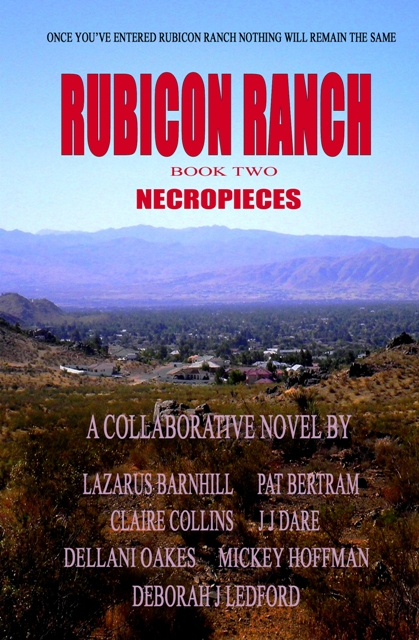
Sneak Preview of Rubicon Ranch: Necropieces

Rubicon Ranch is a collaborative and innovative crime series set in the desert community of Rubicon Ranch and is being written online by the authors of Second Wind Publishing. Seven authors, including me, are involved in the current story — Rubicon Ranch: Necropieces.

Residents of Rubicon Ranch are finding body parts scattered all over the desert. Who was the victim and why did someone want him so very dead? Everyone in this upscale housing development is hiding something. Everyone has an agenda. Everyone’s life will be different after they have encountered the Rubicon. Rubicon Ranch, that is.

Although some of the characters were introduced in Rubicon Ranch: Riley’s Story, a previous collaboration, Rubicon Ranch: Necropieces is a stand-alone novel. The first chapter will be posted on Monday, June 11, and one chapter will be posted every Monday after that.

We hope you will enjoy seeing the story develop as we write it. Let the mystery begin! Whodunit? No one knows, not even the writers, and we won’t know until the very end!

Chapter 1: Melanie Gray
by Pat Bertram

Melanie Gray woke with tears on her face. She sat up in the bed she’d shared with her husband Alexander, put her elbows on crossed knees, and cradled her face in her hands. The pain she tried to hide even from herself erupted, filling her chest with such agony she could only breathe in shuddering gasps.

She’d been doing so well, concentrating on shooting the photographs to finish their coffee table book on desert life, photos that Alexander should have taken, would have taken if he hadn’t died. So why the upsurge in grief? Then it came to her—today marked the third month since Alexander’s death.

Three months! Melanie saw the months marching on, one by one, each carefully counted while she grew old alone. She was only forty-three, which meant a lifetime of loneliness ahead of her.

I can’t do this.

But she’d already been doing it—living each shocking day as it came.

First, she’d found out that Alexander had died in a one-car crash under suspicious circumstances — maybe an accident, or maybe something worse, something she couldn’t bear to think about. Then she had discovered that he’d been texting a woman when he died, a woman who claimed to be his mistress. Finally, she learned that somehow he’d managed to spend the considerable advance they’d received for their book, leaving her with a six-month paid lease on this house, barely enough cash for groceries, and a book contract she needed to fulfill. No savings. And no car.

At least the desert was close, so she didn’t need a car to do her job. Rubicon Ranch, the bedroom community where they’d rented the house, bordered on the high desert of inland California, and offered gorgeous vistas, wildlife . . . and death.

“Damn you, Alexander! Why did you have to die? You were the one who was supposed to shoot the photos. I only wrote the words. If you’d paid attention to your driving, you’d still be alive, and I’d never have found that little girl’s body.”

Poor little Riley Peterson. Kidnapped as a baby, dead at age nine without ever knowing that her biological parents had spent her whole life searching for her.

Melanie let her tears fall for a few more minutes, took one more shuddering breath, and hauled herself to her feet. As bleak as her life seemed, as sad and as lonely as she felt, she was still alive. And she had work to do.

As always, she dressed in white — loose cotton pants, billowing long-sleeved top, wide-brimmed straw hat, flowing scarf. She checked her pockets to make sure she had her cell phone, camera, and extra memory card. Then she grabbed a canteen of water, slung the strap over her shoulder like a bandolier, and stepped outside.

A perfect early fall day. Clear blue skies, the deepest blue she’d seen since she’d moved to Rubicon Ranch. A hint of a sweet-scented breeze wafting up Delano Road. Temperatures in the high seventies, though they would probably rise to the mid-eighties by noon.

The grizzled homeowner across the street picked up a newspaper from his driveway, waved it at Melanie, turned, and stood still. Wondering what had caught his attention, Melanie followed his gaze.

A tan bullmastiff towed a pretty woman up the street. The woman’s dark hair, drawn into a ponytail, swished jauntily as she ran to keep up with her exuberant dog. What should have looked like a carefree moment seemed one of desperation to Melanie, as if the woman were running from demons only she could see.

“Funny how art often imitates life, eh?” came a deep voice from behind Melanie.

She jerked her head in the direction of the voice, and gaped at Morris Sinclair, her next-door neighbor, who had managed to sneak up on her without her noticing.

Morris, an international bestselling horror novelist had been a suspect in Riley Peterson’s death. The sheriff had declared the author innocent of the murder but guilty of buying stolen crime scene photos. And guilty of feigning Alzheimer’s. Melanie didn’t know how the sheriff had come to that conclusion. As far as she could see, if Morris had been feigning Alzheimer’s, he must have been trying to hide the truth — that he was insanely evil. Or evilly insane.

“Or maybe, in her case, life is imitating art,” Morris said.

“What are you doing here,” Melanie demanded. “Does Moody know you’re on the loose?” Moody, Morris’s daughter, had spent time in prison for the accidental death of a child. You’d think a man as perverse as Morris would be proud of her for that accomplishment, but he treated his daughter with even less regard than he treated everyone else.

“Am I my daughter’s keeper?” Morris intoned.

Melanie backed away from him. “I’m sorry. I don’t have time for this.”

“I know. You have to go out into the desert to shoot more of your little photos.” He bared his long, old-ivory-colored teeth at her in what might have been meant as a smile but came across as a predatory leer. Pointing a bony finger at her camera, he added, “You know how to use that thing, right?”

Melanie lifted her chin. “I do.”

“I’ll offer you the same arrangement I had with your husband.”

“You had an arrangement with Alexander?”

“Yeah. Alexander. Did you have more than one husband?”

Melanie stared at him in confusion, but when his dark opaque eyes met her gaze, she ducked her head.

“Alexander used to take certain . . . photos for me.” Morris raised his voice. “Photos of body parts.”

“Body parts?” Melanie asked. “You mean like arms and legs? You can find photos of those anywhere.”

“But I need amputated body parts. Dead parts. Lots of blood and gore. Necropieces.”

Melanie recognized the name of Morris’s most famous horror series — Necropieces — but none of his other words made sense. “You’re telling me Alexander took photos of amputated limbs for you?”

“And entrails. And organs. He loved shooting the images. Had a nicely developed sense of the macabre.”

“No,” Melanie said in a normal tone of voice. Then, all at once, the agony of the past few months gathered itself and launched a scream. “Nooooo.”

The word seemed to echo up and down the quiet street. She caught a glimpse of movement on the porch a couple of houses away, and she realized the old man who lived there, Eloy Franklin, had heard her shriek, but she didn’t care. She had enough of insanity and things that didn’t make sense.

“You leave me alone, Sinclair,” she shouted as loud as she could so that Morris would get the message, “or I’ll be shooting your dead body parts.”

“Every one of you bastards wants me dead!” Morris screamed, matching her decibel for decibel. He threw his arms wide as if to address the neighborhood. “Kill me! Kill me! Kill me. Cowards, every one of you! None of you have the guts to do anything but sit in your dark little caves and try to wish me away. Cowards! And you—” He turned to face Melanie. “I dare you. Kill me like you killed Alexander.”

Melanie gasped. “Alexander died in an accident.”

“An accident you created,” Morris said calmly, as if he’d never raised his voice. “Before that little girl died, she told Moody you’d messed with your car.”

“You’re lying.” Melanie’s words barely squeaked through her clenched teeth.

“Ask Moody.” Morris put a finger to his chin and cocked his head to one side. “So, will you take the photos for me? I’ll pay you well.”

Getting My Kicks on Route 66

Each year,  the California Historic Route 66 Association selects one of the eight states through which Route 66 runs to host the Route 66 International Festival. This year, the festival will be held from August 9-12, 2012 at the San Bernardino County Fairgrounds in Victorville, CA. Making it an even more historic event, the fairgrounds are on old Route 66!  With the theme “California Dreamin’ on Route 66”, the Route 66 International Festival 2012 will attract thousands of Route 66 enthusiasts, historians, fans and custodians of the “Mother Road” from across the country; including international visitors from 17 different countries, as well as local residents. And me.

I’ve been accepted as a participant in the festival, and I’ll be there signing my books on August 10th and 11th. Except for Daughter Am I, the story of a road trip from Colorado to Chicago, my books don’t have anything to do with Route 66, but I’ve had little luck with writer’s conferences and library presentations, so I’m going to try something completely different. It should be interesting. I’ll have to stay for the two days rather than do what I normally do at festivals — walk around for a few minutes then leave. (I never did know how to have fun. At least not what other people consider fun.)

So, if you’re going to be in Victorville on August 10 and 11th, be sure to stop by the fairgrounds and look me up. I’ll be waiting for you.

The Story Behind Rubicon Ranch

Almost a year ago, I got the idea to write a collaborative novel online. I broached Second Wind Publishing authors with the concept, and I found eight other writers willing to participate in the experiment. It took a few months to hammer out the details, which seemed an endless task back then, but now I see as incredibly swift. The story was, after all, a committee production.

We started out with what we considered the most heinous of crimes — the death of a little girl. In the first chapter: Chapter 1: Melanie Gray — by Pat Bertram, which was posted on October 24, 2010, Melanie found the girl’s body stuffed in an abandoned television console when she was wandering in the desert, trying to come to terms with the death of her husband. Poor Melanie. So much death!

Each author created a character who might have a reason to kill little Riley. And each character was hiding something.

Could Kourtney and Jeff Peterson have killed their daughter, mischievous nine-year-old Riley, to protect their secret?

Moody Sinclair had once killed an eight-year-old boy. Has she killed again?

Fifteen-year-old Dylan McKenzie is a straight A honor student. By day. Did Riley discover the other Dylan, the one who prowls at night?

Cooper Dahlsing does strange things while sleepwalking. Could he have killed and not known it?

Mark and Jamie Westbrook, self-styled private investigators, show up to help solve the murder, but perhaps they had a hand in creating the crime?

Eighty-two-year-old Eloy Franklin sits on his porch and watches. But does he do more than watch?

Forty-three-year-old Melanie Gray found Riley’s body stuffed in a television console that had been dumped in the desert. But is she as innocent as she seems?

Sheriff Seth Bryan is bitter and cynical at having lost everything he values. Is he manufacturing crimes to bring him the notoriety he craves?

So many villainous characters! And until the very end, no one knew who committed the dastardly deed, not even the writers.

The novel was supposed to be a promotion stunt, but halfway through, it got derailed by life. One author had to deal with colon cancer, including three debilitating operations. Another author had to deal with a flooded house that was uninhabitable for six months. Still other authors had to deal with grief after the loss of significant people in their lives or heavy job pressures. When we started in again, we’d lost all our readers, so there was no longer any promotional value, but still we persevered.

And now the book is finished. You can read the entire novel online for free. If you prefer to read the book on an ereading device, Rubicon Ranch: Riley’s Story is available as a Kindle or in the ebook format of your choice from Smashwords. It’s also available in print from Amazon and Second Wind Publishing.

But . . .

That is not the end of Rubicon Ranch! Though some of the authors went on to other projects, enough wanted to continue the Rubicon Ranch saga, so we lassoed a few additional authors into creating characters. And now we have a new story.

Three months after finding the body of the little girl, poor Melanie is again wandering in the desert, still having a hard time dealing with her husband’s death, when she sees a congress of ravens pecking at a dismembered foot. Who was the victim and why did someone want him so very dead? Everyone in this upscale housing development is hiding something. Everyone has an agenda. Everyone’s life will be different after they have encountered the Rubicon. Rubicon Ranch, that is.

Although some of the characters from the previous collaboration are featured in the new story, Rubicon Ranch: Necropieces is a stand-alone novel. The first chapter will be posted Monday, June 11, 2012 on the Rubicon Ranch blog, and a new chapter will be posted every Monday after that.

I hope you will join us in this new serial adventure. It should be a devious tale.

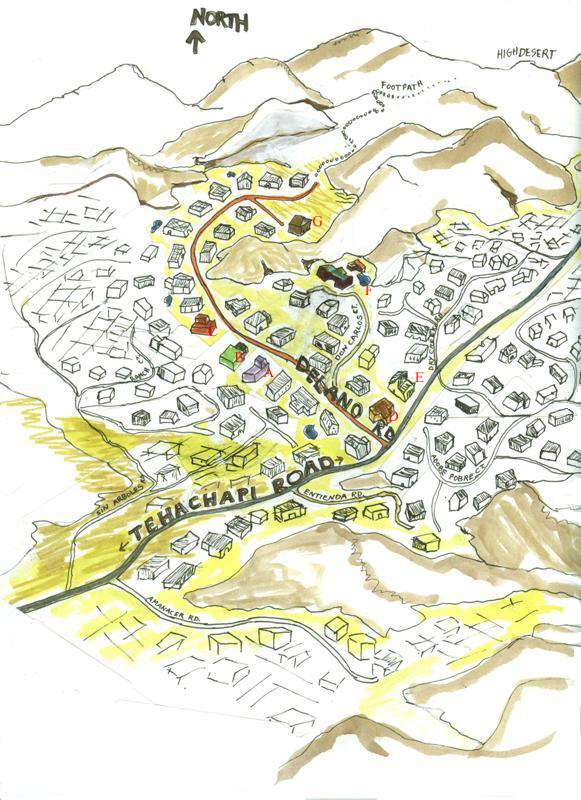
Map of Rubicon Ranch.
A) Melanie Gray
B) Moody Sinclair
C) Eloy Franklin
D) Leia Menendez
E) Ward Preminger
F) Egypt Hayes
G) the Peterson house

Great Reviews for Light Bringer

I got a great review for Light Bringer yesterday from S.M Senden. “Pat Bertram has woven a wonderful story that weaves together imagination with history, science fiction, love, power and so much more, and it works so well. If you are looking for a good story, well written, then read this book. I hope you will love it as much as I did!”

I am thrilled when readers love any of my books, but especially Light Bringer.

First, it is very difficult to classify, even for reviewers. As Aaron Lazar wrote, “Light Bringer is something completely new and surprising . . . surprising in its freshness, originality, its genre bending brilliance. Part thriller, part fantasy, part sci fi, part mystery . . . its plots were large and complex, encompassing themes that plague us every day; offering social and world commentary blended with weather trend observations (where ARE all those tornadoes and tsunamis coming from??) I do believe Bertram has defined a new genre, and it is a pure delight. Fresh. Original. Riveting. The characters are real and engaging.”

Second, it is the result of twenty years of research into conspiracy theories and myth. Many researchers have traced the drive toward a one-world government conspiracy back 7000 years. Others believe that the black death was a man-made epidemic, created in an effort to “dumb down” the inhabitants of Earth. (William Bramley, author of Gods of Eden, wrote: “Strange men in black, demons, and other terrifying figures were observed in other European communities carrying ‘brooms’ or ‘scythes’ or ‘swords’ that were used to sweep or knock at people’s doors. The inhabitants of these houses fell ill with plague afterwards. It is from these reports that people created the popular image of death as a skeleton, a demon, a man in a black robe carrying a scythe.” This is the origin of the grim reaper) In fact, myths all over the world speak of the gods giving and the gods taking away. According to the Popul Vuh, the gods created the first humans exactly like the gods themselves. Displeased that the simple creatures of their making were also gods, the creators took some of the god-like abilities away from them, and we are the result. And from all that research came the idea for Light Bringer.

Third, the lyricism of the book seems to bring out a corresponding lyricism in reviewers. Sheila Deeth called Light Bringer “mysteriously beautiful and musical,” and then added, “Pat Bertram’s novel soars in her descriptions of mystery and scenery. The song of the rainbow flows through the characters, binding them together, while the silence of the great unknown drives them and pulls them apart.” Tracy Fabre wrote, “This novel is color and sound and more color, described as it’s never been described before. Part sci-fi, part small town life, part intrigue, part romance, part rainbow explosion, this is a tale of two people who are not like other people yet end up in a little out-of-the-way community where a lot of strange things have happened and continue to happen. It’s a multi-layered story she should be very proud of, and incidentally will make you crave muffins. Consider yourself warned.”

***

Light Bringer: Becka Johnson had been abandoned on the doorstep of a remote cabin in Chalcedony, Colorado when she was a baby. Now, thirty-seven years later, she has returned to Chalcedony to discover her identity, but she only finds more questions. Who has been looking for her all those years? Why are those same people interested in fellow newcomer Philip Hansen? Who is Philip, and why does her body sing in harmony with his? And what do either of them have to do with a shadow corporation that once operated a secret underground installation in the area?

Click here to read the first chapter of Light Bringer by Pat Bertram

Click here to buy Light Bringer from Second Wind Publishing, LLC

Click here to download 20% free at Smashwords or to buy any ebook format, including Kindle.

(Also available from Amazon and B&N)

Conflict Opens a Door and a Story Begins

Sometimes it seems as if most books and movies today are glorified comic books, epic battles between the dubiously good and the impossibly evil. Conflicts in which there are no shades of gray must be satisfying for many people, but I like a little more subtlety in my conflicts, a little more reality.

In a world that is run by major corporations, stories where a lone hero takes on a megalithic corporation, brings down the owner of the company, and saves the world just are not plausible. Though I’m sure presidents of the major corporations think they are indispensable, they are not. If they are eliminated, there will always be others to take their place, and the corporations will go on doing whatever it is that they do.

Because I know this and cannot escape it even in a world of my own creation, conflicts in my books tend to be less clearly defined. Of course I have heroes and villains, but the villains are not always dastardly ones, though my other characters may perceive them as such. The villains are the heroes of their own story, and though a corporation is often the villains’ vehicle, my heroes don’t bring it down.

I like my heroes to find a romantic partner, a co-protagonist. It seems to dissipate the energy of the story if the two are always in conflict, so I prefer it when they bond together in their struggle against fate (or an employee of a corporation as the personification of fate). To me, the biggest villain around is fate. What is more unfair, more murderous, more disastrous than fate?

My heroes never bring on their fate. Perhaps my books would be more dramatic if they did, but I cannot sympathize with characters who cause their own problems. And why do they have to cause problems for themselves when other people or even life itself is always ready to cause problems for them?

When fate comes knocking on the door, everything changes. And that’s when a real story, not a comic book, begins.

In my novel Light Bringer, “fate knocking at the door” is a one of the unintended themes. In the prologue, baby Rena is found at the door of a remote Colorado cabin. In the first chapter, fate comes with an actual knock when men proclaiming to be NSA agents show up at Philip Hansen’s door. Fate finds Jane Keeler when she shows up at her sister’s door and finds the house empty. Fate knocks even harder when she opens the door of a local coffee shop and meets the man of her dreams, and poor Jane’s fate is sealed when she is abducted and shoved through the door of car.

So many doors! Philip knocks on Rena’s door, and later the two are carried uncocnscious through the door to an underground facility, where Jane is also being held behind a locked door. Philip and Rena find out that between them they can open doors without a key, and when they do, they find secrets behind even more doors. And then there is the ghost cat Wisdom and the invisible watcher who seem to need no doors, but are more than willing to open them for Philip and Rena. Each time a character goes through a door, things change, and they find more conflict.

Fate doesn’t have to come with an actual knock, but it’s been said there are only two stories — a character goes on a trip and a stranger knocks on the door, so doors are an important symbol of conflict and change.

How do doors enter into your story?

Have You Ever Wondered How Amazon’s Algorithms Work?

Amazon has always mystified me, not just how they rank books but how some people who seldom promote manage to sell thousands of copies of their books, and others who seem to promote just as much languish at the bottom of the sales ranks. Today I learned two things.

1) Studies have shown that the number of reviews a book has on Amazon makes a difference, but their worth is still debatable, especially since so many people have found a way around Amazon’s rules. Not only are reviews for sale, but a single Amazon reviewer posted over 23,000 reviews in a single year.  It’s taken me a lifetime to read almost that many books!!

A fellow author sent me the link to a new Harvard Study with a note that the study shows customer reviews have just as much weight as professional reviews, but the study does not say that. According to an article at The Big River Review, “Though reporting in newspapers and blogs seems to present the work as a vindication of the current Amazon review environment, the study is not about, nor does it present itself as being about, the relative veracity or reliability of the two forms of reviews in the present day. It is about editorial favoritism related to the top 100 books from 2004-2007.” If you are interested in learning more about the dangers of Amazon’s review policy, please check out this website. Very interesting! http://www.thebigriverreview.com/

2) Amazon has two lists, a bestsellers list and a popularity list. The bestseller list reflects the number of sales in the past 24 hours, while the popularity list reflects the number of sales plus the price of the book for the past 30 days. Which is why giving away books might put you high on the bestseller lists but keep you off the popularity lists. Being high on the popularity lists can account for thirty to forty book sales a day. (You can find the entire article here: Updates to Amazon’s Book Ranking Algorithms: The Death of 99-Cent Ebooks? An End to KDP Select Perks?)

I still haven’t learned how to get on the lists, though. Obviously, selling a ton books helps, but that skill eludes me.

On the chance that reviews will help, I will be glad to send a coupon for a free ebook to anyone willing to review one of my books. Just let me know which one you would like.

Are You Envious of Other Authors?

A few years ago, I read the entire oeuvre of a bestselling author, trying to figure out the secret of her success, and I never found it. Perhaps it was hidden beneath her appalling writing style, but her poor writing dimed any possibility of my enlightenment.

Even a neophyte writer knows that any action a character undertakes must be motivated. Although in life we often act on a whim or a hunch, when a character in a novel does it, it comes across as too slick, too much author convenience, as if the writer couldn’t be bothered to take the time to come up with a plausible motive for the action.

For example, in one book, the writer had someone searching the character’s house for a set of papers, which weren’t there because the character had removed them on a hunch. You and I could never get away with that! We’d have to come up with a motive, and it’s not that difficult. The character could have taken the papers to a diner to peruse them during lunch. Or maybe taken them to a safe deposit box. Or any reason other than a hunch.

Even worse, when the character found out her house had been searched, she was stunned. Then why the hunch to remove the papers? Maybe she was expecting rats to eat them.

In a roundabout way, I suppose I did learn something: write intelligently, at least until you become a bestselling author. Bestselling authors seem to get away with increasingly shoddy writing (since I read this author’s books in sequence it was very obvious how lackadaisical her craft had become in her later books), and yet we are supposed to continue to treat them and their books with respect.

In a discussion on Facebook, a writer posed the following question: Seems nearly every day I hear a writer complain that Grisham has become a hack, or King should go back to drinking, or Clancy wouldn’t recognize POV if he tripped over it. When you’re struggling with getting recognition, how do you deal with jealousy of successful authors?

Before I was a writer, I was a reader, and as a reader, I have every right to complain that such writers have become hacks. In fact, it’s because the writers I used to like started turning out substandard work and I couldn’t find new authors that I like, that I started writing. I figured if I couldn’t read the books I liked, I could write them.

Apparently, though, once you become an author yourself, you are supposed to give up your critical capacity. If you say anything against another author, it comes across as jealousy, as if you’re envious of the other writer’s success.

In the particular case of the bestselling author I critiqued above, I am not envious of her success, I am not envious of her fans, I am not certainly not envious of her writing style. Though I’m mystified by her ability to write so copiously since writing comes hard for me, but I’m not envious of that ability, either.

I am, however, jealous of the time and money I spent on her books, and I’d like them back.