What, in your opinion, are the essential qualities of a good story?

The most important quality of a good story is the ability to take readers somewhere else and make them glad they went. It’s also essential to make the writing easy to read, which means the writing must be grammatically correct. Nothing takes an experienced reader out of a story faster than having to decipher convoluted sentences with improper punctuation. Ideally, a story should leave readers a bit better off than they were before, either because of what they learned about the world and themselves, or because of the respite from their everyday lives.

Here are some responses from others authors about the essential qualities of a good story. The comments are taken from interviews posted at Pat Bertram Introduces . . .

From an interview with J J Dare, Author of False Positive and False World

The hook is the essential part of a story; with a good hook, the reader won’t want to put a book down. I try to draw the reader in immediately with a one-two punch.

From an interview with Mickey Hoffman, author of School of Lies

I want the main characters to have a “quest.” The quest can be a real journey or one in their heads and if there’s mystery involved all the better.

From an interview with Michael Murphy, author of Scorpion Bay

In my opinion a good story has conflict throughout and characters the reader will care about. I don’t believe the story, what happens to the characters is nearly as important has how these events impact the character’s lives, how they’ve evolved and grown, or in some instances, how they’ve stuck to their principles and are not changed by events in the story. An example of this type of story would be the movie High Noon.

From an interview with John Grover, Author of “Feminine Wiles”

A good story is about style, the style it is written in makes it unique and second is to make the reader care about your characters. Without empathy for your characters readers won’t care what happens to them. Once they care, you can really rev things up. I think it is all in the way you tell the story and how the characters come to life. Write about what you know, add in touches from your life and real people and it will come to life.

So, what, in your opinion, are the essential qualities of a good story?

(If you’d like me to interview you, please check out my author questionnaire http://patbertram.wordpress.com/author-questionnaire/ and follow the instruction.)

Suspense/Thriller Writers Self-Promotion Extravaganza!

Every Saturday, I host a self-promotion extravaganza for my Suspense/Thriller Writers Group on Facebook. You don’t have to belong to the group to join the event and participate in the extravaganza, so if you are an author with a book to promote, I hope you will join us! While you’re there, be sure to check out the books of the other authors. You can find the event here: Suspense/Thriller Writers Self-Promotion Extravaganza! Just click on “join” and tell us about your book.

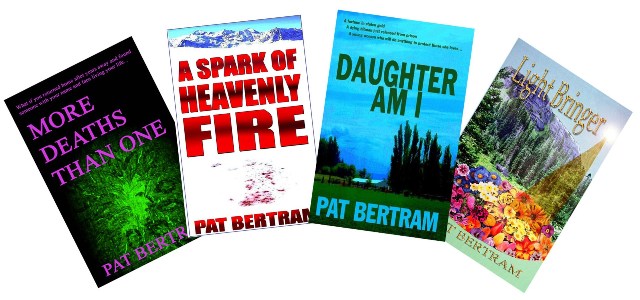
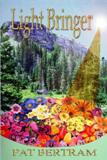
You already know my books, but if you are using Internet Explorer to view this blog, you won’t be able to see the cover images on the sidebar until WordPress fixes a glitch, so I’m listing them here. If you’d like to read the first chapter of any of them, just click on the cover.

Light Bringer: Becka Johnson had been abandoned on the doorstep of a remote cabin in Chalcedony, Colorado when she was a baby. Now, thirty-seven years later, she has returned to Chalcedony to discover her identity, but she only finds more questions. Who has been looking for her all those years? Why are those same people interested in fellow newcomer Philip Hansen? Who is Philip, and why does her body sing in harmony with his? And what do either of them have to do with a shadow corporation that once operated a secret underground installation in the area?

DAIDaughter Am I: When twenty-five-year-old Mary Stuart learns she inherited a farm from her recently murdered grandparents — grandparents her father claimed had died before she was born — she becomes obsessed with finding out who they were and why someone wanted them dead. Along the way she accumulates a crew of feisty octogenarians — former gangsters and friends of her grandfather. She meets and falls in love Tim Olson, whose grandfather shared a deadly secret with her great-grandfather. Now Mary and Tim need to stay one step ahead of the killer who is desperate to dig up that secret.

More Deaths Than One: Bob Stark returns to Denver after 18 years in Southeast Asia to discover that the mother he buried before he left is dead again. He attends her new funeral and sees . . . himself. Is his other self a hoaxer, or is something more sinister going on? And why are two men who appear to be government agents hunting for him? With the help of Kerry Casillas, a baffling young woman Bob meets in a coffee shop, he uncovers the unimaginable truth.

A Spark of Heavenly Fire: In quarantined Colorado, where hundreds of thousands of people are dying from an unstoppable disease called the red death, insomniac Kate Cummings struggles to find the courage to live and to love. Investigative reporter Greg Pullman, is determined to discover who unleashed the deadly organism and why they did it, until the cost — Kate’s life — becomes more than he can pay.

Have you ever had difficulty killing off a favorite character in your story?

No. For me, story is sovereign. Everything must serve the story, and if the death of a favorite character will serve the story, then that’s the way it has to be. To be honest, though, I haven’t yet killed off a favorite character. The ones I have killed were created to be killed, and I took great glee in doing so. Mostly, I’m not one for being selective in my killings. In A Spark of Heavenly Fire, I decimate Colorado. (I am using the word in its proper context here — I kill off a tenth of the population.) In Light Bringer, I hint at the destruction of vast numbers of people, and in my current work (that isn’t progressing very rapidly) I do, in fact, kill off almost the entire population of the world. After all that carnage, what’s one more character killed off, favorite or not?

Here are some responses from others authors about difficulty of killing off a favorite character. The comments are taken from interviews posted at Pat Bertram Introduces . . .

From an interview with Dellani Oakes, Author of Lone Wolf

I greatly dislike killing a character and avoid it if I can. However, there are times when a character must die to advance the plot. The one who upset me the most was a guy named Murdock Pickford. He’s in a prequel to my sci-fi series. Murdock is a nice guy. He’s kind, capable, loving and forgiving. He’s engaged to a woman who’s pregnant with another man’s baby & he agrees to raise her as his own. He’s thrilled about the baby, excited about getting married—and he has to die, horribly, brutally, for the book to move forward. I’m not ashamed to admit that I cried when I had to kill him off.

From an interview with Jocelyn Modo, Author of “Revolution Lovers”

In Revolution Lovers something truly horrible happens to Adie…I’ve avoided that scene since I wrote it. I can’t look at what I did to her, don’t want to face what I did to my beloved character. I feel silly saying it, but I feel guilty about hurting her.

From an interview with Rod Marsden, Author of “Disco Evil” and “Ghost Dance”

When you deal with the supernatural killing off a characters doesn’t mean they won’t return. I have had characters return a number of times after death to either help or hinder the living.

From an interview with Christine Lindsay, Author of “Shadowed in Silk”

I have to laugh at this as it may sound horribly brutal. But I have no problem killing my characters off at all.  In all of my books I kill off at least one secondary character, sometimes more as is the case of Shadowed in Silk.

I love having my strongest Christians die. I often cry as I write the scenes where they are ready to meet their Lord. And sometimes bad characters have to die too. I try hard not to think of their eternal situation, and remind myself that they are fictional characters — not flesh and blood — and I am not God.

What about you? Have you ever had difficulty killing off a favorite character in your story?

(If you’d like me to interview you, please check out my author questionnaire http://patbertram.wordpress.com/author-questionnaire/ and follow the instruction.)

“A Spark of Heavenly Fire” is a well paced thriller

The following is a review of my novel A Spark of Heavenly Fire, and was written by Dellani Oakes.

***

Kate Cummings works in a medical clinic as a patient advocate. Since the death of her husband, she’s led a quiet, uneventful life. All that changes when a jogger in the park falls on her, hemorrhages and dies. This event is strange enough, but when the same symptoms appear in a woman at the clinic, Kate realizes that something more is going on.

At the park, Kate meets Greg Pullman, a reporter for the newspaper. He’s somewhat younger than she, but they click on many different levels. When his fiancee, Pippi O’Brian, dumps him, he finds friendship and solace with Kate.

Together, Kate and Greg begin investigating the odd circumstances surrounding the deaths of the jogger and the woman at her office. As more and more people get ill, the city of Denver finds itself under military quarantine.

“A Spark of Heavenly Fire” is a well paced thriller. Kate and Greg race against time, trying to find the cause of the outbreak as well as survive in the aftermath. The characters are 3 dimensional and believable. The reader feels a link with them, and hope that they will somehow survive.

I highly recommend “A Spark of Heavenly Fire” for anyone who likes a good mystery with a dash of romance. It’s an excellent book and I look forward to reading Pat Bertram’s other novels – “More Deaths Than One”, “Daughter Am I”, “Lightbringer” and “Grief: The Great Yearning” (non-fiction).

Look for all Ms. Bertram’s books at www.secondwindpublishing.com as well as Amazon.com, BN.com and Smashwords.com

“More Deaths Than One” will leave you breathless

The following is a review of my novel More Deaths Than One, and was written by Dellani Oakes. I didn’t bribe her into saying such nice things. I promise.

***

“More Deaths Than One” by Pat Bertram will leave you breathless—first with anticipation, finally with a contented sigh of a job well done. Set in 1988, this well crafted, fast paced novel of love and intrigue spans the globe from Denver, Colorado to Bangkok, Thailand.

Bob Stark is a quiet man. A Vietnam vet, he’s returned to the states after nearly 18 years in Thailand. He came back to his childhood home of Denver because his life in Thailand couldn’t continue. His friend and mentor, Hsiang-li, left on a personal quest to find a golden Buddha in the jungle—the place where he had to bury his wife and child after they were murdered.

Kerry Casillas works nights in the diner Bob frequents. One night, she introduces herself and they get to know one another. Soon after meeting Kerry, strange things start to happen. Bob and Kerry find themselves embroiled in a mystery far beyond their understanding.

“More Deaths Than One” is an interesting tale of one man’s journey to find the truth. The character of Bob Stark is deep and many faceted. He’s quiet, kind and resourceful, showing abilities even he didn’t know he possessed.

Kerry is a fun loving character and the opposite of Bob in many ways. She’s talkative, outgoing and imaginative. She is the perfect partner and counterpart to Bob. She, too, has hidden talents that surprise and please Bob.

The well-paced plot of “More Deaths Than One”, keeps the reader riveted, waiting to discover the many mysteries in Bob’s past. I enjoyed the fact that though I guessed at all of these secrets, I was right about only a few. Bertram truly kept me hopping as I made my way through the book. I like when a novel isn’t so predictable that I know the end before it arrives.


Aaron Lazar’s Review of A SPARK OF HEAVENLY FIRE

A Spark of Heavenly Fire
by Pat Bertram
Publisher: Second Wind Publishing
ISBN number: 978-1-935171-23-2
Review by Aaron Paul Lazar
Lazarbooks.com

Who says you can’t squeeze romance into a thriller? And while you’re at it, how about weaving in a deeply moving story about human redemption?

Author Pat Bertram says you can. And she’ll convince you before you can say chimera — the lethal combination of virus, bacterium, fungus, and human genes that causes the rapid spread of the “red death,” a bio-engineered weapon threatening the entire state of Colorado.

Kate Cummings is trying to deal with the loss of her husband, who drove his car off a mountain after a long battle with Multiple Sclerosis. She passes by his bedroom without daring to enter, and slogs through life in a solemn daze, feeling guilty for every time she waited a few extra minutes to answer his summons, or for each time she became angry. His loss haunts her, and although her work at the Bowers Medical Clinic is fulfilling, it can’t heal the hole in her heart.

When a jogger stumbles into Kate with red eyes blazing, he vomits blood on her and dies instantly. A rash of similar deaths follows, decimating the state. Orange paint markers on front doors –– signifying a “red death” in the marked homes — begin to appear with frightening regularity. Panicked parents discard their red-eyed children, fearful of contagion.

Enter Greg Pullman, reporter for the Denver News, who’s engaged to the ditzy beauty, Pippi O’Brien, local TV weather girl. But when he bumps into Kate after Pippi heads for the border in search of safety, things change. Together, Kate and Greg investigate and unearth the shocking source of the horror that has shut down their state and caused a rogue wing of the military to terrorize Colorado’s remaining citizens. Basic human amenities – so often taken for granted –– become grounds for murder. And the streets are no longer safe to walk unescorted.

In addition to a killer story line, smooth writing, and phenomenal characterization, this page turning thriller features fine examples of charity through glimpses into Kate’s huge heart. The remarkable heroine opens her home to survivors who are homeless and hungry. Soon, partnered with a destitute woman named Dee, Kate’s home becomes a refuge for survivors. And in the midst of the massive deaths, terror, and horror, Kate finds salvation.

The tension in A Spark of Heavenly Fire is electric. Taut suspense pulls you along at a rapid pace. This reader was up way past his bedtime three nights in a row. And yes, it was that good.

***

Thank you, Aaron!

Be sure to check out Aaron Paul Lazar’s books at http://www.lazarbooks.com/

Learning to Use Beats in Dialogue

One of the hardest techniques for new writers to handle is dialogue. When I first started out, my characters never just said something. They agreed, cautioned, reminded, mimicked, answered, contributed, guessed, explained, responded, admonished, confessed, encouraged, clarified, blurted, pointed, winced, replied, corrected, acknowledged, returned, laughed, challenged, chided, objected, contested, quipped, offered, moaned, complained, repeated, stammered, pleaded, inquired, mumbled, interrupted, confirmed, addressed, countered, advised, completed, allowed, supplied, ordered, asked, continued, chided, answered, whispered, teased, requested, hollered, echoed, declared, informed, spoke, bellowed, spit out, thundered, hissed. All within a few pages. Whew!

Even worse, I would sit and agonize over the way my characters spoke. “He responded sparingly.” “She informed him haughtily.” He mumbled sadly.” Ouch.

It was a joy to discover that modern dialogue relies primarily on “said,” such a common word, the reader’s gaze glides over it as if it were invisible. It was even more of a joy to discover that adverbs were frowned on. The dialogue itself, or the beat — the bit of action accompanying the dialogue — should show the character’s emotion. “I hate you”, she said angrily tells us what the character is feeling. She picked up a rock and threw it at him. “I hate you!” shows us what she is feeling, allowing us to become intimately involved with the character. The only time an adverb is necessary is when the character’s words are at odds with his mood, such as: “I had a great time,” he said sadly. You can also use an occasional “ly”adverb to describe the tonal quality of the character’s voice. “I hate you,” he said softly.

Besides helping identify who is speaking, beats help set the stage, tell us about the character’s personality, and vary the rhythm of the dialogue. Overdone, the beats are as distracting as any other speaker attribute, so the secret is to pay attention to the flow. Do you want short snappy dialogue? Don’t use beats. Do you want to slow things down a bit, keep the dialogue from seeming too disembodied? Use a few beats.

It’s hard to write crowd scenes and keep each character identified without resorting to copious “said”s, but beats keep the scene moving and, if you use beats that are specific to your character, you make the various characters come alive.

This excerpt from my novel Daughter Am I shows the use of beats. The scene is between my hero Mary, a young woman in search of her grandparents’ murderer, and a group of feisty octogenarians who are trying to help.

*     *     *

The man stopped bouncing and let his arms drop to his sides. Now that he stood relatively still, Mary could see he was skinnier than she’d first thought. A gray slouch hat tilted toward one eye, but the baggy pants cinched high above his waist and the bright flowery shirt several sizes too large marred the jaunty effect. His hands shook uncontrollably. Parkinson’s disease?

“You must be Happy,” she said.

Frowning, Happy patted his torso. “Must I be happy?” His voice deepened to what Mary assumed was his normal tone. “Can I be happy? Can anyone truly be happy?”

“His name is Barry Hapworth,” Kid Rags said, flicking a bit of lint off his navy pinstriped suit jacket. “For several obvious reasons, everyone calls him Happy.”

Mary glanced from the bus to Happy. “Were you driving this thing?”

Happy puffed out his meager chest. “Sure was.”

“And did you almost run over Mrs. Werner’s cat?”

“I’ll take the fifth.” Happy paused for a fraction of a second. “A fifth of bourbon.”

“Did someone say bourbon?” Kid Rags removed the flask from his hip pocket, took a swig, and passed it around.

“Who are all these people?” Bill asked from behind Mary.

Mary turned, wondering how she could explain the situation to her fiancé, but Teach saved her the trouble and made the introductions. Arms still folded across his chest, Crunchy nodded to Bill, then stepped close to Mary. Happy punched the air, but stopped when Bill showed no inclination to fight.

Kid Rags shook Bill’s hand. “You’re a lucky man.”

“What are you all doing here?” Mary asked. “I was supposed to pick you up. And why is Happy here?”

“Happy is a friend of Kid Rags,” Teach began, but Kid Rags interrupted him, saying hastily, “Not a friend. Just a fellow I know.”

“Happy knows someone who knows Iron Sam,” Teach continued, “and since we knew your car wasn’t big enough for all of us, we accepted Happy’s offer to drive us in his bus.”

“Who’s Iron Sam?” Bill asked, sounding plaintive.

“Butcher Boy,” Kid Rags said.

Bill’s eyebrows drew together. “Butcher Boy? Mary, are you sure you know what you’re doing?”

Mary laughed, suddenly feeling lighthearted and carefree. “I haven’t a clue.”


Gone With the Electronic Wind

I seem to be changing, whether I realize it on a daily basis or not. For the most part, I am more patient than I used to be. I have a greater ability to wait because there’s no reason to be one place rather than another. I am also aware the future will come whether I will it or not. But . . . I have a lot less patience for disrespect. And I am not as I nice as I once was.

Take today, for example. I got a friend request from someone on LinkedIn. I accepted the request, then she sent me an invitation to join her crime writers group. After I did so, she sent a message suggesting I post a bit about one of my books in the group’s discussion boards. Which I did. Then she said to post a link to the book (though I had already done so) and after I posted the second link, she left a comment on the very public post saying the book sounded interesting, but she wasn’t going to buy it. Huh? Why not just say it sounded interesting and leave it at that? Even worse, she went on a rant about ebook pricing. Apparently, J. Konrath has decided that $2.99 is the perfect ebook price (who made him king, anyway?) so the LinkedIn woman decided that any book priced more than that is overpriced. Her reasoning? Some of the major publishers were selling ebooks at almost the same price as a print book, and since there was nothing changing hands — no actual printed book — she figured that the publishers were cheating her.

My publisher prices my ebooks at less than a third of the print price, so why was she griping about my book? Aren’t publishers (and authors!!) allowed to make money anymore? Amazon skims 30% right off the top of all books (70% off $.99 books), and for this skim, they don’t do anything except offer the book as a download. There is no human involvement, so no payroll, no expenses except for a few cents worth of computer time. Apparently the woman has no objection to a huge near monopoly like Amazon raking in the dough. But a small publishing house? Oh, no. They aren’t allowed to make a profit! Sure the ebook is only a few electrons, and no physical product is exchanging hands, but what about the hundreds of hours that goes into publishing a book? (I’m not even counting the hours it takes to write the book.) It takes time and money to format, edit, create a cover, copyedit it, proof it. And yet she complains the publishers are selling nothing.

Perhaps her rant would have made sense if I had been the one to ask to be connected, if I had been the one to ask to join her group, if I had posted the book link without permission. But she instigated the whole situation, and then she was unbearably rude.

So I got even. I deleted her from my online world. Poof! Gone with the electronic wind.

What’s the most surprising part of being a writer?

What’s the most surprising part of being a writer?

The most surprising part for me is that I know how to write. For many years, my life was shadowed by the sadness of having no innate talent for writing. I’m not being modest — I really couldn’t write a novel or anything worth reading except for some snippets of poetic thoughts. When I decided to write a novel despite that lack of talent, I set out to learn everything I could about developing a readable story. Most of the how-to books confused the heck out of me — the authors would talk about rising conflicts and motivation/reaction units, and I didn’t have a clue what they meant. It’s only recently that I realized I actually know what I’m doing.

Here are some responses from others authors about the most surprising part of being a writer. The comments are taken from interviews posted at Pat Bertram Introduces . . .

From an interview with J J Dare, Author of False Positive and False World

The most surprising aspect of being a published writer is the positive feedback I’ve received from readers. Only a few weeks ago, I had a reader ask when the third book in the Joe Daniels’ trilogy would be coming out.

From an interview with Smoky Trudeau Zeidel, Author of “On the Choptank Shores”

The awe some people display when they find out I’ve not only written a book, but written several! Really, I don’t tell people I’m an author to stun them! It’s what I do, just like some people are gardeners or bank tellers or forest rangers. But there is something about being a writer that makes other people think you’re pretty cool — even if you aren’t!

From an interview with Sheila Deeth, Author of “Flower Child”

I’ve surprised myself by finally learning to tell people I’m a writer — maybe that’s what I should have said has changed since my first book was published.

From an interview with Beth Groundwater, Author of “A Real Basket Case”

The amount of non-writing work involved! There’s the contracting process, research, promotion, networking and all of the other ancillary activities that are part of having a writing career, but that take precious time away from the writing itself.

So, for you, what’s the most surprising part of being a writer?

(If you’d like me to interview you, please check out my author questionnaire http://patbertram.wordpress.com/author-questionnaire/ and follow the instruction.)

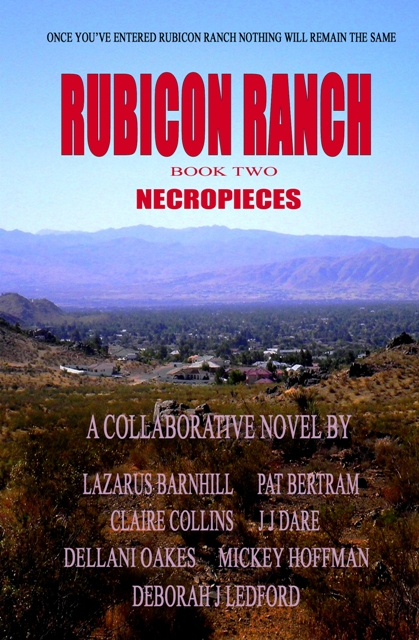
Sneak Preview of Rubicon Ranch: Necropieces

Rubicon Ranch is a collaborative and innovative crime series set in the desert community of Rubicon Ranch and is being written online by the authors of Second Wind Publishing. Seven authors, including me, are involved in the current story — Rubicon Ranch: Necropieces.

Residents of Rubicon Ranch are finding body parts scattered all over the desert. Who was the victim and why did someone want him so very dead? Everyone in this upscale housing development is hiding something. Everyone has an agenda. Everyone’s life will be different after they have encountered the Rubicon. Rubicon Ranch, that is.

Although some of the characters were introduced in Rubicon Ranch: Riley’s Story, a previous collaboration, Rubicon Ranch: Necropieces is a stand-alone novel. The first chapter will be posted on Monday, June 11, and one chapter will be posted every Monday after that.

We hope you will enjoy seeing the story develop as we write it. Let the mystery begin! Whodunit? No one knows, not even the writers, and we won’t know until the very end!

Chapter 1: Melanie Gray
by Pat Bertram

Melanie Gray woke with tears on her face. She sat up in the bed she’d shared with her husband Alexander, put her elbows on crossed knees, and cradled her face in her hands. The pain she tried to hide even from herself erupted, filling her chest with such agony she could only breathe in shuddering gasps.

She’d been doing so well, concentrating on shooting the photographs to finish their coffee table book on desert life, photos that Alexander should have taken, would have taken if he hadn’t died. So why the upsurge in grief? Then it came to her—today marked the third month since Alexander’s death.

Three months! Melanie saw the months marching on, one by one, each carefully counted while she grew old alone. She was only forty-three, which meant a lifetime of loneliness ahead of her.

I can’t do this.

But she’d already been doing it—living each shocking day as it came.

First, she’d found out that Alexander had died in a one-car crash under suspicious circumstances — maybe an accident, or maybe something worse, something she couldn’t bear to think about. Then she had discovered that he’d been texting a woman when he died, a woman who claimed to be his mistress. Finally, she learned that somehow he’d managed to spend the considerable advance they’d received for their book, leaving her with a six-month paid lease on this house, barely enough cash for groceries, and a book contract she needed to fulfill. No savings. And no car.

At least the desert was close, so she didn’t need a car to do her job. Rubicon Ranch, the bedroom community where they’d rented the house, bordered on the high desert of inland California, and offered gorgeous vistas, wildlife . . . and death.

“Damn you, Alexander! Why did you have to die? You were the one who was supposed to shoot the photos. I only wrote the words. If you’d paid attention to your driving, you’d still be alive, and I’d never have found that little girl’s body.”

Poor little Riley Peterson. Kidnapped as a baby, dead at age nine without ever knowing that her biological parents had spent her whole life searching for her.

Melanie let her tears fall for a few more minutes, took one more shuddering breath, and hauled herself to her feet. As bleak as her life seemed, as sad and as lonely as she felt, she was still alive. And she had work to do.

As always, she dressed in white — loose cotton pants, billowing long-sleeved top, wide-brimmed straw hat, flowing scarf. She checked her pockets to make sure she had her cell phone, camera, and extra memory card. Then she grabbed a canteen of water, slung the strap over her shoulder like a bandolier, and stepped outside.

A perfect early fall day. Clear blue skies, the deepest blue she’d seen since she’d moved to Rubicon Ranch. A hint of a sweet-scented breeze wafting up Delano Road. Temperatures in the high seventies, though they would probably rise to the mid-eighties by noon.

The grizzled homeowner across the street picked up a newspaper from his driveway, waved it at Melanie, turned, and stood still. Wondering what had caught his attention, Melanie followed his gaze.

A tan bullmastiff towed a pretty woman up the street. The woman’s dark hair, drawn into a ponytail, swished jauntily as she ran to keep up with her exuberant dog. What should have looked like a carefree moment seemed one of desperation to Melanie, as if the woman were running from demons only she could see.

“Funny how art often imitates life, eh?” came a deep voice from behind Melanie.

She jerked her head in the direction of the voice, and gaped at Morris Sinclair, her next-door neighbor, who had managed to sneak up on her without her noticing.

Morris, an international bestselling horror novelist had been a suspect in Riley Peterson’s death. The sheriff had declared the author innocent of the murder but guilty of buying stolen crime scene photos. And guilty of feigning Alzheimer’s. Melanie didn’t know how the sheriff had come to that conclusion. As far as she could see, if Morris had been feigning Alzheimer’s, he must have been trying to hide the truth — that he was insanely evil. Or evilly insane.

“Or maybe, in her case, life is imitating art,” Morris said.

“What are you doing here,” Melanie demanded. “Does Moody know you’re on the loose?” Moody, Morris’s daughter, had spent time in prison for the accidental death of a child. You’d think a man as perverse as Morris would be proud of her for that accomplishment, but he treated his daughter with even less regard than he treated everyone else.

“Am I my daughter’s keeper?” Morris intoned.

Melanie backed away from him. “I’m sorry. I don’t have time for this.”

“I know. You have to go out into the desert to shoot more of your little photos.” He bared his long, old-ivory-colored teeth at her in what might have been meant as a smile but came across as a predatory leer. Pointing a bony finger at her camera, he added, “You know how to use that thing, right?”

Melanie lifted her chin. “I do.”

“I’ll offer you the same arrangement I had with your husband.”

“You had an arrangement with Alexander?”

“Yeah. Alexander. Did you have more than one husband?”

Melanie stared at him in confusion, but when his dark opaque eyes met her gaze, she ducked her head.

“Alexander used to take certain . . . photos for me.” Morris raised his voice. “Photos of body parts.”

“Body parts?” Melanie asked. “You mean like arms and legs? You can find photos of those anywhere.”

“But I need amputated body parts. Dead parts. Lots of blood and gore. Necropieces.”

Melanie recognized the name of Morris’s most famous horror series — Necropieces — but none of his other words made sense. “You’re telling me Alexander took photos of amputated limbs for you?”

“And entrails. And organs. He loved shooting the images. Had a nicely developed sense of the macabre.”

“No,” Melanie said in a normal tone of voice. Then, all at once, the agony of the past few months gathered itself and launched a scream. “Nooooo.”

The word seemed to echo up and down the quiet street. She caught a glimpse of movement on the porch a couple of houses away, and she realized the old man who lived there, Eloy Franklin, had heard her shriek, but she didn’t care. She had enough of insanity and things that didn’t make sense.

“You leave me alone, Sinclair,” she shouted as loud as she could so that Morris would get the message, “or I’ll be shooting your dead body parts.”

“Every one of you bastards wants me dead!” Morris screamed, matching her decibel for decibel. He threw his arms wide as if to address the neighborhood. “Kill me! Kill me! Kill me. Cowards, every one of you! None of you have the guts to do anything but sit in your dark little caves and try to wish me away. Cowards! And you—” He turned to face Melanie. “I dare you. Kill me like you killed Alexander.”

Melanie gasped. “Alexander died in an accident.”

“An accident you created,” Morris said calmly, as if he’d never raised his voice. “Before that little girl died, she told Moody you’d messed with your car.”

“You’re lying.” Melanie’s words barely squeaked through her clenched teeth.

“Ask Moody.” Morris put a finger to his chin and cocked his head to one side. “So, will you take the photos for me? I’ll pay you well.”