Creativity Has No Price

A couple of days ago, I posted a bloggery What is the Price of Creativity, where I lamented the devaluation of books. What everyone believes they can do, no one values, and so readers today expect to get ebooks for a nominal sum, or even free.  Mickey Hoffman, author of School of Lies and Deadly Traffic, wrote such an insightful rebuttal to that article that I thought it deserved to be featured here (though truthfully, everyone made important  points). Mickey wrote:
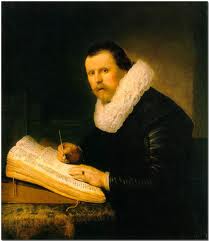
Rembrandt died poor. He’s now regarded as one of the creative geniuses of the art world. This stuff has been going on forever. In ancient times the people who carved the famous statues in Greece didn’t even put their names on their work. Creativity has never been as useful to humans or held as high a value as the ability to make money, to manipulate others, to convince the masses that one is a god, etc.

The ability to write used to be admired only because for centuries most people could not even read or write their own names. And only the Bible was deemed worthy of reading. When reading no longer was such a mysterious process done only by a monk or priest and people realized it wasn’t so difficult to learn to do it for themselves, then they began to read, but still mostly religious tomes. If you look at many countries today, the kids are taught to read only for the purpose of reading the Koran. So it still happens.

In the West, as the ability to read became more common, writing became more common. Letter writing was the rage and those who could write creatively were held in high esteem. But were they actually paid well for it? Not often. Rich people had books but didn’t read them, they used them like trophies to show they were cultured. Writers still struggled to make a living and always have. Only a few have been able to support themselves that way. There have always been trashy publications and well written ones. Just more of both now.

You could argue against public libraries too, and make an argument that the ability to read for free would devalue writing. I don’t think the availablity has much to do with it. What’s changed are two things. One is the cultural idea that’s infected education: Everyone’s a winner. No one can be told they’re not good at something for fear of damaging their self-esteem. Kids aren’t reading well-written books in elementary or high school anymore so they have no means of comparison. They don’t have to learn how to write well either unless it’s on a test. College professors are getting essays with abbreviated text messaging words in them. My brother, a professor, used to read me some of the stuff his students wrote. These things were so unintelligible I didn’t know whether to cry or laugh. Somehow they made it into college anyway.

Second, television and films. Need I say more? I think we’ve all noticed that best sellers read like they’ve been written to be made into an action/thriller movie. And if they are, then they’re actually composed with different elements in mind than a writer puts into a story made for reading only.

So how is the public to know they’re reading garbage? Just throw in a vampire or a ghost or a serial killer or a few sex scenes and that’s enough to find an audience. And the agents and publishers know this. Don’t blame Amazon or anyone else, blame US.
What is the Price of Creativity?

The book business continues to dishearten me. The recent pursuit by the government against the major publishers and Apple on antitrust charges gives Amazon a virtual monopoly with the ability to charge whatever prices they want, eternally undercutting the competition. This also gives Amazon control of the royalties the authors earn, which is little enough to begin with, and makes self-publishing on Amazon an even more attractive option. Which gives Amazon even more control.

Perhaps the publishers were charging more than people would have liked, but frankly, as much as I hate the major publishers, there is more at stake here than simple manufacturing costs. Admittedly, it doesn’t cost anything beyond an initial investment to produce an ebook, but what about the value of the contents, the creative output, the artistry of the writing itself? No one complains that the painting they bought for $100,000 is overpriced even though it merely cost the artist a few dollars worth of paint and canvas, so why do readers begrudge writers compensation for their creativity? What didn’t exist now does. Shouldn’t there be value to that?

And that is the real issue here. Value.

Readers don’t seem to care that the art of writing no longer has any value. They can get an endless supply of books free or close to free. They seem to believe that good writing will rise to the top, that bad writing will simply fade away, but that is not true. What sells is adequate writing, writing that is just good enough to get the job done. Some good books might find a readership, but if they don’t, it does not negate the inherent value of the book. Nor does a barely adequate book become a good book simply because it sells.

Huge numbers of people shrug and say, “Ebooks are here, get over it.” They are thrilled at the disappearance of any “elitism” that might once have been conferred upon published authors. Anyone can write. Anyone can publish. What everyone believes they can do, no one values. People are reading more now because of the low cost and ease of ebooks, but are they reading anything of value, are they becoming better human beings because of the books, or are they simply passing time?

I was shocked the first time I heard that books are considered entertainment, that books compete with movies and video games for entertainment dollars. Books are more than entertainment. Or they should be. The written word becomes part of us. What was conceived in one mind comes to life in another. It’s a connection between two human beings who have never met. Isn’t that of greater consideration than a fight over entertainment dollars? Through books you can travel to other places in the world, and you can travel to other places in your own mind. You can experience feelings, ideas, philosophies that you never knew you had. Isn’t that more than mere entertainment?

I’m not sure I want to participate in a book world that places such a small value on the written word. I’ve been trying to find a reason to write again, but frankly, I don’t I see the point.

My Short Story “The Willow” Has Been Anthologized!

My short story, “The Willow,” has been published in the Second Wind anthology Change is in the Wind. Reviewer Sheila Deeth says:  “Pat Bertram’s ‘The Willow’ haunts with its beautiful portrayal of love and loss.”

I hope you will read this story. It did what I wanted, capturing the essence of timeless love and the new life that comes from loss. You don’t even have to buy the book. I’ll let you download the anthology this week for free! To download the ebook, go to https://www.smashwords.com/books/view/146269, pick the format of your choice, and then use coupon code HG57Y when you purchase the book. Your cost should be $0.00 (Offer expires April 17, 2012)

Excerpt from “The Willow”:

One summer day, shortly after their twenty-fifth wedding anniversary, Gracie was curled on the couch, proofing the catalog for an exhibit of the new modernists, when Scott trudged into the room. Gladness at the sight of him sparked a smile as always, but something in his manner . . .  a hesitation . . . made her smile fade.

“Do we have any plant food?” he asked, his words slurred.

“There should be some in the garage.” She peered at him. “Are you okay?”

“I think I’m dying.”

Gracie bolted upright, heart pounding so hard it shook her body. “What?”

“A little plant food should help.” Scott started to walk away.

“Wait! Just wait a minute, Scott.”

He glanced over his shoulder, a questioning furrow between his brows.

“You can’t just drop a bomb like that and then leave as if nothing happened,” she said.

“What bomb?”

She stared at him for a second, unable to speak, but finally managed to croak out the words. “You said, ‘I think I’m dying.’”

“I didn’t say you were dying.”

“Not me. You. You said you were dying.”

“I said the tree was dying. You never listen, do you?”

The chill in his voice froze her. All she could do was sit immobile on the suddenly uncomfortable couch and watch him. He stumbled as he left the room, and his shoulder hit the doorjamb.

Fear, like fury, flashed through her body. Something was wrong with Scott. Terribly wrong. In all their years together, he’d never spoken to her in such a tone. She hadn’t even known he had such a tone. And that stumble? He was the most graceful man she’d ever met, walking on the high beams of his buildings as if they were earth-bound sidewalks.

She chased after Scott and found him staring up at the canopy of the globe willow. Golden leaves sprinkled down on him as if it were fall instead of just beyond spring.

“Do we have any plant food?” he asked, warmth and worry in his voice.

Gracie put a hand to her mouth to hold back a dry sob. Didn’t he remember that he’d already asked her about the plant food? “Maybe it’s time for you to get a check-up,” she said.

“Me? I feel good.” He grinned at her and held out his arms. “How about a little stress release, love? That’s all I need to make me feel great.”

Blurb from Change is in the Wind:

The assignment was simple: submit a short story dealing with change. The results were astonishing, engaging, and incredibly varied. The stories compiled in this volume range from taut action drama, to stealthy intrigue, to enthralling spirituality, to tangled relationships, to timeless love renewed—or lost, to angelic second chances.  No two of the tales are remotely similar, and yet they are linked in remarkable ways. Each story is tied it to all the others in the anthology with two exquisite threads. The first constant theme is redemption; in each case there is a transformation, often painful, that brings new beginnings, new possibilities and revitalized life. The second theme is love—timeless and true—expressed in a multitude of ways, but unfailing in bringing hope and newness. Change in the Wind is an extraordinary collection of marvelous stories from gifted, eclectic writers who draw us into their worlds and leave us wanting more.

Second Wind Publishing is starting a new short story contest. Perhaps you will be included in the next anthology! For information about this new contest, click here: Holiday short story contest

Virtual Book Tours

Virtual book tours became prevalent very quickly. I’ve heard how great they are — mostly from the major publishers who don’t want to spend the money to send their authors on an unvirtual tour — that I wonder how worthwhile blog tours really are. I know the most popular book blogs do help get the word out, but it’s hard to get a guest spot on those blogs unless you have a publicity department behind you. Some people who have done tours think the tour helped with sales, other says not. Me? I’m still not sure. I did two tours, and neither seemed to make any difference in sales.

I’ve read that for most authors, the real benefit of doing a book signing in an offline store is the connection one makes with the bookseller, and perhaps the same holds true with a virtual book tour. I’ve made connections with other bloggers, introduced my books to people who would not otherwise have discovered them, and talked about my books with those who have read them.

Setting up a blog tour is easy, though time-consuming. You need to research blogs to find the best fit, and then you need to query the blogger. If you are invited to be a guest on the blog, you need to find out what is expected of you — an article, an interview, a giveaway — and you need make sure that every article you write, every response in an interview is different and appealing.

People will not follow your blog tour if you keep recycling the same article. Make sure you send your guest post, a bio, a photo of you, a photo of your cover days in advance. Then on the day the article is posted, you need to visit the blog several times and respond to comments.

A disconcerting aspects of my tours was how few bloggers did anything beyond posting the article. No mention on Facebook, no Twitter, no promotion of any kind. So, the main thing is, make sure you do what you can yourself to promote. Which meant, for me, two blog articles a day, one for the host, and one for my blog to promote the host. Plus Facebook status updates, posting the link on my profile, and Twittering.

The tours were fun and challenging, and I’ve certainly did what I could to launch my last two novels, but will I do it again? Possibly. I have a hunch the benefits of a tour are long term, and the more one does to get their name out there, the better the chance of getting known, but I’m still not convinced they were worth all the effort.

Purposely-Flawed Characters. Or Not.

Interesting characters make interesting stories, not the other way around. An author develops interesting characters by putting them under pressure, giving them much to lose, and letting them change because of their experiences. And the author makes these characters at least a bit larger than life. Who wants to read about characters who sit around watching television all the time or who repeatedly have the same tiresome argument with their children or who can’t resolve their problems? We deal with that every day. We don’t need to read about it. On the other hand, if the traits are too idealized, characters come across as comic book silly.

Depth of character is revealed in the choices a character makes while at risk. Without the element of risk, there is no real story, only a string of episodes. Think what Superman would be like without Kryptonite — totally uninteresting and flawed in his perfection. But Kryptonite is a purposeful flaw, put there to make Superman more interesting, which makes him seem even more of a comic book character. Oh, wait. He’s supposed to be a comic book character!

To offset the problem of idealized characters, many writers try to create a purposely-flawed character, such as a boozing cop or a mother who can’t communicate with her teenager, but this seems an unnecessary distraction unless, of course, it is a vital part of the character’s motivation. So many flawed characters, particularly the hero with a drinking problem, have been done to death. I know there is a long tradition of hard-drinking detectives, but there has to be a more creative way of giving characters flaws. Or not.  Writers are so enthralled with the idea of flawed heroes, that they are missing the point. They don’t have to give their heroes obvious flaws. Writers are flawed. By making their heroes realistic, the heroes are automatically flawed.

A character must lose occasionally or make mistakes. Where is the suspense if every time a character attempts to do something she succeeds? And in that loss is a shadow of the flaw, because the setback must be realistic. Did the character lose because of arrogance, assuming she knew what to do when she didn’t? Did the character lose because she wasn’t physically fit or knowledgeable enough? Did the character lose because she didn’t plan correctly, because she was unfocused, because of her inner conflicts? Such losses force a fully realized character to change so in the end she can succeed.

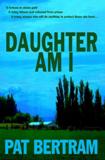
In the beginning of Daughter Am I, twenty-five-year-old Mary Stuart has no real direction, no purpose, but when she learns she inherited a farm from her recently murdered grandparents — grandparents her father claimed had died before she was born — she becomes obsessed with finding out who they were and why someone wanted them dead. She drives halfway across the country with a feisty crew of octogenarians, friends of her grandparents, and even though she discovers they all had ties to the mob, she doesn’t let her good sense override her obsession. This understandable obsession is her flaw (though I did not write her to be a flawed charater), and if she doesn’t grow during the course of the story, if she doesn’t learn from her setbacks, the obsession could become a fatal flaw. Fatal or not, flaw or not, Mary’s obsession makes her real, makes her a bit larger than life, and makes her interesting.

What is the easiest part of the writing process? What is the most difficult?

The easiest aspect of writing for me is editing. The words are all there, it’s just a matter of making sure they are the right ones and that they say what I want them to say. The most rewarding is knowing I wrote a book worth reading. People tell me they really enjoy Daughter Am I, that they “hate saying goodbye to these wonderful characters.”

The most difficult part of writing for me right now is just sitting down and writing. I have no real inclination to write fiction, and I find it hard to focus on a long project. I’m sure the desire will come back, probably when I stop spending so much time on the Internet.

Here are some responses from other authors about the easiest and hardest parts of the writing process. The comments are taken from interviews posted at Pat Bertram Introduces . . .

From an interview with J J Dare, Author of False Positive and False World

The easiest part of the writing process is inspiration. When it’s there, the words flow like a raging river. If the story is in my head and I’ve been tapped by my muse (and she stays with me), I can write a novel in a week.

The hardest part of the writing process is inspiration. When it’s not there, it can’t be faked. Constipated writing can be unbearable.

From an interview with Dale Cozort, Author of “Exchange

For me, the easiest part is writing the rough draft. Once I have characters and a plot outline I can write the rough draft of a novel in four to six weeks and I enjoy doing it. What happens before and after writing the rough draft is far more difficult and time-consuming.

The most difficult part is the last five percent of the editing process, the part that gets you from almost the right words to exactly the right words. For me that takes more time than writing the rough draft.

From an interview with A. F. Stewart, Author of Once Upon a Dark and Eerie

For me, the easiest element of writing is the dialogue. I rarely have a problem with the flow of dialogue. Possibly because I can hear all those character voices whispering in my head.

The most difficult part is writing the middle section of the plot. I’m great at churning out beginnings and endings, but I always have to work at writing the stuff in between.

So, for you, What is the easiest part of the writing process? What is the most difficult?

(If you’d like me to interview you, please check out my author questionnaire http://patbertram.wordpress.com/author-questionnaire/ and follow the instruction.)

Choosing Book Titles

The title of a book is important. It’s the first thing a prospective reader sees . . . or at least it used to be. Now the author’s name generally comes first and apparently is a much better selling tool than the title ever was. A title is still important, however. It often sets the mood for the book, it lays out the theme, and it tantalizes readers into opening the book. Think of Gone With the Wind. With such a title, you expect a wide sweep of a story. The title speaks of loss and perhaps survival in the face of broad changes. Even before you open the book, you are primed to find out what is lost and why it disappeared into the wind. Imagine then, how different your feeling would be if the book had been published under its working title. Pansy. Would the book, the movie, the character have ever had such an impact if that had been the name? Of course not.

Another major work with last minute name changes was Catch 22 by Joseph Heller. Originally Catch 18, it was changed because of another book that was coming out at the same time: Leon Uris’s Mila 18. And 1984 was originally 1948. So not the same feeling!

Choosing a title is not an easy task. My novels all had simple working titles: The Red Death, The Chameleon, The Gangster Book, The Alien Book, but except for The Red Death, none of those titles were ever possible for the real title.

For A Spark of Heavenly Fire, I considered using the title The Red Death since my quarantine mirrored the middle ages, though in a hi-tech way, but the name had already been used several times. And anyway, from the very first, I’d planned on using A Spark of Heavenly Fire. That was my inspiration for the book, the Washington Irving quote: “There is in every true woman’s heart a spark of heavenly fire, which lies dormant in the broad daylight of prosperity; but which kindles up, and beams and blazes in the dark hour of adversity.” I wanted to tell the story of ordinary women, women who seemed colorless in ordinary times, but who blazed brightly in dark times. When I found no takers for the book, I thought perhaps the title didn’t reflect the story, so I changed it to In the Dark Hour. And I got an agent. She couldn’t sell the book, so when my contract was up, I changed the title back to A Spark of Heavenly Fire. And that’s the title Second Wind Publishing released it under.
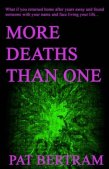
I had to try several times before I got the title of More Deaths Than One right. The working title was The Chameleon but that was never a real contender since I didn’t want to give the story away. So first I used the Law of the Jungle, which amused me since the jungle was so much a part of the story. Also, at one point I had my hero say that the villain might be above the law, but he wasn’t above the law of the jungle. Both the line in the book and the title ended up being deleted because they were too trite, so next I went with Nature of the Beast. It was adequate, and I would have stuck with it despite its triteness, but then I came across a couplet from Oscar Wilde’s “Ballad of Reading Gaol”: He who lives more lives than one/More deaths than one must die. Since my hero appeared to have more lives (and deaths) than one, More Deaths Than One struck me as the perfect title.
Daughter Am I, my gangster book, only had one previous title: Sins of the Fathers, though really it should have been Sins of the Grandfathers. Then I found the Rudyard Kipling quote: “Daughter am I in my mother’s house but mistress in my own.” The quote would have more accurately described the theme of the book if it were “daughter am I in my father’s house,” but I was taken with the title Daughter Am I and decided it was close enough.

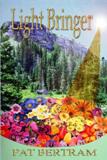
Which brings me to my most recent novel, Light Bringer. Sad to say, I haven’t a single story to tell about the title. Even though the working title was The Alien Book, I always knew the title was Light Bringer. Light is the theme of the book, and the Light Bringer (planet X) was the reason for the story.

So, as a reader, what are your favorite titles? As an author, how did you come up with the names of your books?

What’s your writing schedule like? Do you strive for a certain amount of words each day?

I have no routine. When I do write, it’s usually late at night because all is quiet. I don’t set a daily goal — the words come hard for me, so I’m grateful for whatever words I manage to get on paper. It’s amazing to me that with as sporadically and as slowly as I write, I’ve still managed to complete four and a non-fiction book. I guess it just goes to show what one can do by plugging away. Oddly, considering this is the electronic age, I still prefer to write longhand, though I am gradually doing more writing on the computer

Here are some examples of other author’s writing schedules. The comments are taken from interviews posted at Pat Bertram Introduces . . .

From an interview with Dale Cozort, Author of “Exchange

I usually concentrate on one aspect of writing at a time. If I’m writing I schedule myself to write a thousand to three thousand words per day, depending on what other obligations I have. If I’m editing or marketing that’s usually all I do that day.

A group of people from a workshop I went to last July pledged to write at least two hundred and fifty words per day every day for thirty days. We kept renewing that through the end of December and most of us ended up averaging five hundred to a thousand words per day. The two-hundred and fifty words is a small enough amount that you can do it in twenty minutes to a half hour, so pledging to do that is a good way to avoid procrastination. At the same time, the mindset for editing and marketing are enough different from writing mode that I found myself having to work at making the transition.

From an interview with Polly Iyer, Author of “Hooked”

I write all the time. I try for a certain amount of words when I’m writing a new story, but much of writing is rewriting. That’s when I go hoarse reading aloud to see if the dialogue works or if sentences sound strained.

From an interview with T. C. Isbell, Author of “Southern Cross”

Even though I’m retired, I approach writing like a job. I believe that following an established schedule is the key to finishing a project. I start writing at seven in the morning, right after my wife leaves for work, and work pretty much through the day. I take short breaks, but other than that I’m either researching or writing. I try to add at least one thousand words a day to my manuscript. Some days the juices flow and I put down two thousand words. There are days where I write the same sentence over and over. I stop writing before my wife comes home from work.

From an interview with Malcolm R. Campbell, Author of “Sarabande”

I do everything possible to avoid having a writing schedule, much less a daily word-count goal. The story unfolds as it unfolds. I don’t know what’s going to happen next, much less when my characters or my muse or the universe are going to fill me in on the next scene or chapter. Sitting down to write at a specific time or forcing out a set number or words each day would ruin the flow. This sounds like a lazier approach than it is. Whenever I have a novel in progress, I am rather obsessed with it. It is always on my mind. Basically, I’m much better off when I’m actually writing it than when I’m not writing it.

So, what’s your writing schedule like? Do you strive for a certain amount of words each day?

(If you’d like me to interview you, please check out my author questionnaire http://patbertram.wordpress.com/author-questionnaire/ and follow the instruction.)

All Books Are Not Created Equal

This anything-goes publishing world has been perplexing me for quite some time now, both as an author who is trying to find a place in the wild book frontier of throw-everything-out-there-and-see-what-sticks and as a reader who is trying to find sanity and good-editing and great story-telling among the millions of books being offered for sale.

People think that good books will rise to the top, that such books will automatically find a readership, but that is not always the case. Wonderful books are being overlooked, and dreadful books with no redeeming value are filling millions of Kindles. Shrugging off the conundrum as “survival of the fittest” doesn’t help matters, because in this case, it seems to be matter of devolution, of having to accept typos, poor grammar, ridiculous errors of fact, and an appallingly low standard of literacy. Compounding the problem is that many good writers, who have to watch their books stagnate, no longer see the point in writing, which lowers standards even more.

I used to think this was a matter of a breakdown in the filtering process. If authors have to submit their books to publishers, if they have to go through an editing and copyediting process, then books have a minimum of errors and at least a modicum of good storytelling. Or at least they used to. Even the major publishers are lowering their quality control. If their aim has always been to sell the lowest common denominator, and if those people don’t care about quality, then there is no point in adding to the expense by doing the work. Nowadays, when the fastest selling self-published authors are those with an ever growing stream of books, quantity and not quality are the key.

The real problem as I have come to see is not one of filtering, but of strata. There used to be definite strata when it came to readers. People stuck to their own genres, though even within a genre there were definite layers of quality. Some romance writers, such as Colleen McCullough, rose to iconic status. Others, such as Danielle Steele, were firmly entrenched in the lower middle. And still others churned out myriad books for lowest of the low, Harlequin and Silhouette and the other subscription publishers.

And never, except for perhaps the iconic writers, did anyone consider these books to be great writing. (Most could not even fall under the heading of good writing.) And never did the best writers have to compete or be compared to these writers. Yet that is what is happening today. With Amazon taking hold of the book business and running away with it, demarcations between utter trash and high quality books have completely disappeared. All books are thrown into the slush pile, all are ranked by the same classification system, all are treated equally.

But the truth is, all books are not created equal. Just because a book is uploaded to Amazon, just because it sells, it does not mean the book is worthwhile. A badly written book with no redeeming value is still trash, but few people seem to notice, and fewer seem to care.

***

See also:


How has your background influenced your writing?

I always thought I’d be a writer, so when I was twenty-five, I quit a job to write a book about a love that transcended time and physical bonds, told with sensitivity and great wisdom. Unfortunately, I discovered I had no talent for writing and no wisdom, so I gave up writing.

After I discovered I didn’t know how to write, I did temporary work for several years to gain experience of life. Or at least life as it pertains to work. I worked at hundreds of different companies doing everything from filing to billing to bookkeeping to operating a switchboard to selling cars to being a legal secretary. When I wasn’t working, which was frequently, I read. All those thousands of books seeped into my subconscious, and gave me a feel for storytelling, and so when I took up writing again, I had more of an idea of how to tell a story. I just had to learn the specifics, such as show don’t tell, which I did.

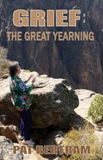
Two years ago, my life mate/soul mate died, and the only way I could handle my overwhelming grief was to pour it out onto pages of a journal, letters to him, and blog posts. When I discovered how much those blog posts meant to people who had also suffered grievous losses, I compiled my writings into a book about my first year of grief called Grief: The Great Yearning, which has recently been published by Second Wind Publishing. And so, quite by accident, I ended up writing the story of a love that transcended time and physical bonds, told with sensitivity and great wisdom. I just never knew that the story I’d always wanted to write would be mine.

Here are some ways their backgrounds influence other authors. The comments are taken from interviews posted at Pat Bertram Introduces . . .

From an interview with Sandra Shwayder Sanchez, Author of “The Nun”

I was a child people called “an old soul” . . . an aunt said I seemed to look right through people and I do remember having insights about what was going on inside the heads of adults and often felt very sorry for them. My mother used to discuss Freudian dream interpretation with me and that fascinated me as well as the mythologies and fairy tales I enjoyed reading. So it was I think inevitable that I would write books in which the world of our dreams and the world of consensual reality interface and merge with almost imperceptible boundaries.

From an interview with Dale Cozort, Author of “Exchange

I grew up in a fair-sized city, but I spent a lot of time with relatives in the country, so I probably write rural life a little more authentically than someone without that experience. I also have a computer background, so there is always a little bit of the techie in my stories. I have to dial that back so it doesn’t get in the way of the story.

From an interview with Sheila Deeth, Author of “Flower Child”

I call myself a mongrel Christian mathematician. I think my mixed-up background helps me (or forces me to) see things from a slightly different perspective. Being an English American does the same thing — it makes me more aware of how many of my assumptions are cultural, so it lets me explore characters who might make different assumptions.

So, how has your background infuenced your writing?

(If you’d like me to interview you, please check out my author questionnaire http://patbertram.wordpress.com/author-questionnaire/ and follow the instruction.)