My Grief Book is One Step Closer to Publication

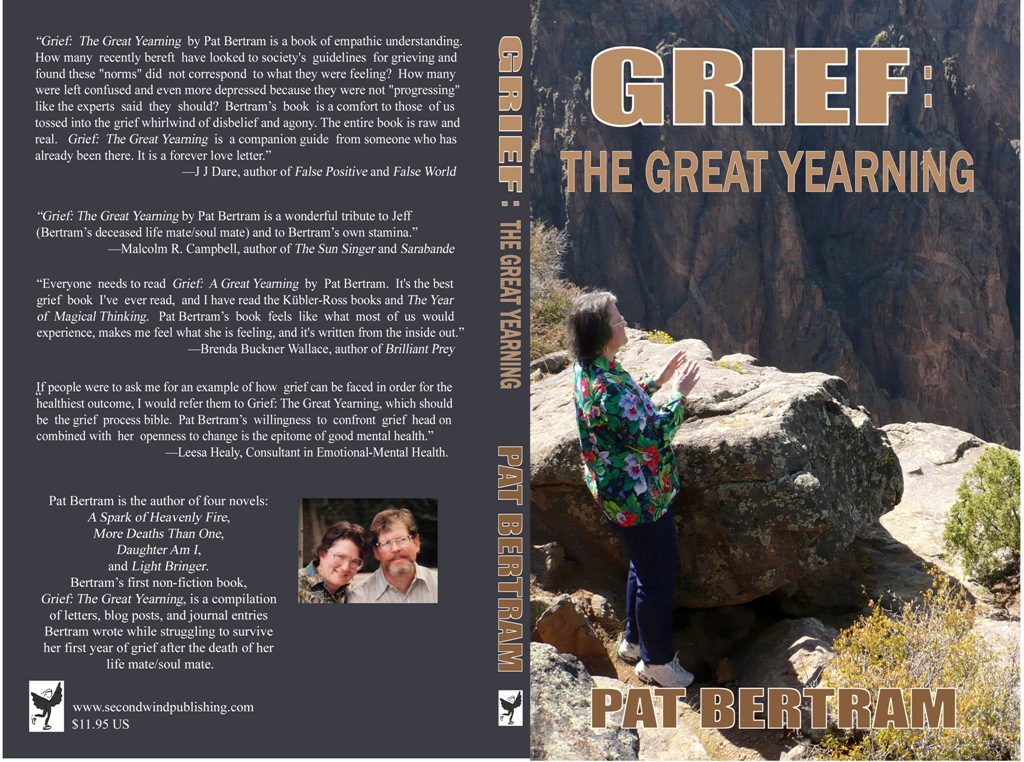
Grief: The Great Yearning is one step closer to publication. Today I received what might be the final copyedits. One of my fellow bereft volunteered to proof the book for me (actually, a mutual friend volunteered him, and he was kind enough to go along with the suggestion), and he turned out to be a phenomenal copyeditor. Found mistakes that all the rest of us missed. We don’t even have the excuse that we couldn’t see the words for the tears, since he had the same problem.

Very few people have managed to get through the book dry-eyed. Even though each person’s grief is different, there are enough similarities that this book speaks to everyone. It’s been called powerful, profound, exquisite, wrenching, raw, real. One woman wrote me, “I really like your book. When my husband died I devoured books about loss of spouse…maybe 30-40. The ones that were most helpful were similar to yours in that they recounted the journey. NONE were as complete as yours and that is what I wanted.”

Some people think the book will be best as a companion to those who are grieving. Some people think it will be best as a book to give their friends and relatives to help their loved ones understand what the bereft is going through. Some people think it should be required reading in classes for would-be therapists. Some people think it should be handed out to everyone whose spouse signs up with hospice so they are not shocked and bewildered when grief hits.

I never set out to write a book about grief. I merely cried out to an unfeeling void, looking for whatever comfort I could, trying to understand what had happened to him and me and our shared life. Apparently all that chaotic feeling ended up on paper, and now those emotions are tidily packed away into a book. Well, packed away until someone opens the book; then emotion explodes out of the binding.

Writing fiction comes hard to me. I have to drag every word out of my depths, but the words in this book came gushing forth. Of course, I was writing for me, not for others, and I didn’t have to create emotion out of nothing. I had emotion to spare.

Perhaps the time is right for this book. Perhaps it won’t mosey along like my novels, but will burn up the atmosphere when it takes off. Perhaps I really did write an important book. What a strange thought.

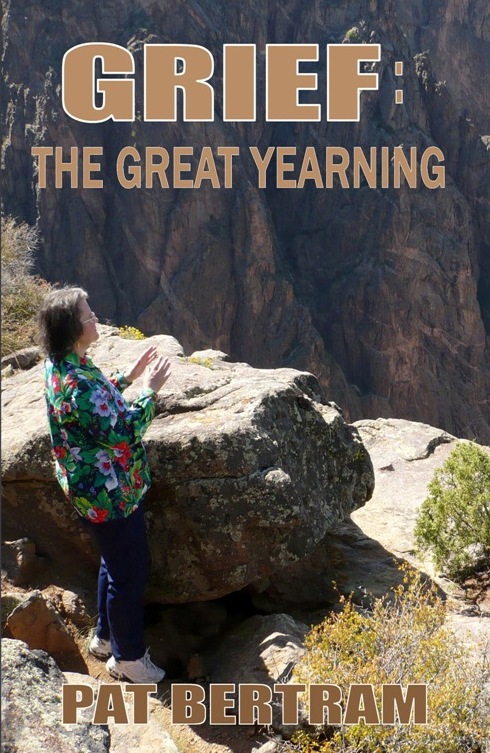
First Look at the Cover for My Grief Book!

It seems odd to be pleased over the imminent release of my grief book, as if I’m trying to capitalize on grief, but the grief is a done deal. That particular sadness is here whether the book gets published or not. I do think it’s something to be pleased about, though. It will be a helpful book, both as a companion for people who are dealing with a grief that few of their family or friends understand, and for people who want to understand what their bereft loved one is going through.  It also seems odd to be a cover girl — That certainly was never one of my ambitions! — but I couldn’t imagine a better photo for the cover than this one of me at the Black Canyon of the Gunnison. It was a completely spontaneous photo. My hands were supposed to be on the rock, but I started turning at the last minute. (Much to the chagrin of my brother who took the photo. He made me do it over, but the do-over wasn’t as evocative as this one.)

Perplexed by the Anything-Goes Publishing World (Part II)

Yesterday I wrote about how this new wild frontier, this stampede to publish and be damned (or not) of the new publishing world and how it could be lowering literacy standards because of the almost blythe acceptance of errors in books. The prevailing attitude is that as long as the writer is satisfied with the book, that’s all that matters. Neither they nor their readers seem to care if their story is derivative, if the editing is slipshod, if typos litter the pages.

To add to the confusion of this anything-goes publishing world, books that do well are seldom the best. Often, these successful books are the result of a very aggressive promotion campaign or the result of luck — by being chosen by Amazon for an aggressive promotion campaign or by hitting the right market at the right time.

It seems as if the world is a poorer place if good books are destined to remain undiscovered simply because the author is a wonderful writer and a mediocre promoter. Since we reward wonderful promoters who are mediocre writers with huge numbers of sales, the whole book business becomes even more skewed than it already is. People think that good books will rise to the top, that such books will automatically find a readership, but that is not always the case. And shrugging off the conundrum as “survival of the fittest” doesn’t help matters.

Some people think readers are screaming for quality, that readers are lost in the stampede, but when you consider the vast number of sales made by a few mediocre but bestselling traditionally published authors, most people are not screaming for quality. They are screaming for . . . comfort, perhaps. Predictability. A community of like-minded readers.

To make the situation even more complicated, publishers are not taking responsibility for marketing the books they publish. They want their authors to do that.

I recently read an article by a publisher who said that a publisher’s role was simply to prepare a book for market and to make it available. That’s it. Learning how to promote, navigating the insanely competitive book market, marketing one’s book, paying for book tours and conferences — all of that is the responsibility of the author. So then why does an author need a publisher at all? With Create Space, Lulu, Smashwords, and now Goodreads getting into the epublishing business, authors can prepare their own books for market. And what they can’t do, they can hire done, and keep all the profits. And authors by the millions are doing that very thing.

Maybe the problem I’m having coming to terms with this new wild frontier stems from a life-long respect for books, a sense that books are somehow sacred. Maybe it’s time for me to give up that old-fashioned attitude and treat books like any other temporary reading commodity, such as a blog post or a cereal box.

Perplexed by the Anything-Goes Publishing World (Part I)

In a recent discussion on Facebook, someone mentioned the case of a self-published story that was being offered for sale on Amazon. A woman posted a review, stating her opinion that the work was far from ready for publishing, and she gave the writer several examples of how to improve, but the writer took these comments as insults. What ensued was a protracted argument between the writer and the reviewer.

The Facebooker who brought this exchange to our attention asked who was right and who was wrong. I thought the reviewer brought up some excellent points, gave wonderful suggestions for redoing the story without getting disrespectful about it. (And the reviewer could have gotten nasty. The story really was atrocious.)

I can’t imagine arguing with a reviewer as the author did, though. A couple of times I have privately asked a reviewer to remove a spoiler that gave away the ending (and the reviewers graciously complied) but the writer in this case had a terribly unprofessional and arrogant attitude. She more or less said she could publish whatever she wanted, it didn’t have to be perfect, and too bad if people didn’t like it. Unfortunately, there are millions like her, which leaves me continually perplexed by the entire book business today.

The major publishers have had control of publishing standards for way too long. I certainly have no love for conglomerates or corporate thinking, so I don’t object to a lessening of their control. On the other hand, many writers now think they don’t need any standards at all. They say they can write whatever they wish, however they wish. The prevailing attitude is that as long as the writer is satisfied with the book, that’s all that matters. They don’t care if their story is derivative, if the editing is slipshod, if typos litter the pages.

Some of these writers even manage to sell a significant number of copies of their books.

Self-published writers seem to be a militant lot, demanding the same respect as authors whose books are published by a traditional or an independent press, yet self-published authors adhere to no one’s standards but their own, while a book that was accepted by and released by a publishing company has had to live up to at least the publisher’s standards. But some self-published writers do adhere to a high standard of literacy while some bestsellers released by the major publishers have an appallingly low standard of literacy.

Does any of this matter? With texting and twittering, leaving out letters of words to shorten them or using number for letters is standard. (AFAIK, u cn rd this. Me 2. LOL) Eek. Whole novels have been written in such shorthand.

Do kids today learn grammar in school? Do they need to know grammar? With spell check and grammar check on their computers, probably not. So, if books today have grammar mistakes, punctuation mistakes, typos, do most people even notice? Those of us who have spent a lifetime reading do notice, but do we count? We value language, but is language important? Language is an evolving organism, so perhaps those of us who quail at poorly written and poorly copy written books are running a race that has already been lost. A new generation grows into adulthood every year along with a new generation of electronic toys and tools and together they spawn a new generation of idioms. A new language.

I don’t know why this new anything-goes publishing world perplexes me. Most writers seem thrilled with the new order of doing book business. They don’t have to take the time to research the business, finding out which agents will accept their genre and which publishers they can submit to without an agent. They don’t have to learn how to write query letters or learn how to write a description and a hook. They don’t need to learn to deal with rejection. And especially, they don’t need to learn how to improve their work to make it as near perfect as possible. They simply decide to publish. That’s all it takes.

And most readers seem thrilled to find myriad books to download to their new ereaders.

So perhaps it’s just me who worries about a lessening of standards. Perhaps this new frontier, this stampede to publish and be damned (or not) is what everyone else wants. It’s certainly not the first time in my life the world didn’t act in accord with what I thought was the right direction for it to take, and it certainly won’t be the last.

See also: Perplexed by the Anything-Goes Publishing World (Part II)

Book Bits #114 – Kudos to Beauty & the Book, Roald Dahl stamps, William Gibson, Queen Elizabeth

Three reasons to read Malcolm R. Campbell‘s Book Bits #114

1. It’s the best compendium of book information orbiting the blogosphere

2. It has a link to my Pat Bertram Introduces blog where I interview Benjamin Cheah, an author from Singapore

3. It has a link to the incomparable Beth Hill’s latest article for her The Editor’s Blog.

Book Bits #114 – Kudos to Beauty & the Book, Roald Dahl stamps, William Gibson, Queen Elizabeth.

(If you would like to do an interview for my Pat Bertram Introduces blog, you can find the questions and instructions by clicking here: Pat Bertram Introduces . . . )

Are You Playing The Kindle Game?

People keep saying that Kindle, even more than other reading devices, has revitalized the book industry, making books affordable and reading more accessible. They say the market is expanding, that people who never read are now interested in books. But is this true? Are they interested in reading, or are they interested in playing the Kindle game, downloading books as fast as possible to fill their new toy?

One reason people always gave for not reading is that they don’t have time. Do people suddenly have huge extra blocks of time to read, to get into a book, to explore new ways of thinking and experience new ways of being? I think not. It seems that reading is now part of the multi-tasking generation, where you read while doing something else. Is this reading? People say that reading is not a solitary activity any more, that new enhanced reading apps make it social. If so, is this really reading?

The other half of the Kindle game is the author game, where selling as many books as possible, is all that matters. Whether people actually read the book is immaterial. Of course, the major publishers started this game a long time ago, this game of sales records, and now it’s been taken to the people where anyone can play. But that doesn’t mean the books being sold then or now are worth reading.

When I mentioned in a comment to a fellow blogger that Amazon was a major publisher, she corrected me and said it was a sales platform, like using WordPress. It’s a perfect analogy, and it explains an unusual phenomenon — my rapidly increasing blog rating. It always used to hang around 3,500,000 on Alexa.com, but suddenly, for no reason I could see (my readership is growing, but not enough to explain a leap in rankings), my blog began increasing in rank, and now it’s at 929,990 (out of 346 million sites). Are blogs disappearing (or falling off the scale) because people are now uploading things for Kindle that they once posted on their blogs? If so, then books are being devalued to the level of a bloggerie.

Makes me wonder if I’ll ever take up writing again.

But for now, if you are playing the Kindle game, all my books are available both in print and in ebook format. You can get them online at Second Wind Publishing, Amazon, B&N and Smashwords. Smashwords is great! The books are available in all ebook formats, including palm reading devices, and you can download the first 20-30% free.

This is the third post where I’ve been mulling over the current state of the book business. The other two are: Is the Book Business Dying? and First the Bread Wars, Now the Book Wars.

First the Bread Wars, Now the Book Wars

Before a certain well-known bread was manufactured, people bought their bread fresh every day from a local bakery. When bread was first mass-produced and packaged in a colorful wrapping, people were hesitant to buy because they didn’t believe it could be fresh since it hadn’t been baked that very morning. So, what did the bread manufacturer do? They had people drive up and down the streets handing out loaves of their bread to everyone they saw. Who could pass up a free loaf of bread? Not many people, that’s for sure. One free loaf wouldn’t have made an impact. That brand of bread would have become just one choice among many. But . . . the company kept giving away the bread, day after day after day. Soon people began to expect free bread. They stopped buying bread from their local bakers, and eventually, those bakers went out of business. The manufactured bread became the only choice in town, a price was attached, and the price went up and up and up. And people had no idea this coup d’état had taken place or that they had been pawns in a major cultural revolution.

That story might sound like a fairy tale, but it happened. And it’s happening again, though this time it’s about books. There is a war going on between Amazon and the major publishers to determine the course of the book business, and we are all pawns. People laugh at the entrenched publishers, saying they don’t have a clue where the book business is going, but the truth is, they do know, and they are fighting back. It’s a war of price — what to charge readers to buy an ebook (most people who own kindles seem to believe they paid their price of admission by buying the kindle and that anything they download should be free or pretty close to it). And it’s a war of literary value. Dinner and a movie costs a small fortune now, and the pleasure is fleeting. The movie is forgotten, but even before that, the food becomes waste. Why should a book, especially a thoughtful, well-written book be valued less than human waste?

Make no mistake about it. Books are being devalued at this very minute. People think they are in the vanguard of a fight for the people’s right to write and publish whatever they wish without having to kowtow to the old publshing standards. But who are they working for? Amazon. With all the free books people are uploading onto Amazon, Amazon doesn’t even have to manufacture a product like the bread company did. People are standing in line, begging to give them product, hoping to be one of the chosen few who makes a mint selling books. And Amazon is playing them like a violin, choosing certain books to promote, showing everyone that yes, it is possible. But only if you give Amazon the keys to your literary kingdom.

Perhaps people do have the right to write and publish whatever they like, good or bad. The major publishers certainly didn’t do a good job of it, shoving crap down our throats and expecting us to like it, but once upon a time, there were standards. Sure, some good books were rejected out of hand, but others were published, polished, promoted. It was a golden age of reading, but it came to an end because of corporate greed and the first devaluation of books. Bottom line became important, quality was slashed, books were chosen not so much on merit but what a person standing in a grocery story line would be apt to throw in their cart. People didn’t seem to care since there were so many other entertainment choices vying for their spare change.

So now, books are being devalued even more. Amazon is spewing out bestsellers as fast as the major book publishers are. It sounds nice, doesn’t it: let readers decide what they want to read. But it doesn’t happen that way. Readers are inundated with constant demands to “buy my book!” Dross is being over-promoted at both ends of the spectrum — the traditionally published books and the self-published kindle books. The books that come to the general reader’s attention are those the various book publishing companies choose to push (and make no mistake about it — Amazon is a publisher in a major way), and the books that the relentless and shameful marketers are bringing to your attention. Of course there are good books at both ends of the spectrum. But the vast majority are books that any discerning reader couldn’t stomach.
There is a third player in this war, though so far they seem to be standing by, bewildered by the onslaught. These are the small, independent, royalty paying publishing companies who follow the traditional publishing model to the extent that they accept submissions but choose to publish only the best.

People assume I am a kindle author because I am so visible in various places on the internet, but I am not. My books were chosen out of a slushpile, and were accepted by Second Wind Publishing. It would be nice if, after the gunsmoke clears away, that we few, we chosen few, are still left standing.
Is the Book Business Dying?

Is the preponderance of self-published books killing the book business? I’ve been reading articles about how Amazon is promoting self-published ebooks — a few people have been picked by Amazon arbitrarily, and Amazon promoted these books constantly for a week and made them best-sellers. I’ve seen a couple of these best-selling self-published ebooks, and they are so poorly written, I can’t see why anyone would buy them, but since people do buy them, it must mean readers don’t care about good writing or good story-telling. I’ve also seen books go viral for absolutely no reason I can fathom. (And often, the writer has no clue, either.) Most often, these books go viral only on Amazon, with no bleed-over into other ebook formats, which means Amazon has an amazing control of the book business.

There seems to be a movement going on to erode the traditional means of determining a worthwhile book, with vast numbers of people saying book standards are dead and they can write however they choose, without regard to grammar or story-writing skills. Which apparently is true, since such books find a market. (And often, these books get 5-star reviews, which says more about the reviewer than the book.) There is also a growing militancy among self-publishers. If you say anything against the practice, there is a huge backlash of disapproval.

I’m not saying all self-published books are poor quality — some are well written and well-edited and deserve their acclaim. Nor am I saying that traditionally published books are good quality — most are not worth reading. But with books on both ends of the spectrum selling millions of copies, is there any place for those with well written, unique, and perhaps thoughtful books who aren’t self-published and who don’t have a major publisher behind them to push the books? Or have the people spoken and said they have no use for such books?

When books are so prevalent, especially when vast numbers of readers seem to have no ability to determine what is worthwhile, books become devalued. Albert Nock, in the 1930s, disagreed with universal literacy. He contended that when everyone can read, books will be written to appeal to the least common denominator, and there is no doubt that during the subsequent decades, books were published based on their ability to appeal to the most readers possible. If there is any truth that book quality declined with universal literacy, wouldn’t it be even more true if there is universal publishing?

Historically, whenever one product or category of products dominated the market, it presaged the end of that product. If you are old enough, you remember when the streets were clogged with VW Beetles, and now you seldom see one. Is the preponderance of books on the market today the beginning of the end?

Letter to Book Reviewers

Dear Book Reviewers:

I love your enthusiasm for my books, I appreciate your support, and I’m especially thankful you took the time out of your busy day to review the books and post the reviews, but . . . must you give away so much of the plot? A review is not a synopsis and readers do not need you to reveal every major plot point of the book. And they especially do not need (or want) you to tell them how it ends. What people want is a reason to read the book, and if you tell them too much, you have taken away any reason for them to read it, in which case you have done us all a disservice. And I am sure that was never your intention.

I don’t mean to sound harsh or ungrateful, but I spend a lot of time mapping my books, slowly revealing the truth, each new revelation dependant on the one that comes before, so that by the end of the book, people end up believing (at least for the moment) that the story is true. If surprises are revealed out of sequence, it breaks the chain of evidence. So not only will readers know what to expect, they will be robbed of the unique experience of believing something foreign to their everyday lives.

As a general rule, if you must, you can mention things that happen in the first fourth of the book, and for sure you can hint at what will happen in later chapters without mentioning specific events, but anything beyond that is a spoiler and should be noted at the beginning of the review. (For example: “This review contains spoilers.”) Those who don’t like surprises will continue reading your review. Those who do like surprises can choose not to read it.

Recently I’ve asked a couple of you to remove spoilers from your reviews, and you kindly and graciously agreed, and for that, I thank you. Others of you refused to change a word, saying you stand by what you said. I did not ask you to change your opinion. I merely asked you to remove the spoilers, which did not merit the abusive reply.

For those of you who don’t like my books, that’s fine, but please don’t write a dismissive review based on what the books are not. My books are not romances, (though all contain a romance of sorts) so do not expect them to follow the genre conventions for romance novels. My books are not apocalyptic, so do not expect them to follow the conventions for such stories. If you need a tag for the novels, call them thrillers, call them suspense, call them conspiracy novels, or you can call them “typical Bertram.”

As Malcolm Campbell said of Light Bringer, it is “typical Bertram: plots within plots, multiple characters with multiple agendas, fast moving, more than enough mystery and intrigue for everyone.”

Respectfully,

Pat Bertram
author of Light BringerMore Deaths Than One, A Spark of Heavenly Fireand Daughter Am I. All are available for Kindle on Amazon.

All the Elements of “Daughter Am I” Meld into a Life-like Drama

I don’t often get fan mail, so when I do get a personal message, it really perks me up. And when I get a message like the following, it makes my day:

Hi Pat –

I have a confession to make, and this has nothing to do with the fact that you plan to read my book. No ulterior motives.

Normally I avoid buying/reading books by friends online because 80% of the time (a conservative figure) I find myself stuck with a real clunker, then feel frustrated as to what to “report” when the “writer” friend wants my opinion. I don’t like being dishonest but, you know how it is. Underwhelmed is one thing, but having to read a bumbling, disjointed, retch-worthy error-filled story resembling an eighth grader’s essay makes me nuts. So I tend to run the other way.

Discounting my modesty about my writing side, I will freely admit to being a terrific reader. No reason for shyness or modesty there. I know what I like and can tell the difference between the work of a hack and a real talent. Pat — you have talent.

I’m not sure why I broke my own “rule” when I bought Daughter Am I yesterday — but the book hasn’t disappointed me. It’s a great story. The characters are believable, identifiable, purposeful, & entertaining. The scene description is just enough — not undercooked or burnt to a crisp. And the plot moves, holds attention & makes the reader (me) anxious for more. You certainly understand how to make all elements of a story meld into a life-like drama. There you have it — my unsolicited opinion. I’m really impressed with Daughter Am I and thought I’d say so.

Have a great day.

These words brought tears to my eyes. That someone liked my book so much they felt compelled to write me was an unexpected and most gracious Christmas present.

Quite coincidentally, I am being interviewed on my publisher’s blog today about this very book. If you’d like to know more about the novel and its cast of entertaining characters, please click here: Interview With Pat Bertram, Author of “Daughter Am I”

All my books are available both in print and in ebook format, perfect for holiday gift giving. You can get them online at Second Wind Publishing, Amazon, B&N and Smashwords. Smashwords is great! The books are available in all ebook formats, including palm reading devices, and you can download the first 20-30% free!