Keeping It Real in a Fabricated World

Ian O’Neill, the one-time advertising copywriter turned award winning freelance journalist, is the author of Endo, a mystery/suspense novel set in Ontario, Canada. Ian has written for newspaper, magazine, radio, television and once wrote a dirty limerick on a dusty car but didn’t sign it. Ian writes:

Writing a fiction novel can be oxymoronic since we fill the fabricated story with facts. In my novel, Endo, I made up a detective, his life, the world around him, but added facts to keep the reader grounded. I used real towns and cities but fabricated the buildings and addresses he visited. I created numerous characters but gave them real jobs: park rangers, crime scene investigators, a coroner and most of all, police officers.

I didn’t kill anyone but I did research what happens after a body is discovered. In storytelling there needs to be a mix of truth amongst lies. It’s a delicate balance that keeps the reader walking a fine line between what is real and what isn’t. As writers, we must suspend our reader’s disbelief. To do that, we need to understand how far is too far. Sometimes we miss the mark and readers are more than pleased to point out the error of our good intentions.

I’m not the first writer to bend the truth to benefit his story and I know that all of the writers reading this piece will do the same. But, I caution you on just how far you’ll go to make a story plausible because too far means the reader will not believe. Even in genres where you’d think anything is acceptable, you still have to maintain the parameters that you set out in the story. So, in chapter two you introduce a woman who can read minds; any mind, anywhere, as long as the person she’s trying to read is in her sight. Then, chapter 29 rolls around and she is miraculously able to read the mind of a killer in a basement apartment in Arkansas when she’s in California. But it made the story plausible, right?

Our focus here is on crime and mystery novels and I’m not going to spend a lot of time on formula; suffice to say most mystery novels begin with a crime.

The usual suspects: murder, kidnapping, bank robbing, theft of some kind. Regardless of the crime you choose, it must be believable. If it begins with an outlandish crime then it’s your job to talk the reader into believing it could happen.

Writers have the best job in the world. We get to make stuff up for a living. We create the crime, make it seem implausible or difficult for anyone to accomplish. We throw in obstacle after obstacle in hopes of stopping our heroes from getting to a solution. We muddy the waters with all kinds of distractions including love, lust and greed to name a few. In all of that, our reader must never stop suspending their disbelief. It sounds like a very tall order and that’s because it is.

Cops and detectives are different in all parts of the world, each operating under a different set of rules and guidelines. It would be best to find out specific rules and laws in the country or area of the detectives, cops or P.I.s in your story. For the purposes of this article, let’s have our hero be a cop from the States.

A policeman being first to arrive at a crime scene acts in similar ways to a detective in the same situation. Their eyes are wide open to the possibility that the perpetrator is still at the scene. Once they check the scene and realize they are alone, what do they have at their disposal to take in the scene. Well, at first, as I said, their keen senses but eventually they’ll use what every person in law enforcement carries, a pad and pencil.

Mundane, yes, but a necessary tool not only for the cop in question, but also for the writer. Balance is key. It offers reality at a time when you’ve introduced a fake crime. Besides, the pen or pencil could be a weapon, right?

Detectives often draw out the scene as accurately as possible. Sound familiar? I’m not sure how many of the writers reading this article do this, but I draw out my main characters’ homes’ floor plans. Or, the floor plans to any buildings that appear frequently in the novel. Just as I can check back to ensure my accuracy and not test my memory, your detective can do the same.

The scene is secured. By that, the detective or policeman will ensure that no one enters the scene thereby contaminating evidence. Anyone already at the scene, including the first on the scene, will not smoke or use the sink or toilet. No one will touch anything at the scene. This is as real as it gets considering Locard’s exchange principle. Dr. Edmond Locard, considered to be the father of modern forensics, in 1910 opened the first forensics lab in Lyon, France. He postulated that a criminal would leave behind evidence and take evidence from the scene, therefore an exchange would occur. Today we call it trace evidence.

Can shit be traced?

When writing always remember that you must keep your reader’s belief suspended. It will impact every word you put on the page. I watched a show about real cops on a case and all were huddled around a door while a crime scene analyst (yeah, a CSA), took a shoe impression from a door. One of the lead detectives looked into the camera and with sarcasm dripping from every word said, “And now we’ll just enter this into the shoe database.”

This very scenario is believable if handled correctly. Remember, too, that readers want to believe. If a person’s stomach contents can tell investigators what the victim ate, they have a good chance of using that information in many ways. They can use it as a timeline or trace them to a location. This happens and is believable. A victim’s fecal-matter can be traced but you have to ask yourself if a reader wants to follow along with that lead?

I wrote a scene and posted it to my online writing group. It was in a courtroom during impact statements – when the victim’s loved ones, family and friends convey to the court how they have been effected by what the convicted person has done. These are usually part of a murder trial and my story was no different. I painted a picture of the courtroom and how, after one man had told the killer he would rot in hell and be damned forever for what he’d done, people applauded and cheered. One of my critics refused to believe this could happen. I never explained to them that I’d seen it happen a number of times in documentaries that followed murder cases to their conclusion. It wouldn’t have mattered. They had a right to not believe this situation. There is always a chance that some reader will no longer suspend their disbelief based on their own morals and sensibilities.

Situations are difficult to predict amongst readers, but using existing investigation tools and better, the personnel who perform them, will cement a reader’s belief. And, there are a lot of different experts one can draw on to balance out fiction with facts. Crime Scene Analysts are responsible for photographing a crime scene as well as recovering evidence and processing latent fingerprints. Document Examiners work mostly in a lab to examine documents and document-related evidence which includes handwriting, printing and signatures. There’s also a Firearms/Tool Mark Examiner who is responsible for performing scientific analysis on firearms and tool mark evidence. One of the least known jobs of this expert is to examine and compare footwear and tire tread evidence.

There are an abundance of individuals responsible for tracking and taking down criminals: Evidence Custodians, Criminalists, Photo Technicians, Lab Technicians and probably one of the most recognizable, Latent Fingerprint Examiner. Job descriptions are available on the internet for these positions or in several excellent books on forensics and criminology.

While crafting your mystery referring to these facts will enable you to suspend your reader’s disbelief – what could be the biggest fact about fiction.

One lucky commenter, chosen at random from Ian’s two guest posts, will receive a copy of Endo, which will arrive in an evidence bag with a toe tag, five fingerprint card strips and a few ‘crime scene tape‘ bandages.

Also see:
Never Be Afraid to Ask by Ian O’Neill
The Magic of Mysteries: The Art (and Joy) of Misdirection

add to del.icio.us : Add to Blinkslist : add to furl : Digg it : Stumble It! : add to simpy : seed the vine : : : TailRank : post to facebook

Is Anyone Really Writing the Great American Novel?

I still come across characters in books who want to write The Great American Novel, though in real life (or as real as it gets online) I don’t see people saying that. Has the desire to write The Great American Novel been superseded by the desire to write the next million-dollar bestseller? And is either goal realistic for most of us, or even worth pursuing?

Frankly, when I started writing this bloggery, I didn’t even know what The Great American Novel is, so I went trolling the Internet (so much more fun than actually sitting here writing!) to see what I could see. (Ah, the adventure of it all!)

(I don’t know why blogging brings out my desire to use parentheses — I seldom use them in my other writing, but there it is.)

Anyway, from what I gather, The Great American Novel shows the impact of American culture on the characters, shows the spirit of life in the United States at the time of publication, and is supposed to be a counterpart to the great English writers. Nothing in that definition precludes the novel being a bestseller, but it’s generally assumed that The Great American Novel is a literary novel rather than a commercial one. If the novel needs to show the spirit of life in the U.S. at the time of publication, then that means it needs to show today’s culture. Do we have a culture any more? I sure hate to think that fast food restaurants and blockbuster movies and and bestselling pap — books and music — are the only things that define us culturally. Though they certainly have had an impact on all our lives.

And why The Great American Novel? Why not the Great International Novel? The Great One-World Government Novel? The Great Earth Novel? Aren’t we supposed to be moving out of a parochial viewpoint into a global one? Either way, I am not writing an American novel, great or otherwise, even though my novels are set in Colorado. Perhaps Light Bringer, which will be published later this year can be considered a The Great Earth Novel since it strives to tell the history of humankind in a unique way. (Some people call it science fiction. Could be, I don’t know — I just told the story.)

What about you? Do you have any desire to write The Great American Novel? The Great Canadian Novel? The Great Global Novel? The next million-dollar bestseller?

add to del.icio.us : Add to Blinkslist : add to furl : Digg it : Stumble It! : add to simpy : seed the vine : : : TailRank : post to facebook

I Received an Invitation to be a Speaker at a Writer’s Conference!

My fame is spreading! Well,  maybe it’s not my fame that’s spreading, maybe it’s just my name. Or perhaps they are the same? Yikes, writing like that would never get into one of my novels. Inadvertant rhymes? That won’t do! Still, the sentiment is true. Someone, somewhere has heard of me, because yesterday I received an invitation to be a speaker at a writer’s conference!

Scribblers’ Retreat Writers’ Conference would like to cordially invite Pat
Bertram to be a guest speaker for one of our four conferences in 2010. We
have ten speakers for each conference and four conferences annually.

Scribblers’ Retreat Writers’ Conference is an international, non-profit,
literary arts organization dedicated to bringing together “those who have
made it” to “those who want to”. By creating the most innovative,
educational, and dynamic symposiums composed of the literary elite, we offer
those attending a unique opportunity to learn from and socialize with the
people they admire. This is a way to impart your talents to the global
community; to make a difference.

The conferences are held on beautiful St. Simons Island, Georgia. You will
be able to take advantage of the tranquil atmosphere provided by live oaks
and beaches, the history and art, ghost and dolphin tours, or even climb the
old light house.

Please look at your calendar to see which dates would be more preferable and
browse our website below. Join us in this grand endeavor in literacy and in
fulfilling dreams of success.

To talk about writing in a gorgeous place? Sounds like a dream. I have to choose a single topic, though. Hmmm. Which should it be: Style and technique? Networking? Writing support groups and blogs? I’ll get back to you — and them — about that.

add to del.icio.us : Add to Blinkslist : add to furl : Digg it : Stumble It! : add to simpy : seed the vine : : : TailRank : post to facebook

Creatures of the Corn

When he entered the cornfield and saw the stalks closing in over his head, his heart beat faster and icy beads of sweat chilled his brow. He wiped his clammy hands on his pants and forced himself to relax.

He looked around. A wide path cut through the corn, and the tall stalks afforded some protection from the incessant wind.

He stopped short. What was that?

He listened, but did not hear anything out of the ordinary.

Man, you’ve got yourself spooked. Get your head straight!

As he hurried to catch up to Pippi, he heard the noise once more.

Was something shuffling through the corn?

He stopped.

Listened.

Heard only the wind rustling the dry corn stalks.

He started walking again. Straining his ears, he thought he could hear the sound of footsteps, not in sync with his but a fraction of a second later, like an echo.

Maybe it was an echo? It couldn’t be. He barely made any noise.

He moved faster; so did the furtive footsteps.

Pippi stopped and waited for him. “Did you hear something?” she asked. “I thought I heard footsteps.”

“Me too.”

She shivered. “It’s like The Children of the Corn.”

He heard a metallic thunk. A rifle being cocked?

Without warning, Pippi took off running.

He hesitated a moment, then he trotted after her.

 *    *   *

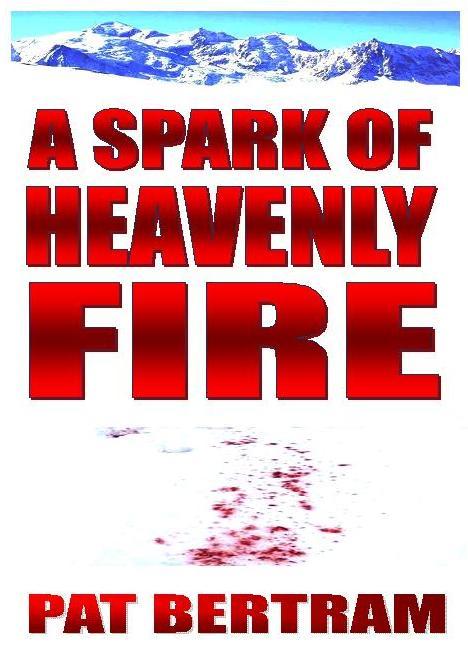
That is a scene from my novel A Spark of Heavenly Fire. I’ve been wondering if the characters’ fear was a bit over the top, because it is only a cornfield after all. But now I know I didn’t go far enough.

This year a cornfield has been planted across the lane from where I live, and the corn is tall and dense and very, very spooky. Yes, corn does rustle. And yes there are strange noises. And yes, creatures of all kinds live in the corn. Or at least visit it. I’ve seen deer come charging out of the corn and cross the lane in front of me. I’ve seen birds, cats, skunks. And, most astonishing of all, a fox. Never seen a fox before, but there it was, slinking out of a row of stalks. It started crossing the lane in front of me, stopped, stared at me, then streaked back into the corn. Within a second it had disappeared.

Just to show you how dense the cornfield is, here is a photo of me standing three feet inside the stalks. (I’m in the far left row. You can see the shadow of my head in the bottom left hand corner of the picture.) When I realized how impossible it would be for you to see me, I considered taking another photo. Then I remembered: Startled deer. Foxes. And who knows — maybe even another me.

100_1304c

add to del.icio.us : Add to Blinkslist : add to furl : Digg it : Stumble It! : add to simpy : seed the vine : : : TailRank : post to facebook

A Shocking (And Embarrassing) Reality

I received my second royalty check yesterday and was shocked (and a bit embarrassed) by how few books I had sold online in the past couple of months. I’ve been a big advocate of online promotion, and I’ve had a great time connecting with people on Facebook, Gather, Twitter, Goodreads, this blog, and other sites. Apparently, however, while I’ve been making friends, I haven’t been making sales. I realize the economy is bad, that people are spending money for vacations and back to school clothes, that many people are without work, but that can’t be the total answer since 30% of each of my books is available as a free download on Smashwords. And people aren’t downloading them.

I’ve been saying all along that I’m missing a piece of the on-line promotion puzzle, and this just proves that I am right. To be honest, I still don’t know what that missing piece is. I get dozens of emails from authors telling me about their books, giving a synopsis and a plea to buy. I won’t follow their example. Such emails might work — people are kind and often will follow through — but I find them intrusive. And annoying. So annoying that I don’t even bother to read them. Since I won’t do unto others what I won’t let them do unto me, emailing people is out.

I know many authors who continually speak and write of their books, cramming them down our gullets until we want to scream. We can’t scream, of course, because that book is gagging us. That’s why you never hear a protest against this sort of tactic.

I could do what other authors are doing — give up on promotion to concentrate on writing another book that might be “the one.” The problem with this (for me, anyway) is that I already have two more books that will soon be published. Daughter Am I (sort of a gangsterish book with my own twist on the bootlegger story) will be published in August, and Light Bringer (sort of a science fiction, alternate history, retelling of human history novel, with my own twist on the past), will be published in November.

I can see one problem — I can’t write an elevator speech! After all this time, I still don’t know how to describe my books in a single sentence. Nor have I figured out my genre. One reader emailed me (yes, I do read and respond happily to emails from people who aren’t trying to sell me something unless it is one of those endlessly forwarded messages that no one ever reads). She commented: I now see what you mean about an unnamed genre. Kind of a big picture conspiracy, behind the scenes machinations and how that affects the little guy (or gal) on the street. (Thank you, Wanda!)

So, what’s the answer? I promise, when I figure it out, I will let you know. By November, I hope. Light Bringer is my magnum opus (of the four people who have read it, two called it brilliant; the other two merely said it was wonderful), but how magnum can an opus be if no one reads it?

Meantime, my fame, such as it is, is spreading. In the past few days, I found my name in four different blog posts and links to my blogs in a couple of surprising places:

Murder in the Wind — I won! Thank you! By Sheila Deeth

I blog, you blog, we all blog — Why? By Claire Collins

To Kindle or Not to Kindle by Norm Brown

Interview with Alan Baxter on Smashwords

Bookselling Links on the New Atlantic Independent Booksellers Association website

Yahoo Answers

It’s a good beginning.

add to del.icio.us : Add to Blinkslist : add to furl : Digg it : Stumble It! : add to simpy : seed the vine : : : TailRank : post to facebook

Wringing the Ings From Our Things

I know you’re getting sick of hearing how much I hate copyediting, but it’s only my work I hate copyediting. I truly get a thrill out of reading a soon-to-be-published book that one day thousands of people might love. In addition, I get to mark up the manuscript. My suggestions probably won’t make any difference to the success of the work, but they might help keep future readers anchored in the story. It seems that nowadays most readers are also writers, and while we may be a forgiving lot, inconsistencies, word echoes, and improper phraseology easily jerk us out of the fictive dream.

One of the most common problems I’m finding is wrongly used participial phrases that end in ing. According to The Elements of Style by Strunk and White, a participial phrase at the beginning of a sentence must refer to the grammatical subject.

The example in the book is: Walking down the road, he saw a woman accompanied by two children. Who is walking? He is, of course, since he is the subject of the sentence, and the ing phrase always refers to the subject. If the woman is walking, you have to rephrase the sentence: He saw a woman, accompanied by two children, walking down the road. You, I’m sure, would never have to worry about who is walking because you’d never use such an ambiguous sentence in the first place!

The other examples of wrong phrases Strunk and White give are humorous and show why it’s important to follow the rule:

Being in dilapidated condition, I was able to buy the house cheap.
Wondering irresolutely what to do next, the clock struck twelve.
As a mother of five, with another on the way, the ironing board was always up.

In case you don’t know how to rephrase the above sentences, here are my quick efforts:

Because of the dilapidated condition of the house, I was able to buy the place cheap.
As I wondered what to do next, the clock struck twelve.
A mother of five, with another on the way, I was never able to put the ironing board away.

Another ing problem comes from simultaneous actions, when an author has a character do something that’s physically impossible. For example: Pulling out of the driveway, he drove down the street. He cannot be pulling out of the driveway at the same time he’s driving down the street. He pulled out of the driveway, then drove down the street.

I know you know all this, but such sentence structures do slip into our writing. It’s up to us to wring them out of our work.

add to del.icio.us : Add to Blinkslist : add to furl : Digg it : Stumble It! : add to simpy : seed the vine : : : TailRank : post to facebook

Sex SCENE not SEX Scene

One problem new writers have when they approach a sex scene is that they think of it as a SEX scene rather than a sex SCENE. Any effective scene — sex or not – serves multiple purposes. This is especially true of a sex scene, otherwise it will seem unconnected to the story, as if you just threw sex in the mix because you felt it was time to titillate your readers.

One good use of a sex scene is to show character. One of my favorite scenes in my novel A Spark of Heavenly Fire is when Jeremy King, a world famous actor, sleeps with a woman he just met in a bar.

The sound of weeping woke Jeremy. He turned his head toward his companion and saw one trembling shoulder and a tangle of gleaming hair.

He stretched luxuriously. The red hair hadn’t lied. The girl had been all fire, kindling a passion in him he hadn’t felt in years. The memory of it made him hard.

He reached over and pulled the girl into his arms. He smoothed back her hair and kissed away her tears, murmuring, “Honey,” and “Sweetheart,” and “Dear.”

“I’m such a terrible person,” she said, sobbing.

“Shh. Shh,” he whispered between tiny kisses.

Her arms stole around his neck, and her lips sought his. In a surprisingly short time she bucked beneath him, calling out his name.

You’ve still got it, King, he thought exultantly. Then, after one final thrust, he tumbled into oblivion.

I always liked that scene. It’s not very graphic, but it did what I wanted it to — define the characters

Another good use of a scene is to show the ebb and flow of human connection. For example, you could have three scenes spread throughout the story. In the first scene, perhaps, the man climaxes, feeling connected to the woman. When he immediately goes to sleep, she feels disconnected. In the second scene, perhaps he can’t get it up, leaving him feeling disconnected, but since he tries to make it up to her by cuddling her, she feels connected. In the third scene, they climax together, perhaps cuddle afterward, so they both feel connected.

In addition to the sex, then, you show a pattern of connection and disconnection between the couple (in other words, conflict), you show a whole new perspective of the characters, and you show a change in their relationship. You also end up with a subplot that adds to the overall richness of the story. In other words, you end up with a series of sex SCENES, not just SEX scenes.

add to del.icio.us : Add to Blinkslist : add to furl : Digg it : Stumble It! : add to simpy : seed the vine : : : TailRank : post to facebook

Pat Bertram and Malcolm R. Campbell Discuss the Writer’s Journey

Malcolm: I’ve always liked the concept of life as a journey in which each of us walks as a seeker and/or a hero on a winding route to places we don’t yet know or understand. So, I appreciate the invitation to stop by your blog and talk about the writer’s journey.

Bertram: The mythic journey concept has infinite possibilities, both as a story structure and a metaphor for one’s life as an author. Do you make use of the mythic journey structure in your writing?

Malcolm: There are mythic qualities in THE SUN SINGER (2004) which is based on the hero’s path or the mythic journey as you call it. Ditto for the as-yet unpublished GARDEN OF HEAVEN. The upcoming JOCK STEWART AND THE MISSING SEA OF FIRE is unrelated to the others and is sort of a mystery/humor novel about a newspaper reporter.

Bertram: I like your image of writers as seekers walking a winding route to places we don’t yet know or understand. I often mention how hard writing is for me, but that’s because I don’t know how to write the books I want to write. I have to learn how to write each one separately as I’m writing them, and each takes me on a different journey.

Malcolm: My long-time mantra comes from author and teacher Richard M. Eastman’s book Style: Writing as the Discovery of Outlook (3rd edition, 1984):

“You don’t begin to write with a complete message or experience already imagined, which is then to be wrapped in language as a means of sending it to your readers. Writing isn’t so much communication as creation. In a real sense, you don’t have an outlook on anything without first having written on it. This outlook comes into being through the dozens of tests, choices, and unexpected chances which turn up as you write on some engaging topic; and most writers agree that the final creation isn’t anything you could have precisely anticipated when you first set pen to paper.”

Bertram: That makes sense. For me, blogging especially is a way of discovering my outlook on whatever it is that I’m writing about.

Malcolm: This has been true for me whether I was writing a national register application, applying for a grant, writing a feature article or working on my novels, The Sun Singer (2004) or Jock Stewart and the Missing Sea of Fire (coming soon). In each case, I began with a body of knowledge and an opinion that were very different by the time I finished writing.

In terms of subject matter, do you find this to be true with your novels? I’m guessing that regardless of what you knew about pandemics, your understanding of them and their potential impact was much different after you wrote A Spark of Heavenly Fire than it was when you were first thinking about writing the novel.

Bertram: My research into pandemics was actually quite extensive, and so was my research into the government’s response to such an emergency (I based my fictional response on actual executive orders that Clinton signed), so there wasn’t much difference in my understanding during the course of the book, but there was a big difference in my thoughts about what they want us to know and what they don’t. When I learned about Pingfan, the Japanese biological warfare installation where they did horrendous experiments on POW’s and nearby villagers, I thought I’d stumbled onto something really explosive. Yet, as happened to a character in A Spark of Heavenly Fire, the very next novel I picked up used Pingfan as a setting. It got me to thinking about the nature of cover-ups, and many of the discussions in the last half of the book took place while I was writing the book.

Malcolm: We often hear that the writer’s journey has an inner and outer aspect. I see the outer aspect plot as it unfolds with a variety of characters, locations, and challenges. You chose Denver and pandemics for A Spark of Heavenly Fire and I chose the Montana Rockies of an alternate universe for The Sun Singer. Thinking of stories based on the hero’s path schema, from Star Wars to The Matrix to Harry Potter, and Lord of the Rings, the emotional, psychological changes and spiritual growth of the protagonist are viewed as more central and important than his thoughts, words and deeds. In mythic terms, the hero undergoes a transformation by undergoing the trials and tribulations of the outer journey. Robert Adams undergoes a transformation in The Sun Singer just as Jock Stewart is changed by the events in Sea of Fire. Do you feel this way about Kate Cummings and Greg Pullman?

Bertram: All the characters in A Spark of Heavenly Fire undergo transformation, especially the women. I always liked Washington Irving’s quote, and wrote the book using it as the theme: “There is in every true woman’s heart, a spark of heavenly fire, which lies dormant in the broad daylight of prosperity, but which kindles up and beams and blazes in the dark hour of adversity.”

Malcolm: In my life, the deepest part of the writer’s journey comes from how the writing changes me. The Sun Singer and the darker, as-yet unpublished Garden of Heaven were each written over a twenty-year period because, other than the plot and theme the reader sees, these novels dealt with integral issues within my own life. I had a lot to work out!

Bertram: I’m beginning to see that what I write is what I happen to be living. My first four books explored the theme of public lies and hidden truths because that’s what I was studying at the time. My current work supposedly explores the theme of safety vs. freedom, but it’s really about change, and there is a lot of change in my life right now.

You have a book that’s going to be published this summer. You once mentioned that you wrote it differently from the first two.

Malcolm: In Jock Stewart and the Missing Sea of Fire, I opened the floodgates and let the words flow. I wrote quickly and it felt like play because I had turned my wisecracking alter ego loose with no chains or boundaries. When I finished writing and editing the material in less than two months, I felt the good kind of tired one feels after an afternoon at a carnival or a day at the beach. This was energizing because, well, I was still capable of play and the benefits of play. Do you feel this “play value” from certain chapters of your novels or from your short stories?

Bertram: I start out playing with ideas and characters, and then when I start writing and trying to make all the pieces come together, I lose that feeling of play. One of the things I am looking for on my journey as a writer is more playfulness. I don’t know if you can you choose where you want to go on the journey, or if the journey takes you where it wishes, but I would like to experience what you did — opening the floodgates and letting the story flow.

Malcolm: I’m curious about your novel in progress.

Bertram: So am I! For a long time I had no real idea what I was writing — I thought I was writing a whimsically ironic apocalyptic fantasy — then all of a sudden one day it dawned on me I’m writing another story of a mythic journey. As my hero tries to find his place in a world that changes by the minute — cities becoming prairie, oceans appearing out of nowhere — he follows the hero’s path, and becomes transformed.

My third book, which is going to be published in a couple of months, was my first mythical journey story. It’s about a young woman who discovers that her grandparents were recently murdered which came as a shock to her because her father claimed they had died before she was born. She goes on a journey to discover who her grandparents were, why someone wanted them dead, and why her father lied to her. I purposely used the mythic template for the book (wanted an excuse to use it, actually), though her mentors and allies aren’t the typical alien or fantasy characters such as wizards, but are aged gangsters and conmen.

Malcolm: My father’s brother was murdered in Fort Collins before I was born. The case was never solved. From time to time, I wonder what happened. Time and distance are part of the challenge of finding details. It would be a journey to dig into it as your character will do in Daughter Am I. I love the concept of going back to figure out the real story.

Bertram: I do, too. All of my books follow the same underlying story: who are we, really? And how do our experiences change us? Which brings me to another question I want to discuss: does a person write a book or does the book write a person?

Malcolm: Your question reminds me of the difference between a layperson’s view of a complex and a Jungian analyst’s view of a complex. People sometimes admit that they have one complex or another. Jungians see it the other way around, saying that the complex has you.

Perhaps the relationship between author and book is the same for many authors, with the book holding a much greater sway over the author’s life than s/he–and especially his readers–may believe. At best, it’s like a marriage, author and book, and the better the book is, the better that marriage has been.

Bertram: That makes sense. I am at a crossroads in my writing life. I’ve used up the theme that haunted me for many years — public lies and hidden truths. Because of my stories, I seem to have come to an accommodation with the reality, and so I no longer have any desire to write about such things. So now I’m waiting for some other . . . passion, perhaps. Or a transformation. Because it does seem as if writing transforms us.

Malcolm: People often talk about defining moments, good and bad. Afterwards, they see themselves and the world differently. Plunging into the deep waters of a work of fiction in progress is also a defining moment. Writers experience what their characters experience whether it’s the horrors of Pingfan or the joy of my protagonist in The Sun Singer when he reaches the summit of a mountain of visions. We polish these scenes until the horror and the joy are shown to the reader in ways that cause the greatest impact. Doing this, I think, changes a writer just as much as a “real life” experience.

Bertram: In The Writers Journey, Christopher Vogler talks about writing as a perilous journey to probe the depths of our souls, and that the struggles we undergo to write, to sell our work, to deal with rejection seem to kill us, but we are resurrected to write again. And to go on another journey. Best of luck with your next journey, Malcolm.

Malcolm: This has been fun, Pat. Of course, I’m not the same person here at the end of the post that I was when we started. But that’s what it’s like being on the path.

See Also:
The Writer’s Journey
Celebrating Five Years of The Sun Singer

add to del.icio.us : Add to Blinkslist : add to furl : Digg it : Stumble It! : add to simpy : seed the vine : : : TailRank : post to facebook

The Writer’s Journey

Malcolm R. Campbell, my guest today, worked as a college journalism instructor, corporate communications director, technical writer and grant writer before publishing The Sun Singer in 2004.  Malcolm says:

Writers’ journeys are filled with highs, lows and limbos, and down at the what’s-my-next-word level the path often looks like a mess. Joseph Campbell suggested that our lives often appear disorganized when viewed close up. Yet when the point of view is pulled back far enough, the route from here to there and back again stands out as perfect and well orchestrated. 

I wrote my fantasy adventure novel “The Sun Singer” in 1983 because there was a story inside my head that I thought I ought to tell. A young man suddenly becomes psychic when he visits a bronze statue of Apollo. At first, it’s fun. Then he sees a tragedy and his gift is immediately tarnished and he tries to ignore it until he ends up in a mysterious alternative universe in the western mountains. He needs the gift to survive and to complete a mission his avatar grandfather couldn’t complete. 

When I found an agent who liked the novel, that was definitely a “high.” While she thought literary fiction with a teenaged protagonist would be a challenge to market, she liked the story and settings and wanted to try Within a month, I withdrew the novel when she told me one of her other clients books suddenly became a bestseller. That meant my novel would sit on her shelf for potentially a year before she could actively work with it. This was definitely a “low.” 

The low got lower when the manuscript was rejected by about 100 publishers, many of whom liked the book but said that nobody could successfully sell a literary novel to teens or a teenager’s story to adults. This was pre-Harry Potter! They wouldn’t touch the book unless I added ten years to the character’s life. This began a 20-year period of limbo when “The Sun Singer” sat at the bottom of the sock drawer forgotten until I self-published it in 2004. 

The agent did me a favor. She saw the novel in a pre-PC era. The book was a paper manuscript typed with an electric typewriter. When I took it out of the sock drawer in 2004, I had to scan it into a file with an OCR program. What a mess. In the process, I fine-tuned the book a great deal. It became a much better story. 

I suspect most writers can tell similar stories. Manuscripts that look hot, then look cold. Stories buried in the back of a file cabinet that suddenly come to life years later. 

My upcoming novel, “Jock Stewart and the Missing Sea of Fire” is quite a different story. I had been trying to market a companion book to “The Sun Singer” for over a year when a publisher told me that in today’s market, no publisher was going to take a risk on a 240,000-word, push-the-envelope literary novel by an unknown. 

Intended or not, I heard a challenge in those words: do something to become known. That meant putting another manuscript in the sock drawer and writing a much shorter book for a mainstream audience. I wrote the first draft straight through without stopping. The story seemed to tell itself because it was sitting right under my nose. My alter ego “Jock Stewart,” a hard-boiled 1940s-style reporter, had been running a blog called Morning Satirical News with exactly the style and focus I needed. 

After taking 20 years to publish “The Sun Singer” and 10 years to write the companion book, writing a book without all the angst of creation was a very empowering experience. It represented a jog in my writer’s journey that I had never foreseen. I’m still rather stunned by what’s happened. I have a feeling, though, that one day I’ll stand back and see everything from another perspective and feel that what happened had to happen as though the trail was always clearly marked on an old map I’d forgotten about.

See Also:
Pat Bertram and Malcolm R. Campbell Discuss the Writer’s Journey
Celebrating Five Years of The Sun Singer

add to del.icio.us : Add to Blinkslist : add to furl : Digg it : Stumble It! : add to simpy : seed the vine : : : TailRank : post to facebook

Where Do We Go From Here?

I’m sure it won’t come as any surprise to those of you who follow my blog and my comments, but I am at a crossroads in my life. I’ve spent most of the past eight years learning to write, writing my four novels, studying the publishing industry, sending out query letters, dealing with hundreds of rejections, finally finding a publisher, preparing the books for publication, and then waiting for their release. Two of my novels have already been published and the other two will be published later this year — Daughter Am I in August and Light Bringer in November. Daughter Am I is in the proof stage right now, and I am doing the final edits of Light Bringer. (Have I mentioned how much I hate doing that? It’s the one phase of writing that I truly abhor — de-wasing the manuscript, getting rid of the justs and onlys, the ups and downs, and all the other extraneous words that only serve to dilute the story.)

Eventually though, the books will be put to rest — in readers’ hands, I hope. And then what? The overall theme for these four books has been public lies and hidden truths, but Light Bringer pulls it all together and kills the need to write any more on the topic. I do have another book in the works, which is about half finished. I thought I was writing a book about freedom vs. security, but it turns out that I write what I live, and so the book is really about change. Lots of changes. Perhaps the reason I haven’t been able to work on that particular manuscript is that I need to first rethink my journey as a writer and decide where to go from here.

Which brings me to tonight’s discussion. One thing I am rethinking is this group. Members come and go, though a few people have participated in most of the discussions. Considering the few participants recently, I’ve been wondering if I should disband the group, but the fact is, I still enjoy it. So, even if I end up monologuing, I will continue. But . . . should I restructure to make it more user friendly? Set it up at another time? Perhaps 7:30 to 8:30 pm ET? Change the focus of the discussions? We’ve talked about many different aspects of writing, but perhaps there are topics that you would like to discuss that we haven’t touched on. Perhaps you would like to post bits of writing for critiquing? (Though I have to tell you that I can’t really participate in such discussions — I no longer feel that I have the right to give my opinion about other people’s writing since I don’t follow the rules myself.) Also, I have become a bit self-conscious about asking people to host. It seems to be a bit of an imposition, especially since there are so few regulars. So do I continue doing that? Or do I post the discussions myself until someone volunteers?

Besides talking about where this group should go from here, let’s also talk about where we each will go from here. I know I’m not the only one at a crossroads. Some of you are getting published, others are doing the final revisions on their books or beginning the querying process. Still others are setting up new websites with a look to the future. Maybe together we can figure out the next step.

On Thursday, June 11, 2009 at 9:00 pm ET, the group No Whine, Just Champagne will discuss where we go from here, both as a group and as individuals. I hope you can make it. I’m interested in what you have to say. Everyone  is welcome to participate, and I hope you will!

Click here to join the live discussion: Where Do We Go From Here? If you prefer, you can leave your comments here on the blog. I would like to know where you are going.  

add to del.icio.us : Add to Blinkslist : add to furl : Digg it : Stumble It! : add to simpy : seed the vine : : : TailRank : post to facebook