De-Creating a Sea Beast

Today I created a marvelous sea beast. It had the body of a crocodile and a knobby round head with flat features perched atop a long neck. It moved with the speed of a snake strike, and its breath smelled of wildflowers. It was supposed leap out of the water to try to ravage my hero. What would save the poor guy was the beast’s inability to gain purchase on the pebbly beach.

Today I also de-created the beast. The problem? It was a duplication of effect. Two pages before the beast’s emergence, I had a similar scene involving a tiger attack, and as the saying goes: when it comes to writing, one plus one equals zero.

It’s hard to move an episodic story forward. How many times can one guy manage to survive dangerous situations in a hostile new world without it beginning to seem contrived? But if he isn’t beset by multiple problems, why would he ever let himself be maneuvered into entering a human zoo? Duplication of effect would take away the immediacy of his problem, making it seem more humdrum and less of a conundrum.

No wonder each book I write takes longer to write than the last. I don’t like to follow in my own footsteps, so I always choose stories (or they choose me) that I don’t know how to write. Not only do I have to write the book, I have to teach myself how to write it. But that’s my own conundrum: Writing that which I don’t know how to write.

At least I had fun creating my leviathan. And perhaps someday I will be able re-create him, if later in not in this book, maybe in the next.

You’ve Written “The End.” Now What?

Sherilyn Winrose, author of Safe Harbor, talks about her novel:

It’s been written, you’ve come to the conculsion of your story. Joy, Elation! Congratulations you’ve finished a full length novel. Many dream, many aspire, and you’ve completed the goal: to write “The End.”

When I was writing my first manuscript (ms) I had my best friend (the one person in the world who would tell me if it was crap) beta reading as I went. In as much I did clean up editing along the way. Little did I know how far from the finish line I was; probably a good thing in retrospect.

I bought books on how to query and be published. Very quickly I discovered I was a guppy swimming with sharks. One needs an agent to find a publisher. Agents like to take on authors who have an interested publisher. Huh? I need an agent to get a publisher, and to get an agent I need a publisher?

Confused, I set about sending queries and writing my next book.

What I didn’t know?

I had a first draft, not a finished piece. Reject letters came in and I kept writing.

Fast forward to a contest. I got out my ms and started to read in hopes of polishing it into a winning submission. Gasp! I wrote that? It’s littered with infomation dumps, saidisms, head hopping.. good gracious no wonder all I got were reject letters.

Time for the first real rewrite/edit. Good news? I still love my characters and the stories I’ve written. Bad news? As I learn and grow as a writer I find myself back in the orginal mss looking to clean them up.

The journey from “The End” to Published is a long road.  I made it, and stand as a testiment that hard work and perseverance does indeed pay off.

Sherilyn’s debut novel, Safe Harbor, is available through Second Wind Publishing.

On Writing: Finding Your Style

Most books on writing I’ve read talk about developing a syle, but recently I came across the remark that “style happens.” If style is simply the way you write, how does it come about? In my case, I don’t try for a specific style, such as gritty or sentimental, flamboyant or minimal, sassy or grim or lyrical. Whatever style I have does not even come when I write, but when I edit. In paring away all the excess, I end up with a matter-of-fact style (or so I’ve been told).

I recently entered a contest to rewrite the first 263 words of The DaVinci Code. Dan Brown has a melodramatic style, one that sublimates good writing for effect. (For example, it is a physical impossibility to freeze and turn one’s head at the same time.) In editing his words, I changed the style, but not the basic meaning of the piece.

Here are Brown’s words:

Renowned curator Jacques Saunière staggered through the vaulted archway of the museum’s Grand Gallery. He lunged for the nearest painting he could see, a Carravagio. Grabbing the gilded frame, the seventy-three-year-old man heaved the masterpiece toward himself until it tore from the wall and Saunière collapsed backward in a heap beneath the canvas.

As he anticipated, a thundering iron gate fell nearby, barricading the entrance to the suite. The parquet floor shook. Far off, an alarm began to ring.

The curator lay a moment, gasping for breath, taking stock. I am still alive. He crawled out from under the canvas and scanned the cavernous space for someplace to hide.

A voice spoke, chillingly close. “Do not move.”

On his hands and knees, the curator froze, turning his head slowly.

Only fifteen feet away, outside the sealed gate, the mountainous silhouette of his attacker stared through the iron bars. He was broad and tall, with ghost-pale skin and thinning white hair. His irises were pink with dark red pupils. The albino drew a pistol from his coat and aimed the long silencer through the bars, directly at the curator. “You should not have run.” His accent was not easy to place. “Now tell me where it is.”

“I told you already,” the curator stammered, kneeling defenseless on the floor of the gallery. “I have no idea what you are talking about!”

“You are lying.” The man stared at him, perfectly immobile except for the glint in his ghostly eyes. “You and your brethren possess something that is not yours.”

Here is my edit:

Jaques Sauniere staggered through the vaulted archway of the Louvre’s Grand Gallery, lunged for the Carravagio, and tore it from the wall. He collapsed under the weight.

Fifteen feet away, an iron gate dropped with a thud, barricading the entrance of the suite.

Sauniere lay still, struggling to breathe. The sacrifice of the Carravagio gave him a moment’s safety. But he needed to hide.

He inched from beneath the canvas.

“Do not move.”

He froze. That accented voice was unmistakable. How did the albino find him so quickly?

“Where is it?” the albino demanded.

Sauniere turned toward the hulk on the other side of the gate. His gaze shifted from the silenced pistol in the man’s huge hand to the pink eyes with the dark red pupils. “I don’t know what you’re talking about.”

“You and your brethren are in possession of something that does not belong to you. I want it.”

Writing Discussion With Cliff Burns — Part III

When I asked Cliff Burns, author of So Dark the Night, if he’d like to guest host my blog, he responded that he’d rather have a discussion. I was thrilled. I enjoy talking about writing, but even more than that, I love learning how other writers approach the craft. This is the third and final part of the discussion.

BERTRAM: National Novel Writing Month is coming up, and its adherents are a heated bunch — they don’t seem to like anyone questioning the process. You’re one of the few I’ve come across who speak out against it. 

BURNS: I know people have really taken me to task for lambasting NaNoWriMo and its adherents. To me, the concept is a stupid one — write a novel in a month, give me a break! It devalues the professionalism of the vocation, the enormous amount of time and energy authors put into learning and developing their craft. Anyone can claim to be an “author” or “artist” — the arts seem to condone this sort of thing. I suppose I’m an elitist and a snob. It took me ten years of daily writing and scores of credits before I was able to call myself a writer without feeling self-conscious and phony. As I wrote in a recent post: you’re not a plumber if you unclog a toilet and you’re not an electrician if you screw in a light bulb. Each of those trades requires training, a lengthy apprenticeship period. Why should the arts be any different? 

BERTRAM: I can’t even imagine what it would take to write a novel in a month. The writing of a novel takes me a year, and some of the research I’ve done has taken more than that. But then, I am not an intuitive writer. I have to drag each word out of hiding and find its place in the puzzle that is a novel. I suppose two types could write 50,000 words in a month — the intuitive writers who spew out words, and the logical writers who have the whole thing outlined before they begin. Me? I fall somewhere in the middle. I so hate tossing aside my hard work that I habitually rework my writing as I write. (Though I have rewritten one of my novels four times, and deleted 25,000 words from another..)

BURNS: My first drafts come out in a huge gout of words — I try to get it all down as quickly as I can.   I think I wrote the first draft of one of my novels in 45 days. But . . . then I spend the next eighteen months (or more) revising, editing, polishing, going over each syllable with painstaking care. I outline a little bit, scribble down character names, some ideas for certain scenes, but that first draft usually becomes the outline I work from. It’s incredibly labour-intensive but the only method that works for me.. I would say only a few words or phrases survive from my first draft by the time I’m finished. It’s only a roadmap, nothing more. And I never grow attached to a character or scene — “everything in service to the story”, that’s my motto. All else is expendable.

BERTRAM:  I was going to ask if you push for a daily word count, but you mostly answered that. So how about: do you write at the same time and in the same place and in the same manner (computer, pen/paper) everyday?

BURNS: My office is right across from our bedroom so it’s the first place I visit in the morning. Moving things around on my desk, gearing up for the day. I play lots of music to get warmed up, start the juices flowing. Commence work when my family leaves for school or work, break for lunch, maybe tea later in the day, popping downstairs when my family returns. We have supper together and then often it’s back to the office to square things away, tie off loose ends and set things up for the morrow.

BURNS: First drafts are almost always handwritten (even my 450+ page novel So Dark the Night) and then tapped into my ancient Mac computer with fingers swollen and aching from arthritis or nerve damage.  Twenty-five years or more of three or four-fingered typing has taken its toll. How does that compare to you? I hope you’re a lot saner in your work habits than I am. You strike me as a pretty levelheaded individual . . . or am I wrong?

BERTRAM: You’re not wrong, but when it comes to writing, I’m not so much level-headed as undriven. Each of the words has to be dragged out of me, an act of will. And sometimes the words are not there. But I don’t sweat it; I edit, I blog, I promote. And when the words come, I’m ready. I also write handwrite my first drafts — I think one reason for the crap published today is that authors lack the brain/finger/pencil/paper flow. I read once that the only place other than the brain where gray matter is found is on the fingertips. May or may not be true. But it feels true.

BERTRAM: When does a writer become an author? I used to think it was when a writer got published, but now that anyone can get published, it’s not much of a criterion. Nor does a writer become an author when they can make a living at it; good writers seldom can. The hacks usually do.

BURNS: A writer writes. That’s it. Every single day. Publication credits are meaningless (especially today) and critical acclaim doesn’t amount to a hill of beans. Sales figures? Well, Dan Brown sold millions, as did Stephanie Meyer and, in my view, their work is sub-literate.  he way you can tell is read it out loud. Just one page, any page will do. If you’re not crying with laughter after a couple of paragraphs, it’s time to get a funny bone transplant.

BURNS: Aspiring authors: apply yourself to the task of writing with discipline and courage and perseverance. I love the quote from Nabokov about “writing in defiance of all the world’s muteness”. Not just scribbling the same thing, working to the same formula but trying to stretch your talent as far as it will go . . .. and beyond. Working outside your comfort zone, writing prose that scares and intimidates you. But it’s the daily practice that, to me, reveals those who are serious and distinguishes them from the wannabes I loathe.

BERTRAM: is possible to become an author people will read even without the “help” of corporate publishing?
 
BURNS: I self-published my first book back in 1990 — it sold out its print run in less than 5 months and earned praise from various reviewers, as well as Governor-General Award-winning writer Timothy Findley. I started my blog, “Beautiful Desolation” 18 months ago and since then I have ceased submitting work to other venues — my work (including 2 novels) now goes directly to my blog and I’ve never been happier. Corporate publishing is dying, the profit margins aren’t big enough and soon the Big Boys will be dumping their publishing arms. The new technologies allow writers to have access to readers around the world–I only wish this stuff had been around ten years ago, it would have saved me a lot of frustration and fury. Kindle? E-books? POD? Why not? Anything that allows the writer to get a bigger slice of the pie is all right with me…
 
BERTRAM: How did you promote your self-published book in 1990? What would you do differently today?
 

BURNS: That was my book Sex & Other Acts of the Imagination and a lot has changed since then. For one thing there are far fewer independent bookstore and those were the folks who sold the lion’s share of Sex. I took copies with me everywhere I went–Saskatoon, Regina, Edmonton, Vancouver, Toronto–approached every indie bookstore I could and sold them (usually on consignment). The vast majority of those book stores are gone now, sad to say. Sex cost $3000 to publish, my second collection, The Reality Machine, cost $6000 in 1997. Nowadays print-on-demand might save me some money–that’s something I’m looking into, likely using Lulu.com. Can’t quote you any price for that (as yet) but I’ll be using my blog and the vast reach of the internet to spread the word..

BERTRAM: Is there one website more than another that brings you readers? Any suggestions for authors just starting to promote?

BURNS: Hmmm . . . well, I try to reach out to sites that discuss writing and publishing and I have a RedRoom authors page. I comment on a lot of blogs, replying to posts that amuse or annoy me for one reason or another. My blog, Beautiful Desolation, is my primary promotional venue, to tell the truth. I’m also on LibraryThing, a place where bibliophiles can hang out and chat. They don’t encourage “blog-pimping” (a term I loathe, by the way), which is ridiculous because often I’ve written a lengthy post on “Beautiful Desolation” regarding a point under discussion. So I refer people to the post anyway and slap down anyone who dares accuse me of self-promotion.

BERTRAM: Thank you for taking the time to talk with me.

BURNS: Interesting the similarities and differences in our approaches and processes, our views toward the life and business of writing. Thanks for the discussion, it helped me better define and synthesize my thoughts.

Writing Discussion With Cliff Burns — Part I

Writing Discussion With Cliff Burns — Part II

Writing Discussion with Cliff Burns — Part II

When I asked Cliff Burns, author of So Dark the Night, if he’d like to guest host my blog, he responded that he’d rather have a discussion. I was thrilled. I enjoy talking about writing, but even more than that, I love learning how other writers approach the craft. This is the second part of our discussion.

BERTRAM: How do you see the “indie world.” Is there hope for independent authors? By that I mean, is there a chance for independent authors ever to make a living at writing?

BURNS: The technologies are still evolving. Obviously, the two major concerns for indie writers is a) preserving and protecting copyright so someone doesn’t rip off your ideas without credit and/or compensation and b) getting paid for your efforts. 

BURNS: Right now, I have two full-length novels on my site and a good number of short stories — all available for free download and reading. There’s a “Donation” button for those who wish to voluntarily leave a small stipend but admittedly few people have taken me up on the offer. But money has never really been the object to me — it’s more presenting my work without editorial interference. Soon I’ll be moving into the world of podcasting and POD printing and hopefully that will spread the word . . . and earn a bit more money. We’ll see.

BERTRAM: Is the book publishing business as we know it coming to an end? How will that effect the “indie world”?

BURNS: The era of corporate book publishing is coming to an end. Media giants swallowed up various publishers in the 1990’s, hoping to milk them for as much profit as they could. Unfortunately, business models don’t work that well with publishing; book-lovers are notoriously eccentric and eclectic in their tastes and it’s hard to predict or graph or pie chart a bestseller. J.K. Rowling came out of nowhere. Profits are not nearly as high, stable or predictable enough in publishing, which is why I think many of the Big Boys will be dumping their publishing arms in the next 3-5 years. And, as I’ve written, this is the best thing that could happen for readers and writers. Smaller, more intimate and committed publishers will supplant the media giants and better books will be released as a result. Lower advances but maybe larger royalties (though writers will have to stay on their toes and make sure the people keeping the books are honest with actual sales figures) . . .

BERTRAM: Did you happen to see the New York Magazine article about the book business not living happily ever after?

BURNS: The New York Magazine article was brilliant, I printed it to have around. Confirms my view that the corporates are on the verge of dumping publishing from their portfolio . . . and also my opinion that most editors and agents are idiots. Some of the money they throw around for the worst sort of crap infuriates me. And meanwhile, their midlist authors (the most interesting of the lot) get no promo, no notice . . . and so they’re dumped from the roster for under-achieving (a classic case of a self-fulfilling prophecy).

BERTRAM: I wonder if the insistence the major publishers have in slotting all novels into niches was one of the things that’s leading to their downfall. It used to be that most books did not fall into the genre category except for, obviously, the different genres. There used to be the genres, which were just a step up from pulp fiction, and at the other end of the spectrum was literary fiction. I liked the books that fell in between — books with readable styles that could not easily be categorized. What I like to read or write cannot be considered literature, but I do prefer fiction that isn’t quite as trivial as that which is on the market today.

BURNS: I’m with you, I like fiction that crosses all sorts of boundaries and defies easy categorization. But, unfortunately, (back to the corporate model), editors and agents like fiction that can be easily slotted. Someone who writes “in the tradition of . . .”. In other words, derivative stuff. Yet another Dan Brown or Stephen King knock-off. Is it the chicken or the egg? Do we blame readers for being undemanding, reading the same old crap over and over again or do we point the finger at editors and agents for not challenging readers? Or both? The corporate model of publishing does trivialize and does not encourage innovation of any kind.

BERTRAM: I guess what I’m really wondering is if people are still reading. I wonder if there are far more writers than readers, thanks to the self-publishing industry. Two of my novels are being released by Second Wind Publishing, a new independent doesn’t yet distribute to bookstores, but I don’t necessarily see that as a bad thing. With independent bookstores disappearing all over the world, it only matters what is available on-line. People keep pointing out to me that less than fifteen percent of books are sold on-line, but if the vast majority of books that are sold off-line are the grocery-store books by best-selling authors, does it matter?

BURNS: My colleague Alexandra Kitty (she runs an alt.news site) insists that people are reading as much, if not more than ever, they’re just doing so on-line (and free!), rather than shelling out money for books. The free culture of the internet creates a mindset of “why should I pay for something when I can get it for nothing on-line?”. And that pertains to newspapers, music piracy and, increasingly, publishing. I used to be on the local library board and I recall figures that indicated people were checking out more books, our numbers went up year by year. Could the expense of buying books have something to do with that?  Hardcovers are getting close to that fifty buck threshold and even paperbacks are pricey items (especially up here in Canada).

BERTRAM: It seems to me that this is one of the best times to try to peddle a book because of all the online resources, such as blogging and discussion forums. It also seems as if this is one of the worst times because of the hundreds of thousands of writers looking for readers. I’m hoping that someone like me who is willing to do the work to promote can reap the rewards.

CLIFF: Yes, everyone can claim to be a writer these days and the new technologies allow people to publish their crap, regardless of the quality of their work. How do we separate the wheat from the chaff? I chose to publish on-line, I chose the “indie” life because I detest the notion of anyone having control or input re: my writing. Some folks who don’t like me would say I’m doing it my way because I’m not good enough for traditional publishing. I say the quality of the work wins out in the end and I’m willing to let readers decide if my work is worth reading. But the surfeit of bad writing on-line drags down the professional status and quality of craftsmanship of those of us who struggle mightily to compose good work. I implore potential readers to use their critical thinking skills and don’t lump us all together.

Writing Discussion with Cliff Burns — Part I

Writing Discussion with Cliff Burns — Part III

Writing Discussion With Cliff Burns — Part I

When I asked Cliff Burns, author of So Dark the Night, if he’d like to guest host my blog, he responded that he’d rather have a discussion. I was thrilled. I enjoy talking about writing, but even more than that, I love learning how other writers approach the craft.

BERTRAM: For me, writing is like the world’s longest crossword puzzle, one that takes a year to complete. I like playing with words, finding their rhythm, and getting them to behave the way I want. I like being able to take those words and create ideas, characters, and emotions. What is writing like for you?

BURNS: I think your analogy is very good. Each story or novel is a puzzle, as you say, an enigma, a conundrum, a locked door mystery that demands great intelligence and ingenuity to solve. Finding the exact right combination of words (out of half a million or so) in common English usage that will perfectly express the mood or feeling you’re trying to get across . . . and then doing it again and again for ten or twenty or four hundred pages. It’s a miracle when we manage to get it right. Which is why I ended up dedicating So Dark the Night  “to my Creator”. There were times when I thought that novel would never get written, I’d never finish it. But something kept me going, supplied the word or image I needed at a crucial moment. Often, the impetus or inspiration seemed to come from outside. I know that sounds weird and creepy but it’s the truth. Have you ever experienced anything similar?

BERTRAM: Many times. And it was usually more than just inspiration. For example, when I began researching my current work and needed to know about relatively unknown extinct animals, every day when I opened my email, there would be an article about one of them on the today’s news page. And when I needed a reason for some gold to be hidden for another story, I happened on a book about the killing of the gold standard in the USA. And when I needed a place for my aliens to come from (and a reason) I happened upon a mention of the Twelfth Planet by Zeccharia Sitchen. Someone, I don’t remember who, called such serendipitous offerings “gifts from the library gods.”

BERTRAM: Writing, editing, and promoting are all time- and mind- consuming occupations. How do you manage?

BURNS: Barely. And my heavy work schedule is one of the reasons I’m just getting over a severe lung infection — my body was over-worked, my immune system screwed and so I was really knocked on my ass. I’m going to make some adjustments, see if I can find a hobby or some mode of relaxation to take a portion of the strain off. I’ve reached middle age and I just can’t maintain my punishing routine without doing lasting harm to myself. How about you? What’s your routine like and how do you cope with the pressure of creating?

BERTRAM: I have no routine. I used to write every day until I got a computer and the internet (about a year ago) and then my words got used up writing articles and commenting. But I was never one who was consumed by inner demons. I wrote because the publishing companies stopped releasing the books I liked to read — ones that couldn’t easily be slotted into a genre, yet not written with a “literary” style, and I figured if I wanted to read that kind of book, I’d have to write them, so I did. I say I don’t write every day, but I’m either thinking about the story and characters, researching, or editing. And now promoting. But come winter, my creative juices start flowing, and that’s when my novels get written.

BERTRAM: Are there any particular themes that repeat themselves in your work?

BURNS: Hmm . . . I’m not sure. I suppose many of my characters have been rendered powerless by the circumstances of their lives and are struggling to hang on by their fingernails. Robert Runte (an academic and nice fella I met at a convention years ago) commented along the lines that my characters seem to come from lower class backgrounds and that’s a rarity in spec fic. I agree with Nicholas Christopher (excellent author) when he says that each new work presents fresh challenges and one must learn to write all over again. If you’re doing it right. I never want to fall into the formula trap . . . that’s the death of art and the beginning of commerce.

Writing Discussion With Cliff Burns — Part II

Writing Discussion With Cliff Burns — Part III

Setting the Scene

Sherilyn Winrose, author of Safe Harbor published by Second Wind Publishing, talks about setting the scene:

I find when I’m writing it is like a movie playing in my head and I tend to get wrapped up in the action, dialog and characters, forgetting to paint the scene. So I find myself going back to add visuals later. Often times more than once. Doing sweeps for clothes, decor and so on.

What are my character’s wearing? Do I have the correct styles, fabrics for the period? Do I know the names of the fabrics, styles I’m using? Sometimes I don’t and have to looking for them or have long chunky sentences.

The Costume Gallery

The Fabric Store

Whether it’s a Regency or a Contemporary setting knowing what you are talking about takes a bit of research. 

What a character wears says as much about her as the way she interacts with other characters. Clothes can give subtle hints to things yet to be revealed, or negate the need to explain she’s modest or eccentric or at the top of fashion.

Where do our character’s live? An Arts and Crafts/Californian bungalow or a  Victorian style house. Do you know the different Victorian architecture styles?  As the author it’s your job to be precise in your settings.

Queen Anne is a specific Victorian type not a generic term for the era.  Queen Ann is my personal favorite.

Dave’s Victorian Houses

Are your characters Frank Lloyd Wright, free from clutter, streamlined? Or are they stuck in the eighties with dripping oil lamps and enormous water bed furniture? Or somewhere in between with Gustov Stickley’s clean lines which lend themselves to a homey feeling consistent with the Arts and Craft movement?

FM4 Furniture Styles

Clem Lambine’s Period Homes

As I see it; there should be nothing in a novel which doesn’t serve the purpose of the story. Whether it’s a chintz tea set, Mission style furniture, the color of the walls, carpet or lack there of.

While they might seem inconsequential, what you dress your story with adds layers to characters and the mood of the story. Can you imagine Dracula living in a 70’s split-level? How about Queen Victoria in a sod house?

Knowing what you are talking about can make the descriptive short and unobtrusive. Unless you are in Queen Elizabeth I court it shouldn’t take paragraphs or a page to set the scene or describe a gown.

When I find that I’ve done just that, a lot of it hits the cutting room floor in edits.

So does window dressing happen as you write your first draft?

Do you write in layers, going back to add color to the script?

Is any of the background conscience thought or does it just happen/dictated by the characters themselves?

Do you use back drops and accents as a means to propel the story, or just as fill?

Why NaNoWriMo?

I don’t understand the point of NaNoWriMo. If people spew out 50,000 words in a month, how can any of those words be any good? Unless the writers are very talented, in which case why aren’t they already writing? So why do it? To say they did? I’ve been told that anyone trying to write that fast will write drivel, that the question at the end of the month is: Is it salvagable drivel?

For me, the answer would be no. I’ve been playing around this month with writing quantity rather than quality, and I didn’t get anything except flak from my main character who thinks I should be working harder to get him to safety. It wasn’t pretty. This is the end of the conversation. You can see the whole thing at my Pat Bertram Introduces blog.

Bertram: I really want to know. What would be doing if you weren’t talking to me?

Chip: Going home. I have a cat waiting for me. You’ve left us alone so long, it’s probably gone by now.

Bertram: Not yet, he’s still waiting for you. And he’s doing well. He’s quite a self-sufficient creature, you know.

Chip: It. It’s an it, not a he. “He assumes humanness, and it’s a higher life form than any human I’ve ever met.

Bertram: Okay. It’s waiting for you.

Chip: I hear that patronizing tone in your voice. I don’t have to put up with it.

Bertram: Oh, but you do. I’ve pledged to write 2000 words tonight, and since you’re not giving me anything to work with, we’re going to keep at this until you do.

Chip: What do you need from me?

Bertram: Something to make you real in my head so that I can hardly wait to work on your story everyday. Something that excites me so that I can’t stop thinking about it.

Chip: No one can do that. You’ve read so much you’re jaded, and now you expect me to supply the excitement you once found while reading. But at least you’re working again.

Bertram: But the writing is awful. I can’t use any of it for the book.

Chip: So? I thought the point was to write whatever flows out of your mind.

Bertram: I didn’t expect such drivel. I’d hoped for magic.

Chip: We all hope for magic. Few of us get it.

Bertram: Now we’re getting somewhere. Did you hope for magic?

Chip: Maybe.

Bertram: Then you got it, didn’t you? One day your world was the same as it always was, and the next . . .

Chip: It changed. Nothing is the same. Nothing is real.

Bertram: How does that make you feel?

Chip: What are you, my therapist?

Bertram: Just answer the question.

Chip: It makes me feel frightened. Awed. Unsettled. Lonely. Desperate. Excited. Except for the bugs. I can do without those.

Bertram: You have to admit, it’s interesting for a character who professes to love animals to have an aversion to bugs.

Chip: Big bugs. Two-inch beetles. Seven-foot millipedes. Next thing I know, you’re going to have dragonflies with six-foot wingspans.

Bertram: Great idea, but I don’t want to overdo the bug thing.

Chip: Believe me, I don’t want you to overdo it either. Can I go home now?

Bertram: As soon as you give me something to work with.

Chip: Looks like it’s going to be a very long night.

How do You Solve the Problem of Exposition in Your Writing?

“Exposition is a device for introducing characters, to provide setting, for creating tone, to explain ideas, to analyze background. Exposition should be immediately related to the event that causes its presence. The subject should be relevant to the circumstances, otherwise it’s a distraction that does not contribute.” -Leonard Bishop, Dare to Be a Great Writer

We all know enough about writing to understand that in today’s market, we need to keep exposition should to a minimum. Despite that, we often have to support our premises with facts or explain the reasoning behind that premise.

For my novel Light Bringer, I created a discussion group for people who believed in conspiracies. While each argued for his or pet conspiracy theory, sometimes quite humorously, I was able to expose an alternate view of history without having one character giving a long and boring lecture. The group also functioned as a cast to pull from whenever I needed a character to play a bit part.

For Daughter Am I, I created a character who loved to lecture. Though perhaps he told too much, it did go to character.

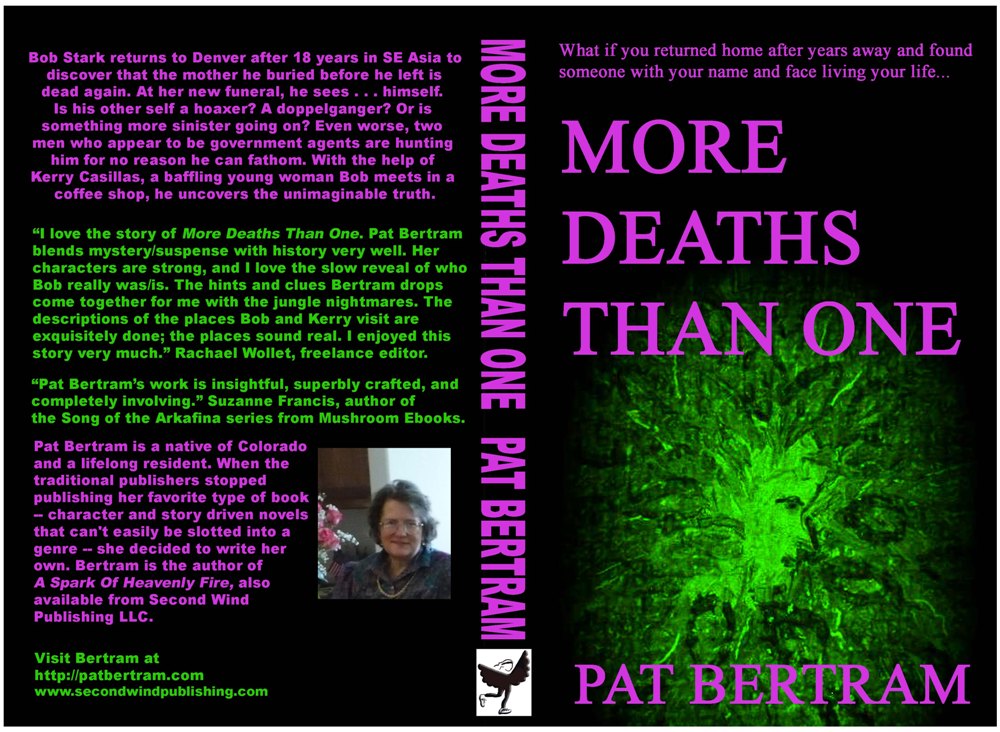
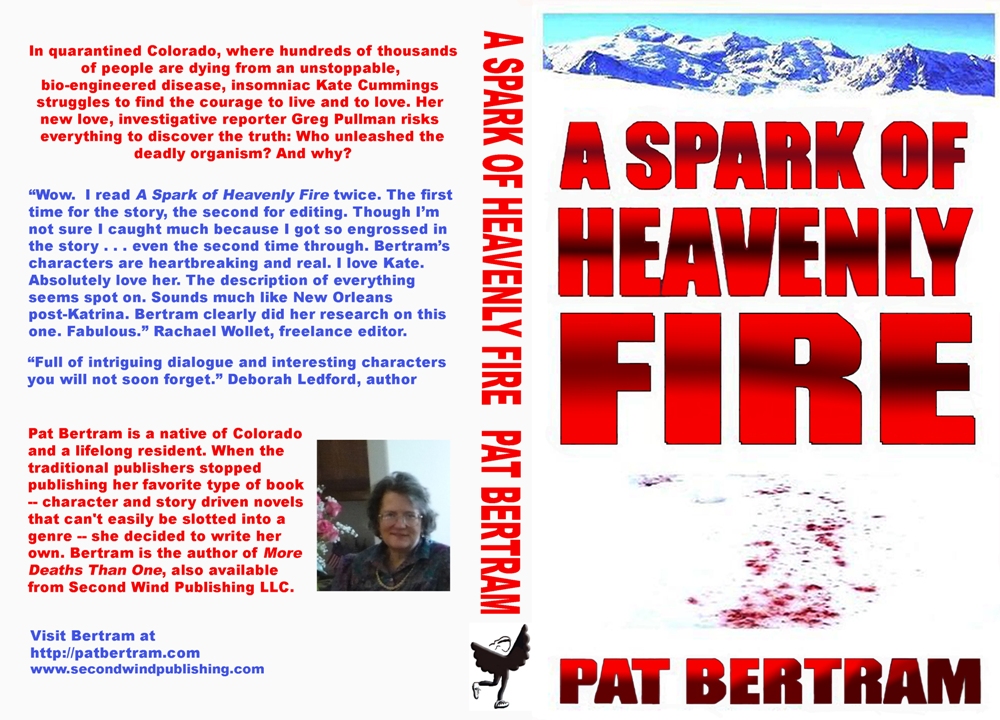
For A Spark of Heavenly Fire and More Deaths Than One, I had characters go in search of the information because I thought that if characters wanted the information badly enough, readers would also want the information and hence tolerate the intrusion of fact.

So how do you solve the problem of exposition? Do you dump it in all at once to get it over with? Do you parcel it out a bit at a time? Do you have one character tell another? Do you have a character seek it out? Do they read it somewhere, such as in an article or online? And how do you make it interesting for the reader?

My writing discussion group No Whine, Just Champagne on Gather.com will exchange ideas about exposition during our Live Discussion on Thursday, October 16 at 9:00pm ET. Hope to see you there!

When a Writer Defaults — Muse on Writing

Karl C. Klein, author of Unnatural Girl soon to be published by Second Wind Publishing, muses about writing:

I cover a lot of ground.
1)defaulting
2)modifiers
3)blonde/blond
4)OK/okay

Reminder: I don’t have the benefit of a formal education. This essay is from my observations. 

The difference between an archetype and a stereotype is vast. The archetype stands as bones upon which we hang flesh — a stereotype is a cardboard cutout we allow our readers to flesh out. I’ve come to call the use of stereotypes defaulting.  

People assume what they assume, shorthanding the world. (I know shorthanding isn’t a word.) We pre-decide many aspects of life. I believe this to be a gift from Darwin, but I’m not going into that aspect. I want to talk about literary fiction.  

When a writer defaults.  

Reading a short story some years ago, I was introduced to many characters. Finally, a new character entered the story. The writer wrote: 

“He was a black man.” 

I wondered about the racial background of all the other characters. I wondered why the writer found it important to mention his race and not the race of the other characters. I wondered: what does he really mean by “He was a black man.” 

The writer used a default. Obviously, all his characters were white, unless otherwise noted. But still, what does he mean by “He was a black man.” I think of the many, many black males I’ve known over the years, their similarities and their differences and realize the statement doesn’t tell me anything worthwhile. After all, Colin Powel and William Drayton (Flavor Flav) are both black men and from where I’m sitting, have little in common. 

“He was a black man” is meant as a default, a stereotype, a cardboard cutout, a straw man merely to take the place where a real character might stand. The reader has the responsibility to hang the flesh on this character based on the reader’s prejudgment of what a black man looks like and how he might act. 

Let’s bring another character into the room: “She was a blonde.” 

OK, now we have a story populated with Will Smith and Brittany Spears. 

Note: Blonde is a person, normally female, with blond-colored hair. This term in many circles is consider derogatory (The color of the hair is not the person. To say, “See that blonde over there” is akin to saying: “See those tits over there?”) To me, in literary fiction, I see ‘Blonde’ as a meaningless term, saying nothing about the character. The term blond refers to a range of colors from sun-faded wicker to light walnut. 

Allow me a copy and paste here, a snippet from a short story, “Remembering the 4th:” 

“Minutes before lunch, I found myself suspended against the lockers outside English class, angry faces like an animated Whitman Sampler pushed shouts at me. The walnut face holding me leached so close, I knew we’d be having pizza for lunch.” 

Let me backtrack a moment and say this: there’s nothing wrong with populating your work with straw men, allowing the reader to flesh them out. It’s been a style growing in popularity, some people arguing we should describe characters and scenes as little as possible, allowing the reader to be more involved in the creation of the story. I have no idea what the style might be called, but I call it ‘reductionism.’  

The rewrite of “Waiting for Godot:” 

The curtain opens, the stage is bare. For sixty minutes the audience stares, waiting for something to happen, imagining what Estragon and Vladimir might do if they were there. Now that’s existentialism.  

OK 

(Note: OK is the preferred spelling over okay, though I prefer okay, I write OK with clenched teeth just like I drop the *@%* comma between two independent clauses connected with a conjunction, though I hate that comma with the passion of 10,000 suns. However, I’ll only give up my comma splices when they peel the pen from my cold, dead hand). 

Anytime we drop something generic on the page, we’re defaulting. When we say ‘his eyes were brown,’ we’re assuming the reader is going to know what we’re talking about when in reality, brown for eyes is a generic color.  

Again, a copy and paste, this time from a book in process I’m editing as she writes, “As Time Goes By:” 

“I thought her eyes should be blue like the midday summer sky, but they were like oiled rawhide with splotches of suede and a baker’s chocolate corona.” 

(there’s that comma I hate with the passion of 10,000 suns) 

Note, too, the ‘midday summer sky’ is a different blue than a winter sky or even a morning sky. 

Another copy and paste from the same work: 

“Uncle Mike’s eyes are dark and rich like winter evergreen in the shadows but with a hint of moist soil. His hair’s black, almost blue with a curl flipping in the front like Superman. I had to look up, standing under him.” 

Let me address modifiers while we’re here. As the writer, we often get in the story and write from our point of view and not the character’s. We want to make a statement like “He was very tall,” which in reality is meaningless to the reader. First off, ‘very’ is not a very good modifier because it doesn’t say much.  

Substitute “damn” every time you’re inclined to write “very”; your editor will delete it and the writing will be just as it should be. —Mark Twain 

“Very” isn’t a very good modifier.

“Very” isn’t a good modifier. 

Both say the same thing. “Very” is great in dialog, particularly with excited tweens, but in narrative, similes and comparisons are better. 

“I had to look up, standing under him.”

is much better than:

“He was very tall.” 

Another example of ‘show’ instead of ‘tell.’ 

Another example from a short story: “Love Letters,” by Kacie Kameron: 

“I had the gift of a perfect love. 

I was fifteen, spellbound by his brown-green eyes, the color of wet cow dung, intoxicated by the moist sea air and hot summer morning.” 

I think when people say a story needs to open with a hook, this is what they’re talking about.  

“wet cow dung” is wonderful. 

Good writing is hard work. Great writing is damn hard work.