Perplexed by the Anything-Goes Publishing World (Part II)

Yesterday I wrote about how this new wild frontier, this stampede to publish and be damned (or not) of the new publishing world and how it could be lowering literacy standards because of the almost blythe acceptance of errors in books. The prevailing attitude is that as long as the writer is satisfied with the book, that’s all that matters. Neither they nor their readers seem to care if their story is derivative, if the editing is slipshod, if typos litter the pages.

To add to the confusion of this anything-goes publishing world, books that do well are seldom the best. Often, these successful books are the result of a very aggressive promotion campaign or the result of luck — by being chosen by Amazon for an aggressive promotion campaign or by hitting the right market at the right time.

It seems as if the world is a poorer place if good books are destined to remain undiscovered simply because the author is a wonderful writer and a mediocre promoter. Since we reward wonderful promoters who are mediocre writers with huge numbers of sales, the whole book business becomes even more skewed than it already is. People think that good books will rise to the top, that such books will automatically find a readership, but that is not always the case. And shrugging off the conundrum as “survival of the fittest” doesn’t help matters.

Some people think readers are screaming for quality, that readers are lost in the stampede, but when you consider the vast number of sales made by a few mediocre but bestselling traditionally published authors, most people are not screaming for quality. They are screaming for . . . comfort, perhaps. Predictability. A community of like-minded readers.

To make the situation even more complicated, publishers are not taking responsibility for marketing the books they publish. They want their authors to do that.

I recently read an article by a publisher who said that a publisher’s role was simply to prepare a book for market and to make it available. That’s it. Learning how to promote, navigating the insanely competitive book market, marketing one’s book, paying for book tours and conferences — all of that is the responsibility of the author. So then why does an author need a publisher at all? With Create Space, Lulu, Smashwords, and now Goodreads getting into the epublishing business, authors can prepare their own books for market. And what they can’t do, they can hire done, and keep all the profits. And authors by the millions are doing that very thing.

Maybe the problem I’m having coming to terms with this new wild frontier stems from a life-long respect for books, a sense that books are somehow sacred. Maybe it’s time for me to give up that old-fashioned attitude and treat books like any other temporary reading commodity, such as a blog post or a cereal box.

Perplexed by the Anything-Goes Publishing World (Part I)

In a recent discussion on Facebook, someone mentioned the case of a self-published story that was being offered for sale on Amazon. A woman posted a review, stating her opinion that the work was far from ready for publishing, and she gave the writer several examples of how to improve, but the writer took these comments as insults. What ensued was a protracted argument between the writer and the reviewer.

The Facebooker who brought this exchange to our attention asked who was right and who was wrong. I thought the reviewer brought up some excellent points, gave wonderful suggestions for redoing the story without getting disrespectful about it. (And the reviewer could have gotten nasty. The story really was atrocious.)

I can’t imagine arguing with a reviewer as the author did, though. A couple of times I have privately asked a reviewer to remove a spoiler that gave away the ending (and the reviewers graciously complied) but the writer in this case had a terribly unprofessional and arrogant attitude. She more or less said she could publish whatever she wanted, it didn’t have to be perfect, and too bad if people didn’t like it. Unfortunately, there are millions like her, which leaves me continually perplexed by the entire book business today.

The major publishers have had control of publishing standards for way too long. I certainly have no love for conglomerates or corporate thinking, so I don’t object to a lessening of their control. On the other hand, many writers now think they don’t need any standards at all. They say they can write whatever they wish, however they wish. The prevailing attitude is that as long as the writer is satisfied with the book, that’s all that matters. They don’t care if their story is derivative, if the editing is slipshod, if typos litter the pages.

Some of these writers even manage to sell a significant number of copies of their books.

Self-published writers seem to be a militant lot, demanding the same respect as authors whose books are published by a traditional or an independent press, yet self-published authors adhere to no one’s standards but their own, while a book that was accepted by and released by a publishing company has had to live up to at least the publisher’s standards. But some self-published writers do adhere to a high standard of literacy while some bestsellers released by the major publishers have an appallingly low standard of literacy.

Does any of this matter? With texting and twittering, leaving out letters of words to shorten them or using number for letters is standard. (AFAIK, u cn rd this. Me 2. LOL) Eek. Whole novels have been written in such shorthand.

Do kids today learn grammar in school? Do they need to know grammar? With spell check and grammar check on their computers, probably not. So, if books today have grammar mistakes, punctuation mistakes, typos, do most people even notice? Those of us who have spent a lifetime reading do notice, but do we count? We value language, but is language important? Language is an evolving organism, so perhaps those of us who quail at poorly written and poorly copy written books are running a race that has already been lost. A new generation grows into adulthood every year along with a new generation of electronic toys and tools and together they spawn a new generation of idioms. A new language.

I don’t know why this new anything-goes publishing world perplexes me. Most writers seem thrilled with the new order of doing book business. They don’t have to take the time to research the business, finding out which agents will accept their genre and which publishers they can submit to without an agent. They don’t have to learn how to write query letters or learn how to write a description and a hook. They don’t need to learn to deal with rejection. And especially, they don’t need to learn how to improve their work to make it as near perfect as possible. They simply decide to publish. That’s all it takes.

And most readers seem thrilled to find myriad books to download to their new ereaders.

So perhaps it’s just me who worries about a lessening of standards. Perhaps this new frontier, this stampede to publish and be damned (or not) is what everyone else wants. It’s certainly not the first time in my life the world didn’t act in accord with what I thought was the right direction for it to take, and it certainly won’t be the last.

See also: Perplexed by the Anything-Goes Publishing World (Part II)

Top Five Things I’ve Learned About Twitter

Twitter is a microblogging site where you post 140 characters at a time. I’ve written 100-word stories, 100,000-word novels, blog posts of various word counts, but anything that can be said in 140 characters or less almost doesn’t seem to be worth saying, so I’m having a hard time finding a home in the Twitosphere (or do I mean the Twitterverse?). Still, I am learning a few things about this twitterish world. Here are the top five things I’ve learned:

1. Tagging your tweets. You add tags to your tweets by using hash marks. For example, when I tweet this post, if I add #twitter to my tweet, people who are interested in finding out who is tweeting Twitter can search for #twitter, and discover all recent posts with that hash mark. (Okay, so you already knew that. But this is a post about things I’ve learned, and for some reason, that basic bit of twitia passed me by.)

2. Twit chats. #writechat is a group of writers who meet every Sunday on Twitter from 12:00 pm to 3:00 pm PT. You don’t need an invitation to join the discussion. (Well, maybe you do, but I crashed the party and no one complained.) All you have to do is go to your Twitter account and search for #writechat. Or you can start your own discussion group. Pick a name, add a hash mark, tell a few friends, and there you are, master of your own twit chat.

3. Trending topics. On the right sidebar of your Twitter home page, there is a list of trends. These trends are topics that are currently popular (as in right-this-very-minute popular) and are compiled from the most retweeted tweets, mostly news items. Twitterers think that they are tweeting non-mainstream news, that they are in the vanguard of a rebellion against traditional news sources, but as it turns out, the most retweeted twits and tweets come from the major media via their followers.

4. Friend or follow. Some twits like to follow everyone to get a huge following, and after you have followed them because you really don’t know what you’re doing and so you follow everyone who follows you, these twits unfollow you. Don’t you feel used? Well, no. Because you didn’t know they unfollowed you. Twitter sends you a message when someone follows you, but they don’t care if anyone unfollows you. So, here’s where you even the score: go to Friend or Follow, fill in your Twitter user name, and wait for the results. They might surprise you. You can easily unfollow your unfollowers from the site.

5. Clean your twits. Sometimes you end up with spammers or people you thought were your friends but who tweet a hundred times a day. Or you end up with a whole stream of multi-level marketers. Here’s an easy way of telling who is who. Go to: Twit Cleaner, fill in the information requested, and you get a whole list of unsweet tweeters with dodgy behavior such as those who tweet only links, those who only retweet other’s tweets, those who tweet the same links over and over again.

The main problem with cleaning your twits is that you end up with a huge discrepancy between the number of those who follow you and those you follow, and Twitter frowns on that. But whose Twitter is this? The way I figure, it’s better to follow fewer followers and get to know them, than to follow all who follow you and be inundated with the same twiddly stuff over and over again.

I’d planned to end this blog with a refutation of my bad report — Twit Cleaner told me I was guilty of dodgy behavior, that my tweets were mostly links. I was going to say that if people wanted to unfollow me because I tweeted too many links, then that is fine with me since if they’re not interested in what I tweet, they are of no use to me. Unfortunately, I just got a new report from The Twit Cleaner. They said “You’re awesome! Not very much to improve here. You’re basically already pretty great. Keep being your wonderful self.”

Thank you. I will.

Book Bits #114 – Kudos to Beauty & the Book, Roald Dahl stamps, William Gibson, Queen Elizabeth

Three reasons to read Malcolm R. Campbell‘s Book Bits #114

1. It’s the best compendium of book information orbiting the blogosphere

2. It has a link to my Pat Bertram Introduces blog where I interview Benjamin Cheah, an author from Singapore

3. It has a link to the incomparable Beth Hill’s latest article for her The Editor’s Blog.

Book Bits #114 – Kudos to Beauty & the Book, Roald Dahl stamps, William Gibson, Queen Elizabeth.

(If you would like to do an interview for my Pat Bertram Introduces blog, you can find the questions and instructions by clicking here: Pat Bertram Introduces . . . )

The Five Major Challenges We Face During the Second Year of Grief

The challenges we face during the first year after the death of a life mate/soul mate (or any other significant person), are too great to enumerate. It’s all we can do to cope with the seemingly endless chores of laying our beloved to rest while dealing with the emotional shock, the physical pain, the psychological affront. Sometimes the first anniversary of his death is one of peace when we realize that we managed to survive the worst year of our life, but then we wake up to the second year and find a whole other set of challenges to meet.

These seem to be the five major challenges to face during the second year of grief:

1. Trying to understand where he went. We can understand that he is out of our lives (even though we don’t like it), but we cannot understand his total goneness from this earth. No matter what we do, how we feel, or what we believe, it doesn’t change the fact that he is dead. And there is nothing we can do about it.

2. Living without him — we can do it, we’ve proved that during the past months, but we still have a problem figuring out why we would want to.

3. Dealing with continued grief bursts. Though we do okay most of the time, and though we fulfill our daily responsibilities quite capably, upsurges of grief still hit us, sometimes right on schedule (such as my sadder Saturdays), and sometimes for no reason at all. Sometimes they last for days (such as the upsurge of grief most of us felt this New Year’s Eve) and sometimes they last for mere minutes. But always, just when we think we can handle it, grief returns and we feel as if he just died.

4. Finding something to look forward to rather than simply existing. The second years seems to be a limbo, a time of waiting though we don’t seem to be waiting for anything. We’re just . . . waiting.

5. Handling the yearning. So many people who try to explain grief get it wrong. It’s not about going through five or seven or ten stages of grief. It’s about yearning for one more smile, one more word, one more hug from the person who was everything to us. The first year of yearning was hard, but somehow many of us had the strange idea that this was some sort of test and that after we passed the test, he’d pop back into our lives and we’d go on as before. Well, now we know this is no test. It’s the real thing. And there is nothing protecting us from that great clawing yearning.

Making a list is easy. Meeting the challenges of the second year of grief is hard, but maybe we succeed simply by living, by dealing with each day as it comes.

***

Pat Bertram is the author of Grief: The Inside Story – A Guide to Surviving the Loss of a Loved One. “Grief: The Inside Story is perfect and that is not hyperbole! It is exactly what folk who are grieving need to read.” –Leesa Healy, RN, GDAS GDAT, Emotional/Mental Health Therapist & Educator.

A New Pattern of Grief

I’ve lived ninety-three Saturdays since the death of my life mate/soul mate. Of course, I’ve lived ninety-three of each of the other days, too, but Saturday is the day I cross the Rubicon. (Or do I mean it’s the day I meet my Waterloo?) Either way, it continues to be my sadder day, the day he died, the day I always have an upswing of grief.

People think that by counting these sadder days I am steeping myself in grief, when the truth is, the sadness comes even before I know what day it is. Something deep inside of me is counting the weeks of this new life of mine. I’m sure there will come a time when first one Saturday passes without an extra burst of melancholy, and then another, and eventually my internal datekeeper will forget the day ever had a special meaning.

But not yet.

I truly thought I’d be done with grief by now. I’ve had several periods of relative stasis where I felt as if I’d moved beyond the sorrow, but so far, my grief has always returned, and it will probably continue to return for many months to come. It seems as if this process takes three to five years. Most people I’ve talked to who lost a mate say it took them four years to find the joy of living again. My twenty-one months, in comparison, falls way short of that.

Lately, a new pattern has been emerging. After a grief burst, there is a backwash of serenity, an acceptance of life as it now is, a determination to deal with my remaining years as best as I can. I even start thinking about the future, trying to imagine things I might try or places I might go. My mind drifts and I wonder how he will like those things or places. Then I realize . . . again . . . that he is dead, and grief washes over me.

I feel like a not very bright child who keeps running into a wall because she can’t quite understand her inability to pass through to the other side. For me, his total goneness from this life is my wall. I don’t understand death, don’t think our brains are wired to understand it, yet I keep running into his goneness as if somehow I think the solidity of it will dissolve under my attack. Not very bright of me, is it?

I don’t live in the past. I remember our shared life, of course, but mingled with the good memories are too many recollections of his suffering, which makes the past an unpleasant place to dwell. Or to dwell on. Nor can I bear to think of a future where he has no place, and so I live in the present. But I make note of my sadder Saturdays to prove to myself that yes, I can do this. I can live in a future without him. Ninety-three weeks ago, these Saturdays were all in the future and now they are all in the past. I lived them, and I’ll continue to live and count my Saturdays.

My main problem is that even though I know I can do this — living without him — I still have a problem figuring out why I would want to. But the reason will come. It has to.

Grief: Looking at the World Through a Camera Lens

My publisher suggested adding photos to my soon-to-be-published book about grief, and I jumped at the chance. I’d recently read David Ebright’s YA novel Reckless Endeavor, and was impressed by how much veracity just a couple of photos gave his story, so I was glad of the opportunity to do the same for my book. The only problem is, I have almost no photos of me and my life mate. We simply did not take photos — not of the places we lived, and not of each other. It’s not that we weren’t visually inclined, it’s that we lived in the moment. If you take a photo of the moment, the shoot becomes the moment and you lose the moment itself.

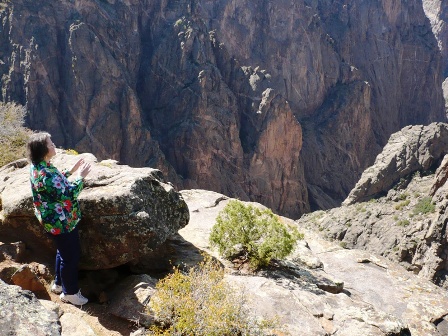
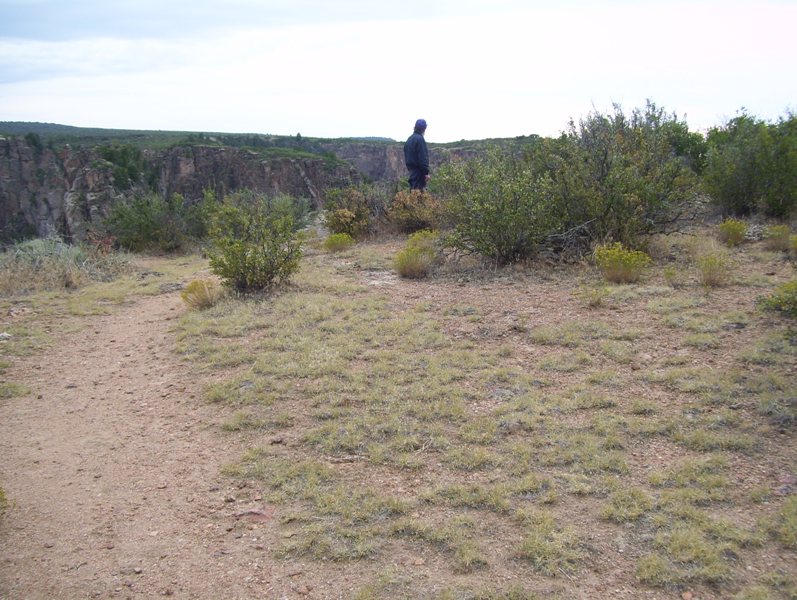
A couple of years before he died, I was gifted with a digital camera, and I took hundreds of photos of trees, animal tracksa cattle drive, some yaks in a nearby field, wildflowers (well, weeds) along the lane where I walked. It helped me get through what I thought were the worst years of my life, the years of his dying. Oddly, during all that time, I only took one photo of him, and that was by accident. We always wanted to see the north rim of the Black Canyon of the Gunnison, but since the road leading to the canyon was gravel, it was too hard on our old cars. We promised each other that if we ever had the use of a rental car, we would take the trip. That August, I rented a car so I could visit my brother, and when I returned, I suggested we finally go see the north rim of the canyon. He didn’t want to make the trip since he was so sick, but at the last moment, he agreed to come with me. It’s a good memory. Just him and me and the ground that fell away just beyond our feet. I had my camera, and since I knew I’d never be back, I snapped a few photos, and he ended up being in one of those pictures. It still makes me cry, that photo. He’s standing with his back to me, staring at  . . . eternity, perhaps. Did he know he had just a few more months to live? I sure didn’t, or perhaps I was simply refusing to face the truth.

The year after he died (which actually was the worst year of my life), I took thousands of photos. The world had turned black and white, and it was only through the lens of a camera that I could see color and life. I roamed the neighborhood and the nearby desert, looking for visual treasures.

And then suddenly, a few months ago, I stopped carrying my camera around. Apparently, despite my continued sadness, I’m back in the moment, living life at full strength rather than diluted through the lens of the camera. I didn’t even realize how far I’d come until I started hunting photos for my book and realized I’d stopped taking pictures.

(I did manage to scrounge a few photos for the book, though not as many as my publisher wanted. And we’ll be using the only photo of the two of us for the back cover even if it is fifteen years old.)

Life’s Little Bonsai

The delightful Juliet Waldron, Crone Henge blogger and fellow Second Wind author, left a comment on my blog yesterday, saying we are all life’s little bonsai, and this image has stuck in my head because it seems so true. Life and fate do their best to form us into whatever torturous configurations please them, and we’re left to do the best we can with whatever shape we’re given.

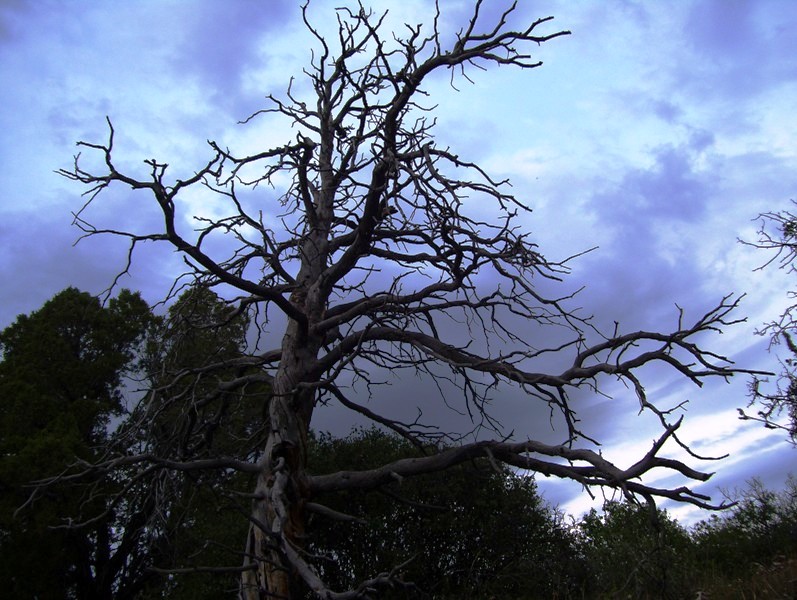
It seems fitting then, that I planted a Japanese black pine tree yesterday as a symbol of continuing my life despite the traumas and dramas thrown at me the past few years. I doubt I will torture the poor thing into a standard bonsai shape, though I suppose unrestrained growth could make it weaker, and that would be just as torturous for the poor thing as purposeful mutilation. (I don’t know why I worry so much about torturing the tree. Nature does the same thing to wild trees, as you can see from this photo I took at the Black Canyon of the Gunnison. And anyway, I just planted the seeds yesterday, so I am a long way from having to make a decision about caring for the pine.)

I’ve been checking the final edits for my grief book, which will be published in another two or three months, and I notice how often I acknowledge the pain of having lost my life mate/soul mate and then state my determination not to let life and fate destroy the possibility of any future happiness. Sometimes, now, for just a second, I can stand outside myself and wonder how the death of one man could have put me in such a state for so long. I mean, life does torture us with all sorts of traumas, it kills with impunity, and we all will face the same fate in the end. So why should this particular loss mean so much? Why should it hurt so much? Despite all these months of pain, I’m glad I grieved for him and didn’t just go on with my life as if nothing earthshaking and soulquaking had happened. His life—and death—shouldn’t pass lightly.

I wonder what he will think of the grief book. It’s so much of a love story, this story of ours, and we were both private people. (Some called us secretive, but we weren’t. We just kept ourselves to ourselves.) And soon the whole world (well, a hundred people anyway) will know the truth of our lives and will see how we dealt with being life’s little bonsai.

Sometimes I wonder if I’m being appallingly foolish for putting myself out there like that, and other times I figure it’s just another of the twists and turns that are shaping me.

After the Waiting Comes the Dread

So, no more 2011. I stayed awake until the year was officially over . . .  waiting . . .  but I felt no different when the clock hit 12:01 a.m. than I did at 11:59 p.m. It was the passing of a moment, that’s all. But this morning, I woke with a feeling of dread. I haven’t felt such a roiling since the months immediately following the death of my life mate/soul mate. I feel as if I’ve lost something precious that I can never get back, as if the world has changed in some unidentifiable way. I don’t know what that something is, though. It’s not the loss of 2011 — those are just numbers. It’s not the loss of my mate — he already died and cannot die again.

Perhaps it’s the past that I’ve lost? All that’s left for me now is today, and the rest of my today’s, however many there will be. (And considering the age my mother was when she died and the age my father is today, I could have a LOT of days.)

Perhaps it’s that irrational hope of reunion that I’ve lost? For a long time, I had the feeling that if I am strong, if I pass the test of living without him, if I face life with hope, then I will be able to go back home to our shared life. That feeling was very strong at the beginning, and I was careful to deal with all the challenges that grief brought me. But he never came back, never called, and of course, he never will, not in this life anyway (and this life is the life I am living).

Perhaps it’s the sense of togetherness that I’ve lost? During the months since his death, I’ve often felt as if this were still our life — his and mine — with the tasks of living now solely my responsibilty.  But the truth is, this is my life, and my life alone. He’s not here to help, to listen, to care. (I talk to him, especially when I am out in the desert, but so far he’s keeping silent.)

Despite all my losses, I hope I will be able to face the coming years and the coming changes in my life with courage and hope and generosity of spirit. I am in a transitional stage, and someday — perhaps before I’m ready — I’ll have to figure out where to live, what to do, how to grow old alone.

But for now, today, all I feel is dread.

Waiting for the End of the Year

I’ve survived, celebrated, or ignored many New Year’s Eves in my life. Mostly ignored. A new year merely meant starting over with a clean unmarked calendar and remembering to use a new number when writing the date. For the rest, it didn’t matter. I dragged my old self into the new year, along with all my old problems and frustrations, griefs and hopes, so that there was nothing intrinsically different from one year to the next.

Last New Year’s Eve, the end of the worst year of my life, I toasted the upcoming new year. That was the first time in my life I ever ushered in a new year with any sort of ceremony, but I thought it was important to put on a good show for myself. I needed the symbolism of looking forward to the future, building hopes and creating dreams, finding reasons to live when I could barely find a reason to get up each day.

And now here I am, three hundred and sixty-five days later, waiting for this year to end. I’m not celebrating the end of this year or toasting the new one. I’m simply waiting.

I mentioned in a couple of previous posts this week how grief snuck up on me again. This year ends the first full calendar year since the death of my life mate/soul mate. I can no longer say, “He died last year.” Our shared life is now more remote than ever. And so I’ve been grieving the end of this year. And the end is almost upon me.

I have no sense of the future tonight. I only feel, deep in my soul, that this is the end of something. I’ll be staying up until midnight, holding on to this year as long as possible. And then? I don’t know. The end of something, if only a year, should presage the beginning of something else, shouldn’t it? But I have no plans. No plans to make plans. No plans to plan to make plans. I’m not being negative, I simply have no sense of the future, of what that future might bring.

Right now, tonight, I only feel that this year is ending, and I need to see this year to its very end.