I Fear, You Fear, We All Fear

Sheri Parks, an assistant professor at the University of Maryland, says that many teens today have had years of exposure to violent video games and media images, which studies show desensitizes them to violence.

How odd to think that there are now studies showing this desensitization. Many of today’s — and yesterday’s — video games were developed by the military because studies had shown that repeated images of violence and death inured people to killing. In World War II, as many as 85% of soldiers fired over enemies’ heads or did not fire at all. After World War II, there was a concerted effort by the military to overcome this natural reluctance to kill, and apparently they succeeded, because during close combat in Vietnam, only about 5% of soldiers failed to aim to kill.

These same desensitizing “games” were later released as toys for children. Is it any wonder that teens today stand by and take pictures while a young girl is gang raped?

Today I am a guest at A.F. Stewart’s blog talking about fears. I kept my post light in honor of Halloween, but findings such as these about desensitization scare the heck out of me. Author Lee Child says that we don’t write what we know, we write what we fear, and that certainly is true in my case. I fear the machinations of the powerful, deadly, and calculating men and women who control our lives behind the scenes.

This theme is most prevalent in More Deaths Than One (in fact, I came across the information about desensitization while researching the military, soldiers, and killing for that particular novel) though it shows up in milder forms in all of my novels. Conspiracy? Perhaps. Truth? Probably. Fear? Definitely.

Now that I have scared you, go check out a lighter side of fear and tell me: What Are You Afraid Of?

More Deaths Than OneMore Deaths Than One is available from AmazonSecond Wind Publishing, and Smashwords. (You can download 30% free at Smashwords as well as buy in all ebook formats.)

add to del.icio.us : Add to Blinkslist : add to furl : Digg it : Stumble It! : add to simpy : seed the vine : : : TailRank : post to facebook

Researching Gangster Lore for Daughter Am I

I have notebooks full of gangster lore that I collected when I researched Daughter Am I, my young woman/old gangsters coming of age novel. (I keep calling it that, but it’s so much more — a murder mystery, a treasure hunt, a romp through the middle of the United States with a young woman and a busload of irrepressible octogenarian rogues. “Snow White and the Seven Old Farts” as one of the villains called them.) As usual, I am digressing. Someday, perhaps, I will learn that just because I use parenthesis, it doesn’t give me the right to meander off topic. Or maybe it does.

Anyway, the point is, I was able to use only an iota of my notes. So many real-life characters never even got to be reborn in the person of one of my “elders.” (There’s a topic for discussion — what does one call a busload of aged men and women? I despise the term “senior citizens,” I have no fondness for “old folks” — the term, that is — and “golden- agers” is too nauseating. So I settled for “elders” with its nuance of wisdom.)

One such character I never used for my book was Jake “The Barber” Factor, who stole millions from people through stock market swindles and investment fraud. He worked as a bootblack when he was a boy, shining shoes outside of a barbershop. The price of a shine was two cents, but he’d tell unwary customers that he’d give them a “steamboat shine” for one cent. If the customer agreed, he’d polish one shoe until it gleamed, then he’d say, “There’s your steamboat shine, Mister. For a dime, I’ll shine the other shoe.” 

Oscar Wilde once said, ” The Americans are certainly great hero worshippers, and always take heros from the criminal classes.” Well, perhaps not always, but most of us bear a grudging admiration for con men and women, mostly because they seem so much smarter than the rest of us. Or maybe they just have fewer scruples.

Daughter Am I will be released by Second Wind Publishing in the middle of October. 

add to del.icio.us : Add to Blinkslist : add to furl : Digg it : Stumble It! : add to simpy : seed the vine : : : TailRank : post to facebook

My Fruitful Summer

We are now officially into autumn, and where are the words I planned to write? Not in my head, not on paper. A Facebook friend emailed me the other day and asked if he could be part of the blog tour for my new book. All of a sudden it dawned on me that I have done no promotion for Daughter Am I, my young woman/old gangster coming of age tale. I’ve been so caught up in the edits, in making the book as perfect as possible, that I conveniently forgot that the finish line for one heat of the race is the starting line for another. To my dismay, I’ve discovered that getting published does not end the querying — I’ve spent the past few days trying to find bloggers willing to host my tour, and at the rate I’m going it will take many more days of querying to find enough hosts to make the tour interesting.

I did have a fruitful summer, though — I went to a u-pick cherry farm a mile down the road, (took pictures, have a great title for the photo essay, but the words to said essay are buried in the back cabinet of my brain with the rest of the words I’m not writing). I also picked plums — greengages — just a few yards from my house. Now that particular photo essay I managed to do while I was procrastinating on writing this discussion: Plum Tuckered.

Bear with me. There is a writing discussion in this.

All that fruit picking made me think that once upon a time food was free for the picking. Literally. That realization helped put me in my hero’s frame of mind — he is going to be living in the wild when I finally get back to my WIP. It also gave me a totem or token or symbol for the second part of the book (the token in the first part was a specific type of candy). And finally, it made me wonder about the use of fruit in stories. The only thing I remember about a certain book I read when young was a mention of greengages. “The children were sick from eating too many greengages.” That’s it. I don’t remember anything else — not the title, not the author, not the story.

So, has any fictional fruit made an impression on you? Eve’s apple, of course. Snow White’s apple. Apple sellers in the Depression era. Oranges in Victorian Christmas stories.

Has fruit ever played a part in anything you’ve written? Did you have a fruitful summer in any meaning of the word? What are you working on? How was your writing week? Did you accomplish what you wanted? Did you make any interesting discoveries? Did you have fun or was it a chore?

Let’s talk.

add to del.icio.us : Add to Blinkslist : add to furl : Digg it : Stumble It! : add to simpy : seed the vine : : : TailRank : post to facebook

Okay, I Admit It. I’m Jealous.

Jealous of whom? Need you ask? I bet if they were honest, most authors would also admit they were jealous of Dan Brown. Whatever one thinks of the man himself, the man as a story steller, the man as a wordsmith, the fact is, he wrote a book that is dazzling the world.

I only read The DaVinci Code because I was curious as to what captured people’s attention when it came to books. Though his prose is supposedly the worst thing since moldy bread, what I noticed were the internal inconsistencies — if the villain was so smart as to stay one step ahead of Robert and Sophie, if he was so smart as to figure out where they were going next and kill the person they wanted to contact, why wasn’t he smart enough just to kill the two of them and put us out of our misery? I don’t like books where the body count rises just to show how smart the hero is to stay alive. Cheap thrills, but apparently they work. 

The internal inconsistencies were bad enough, but what drove me nuts were the external inconsistencies — though the cathedrals in France do hide a code, the code predates the cathedrals, predates Christianity even. The cathedrals were all built on ancient mystical sites, as was the Vatican itself.  If the cathedrals themselves do contain a code, it is a manifestation of the prehistoric meaning. And then there was Sophie as the direct descendent of Jesus. Puh-leeze. A family tree is exactly that — an everspreading, ever thinning genetic branching. Even if Sophie was a direct descendent, her Jesus genes would be so minuscule as to be indistinguishable from yours or mine. (Go back twenty generations, and we’re all related.) I won’t even mention the possibility that Mary Magdalene never existed as a flesh and blood woman but, together with the other two Marys, was a manifestation of the mother goddess. And then, of course, I kept hearing echoes of a previous book I’d read — Holy Blood, Holy Grail — the book that he didn’t credit for his research.

Still, with all that, he captured the world’s attention, and now with his new book, for whatever reason, he is dazzling the world again. I wonder what that would be like? Must be nice.

add to del.icio.us : Add to Blinkslist : add to furl : Digg it : Stumble It! : add to simpy : seed the vine : : : TailRank : post to facebook

Whew! Now I Feel Safe?

I’ve been reading a very old book on blogging. For normal purposes, a 2006 copyright isn’t that old, but apparently when it comes to the blogosphere, it’s so old as to be . . . well, not worthless, but outdated. The only mention of WordPress in the book was the .org version. The .com version (the one most of us have come to rely on) wasn’t even mentioned. Is WordPress.com that new? I don’t know — I’ve only been blogging for two years, so anything before September 2007 is prehistoric to me.

Anyway, the author of the book suggests backing up your blog to make sure that your don’t lose your content in case the host’s computer crashes or the host goes out of business, as did someone who hosted 3,000 blogs many, many blogyears ago. (Apparently a blogyear is akin to a dogyear.) So I hied myself to the WordPress forum to find out the best way to back up my 351 posts, 4 pages, 33 categories, 1,350 tags, and 1,865 valuable (and much appreciated) comments. According to WordPress, however, the blogs are already backed up. I found this on a FAQ page:

If your blog is hosted here at WordPress.com, we handle all necessary backups. If a very large meteor were to hit all of the WordPress.com servers and destroy them beyond repair, all of your data would still be safe and we could have your blog online within a couple of days (after the meteor situation dies down, of course).

I also found this in a discussion forum: 

Right now there are 3 copies of your blog in 3 different parts of the USA.

If California drops into the Pacific, your blog is still safe.
If California drops into the Pacific AND Texas gets hit by a meteor storm which destroys it you can still blog all about it.
If all 3 go down then there is something very serious going on …

There isn’t really a need to backup.

Unless, of course, you want to, in which case you go to your dashboard, scroll down to tools, click on export, and send your blog files to . . . wherever.

I feel safe now, don’t you? I won’t think about California dropping into the Pacific, Texas getting hit by a meteor storm, that unspecified meteor situation, or that even more unspecified “something very serious going on”. Not much, anyway.

add to del.icio.us : Add to Blinkslist : add to furl : Digg it : Stumble It! : add to simpy : seed the vine : : : TailRank : post to facebook

Something Ew and Different

So, did you miss me? I bet you didn’t even know I was gone. I went to Las Vegas to a surprise birthday party for my brother, and I couldn’t talk about it beforehand since I didn’t want to be the one to un-surprise him. It was fun, though the town is wasted on me — I forgot to gamble. I guess I’ll have to find another way to get rich. I know! I’ll write a book, become a bestselling author, and make millions. Are you laughing, too? It would have been better for me to be a bettor.

I was hoping that by leaving the promotion conundrum behind perhaps my subconscious would work out the problem for me, and I would suddenly know how to sell tons of books, but no enlightenment came my way. I did discover that I’m not as addicted to the internet as I thought I was. I didn’t even miss it.

What I didn’t miss this time were the sex scene fountains — I finally got a chance to see them. It was like meeting a celebrity since I’d seen them many times . . . in movies. (What Planet Are You From is the only one that comes to mind at the moment.) During the sex scenes, the director showed the fountains at the Bellagio climaxing instead of the couple, so I call them the sex scene fountains, though I don’t imagine the Bellagio publicity department would appreciate the moniker.

What else happened? I met some online friends, which was a kick. After about thirty seconds to readjust the mental image, it was as if we’d known each other for years. Which we had.

I also got reacquainted with a nephew who is studying visual arts, and we decided to collaborate on a graphic novel. I’ll do the writing, he’ll do the art. He doesn’t want me to research how to write a graphic novel because he says that way I’ll write something totally new and redefine the genre. We’ll see. Should be interesting since I’ve never even seen a graphic novel. So now I have two writing projects that I’m not working on. One of these days I’ll get busy. I promise.

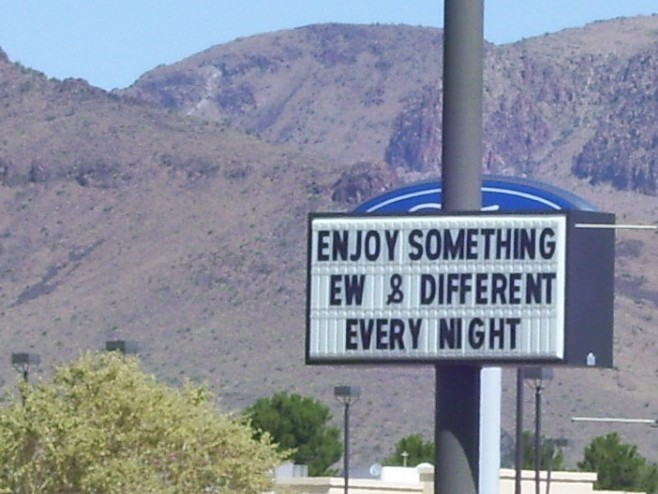
Meantime, as a lesson in how important copyediting is, I took a photo of a sign at a restaurant. One letter does matter!

014a

add to del.icio.us : Add to Blinkslist : add to furl : Digg it : Stumble It! : add to simpy : seed the vine : : : TailRank : post to facebook

Is Anyone Really Writing the Great American Novel?

I still come across characters in books who want to write The Great American Novel, though in real life (or as real as it gets online) I don’t see people saying that. Has the desire to write The Great American Novel been superseded by the desire to write the next million-dollar bestseller? And is either goal realistic for most of us, or even worth pursuing?

Frankly, when I started writing this bloggery, I didn’t even know what The Great American Novel is, so I went trolling the Internet (so much more fun than actually sitting here writing!) to see what I could see. (Ah, the adventure of it all!)

(I don’t know why blogging brings out my desire to use parentheses — I seldom use them in my other writing, but there it is.)

Anyway, from what I gather, The Great American Novel shows the impact of American culture on the characters, shows the spirit of life in the United States at the time of publication, and is supposed to be a counterpart to the great English writers. Nothing in that definition precludes the novel being a bestseller, but it’s generally assumed that The Great American Novel is a literary novel rather than a commercial one. If the novel needs to show the spirit of life in the U.S. at the time of publication, then that means it needs to show today’s culture. Do we have a culture any more? I sure hate to think that fast food restaurants and blockbuster movies and and bestselling pap — books and music — are the only things that define us culturally. Though they certainly have had an impact on all our lives.

And why The Great American Novel? Why not the Great International Novel? The Great One-World Government Novel? The Great Earth Novel? Aren’t we supposed to be moving out of a parochial viewpoint into a global one? Either way, I am not writing an American novel, great or otherwise, even though my novels are set in Colorado. Perhaps Light Bringer, which will be published later this year can be considered a The Great Earth Novel since it strives to tell the history of humankind in a unique way. (Some people call it science fiction. Could be, I don’t know — I just told the story.)

What about you? Do you have any desire to write The Great American Novel? The Great Canadian Novel? The Great Global Novel? The next million-dollar bestseller?

add to del.icio.us : Add to Blinkslist : add to furl : Digg it : Stumble It! : add to simpy : seed the vine : : : TailRank : post to facebook

I Received an Invitation to be a Speaker at a Writer’s Conference!

My fame is spreading! Well,  maybe it’s not my fame that’s spreading, maybe it’s just my name. Or perhaps they are the same? Yikes, writing like that would never get into one of my novels. Inadvertant rhymes? That won’t do! Still, the sentiment is true. Someone, somewhere has heard of me, because yesterday I received an invitation to be a speaker at a writer’s conference!

Scribblers’ Retreat Writers’ Conference would like to cordially invite Pat
Bertram to be a guest speaker for one of our four conferences in 2010. We
have ten speakers for each conference and four conferences annually.

Scribblers’ Retreat Writers’ Conference is an international, non-profit,
literary arts organization dedicated to bringing together “those who have
made it” to “those who want to”. By creating the most innovative,
educational, and dynamic symposiums composed of the literary elite, we offer
those attending a unique opportunity to learn from and socialize with the
people they admire. This is a way to impart your talents to the global
community; to make a difference.

The conferences are held on beautiful St. Simons Island, Georgia. You will
be able to take advantage of the tranquil atmosphere provided by live oaks
and beaches, the history and art, ghost and dolphin tours, or even climb the
old light house.

Please look at your calendar to see which dates would be more preferable and
browse our website below. Join us in this grand endeavor in literacy and in
fulfilling dreams of success.

To talk about writing in a gorgeous place? Sounds like a dream. I have to choose a single topic, though. Hmmm. Which should it be: Style and technique? Networking? Writing support groups and blogs? I’ll get back to you — and them — about that.

add to del.icio.us : Add to Blinkslist : add to furl : Digg it : Stumble It! : add to simpy : seed the vine : : : TailRank : post to facebook

The Apollo Moon Landing, The Dish, and Me

I was taking a walk on earth forty years ago when men were walking on the moon. Unlike everyone else, it seems, I wasn’t sitting in front of a television. For one, we didn’t have a television, for another, the whole thing seemed rather ho-hum to an inveterate reader of science fiction. If we hadn’t been there in truth, we’d been there in stories, in imagination. So, oblivious to the excitement, I went for a walk.

The passing years — and all the movies and the books about the subject — didn’t change my mind. Perhaps it was as great an achievement as people seemed to think. Perhaps we had wasted our money in a moon race instead of solving our problems here on earth as many said. But the matter never caught my attention. Until . . . The Dish.

The Dish, a movie released in 2000, tells the story of the Australian participation in the 1969 moon landing. A dish, placed in the middle of a sheep paddock in Parkes, Australia, was to actually transmit the landing and moonwalk to the world.

Why did this movie about a little known aspect of the mission catch my attention? The characters. The quirky characters, their humor, and their excitement to be a part of this major undertaking made me experience, for the first time, the wonder of the achievement.

Thinking of the Apollo landing (now why would I be thinking about that today? Hmmmm) and subsequently The Dish, I was reminded that if we filter our stories through the eyes of our characters, if we make the characters excited about the events of our story worlds, if we make them want to know the facts of our worlds, then we will allow our readers to experience the excitement for themselves.

(What, you thought I’d pass on the chance for an object lesson about writing? Surely, you know me better than that by now!)

add to del.icio.us : Add to Blinkslist : add to furl : Digg it : Stumble It! : add to simpy : seed the vine : : : TailRank : post to facebook

The Most Unexpected Truth About Writing

My guest today is Lazarus Barnhill, author of the wonderful and profound Lacey Took a Holiday and The Medicine People, available from Second Wind Publishing. Laz talks about destiny, which is a perfect topic for his guest appearance here on my blog. We met in November 2007 during an online writing contest (TruTV Search For the Next Great Crime Writer Contest on Gather.com) where we finished consecutively  — 10th and 11th — out of over three hundred entries. Now we are colleagues again — this time at Second Wind Publishing. Lazarus says:

“We are not accustomed to thinking that God’s will for us and our own inner dreams can coincide.”  –Julia Cameron, The Artist’s Way

It was Monday, August, 20, 2007, and I was driving home from down east North Carolina in a driving rainstorm.  After I dropped off my daughter at her home, I turned on the local NPR station.  As it happened, I tuned in precisely in the middle of an interview.  It became clear within a few seconds that I was listening to an author who had just had his first book published.  Because I was trying to catch up on the information in the report, I paid especially close attention and was able to piece together that there had been an online contest, the winner of which received a contract to have his book published by a major house.  As an aside, the interviewer concluded the report by saying that the same literary website was about to host a second contest.  This second one was for romance novels.

At that particular moment, I was sitting at a stoplight.  I remembered how, a few months before, I had finished a novel that-if you closed one eye and squinted just right-could be considered a romance: Lacey Took a Holiday. The light was still red, so I took out my extra fine point felt tip pen and scribbled the site on the back of my hand: “Gather”.

This commenced a twenty-month string of the most unlikely events: the following day was the last day to enter the romance contest and I made it in just under the wire; in the process of reading the romance chapters of almost 300 other authors, I became well acquainted with a number of them and for the first time recognized a “great miscarriage of publishing justice” (there were far, far more worthy romance novels than there were agents and publishers to snatch them up); many of the quality writers began to coalesce into writing groups and I was actually invited to join in with them; a third Gather contest — crime/mystery novels — commenced soon after the conclusion of the romance competition and I had, only days before, finished a crime novel (The Medicine People); once again I encountered and befriended a number of outstanding writers and experienced the reality that only one of them was going to receive a book contract; at the end of that contest, a blended group of romance and crime authors decided to take matter into their hands and start up a publishing company; that company (Second Wind Publishing), ten months after its inception, has twenty books available for purchase in multiple venues with another twenty waiting in queue.

The other day I was marveling at the uncanny string of events that brought me so many wonderful new friends (by the way — thanks, Pat, for the invitation to be here!), saw the publication of my first two novels and empowered me to express my artistic vision in ways that I never imagined.  Ironically, as I participated in the Gather contests, I had assumed I would be one of those writers who might pen a worthy story, but never get picked up by an agent or contracted by a major publishing house.  In retrospect, I’ve gotten to the point where I feel pretty lucky that I didn’t.  In fact, as I read Julia Cameron’s remarks in her wonderful book, The Artist’s Way, I began to wonder if in fact what I saw as a lucky string of chance events was really a matter of listening to a still, small voice that has always intended better for me than I could have imagined for myself.  If Julia Cameron is right, that same little voice has something to say to all of us.

My premise is this: whatever force there is out there in creation (call it God, destiny, a Higher Power or whatever you want) actually wants you to write. When you write, you are fulfilling an essential aspect of your truest purpose for existing. What do you think?

Here is another far out, mystical question: for the sake of argument, let’s say the universe wants you (in fact the whole perverse group of us literary creative people) to write. Is there such a thing as praying for help with your writing? What would you pray? “Get me unstuck, O literary angel”? What about this, “Let my writing muse guide me to express my truest self as a writer, and trust the outcome to be in greater hands than mine”?

What if your literary angel has a purpose and story in mind for your writing that is greater than anything you can currently imagine? Of course that implies that being on the NY Times bestseller list may not be the greatest destiny.

See also: Pat Bertram And Lazarus Barnhill Discuss Writing as Destiny

add to del.icio.us : Add to Blinkslist : add to furl : Digg it : add to ma.gnolia : Stumble It! : add to simpy : seed the vine : : : TailRank : post to facebook