Mystery Evening Critique

The Roaring Twenties mystery fundraiser was a success. It had the biggest turnout to a local event that I’d seen, it made money, and people had fun. At least, they had fun to the extent that the evening met their expectations. The people with no expectations and those who were willing to get into the spirit of the game had the most fun. Those who expected to sit and watch a play were not quite as satisfied.

People’s comments to me revealed their expectations, and said more about them than it did about my writing. Some people said I did great, and I could see they meant it. Some people avoided me. Others damned me with faint praise: “It was good for a first attempt.” Or “You’ll do better next year.” Others said it was fun, but that they couldn’t hear most of the play.

A friend warned me about this — how nerve wracking it was for scriptwriters who had to sit back and see their dialogue not working the way it was supposed to. I’d glibly responded to him, “If it doesn’t work, I’ll get to blame the role-players for not doing their job of engaging the audience.”

And so it was.

Few people, even those to whom I had explained the concept, got the point — that it was a game, a role-playing game, with some scripted parts to keep things going. Everyone who came was supposed to play a role, and to that end, each had been given a cheat sheet with a bit about their character. For example: You bet on Sugar Beet since it was supposed to be a sure thing, and now you think Mr. Big sold you out. Or You strongly approve of the suffragette movement, and you think flirts like Poppy give women a bad name.

The people who played the various scripted characters were supposed to sit among those without lines and get them involved. Only a couple of women did this, and did it admirably, but I could see the strain it was for them since so few responded to their attempts. Some of the younger people who volunteered to play a part were great, but others huddled in a corner with their friends instead of getting the non-scripted folks to participate, and they kept sitting when they too-quietly spoke their lines rather than standing up when they were supposed to speak.

After the murder, non-scripted people were supposed to have been interrogated, but that part was dropped, maybe because of the problem with getting attendees into the spirit of the game.

I’d thought that during the event the characters would become less my creation and more theirs as they adlibbed, took things further than what I had suggested, and got other non-scripted guests to participate. None of that happened. And since I wasn’t one of those who were supposed to be chivvying others into participating, there was nothing I could do about it. Nor was there anything I could do about lost lines, swallowed punchlines, clues that no one could hear, participants with jitters and nerves, and people who wanted to do things their own way.

That the evening was a success was due to the efforts of those who did get into the spirit of the thing and who so wonderfully (and in the case of the bartender, so chillingly, and in the case of the jockey, so charmingly) delivered their lines.

From a personal standpoint, I enjoyed the evening. It was interesting to see how far I had come in the eleven months since I’d moved here — how many people I knew or recognized, how many people knew or recognized me.

From an author standpoint, it wasn’t nearly as enjoyable, mostly because of my own expectations. The game never took on a life of its own, as I had hoped. I’d seen it as sort of a flash mob thing, where scripted characters, seemingly from the audience, would jump in with their lines as if on the spur of the moment, which never happened because of the aforesaid huddling. And I woefully overestimated how many attendees would get into the speakeasy attitude and play along. (I should have known what would happen when only a smattering of people with non-scripted lines made any effort to dress the part.)

So what’s the solution? Insist on having greater control of the process? But then, this wasn’t really about me as an author, but about the community. Give explicit instructions to the scripted players, making sure they sit among the “audience,” and write additional lines so they aren’t expected to adlib? When people make a reservation, ask if they are willing to say a few lines, and then give them specific things to say? Wait to see who shows up in costume, and give those people lines? The characters who were the most enthusiastic and who really carried the evening were those who had been coopted almost at the last minute, so is the solution to coopt more people like these, people with big voices and bigger personalities? Or is the answer to give up on the idea of an interactive experience and give people the play they expected?

But then, that raises the question: Is this who we have become? A people who would rather simply sit and watch rather than get involved?

I don’t know the answer, and I don’t need to since my scriptwriting days are done.

Besides, the evening really was a success, and in the end, that’s all that counts.

***

Pat Bertram is the author of Grief: The Inside Story – A Guide to Surviving the Loss of a Loved One. “Grief: The Inside Story is perfect and that is not hyperbole! It is exactly what folk who are grieving need to read.” –Leesa Healy, RN, GDAS GDAT, Emotional/Mental Health Therapist & Educator.

Mysteries

Editing the murder mystery I’ve been writing for a dinner at the local museum on February 9, seemed as involved as any other editing job. There were a few small inconsistencies to repair, but the main thing I had to do was to add lines so that the characters can introduce themselves. I didn’t want to do a program with the characters and their roles listed, because in a way, everyone who comes to the dinner will have a part — as a visitor to the speakeasy if for no other reason. Those who will be set apart as possible villains, though, will have to have a name, otherwise, how would anyone be able to vote for the dastardliest villain?

Tomorrow will be rehearsal, though mostly it will be a matter of setting up the logistics of the mystery. Although no one but the mistress of ceremonies will have many lines to say, I don’t expect anyone to memorize their parts. (They can if they want to, of course.) For the most part, they just need to know what they are supposed to be doing and how the whole thing fits together.

I’m hoping people will get into the spirit of the thing and not just sit back and watch as the story unfolds, but if people prefer to watch, that’s okay, too.

I feel as if I should be nervous about the murder mystery because after all, the story was my creation, but I’m not. Or at least, not very.

Maybe it’s because so much is going on. Not just meetings and preparing for the dinner and attending the mayor’s strategic planning sessions, but also the house. The excavator should be available for rent sometime next week, so I’ll get to watch a different sort of play unfold — digging the foundation and pouring the cement and whatever else it takes to start building a garage.

I wonder if the dig will uncover some other weird bit of mystery to go along with all the other mysterious artifacts we’ve uncovered, such as the cistern, ancient sewage pipes, water where no water should be, bloody shirts, and a few miscellaneous bones.

Whatever happens, the dig should be interesting!

And so will the murder mystery dinner. If you are in the area, please join us for an evening of food and frolic.

***

Pat Bertram is the author of Grief: The Inside Story – A Guide to Surviving the Loss of a Loved One. “Grief: The Inside Story is perfect and that is not hyperbole! It is exactly what folk who are grieving need to read.” –Leesa Healy, RN, GDAS GDAT, Emotional/Mental Health Therapist & Educator.
Activities!

It still seems odd that I am so involved in activities after being in town for such a short time. (Not even a year yet.) It’s so not me. At least, it hasn’t been.

Today was one of those particularly busy days, starting with an early morning visit with the contractor who came to pick up his tools that I was holding hostage. I wasn’t really holding them hostage; it’s just that he left them here because he thought he’d be able to rent the excavator sooner than he was able to. He also wanted to talk about scheduling. Next week, he should have the excavator, so he will be able to dig the foundation for the garage. I hope for his sake, the weather warms up before he gets to work. Although it’s supposed to get up into the seventies this weekend, the temperature will drop considerably on Monday and Tuesday. (A low of 6˚ — brrrr.)

After he left, my next visitor arrived. She came to pick up the book (Unfinished) I’d donated to a fund raiser, and to buy a couple of others to auction off.

After she left, the president of the art guild arrived. We needed to go over the script for the mystery dinner — since she’s going to be the mistress of ceremonies of the speakeasy, she wanted to know what everyone will be doing, when they will be doing it, and how to cue the various skits. She also is the only one who knows who has volunteered to play the various speaking parts, so we were able to get the script cast and updated to make things simpler. (My part will be to sign people in, to take money at the door, and then later to tally up the votes for Most Dastardly Villain, best costume, and best actor.)

Since she is also one-half of the couple I bought the house from, we took the time to tour the changes that have been made to the place since I moved in.

Later, I will be going to a community dinner. I wasn’t planning on going — I’m exhausted, not just from lack of sleep (all of a sudden last night, the beginning to my next book showed up in my head took roost) but also from all the activity, but since I missed a potluck lunch earlier today (the monthly birthday celebration at the senior center), I figured I should at least do one thing to get me out of the house.

Whew! Just talking about all these activities has worn me out.

I’d better go read for a while, relax, and hope I’m still awake when it’s time to leave this evening.

***

Pat Bertram is the author of Grief: The Inside Story – A Guide to Surviving the Loss of a Loved One. “Grief: The Inside Story is perfect and that is not hyperbole! It is exactly what folk who are grieving need to read.” –Leesa Healy, RN, GDAS GDAT, Emotional/Mental Health Therapist & Educator.
 

Strategic Planning

I attended another strategic planning session at the town hall last night, and I still find the sessions interesting on several accounts. It’s interesting to hear ideas and see the plan form, interesting to see who shows up, interesting to find that, although many of the original attendees have dropped out, I am still going.

Almost every place I have lived has exploded into a growth cycle a couple of years after I moved there. The only exception was the town I stayed when I was in California, but though I was present in the state for several years, I never moved there. (California might have a different slant on the matter, but I figure my point of view is the correct one, otherwise the growth would have been much greater than it was.)

I see that possibility for exponential growth here, too. Several people I have talked to have said the town should market itself as a retirement community, and apparently the mayor agrees, though I tend to think it will happen whether people want it or not.

The town is old, with a lot of cute old houses — cheap houses — crying out for a makeover. These houses are generally small, which makes them perfect for those who are downsizing. At the moment, less than half of the houses in town are owner-occupied, which is the crux of many of the town’s problems — a transient population, absentee ownership, and a general lack of caring about those properties. At the moment, there is a trickle of older people moving to the area because of the ability to buy a house. I am one of them. I never in my wildest dreams expected to be able to own a house. And yet here I am.

Some of the people I know are lifelong residents, others are people who left and came back here to retire, and the rest are like me — people who have moved here to live out our remaining years in homes that we own. We all have a stake in this town, more even than the youth growing up here. We are here to stay. Many of them are not. (And yet, very few of the people I know have been coming to the meetings, even those who have — or think they have — solutions to the stagnant economy.)

The problem with marketing this town as a retirement community is that there are no doctors in town and no urgent care. Though there are a couple of hospitals within a 30-mile radius (and ambulance service), there are no specialists in the whole southeastern part of the state. Most people end up going to the big cities along the front range for specialty care, such as cancer, or liver problems, or whatever.

Still, the southeastern part of Colorado has a fairly mild four-season climate, the mildest in Colorado. It does get cold in the winter and hot in the summer, but there are almost always a few comfortable hours each day for outside activities — early morning and evening in the summer; afternoon in the winter. Add that to a favorable housing market, as well as an active Area Agency on Aging that is trying to improve the lot of older folks, and this place is well set up for a retirement destination.

Whenever I have mentioned my belief that this town could explode in both population and housing costs, people scoff at me. Many of the rural folk have sold their water rights (which makes me wonder how many of them ever watched a classic western movie — most of those films are about water rights, the value of keeping them, and the importance of water to future self-governance), but for now, water is not the issue.

The history of Colorado during the past several decades shows the trend and makes me think I am correct about this place ready to explode in population and, unfortunately, housing costs. Every time California has a huge uptick in property values along with a corresponding downtick in moral values (on a political level, not a personal one), vast numbers of Californians move to Colorado, where property costs aren’t (or weren’t) as high. They generally move to the front range, causing those property prices to escalate, causing people in those cities to sell up and look for a cheaper area. This has happened often enough (there were at least two, probably three of these waves in the past three decades) that property values in most areas of the state have escalated accordingly. Even if I had wanted to, I couldn’t have moved back to the western slope where Jeff and I lived, because those property values increased beyond my means (and way beyond their true value.) I can’t even afford a place to rent there. The place where we lived now rents for three times what we paid.

So that leaves southeastern Colorado. The area i lagging way behind the rest of the state, which is why I like it and why I am here, but I truly don’t see it remaining this way. Any new growth, of course, would bring new problems — on the one hand, property values could rise to the point where the careless landlords will sell to people who will care for the property. But those same increased values will make it not quite as an attractive place to retire.

Hence, the strategic planning committee. The mayor and the council are already looking into the possibility of senior housing. (My concerns aren’t with housing or economic development so much as safety — making sure it’s safe to walk, making sure the crosswalks are accessible, and making sure that the less-than-law-abiding folk are kept in check.)

I don’t know whether my presence at these meetings is needed, but it’s been a good experience. At least, if the growth does come, especially if it comes in a way that doesn’t benefit me, I will have had my say.

***

Pat Bertram is the author of Grief: The Inside Story – A Guide to Surviving the Loss of a Loved One. “Grief: The Inside Story is perfect and that is not hyperbole! It is exactly what folk who are grieving need to read.” –Leesa Healy, RN, GDAS GDAT, Emotional/Mental Health Therapist & Educator.
 

Getting Back Into Dancing

Now that much of the chaos of the past year is gone — buying a house, moving, settling in to a new town, meeting people, fixing things that need to be fixed — I’m gradually getting back into exercise. There is still much to do around the house, such as having a garage build and a bit of landscaping done, but on the days when no one is here working, there is certainly no reason for me not to exercise. Except laziness, of course, but that’s not a reason, just an excuse.

Nor is having all the stuff that was once in my garage piled into the back room (aka enclosed porch, aka exercise room) a reason. It finally dawned on me if I removed the folding table and chairs from my dining area, I have a perfectly acceptable workout space. Even better, it’s warmer than the back room.

So, having run out of excuses, I’ve had no other option than to exercise.

It’s appalling how quickly one loses flexibility when one has not been exercising or even stretching. (“One” meaning me, of course.) Yikes. I can still get down on the floor, so it won’t be long before I get some flexibility back. Meantime, I’ve been having fun practicing belly dance steps.

From the first time I took a belly dance class, I thought it would be a perfect way for me to get in shape because it seems more intuitive — more natural — than other dances. (Ballet, for example, is known for going against nature, and it certainly went against my nature, though I did work to the best of my ability.) Although I loved the belly dance class, I became disenchanted because so much of the class time was taken up with performance talk and costume planning. What was left of the hour went to learning and practicing a routine, so there was not much time dedicated to basics.

Since I can now schedule my own “class,” I am focusing on basics. I’m curious to see if a concerted effort at this sort of exercise will have the benefits I hope for, but if not, well . . . dancing. Dancing in itself is a benefit. Every step I take, every move I make is a blessing, and I am grateful to still be ambulatory, still breathing on my own, still fairly active. (I was going to say “spry,” but I’m not old enough yet to be spry.)

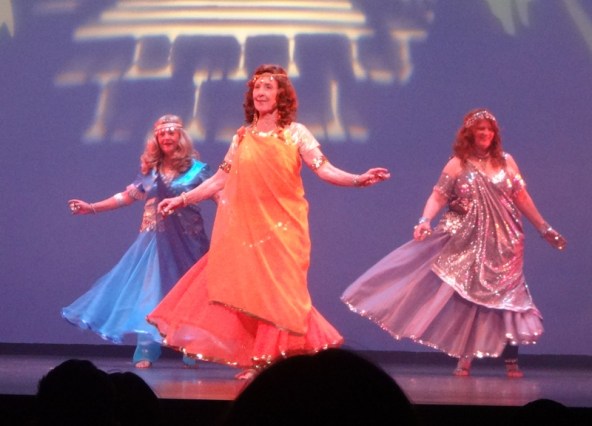
I do miss the energy of choreographed dancing with a group — it always seemed I could do more than when I was by myself, but I don’t miss performing.

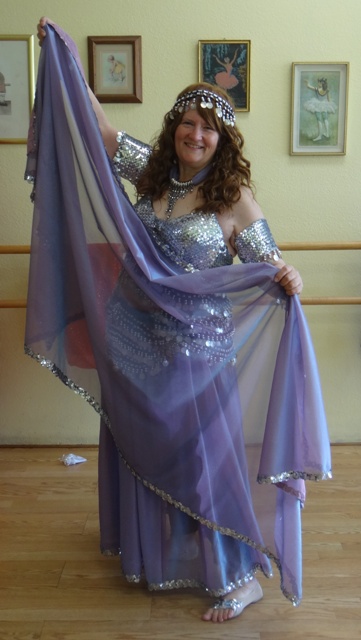
I did my first belly dance performance with the group only a few months after I starting taking classes, and though I was no slimmer then than I am now, I was okay with it — I had a fabulous costume, a flattering wig, and a great attitude: “This is who I am. Deal with it.” As time went on, I lost that attitude, and so performing became more of a chore and less of a joy, though I did retain the love of dancing for dancing’s sake.

Of all dance forms, belly dance seems to lend itself to solo dancing, to pulling energy from the soul rather than the spirit of a group, to being one with one’s body. It helps that I’m not dancing in front of a mirror — I can feel young and beautiful and graceful without the unpalatable truth glaring at me.

Once the garage is built and my back room available to me once more, I will be able to do some barre work, maybe some tap or jazz, and perhaps even Hawaiian. Until then, there’s me, a veil, an open floor, and belly dance.

***

Pat Bertram is the author of Grief: The Inside Story – A Guide to Surviving the Loss of a Loved One. “Grief: The Inside Story is perfect and that is not hyperbole! It is exactly what folk who are grieving need to read.” –Leesa Healy, RN, GDAS GDAT, Emotional/Mental Health Therapist & Educator.
Happy Lunar New Year

In honor of the Lunar New Year (Chinese New Year), I looked up my Chinese horoscope, and oh, my! People who cast star horoscopes generally try to put a good light on their predictions, but apparently, the same is not true of Chinese horoscopes. Mine for this Lunar New Year is: “Your horoscope is not very good at all. Your career development will be hindered. Your financial fortunes are not optimistic. You need to consider carefully to weigh gains and losses before making decisions. Your health luck is not ideal. Do not drink alcohols too much. But don’t be too worried, otherwise your situation will only get worse and worse.”

Really? Sheesh. I might as well go to bed and stay there until the next Lunar New Year.

There is the gentler star sign horoscope, however, to balance this rather dismal prediction, though looking closer, both horoscopes say the same thing.

Instead of: “Your horoscope is not very good at all,” the stars say: “All your daydreams could come crashing down. You won’t want to face the realities that slowly creep in. You’re tougher than you seem, though, so having to face the music can be a blessing in disguise.” Sure sounds as if I’m in for a rocky time.

Instead of: “Your career development will be hindered,” the stars say: “This can be a time for working on a project in advance of a launch date. You may be in a processing or hatching stage with a venture.” In other words, my career is going nowhere. To be honest, that’s to be expected. Although a publisher accepted my latest manuscript, I don’t have a publication date and I don’t expect one until the latter part of the year. And, although I have a book stewing in my brain pan, I have yet to write a single word.

Instead of: “Your financial fortunes are not optimistic,” the stars say: “You need to set aside enough money to meet unexpected expenses.” Well, so much for my financial fortunes this year!

Instead of: “You need to consider carefully to weigh gains and losses before making decisions,” the stars say: “You need to refrain from making major decisions in money matters, and you are not to incur any major expenses.” Oops. Too late. A garage isn’t exactly a minor expense.

Instead of: ‘Your health luck is not ideal,” the stars say: “Health issues may come to the fore. There can be some strains on mental and physical health.” That doesn’t sound appealing, but hopefully, being careful and taking care of myself will offset some of this not-so-good health luck.

Instead of: “Do not drink alcohols too much.,” the stars say: “You might often be tempted to escape your everyday responsibilities and challenges, and should avoid reliance on drugs or drinking.” Does that mean I have to forgo my single yearly Bailey’s Irish Cream toast to my mother? But, by any calculation, a single drink can’t be considered either “too much” or a “reliance on drugs or drinking,” so I think I’m safe.

Instead of: “Don’t be too worried, otherwise your situation will only get worse and worse,” the stars say: “The cosmos asks you now to surrender some of your attachments and to surrender to the unknown. Releasing control is necessary. You could feel that you are dealing with endings more than new beginnings in some areas of life during this transit, as you let go of outdated attachments. With self-discipline, you could find more joy and confidence.” So, basically, this is a year of not so good luck for me, but I shouldn’t worry, or it will get worse. Okay, got it.

The stars, at least, offer hope. “This is a time when you are filled with ideas about the future. You are planting seeds, so to speak, aiming to get started on projects that will reap rewards in the future. For the most part, you are likely to take advantage of this period in your life in order to expand your social life and friends base as well as to dream up exciting new paths for the future.” Apparently, if I can’t have good luck this year, there is always next year.

Fortunately, horoscopes have never reflected anything that has ever happened in my life, and despite this rather interesting research project today, I don’t expect these horoscopes to be any different.

So, let’s all have a happy Lunar New Year!

***

Pat Bertram is the author of Grief: The Inside Story – A Guide to Surviving the Loss of a Loved One. “Grief: The Inside Story is perfect and that is not hyperbole! It is exactly what folk who are grieving need to read.” –Leesa Healy, RN, GDAS GDAT, Emotional/Mental Health Therapist & Educator.

You Know You’re Not in California Anymore . . .

Jeff and I always brought our own bags to the grocery store even though it wasn’t mandated or even strongly recommended. We just did it because we didn’t need all those bags and didn’t want to have to worry about recycling unnecessary bags. After I went to take care of my dad in California, and the state outlawed single use plastic bags, there was no problem. I continued bringing my own bags. Once or twice I made an unexpected stop, and so went ahead and bought the multi-use bags that were available under the new law. These bags were said to be so much better because they were supposed to be able to be used 300 times. Um, no. I think I got about three uses out of them before they were rendered unusable.

Even worse, people on food stamps and other programs did not have to pay for those bags, so they used those heavy multi-use bags with the same disregard they did the old cheap ones, which helped the environment not at all since the new bags have a much heavier environmental impact than the original thin bags. Also people who used to use the single-use grocery bags for trash liners and such, now have to buy them, which does little to reduce plastic bag waste. (Studies also shown that since the ban, people buy more and thicker trash bags than they did before the ban.) Moreover, the cotton or polyester bags that people use instead need to be used 131 times before they break even in an environmental sense, and those bags — especially the polyester ones — don’t last that long. And you still need plastic for things like meat, because meat often leaks, and soiled bags can cause illness. Most confusing to me is that paper bags are given free if people want them, but the idea of cutting down trees just so people have things to carry their groceries in seems absurd (and wasteful) to me.

But that’s not really the point of this discourse. I was just reminded of the plastic-bag controversy when I went to a local store the other day, plopped the bags I was reusing on the counter, and told the cashier, “I brought my own bags.” He looked at me blankly, then threw them away. “I brought those bags to reuse,” I told him. “That’s what ‘I brought my own bags’ meant.” The kid still didn’t get it. He put a couple of my items in a new bag, and when I told him I didn’t want a bag, he started to throw away that unused bag, too. I said, “If you’re going to just throw it away, it defeats the purpose of not using a bag, so I’ll take it.” Another blank stare.

Yep. Not in California anymore. As ill-conceived as the California ruling is, it’s still a good idea for people to be more cognizant of excess plastic bag use. Some people are aware of the necessity of reusing bags or bringing their own, they just don’t do it. One older woman told me her grown daughter always brought her own bags to stores, but her daughter only had to shop for one person, and she had to shop for a family. I told her it was just as easy to bring ten bags as one, and she nodded, but the look she gave me was as blank as the one the kid had given me.

Colorado still allows single-use bags, which is nice for me — if I need wastepaper basket liners, I let the grocery stores put my groceries in their bags. That way I don’t have to buy any. Still, if it ever got to that point, I’d find a way since many stores are exempt from the ban, but I hope I don’t have to worry about it.

Legislation is never an answer. Being aware of the impact of one’s actions is. Not that I’m preaching. I just found these examples of not being in California anymore rather illuminating. Actually, I’m not really even in Colorado anymore, at least not when it comes to bag use. Stores on the front range (Denver, Colorado Springs, etc) and stores on the western slope (Grand Junction, Montrose, etc) credit people for using their own bags (it used to be five cents a bag), so that cashiers were at least cognizant of the idea of reuse.

Eventually, I’ll get people around here used to the idea that I don’t waste plastic bags. Already one or two cashiers automatically hand me my items. But I have yet to see anyone else bring their own bags.

***

Pat Bertram is the author of Grief: The Inside Story – A Guide to Surviving the Loss of a Loved One. “Grief: The Inside Story is perfect and that is not hyperbole! It is exactly what folk who are grieving need to read.” –Leesa Healy, RN, GDAS GDAT, Emotional/Mental Health Therapist & Educator.
Librarier

There is an anecdote going around the internet where a mother asks her little girl what she wants to be when she grows up.

The girl responds, “A librarier.”

“Don’t you mean a librarian?” the mother asks.

“No,” the girl says. “A librarier. Someone who goes to the library and reads.”

This could be a true story because kids can be that precocious, but even if someone besides a little girl made up the word, it’s a good one. And since I identify with the term, I would modify it to simply mean “someone who goes to the library.” I don’t do well reading in public — I need the mental space and freedom to relax into the book, and I can’t do that — don’t want to do that — when people are around. I feel too vulnerable.

Since I’m such a good and reliable librarier, I get to check out more than the maximum. (Being a “good girl” sometimes has its privileges!) But I still go quite frequently.

I have a friend who also reads a lot, but she does read at the library. She once said to me, “People always tell me that life’s too short to spend it reading. I say life’s too short not to spend it reading.”

That’s basically my philosophy. In my younger years, that’s what I did — read. It’s all I ever wanted to do. It’s not a good career choice since there’s no money in it (I could have been a librarian, I suppose, but then I’d have to watch everyone else read while I worked, and that’s not the same thing.) Still, I managed to mostly read my life away.

After Jeff died, everything changed, even reading. For the first time in my life, I couldn’t stand to read fiction. Too many books involved death, and I couldn’t face that faceless beast. Other books involved couples getting together, which was excruciatingly painful since I no longer had anyone. Still other books involved couples not getting together, which was just as bad, because it reminded me of my situation. And I was too unfocused to read non-fiction.

I did struggle with books for a while, but when the library closed for asbestos cleanup, I didn’t miss reading. I did buy an occasional book, but my finances don’t really lend themselves to such an indulgence.

Now, though my finances are even in greater disrepair than ever before, I have a library a few blocks away, a decade’s worth of reading to catch up on, and even better, death’s sting has receded.

So once again, I am a librarier.

***

Pat Bertram is the author of Grief: The Inside Story – A Guide to Surviving the Loss of a Loved One. “Grief: The Inside Story is perfect and that is not hyperbole! It is exactly what folk who are grieving need to read.” –Leesa Healy, RN, GDAS GDAT, Emotional/Mental Health Therapist & Educator.


Celebrating the Newness

I’ve never really celebrated the New Year because it doesn’t mean much to me. It’s a relatively arbitrary date. The calendar numbers change, but that’s all. It’s not a universal new beginning. The Chinese New Year this year is on January 25, the Jewish New Year is on September 18, the Persian New Year is March 19, the Korean New Year is January 25, the  Tibetan New Year begins on February 24, and various communities in the Hindu religion have different dates for their celebration.

January 1 is not even the beginning of a new season or of a solar cycle such as a solstice or an equinox. Nor is there any personal demarcation — no black line separates the old from the new. The world is no different today from yesterday, nor are we. We carry the old year with us because you have the same problems, sadnesses, hopes, fears.

There is a newness to January 1, though, and that is the newness of a new calendar.

Like school kids with stiff new clothes and a satchel full of crayons, unread books, and blank paper, we are ready to set out on an adventure, trembling with both trepidation and excitement. Our new calendars have 365 blank squares. How will we use those squares? With notations of appointments and special days, of course. Perhaps with reminders of bills to pay and chores to do. But many of those days will be blank. What we will do with those blank days? Will we search for happiness or a new love? Will we recommit to an old love? Will we strive to attain a better level of health? Will we experience new things, meet new people, visit new places, sample new foods?

I do feel that particular newness today, that hope.  I’ve had marvelous adventures the past past year — buying a house, settling into a new home and community, making new friends. And now I have 365 blank days on my new calendar. I plan on getting out my box of crayons and coloring those days brightly with the glow of a smile, laughter shared, and moments of appreciation for the world around me.

I hope your days will be filled with color, new adventures, and much joy.

Happy New Year.

***

Pat Bertram is the author of Grief: The Inside Story – A Guide to Surviving the Loss of a Loved One. “Grief: The Inside Story is perfect and that is not hyperbole! It is exactly what folk who are grieving need to read.” –Leesa Healy, RN, GDAS GDAT, Emotional/Mental Health Therapist & Educator.