It’s Never Too Late to Make a New Year’s Resolution

Only 8% of people keep their New Year’s resolutions until the end of the year. Most people abandon them in the first month or even the first week.

This sad state of affairs makes us seem wishy-washy at best and lazy at worst, but there is something more at work than simply a lack of . . . well, a lack of resolve.

I’ve come to realize that instead of losing our resolve, we lose the clean-slateness. After only a few days, the sense of a new beginning dissipates. We become used to writing the new year on our checks. We’re back into the routine of our lives, probably more tired, more broke, and fatter than we were before the holidays. And somehow, in the comfort of our old lives, we forget the idealism we had when embracing a new year. We forget that for a moment we believed anything was possible, that we could become better, stronger, healthier, wiser, richer, more beloved if only we . . .

I abandoned the practice of making resolutions when still a child after I realized that by the end of that first week, I’d completely forgotten my resolution. (I only remembered when the next new year rolled around and I tried to, once again, make that same undoable commitment.)

Too many things happen during the year to make us either forget our resolve or to make us stop caring. So perhaps another reason we can’t keep New Year’s resolutions is that we make them too early in the year. What if we made the resolutions after birthday celebrations, Valentine’s Day, anniversaries, summer, Halloween, Thanksgiving, Christmas are passed?

Today seems a perfect day to make New Year’s resolutions for 2019 — especially since I started these resolutions yesterday. So from now until the end of the year, I resolve eat more vegetables, drink more water, and do a bit of exercise.

Now I have to remember those resolutions.

Oh, the pressure!

***

Pat Bertram is the author of Grief: The Inside Story – A Guide to Surviving the Loss of a Loved One. “Grief: The Inside Story is perfect and that is not hyperbole! It is exactly what folk who are grieving need to read.” –Leesa Healy, RN, GDAS GDAT, Emotional/Mental Health Therapist & Educator.
In and Out of Kilter

The origin of “out of kilter” is unknown, though the phrase itself has been in use since the 1600s. Kilter or kelter means good condition, so you can be both in kilter or out of kilter, though generally at separate times. “Off kilter,” which is a variation “out of kilter” and means the same thing, seems to have originated in the 1920s.

The origin of “out of whack” is also unknown, though the word “whack,” meaning to hit something, was used as early as the 1700s, and “out of whack” itself has been used since 1885. It’s been conjectured that “out of whack” refers to machinery that needs to be whacked to get it going, but the truth is anyone’s guess.

The origin for haywire is known, however, and is a relatively new term, only about a hundred years old. The etymology is obvious when you think about it: hay + wire. Haywire or baling wire is a thin, flexible wire that is used to hold bales of hay together, and was the equivalent of today’s duct tape. I’m sure you’ve heard of old vehicles being held together by baling wire. So not only does haywire refer to shoddy or makeshift work, the wire itself, once it’s off the spool, gets easily tangled. Hence something that is out of whack or off kilter is also haywire.

So why all this talk of things being out of order?

I seldom break things. Though stuff does slip through my fingers all too frequently, the items are either unbreakable or they fall softly without breaking, but last night I knocked over a champagne flute that was on the kitchen counter, (I was toasting the day after my first Christmas in my first house with sparkling cider). Although the flute simply fell over onto its side, it shattered. Took me forever to clean up all the crystal crumbs!

Then later, as I was lounging on the couch drinking tea and reading, I got a text. After responding to the text, I reached out to put my phone on the table and knocked over the empty mug. It too shattered.

Neither of these breakages meant anything (except that I had one less flute and one less mug), but it showed how far I’ve come in the last ten years. About seven months after Jeff died, I dropped a mug. It shattered on the hard tile kitchen floor, and set me back into full grief mode. I couldn’t stop crying for days. It was one more thing gone out of the life we shared, and it struck me as horrendously sad that stuff was going to break, wear out, get used up until there was nothing left of “us”?

Last night, there was no emotional aftershock. The things broke, and I cleaned them up. End of story. Well, except for the part of wondering why things were so off kilter. Which of course, led me to wonder what kilter meant, which led me to out of whack, which led to haywire.

Which leads to my New Year’s wish for you — that your life remains in kilter all next year.

***

Pat Bertram is the author of Grief: The Inside Story – A Guide to Surviving the Loss of a Loved One. “Grief: The Inside Story is perfect and that is not hyperbole! It is exactly what folk who are grieving need to read.” –Leesa Healy, RN, GDAS GDAT, Emotional/Mental Health Therapist & Educator.

Facing the Unfaceable

We who have lost our spouses, life mates, soul mates often have to show empathy and understanding to others rather than receiving it from them. We are the ones hurting, so why do we need to be understanding of their feelings? Because it is far easier for us to remember what it felt like to be in their situation, than it is for them to imagine what it must be like in ours.

Shortly after Jeff died, I had to let a man know of the death, though I don’t remember how I conveyed the information. It took months before I could actually say the words, “Jeff is dead.” But I do remember his response. “I know what you’re going through,” he said. “My dog just passed away.”

I stared at him, unable to process those words. To this day, his remark appalls me, though I have come to understand he was reaching out the only way he knew how.

Death is shrouded with an element of blank. It is the great unknown and unknowable, and our brains are not equipped to handle the immensity. While we are in the grip of our grief, the survival mechanisms of those around us are triggered. To avoid facing the unfaceable, people close to us will indulge in self-protective behaviors that shut us out.

Sometimes long-time friends, especially couples, draw away from us. The death of our spouse and the demise of our couplehood change the dynamics of our friendships. People fear we will now be uncomfortable in the company of couples. At the same time, they are uncomfortable with us because all unwittingly, we are a reminder of how fragile life really is.

This drawing away is often an unconscious reflex — they know we are hurting, know they feel helpless in the presence of our pain, but they don’t really know they are acting any different and certainly they don’t know why.

The jargon of grief is that of illness, of negativity, of . . . fault, as if somehow we who are grieving chose our state and now we have to overcome, heal, recover, move on, get over, return to normal. By blaming us for grieving too long, by refusing to admit that our grief is normal, onlookers to our grief can more comfortably return to their job of surviving, and leave us alone with our sorrow.

Even those who are kind to us bereft, even those who continue to be supportive, lose the urgency they had at the beginning. They cannot sustain that same level of support because grief takes way too long, and they need to focus on their own lives.

Despite these protective behaviors and the almost bumbling way people treat the bereaved, and despite my occasional acrid comment about the insensitive things people say to grievers, people do care, and they do want to say the right thing. In the last couple of days, more than 3,300 people landed on my blog post What Do You Say to Someone Who is Grieving at Christmas? after Googling such things as “how to say Merry Christmas to someone who is grieving.” “how to wish someone a Merry Christmas after a loss,” “Christmas greeting for grieving person,” “how to wish Merry Christmas to someone who is grieving.” In fact, since I posted that particular blog in 2011, more than 80,000 people have viewed the article.

Many thousands more have viewed What to Say to Someone Who is Grieving.

The true villain here is death. While the very idea of death drives non-grievers away, it draws us grievers in, forces us to face the unfaceable, makes us an accomplice. And yes, even allows us to show empathy to those who don’t understand but who try to show sympathy the only way they can.

***

Pat Bertram is the author of Grief: The Inside Story – A Guide to Surviving the Loss of a Loved One. “Grief: The Inside Story is perfect and that is not hyperbole! It is exactly what folk who are grieving need to read.” –Leesa Healy, RN, GDAS GDAT, Emotional/Mental Health Therapist & Educator.

A Gift for You

Merry Christmas, Happy Holidays, Season’s Greetings, Peace and Joy, Warmest Wishes, Happy Solstice, Good Yule, Noel, Good Cheer, Good Tidings, Merry Xmas, Happy Holy Holidays, Warm Greetings, Holly Jolly Holidays, Let it Snow, Ho Ho Ho, Feliz Navidad, Joyeux Noel, Mele Kalikimaka, Buon Natale, Buone Feste Natalizie, Feliz Natal, Nollaig Shona, Fröhliche Weihnachten, God Jul, Wesołych Świąt, as well as any other greeting you use to acknowledge this special day.

Click on the gift to open. Have fun!

***

Pat Bertram is the author of the suspense novels UnfinishedMadame ZeeZee’s Nightmare, Light BringerMore Deaths Than OneA Spark of Heavenly Fireand Daughter Am IBertram is also the author of Grief: The Great Yearning, “an exquisite book, wrenching to read, and at the same time full of profound truths.” Connect with Pat on Google+. Like Pat on Facebook.

Happy End of the Creeping Darkness!

20171214_195354-1.jpgThe creeping darkness will end this evening at 9:19 pm MT. “Creeping darkness” is a phrase I created, which is probably why you haven’t heard of it before.  I have a hard time with this time of year and the way the darkness comes earlier and earlier, stealing light from my days, and so “end of the creeping darkness” seems a perfect name for this particular event. The correct term, of course, is “winter solstice.”

“Solstice” comes from two Latin words, sol meaning “sun” and sistere meaning “stationary” because on this day, in the northern hemisphere, the sun seems to stand still, as if garnering it’s strength to fight back the darkness.

Technically, the winter solstice marks the moment when there is a 23.5-degree tilt in Earth’s axis and the North Pole is at its furthest point from the sun — from here on, the days will get longer, gaining us an additional 6 and 1/2 hours of sunlight per day by June 21st when the days begin to get shorter again. (This is reversed in the southern hemisphere, so today those down under will be celebrating their summer solstice.)

Though neo-pagans have claimed the solstice for their own, this is one of those natural holidays (holy days) that we all should be celebrating. The end of the lengthening nights. The triumph of light over darkness. We don’t even need the metaphors of light=good and dark=bad to find reason to celebrate this day. It’s simply a day of stillness, of hope. A day to give thanks for the promise that even in our darkest hour, light will return.

My celebration will be simple. I’ll turn on my bowls of light and go outside to toast the pale winter sun with sparking cider. Technically, I will be toasting the moon since the sun will have set hours before, but the sun won’t care. It will be shining brightly in the southern hemisphere, and will return to this part of globe tomorrow with greater strength.

Wishing you a bright and hopeful end of the creeping darkness.

***

Pat Bertram is the author of the suspense novels Light BringerMore Deaths Than OneA Spark of Heavenly Fireand Daughter Am IBertram is also the author of Grief: The Great Yearning, “an exquisite book, wrenching to read, and at the same time full of profound truths.” Connect with Pat on Google+. Like Pat on Facebook.

Grieving at Christmas

The misconceptions people have about grief are appalling. Someone asked me today what grievers hope to accomplish by being depressed at Christmas (and not doing anything about it) when the grievers know being depressed won’t bring back their loved one.

As if we a choice about grieving. As if we want to be sad. As if drugging oneself into happiness is a viable choice.

Depression and grief are not choices. They happen whether we want them to or not.

Besides, grief over the loss of a loved one, at Christmas or the rest of the year, is not depression. Clinical depression is being sad for no reason. Grief is its own reason.

Holidays are painful. The first wedding anniversary, the first birthdays, the first major holidays. Each of these days brings a greater sense of grief because we are intensely aware that our life mate is not here to experience these once-happy holidays with us. Whatever traditions we developed together become obsolete when only one of us remains to carry on. The pain and the yearning to be together once more during these times can be devastating.

Thanksgiving, Christmas, Chanukah, New Years are the big holidays with the biggest challenges. These special days are family celebrations, and often we are left alone with our memories and our feelings, even if we are surrounded by family.

The holidays during the second and third and fourth and even beyond can be just as difficult. Not only are our traditions gone along with our loved one, every commercial, every song, almost every movie tells us we should be happy, but all we know is that the person we most want to be with, the person who helped bring us happiness or helped magnify our happiness is gone. Even worse, we often need to pretend to be happy about our situation to keep from ruining the festivities of others.

The grief we feel at this time of year is not a conscious choice and comes even if we aren’t reminded of the holidays.

Our bodies remember the special occasions. Our bodies as well as our minds and spirits grieve, so even if we are able to put our deceased loved ones out of our minds, our bodies grieve for us with an upsurge of adrenaline and a change in brain chemistry.

It takes a lot of energy to try not to remember, not to grieve, which overwhelms the brain and exacerbates the very stresses we are attempting to overcome.

This is all in addition to normal seasonal effects, such as depression from the shorter days and longer nights. It’s also in addition to the normal stresses of the holidays.

No one wants any of this. No one ever thinks grief will bring the loved one back. We wish . . . oh, how we wish for one more smile or one more word, but it’s not going to happen, and we know that. But still, watching others have what we don’t is very painful, even if we are happy for them and their love.

Supposing we could do something about our sadness at Christmas, what do you expect us to do? Drug ourselves into oblivion? That’s a heck of a lot worse than feeling sad. Grief connects us in a tenuous way to our lost love; it’s a way of honoring them, and feeling the pain is the best way to learn to live without our love.

Jeff has been gone long enough that I no longer feel much of an upsurge in grief at this time of year, but I am very aware of what it used to be like for me and what it remains like for many grievers.

So, if you, too, have archaic ideas about grief, like the person who asked the question, please try not to foist your ideas on grievers. After all, one day you might be grieving at Christmas, too.

See also: What Do You Say to Someone Who is Grieving at Christmas? and Dealing With Grief During the Holidays.

***

Pat Bertram is the author of Grief: The Inside Story – A Guide to Surviving the Loss of a Loved One. “Grief: The Inside Story is perfect and that is not hyperbole! It is exactly what folk who are grieving need to read.” –Leesa Healy, RN, GDAS GDAT, Emotional/Mental Health Therapist & Educator.

An Inside Look at a Small Town

Last night I attended a strategy session of the city council. I had no idea that’s what I was doing — the way it was originally explained to me, it seemed a one-time meeting to offer suggestions to improve conditions for senior citizens. Instead, it’s a seven-session focus group to address the needs of the community as a whole.

We discussed various matters, such as what we’d like the town to be, how it is now, how it is perceived by others, what change is under the control of the council and what is not.

Some things that need to be done, such as fixing the sidewalks and the storm drainage problem, are important, but won’t do much for how the town is perceived, though it sure would make it easier to walk! (Those of us who get around on foot generally walk in the streets.)

Most of what needs to be done, as far as I can see, is not under the control of the town. The loose dog situation is the county sheriff’s problem. Other situations are an individual’s problem. So many of the properties are abandoned, not just houses, but strips of what once were small businesses, though these places are probably not actually abandoned but still owned by someone who is simply not doing anything with them. Also, fewer than half the houses here are owner occupied, which makes for a tenuous situation at best, and there is no way to legislate away that ratio.

The council also wants to find a way to keep young adults here, and again, I don’t think it’s possible. The nearby towns that have brought in jobs are those that in the end destroy quality of life — one town brought in a feed lot, which, at certain times of the year, makes the air unbreathable. Same with the towns that brought in marijuana farms. Again, at certain times of the year, the air would be unbreathable. A neighbor a couple houses away has several marijuana plants, and in the summer, the smell of skunk is very strong. I can’t imagine an entire farm of that!

Other agriculture solutions are not feasible since so many rural folks sold their water rights. (That sure stunned me. Didn’t they ever watch westerns, where water rights are worth more than gold? But then, with agriculture collapsing in this area, I suppose they needed the cash in hand.)

Good paying jobs, such as those in the computer industry won’t be coming here, so ambitious young people would want to go out in the world and create a better life for themselves. The best the town can hope for is to make it a place where they want to come home to after they’ve seen and experienced more of life.

I did find it interesting that the youth and the older folk are looking at the situation from two different directions — so many of them are planning to leave, so many of us are here to stay.

A friend once said she thought the town should be advertising itself to seniors — because of the prevalence of small houses and their relatively low price as well as a moderate climate, the place is ideally suited for older people. (I mentioned this idea, but the council doesn’t want to focus on a single demographic.) I tend to think that over the years, this trend toward an older population is going to happen anyway because of the need for cheaper and smaller housing for retirees, though the lack of local doctors and urgent care could be a problem. There are doctors and a hospital about twenty-five miles away, but people who need specialists have to make the long trip to the cities along the front range — such as Pueblo, Colorado Springs, Denver.

No one seemed to care about my idea of an adult jungle gym since they didn’t think it had anything to do with changing how the town is perceived, though I think it does — it shows a progressive bent.

Even though this group isn’t what I thought it was, and even though I don’t really have anything to contribute (I can see the problems but not solutions), I might continue with these sessions. (As long as I can get a ride, that is — I’ve been told that it’s not safe to walk at night here, not even the few blocks to the town hall.) It gives me a different perspective of the town, and the councilwoman for whom I acted as a senior advisor last night wants me to come back. I know this woman from a painting class we took, and I like her, so I might continue for that alone.

Besides, the mayor asked me. Well, obliquely. He said, “Most of you are here because I asked you to come and be advisors, and those I haven’t already asked, I’m asking you now.”

So, there you have it, an inside look at the workings of a small town.

***

Pat Bertram is the author of Grief: The Inside Story – A Guide to Surviving the Loss of a Loved One. “Grief: The Inside Story is perfect and that is not hyperbole! It is exactly what folk who are grieving need to read.” –Leesa Healy, RN, GDAS GDAT, Emotional/Mental Health Therapist & Educator.

Appreciation

A local woman’s snowman collection is being featured at the historical museum. There are hundreds of the creatures, all kinds and sizes (though none made of real snow).

I don’t have anywhere near as many snowmen as she did, but I do have a very small collection of my own. Though I have no particular interest in snowfolk, things do tend to accumulate.

This is an ornament I did in a porcelain painting class. The subject matter was chosen by the teacher, probably because a snowman is a fairly easy subject for beginners:

This is a wooden wall decoration made for me by one of my new friends:

This is a gift card a friend sent to me couple of years ago, that I thought was clever.

And then there are these two five-inch-tall snowfolk who apparently think they are on an island adventure.

I wouldn’t even have those last two except for Jeff. Although they took me forever to make (each hand-sewn body consists of eight pieces, plus another eight for hands and feet), I wasn’t impressed, and intended to get rid of them, but Jeff wouldn’t let me. He liked most of what I made, and if I did throw something away, he always rescued it. These two snowfolk adorned his desk for many years, and at the end of his life, when he told me what he wanted me to do with his “effects,” he requested that I keep them. (In fact, most of the things he asked me to keep were things I had made.)

I realize I am not bound by any promises to the dead, but it’s such a little thing Jeff asked for, and though I still don’t particularly like these little guys, they remind me of him. He was such an appreciator, not just of my things, but of anything of artistic merit.

Jeff was the sort of person movie directors hope would watch their movies, would understand their vision and appreciate all the nuances that went into creating that vision. He’d study the backgrounds and settings, special lighting effects, the subtleties that most people (including me) would miss. It wasn’t just movies — he appreciated music, books, even comic strips. When we got Calvin and Hobbes books, I’d scan through them, reading the words, enjoying the jokes, and was done in a jiffy, but he studied every line of every panel, sometimes taking as long to read/appreciate one strip as it took me to read the whole book.

Most of the things I kept of his are packed away, but I dug out the two island hoppers for this latest installment of my Christmas show and tell.

Now I’m sitting here, staring at the computer screen, tears in my eyes, wishing for . . . I don’t know. Maybe one more of his appreciative smiles. But whatever it is I want, it’s something I can’t have.

What I do have are things. And kept promises.

And a greater appreciation for my small collection of snowmen.

***

Pat Bertram is the author of Grief: The Inside Story – A Guide to Surviving the Loss of a Loved One. “Grief: The Inside Story is perfect and that is not hyperbole! It is exactly what folk who are grieving need to read.” –Leesa Healy, RN, GDAS GDAT, Emotional/Mental Health Therapist & Educator.

All That Glitters

I haven’t done a lot for Christmas in recent years. When I was caring for my father, I made sure to make the day festive for him — decorating his small tree (which I inherited), making a requested meal (usually ham and potato salad), and getting token gifts. After he was gone, I did very little for Christmas, though I did exchange a couple of presents.

Since I’ve always saved wrappings and ribbons, I never had to purchase either. This year, however, I decided to go all out for Christmas — after all, it is the first Christmas/holiday season in my own home in my very own house. I’d used all the ribbons I had for hat decorations, and I had gotten rid of any paper when I condensed the stuff in my storage unit at the beginning of last year, so I needed to buy wrapping things.

The wrapping paper was cheap and pretty, and though I prefer blank undersides (to make gift cards and such), I had to admit the cutting lines made things easier. But oh, what a shock to find, at the end of the roll of wrapping paper not a cardboard tube (which I had plans for!) but simply rolled up brown paper. I did manage to roll that heavy brown paper tight enough to make an okay tube for what I needed (to store leftover window screening). But jeez. What’s the fun of buying rolls of wrapping paper if you don’t get a long tube with it?

And the ribbons. Oh, my. The upside: so glittery. The downside: so glittery.

When I finished wrapping my packages last night, I noticed that glitter was everywhere. I was covered with glitter. The floor was covered with glitter. The countertops and table were covered with glitter.

I dry mopped, thinking that the trap-and-lock cloths would easily pick up all the glitter. Nope. Some, sure, but not even most. Then I tried vacuuming. Again, nope. Those little suckers stuck to the floor and wouldn’t budge. Then I wet mopped — twice — which got up most of the remaining glitter, but now, when the lights are on, I can see glitter between the floorboards. My floor is the original antique flooring that has never been refinished, and some of the boards have shrunk a bit in this dry climate, leaving space for glitter to settle. I have a hunch I’ll be cleaning up glitter until next Christmas.

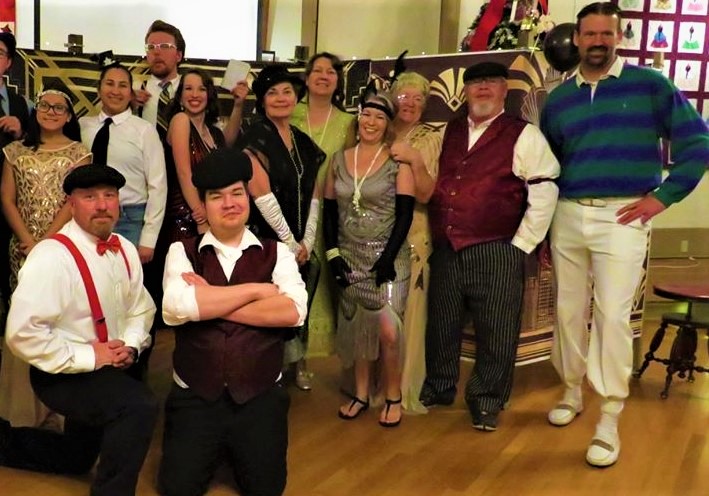
I was already tired from a full day of festivities at a Christmas event put on by both the museum folks and the art guild. (Here’s some of us art guild members all decked out in holiday gear.)

All that cleaning took me way past my bedtime (and I am not an early-to-bed-early-to-rise person) and wiped me out.

I try to end every blog post with some sort of hook or moral or lesson gleaned from the experience I’d written about — because otherwise, what’s the point — but the only thing I can think of to end this post is a note to myself: No matter how enticingly glittery the glittery things are, next year, be sure to buy plain old non-glittery ribbon and paper.

***

Pat Bertram is the author of Grief: The Inside Story – A Guide to Surviving the Loss of a Loved One. “Grief: The Inside Story is perfect and that is not hyperbole! It is exactly what folk who are grieving need to read.” –Leesa Healy, RN, GDAS GDAT, Emotional/Mental Health Therapist & Educator.

Oops

Oops. I’d completely forgotten I was supposed to be writing a 1920s murder mystery for a dinner in February, and it needs to be done by the middle of January.

When I agreed to do write the mystery, I had plenty of time, but I frittered that time away on . . . well, on living. So now I’m trying to catch up.

I sort of have an idea of who will be the victim, who the killer is. I know where all this takes place: one night at a speakeasy. I know an Italian dinner will be served. I know there will be a representation of at least some of the iconic elements of that 100-year-old decade besides the speakeasy: jazz, gangsters, flappers. Other than that, I haven’t a clue how to go about concocting such a mystery. Obviously, the first part of the dinner is about laying the background for the characters and why someone wanted to do the dastardly deed. Then, even more obviously, there needs to be a dead body. And finally, at the end, there needs to be a way for everyone to figure out who did it.

I’m not sure how to lay the clues. Or what the clues should be. I could write this as a mystery story, and then extrapolate the guessing game from that, but considering how long it takes me to write fiction, it might not be done until next year, especially since they want it to be funny, and funny takes longer.

Still, that’s not a bad idea, writing the mystery as a story. Once I have the whole story, I could possibly work backward. More importantly, it would give me bits of dialogue to hand out to guests, because it’s hard to tell people what they need to be saying if I don’t know.

All done in less than a month? With Christmas coming? Yikes!

Maybe I can start tomorrow. But no, I am helping with a fundraiser at the museum. Maybe Monday? But Monday I am going to the big city (or what passes for a big city in these parts) with a friend who has a doctor appointment. Maybe Tuesday? But Tuesday, I am going to a meeting to help brainstorm ideas for AARPs Livable Communities program.

It’s beginning to look as if the mystery will have to write itself.

***

Pat Bertram is the author of Grief: The Inside Story – A Guide to Surviving the Loss of a Loved One. “Grief: The Inside Story is perfect and that is not hyperbole! It is exactly what folk who are grieving need to read.” –Leesa Healy, RN, GDAS GDAT, Emotional/Mental Health Therapist & Educator.