Ask and You Shall Receive

I’ve asked for many things in my life that I never received, small things like not getting a refund for something I ordered that had never been sent and big things like Jeff getting well, but apparently, Jonathan apples are one thing I can ask for and actually receive.

I’d asked the produce manager at the local grocery store for Jonathan apples, and he ordered them. (I wasn’t the only one that wanted them, which helped. He says he has several ladies who want Jonathans and only Jonathans).

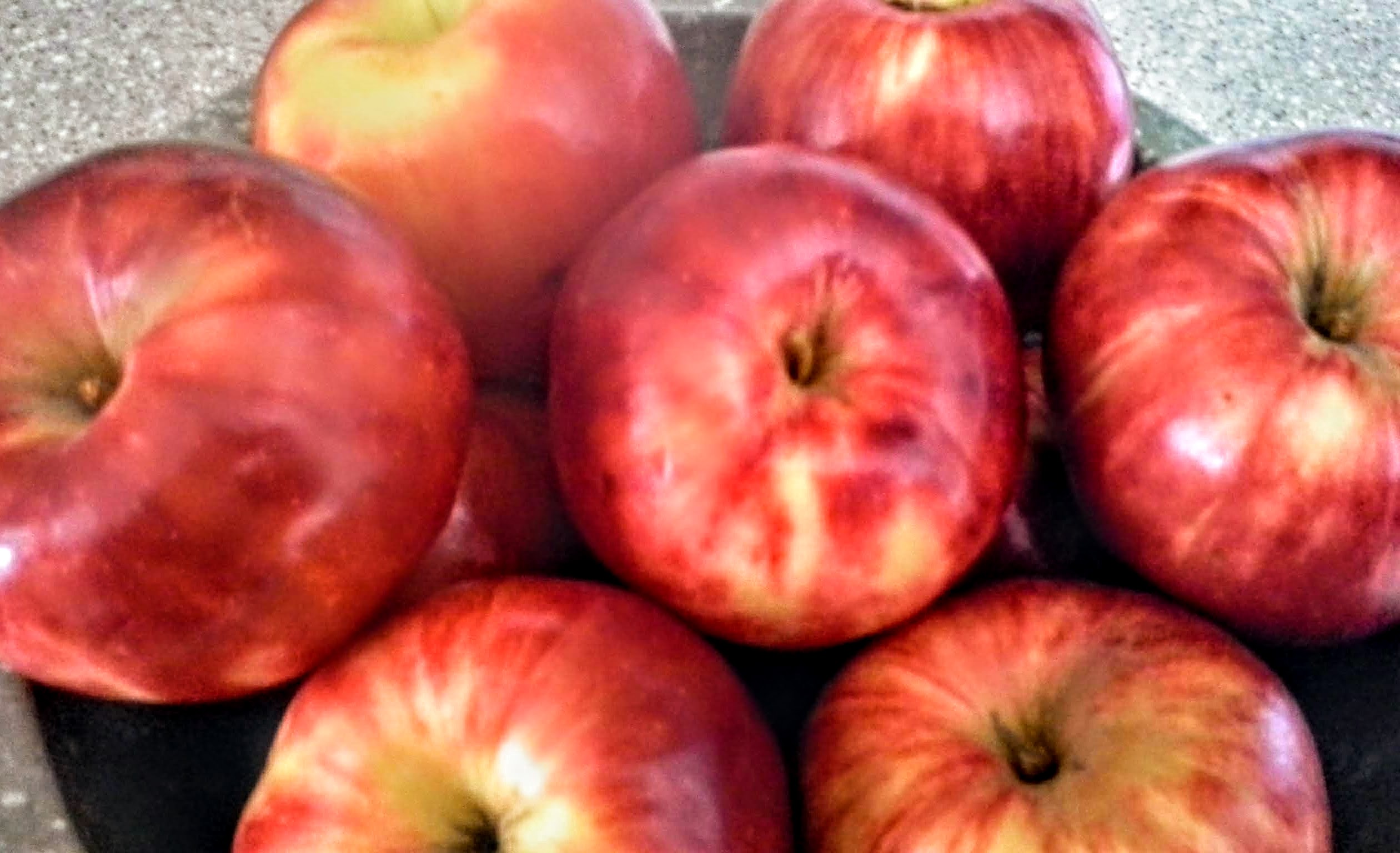
The order finally came in! I had to ask where the apples were because I didn’t recognize them. The Jonathans I was used to, those grown in Colorado, were small. The apples I was steered toward didn’t look any different from any other apple, and since the apples didn’t have a sticker as so many do, I wasn’t sure what I was getting.

Also, I wasn’t sure I would know a Jonathan anymore if it bit me (or rather, if I bit it) — it’s been many years since I’ve even tasted one.

But one careful test bite and oh, yes! It was exactly as I remember — perfection!

It’s hard to pinpoint exactly why Jonathans are different from other apples. They have the shortest growing season of all apples, which makes them scarce. A soft crispness makes them bruise easily and prevents long-term storage. A tart sweetness makes for a great baking apple and even better eating. And yet, despite the distinctive flavor and texture, they still have that appleness that all others have. (If you close your eyes and take a bite of an apple, you know what you are eating, even if you don’t recognize the exact variety.)

Well, it’s been nice visiting with you, but I have to go. A Jonathan apple is waiting for me!

***

Pat Bertram is the author of Grief: The Inside Story – A Guide to Surviving the Loss of a Loved One. “Grief: The Inside Story is perfect and that is not hyperbole! It is exactly what folk who are grieving need to read.” –Leesa Healy, RN, GDAS GDAT, Emotional/Mental Health Therapist & Educator.

Someone Who Understands

I made a pastor cry today. Or maybe it was just that I offered him the opportunity. But still . . .

A local church had a potato bar and pie auction for a fundraiser, and I went. Interestingly, I’ve spent more time in various churches during the past few months than I have in decades; all of my new friends are religious, and each of them attends a different church. Since all the churches seem to work together for various activities, I see these people at many functions.

And I see new people. As I was leaving at the end of the auction, someone I’d never seen before came up to me and asked me why people called me Pat in the Hat. She said that when I came in, she heard people saying, “Here’s Pat in the Hat.” I pointed to the hat I was wearing. Yep. That’s my claim to fame. Always with a hat.

Today was an especially fun event until I ruined it with my talk of grief. The pastor auctioned off the pies, and he was so persuasive and so utterly charming and amusing, it was hard not to participate. Afterward, a friend introduced us and mentioned I was a writer. He asked what I wrote, and I said mostly mysteries but I had also written a couple of books on grief. So of course, I started expounding about grief, what I’ve learned, and what I’ve been doing to pass my experiences and expertise on to others.

He seemed impressed that I had such a mission. We talked about how so many grief counselors hadn’t experienced profound grief themselves, and how it skewed the help they were able to offer.

Then I noticed he had tears in his eyes. “Who did you lose?” I asked quietly. “Your wife?” He couldn’t respond right away. Finally he said, “Not wife. Children.” I hugged him, and said I was so very sorry. He nodded at that, and said, “You do know the right thing to say.” (So yes, I was right with my post a couple of days ago about saying “I’m Sorry.”)

I didn’t ask particulars about the deaths — it seemed too intrusive — but we talked a few more minutes about grief and loss and emptiness. He thanked me for participating in the auction, and for being such a good sport. Then we parted.

It still holds true after all these years, that grief can quickly bind two people in a profound moment of sharing. Neither of our losses are recent, but both have left holes in us that nothing can fill. Although his faith is strong, and he believes he will see his children again, he still sorrows. He never got to see them grow up. Never got to see the adults they could have become.

It’s hard to lose part of oneself like that. It’s hard to live with it. But he does.

We all do.

We always feel their absence.

And we always feel the grief that connects us to someone who understands.

***

Pat Bertram is the author of Grief: The Inside Story – A Guide to Surviving the Loss of a Loved One. “Grief: The Inside Story is perfect and that is not hyperbole! It is exactly what folk who are grieving need to read.” –Leesa Healy, RN, GDAS GDAT, Emotional/Mental Health Therapist & Educator.

I’m Sorry

People often ask me what’s the best thing to say to comfort someone who is grieving. My response is that nothing we can say can comfort someone who has lost their spouse or income or health or whatever it is they are grieving. We still need to say something, though (unless we are in the griever’s presence, then a hug is often better than any word). We can’t just ignore a friend’s pain.

Oddly, despite all my various losses, and despite all my writing about grief, I still feel helpless and tongue-tied in the presence of other people’s sorrow.

Several friends are going through devastating times right now, either death of their spouse, an imminent breakup, loss of income, severe health issues.

All I can think to say to these grievers is a simple, “I’m sorry.”

Although most people think “I’m sorry” connotes an apology, the first definition of “sorry” is: “feeling distress, especially through sympathy with someone else’s misfortune.” Which is exactly what we want to say to someone who is hurting.

The only problem with “I’m sorry” is when you add “for your loss.”

Not only is “I’m sorry for your loss,” too rote, too insensitive, too bureaucratic, it also seems a bit too distancing. The first two words express distress and sympathy, a reaching out; the last two words seem to repudiate the outreach, making it clear the distress is the griever’s alone. Although the agony and angst of grief does belong to the griever, each person’s death diminishes us all. And that loss of light in the world should be acknowledged.

Even more than that, it’s not just the loss we are sorry for. We’re also sorry for everything else that comes along with that major loss: the chaotic emotions, the feeling of amputation, the lifestyle change, the lessening of income, the brain fog, the hardships of growing old alone, the loss of the person we were with our deceased loved one, the increased death rate, the horrendous stress.

Most people don’t have an inkling of the scope of grief that the death of a loved one or a devastating divorce or a financial trauma can bring, so they distance themselves. I can’t blame people for not wanting to know the truth.

But I do have an inkling.

And I’m sorry for all that you are going through, so very sorry.

***

Pat Bertram is the author of Grief: The Inside Story – A Guide to Surviving the Loss of a Loved One. “Grief: The Inside Story is perfect and that is not hyperbole! It is exactly what folk who are grieving need to read.” –Leesa Healy, RN, GDAS GDAT, Emotional/Mental Health Therapist & Educator.

One Good Apple Deserves Another

A while ago I wrote about apple season, and how hard it was for me to get my favorite Jonathan apples (haven’t had one for years). I also mentioned in a comment on that post about how I used to also like Rome Beauty apples, but they seemed to be disappearing, too. I hadn’t eaten one or even seen one for decades. Well, today I went to the grocery store, and there it was, a Rome Beauty apple, though now, apparently, they just call them Rome apples.

But they are still beauties. And still a treat.

Even better, the produce manager said Jonathan apples appeared on his order form today. And perhaps he will have them on Monday.

Oh, wow!!

I am so looking forward to treating myself to more apples. As they say, one good apple deserves another. Well, no. No one has ever said that but me, right now. Doesn’t make it any less true.

I am seventeen days late for National Apple Day in the USA (October 21), but have a Happy Apple Day anyway! I sure will.

***

Pat Bertram is the author of Grief: The Inside Story – A Guide to Surviving the Loss of a Loved One. “Grief: The Inside Story is perfect and that is not hyperbole! It is exactly what folk who are grieving need to read.” –Leesa Healy, RN, GDAS GDAT, Emotional/Mental Health Therapist & Educator.

The Opposite of Peace

A blog blast for peace almost by definition demands thoughts of the opposite state (violence and fears) because if peace were the norm, we wouldn’t need to talk about peace — it would be taken for granted. But peace is not necessarily the norm, except among you and me and the rest of us peaceable folk. In fact, violence, way more than peace, is an acceptable part of the culture: witness all the violent movies, TV shows, video games.

Sheri Parks, an assistant professor at the University of Maryland, says that many teens today have had years of exposure to violent video games and media images, which studies show desensitizes them to violence. Not surprising. Many of today’s — and yesterday’s — video games were developed by the military because studies had shown that repeated images of violence and death inured people to killing. In World War II, as many as 85% of soldiers fired over enemies’ heads or did not fire at all. After World War II, there was a concerted effort by the military to overcome this natural reluctance to kill, and apparently they succeeded, because during close combat in Vietnam, only about 5% of soldiers failed to aim to kill. These same desensitizing “games” were later released as toys for children.

Findings such as these about desensitization — whether new or old — scare the heck out of me. Author Lee Child says that we don’t write what we know, we write what we fear. Perhaps this is true. My books are filled with fears — fear of being at the mercy of mindless governments and corrupt corporations, fear of deadly and unstoppable diseases, fear of the loss of self, fear that our memories lie. Since all of these fears can be lumped into one group — fear of powerlessness — I wonder if all fears came down to that same thing. Mine do, anyway.
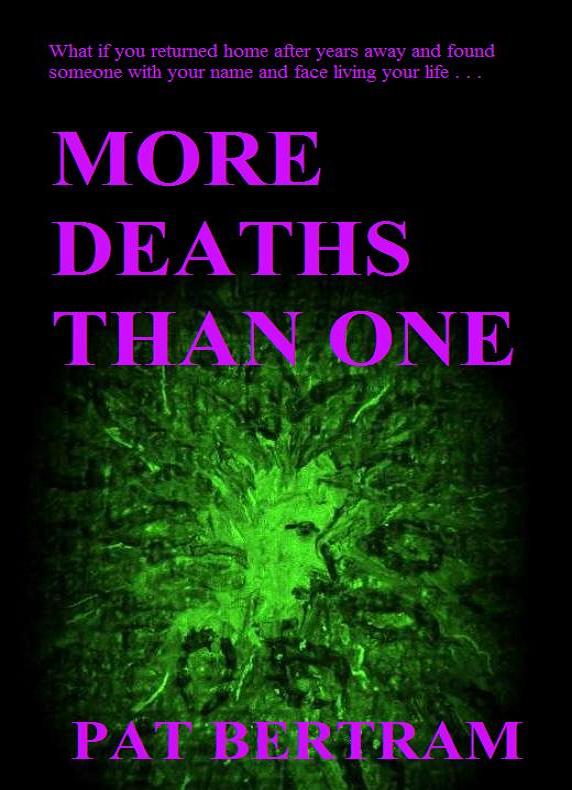
This theme of powerlessness is most prevalent in my novel More Deaths Than One (in fact, I came across the information about desensitization while researching the military, soldiers, and killing for that particular novel) though it shows up in milder forms in all of my novels. Conspiracy? Perhaps. Truth? Probably. Fear? Definitely.

Through stories, you learn how to deal with your fears, especially if you are the one writing the story. If you novelize a fear of being eaten alive by monsters from outer space, then the terrestrial ones eating you alive don’t seem so monstrous. If you watch a movie about aliens taking over your body, then the terrestrial one taking over your mind might not seem quite so alien.

You don’t think you are being eaten alive or that your mind is being taken over? Well, you are and it is — it’s called aging. Little by little, the you that you know is being supplanted by a creature you could never fathom being. Some people turn into querulous beings totally unrecognizable from the derring-dos of their youthful selves. Some turn into their mothers. Some . . . Well, I’ve scared you enough.

I researched phobias to see what sort of things other people are afraid of, and now I’m in danger of becoming a phobiaphobe. Although I am sympathetic to anyone caught in the horror of a phobia, I do enjoy the names. Names such as levophobia, kainophobia, lachanophobia, mageirocophobia, melophobia, nomatophobia, nyctohylophobia, paraskavedekatriaphobia. Great names for dreadful conditions.

In the end, except when it comes to writing with its necessity for conflict, it seems as if peace is a much easier way to live than the alternatives of fear and violence that permeate our culture. So here’s to next years Blog Blast for Peace!

***

Okay, I’ll let you off the hook so you don’t turn into a Sesquipedalophobe (someone who fears long words). Here’s what the above-mentioned words mean:

  • Levophobia — Fear of things to the left side of the body
  • Kainophobia — Fear of anything new
  • Lachanophobia — Fear of vegetables
  • Mageirocophobia — Fear of cooking
  • Melophobia — Fear of music
  • Nomatophobia — Fear of names
  • Nyctohylophobia —- Fear of dark wooded areas
  • Paraskavedekatriaphobia — Fear of Friday the 13th
  • Phobiaphobe — Fear of fear
  • Triskaidekaphobia — Fear of the number thirteen

The one fear I hope no one ever gets is patbertramophobia. So not good for me as a writer!

***

Pat Bertram is the author of Grief: The Inside Story – A Guide to Surviving the Loss of a Loved One. “Grief: The Inside Story is perfect and that is not hyperbole! It is exactly what folk who are grieving need to read.” –Leesa Healy, RN, GDAS GDAT, Emotional/Mental Health Therapist & Educator.
Who Visits My Blog

Well, yes, of course, you visit my blog. But so do people from all around the world.  Most come from the USA and other English speaking countries. Others come from countries I’ve never even heard of, and yet, someone in those countries has heard of me. What an amazing thing the internet is!

Here is a map showing where my visitors originate:

Pink shows visitors, and the darker the pink, the more visitors. Apparently, if I am reading the map correctly, the only places from which no visitors have come are Greenland, Svalbard, Turkmenistan, Western Sahara, Guinea-Bissau, Chad, and Central African Republic. I find this utterly astonishing. Not to be disingenuous, but I simply can’t imagine being interesting enough to attract so many different people.

Here is the incredible list of countries where visitors have come from. (The number represents visitations only, not views, since often people click on more than one blog entry, and each click is a view):

United States 364502
United Kingdom 64705
Canada 42126
India 35091
Australia 25092
Philippines 7152
Pakistan 6247
Ireland 6045
South Africa 4668
New Zealand 4236
Malaysia 4145
Singapore 4003
Germany 3227
European Union 2448
France 2093
Netherlands 1982
Indonesia 1657
United Arab Emirates 1556
Brazil 1364
Hong Kong SAR China 1318
Italy 1317
Spain 1283
Norway 1262
Russia 1258
Saudi Arabia 1091
Denmark 1085
Thailand 1053
Japan 1012
Sweden 1002
Turkey 957
Lebanon 939
Bangladesh 881
Vietnam 875
Romania 834
Mexico 827
Belgium 822
South Korea 799
Switzerland 739
Nigeria 733
Poland 714
Kenya 711
Greece 709
Argentina 685
Israel 589
Nepal 570
Egypt 561
Jamaica 556
Sri Lanka 510
Portugal 490
Finland 462
Trinidad & Tobago 444
Austria 415
Taiwan 406
Hungary 353
Ukraine 337
Jordan 330
Cambodia 319
Malta 316
Ghana 298
Qatar 292
Czech Republic 278
Bulgaria 278
Serbia 271
Mauritius 261
Kuwait 260
Morocco 252
Croatia 244
Slovakia 236
Puerto Rico 231
Colombia 226
Slovenia 194
Oman 185
Tunisia 171
Albania 162
Algeria 158
Chile 156
Iraq 153
Cyprus 153
American Samoa 150
Bahrain 141
Bahamas 141
Lithuania 138
Estonia 131
China 126
Uganda 124
British Virgin Islands 121
Iceland 119
Zimbabwe 119
Tanzania 117
Latvia 115
Georgia 112
Myanmar (Burma) 110
Peru 108
Ecuador 102
Venezuela 101
Macedonia 100
Botswana 96
Guyana 96
Costa Rica 94
Palestinian Territories 93
Panama 91
Armenia 91
Belize 88
Brunei 85
Barbados 80
Maldives 79
Fiji 77
Bosnia & Herzegovina 76
Isle of Man 74
Luxembourg 73
Jersey 71
Azerbaijan 70
Bhutan 69
Dominican Republic 64
Afghanistan 63
Namibia 62
Antigua & Barbuda 59
Yemen 55
Syria 55
Zambia 55
Kazakhstan 54
Grenada 54
Moldova 53
Malawi 49
Papua New Guinea 49
Guernsey 49
Ethiopia 48
Guatemala 47
Belarus 47
Macau SAR China 46
Bermuda 46
Guam 44
St. Vincent & Grenadines 44
Cayman Islands 44
St. Lucia 43
Cameroon 41
El Salvador 37
Libya 35
Uruguay 34
Curaçao 32
Laos 32
Bolivia 31
Lesotho 30
Gibraltar 29
Honduras 28
Paraguay 27
Mongolia 26
Nicaragua 26
Montenegro 26
U.S. Virgin Islands 25
Swaziland 25
Rwanda 25
Aruba 24
St. Kitts & Nevis 20
Suriname 20
Mozambique 20
Dominica 19
Monaco 19
Côte d’Ivoire 17
Northern Mariana Islands 16
Sudan 16
Seychelles 16
Åland Islands 14
Senegal 13
Congo – Kinshasa 12
Somalia 10
Kyrgyzstan 10
Angola 10
Madagascar 9
Vanuatu 8
Djibouti 7
Uzbekistan 7
Réunion 7
Guadeloupe 7
Anguilla 7
Liberia 6
Caribbean Netherlands 6
Solomon Islands 5
Faroe Islands 5
Haiti 4
Cook Islands 4
Turks & Caicos Islands 4
Benin 3
Iran 3
Burundi 3
French Polynesia 3
Cuba 3
Liechtenstein 3
Gabon 3
Sierra Leone 3
Timor-Leste 2
Martinique 2
Mali 2
Tajikistan 2
Micronesia 2
Vatican City 1
Burkina Faso 1
South Sudan 1
Congo – Brazzaville 1
Falkland Islands 1
St. Helena 1
Marshall Islands 1
Mauritania 1
Netherlands Antilles 1
French Guiana 1
Montserrat 1
Kiribati 1
Cape Verde 1
Niger 1
Samoa 1
Sint Maarten 1

***

Pat Bertram is the author of Grief: The Inside Story – A Guide to Surviving the Loss of a Loved One. “Grief: The Inside Story is perfect and that is not hyperbole! It is exactly what folk who are grieving need to read.” –Leesa Healy, RN, GDAS GDAT, Emotional/Mental Health Therapist & Educator.

 

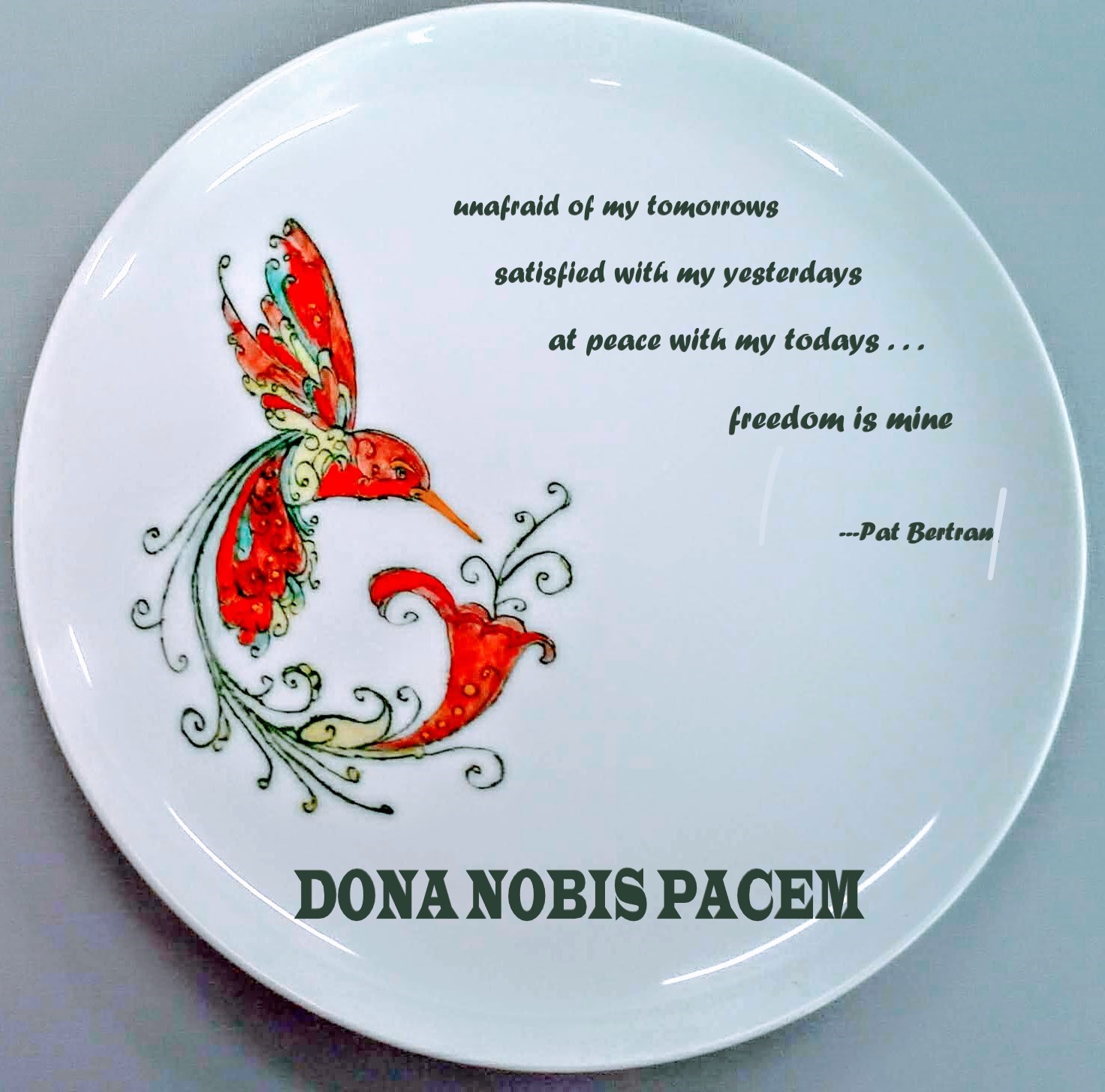
Dona Nobis Pacem

Today, along with thousands of people all over the world, I am blogging for peace. If words matter, this is important.

People always talk about the human race as if we are warmongers, and yes, some people are, most notably those who make money and take power from wars, but think about it. How many wars have you personally started? For the most part, we (you and me, anyway) are peace lovers. We shy away from violence. We seldom start personal conflicts, though sometimes we do unwilling get involved in contretemps we don’t quite know how to end.

Although I don’t think we can do much on an individual basis to bring global peace, we can try to find peace within ourselves. If all on this earth were at peace with themselves and those they see every day, then our human world would be at peace.

Environmental scientist David Orr wrote in his book Ecological Literacy: Educating Our Children for a Sustainable World, “The plain fact is that the planet does not need more successful people. But it does desperately need more peacemakers, healers, restorers, storytellers, and lovers of every kind. It needs people who live well in their places. It needs people of moral courage willing to join the fight to make the world habitable and humane. And these qualities have little to do with success as we have defined it.”

Let us be peacemakers. Let us find the freedom that only peace within can bring.

***

Pat Bertram is the author of Grief: The Inside Story – A Guide to Surviving the Loss of a Loved One. “Grief: The Inside Story is perfect and that is not hyperbole! It is exactly what folk who are grieving need to read.” –Leesa Healy, RN, GDAS GDAT, Emotional/Mental Health Therapist & Educator.

 

Tea Time

When I was on my trip up the Pacific Coast a year and a half ago, I stopped at a dear friend’s house. We’d never actually met until that time, but we’d been online friends for so long that there wasn’t even a moment of awkwardness. We seamlessly moved from online conversations to offline conversations.

There was much about that visit to savor: her wonderful library that included my books, a trip to the nearby rhododendron garden, learning to do cryptic crosswords . . . and tea. Although she herself isn’t a tea drinker, she had a lovely box filled with a variety of teas.

Ah! Tea envy!

I’ve never been a big tea drinker, but lately I’ve become something of a teaphile. (There is no such word, but the suffix “phile” means lover of, as in the case of bibliophile, a lover of books, so teaphile should be a word.)

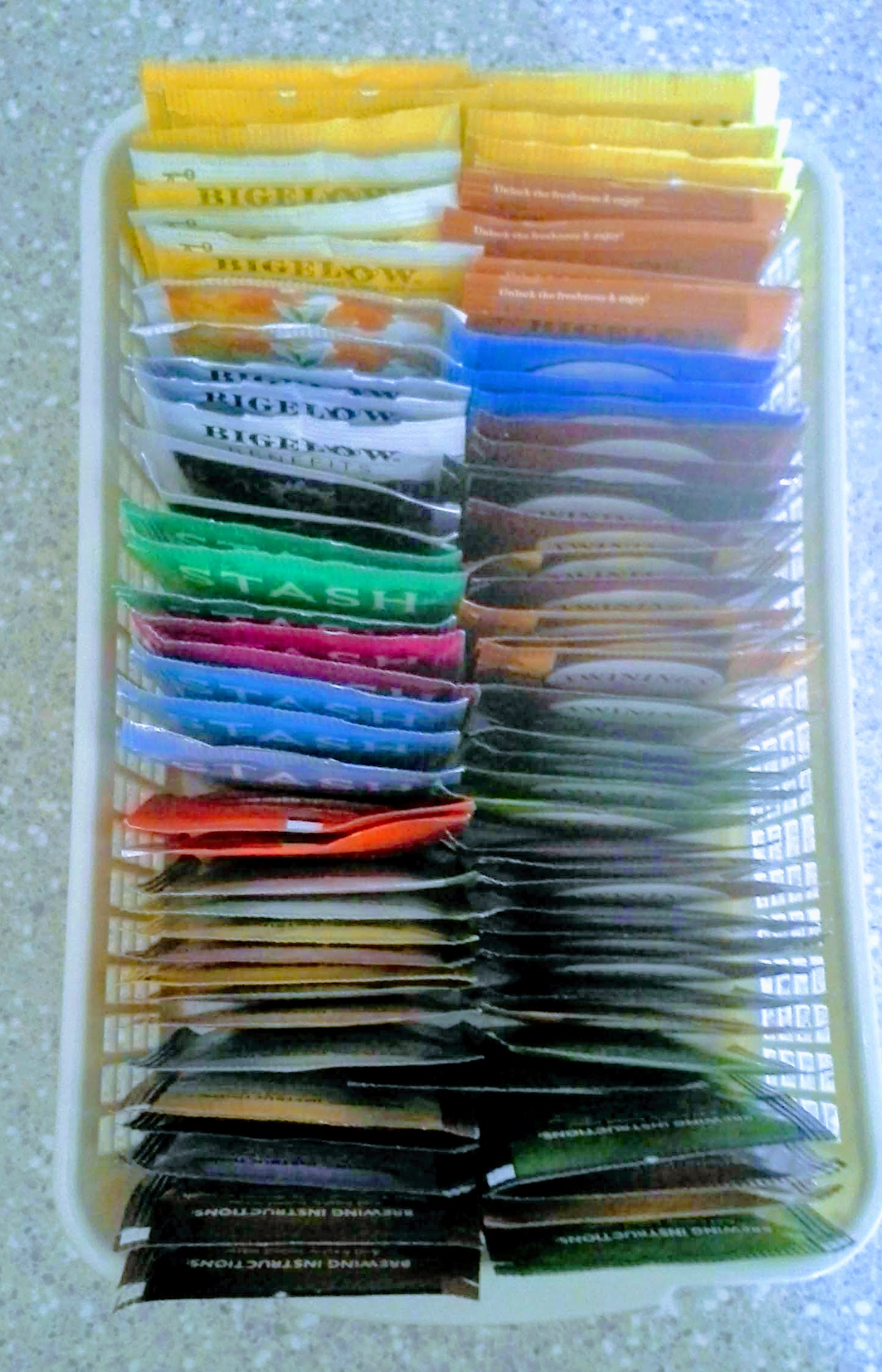
Ever since I got my own kitchen, I’ve been collecting teas, but so often, a box of one kind is too much, so I finally ordered assortments of teas that come individually packaged. Now this teaphile (me) has a tea file!

I’ve been making tea in the microwave, but to my surprise, the Twinning packets says “Do not microwave.” So naturally, I had to research this. Apparently, microwaved water is not heated through and through but contains pockets of colder water, and the unreliable temperature makes for a bitter tea. Because green tea steeps at a lower temperature, it could be okay to microwave green teas. (Water for black tea needs to be heated to 212˚, but green tea does fine at 176˚.)

I imagine it would also be okay to microwave herbal teas since herbal teas aren’t really teas. They are tisanes. Real tea, such as green tea, black tea and oolong tea, come from leaves of the Camellia sinensis plant. Herbal teas are made from herbs, of course, as well as spices, dried fruits, and flowers.

But, being a teaphile comes with some responsibility, such as making tea correctly. So I’ve been boiling water in my borosilicate glass teapot, which supposedly does not transfer any contaminants to the water as some tea kettles do. (The original Pyrex was made with borosilicate glass, but ever since 1998 has been made with the inferior lime glass which does not handle heat nearly as well.)

I have two different borosilicate glass teapots, one says not to microwave, one says not for stovetop use, which doesn’t make any sense, so I wrote to the manufacturer. Haven’t heard from them.

But only one teapot is necessary, so I’ve been using the one for the stove top, and it’s working fine.

All this writing and research is making me thirsty. I think I’ll go make myself a cup of tea.

Will you join me?

***

Pat Bertram is the author of Grief: The Inside Story – A Guide to Surviving the Loss of a Loved One. “Grief: The Inside Story is perfect and that is not hyperbole! It is exactly what folk who are grieving need to read.” –Leesa Healy, RN, GDAS GDAT, Emotional/Mental Health Therapist & Educator.

A Long Slow Conversation

For the most part, despite writers’ groups and online discussions, writing is a solitary occupation. You spend years writing a book, months rewriting it, and perhaps a year or two editing it. (Unless you are participating in National Novel Writing Month as hundreds of thousands are doing this November, then you spend . . . gasp! . . . a whole month writing your book!)

During the time you are writing, you have only your vision to sustain you. You wonder if anyone will ever buy the book. You wonder if anyone will like it. You don’t need acclaim, because writing is an end in itself. Still, readers connect the circle between you and the culmination of your vision, and in an odd sort of way, they finish the book. They take your vision and make it their own.

Many writers don’t consider readers during the writing process. They write solely for themselves and are proud of that fact, but what they don’t realize is how often their story fails to reach beyond the confines of the cover to allow the reader to participate in the story.

I write for myself in that I can only write what I can write. Even though I know the kinds of books that sell in great numbers, I’ve never been able to make that leap. My mind simply rebels — it wants to write what it wants and when it wants. Currently, my mind doesn’t seem to want to write any story; it simply wants to steep in the story I am presently living: new house owner. One day, though, a new story will pop up that I want to write. (I’m already trying to figure out who in my new town will be the victim of my next “Nightmare” story, the sequel to Madame ZeeZee’s Nightmare.)

Although I can only write what my mind will allow, I still take potential readers into consideration. I wonder what readers will think. Will they understand my references? Will they find the humor? Is my writing clear enough? I like thinking that perhaps someday a reader will share this as yet unwritten product of my mind.

Malcolm R. Campbell, author of Conjure Woman’s Cat, wrote: “Whether it’s a book, poem, post, review, article or news story, I always hope somebody will say something. One never knows. It’s a slow conversation, so much time having gone by between the moment when something was written and the moment when somebody tells you they found it.”

Such a wonderful description of writing/reading — a slow conversation. I know I’ve read many books where I felt the author and I were having a conversation, silent though it may be. I read and I think about what I read.

It’s quite a heady realization that now I am a writer with readers of my own. I hope they enjoy our long, slow conversation.

***

Pat Bertram is the author of Grief: The Inside Story – A Guide to Surviving the Loss of a Loved One. “Grief: The Inside Story is perfect and that is not hyperbole! It is exactly what folk who are grieving need to read.” –Leesa Healy, RN, GDAS GDAT, Emotional/Mental Health Therapist & Educator.
 

Good Deeds Going Awry

It’s really a joy being part of a community. I’ve had a bad cough the past week, and in the past few days, more people brought me soup and crackers or offered to run errands than in all the time I was housebound with my mangled arm.

I’m not worried about paying the favors back or fore (I know the common phrase is “pay it forward,” but that terminology only works if one also says “pay it backward,” and we don’t.) When people need help that I can give, I will do so — it’s all about being part of the community.

Or is it?

I recently watched the movie Pay it Forward. (If you haven’t seen the flick and want to, don’t read ahead. Major spoiler!!)

The movie is about a kid who gets the idea of doing good for people and then having them pay it fore rather than back. As a concept, it’s kind of cool, as long as the person who did you the favor knows you’re going to pay it to someone else rather than to them. (Not that we do favors for others expecting to be paid back, but it is nice when they in turn do favors for us — it helps cement the community bond.)

The kid ends up dead (he tried to rescue a friend from bullies, and got knifed). The finale of the movie shows hundreds of people coming to the house bearing flowers and candles. What was supposed to be a tear-jerking moment, showing all the people whose lives the kid had touched, just made me shake my head. There is no way such a display could bring more than a momentary comfort to the mother. In the cold light of day (and the dark of night), she would rather have her son than this evidence of his impact.

I also had to shake my head at this proof of the old adage: no good deed goes unpunished.

The movie reminded me of a CSI show in which Grissom told a story about a guy who found a spider swimming in his toilet. For a couple of mornings, the guy watched the spider struggling to survive the maelstrom of flushing. One morning, the guy decided to rescue the spider. He took it out of the water and set it on the floor. The next day, he found the spider dead. “Why,” Grissom asked, “did the spider die? Because one life impinged on another.”

Yep. No good deed goes unpunished. In the movie, the doer died, in the show, the do-ee did. Generally, no one dies after doing good deeds, but occasionally, as in these examples, the good deed backfires. Sometimes the favor leads to demands and expectations, and when those expectations aren’t met, the benefactor is seen as an evil-doer rather than a do-gooder. Other times the punishment is benign: people resent the interference or are simply ungrateful.

Come to think of it, the destruction of my arm that I mentioned above is another example of a good deed being punished — if I had stood my ground and not done the dance performance as I wished, I’d still have a perfect arm, but because I did a good deed (performed in place of someone who couldn’t make it) I have a humpty-dumpty arm.

I just hope no one is going to be punished for bringing me soup and crackers. I certainly appreciate the favor, don’t resent it, won’t expect more than what was offered.

I’ll pay the favors both fore and aft.

And I’ll hope that none of our good deeds go awry and that we all survive intact.

***

Pat Bertram is the author of Grief: The Inside Story – A Guide to Surviving the Loss of a Loved One. “Grief: The Inside Story is perfect and that is not hyperbole! It is exactly what folk who are grieving need to read.” –Leesa Healy, RN, GDAS GDAT, Emotional/Mental Health Therapist & Educator.