Aphantasia

Ever since I became an author and interacted with other authors, I have been fascinated by the different ways peoples’ brains work when it comes to writing. Some people sit down and start writing, and the words appear on the page almost without their volition. Some people envision whole scenes, and interact with those scenes. Some people see a movie in their head, and simply write down what they see.

I have never experienced any of those things. For me, writing has always been a puzzle, putting together words to create characters and conflicts, scenes and scenery, plots and passions. But I have never once seen an image in my mind’s eye of anything I have cooked up in my brain pan. I simply don’t think in images, and never have.

I remember once telling my mother about a girl who clerked at the local Safeway. This pretty girl was kind and thoughtful, and never seemed to think the work a burden. My mother said she’d look for the girl. Weeks later, she told me she finally met the girl, and she shook her head at me. “It would have been easier if you had told me she was black.” I was taken aback because I didn’t remember that particular detail. I only had an impression of her, a vague idea of what she looked like. I took this to mean I was color blind as to race, when it really meant I was mentally blind.

Another time a friend mentioned a fellow we worked with who had a full beard. I thought the friend was joking because I was sure we didn’t work with anyone like that. The friend pointed out the fellow, and sure enough, there he sat, a few feet away from me, full beard and all. That time I took my lack of attention to this detail as a general lack of attention, when it was really another example of where I was mentally blind.

I’ve never understood how people could utilize visualizing techniques, because I can’t visualize. I can remember, of course, but my memories don’t take the form of images. They depend more on a sense of . . . essence. Needless to say, I would be a terrible witness if it ever came to that. I do notice things, and I do pay attention, but I don’t have the detailed visual recall necessary to a be good witness.

It turns out there is actually a word for the inability to see mental pictures: aphantasia. For some reason, aphantasics tend to be introverted, while hyperphantasics (those with well-developed mental imagery capabilities) tend to be extroverted, though what one condition has to do with the other, I don’t know.

Supposedly, there are techniques that can help “cure” me of this ailment, if in fact I have it. I do see vague images at times, which some researchers say means I am not aphantasic, though other researchers say that some aphantasics have visual memory recall. Either way, it makes no difference to me. After so many decades of not seeing pictures in my head, I’m fine with my lack of visual imagery, no matter what the condition is called. And anyway, at this advanced stage in my life, strong imagery could only confuse me.

***

What if God decided S/He didn’t like how the world turned out, and turned it over to a development company from the planet Xerxes for re-creation? Would you survive? Could you survive?

A fun book for not-so-fun times.

Click here to buy Bob, The Right Hand of God.

Traveling Books

Although you might think this post concerns books about traveling, it’s actually about books that travel. I’d never given much thought to how far books travel, and probably never would have if it weren’t for the confluence of two events. First, my friend who returned to Thailand to be with his ailing wife, took my book Bob, The Right Hand of God with him, which, according to him, makes me an international author. Sounds good, doesn’t it, being an international author? More accurately, it makes the book itself an international book because the author — me — is definitely not international since I’ve never been out of the USA. But my book is now out of the country, having gone by way of car, plane, bus, and perhaps even train, so that makes it a traveling book.

The second event concerns the book I am currently reading. It was written by a Spanish author and translated and published in the U.K. And somehow a copy of that book, printed so very far away, ended up in the local library in the ongoing book sale section. It looks like a well-read and much-loved book, so who knows what sort of roundabout journey that book made to get here. And now it’s in my hands.

This made me think of other traveling books I have known. For example, a friend sent me a trio of books about trees for a house anniversary gift, and those books also came from the U.K. Actually, they came from Amazon in Las Vegas, which is mystifying because she ordered the books from a business located in U.K. Still, since those books were published in London, they had to have traveled to Las Vegas somehow, before they ended up here.

I’ve also been an agent a couple of times for someone overseas who needed out-of-print books that were not available where he was living, and if I remember correctly, at least one of those books originated over there.

Most books don’t travel that far, at least I don’t think they do, but still, they rack up the miles going from the printer to the distributor to the seller to the buyer and then to the reader if the buyer and reader aren’t the same person. Eventually, books travel to a secondhand store and then continue their journey to another home. I ordered one such book from a used book outlet in Oklahoma, and the gift card inserted into that obviously unread book showed that it had been gifted to someone in New York. It was delivered to me in California, and then I myself brought it to Colorado.

But that was a simple journey. Some books travel in a more convoluted fashion. I heard of a woman who had donated her childhood books, then later in life found one of those very same books in a used book store far from where she grew up. She bought it, of course, because obviously it wanted to go back home to her. One can only imagine the secret life of that book — where it had traveled, who had read it, who loved it, and how it ended up back in the hands of its original owner.

A huge percentage of books don’t enjoy that kind of far-reaching journey. 77,000,000 unsold and unread books are pulped — destroyed — each year by the major publishers. (Print-on-demand, where only books that are already sold are printed, hasn’t changed things much because bookstores need the product on hand even though they return up to 40% of those books to the publisher, and up to 95% of those books are sent to landfills or recycled into paper pulp.)

But that’s too depressing to think about. I’d rather imagine the journeys books go on. It’s only fitting that they get their own journeys since so many of them take us on mental journeys and allow us flights of fancy such as this blog post.

***

What if God decided S/He didn’t like how the world turned out, and turned it over to a development company from the planet Xerxes for re-creation? Would you survive? Could you survive?

A fun book for not-so-fun times.

Click here to buy Bob, The Right Hand of God.

Adjusting to the Time Change

It’s been more than two weeks since the change to daylight saving time, and I’m still not used to it. Although I am going to bed at the same real time (assuming time is real), the clock tells me I’m going to bed an hour later. Even worse, I’m too groggy in the morning to figure out what time I’m supposed to get up. Is it an hour later than I had been waking? An hour earlier? During the day, I can figure out the time change if I need to, but mostly I don’t since I go by what the clock says. But in the morning? I have no idea what time I’m getting up, so sometimes, like yesterday, it feels as if there are too few hours in a day, and other times, like today, it feels as if there are too many.

Admittedly, some of that off-kilter feeling has to do with how busy I am. Yesterday, I was on the go almost all day, getting caught up on household chores and such, so today there wasn’t much left to do. I also managed to sleep a couple of extra hours yesterday morning, but barely managed to stay in bed until first light today, so not only am I left with the perception of extra hours today because of more free time, but there is also the reality of extra hours because of the early rising.

From what I understand, both this state and this country are trying to pass laws to make daylight saving time permanent, so there is double the chance of it happening, which makes me wonder how it will affect us.

Dr. Muhammad Adeel Rishi, pulmonologist and sleep physician at Indiana University thinks we should go back to permanent standard time, since our circadian rhythm is connected to the sun, and that rhythm is more in sync with permanent standard time.

Dr. Phyllis Zee, director of the Center for Circadian and Sleep Medicine at Northwestern University Feinberg School of Medicine agrees with that assessment, but also says that of the three choices — permanent daylight saving time, permanent standard time, or switching between the two —permanent DST is the worst solution.

I would prefer if they got rid of daylight saving time altogether, but despite what Dr. Zee says, permanent daylight saving time might be better than having to readjust twice a year. That adjustment period certainly is difficult, and has been linked to sleep disturbances, mood and mental alterations, traffic accidents, and heart attacks.

Whatever they decide, I’ll have to deal with it, though come to think of it, permanent daylight saving time might not be so bad because in winter, here on the eastern edge of the time zone, the sun would set at 5:30 pm instead of 4:30, as it does now. 4:30 pm is dang early for it to get dark!

[Incidentally, I wrote daylight saving time instead of daylight savings time because although the second usage is more common — and how I used the term because I didn’t know any better — the first is correct. Supposedly, “saving” is singular because it acts as part of an adjective rather than a verb, though if it is part of an adjective, daylight and saving should be hyphenated. No matter how you say it or write it, though, the clock manipulation is still annoying.]

But the legislation is in the future. For now, I have to adjust as well as I can to these off-kilter days that are sometimes too long and sometimes too short.

***

What if God decided S/He didn’t like how the world turned out, and turned it over to a development company from the planet Xerxes for re-creation? Would you survive? Could you survive?

A fun book for not-so-fun times.

Click here to buy Bob, The Right Hand of God.

Sad Day

I was sad last night, but it had nothing to do with Jeff or me or the anniversary of his death. I had to say good-bye to a friend who is heading back to Thailand to care for his wife until the end. The doctors’ prognoses for her have varied over the past several months, from a possible three months left to maybe a year or two, so he’s not planning on coming back any time soon. He smiled when he said good-bye, but his eyes were bleak. I cannot imagine doing what he is doing — leaving the country for an indefinite stay so he can give his wife the care she needs. It’s so very heroic. Sad, but heroic. Admittedly, he’s fine with living elsewhere, but his previous lengthy visits to other countries have been for fun and education, rather than for the heartbreaking task that is awaiting him this time. Even worse, he tries to put on a happy face since she doesn’t want anyone to be sad on her account.

I can’t help being sad over the situation because his wife is a dear sister/friend. From the beginning, although we are different nationalities, grew up on opposite sides of the globe, and had a bit of a language problem, we discovered a strong connection to each other. All I can do for either of them, the one cared for and her caregiver, is to continue looking after their house to give them one less thing to worry about.

Not wanting to feel sad (because even if the end is coming, my friend is alive and happy now despite her infirmities), I kept myself busy all day. I went for a walk, cleaned my floors, cleaned my clothes, cleaned me, fixed a nice meal (a salad and an overloaded-with-spinach frittata), and did various other small chores.

And now I am here, dumping my sadness into the ether where I have deposited so much sadness over the years.

After today, I intend to honor her wishes and think of her at home in Thailand. Happy. With her husband and family and old friends.

But first, I need to get through today.

***

Pat Bertram is the author of Grief: The Inside Story – A Guide to Surviving the Loss of a Loved One. “Grief: The Inside Story is perfect and that is not hyperbole! It is exactly what folk who are grieving need to read.” –Leesa Healy, RN, GDAS GDAT, Emotional/Mental Health Therapist & Educator.

Rich People Problems

I’m just finished China Rich Girlfriend, the sequel to Crazy Rich Asians, and am about to embark on the third book, Rich People Problems. To be honest, I do not care at all about the problems rich people have. I’m sure they have problems, but I’m also sure that their money keeps them from having most of the problems the rest of us have (such as not enough to pay the rent, not being able to afford child care, not being able to buy a car that doesn’t keep breaking down, et cetera, et cetera, et cetera).

The books, short on characterization and plot, are long on shopping and name dropping. I’m mostly reading the books because they were lent to me by an Asian friend who is neither crazy rich nor China rich. She was, however, born and raised in Malaysia’s Cameron Highlands, a resort area, the site of picturesque tea plantations, and the setting for one of the scenes in the first book.

I got bored with the shopping scenes and descriptions of insanely expensive paintings and objets d’art loosely held together by soap-opera-worthy moments, so my mind tended to wander. I found myself smiling at the vast difference between the Asians portrayed in the books — completely materialistic beings — with the Asians living in my head — Zen- and Dao-influenced folk who are spiritually inclined, love harmony, and eschew material things. (This idea came more from my study of comparative religions rather than any true knowledge of individual Asian people besides my friends.) Adding to the dichotomy, there is the difference between the Chinese in this book and the Chinese I’ve read about in other books who are forced to work in sweatshops.

I suppose the reality of Asian life spans the full gamut of practices and beliefs as it does elsewhere, but although I have been told that the mindset described in these books is accurate, it still rings false to me. But then, my grandparents moved to this country to raise their family away from their own peasant roots, so I identify with neither the peasant point of view nor the crazily rich mindset. (I mostly find my wealth in the true riches of life — plumbing, a nice place to live, enough food, friends, and all the other comforts that make so much of life today a luxury that people in previous eras could not even imagine.) It does seem, though, as if these crazy-rich Asians have much in common with any other crazy-rich nationalities, with their emphasis on generational ties, keeping the money in the family, and finding the proper mates for their children.

Another thing that made me smile as I drifted from the story was a character in this book, a trendsetter with millions of followers on the various social networks. Being what is called an “influencer,” all she has to do is show up at a restaurant (a very expensive restaurant), be seen an exclusive resort, or wear a designer outfit to have her outing comped with her only payment being a photo of herself at the venue posted online. That’s not what made me smile, though. What amused me was thinking of myself in such a situation, and understanding why the number of my followers lags slightly behind hers. Here I am, wearing old dance leggings and a no-name turtleneck, with not a jewel in sight, sitting in a house that would fit in a single room in one of her houses, walls that are bare of any artwork, and hand-me-down furniture. I was rather a gadabout yesterday, met some friends as I was walking, had tea with another friend and dinner with a different group of people. But none of those outings took place in a famous restaurant or a luxurious spa, so even if I were wearing designer clothes, and even if I did live in a designer house, there would still be no possibility of a job as an influencer. (And yet, thinking about this, I bet my day was better than that rich girl’s day. Not only was it a nice day, it was real rather than a made-up fantasy.)

Now I’m heading off to read about Rich People Problems. The good thing about it is that no matter what problems they have, I would never have to deal with, so I don’t need to waste even a second of my life on empathizing with them.

***

What if God decided S/He didn’t like how the world turned out, and turned it over to a development company from the planet Xerxes for re-creation? Would you survive? Could you survive? If you haven’t yet read this book, now is the time to buy since it’s on sale.

Click here to buy Bob, The Right Hand of God.

Crazy Rich

An Asian friend lent me her copy of Crazy Rich Asians. She really enjoyed the book, not just for the story and the humor, but because she knew many of the places in the book and had eaten much of the food, so it was personal for her.

I was looking forward to reading the book, but when I started, I realized I’d read it before. Admittedly, I don’t remember the titles of a lot of books I’ve read, so it’s not uncommon for me to get books I’ve already read, but I would have thought I’d have remembered the title. It’s certainly unique enough. But, no.

The first part of the book reminded me of the old regency romances, with all the gossip, the over-the-top wealth, the drive for titled or entitled parents to make suitable matches for their children, but as the book progressed, I felt suffocated by all the money, the shopping, the emphasis on trivialities, the snobbery. More than that, I could not empathize with any of the characters. Who needs that sort of wealth? Not me, that’s for sure. Not only don’t I need it, I wouldn’t want it.

The real riches (the material ones rather than the emotional or spiritual ones) are simple. A place to live with plumbing, heating and electricity. More than adequate food. Clothes to keep one covered and warm and feeling good about oneself. A car to get around. Books to read. Feet and shoes that allow one to walk and connect with the world on a fundamental basis. A computer to connect with the world on a broader basis.

I’m sure there are a few other items to add to that list, but truly, these are the riches. Does it matter if one lives in a 1,000-square-foot house or a 10,000-square-foot house? No matter how big the house, you can only be in one room at a time. The same goes for clothes. No matter how many (or how few) you have, you can only wear so many garments at one time. You can only drive one car at a time, eat only so much food. Whether the car or food or clothes are hideously expensive or cheap hand-me-downs, they serve the same function.

Not only do I have all the things one needs to be rich — at least rich compared to the past when there was no plumbing, no heating, no cars, no closet full of clothes — I feel rich.

When friends and I would talk about such things as winning the lottery, I’d mention that all I really wanted was enough money so I didn’t have to worry about money. It finally dawned on me that if that was the only reason to get richer, there was a simple solution: stop worrying about money.

So I did.

Not worrying doesn’t change the possibility of an impoverished old age, though it does keep me focused on what is important — working while I can, taking care of myself, learning to accept the vicissitudes of life. It also means stocking up on a few things when I can, for example, during my recent — and rare — visit to a big city with all the major stores, I bought some shoes, though I don’t need them quite yet.

I also think not worrying about my finances (or at least trying to not worry) helps to create an attitude of gratitude, which is important to one’s well-being, and adds to the feeling of being rich.

It’s just as well that I’m okay at not being crazy rich, very rich, or even just simply rich because it will never happen. And that, too makes me rich because from what I have read in this book about insanely rich people (Asian or not) is that being rich is hard work.

***

Pat Bertram is the author of intriguing fiction and insightful works of grief.

Handling the News

For much of human history, news only traveled as fast as a man could run. Later, it traveled only as fast a horse, and later, as humans expanded over the face of the earth, news traveled as fast as the wind via sailing ships.

Now, news is instantaneous. What happens in one part of the world is instantly known, so not only do we have to deal with what we see, hear, feel in our personal space, and deal with what we learn from friends and neighbors about what is going on in our nearby vicinity, we have to deal with crisis all over the world. And if that wasn’t bad enough, we are constantly being inundated with stories of decades-old atrocities, lest we forget.

It makes me wonder how all this affects us. I know how it makes us feel emotionally, and it sometimes even goads us do something, no matter how futile. But for a species that grew up in relatively newsless societies, it can’t be good for us. Even if the news is true, even if the reasons for the news as well as the backstory we are being fed is true, what possible difference can knowing make? Well, the cynical me says that it keeps those of us dealing with collateral damage, such as higher prices, pacified, because no matter how bad it gets here, it’s worse elsewhere.

Still, all day, every day, we are forced to confront and be saddened by events that a couple of hundred years ago we would never have heard of until long after those events were over.

If I sounds uncompassionate, it’s because I have my own mission (not one I chose, but one that was thrust on me because of my grief writing), succoring those reeling from the death of a spouse. Just yesterday, a woman contacted me because so much of what I have written about grief over the loss of someone intrinsic to our lives struck a chord with her. In this case, it was my saying that all grief is not the same because all losses are not the same. She’s been dealing with the typical non-support and dismissiveness we all had to deal with, such as the loss of a spouse being compared to the loss of a pet. (I’m not getting into this discussion again. I know people deal with grief for any number of losses, but the truth is, if a pet dies, it doesn’t leave you with a reduced income and three young children to raise by yourself as well as the loss of your sense of identity, the exile from your coupled friends and dozens of other horrendous changes to your life, any one of which would be occasion for grief.)

If it weren’t for modern means of communication, I wouldn’t hear from these grieving people, but I do. And it’s personal because they contact me specifically. Is their sorrow any worse than the sorrow of someone interviewed on television? Truthfully, I don’t know. As with much of life, I have no answers, just one heck of a lot of questions.

Still, I can’t help but wonder if we’re equipped to handle all the news that’s being fed to us.

***

Pat Bertram is the author of Grief: The Inside Story – A Guide to Surviving the Loss of a Loved One. “Grief: The Inside Story is perfect and that is not hyperbole! It is exactly what folk who are grieving need to read.” –Leesa Healy, RN, GDAS GDAT, Emotional/Mental Health Therapist & Educator.

Simple Arithmetic

I purchased a few items at the grocery store this morning. The bill came to $9.56. I had the coins plus a ten-dollar bill and seven ones. Not wanting that fistful of one-dollar bills, I gave the young clerk $14.56. She counted the money, then stared at me for a second before counting the money again. She kept the change and the ten and tried to give me back the ones because the ten was enough. I just smiled at her and told her to key in the amount I gave her as payment. When the $5.00 in change popped up, her eyes got big. She said, “I see what you did.”

I gave my stock response to such transactions, “Hard going in but easy coming out.”

It’s amazing that to me that people can’t do these kinds of calculations any more. It’s automatic for me, but obviously not for others.

I’m lucky, I suppose that simple arithmetic has always been easy. For example, adding $19.99 and $17.56 takes no mental effort. It’s obviously $37.55. Add a penny to the $19.99 to get $20.00. Subtract a penny from $17.56 to get $17.55. It’s easy, then, to add $20.00 and $17.55. Well, easy for me, even today. It was a lot easier decades ago when my mind was still blessed with the rapid synapses of youthful neurons.

I’d read once that educators had noticed some students being able to do such simple addition almost without thinking, and so they created common core math to even the playing field. Actually, that is not a good metaphor. When it comes to athletics, they still favor those with talent, but when it comes to mental exercise, they seem to want everyone to have the same advantages. Not that I blame them. Everyone should be able to do simple arithmetic in their heads without resorting to pen and paper, fingers, or calculators.

Like most others who had the benefit of learning plain old arithmetic and memorizing the times tables, I was appalled at what seemed an unnecessary complication to learning when they changed the curriculum so drastically, though their rationale made sense. When I looked up common core math to see what it actually was, however, I couldn’t understand it at all. So maybe that was what they wanted? Not to give the arithmetically unblessed a step up, but to bring the others a step down?

Not that it matters. I’m just glad my brain works well enough so that I don’t have any trouble counting out money at the grocery store. If they can’t figure it out on their end, well, that’s what the cash register is for.

***

Pat Bertram is the author of intriguing fiction and insightful works of grief.

Cheers!

Today was a day for celebration. I received flowers from my employers.

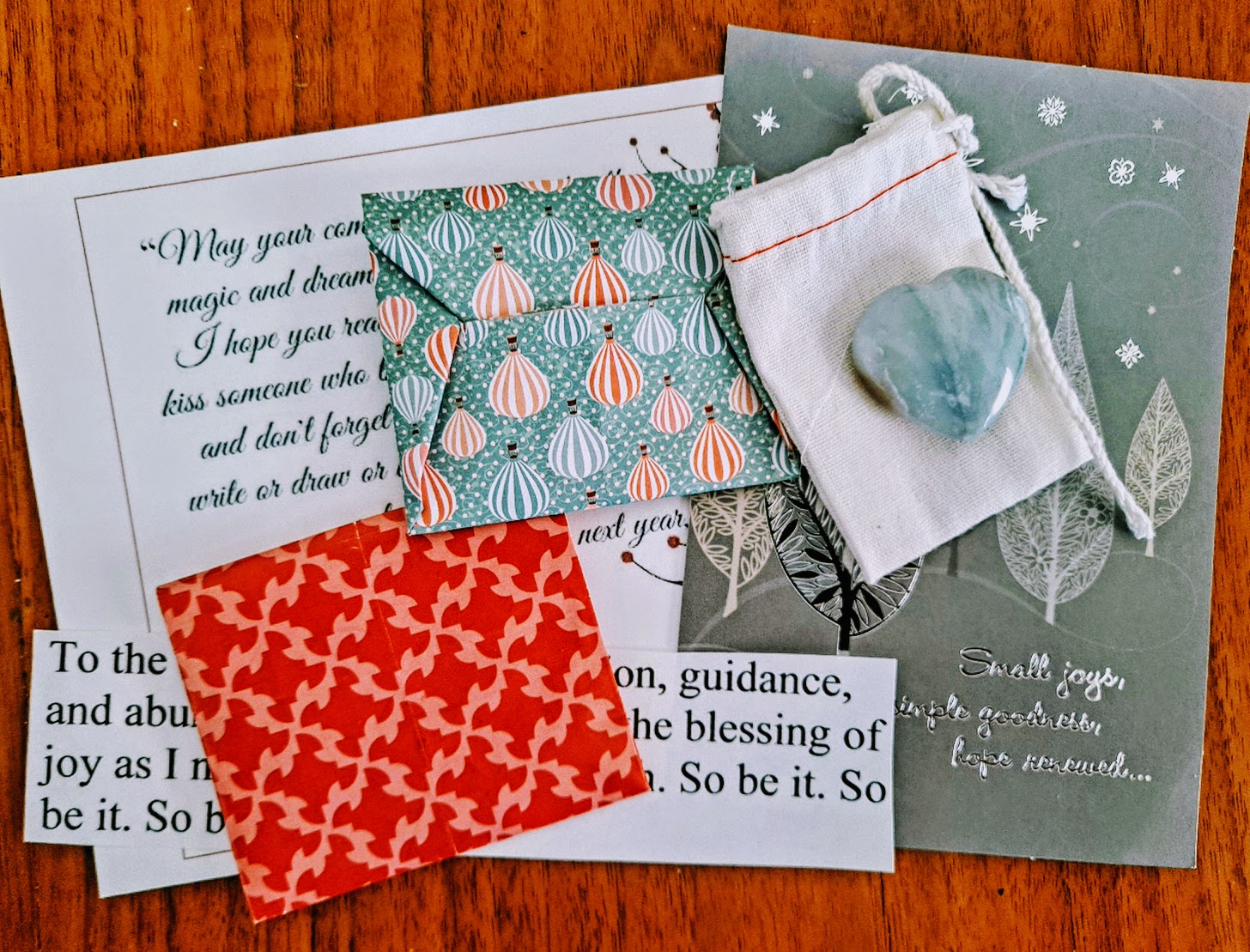
And a goodie-filled celebration station from my sister.

I also received a special gift for my house — the replacement greengage plum trees arrived today, and I have a commitment from my contractor to get them planted as soon as possible. I feel good about these trees. March 7th seems to be a lucky day for me. After all, this is the anniversary of the day I closed on my house, and for sure, that was a lucky day! So I have every expectation of these trees doing well.

While March 27th, the anniversary of Jeff’s death, is a day for me to reflect on the vagaries of life, March 7th is a day for me to celebrate the joys of life, serendipitous occasions, and unmade wishes come true.

I never wished for a house, never really even wished for a home of my own, never wanted the responsibility, and yet through a series of unlikely events such as actually finding a nice place I could afford in an area with an atmosphere that feels comfortable, here I am. It’s as if life reached inside me, pulled out a wish I’d never considered, and made it come true.

I suppose it’s fitting that the anniversaries of the two most life-changing events of my latter years occur in the same month. I’m glad this one comes first, though — I wouldn’t ever want to feel as if this house is a consolation prize for losing the love of my life. The two are separate events, and yet . . . not. Because obviously, if Jeff were still here, I wouldn’t have a house.

But that’s not a conundrum for today. Today is about celebration. And gratitude. Because I am so very grateful I have a lovely home in a nice town, with friends, a nearby library, a job. And people to help me celebrate.

Cheers!

***

Pat Bertram is the author of Grief: The Inside Story – A Guide to Surviving the Loss of a Loved One. “Grief: The Inside Story is perfect and that is not hyperbole! It is exactly what folk who are grieving need to read.” –Leesa Healy, RN, GDAS GDAT, Emotional/Mental Health Therapist & Educator.

How the Bob Has Affected Me

I’ve been saying that The Bob hasn’t affected me much at all. Even the stay-at-home mandates and quarantine times haven’t been a problem since they fed into my natural inclination to be a quasi-recluse. But as it turns out, The Bob has affected me, though so far, it hasn’t infected me.

Admittedly, it will be hard for me ever to get back into the socializing that I’d tried so hard to accomplish, but I don’t think it’s so much a lack of inclination (though there is that, too) but rather a hesitation to open myself to the possibility of getting sick. Because of The Bob, I am conscious of how disease spreads through even small gatherings, and I’m not sure I want to open myself up to that quite yet. It’s possible I’ll never again want to be that vulnerable, though never is a very long time.

Still, except for allergies (because of the winds, this is not a good area to live if one is allergic to dust), I haven’t been sick a single day since The Bob arrived in town. And oddly, it arrived here long before the P word was even mentioned. (P=Pandemic.) There was a horrendous flu that roared through here in late December 2019 before anyone had heard of The Bob. In retrospect, it seems as if that flu was The Bob, and is probably why this town seemed to offer a natural immunity for a while. I’d never understood how it got here, but I recently found out that a woman came directly here from Wuhan to visit a friend of hers, and so started that horrid pre-Bob flu season.

I didn’t get sick during that first wave, though I’d been around a lot of the people who got sick, and I didn’t get sick during subsequent waves, not even after I was directly exposed a couple of months ago, leading to a time of quarantine. Nor did I catch a cold or laryngitis or any of the other illnesses going around. This is the longest I’ve ever gone without even a cold, and I’m sure it’s because I see so few people. I suppose I should say so few different people. Because of my job, I do spend time with people, it’s just that they are the same people every day.

Not only am I leery of crowds, but I am leery of travelers. People who hang around where they live come in contact with a relatively small group of people (relative to the world’s population, that is), but travelers are within a couple of degrees of coming in contact with a vast number of people. (If you’re sitting next to someone on an airplane, for example, you’re not just in contact with them, but also one degree removed from everyone they have been in contact with, and two degrees removed from everyone those contacts had been in contact with.) And after all, that’s how The Bob originally spread, not just to here, but to everywhere.

When my sister reneged on a visit to come see me, I was actually relieved. Though I would have liked to see her, I wasn’t sure what sort of extra, unwanted baggage she would carry off the plane, and I was glad not to have to deal with it.

I’ve been taking care of a house for a friend who’s been out of the country for almost a year, and he called today to tell me he was back and to ask if he could stop by so I could bring him current on all that happened when he was gone. It’s not something I would have ever done before The Bob, but I asked him if it was okay if we waited a week. Although he’s not in quarantine (apparently, there is no quarantine for vaccinated folks, though they can still get sick from The Bob, and can still transmit The Bob to others), I couldn’t help but think of all those people he was in contact with during his very long and arduous trip from halfway around the world.

Luckily, he was okay with my request. Even more luckily, from my point of view, he has a lot of work to catch up on, so I don’t have to feel guilty about his being alone for the week. Of course, even if he wasn’t okay with my putting off our get together, he’d have to agree if he wants me to continue looking after his house when he leaves again. And, of course, because of how The Bob has affected me, not only do I not feel guilty, I don’t feel guilty about not feeling guilty.

[If you don’t already know, I call it The Bob because of a conversation in A Spark of Heavenly Fire, my novel about a novel disease. Click here to read that conversation: The Bob | Bertram’s Blog (bertramsblog.com)]

***

Pat Bertram is the author of intriguing fiction and insightful works of grief.