The Future of Books: The Problem of Filtering (Part 2)

My guest blogger today is Dale Cozort, author of American Indian Victories. This is the second in a three part series discussing the future of books. Normally I don’t post such long articles, but I thought Cozort’s analysis was too important to edit down. Cozort writes: 

Part one looked at how the filters that keep readers from having to sort through a glut of really bad writing are breaking down.  This section will look at how authors and readers can adapt to a world where the traditional filters are less useful. Part three will look at how publishers might react to reestablish their role in filtering.  

New Types of “Brand Names”: With the glut of books, readers are looking for ways of to be sure they are getting good quality reading material.  In that environment, “brand names”-names that readers have heard of-sell books, even if the names have little to do with publishing.  Celebrity is its own brand name.  Oprah’s book selections come to mind.  Fortunately or unfortunately, talk show hosts with the ability to attract readers are scarce. We probably won’t see book recommendations from say Jerry Springer.  (Shudder) 

We will probably see celebrities of other kinds acting as filters in various ways though.  Politicians like Newt Gingrich and actors like William Shatner have gotten into the book business.  Celebrity “bookshelves” or endorsements on Amazon.com and the like would sell books too, but would probably be too expensive in most cases, though actors and celebrities in certain niches might find that it’s a good way to keep their names in the public eye.  Would you be more willing to try a book from someone you’ve never heard of if it was on an Amazon bookshelf from say Joss Whedon (creator of Buffy, Angel and Firefly) or one of the actors from his shows?  If you loved those shows you might, and if the quality was high, you might try others from his shelf (assuming that he had one).  Popular bloggers sometimes get into the book filtering business too, recommending books and sometimes writing their own books. 

Popular writers can act as filters too.  Authors do recommend promising new writers to agents and publishers.  They sometimes offer blurbs to promising young authors or recommend them in their blogs.  Some popular authors near the end of their careers as writers have taken to being “co-authors” with a collection of promising young authors, basically lending their name (and probably some polish) to books written mainly by the younger or lesser known author.  The popular author’s name on the book attracts readers, acting as kind of a filter while pointing fans to good new authors. 

I could see aging but still popular and intellectually active science fiction authors like Jerry Pournelle or Robert Silverberg doing virtual bookshelves of promising new science fiction on Amazon in exchange for a share of the revenue from any traffic driven to the books on their shelves. Another possibility: publishers could set up boutique brands of “X-famous author Recommends” books, letting the author act as screener and to some extent putting his status as a brand name on the line.  That might also be a way for an up and coming independent press to differentiate itself, though the cost of bringing a big name in may be prohibitive. 

Data Mining: In a world with a glut of choices in books, figuring out reader preferences and directing them to books they’ll like can be great for both authors and readers.  Amazon is often very good at this.  Their recommendations based on previous purchases can be extremely well targeted.  To some extent their data mining replaces the old bookstore owner who knew the customers tastes and could direct them to good new authors. 

From a reader’s point of view, sites like Goodreads or Shelfari can do some of the same things.  If I see a reader with ten or twenty percent of their Goodreads library in common with mine I know that there is a good chance I’ll like the other books they’re reading too.  Sites like that would be even more helpful for finding new books to read if readers could sort other readers by percentage of books in common.  Goodreads is to some extent an amplified word of mouth. 

Word of mouth/social networking: Speaking of word of mouth, it can be important as a filter too, but for some reason doesn’t seem to work as well for books as it does for movies.  Part of the problem is our diversity of tastes in books.  Social networking may amplify the role of word of mouth, but so many aspiring authors are trying to manipulate it in various ways that it may not be particularly effective. 

Websites/blogs: Author websites and blogs may give readers some idea if they are going to like an author or not.  From a reader’s point of view it’s probably a good idea to look for an author’s blog or website if you’re not sure you want to take a chance on a book.  If the blog or website is not professional the book may not be either.  If you don’t like the writing style on the blog, that’s a good sign you won’t like the writing in the book either.  The flip side of that is that authors need to make sure their websites look professional and make a good impression.  That’s a do as I say not as I do thing.  My website badly needs remodeling.  

“The Wisdom of Crowds”: A couple of years ago someone at social networking website Gather.com had what seemed to be a brilliant idea: Stage an American Idol-style contest for unpublished authors.  The winner would get a publishing contract with Simon and Schuster and a big boost in sales from their exposure during the competition.  It would be democracy in action.  Readers would choose who got published.  Well, for a variety of reasons it didn’t work out that way, though two reasonably worthy winners did eventually emerge. 

The concept has been tried a few times since then, both by Gather and by Amazon.com, but in both cases the ‘popular vote’ element has been toned down.  In both of the subsequent Gather contests, the eventual winner received little popular attention during the contest and little advertising boost from the victory.  I still think there’s potential in the approach, but nobody seems to have found the right formula yet.  All of the contests so far have suffered from a common problem: not enough impartial readers participating.  There is also an inherent problem with the approach.  If a publisher’s marketing people don’t like a book or understand its appeal that makes it hard for them to market that book effectively. 

Web forums: As an author, it’s a good idea to have some presence on various on-line forums related to your subject matter, but you’ve got to be careful not to let them eat up too much of your writing time.  You’ll also need to learn how to avoid trolls, flame wars and the usual Internet hazards.  If a major hunk of your potential audience decides you’re a jerk, then you probably aren’t helping yourself.  If you get a good reputation on the forums but don’t get stuff written you’ve defeated the purpose of the exercise.  Also, be aware that a good reputation in an Internet forum is a very transient thing, as are boosts from blogging and web posts.  If you don’t maintain a consistent presence any impression you have made will quickly be forgotten. 

Free samples: Baen Books, a science fiction publisher, has a program where people can download free e-books of some of their authors’ older books.  The idea is that readers will get hooked on the free samples and then go out and buy the newer books from those authors.  Apparently that has worked fairly well.  The key here though is that these are books that have already been through the filtering process at a traditional publisher, and the authors have other books that have also been through that process.  Giving away e-books is probably not going to work for most aspiring authors, though some other kinds of free samples may. 

New technology: The first few good writers who hop on a new technology that takes off can often establish a good readership.  In the early days of the World Wide Web it was relatively easy to establish a good-sized niche readership if you consistently had something interesting to say.  Good writers who jumped into blogging early and consistently did well.  Those niches fill up quickly though, and it becomes more and more difficult to attract readers.  Technology advances will undoubtedly open up more niches like that.  The key for aspiring authors is to recognize technologies that are likely to take off and get into them early.  That’s much easier said than done.  You can waste a lot of time on things that look promising but never really amount to much. 

So, do I have a magic key to solving the filtering problem and getting authors together with their audiences?  Yes, but I’m going to keep it a secret and use it to become fabulously rich.  Just kidding.  I don’t think any one thing is going to fix the problems or even that all of the things I’ve mentioned are going to solve the problems.  Readers, authors and publishers are going to be living in an environment where many times readers never find authors that they would love, where good authors often never find their audience, and where publishers never find authors the public would love.  At the same time we’ll be living in an environment where readers have more choice in their reading than ever before.  They’ll have to work harder to exercise it, but it will be there. 

Finally, if you’re an aspiring writer be a reader too.  Go out and do what you have to do to find good books from authors you’ve never heard of before and from publishers you’ve never heard of before.  You’ll find some “bad karaoke” writing, but you’ll also find some gems and reading those gems will make you a better writer.  When you find good writing tell your friends about it.

The Future of Books: The Problem of Filtering (Part 1)
The Future of Books: The Problem of Filtering (Part 3)

—– 

Dale Cozort is author of American Indian Victories.  Visit his website at www.DaleCozort.com

On Writing: Style and Cadence

Ken Coffman, my guest blogger today, is the author of eight books, including a popular technical book called Real World FPGA Design with Verilog. He could easily make money writing additional technical books, but has more fun writing absurd novels like Steel Waters and Glen Wilson’s Bad Medicine, available from fine online bookstores everywhere. Ken writes:

Recently, my friend Lisa said this to me: “You tend to like more baroque-type authors, gravitate towards writers with that style, and write in that style.  Ironically, I really do like Hemingway, in that when I read him way back when, I immediately liked and related to the prose style . . . ”

It’s true. We’re diverse, and different things float our metaphorical schooners. See, there I go. I could have simply said boat and your eye would have slid smoothly over the cliché. But, I didn’t want to.

Anyway, back to the point I’m laboring to make.

          Nick looked on at the moon, coming up over the hills.
          “It isn’t fun any more.”
          He was afraid to look at Marjorie. Then he looked at her. She sat there with her back toward him. He looked at her back. “It isn’t fun any more. Not any of it.”
          She didn’t say anything. He went on. “I feel as though everything was gone to hell inside of me. I don’t know, Marge. I don’t know what to say.”
          He looked on at her back.
          “Isn’t love any fun?” Marjorie said.
          “No,” Nick said. Marjorie stood up. Nick sat there, his head in his hands.
                — 
Ernest Hemingway, The End of Something

Of course, I can appreciate Hemingway’s sparse mastery. In feeble imitation, sometimes I report things in a flat tone to emphasize a point or work against the reader’s mental picture. But, generally, my ambitions lie elsewhere. I like prose that is more playful and convoluted.

Tom Robbins, who I like to call my neighbor, writes like this:

          A few months later, everyone of the bride’s relatives, including even distant cousins, decided that life was meaningless without that most talented, most delightful girl, not to mention her pious and generous family, and so the relatives, as well, set off for the hills and Fan Nan Nan. Their departure tore a hole in the fabric of the community; there was an abiding emptiness there.
               –
– Tom Robbins, Villa Incognito

The difference in style could hardly be more obvious. Tom’s zany prose dances.

          Then I looked at Dale, my sergeant, wringing out his shirt in a metal water drum. His back was brown, ridged with vertebrae, his ribs like sticks against his skin, the points of his black hair shiny with sweat. Then his lean Czechoslovakian face smiled at me, with more tenderness and affection in his eyes than I had yet seen in a woman’s.
          He was killed eight days later when a Huey tipped the treetops in an LZ and suddenly dipped sideways into the clearing.
                —  James Lee Burke, Heaven’s Prisoners

Burke has a huge vocabulary and is unafraid to take a risk. He sits on a limb and with careful, deliberate, thoughtful strokes, works his saw.

To my taste, the master of mixing the eloquent with the absurd is Nabokov.

          I thought I had crossed the frontier when a bare-headed Red Army soldier with a Mongol face who was picking whortleberries near the trail challenged me: “And whither,” he asked picking up his cap from a stump, “may you be rolling (kotishsya), little apple (yablochko)? Pokazyvay-ka dokumentiki (Let me see your papers).”
          I groped in my pockets, fished out what I needed, and shot him dead, as he lunged at me; then he fell on his face, as if sunstruck on the parade ground, at the feet of his king. None of the serried tree trunks looked his way, and I fled, still clutching Dagmara’s lovely little revolver. Only half an hour later, when I reached at last another part of the forest in a more or less conventional republic, only then did my calves cease to quake.
              — Vladimir Nabokov, Look at the Harlequins!

So, how am I doing? You judge.

          “I’m bored,” Nort said.
          “That’s because you’re not doing anything.”
          “And you can’t make me.”
          “Right,” Jake said. “Exactly.”
          “I’m not staying here. I’ll beg on the street.”
          Jake looked up.
          “It used to be that a man would rather die than be a beggar or take charity,” he said.
          “Things are different now.”
          “I can see that. Good luck out there.”
          “What’s wrong with you? You don’t care about me at all.”
          Jake licked the tip of his pencil.
          “When I was in Da Nang, I was stabbed in the gut with a sharp stick by a starving 11-year-old who wanted the three dollars in my wallet.” He lifted his shirt to show a twisted scar. “After I killed him with a brick, I realized either God either didn’t exist or was the biggest asshole of us all. I care about you, but out in the world you’ll die of AIDS or get stabbed in an alley by a cracked-out whore. It doesn’t pay to get emotionally attached to the doomed.”
               — Ken Coffman, Fairhaven 

You plant your butt in your chair and you face the demons that live in that blank screen. You spend hours and hours wringing words, situations, and plots from too-thin air.

Who are your influences? And, what are your ambitions?

Discussion of Elmore Leonard’s Ten Rules For Writing Fiction

Elmore Leonard is hosting our discussion. He doesn’t know it, of course, but we had so much fun with Kurt Vonnegut’s Eight Rules, I thought we’d use Leonard’s rules this time.)

Ten Rules of Writing by Elmore Leonard:

These are rules I’ve picked up along the way to help me remain invisible when I’m writing a book, to help me show rather than tell what’s taking place in the story. If you have a facility for language and imagery and the sound of your voice pleases you, invisibility is not what you are after, and you can skip the rules. Still, you might look them over.

1. Never open a book with weather.

If it’s only to create atmosphere, and not a character’s reaction to the weather, you don’t want to go on too long. The reader is apt to leaf ahead looking for people. There are exceptions. If you happen to be Barry Lopez, who has more ways to describe ice and snow than an Eskimo, you can do all the weather reporting you want.

2. Avoid prologues.

They can be annoying, especially a prologue following an introduction that comes after a foreword. But these are ordinarily found in nonfiction. A prologue in a novel is backstory, and you can drop it in anywhere you want.

There is a prologue in John Steinbeck’s “Sweet Thursday,” but it’s O.K. because a character in the book makes the point of what my rules are all about. He says: “I like a lot of talk in a book and I don’t like to have nobody tell me what the guy that’s talking looks like. I want to figure out what he looks like from the way he talks. . . . figure out what the guy’s thinking from what he says. I like some description but not too much of that. . . . Sometimes I want a book to break loose with a bunch of hooptedoodle. . . . Spin up some pretty words maybe or sing a little song with language. That’s nice. But I wish it was set aside so I don’t have to read it. I don’t want hooptedoodle to get mixed up with the story.”

3. Never use a verb other than “said” to carry dialogue.

The line of dialogue belongs to the character; the verb is the writer sticking his nose in. But said is far less intrusive than grumbled, gasped, cautioned, lied. I once noticed Mary McCarthy ending a line of dialogue with “she asseverated,” and had to stop reading to get the dictionary.

4. Never use an adverb to modify the verb “said” . . .

. . . he admonished gravely. To use an adverb this way (or almost any way) is a mortal sin. The writer is now exposing himself in earnest, using a word that distracts and can interrupt the rhythm of the exchange. I have a character in one of my books tell how she used to write historical romances “full of rape and adverbs.”

5. Keep your exclamation points under control.

You are allowed no more than two or three per 100,000 words of prose. If you have the knack of playing with exclaimers the way Tom Wolfe does, you can throw them in by the handful.

6. Never use the words “suddenly” or “all hell broke loose.”

This rule doesn’t require an explanation. I have noticed that writers who use “suddenly” tend to exercise less control in the application of exclamation points.

7. Use regional dialect, patois, sparingly.

Once you start spelling words in dialogue phonetically and loading the page with apostrophes, you won’t be able to stop. Notice the way Annie Proulx captures the flavor of Wyoming voices in her book of short stories “Close Range.”

8. Avoid detailed descriptions of characters.

Which Steinbeck covered. In Ernest Hemingway’s “Hills Like White Elephants” what do the “American and the girl with him” look like? “She had taken off her hat and put it on the table.” That’s the only reference to a physical description in the story, and yet we see the couple and know them by their tones of voice, with not one adverb in sight.

9. Don’t go into great detail describing places and things.

Unless you’re Margaret Atwood and can paint scenes with language or write landscapes in the style of Jim Harrison. But even if you’re good at it, you don’t want descriptions that bring the action, the flow of the story, to a standstill.

And finally:

10. Try to leave out the part that readers tend to skip.

A rule that came to mind in 1983. Think of what you skip reading a novel: thick paragraphs of prose you can see have too many words in them. What the writer is doing, he’s writing, perpetrating hooptedoodle, perhaps taking another shot at the weather, or has gone into the character’s head, and the reader either knows what the guy’s thinking or doesn’t care. I’ll bet you don’t skip dialogue.

My most important rule is one that sums up the 10.

If it sounds like writing, I rewrite it.

Or, if proper usage gets in the way, it may have to go. I can’t allow what we learned in English composition to disrupt the sound and rhythm of the narrative. It’s my attempt to remain invisible, not distract the reader from the story with obvious writing. (Joseph Conrad said something about words getting in the way of what you want to say.)

If I write in scenes and always from the point of view of a particular character-the one whose view best brings the scene to life-I’m able to concentrate on the voices of the characters telling you who they are and how they feel about what they see and what’s going on, and I’m nowhere in sight.

What Steinbeck did in “Sweet Thursday” was title his chapters as an indication, though obscure, of what they cover. “Whom the Gods Love They Drive Nuts” is one, “Lousy Wednesday” another. The third chapter is titled “Hooptedoodle 1” and the 38th chapter “Hooptedoodle 2” as warnings to the reader, as if Steinbeck is saying: “Here’s where you’ll see me taking flights of fancy with my writing, and it won’t get in the way of the story. Skip them if you want.”

“Sweet Thursday” came out in 1954, when I was just beginning to be published, and I’ve never forgotten that prologue.

Did I read the hooptedoodle chapters? Every word.

Do you agree with these rules? Which, if any do you follow? Which, if any, do you not follow? Which, if any of these rules, do you think are hooptedoodle?

The group No Whine, Just Champagne will exchange ideas about these rules during our live discussion on December 11, 2008 at 9:00pm ET. Feel free to join us, or to leave your comments here.

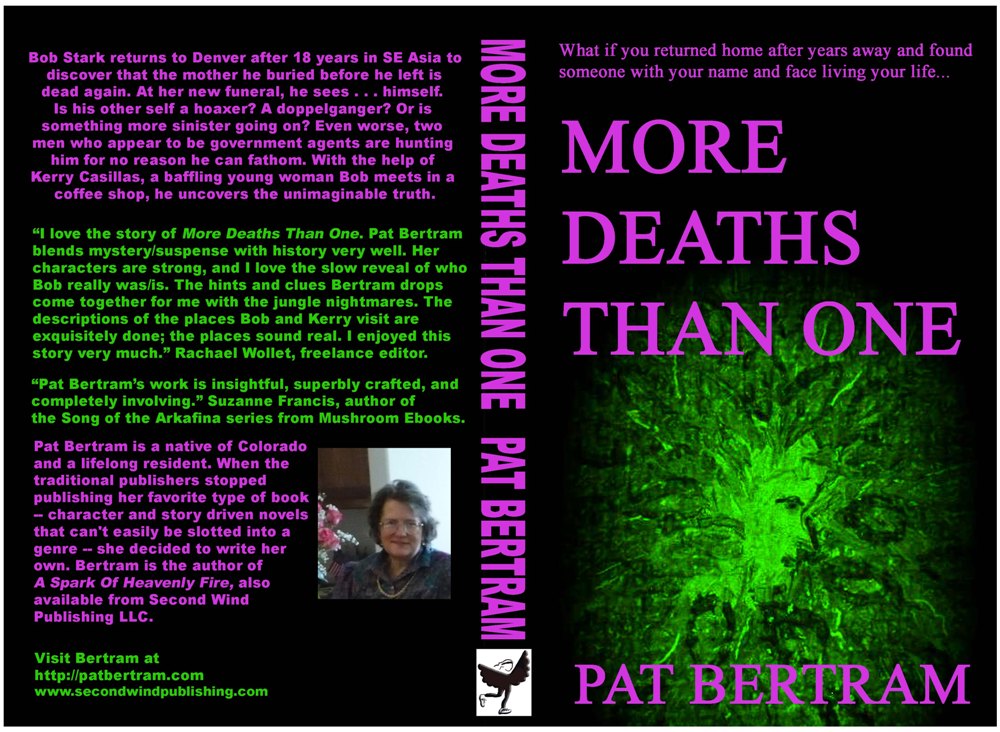
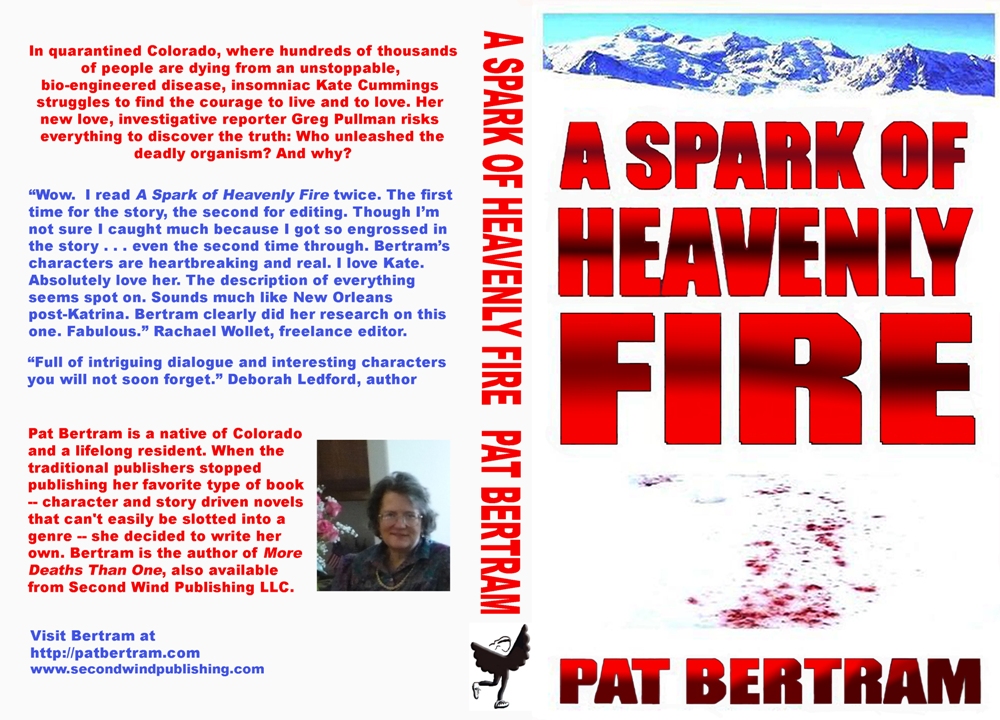
Sneak Preview of My Book Covers.

Front and Back Covers of More Deaths Than One

Front and Back Covers of More Deaths Than One

Front and Back Covers of A Spark of Heavenly Fire

Front and Back Covers of A Spark of Heavenly Fire

Heart of Diamonds

My guest blogger today is Dave Donelson, author of Heart of Diamonds, a romantic thriller with roots in reality. Donelson says: 

There has been a great deal of discussion about reality versus imagination in memoir, but something that’s often overlooked is the role real events and people can play in fiction. 

That is especially true in a novel like Heart of Diamonds, my high-concept romantic thriller about blood diamonds in the Congo. The plot concerns the White House, the President of the Democratic Republic of Congo, and an American televangelist in a diamond smuggling scheme that is uncovered by an enterprising TV reporter, Valerie Grey.

One of the main characters in Heart of Diamonds is Gary Peterson, the American televangelist who owns the diamond mine. He’s a fabulously successful man of God, a close pal of the President of the United States, and utterly devoted to making a quick buck or two if the opportunity presents itself. He also has a right hand man, missionary Thomas Alben, who runs the diamond mine for him and does most of the dirty work in the operation.

All of these characters are fictional, of course, but they had their genesis in the real world. The whole concept for Heart of Diamonds sprang from an article I read in Time Magazine about the cozy relationship between Pat Robertson, the famous American televangelist, and Mobutu Sese-Seko, the dictator who raped the Congo for thirty years. When I found out Robertson owned diamond mines and timber concessions in the Congo-making profits from slave labor, no less –I  simply had to write a book about it.

The Robertson-Mobutu connection is fascinating. Mobutu was essentially put in office by the CIA. He ran the country for three decades and stole literally billions of dollars. During that time, he had one of the worst human rights records in Africa.

The other member of the tag team is Pat Robertson, one of the most successful evangelical preachers of all time. He founded the 700 Club, ran for President of the United States, and has millions of followers around the world who subscribe to his version of Christianity. You wouldn’t think these two men would be buddies, but they were.

Robertson had many business interests in the Congo-and it just wasn’t possible to operate there at the time without the direct approval of Mobutu. It was also well-known that you didn’t get that approval for free. Apparently, Robertson and Mobutu got along famously. The Time article reported that one time, Robertson and his wife and their entourage were flown from Paris to Kinshasa on one of Mobutu’s personal Boeing 707s. In Zaire, Mobutu himself took them on the presidential yacht on a ride up the Congo River to visit one of his estates.

Robertson had a relief program in the Congo that is still functioning, Operation Blessing, as well as a private concern called the African Development Company, which made investments in mining, lumber, agriculture, transportation and power generation, supposedly with an eye to plowing the profits back into humanitarian efforts. One of those investments was a diamond mine in a small town south of Tshikapa near the Congo’s border with Angola. That’s the site of the diamond mine in Heart of Diamonds.

One of the men who ran ADC for Robertson was Bill Lovick, a former minister of the Assemblies of God who was dismissed by the church in 1985 for questionable fund-raising practices. Readers of Heart of Diamonds may find some interesting similarities between these men and some of the characters in the novel, notably televangelist Gary Peterson, the missionary Thomas Alben who runs the diamond mine, and Moise Messime, the President of the Congo.

The more I learned about these guys and the things they were doing in the Congo in the name of Jesus Christ, the more intrigued I became. Heart of Diamonds isn’t their story-the smuggling scheme, the connection to the White House, the U.S. military involvement, and many other elements are completely fictional. The characters are figments of my imagination, too, although they certainly have personality traits similar to some real individuals.

What is very real in Heart of Diamonds is my portrayal of the terrible plight of the people of the Democratic Republic of Congo, which is the direct result of the unadulterated greed of people trying to control the vast natural resources of the country. Mobutu may be long gone and Pat Robertson’s business interests gone with him, but the brutality continues.

Interview with C.A. Milson, author of The Chosen

Interview with C.A Milson, author of The Chosen, available from Amira Press:

Bertram: What inspired you to write The Chosen?

CM:  The first inspiration for writing this particular story came to me in 1989, when I was living in Melbourne, Australia. The original story was titled “Shack of Evil”, a 9-page story based on the character of Jamiesonn. The story idea came from a Hobbytex picture my mother had on the wall of her apartment. After writing “Shack of Evil”, I went on to write an additional 25 short stories, all of different genres, including a children’s story. “Shack of Evil” would later become the base for what is now the trilogy of The Chosen, Bloodline of Darkness, and Prophecy’s End.

Bertram: What was the hardest part of writing your novel?

CM: The hardest part is the re-writing of chapters and scenarios. No part of writing is perfect from the first sentence, as I will have an idea for a chapter, then when I have reviewed it I am likely to scratch that whole scene and go in a completely different direction. The other hard part is coming up with new ideas and concepts. There are times when I can sit in front of the computer for hours with no inspiration at all.

Bertram: What is your favorite scene?

CM: One of my favorite scenes in The Chosen is when Alex faces his nemesis for the last time. Alex has been anointed with supernatural power that even the forces of darkness sit back in awe. There is a scene where he is thrown into the sea of fire, and . . . well, I won’t say too much as that will give the plot away.

Bertram: What do you hope readers will say about your book?

CM: I hope my readers will say that they loved my novel and await the second one to come out!

Bertram: What’s next for you?

CM: Next for me is writing Bloodline of Darkness, which is the second in the trilogy in the life of Alex Manning — a man who is put in the middle of a spiritual conflict he otherwise wants no part of. Bloodline of Darkness is set seven years after The Chosen. Alex has forsaken his powers to live a “normal” life, and the forces of Tartarus have arisen to harvest the souls of humans and plunge the world into darkness. Alex once again must stand and save humanity but can he overcome the ever-present darkness that also reigns in his own heart?

Drabbles and Dribbles

My guest blogger today is Sheila Deeth, author of Christmas! Genesis to Revelation in 100 Words a Day and Easter! Creation to Salvation in 100 Words a Day. Shiela writes: 

I drabble. Technically, since drabble’s a noun, I should say I write drabbles. They’re defined in Wikipedia as “extremely short” works of fiction “exactly one hundred words in length.” But however short, they’re still stories, with beginning, middle and end; and they might even be fun to read, like haiku supersized. 

Dribbles are drabbles with fifty words. And double-drabbles have two hundred. 

It doesn’t take much to write a drabble; just a paragraph or two. And once I’ve typed my mini-masterpiece I can edit something that needs only moments to read. I learn to check, where’s this going? Has anything changed? Did I repeat myself when I should’ve found a synonym? And what can I delete-adjectives, adverbs? 

I learn to choose between showing and telling with only words for one scene, selecting details to draw in the reader, and exercising the gentle art of leaving some things out. 

With a novel, I’ll want readers to keep turning the pages. With a drabble, I hope to keep their thoughts churning. And maybe some small idea will stick, till one day my book hits the stores and glues itself to their questing hands. 

I drabble, and this article is double-drabble sized. 

The drabble below is one of a series I’m posting on gather.com for Thanksgiving (though it’s probably got more to do with Hanukah). There’s a dribbled version underneath.

How do you rebuild what is broken and dirtied and destroyed? Where do you begin? 

They ripped out the altar and built it new. They set new stones to reform the walls and cleansed the undergrowth that had wrecked the pavement. They brought back the lamp and the incense and table and arranged them in their place. And they prepared the sacrifice. 

But all their labors were in vain; there was scarcely oil even to light the lamp. 

How do you rebuild? You pray to God. Then the teaspoon of oil lasted eight days long and the Temple was restored. 

…and a dribble? 

They ripped out the altar, reset the stones, and cleansed the undergrowth that had wrecked the floor. They relit lamps, burned incense, and prepared the sacrifice. But light faded, the oil was gone, the lantern burning dry. 

They prayed and the oil held out, restored, eight glorious days and nights.

The Story Behind “Stalking Susan” by Julie Kramer

Julie Kramer, author of Stalking Susan is here as my guest to to tell us the story behind the Susans:

Because the plot in my debut thriller involves a serial killer targeting women named Susan, people want to know if I have a special enemy by that name. I don’t. STALKING SUSAN is not a personal tale of revenge.

But some stories stay with journalists long after the newscast wraps. A decade ago, as a television news producer, I covered two cold case homicides that inspired me to write STALKING SUSAN. The cases involved two women, both named Susan, murdered exactly two years apart in St. Paul, MN.

My debut story is not their story. That’s why I use the word ‘inspired,’ rather than ‘based on.’ Their cases remain unsolved. But in the world of fiction I was free to ask myself, what if?

Being a career journalist it’s no surprise I’m a rip-it-from-the-headlines writer. But transitioning from writing news to writing fiction did come naturally. It felt like cheating. And it was work to overcome that feeling. Apparently though, I do have an imagination – a vivid one – and it kicks in for the conclusion, if not the set up.

When I wrote STALKING SUSAN, I changed the victims’ appearances, occupations, and the times and locations of their deaths. I also added more victims. I changed their last names and almost changed their first name. But I decided to keep Susan because I never forgot them and I wanted others to remember them, too.

I don’t recommend other authors give their characters the same name — I ended up with five Susans — it complicates storytelling and character development. But if I’d changed their names to Mary, I’d have ended up with a completely different plot. Because the twists in STALKING SUSAN come from using name origination and famous Susans in history as clues. Because of this, readers named Susan tell me they love the story because it makes them feel special.

When it comes to the world of news, It’s the stories without resolution that tend to stick in reporters’ minds. Besides the parallels of name and date of death – which could end up being completely coincidental – what attracted me to these cases was that they were unimportant murders, buried deep inside the daily newspapers with no real follow-up. Fifteen years later a reporter colleague and I made a run for tips and answers and came up empty. That’s how it usually ends in newsrooms, no matter what you see about reporters in the movies or read in books.

In real life, journalists don’t often catch the killer, so writing this book was a little like living a news fantasy.

But it really was just a fantasy, because bottom line, someone, maybe more than one someone, got away with murder. So any opportunity to keep the names of the true victims out there, is a good thing. So here goes:

Susan Ginger Petersen, age 28, was strangled May 17, 1983.
Susan Jean Rheineck, age 16, was asphyxiated May 17, 1985.

Their murders have never officially been connected. Not by DNA, witnesses or any other evidence. But some similarities in the crime scenes are suggestive.

Now the St. Paul Police Cold Case Unit is taking a fresh look at these murders, and privately investigators are saying wouldn’t it be funny if fiction brought attention to bring tips to solve the crimes after all this time.

To learn more about the author visit http://www.juliekramerbooks.com

Julie Kramer: Stalking Susan

So You Want to be an Author

Today’s guest blogger, Ernie Johnson, author of Destiny of the Divas, says:

If that title don’t grab you, nothing will.

Every once in a while you’ll hear someone say “Hell I can write a book. There’s nothing to it.”

DON’T YOU BELIEVE IT…..!

Anyone who thinks there’s nothing to it, better read this story, from someone who’s been there, done that.

Here’s a story about me, Ernie Johnson, a nobody with an electric typewriter and a friend’s manuscript that had been handwritten to the tune of 750 pages. Mind you, this was not written normally. Normal people will write from left to right. This friend wrote from right to left.

I knew nothing about writing books, but I said I’d try. I started by transposing his words, verbatum, until I had it all typed out – double-spaced 12 point Times New Roman. Then my fun began. I sat down and read it over to see where it needed tweaking, or to put it bluntly, what needed to be added to make it worth publishing.

When you stop to figure, I worked the midnight shift, with my friend, and by the time I got home, I needed to get some sleep, by the time I got to work on his book I only had about three hours a day, during the week with which to work on it. I won’t drag this out, but it took me five years to complete, to what I believed was a good story. By then I’d left the company and was working elsewhere, and hadn’t kept in touch with my friend. I went looking for him, and he’d fallen off the face of the earth. In fact, even the Police didn’t know where he was.

It was during the writing of my friend’s manuscript that I decided I wanted to write for myself, so by 1988 I started with an outline and a subject I knew something about, and began OVERTURNED.

By 1990 I’d received an old computer, and when I say old, it was a relic, but it served the purpose for the time being. I transposed everything from Overturned, and was able to see it on screen. I got involved with a writing group, on line, and it was there that I got humiliated by writers who critiqued my work. That may have been the best advice I was ever given. I wrote the way I talked, and, to be very honest, my use of the English language was not the best. I was, back then, an adverb junkie. Really, and truthfully, I was totally an adverb-a-holic, and it showed dramatically in my writing. That was an example of how I talked, and also the way I wrote. Those critiques, as humiliating as they were, was what I needed to be a better writer.

I went through my entire manuscript and corrected all the needless adverbs. I read and reread my manuscript, each time making necessary changes, like missing commas, etc., until I had that mss as fine-tuned as an Indy Racecar. Now the next step to publishing stardom, is finding a publisher to publuish the mss. Now don’t get me wrong, the old addage “PATIENCE IS A VIRTUE” comes to play here really bigtime, for if you don’t have the patience, this is the wrong profession for you to be in. Submissions after submissions came back rejections after rejections. In between all the rejections, I’d written Mountain of Love and Mountain of Love II – Return to Manhadden.

By late 1993 I’d given up hope of my work every being published. I didn’t have the patience to wait forever. I was so depressed with the process, I gave up writing altogether. I said to heck with it.

In the fall of 2001 I went out with a group of friends who did the karaoke thing once a week at a local watering hole, and we went out for breakfast at a local restaurant that was open 24 hours. While we ate, we talked, and I was talking with a friend who mentioned he’d had an idea for a story, but where he wasn’t a writer, he didn’t know how to go about it. Two days later, at the same restaurant, we were discussing his idea. What it boiled down to was he had the names of four girls, and the instruments they played. He had no beginning, no plot, and no title, so in other words – he didn’t have much. My mind was working overtime developing a story and it took me a while, because I didn’t want just any story, I wanted a best seller. I took my time and developed DESTINY OF THE DIVAS into a strong paranormal, mystery, suspense, drama. Even though all prognosis was in my favor, I still had the hard part, finding a publisher.

I got sidettracked, writing about my book and all, but finding a publisher is JUST AS HARD as finding a needle in a haystack, at least for the new untested author. What do I mean by untested? You haven’t proven your worth to a publisher. Publishers want authors who’ll sell books, lots of them, so a first time author has to prove his worth to a top name publisher.

Some authors bypass the traditional publisher route, by going to a POD (PRINT ON DEMAND) publisher, and today there are a number of them out there, both scrupulous and others who try to do good by the author, and I won’t name names here, but for those of you who are considering this route, check with PREDITORS & EDITORS before you sign any agreement with a POD publisher.

I went with LULU.COM – and published OVERTURNED, MOUNTAIN OF LOVE, KASHMANTOU, LET FREEDOM RING, and THE MISADVENTURES OF THE DEVERS BROTHERS.

You might be reading this, and are thinking, WOW…! He’s published six books. He must be rich and famous. Guess again. Yes I’ve got six published books, but if I’m not out here, seven days a week, marketing my books, they won’t sell themselves. Each book needs me out here marketing them.

Is marketing fun? I think I’d rather wrestle an alligator. No, marketing your book is not fun, but it’s necessary.

Being an Author is more than just writing the words. Being an author is being the conductor of the symphony, being the symphony itself, and being the promoter of the symphony. The better a promoter you are, the larger the audience you’ll attract. Not every author is a good promoter, but every author has to try.

Writing Discussion: Playing Fair With Your Readers

A novel is a writer’s contract with readers. The author promises to keep readers interested, to not waste their time, to play fair. The reader promises nothing, except perhaps to read the book if the writer fulfills the contract.

To a great extent, genre is about fulfilling the contract of reader expectations. In a romance novel, the story conflict revolves around the romantic relationship between two people and is characterized by romantic tension, desire, and often an ending that unites the couple. In mystery, the story conflict revolves around a crime and is characterized by clues leading to answers, increased tension, and often danger as the solution nears. If a story strays too far from the reader’s expectations, the reader will feel as if the author is reneging on the contract and might not finish reading the book. Even worse, they might not buy the author’s next one. That isn’t to say a writer can’t follow unexpected storylines, but somehow that difference must be conveyed to readers so they know the author is playing fair.

Suspense is considered a genre, yet suspense should be part of every novel, part of the contract with the reader. If readers are not at least bit curious about the outcome, if the story or the ending is obvious, readers have no reason to read. On the other hand, if the author withholds vital information to release at the end, it creates suspicion, not suspense, and the reader feels cheated.

So, let’s discuss playing fair with the reader. How do you create suspense in your genre? How do you gradually release the needed information, so that at the end, your reader feels surprise mingled with “Of course!” What is your contract with your contract with your readers, and how are you going about fulfilling it? How do you keep from cheating your readers? And for the reader in all of us, have you ever read books that made you angry because the authors did not fulfill their contract?

My online writing group No Whine, Just Champagne will exchange ideas about playing fair with readers during our live discussion on Thursday, November 6 at 9:00pm ET. Hope to see you there!