Homefull

I often write about (or at least refer to) the changes in my life since Jeff died twelve-and-a-half years ago, but I don’t write that much about the changes since my older brother died. Yesterday was the fourth anniversary of his death, and it surprised me that it wasn’t that long ago (or perhaps it surprised me that it was so long ago — with death and grief, it’s sometimes hard to tell). His death set into play a long string of happenstance that ended up with me, in a house, in this sweltering corner of Colorado.

Mostly, his death changed me in some fundamental way so I was ready when my other brother suggested I take my small savings and buy a house. He’d come to help me clear out our deceased brother’s things and deal with any legal issues, and I have a hunch he wanted to make sure I was settled so he wouldn’t have to worry about yet another sibling. Whatever his reasoning, the idea he broached made sense to me, especially when he told me about this area that actually had houses I could afford.

The time was ripe, apparently, for buying houses in and around this area, because every one I liked (and could afford) disappeared from the market even before my real estate agent could look at it.

Luckily, I only needed one house, and that house came looking for me.

It seems as if I’d been looking for a very long time before I became aware of this house, but considering that my brother has been gone only four years and that I’ve been here a couple of months shy of three and a half years, the whole upheaval to my life — ambitions, geographical location, as well as the mental change from life-long renter to homeowner — happened in a matter of months.

It’s ironic that because of the death of my homeless brother, I am homefull. (That’s not a word, though it should be.) At any rate, whatever the proper word, because of him, here I am, with a home of my own.

***

Pat Bertram is the author of Grief: The Inside Story – A Guide to Surviving the Loss of a Loved One. “Grief: The Inside Story is perfect and that is not hyperbole! It is exactly what folk who are grieving need to read.” –Leesa Healy, RN, GDAS GDAT, Emotional/Mental Health Therapist & Educator.
Balancing on the Fulcrum

This heat sure is zapping any energy I might otherwise have had. I still do my early morning yard chores, but the effort required to slog my way through the heat leaves me without any resources for the rest of the day. Even when I’m finished and am inside with the air conditioner going, I can still feel that lack of interest in doing anything. Except for reading, of course. That I can do anywhere or at any time, though I have to admit, few books can hold my interest enough to keep me awake for very long. Naps anyone?

It’s times like this when I can feel the pendulum swing of life. Here we are, stuck in a slough of over 100-degree temperatures, but it wasn’t that long ago when the temperatures were dipping below 0 on the Fahrenheit scale. On a day-to-day basis, the pendulum of the seasons might not seem as if it is moving, but it is. In another six months, we’ll be back to those frigid temperatures.

Another pendulum I could feel today is the one that regulates how I feel about my yard and the work I’m putting into it. A few months ago, I was enchanted with the way everything looked and how everything was going. Now I am definitely unenchanted (meaning the enchantment is at an end) though the pendulum hasn’t yet swung all the way to disenchanted (meaning disillusionment and disappointment). And perhaps the pendulum might not swing that far. My love affair with my garden was a shallow one, based entirely on its looks. As the old flowers and plants die off and late-bloomers blossom, and as (perhaps) the rather bleak look of midsummer desiccation gives way to a more robust autumn look when cooler temperatures favor cool-temperature plants, such as New England asters, chrysanthemums, and my grass, then I might become enchanted again. If not, there’s always next spring and the inevitable pendulum swing.

I try not to be too influenced by wild pendulum swings because life is so much more comfortable on the fulcrum. I do, as much as possible, try to remain emotionally centered without going to extremes of moods. (Grief was an aberration, an insane one-sided, one-way swing of the pendulum of life, though even then, I tried to find whatever balance I could.) Still, even centered as much as possible on the fulcrum, small daily mood changes can seem immense when influenced by the out-of-my-control swings of nature.

And especially when the heat wipes me out, leaving me without the energy to balance on the fulcrum.

***

Pat Bertram is the author of Grief: The Inside Story – A Guide to Surviving the Loss of a Loved One. “Grief: The Inside Story is perfect and that is not hyperbole! It is exactly what folk who are grieving need to read.” –Leesa Healy, RN, GDAS GDAT, Emotional/Mental Health Therapist & Educator.

Grief and Loss of Friendship

A recent widow wrote to Dear Abby because her best friend is blowing her off, cancelling plans, and not calling or texting. The widow is understandably upset because not only is she mourning the loss her husband, she’s mourning the loss of a friendship as well as being hurt and confused because she doesn’t understand her friend’s behavior.

Neither does Abby. (Understand the friend’s behavior, that is.) As she so often does, the advice columnist doesn’t bother to go into depth with her answer, just suggests that the widow join a grief support group and to keep busy so she doesn’t “brood.” After that, according to Abby, the widow can confront her friend if she decides it’s in her best interest.

Normally, that weak answer would make me think the columnist was ignorant of grief, but she herself is a widow. (She’s also 80 years old, which means she should be a lot wiser than she tends to be.)

A woman who recently lost her husband and whose best friend wants nothing to do with her is grieving, not “brooding.” She’s also doubly alone, and loneliness tends to exacerbate grief. So many of us who have also been left alone (with the obvious exception of the columnist) know the truth of grief — that it takes you in its grip and doesn’t let go until it’s ready to let you go.

As for the friend, it probably wouldn’t do any good to confront her. Chances are she has no idea why she’s ignoring her widowed friend. I’m sure the friend feels uncomfortable and hesitant to be around the widow, but if she’s like most people who are still married (I’m making an assumption here), she can’t handle the other woman’s grief because if she gives it any credence, then she also has to accept the possibility that she herself will one day be in the same unimaginable situation.

Death is shrouded with an element of blank. It is the great unknown and unknowable, and our brains are not equipped to handle the immensity. We who are left alone have no choice but to grapple with all the conundrums death brings, but others can and do choose to ignore the whole situation. And they choose to ignore us, because — to them —we are the situation.

While we are in the grip of our grief, the survival mechanisms of those around us are triggered. To avoid facing the unfaceable, people close to us will indulge in self-protective behaviors that shut us out. Some also sense that our needs are so great and so complicated that they would be best not to get too involved. And perhaps they sense their own inadequacy at dealing with the very topic of death.

Even though I’m sure they know deep down they are being unfair, people blame the grievers, as if the grief-stricken had done something to bring on their fate. (That in this case the husband died of The Bob would make it even easier to blame the victim, because either the widow or her husband should have been smart enough to avoid getting sick.) We humans simply cannot handle the idea that life is capricious, that we are living at the whim of fate. (I think learning to handle that concept is part of why grief takes so long. The biggest part, of course, is that someone intrinsic to our lives is gone, leaving us with a huge hole in us and in our life.)

It’s possible that one day the friend will resume the friendship when the raw grief the widow is feeling has been tempered by time and work (grief work, that is). It’s possible the friend will excuse her behavior the way people always do, professing that she thought the widow would be uncomfortable with couples or with people who are still coupled. It’s possible the friend will assume they can get back on the same easy footing they once had, but that easy footing won’t ever happen. Even if the widow comes to understand the friend’s behavior, it’s hard for me to believe that she’d ever be able to let down her guard around someone who so willfully let her down. But more than that, grief changes people. It’s as if a line was drawn, and those on the loss side see things differently from those on the “no loss yet” side.

A fellow griever once told me she had a friend who treated her as if her grief was a small thing, telling her to get over it, to move on, all the usual platitudes. Later, when the friend’s husband died, she called to apologize because she hadn’t known the truth of how hard it is to lose someone to death. As she discovered, you can’t know until you’ve been there, which is why I sometimes give people the benefit of the doubt when they offer paltry advice and scant comfort to people who are hurting. But it’s hard to give the benefit of the doubt to someone who has been there, yet still offers little help or understanding.

The letter writer should have come to me instead of writing Dear Abby. I do offer grievers both help and understanding, as well as a few stray tears of empathy.

At least I do now. Before Jeff died, however, I was as impatient and as uncomfortable as everyone else on the clueless side of the line.

***

Pat Bertram is the author of Grief: The Inside Story – A Guide to Surviving the Loss of a Loved One. “Grief: The Inside Story is perfect and that is not hyperbole! It is exactly what folk who are grieving need to read.” –Leesa Healy, RN, GDAS GDAT, Emotional/Mental Health Therapist & Educator.
Seeing the Bright Side

Anyone who has read my blog for any length of time knows I am not a glass-half-full sort of person. Nor, to be honest, am I a glass-half-empty person. I’m more prosaic than either type, more realistic. The nature of a glass is to not remain at a halfway point. If the glass contains a drinkable beverage, you drink it and then refill the glass with the same or a different beverage, or you wash the glass and put it away. If the glass doesn’t contain a drinkable beverage, you toss out the contents and wash the glass or you toss out the whole thing — glass and contents. If you don’t drink the beverage, the glass still doesn’t remain half empty/half full. There is a thing called evaporation, which means that no matter what, the glass will empty itself.

Life, like the level of the contents in the glass, is in motion. A situation can seem bleak with no bright side at all, such as the death of a loved one, and while that situation never changes, you do. When Jeff died, I tried to tell myself that at least he wasn’t suffering anymore and though I suppose that is a realistic bright side, it didn’t help me at all in dealing with my grief. However, there does come a time — years later, perhaps — when a griever has to stop seeing only the bleakness of life and to try to find a brighter side.

In my case, it was the dance classes I started taking three-and-a-half years after Jeff died. Although I was still grieving for him, my grief wasn’t the only “side” in my life anymore. There was a brighter side, too, which helped light my way through the dark times.

I’ve never trusted people who only look at the bright side of things. It seems to me they are either delusional or indulging in dreams instead of reality. Besides, without dark, there is no light. There was an artist who found fame as a painter of light, but if you were to study his paintings piece by piece (as in a jigsaw puzzle) you will see that most of the painting is dark; the darkness is what makes the light so bright.

I do think it’s possible, because of one’s situation, one’s temperament, or one’s mental frame of mind, that it becomes habit to only look on the dark side. (Which means, I suppose, that for some people, looking only on the bright side is also possible.) If only the dark is apparent, it’s a good idea to try to see the bright side of things. In the case of grief, it’s more than okay to indulge in the bleakness because that’s how we learn to cope with life without our loved one. However, as the years pass, it’s okay to start seeing the bright side of other things.

Although I am still aware of the bleakness of Jeff’s being gone, I have looked for a bright side and in fact, looking for any brightness in my life was how I found myself in a new way of being. It wasn’t that I tried to find a bright side to his being gone — there simply is no bright side. It’s that I tried to find a bright side to my still being here. And there is much brightness in my life now — a house, a home, a garden, flowers, a lawn, friends, neighbors, a compatible town, a nearby library — so much so that I no longer need to find the brightness. It finds me.

***

Pat Bertram is the author of Grief: The Inside Story – A Guide to Surviving the Loss of a Loved One. “Grief: The Inside Story is perfect and that is not hyperbole! It is exactly what folk who are grieving need to read.” –Leesa Healy, RN, GDAS GDAT, Emotional/Mental Health Therapist & Educator.

Finding a Focus After Grief

Not everyone enjoys my gardening posts, especially those who have found this blog because of grief, and that’s understandable, but the truth is, almost all my posts, even the gardening posts, are indirectly related to grief.

The past twelve years, particularly the past five when the pain of Jeff’s death pretty much disappeared, have been about finding a focus outside myself, about making myself . . . bigger. Becoming more.

When you’re connected to someone in an intrinsic way, such as Jeff and I were, almost by definition, you’re bigger than just yourself. You’re part of a twosome, working together to create a life for yourselves. Your combined energy expands each of you beyond your life into something more than either of you would be individually.

When one half of a couple dies, the one left behind feels diminished. No longer part of a couple, you shrink back to yourself, and it simply doesn’t seem to be enough. At least that’s the way it was for me. At the beginning, my grief was so all-encompassing, my pain so great, my shock at how his death made me feel so intense, that it masked the feeling of smallness. Oddly, when my grief began to dissipate, I started to grieve for my grief because as it turned out, grief was something more, something beyond merely me.

And then one day, there I was . . . just me. No Jeff, no grief, no more grappling with the idea of death, no more feeling the winds of eternity in my face.

And it didn’t seem enough. I didn’t seem enough.

If I hadn’t had that connection to another human being for so many years, I might not have noticed that lack of “enoughness,” though come to think of it, before I met Jeff, I struggled with the meaning of life and was often plagued by thoughts of “is this all there is?” It wasn’t until after he died, and I had shrunk back into myself, that those thoughts returned. I missed Jeff, of course, missed our shared life, but as those memories fade somewhat, what I missed even more is being part of something bigger than myself.

Time has passed, as it does, and now I’m used to being merely me, but I still need to focus on something other than myself, to focus on something outside of myself.

Over the years, that focus has changed — from dance, to travel, to home ownership, to gardening — but always, it’s the act of focusing rather than the focal point that is important. It gives me a reason to get up in the morning, creates a semblance of meaning, lends a sense of “something more” to my life.

So yes, my posts often talk about gardening or my lawn or my house or the improvements I’ve made to the property because that’s what I’m focusing on. As I age, chances are my focus will become more about health issues or finding ways to do things that have become hard to do or maybe even just the weather because in an age-restricted life, weather is about the only thing outside one’s self that changes.

But even those posts, whatever they might be (assuming, of course, I am still writing) will be indirectly related to grief because if Jeff were still here, none of this would be relevant.

But he isn’t here, and I am. So I need something to focus on. For now, that focus is gardening.

***

Pat Bertram is the author of Grief: The Inside Story – A Guide to Surviving the Loss of a Loved One. “Grief: The Inside Story is perfect and that is not hyperbole! It is exactly what folk who are grieving need to read.” –Leesa Healy, RN, GDAS GDAT, Emotional/Mental Health Therapist & Educator.

Twenty Wishes

I just finished a book where a group of widows, in an effort to find joy in life again, decided to each make a list of twenty wishes. It was a project they put a lot of time into, trying to come up with so many wishes. The wishes weren’t supposed to be a to-do list, but in the end, some of their wishes were things they were able to do for themselves rather than leave it up to the fates. (Buying a pair of red cowboy boots, for example, vs. falling in love again.)

It was a clever idea, but something like that would never work for me. Though come to think of it, I did attempt to start wishing about three years after Jeff died. Unfortunately, I wasn’t very successful at it. I just couldn’t think of many things I wanted, except truly impossible things like hiking one of the long trails.

As it turns out, so many of the good things that have happened to me — or that I made happen — after Jeff died, were things I would never have wished for because I didn’t know I wanted them. Dance classes, for example. They were an important part of my life for many years, but dancing was not something I’d ever wanted to do, and performance? Totally out of my realm. And yet I did go on stage.

Then there was my cross-country trip, my backpacking trip, my house, my garden. None of these things would ever have ended up on a wish list (except perhaps for wishes that included hiking) because they just didn’t seem feasible. And more importantly, weren’t things I wanted.

And yet all of those things have made my life what it is today. A special life, for sure.

One thing that I might have put on a wish list is a gazebo because I’ve always loved the idea of a gazebo. Weirdly, I still don’t have a gazebo — what I have (or almost have) is a hut.

Instead of being a light, airy, white wrought iron structure, it’s dark and heavy. But it functions the same, or even better, since it’s cool and shady under there. And it will be comfortable when I decide what furniture (if any) would be appropriate.

I’m not really sure the hut fits with my other buildings — the house and the garage, but I have a hunch that if I had painted the hut to match those buildings, it would be too much of the same thing.

But, gazebo or hut, I have a covered structure in my backyard. I’m looking forward to entertaining the Art Guild in a couple of days, and with any luck, the weather will cooperate. Right now, though, the sky is as dark and heavy as my hut. Eek! I sure hope those construction workers manage to get off the roof if a storm rolls in.

But I’m getting off the topic — perhaps — of twenty wishes. Making such a list worked for the women in the story, but in my life, not so much. I certainly wouldn’t want to limit myself to only things I can imagine. I would have missed out on too many great life experiences.

***

Pat Bertram is the author of Grief: The Inside Story – A Guide to Surviving the Loss of a Loved One. “Grief: The Inside Story is perfect and that is not hyperbole! It is exactly what folk who are grieving need to read.” –Leesa Healy, RN, GDAS GDAT, Emotional/Mental Health Therapist & Educator.

Sadness and Gladness

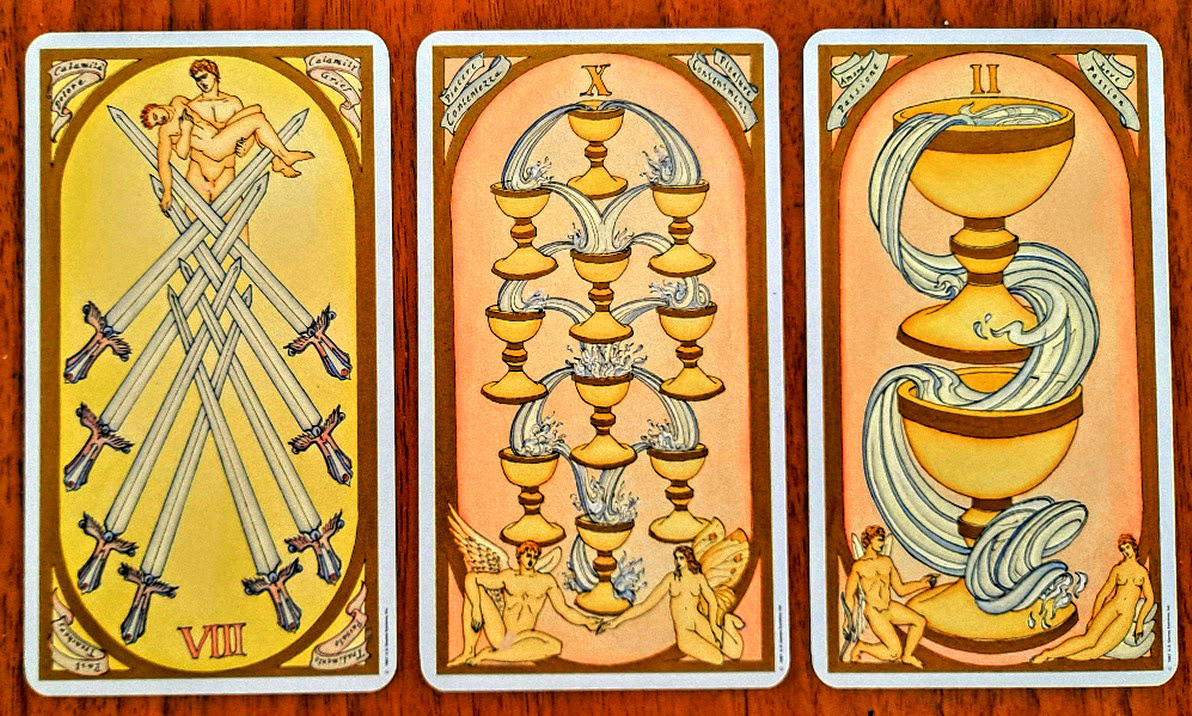
Today was a strange, rather unsettling day. It started out fine. I did my normal morning routine (tarot reading, exercise, Wordle, Quordle) then wrote the note to my friend overseas. I sure was glad to have that small accomplishment out of the way! It’s been niggling at me for the past two months.

On the way to the post office, a friend who was driving by pulled over to chat. I was saddened to hear that her husband had passed away. It’s always hard to get such news, but harder for us who have been there (as opposed to those who haven’t had to deal with such a loss) because we have a good idea what the one left behind is going through. We also know there’s nothing we can do or say to make things better. Each of us has to learn to cope the best way we know how, and to learn how to live alone. That sounds cold, I know, but it’s the bitter truth. Still, I feel sad for her and all that she’s going to have to deal with in the coming months and years.

After she drove off to do her lonely errands, I continued to the post office. I was glad to discover that I could walk normally up the ten or so steps to the post office door. It’s a far cry from being able to hike up eighteen flights of stairs as I did when I worked in a downtown Denver office building (so long ago that it was the tallest building in the city), but ever since I damaged my knees, I’ve had to climb stairs the way a small child does. One foot up and then the other foot dragged up to the same step.

I was glad to discover that the postage to a European country is relatively cheap — only twice what it is to send a letter domestically.

I was glad that this was such a nice, cool day that I could get my errands done and still be able to do some weeding in my gardens.

All those things I was glad about today seem paltry in comparison to the sadness of death and a friend’s grief, but still, I was glad, which is why today was so strangely unsettling.

But that’s life, I suppose — the sadness and gladness all jumbled together so we never quite know how to feel.

***

Pat Bertram is the author of Grief: The Inside Story – A Guide to Surviving the Loss of a Loved One. “Grief: The Inside Story is perfect and that is not hyperbole! It is exactly what folk who are grieving need to read.” –Leesa Healy, RN, GDAS GDAT, Emotional/Mental Health Therapist & Educator.
Do the Job in Front of You

I’m reading a science fiction book about people being able to step from this Earth into multiple other Earths, as if all possible Earths were stacked together like a deck of cards, and people could go from one to another.

At first, it was kids who found a way to step, and suddenly, kids all over the world were disappearing. The cops didn’t know what was going on. Terrorists? Aliens? One young cop asked the sergeant-in-charge what he was supposed to do, and the sergeant relied, “Do the job in front of you.”

It’s funny how in a story about strangeness, such an innocuous remark should have caught my attention, but it seems to be good advice no matter what. For example, landscaping a yard and creating garden spots in that yard can be rather overwhelming. It’s not something that can be done in a season or even two or three. I’m starting my fourth season, if I counted accurately, and despite how nice some parts of the yard are, other parts are still quite wild and weed-infested.

I’ve never had much patience for such long projects — I’m more of a do-it-and-get-it-done sort of person. Or at least I was. Apparently, I am now someone who can embark on a project that will never be finished. Almost by definition, a garden is always in progress. Volunteer plants show up. Long-standing plants die. Weeds take over certain areas. The only way to deal with such a long-term, unending project, is to do the job in front of you.

This change in me, from wanting things to be done to being able to deal with things that never are done, is a holdover from grief. Grief is one of those things that are never finished, though oddly, grief comes about because a loved one is finished — finished with their life here on Earth. But for those left behind, it’s never finished. At the beginning, especially, it seems impossible. Not only are you going through the most horrendous pain and most confusing time of your life, you are faced with a never-ending list of end-of-life chores. A person who dies doesn’t just disappear. The body has to be dealt with. Their things have to be dealt with. The government has to be informed and dealt with. Banks have to be dealt with. The only way to get through all that is to do the job in front of you.

It’s the same way with writing a book — during the course of the months and sometimes years that it takes to complete a novel, there are thousands of decisions to be made. Some people can sit down and simply write, without a plan, without agonizing over every detail, but for others, writing is the details. And the way to write for those people is to do the job in front of them, whether a paragraph, a page, a chapter.

I suppose life is the same way. I tend to try to look into my future, to see what I can do now to prevent some possible effects of old age, but in the end, no amount of projection will protect me (or anyone) from the vagaries of life. All any of us can do is the job in front of us, and the job — the life job — is to live the best we can today.

Luckily, we are all (or at least I think we all are) dealing with a single Earth, which makes things just a bit easier to do the job in front of us.

***

Pat Bertram is the author of Grief: The Inside Story – A Guide to Surviving the Loss of a Loved One. “Grief: The Inside Story is perfect and that is not hyperbole! It is exactly what folk who are grieving need to read.” –Leesa Healy, RN, GDAS GDAT, Emotional/Mental Health Therapist & Educator.

Feeling Old

I had a rather cryptic e-conversation with a therapist friend who recently attended a grief workshop. She mentioned that they stressed things I’ve written about but aren’t commonly known, such as there being no way to do grief wrong (it might be painful, but it isn’t wrong). She said I was ahead, and that this wasn’t the first time.

I responded, “It’s nice to know. But then, I already knew.”

She came back with, “Yes, you did. And I am sorry you had to learn.”

I was about to agree that I was also sorry that I had to learn about grief the hard way, then I realized how remote all those years of grief seem now, so I wrote back, “It’s funny, but it was so long ago, none of it seems to matter anymore, except, of course, for the part about Jeff being dead. That will always matter to me.”

She agreed, “Except, of course, about Jeff, that will always matter. I feel that about many things.” Then we come to the cryptic part. She ended by saying, “Maybe it is age, maybe perspective, but I am feeling many things not felt before.”

I’m not sure what she meant by that final sentence, but it got me thinking about the things I feel now that I have not felt before, and only one thing came to mind: I feel old. That’s sounds so terrible, but it really isn’t. I don’t feel old as in decrepit or sick or helpless, but old as in a different era of my life.

When we were young, the old seemed separate from us, as if they’d never been like us, as if they’d always been old. Most of us were smart enough to know that wasn’t true, but since we’d never seen the elderly when they were young, it seemed true. The other side of that feeling is that we never really thought we ourselves would cross that line from youth to old age. Most young people feel they are different from the elderly, that they will be the exception and will remain forever young. Well, I certainly wasn’t the exception, and now the line has been crossed and I am on the side of the elderly.

Oddly, just as I’d imagined the elderly when I was young, as if they’d always been old, that’s how I feel. As if I’ve always been old. My youth is now as distant and as unimaginable as old age once was. That girl I was, that young woman, that half of a couple, that griever are all lost in the past and no longer seem to have anything to do with the woman I am today.

I don’t think this feeling is a bad thing since it is what it is. It doesn’t feel negative, anyway. It’s just an acknowledgement of a different time of life. The whole maiden, mother, crone trilogy, perhaps. My mother stage sort of came first because as the oldest girl of a rather large family, I so often had to take care of the younger kids. My crone stage came in having to shepherd Jeff and my parents out of this world — a midwife to the dying, so to speak. What’s left is the maiden stage, and that’s not happening. Though in a way, it is. Buying my first house so late in life, starting over in a new place. Just . . . starting. That is all part of the maiden era.

People often talk as if the elderly are simply youngsters in a decaying body, and that might be true for some people, but that isn’t true for me. Despite my facetiousness about going through my “maiden era,” I don’t feel the child in me struggling to escape the burden of age. I feel ageless, or perhaps I feel more as if being my age — the age I am right now —is the right age. And so it was during all the “right now”s of my life. (Meaning that whatever age I was, that was the right age for me at that time.)

The bad part of being old is that the body is wearing down and wearing out. Weird little things happen, such as rolling over in bed and suddenly the knee is out of whack and you can’t walk or your trusty immune system doesn’t work as well or things slide down the wrong tube when swallowing. But even these matters don’t seem so much a part of growing old as of . . . entropy, perhaps.

I might change my mind about all this as I slip from a young elderly age into an older elderly age, but whatever happens, I hope I can continue to see the aging process as just another phase of the adventure we call life. After all, that’s how I tried to deal with grief: accepting it as much as possible as another experience — a rather painful experience (to put it mildly) but no less valid than the pleasant times.

Just as our culture seems to frown on people who admit to feeling grief, as if grief is failing, it seems to frown on people who admit to feeling old, as if that too is a failing. But I didn’t hesitate to admit to feeling sad, so I certainly am not going to hesitate to admit I feel old. It’s just the way life is. And it’s just the way I am.

***

Pat Bertram is the author of Grief: The Inside Story – A Guide to Surviving the Loss of a Loved One. “Grief: The Inside Story is perfect and that is not hyperbole! It is exactly what folk who are grieving need to read.” –Leesa Healy, RN, GDAS GDAT, Emotional/Mental Health Therapist & Educator.

The Courage to Start Over

Two characters in the book I am reading are talking about why they moved to that particular small town. One was born there, moved away, then returned for as yet undisclosed reasons. The other said she just wanted to start over. The first woman said, “I think it’s admirable. A lot of people don’t have the courage to do something like that.”

Is it true? Does it take courage to move to a new place to start over? Or is it that sometimes we’ve lost so much there’s nothing to lose by doing so?

I know several widows who moved out of their homes, and then took off, looking for a place to settle. A couple of them bought RVs, traveled across country, and eventually found a place they liked well enough to stay. Others just . . . wandered. It might have taken courage, but I have a hunch it was simply easier than staying and living with the memories and the ghosts of things past. Some people who are left behind do stay in their once-shared home and that, perhaps, takes more courage than heading out to look for a new place.

In my case, after Jeff died, I moved to a different state to take care of my father, and when he too died, I wandered. In between road trips, I’d rent rooms in people’s houses. Then three years ago, I bought a house sight unseen (though I had seen photos), in an area I’d only driven through once. At the time, I knew no one in town, though I promptly rectified that little matter. Did any of this take courage? Not particularly. Does it take courage for a stone that was catapulted into the air to land somewhere? No. It’s just the way things are. It’s the same thing when you are catapulted out of your life — you eventually have to land somewhere. It’s just the way things are.

Come to think of it, that’s not the only time I went looking for a new place to live, though the other times were with Jeff. We were fed up with the growth of Denver and the attendant problems like crime and pollution. We were also without work. So we just took off with no destination in mind. I don’t think that took courage; it was an adventure, and to be honest, once we left everything behind, it was the freest I ever felt in my entire life. The problem with such an irrevocable act is that eventually you have to find a place to live, and that search destroys the feeling of freedom.

It’s a good thing this place is working out for me because I don’t have another move left in me.

But I am getting off the theme of “courage.” Although I have done many things people say take courage — such as dealing with grief, my solo road trips, buying my first house so late in life — I didn’t particularly feel courageous. I did endure, however, and I did persevere despite having lost so much, and I tend to think that counts more than mere courage.

***

Pat Bertram is the author of Grief: The Inside Story – A Guide to Surviving the Loss of a Loved One. “Grief: The Inside Story is perfect and that is not hyperbole! It is exactly what folk who are grieving need to read.” –Leesa Healy, RN, GDAS GDAT, Emotional/Mental Health Therapist & Educator.




