Truth and Secrets

I came across an interesting quote today: The truth of a person is in her secrets. I know this is true of fiction, especially mysteries and suspense. You learn about a character from what they are willing to do to protect their secrets, and what you think they are willing to do. For example, a reader could think a particular character might be willing to kill to protect that secret, but the character would not take a life under any circumstances.

But is this true in real life? Oh, not the killing part, but the bit about the truth of a person being in her secrets. If so, I have no truth because I have no secrets. I have habits I would prefer people didn’t know about, such as an unconscious tendency to bite off hangnails, and while that might tell you more about me than I would like you to know, it’s not exactly a secret except perhaps from me. If I knew I were doing it, I wouldn’t.

I paused here to look up the definition of secret to see if there is a secret to “secret” I didn’t know that would further explain the quote, but no . . . it’s as I thought. A secret is something that is kept or meant to be kept unknown or unseen by others.

Although I might prefer the people I see regularly to know less about me than I disclose here (though surprisingly, it isn’t as uncomfortable as I thought it would be, and in fact, it’s rather nice not having to talk about the minutiae of my life since they already know it from reading my blog), nothing I write about is a secret. When I was writing about my grief, people offline did not see the same sort of grief in me that I wrote about online, but that’s just the way things were. Even if I was hurting, I generally didn’t show it when I was around people. Like every other griever, I soon learned to hide was I was feeling to protect others from having to deal with my pain as well as to protect myself from their well-meaning (and sometimes not well-meaning) platitudes, such as “You have to move on,” and “You need to get over it.”

But as for secrets? Nope. None.

Some people have accused me of being secretive, confusing secretive with reticent, but the truth is that not everyone deserves to know everything about anyone. There needs to be boundaries, and people who try to look beyond the boundaries aren’t necessarily looking for the truth but are simply being nosy.

I do generally answer direct questions, mostly because I am not as devious as I should be and so don’t lie, nor have I ever learned to graciously deflect questions, but I tend to resent probing questions, and it shows. I don’t ask such questions, either, which becomes a problem when I am talking with someone who thinks that probing questions is how one converses. These people generally don’t want to wait until I volunteer information, which I will when it come up naturally in a conversation without the resentment I feel in an “interrogation.” And they feel belittled because they think I don’t care enough about them to ask them questions.

(Jeff and I were both of the “ask no personal questions” school, and yet over the years, we learned almost everything there was to know about each other, the information coming out in myriad conversations.}

This essay has devolved into a discussion of various means of conversing rather than the topic of the truth being in the secrets, but I suppose the two are opposites sides of the same coin. If you don’t divulge personal information, the other person sees secrets rather than reticence.

But it still doesn’t answer the question about the validity of the quote: the truth of a person in is her secrets. I don’t think it can be true except in the case of someone who is nosy enough to want to invade a person’s privacy. The truth of us might be in our most secret self, but that self is for us to know, not for general consumption.

***

Pat Bertram is the author of Grief: The Inside Story – A Guide to Surviving the Loss of a Loved One. “Grief: The Inside Story is perfect and that is not hyperbole! It is exactly what folk who are grieving need to read.” –Leesa Healy, RN, GDAS GDAT, Emotional/Mental Health Therapist & Educator.

Reversing an Adaptation

The only place I ever came across the idea of reversing an adaptation other than in evolutionary terms was in the novel Dead Sleep by Greg Iles. The story was obviously forgettable because I have no idea what it was about even though it wasn’t that long ago that I read it, and an online synopsis didn’t help much. But I do remember what he said about reversing an adaptation. Or rather, I remember making note of the quote from the book. “Missing persons cases that have lain dormant for years, then suddenly the child or husband turns up. It’s disorienting to people. Homo Sapiens survived by adapting to change, even terrible change. Being forced to reverse an adaptation you’ve made to survive can cause a lot of strange feelings. A lot of resentment.”

That struck a chord in me somewhere deep down because I wonder at times what I would do if Jeff ever returned. I know he’s dead; I was there. The only way the scenario would work would be if he showed up on my doorstep and said, “God decided to let me come back. So here I am.”

It seems such a betrayal of both him and my grief, but part of me is glad I will never have to deal with a reversal of my adaptation to his death. For eleven and a half years I have been adapting to his being gone. For eleven and a half years I have slowly been turning someone I wouldn’t even recognize if I were to see me from the point of view of the woman I once was. For eleven and a half years I have been developing new values — not deep down values, the ones I’ve had all my life, like kindness and loyalty — but other values, such as having a place to live out the rest of my days; of owning that place. Owning a house is not something I ever wanted or valued, and yet here I am, grateful every day for this boon.

Without knowing the name of this phenomenon — reversing an adaptation — it must have been in the back of my mind for a long time. Years ago, I was involved in a time travel writing project with other authors. My character, a widow, went back in time, saw her husband, saw herself, and was appalled at how small her life had been. She could see that she had been on the way to becoming like her colorless mother-in-law, and once back in her “real” time, she threw off the shackles of her dowdy clothes and decided to live a little.

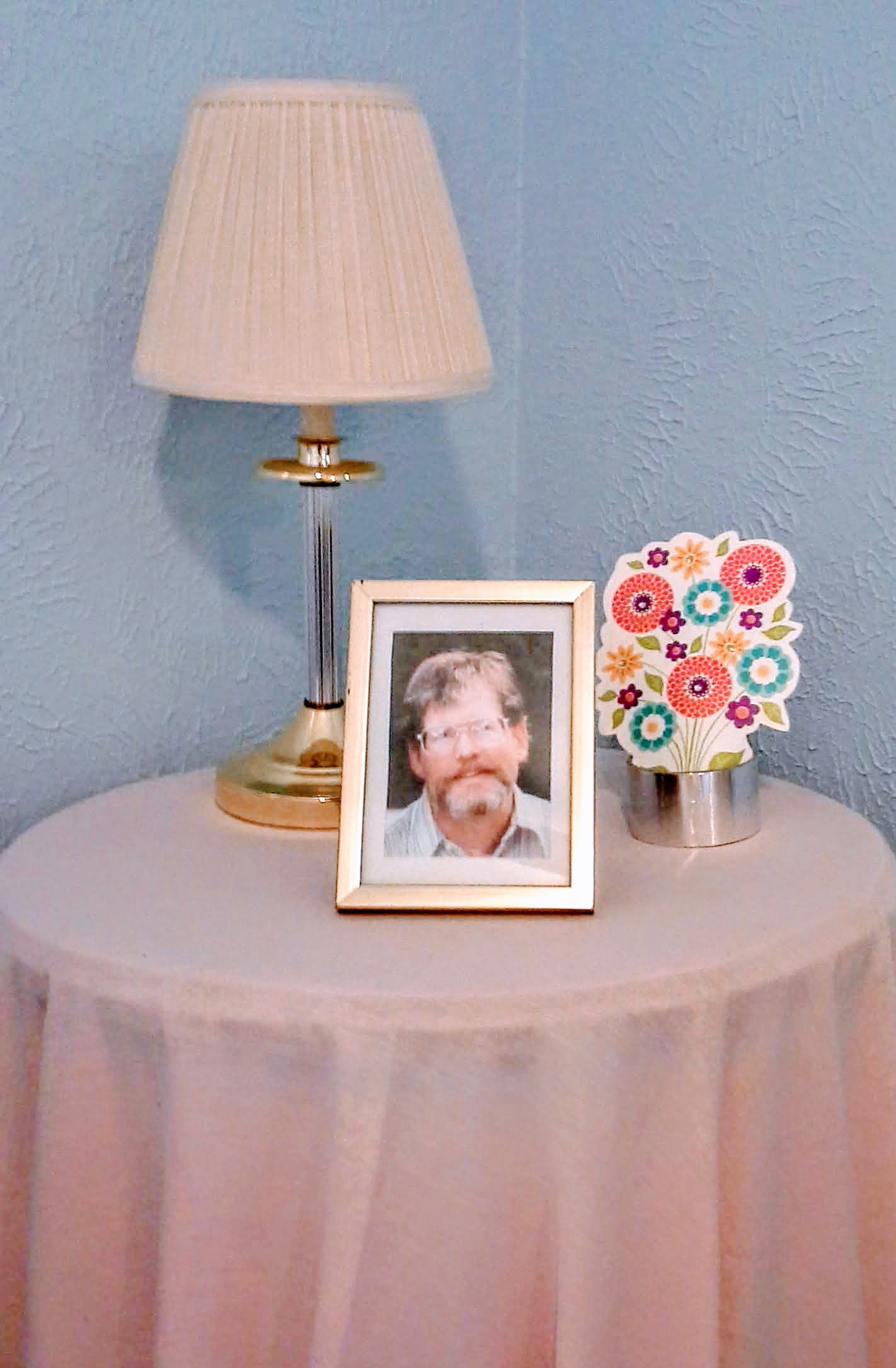
I do think sometimes of what my life would be if Jeff were to show up here. I try to think how to fit him into my life, into my house, but he doesn’t fit except as a photo I talk to every night. It’s been too long that he’s been out of my life. It’s been too long that I’ve been in this new life I’ve slowly been creating out of the ashes and shards of our shared life. I think it helps that I had no choice — I had to become the person I am to survive the shock of severance, the angst of his absence, the utter pain of grief.

To this day, I miss him and I continue to feel the void where he was ripped from me, so if there was an option, would I want him back? Could I deal with the truth, whichever way I decided? Could I reverse the adaptation? I have no idea.

***

Pat Bertram is the author of Grief: The Inside Story – A Guide to Surviving the Loss of a Loved One. “Grief: The Inside Story is perfect and that is not hyperbole! It is exactly what folk who are grieving need to read.” –Leesa Healy, RN, GDAS GDAT, Emotional/Mental Health Therapist & Educator.

“The Loved One Becomes Your Inner Energy”

An email correspondent sent me this French quote: “L’être aimé devient votre énergie intérieure” meaning “The loved one becomes your inner energy.” I don’t know if the quote originally was about a deceased loved one or any loved one, but it does seem to fit those of us whose mates have died. At least, it seems to fit me.

Jeff was the first person to accept me as I was, who actually seemed to enjoy my stray and strange thoughts, and who often could do me one better. Until I met him, the best I could hope for from my friends was a bewildered look as they listened to whatever I had to say before they changed the subject to something more mundane. I was stunned on the day I met Jeff when he threw the conversational ball back at me. That truly had never happened before. It was intoxicating, having a back and forth and up and down and all around conversation dealing with things I was thinking about.

Being with Jeff allowed me to be myself in a way I had never been before. The world does not treat its unwitting and naïve noncomformists well, and I was both. I had no idea why people thought I was different, and obviously, I had no idea how to be like them, because whenever I tried, I became even more different.

With Jeff, I wasn’t different. I just . . . was.

Now that the pain of his being gone has dissipated, and now that I am used to living on my own without my special friend — the one with whom I could do everything, the one with whom I could do nothing (finding people to do something with is fairly easy, but finding someone to do nothing with is special indeed) I notice that whatever energy we generated between us that allowed me the freedom of self is still with me.

I don’t in anyway think that he himself is actually with me — I have no idea if he still exists anywhere in any form — but I do feel that energy. It could be why I talk to him (or rather to his picture on my bedside table). Even though I still feel the void where he once was, I also feel that somehow he is still part of my life. This energy could simply be generated by memories of him, though despite the fact that I draw comfort from thinking of him in general, specific memories tend to make me sad because so many of those memories are tinted by his ill health. (For example, if I have a sweet memory of us sitting on the living room floor playing a board game, then it is followed by the memory that the time came too soon when he could no longer concentrate to play.)

When I was new to grief, a woman told me something her widowed mother said, that the loved one’s absence comes to mean what their presence once did. This is sort of the same thing as the French saying. In both cases, I draw strength from having known him, from being with him, from steeping in the courage with which he met his end.

Part of the eventual acceptance of my new life and my new/old self came from a belief — possibly a nonsensical belief — that he wouldn’t have left me if I wasn’t going to be okay. It’s what kept me going for years when I was so bewildered by all that grief threw at me. And it’s given me the inner energy to fuel all the changes in me and my life that have happened since he died.

It truly is odd to think that though he has been gone almost twelve years, he is still so important to me and influential to my life. But then, it’s no odder than any other weirdness encompassed in the experience we call grief.

***

Pat Bertram is the author of Grief: The Inside Story – A Guide to Surviving the Loss of a Loved One. “Grief: The Inside Story is perfect and that is not hyperbole! It is exactly what folk who are grieving need to read.” –Leesa Healy, RN, GDAS GDAT, Emotional/Mental Health Therapist & Educator.

Dark Too Soon

I don’t mind being alone, don’t mind the reason behind the isolation (a huge upsurge of Bob activity in this area), but having to do it in the dark seems a bit much. I’m not really in the dark, since I can turn on lights, but the sun sets at 4:44 pm. It seems as if the day is no sooner getting started than it’s ending.

Even that, I suppose, isn’t such big a deal, but when it gets dark too soon and I haven’t done my daily blog post, then I panic. Where did the day go? What did I do all day? How can I write if I can’t remember?

I’m glad, of course, that my days are so uneventful. I’ve had enough trauma to last me a lifetime, and even though some friends are going through disastrous experiences, I am at one remove from their situations. A lesson I learned from my grief days (days? No. Years!) is to let people have their own sorrows. I empathize, of course, but I can’t take on their sadness — it belongs to them. Come to think of it, I’m even at one remove — or several removes — from my own grief. In four months, it will be twelve years, and that is a long time. (To put it into perspective, that’s the time it takes for nine-year-old children go through puberty then the teenage storms and finally to reach adulthood.)

The only thing of note I did today was turn my Suspense/Thriller Writers Group on Facebook from public to private. FB is changing the way they do groups, so now if you have a public group, anyone can join immediately without being vetted. Considering how many spammers find the group (not just robots but also authors who only want to promote their books), it would turn a rather innocuous and inert group into a nightmare. Besides, since my blog URL is still blocked, I have little interest in spending any time on FB. For now, I reblog this blog to another blog and post that URL on FB, but when they discover my ruse, and block the reblog, then I’m finished with them.

Although it’s not particularly noteworthy, since it’s something I do every day, I did go out and water my lawn. It still astonishes me that I did that — add a bit of lawn. I wanted just a small corner of grass in my yard (else what’s the point of having a lawnmower), but since I didn’t know how big of an area a pallet of sod would cover, I agreed to buy the two pallets a local landscaping company had left over from another job. I worried that it wouldn’t be enough to cover the 400-square-foot corner; instead it covered 1,000 square feet, if not more, especially since they had a partial pallet left over they threw in at no cost.

I suppose 1,000 square feet isn’t all that much lawn, though it seems huge when it needs to be watered.

Oh, and I did manage to blow most of the leaves off my rock, but a big wind will simply blow them back. So here’s hoping the winds remain fairly calm until the leaves settle in.

I hope you’re doing better with the early dark than I am. And to think it will continue getting darker for the next six weeks! Hmmm. Perhaps I shouldn’t think about that.

***

What if God decided S/He didn’t like how the world turned out, and turned it over to a development company from the planet Xerxes for re-creation? Would you survive? Could you survive?

A fun book for not-so-fun times.

Click here to buy Bob, The Right Hand of God.

Confusing Thoughts For A Confusing Day

During the last year of Jeff’s life, we sometimes talked about what I was going to do after he was gone. We knew I couldn’t stay in that house for very long — there was nowhere around there for me to work, and I couldn’t pay the expenses on my own — so we knew a move was necessary. (We couldn’t have known how short a time I’d have afterward to figure things out, but it turns out I was evicted almost immediately. I have no idea why except that the landlady seemed to think I had designs on her husband. For some reason, widows get a bad rap; she’s not the only one to think we are a rapacious lot, looking to replace what we lost with someone else’s husband.)

Jeff wanted me to go stay with my father because he said I’d have a place to stay where I’d be safe, but I absolutely refused to even consider the matter. My parents and perhaps even my brothers had always taken for granted that I would be the “designated daughter,” the one who would take care of her parents when they couldn’t take care of themselves, and having had to cater to my father at various times in my life, I truly dreaded the possibility of doing it for the rest of his life. As long as Jeff was alive, I was safe from what I thought would be a hell, but when his life drew to an end, the dread returned. (Strangely, I never considered that I would grieve. I figured I’d be sad for a while, but would continue on without a blip. What a shock it was to find out what grief really was!)

Even after Jeff pointed out that taking care of my father wouldn’t be forever, I still refused to consider the matter. It wasn’t until the end, when Jeff was comatose, that I changed my mind and told him I would go stay with my father. A few hours later, Jeff died. Apparently, even unconscious, he was worried about what would happen to me and couldn’t leave until he knew I’d be okay.

My father was 93 at the time, and though he was doing well, he really did need someone to stay with him. He was terrified of the night terrors he sometimes got as well the sundowners hallucinations he’d experienced during a hospital stay. The two of us worked things out. Although he would have liked me to wait on him, I wanted him to be as self-sufficient as possible, so I talked him into continuing the routine he’d adopted after my mother died. And he did keep it up until he couldn’t any longer.

Those years seemed interminable at the time, made worse by the arrival of my dysfunctional older brother, but as Jeff had said, the stay with my father wasn’t forever. He died four and a half years after my arrival.

Today is the seventh anniversary of my father’s death, and it perplexes me to think he’s been gone more years than I stayed with him. How did all those years slip by? The hardship of my time with him (though admittedly, it wasn’t as hard as I expected it to be) now seems like a hiccup in my years of grief over Jeff.

It’s odd to think that those men — Jeff, my father, my older brother — who were so significant to my life are now gone. Odd, too, to think of how each of those deaths has contributed to my current well-being.

Confusing thoughts for a confusing day.

***

Pat Bertram is the author of Grief: The Inside Story – A Guide to Surviving the Loss of a Loved One. “Grief: The Inside Story is perfect and that is not hyperbole! It is exactly what folk who are grieving need to read.” –Leesa Healy, RN, GDAS GDAT, Emotional/Mental Health Therapist & Educator.

Grief and Finding “Home”

Because of my writings on grief, I have met people from all over the world. One woman who contacted me after reading Grief: The Inside Story – A Guide to Surviving the Loss of a Loved One, was from Holland. We became pen pals for a while, and in fact, she was the first to send me a card wishing me happiness in my new home.

Now she’s the one in a new home.

Like many who have lost their mates, she needed a new life, and to that end, she felt she needed to find a new place to live. Apparently, Holland is too crowded and too expensive for her now that she’s living on a single income, so the last I heard, she was looking for a place in the south of France. Today I got a postcard from her, from Aveyron in France.

It’s good to know she’s finally realized her dream — that new dream born from grief and loss.

I’d never heard of Aveyron in southwestern France, but that “department” looks fabulous! (From what I can tell, a department is a division of a region.) According to a guidebook, it is home to ten of the most beautiful villages in France, as well as gorges, castles, and gastronomic delights. Sounds like a wonderful place to live. I hope she’ll find herself at home in her new home.

That’s one of the hardest things to find for us who are left behind after our mates die — a feeling of home. For many of us, our “homes” resided not in a place but in a being with that special person. And when they are gone, every place seems alien for way too many years. The lucky ones — relatively speaking — are those of us who finally find a place to call home. In my case, the area I settled on isn’t especially spectacular, certainly nothing like Ayeyron, though it does have its moments. Nor is the town picaresque, though that too has its moments. (It’s this lack of monumental scenery and mountain views that has prompted me to try to turn my yard into a vista worth looking at.) But it has given me a sense, first of coming home, and now of being home.

Back in my first days of grief, I felt as if I were totally unanchored, as if I were being blown willy-nilly by the winds of fate. It’s not until we find home in ourselves that we can find home in a place (or perhaps it’s the other way around), but it does seem as if we can’t stop feeling unreal and untethered until there is once again a sense of home, a sense of belonging somewhere. (For a long time, I took comfort from the idea that I belonged to and on the earth, but it helps even more to have anchored myself to a specific place on that earth.)

I wish my Holland friend — and all who have been left adrift by the death of the person intrinsic to their life — peace in her new home.

***

Pat Bertram is the author of Grief: The Inside Story – A Guide to Surviving the Loss of a Loved One. “Grief: The Inside Story is perfect and that is not hyperbole! It is exactly what folk who are grieving need to read.” –Leesa Healy, RN, GDAS GDAT, Emotional/Mental Health Therapist & Educator.

The Long and Short of Grief

A therapist friend wanted to know the difference in grieving between someone who lost their life mate/soul mate at the beginning of their relationship and someone who had many years with their mate.

I hesitate to compare grief because we all grieve in many ways for many things, but after a grievous loss, such as that of a spouse, there is a general pattern to grief that one’s mind and body seem to follow. If there weren’t similarities, then no one’s story would have any relevance to any one else, and I do know that what I have written about my experiences with grief resonates with many people. So my answer doesn’t have to do with the depth of grief. There is no way to measure that. I’m mostly discussing the two cases on the base of the patterns of grief.

A long life with a loved one and a short life that was cut off before the relationship could deepen aren’t the same — can’t be the same — and yet, in some respects they are similar. We grieve the loss of an entire lifespan of a person and a relationship. I grieved for both the time I had with Jeff and the time I didn’t have. The fiancé of an acquaintance died right before their wedding. She didn’t have the same amount of time with her fiancé that I did with Jeff, but she will still grieve for the time she had and the time she didn’t have. I had more loss looking back, perhaps, but she has more loss looking forward. For both of us, too many plans and hopes didn’t come to fruition, but especially in the case of the woman who went to a funeral instead of to her wedding.

Losing a loved one to death is always hard. It’s possible in the long run, the fiancé will have it a bit easier in that she won’t have as many habits that are abruptly cut off. When you spend a lifetime with someone, you develop habits to enable to you to cohabit, and then when the habits come to an end because of the loss, your brain goes into overdrive. We do so much by habit, and then suddenly, after the death of a spouse, you have to think how to do everything. (It’s like trying to remember how to walk instead of simply walking.)

Also, when you spend a lifetime with someone, you have the whole problem of your lizard brain going haywire because the other half of your survival unit is gone and when it doesn’t return, your lizard brain suddenly realizes that it too will someday die, and what a horror show of chemical and hormonal imbalances that part of your brain can foment! She won’t have that, but she might have other issues I don’t know about, such as a feeling of unfairness. We all feel the unfairness, of course. My parents had 60 years together. Jeff and I had half that. And oh, did that seem so unfair to me! I imagine the sense of unfairness the fiancé felt was off the charts, because it was incredibly unfair. She didn’t have even one year with her mate, and I got 34. For those of us who have spent many years with our loved one, eventually we are left with a feeling of gratitude for the years we did have to balance the unfairness, and I’m not sure there is much to balance the unfairness of what the fiancé experienced. She’s happy now, married to a widower, and has children, but still, there is always that grief for a love cut short, regret for a life that might been.

There is the terrible shock of death we all feel. There is also a sense of waiting. In my case, I kept waiting for Jeff to call and tell me I could come home, and the fiancé had that, too. Waiting. Always waiting to hear from someone who is so utterly gone from this earth.

And confusion, of course. As confused as I was after Jeff died over where he was and how he was doing, it must have been even greater for the fiancé. Even thinking about it, I feel confused. How is it possible that such things happen? So unfair.

A major factor in the loss of a mate, long-standing or not, is the nearness of death. When you are deeply connected to someone who has died, you feel as if you are standing on the edge of the abyss, as if any loss of balance will pull you into eternity.

That feeling of being able to reach out and touch the love one depends on your level of connection. Some people who have been together many years never had (or have lost) such a deep connection, while some new couples feel it immediately. Still, the presence of death is never easy to handle.

I’m not sure I helped my therapist friend with this analysis, but it was the best I could come up with. All I know for sure is that the death of a person intrinsic to our live dims the light of the world and it takes many years before we adapt to that dimming.

***

Pat Bertram is the author of Grief: The Inside Story – A Guide to Surviving the Loss of a Loved One. “Grief: The Inside Story is perfect and that is not hyperbole! It is exactly what folk who are grieving need to read.” –Leesa Healy, RN, GDAS GDAT, Emotional/Mental Health Therapist & Educator.

Gardening Is the Answer

I finished digging the grass out of a soon-to-be wildflower meadow. For a few minutes this morning, I thought I’d get rained out and would have to save the last six-foot square until tomorrow, but the clouds spat a few drops at me, got bored, and moved one.

After I finished digging and shaking the dirt out of the clumps of grass roots, I raked the area flat, which oddly was the hardest part of the whole task. But I got that job done, too.

An experienced gardener left a comment on my blog yesterday that a wildflower field doesn’t have to be tilled, and I wondered if I had done all that work for nothing. And yet, that Bermuda grass is so strong and overpowering, I was afraid my poor wildflower seeds wouldn’t stand a chance if I didn’t do something about the grass. In fact, that grass is so strong it’s starting to go through the weed-barrier fabric on the north side of the garage. Supposedly, the contractor got the strongest fabric available, but as I said, that grass is strong. It looks like they are going to have to add another strip of the fabric, as well as finish putting up the gutters on the garage, but that is not something I can to do, so I won’t worry about it.

I’m glad to know about not having to till the soil for a wildflower meadow, so in some other spots where I want wildflowers, I can just toss the seeds and stamp them into the ground. Well, after I dig up the weeds, that is. And the grass.

A friend sent me a quote: “The answer is gardening. It doesn’t matter what the question is.”

I thought that was lovely. And it does sort of reinforce a surmise I made. A fellow griever once told me about an old woman she knew who had lost everyone she had ever loved and yet was the happiest person the griever knew. We both marveled at the possibility of finding joy despite all the sorrow, but now I know the woman’s secret. The woman was a gardener, so as I surmised, that’s the answer to the conundrum.

I wonder if I will be that person? More likely, unless gardening keeps me mellow and allows me a life of sorts without having to deal with too many irritations, I will become a curmudgeon.

Either way, gardening does seem to be the answer.

***

Pat Bertram is the author of Grief: The Inside Story – A Guide to Surviving the Loss of a Loved One. “Grief: The Inside Story is perfect and that is not hyperbole! It is exactly what folk who are grieving need to read.” –Leesa Healy, RN, GDAS GDAT, Emotional/Mental Health Therapist & Educator.

Happy Fourteenth Bloggiversary to Me!

I created this blog fourteen years ago today, back when I hadn’t yet become a published author, back when I had just acquired my first computer and didn’t even know what a blog was. I had read how important blogging was for authors, both as a way of getting known and as a way of connecting with readers, so I decided to “act as if” I were going to be published in the hopes of making it happen. I had nothing to say, no one to say it to, no reason to say anything, but I didn’t let that stop me. I started blogging on September 24, 2007, and haven’t stopped since.

Did acting as if I were going to get published work? Perhaps, though there is no direct connection that I know of. Still, one and a half years after starting this blog, my first two books were published. I now have nine books available: four suspense novels, one mystery, three books about grief (one fiction and two non-fiction), and my most recent book, Bob: The Right Hand of God. (My publisher said, “Bob: The Right Hand of God is playful, fun and well-written. It spans genres, so I’m not sure if there is an exploitable target audience. I don’t care. I like it.”

Two-and-half years after I started this blog, my life mate/soul mate died, and his death catapulted me into a world of such pain that it bled over into my posts. This blog became a place where I could try to make sense of what I was going through, to offer comfort and be comforted, to find my way to renewed life. And I struck a chord with people who were also dealing with grief. It’s no wonder my top posts are grief related: What Do You Say to Someone Who is Grieving at Christmas? with 91,801 views and The Five Major Challenges We Face During the Second Year of Grief with 40,705 views.

This blog sustained me during the years I cared for my father after Jeff’s death, and it gave me a place to rest when my father died four years later, and I was thrown out into the world, alone and orphaned.

This blog offered me a place to call home when I set out alone on a five-month, 12,000 mile cross-country road trip, gave me a place where I could talk about all the wonders I was seeing. Often on that trip, when I was between visits with online friends, I thought of William Cowper’s words: How sweet, how passing sweet, is solitude! But grant me still a friend in my retreat, whom I may whisper, solitude is sweet. And this blog became a place where I could whisper, “Solitude is sweet.”

And when I settled into a house of my own, this blog gave me a place of familiarity in an otherwise unfamiliar life.

Currently, as I am dealing with the infirmities of the encroaching years as well as the many facets of first-time homeownership, it’s nice to know that whatever life throws at me, whatever problems I encounter, whatever challenges and adventures — and joys — come my way, this blog will be here for me.

During the past fourteen years, I have written 3,207 blogs, received 21,115 comments, and garnered 960,164 views. It amazes me that anyone wants to read anything that I write here. This is so much a place for just letting my thoughts roam, for thinking through problems, and (I admit it) for pontificating a bit. It’s been a kick, writing this blog, and I want to thank all of you for indulging my whims and whimsies.

Thank you for reading. Thank you all for your comments, your likes, your support. They have meant more to me (especially this past eleven and a half years) than you can ever imagine.

***

Pat Bertram is the author of Grief: The Inside Story – A Guide to Surviving the Loss of a Loved One. “Grief: The Inside Story is perfect and that is not hyperbole! It is exactly what folk who are grieving need to read.” –Leesa Healy, RN, GDAS GDAT, Emotional/Mental Health Therapist & Educator.

Grief and Peace

Studies have indicated that happiness is found mainly in retrospect. For example, happy children don’t know they are happy. They simply are happy. It’s only later, when they look back, perhaps after a terrible time in their adult lives, that they realize they had been happy in their early years. For another example, when someone is involved in a challenging situation that takes all their time and energy, they don’t realize until later they were happy. In fact, often while going through this “happy” situation, people think they are decidedly unhappy.

It happens with grief, too. Sometimes a couple isn’t particularly happy, but after one of the partners is deceased, the remaining person looks back and realizes that, despite the disagreements and difficulties, they really had been happy. Or after caring for a loved one during a long illness, the void they leave behind makes those painful days of being with the loved one seem akin to happiness.

Happiness might also be found in anticipation, in hopes for a time when joy might come again. Oftentimes, when someone has gone through a difficult time, they find it easy to look ahead to future happiness, but not when that difficult time is grief for a loved one, and especially not when the loved one is a spouse or soul mate.

The chaos of grief is so great, the blackness so opaque, the pain so all-consuming, that we cannot look to the future as a rosier time. How could there be happiness again when the person we loved more than anything, when the person whose very presence brought us happiness is dead? Chances are there will be happiness again. We change, our perspective changes, our focus changes, so the pain and yearning that once filled our being gradually shrinks into the essence of our souls. We still feel the loss, but like with bark that has broken to allow a tree to grow beyond its confines, our hearts and souls break and then expand to allow other feelings to exist alongside the pain.

Although I often offer a promise of future peace to grievers who show me their pain, I never promise happiness. In fact, I seldom mention the possibility because it’s no consolation. For a long time, the very idea of finding happiness without our deceased mate seems too much of a betrayal of our shared life.

But peace is attainable. Even in the days when the yearning for one more smile or one more word feels as if it will explode out of us, we can find brief moments of peace when the chaos is temporarily stilled, when the roar of pain and loss is temporarily silenced. As time goes on, these moments happen more frequently, and as even more time goes on, the duration of these moments is extended, until one day the peace begins to linger longer than the chaos.

When grievers call out to me in their pain, I want what any caring person wants — to ease their pain. But I, more than most, know that their grief belongs to them. It’s not up to me to take it away from them or even to add to the pain by “bleeding” for them, as people used to tell me they did. (Did they really think it eased my pain to have them bleed for me? That I bared my pain as plea for someone to take the burden of loss from me? If so, they were wrong. Baring my pain was a gift, to show other grievers that they are not the only ones who feel the pain and chaos of grief, that no matter how insane those feeling seemed, they were a normal reaction to an abnormal situation.)

All I can do is offer grievers a place to voice their pain and to send them a wish for (and a belief in) the possibility of peace.

So today, whether you are struggling with grief or trauma, or feelings of unworthiness and guilt for whatever happiness has come your way, I wish you peace.

***

Pat Bertram is the author of Grief: The Inside Story – A Guide to Surviving the Loss of a Loved One. “Grief: The Inside Story is perfect and that is not hyperbole! It is exactly what folk who are grieving need to read.” –Leesa Healy, RN, GDAS GDAT, Emotional/Mental Health Therapist & Educator