What Do You Do If Someone Posts an Insulting Comment on Your Blog?

I don’t often get negative comments on this blog.

For one thing, my posts tend not to be controversial — they’re more of a way of chronicling my journey through life and the writing life. It’s hard for someone to argue that I’m getting it wrong when I can’t get it wrong. I’m being me, and who can argue with that?

For another thing, my readers tend to be intelligent and kind, and they give thoughtful responses that add to the conversation instead of posting negative comments that bring the discussion to an abrupt end.

The other day, however, someone left an insulting comment on my article How Many Books Are Going to be Published in 2012? (Prepare for a Shock) that I didn’t know how to handle. That is not my favorite post by any means, in fact, it’s one of the few I wish I had never written. I’d only written the article as a way of trying to make sense of the current book climate and to show the meteoric increase in the number of books available, not to establish myself as any authority on the subject. And yet it’s become my most quoted article, and the one most frequently linked to.

It’s no wonder that an insulting remark landed on the post. Someone commented: “why would anyone bother to pay attention to a blog which starts off with uninteresting stuff about the author, and then gives data without a source? takes all types, I guess.”

I guess it does take all types. When I see an article that doesn’t lead up to the hype, I merely pass on by without stopping to leave a comment. But, for whatever reason, that person left a comment. I didn’t know whether to delete it or approve it. And if I posted it, I didn’t know whether to respond to it or ignore it. Admittedly, it’s not much of an insult, but it still put me in a quandary.

I asked my blogger friends on Facebook what they do in such a circumstance, and got a whole range of answers from “delete it” to “find where the person lives and go beat them up.” Some people thought that if it had merit or if it said more about the commenter than me, that I should post it but not respond. Some said that if it was a business blog, to delete the comment, that it wasn’t good to have snipers in your store.

The comment now seems innocuous, and the commenter has a point, why would anyone bother to pay attention to that particular blog post? (Though I did give a source, just not a link to the source.) Still, I left his remark in comment limbo until just a few minutes ago. I found the deciding factor in You and Your Blog Suck: 7 Steps to Responding to Negative Comments, a blog post by Marc Ensign. He said, “By deleting it you are telling your readers that they are welcome to say whatever they want as long as they agree with you. The only time I would consider deleting a post is if it was obscene or offensive to your readers.”

Since the comment under consideration is not obscene, not offensive to my readers, not even much of an insult, I took a deep breath and approved the comment.

So, what do you do if someone posts an insulting remark on your blog? Do you delete it or do you approve it so posts where everyone can see it? If you post it, do you answer it or ignore it?

***

Pat Bertram is the author of the conspiracy novels Light Bringer, More Deaths Than One, A Spark of Heavenly Fire, and Daughter Am I. Bertram is also the author of Grief: The Great Yearning, “an exquisite book, wrenching to read, and at the same time full of profound truths.” Connect with Pat on Google+

Writing and Research: When in Doubt, Twist Things About

When you have lost your way, either in your writing or researching, twist things around, and perhaps it will help you find what you are seeking.

For example, I had to write a story for Second Helpings, the Second Wind Publishing holiday short story and recipe anthology. (Which, incidentally, has now been published. Hint. Hint.) My idea was to tell the story of a woman with an unromantic and inattentive husband. To show her discontent, she kept “poisoning” him by making his favorite fat and sugar-laden chocolate chip cookies. She had an affair with a man who seldom had time for her, and finding that she was just as unhappy, she decided to stay with the man who was present in her life. She broke off the affair, and at the end, she fed her husband cookies made with applesauce and honey instead of butter and sugar to show her change of heart. It was a nice story, but nothing special until I twisted it around and gave her live-in boyfriend the affair. (Since I was changing things, I demoted the husband to boyfriend — I didn’t want to have to deal with a possible divorce.) And then the story took off.

I always knew twisting things around in writing was a good idea, but research? Apparently twisting works for that, too. I’d spent a couple of days researching “thinking caps” for yesterday’s post, and wasn’t getting anywhere. The term only goes back a couple of hundred years (at least in print), though the term “considering cap” goes back four hundred years (again, in print).

I knew the term had to be older than that, mostly because of a gut feeling that there had actually been such things as “thinking caps” and that the term hadn’t always been rhetorical. So I got to thinking about the opposite of thinking caps, which are dunce caps, and wouldn’t you know — there was the answer I was seeking. As I said yesterday, originally dunce caps were thinking caps. The apex represented knowledge, and that knowledge was funneled through the cap to the brain. Although dunce caps stemmed from the 1200s, they were based on wizard’s caps, and went so far back into the mists of time, that there is no way to ever trace the origin.

It gave me a thrill when I realized that my intuition about the relationship between dunce caps and thinking cap was correct. Now, when I can’t find the answer I want, I will look at the opposite.

So, when in doubt, twist things about.

***

Pat Bertram is the author of the conspiracy novels Light Bringer, More Deaths Than One, A Spark of Heavenly Fire, and Daughter Am I. Bertram is also the author of Grief: The Great Yearning, “an exquisite book, wrenching to read, and at the same time full of profound truths.” Connect with Pat on Google+

Put On a Thinking Cap to Help Increase Creativity

The phrase “thinking cap” or “considering cap” goes back at least 400 years, probably much longer since by the time it first appeared in print, the phrase needed no definition. Most people assume the cap has always been metaphoric, but donning a real cap can help focus one’s thoughts.

In an odd twist, “dunce cap,” which has become synonymous with stupidity and foolishness, started out as a thinking cap. John Duns Scotus, a master philosopher born in 1266 in Duns, Scotland, believed that wearing a high conical cap helped funnel knowledge to the brain. (He’d noted that wizards wore them.) In the 1600’s, when his philosophies were ridiculed as foolish and obtuse, the dunce cap became known not as thinking cap but a fool’s cap.

Scientists today have created a high-tech thinking cap that stimulates the brain and seems to increase creativity, but you don’t need hi-tech devices. If you are dealing with writer’s block, for example, you can use colored caps.

How color vision actually works is still a mystery, but there is no mystery about the profound effect color has on human physiology. Red tends to raise blood pressure, increase pulse rate, and excite brain waves. Blue tends to have the reverse effect, and green tends to be neutral.

So, if you wish to increase your creativity, try a little color therapy. It can’t hurt; at the very least it will give you something besides your computer screen or those same old walls to stare at. And it has the benefit of being exceedingly simple. All you have to do is choose your color from the following list, wear it, hang it on the wall, find a knickknack or a bouquet of flowers that color to put on your desk, then focus on it.

Purple will boost your creativity, and help stimulate your intuitive abilities.

Yellow can help you feel optimistic if your blockage is making you anxious and depressed. It can also induce enlightenment, which is what you are looking for.

Dark blue encourages meditative thinking, so it’s especially helpful if are having difficulty focusing.

Green helps promote harmony if your inability to write is making you irritable.

Red will energize you if you’re too tired to think.

Even if the color therapy doesn’t bring about the effect you wish, playing around with all those colors will give your mind a rest from writing, and perhaps when you return to your keyboard, the problem will have resolved itself.

A couple of other suggestions to cap off this article: you can give your character a thinking cap, such as Sherlock Holmes’ deerstalker cap, which might help you refocus on your story.

Or you can forget writing altogether, put on any hat, go for a walk and let your thoughts wander — that’s what I do.

***

Pat Bertram is the author of the conspiracy novels Light Bringer, More Deaths Than One, A Spark of Heavenly Fire, and Daughter Am I. Bertram is also the author of Grief: The Great Yearning, “an exquisite book, wrenching to read, and at the same time full of profound truths.” Connect with Pat on Google+

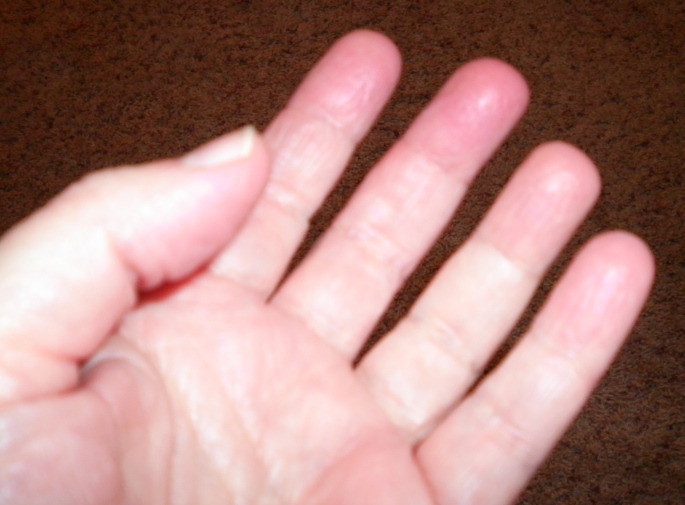
When Describing Your Characters, Don’t Forget Their Hands.

I’m not sure it’s true any more that a picture is worth a thousand words considering that a thousand words takes up only a few kilobytes of computer memory while a good high resolution picture takes up three to four megabytes. And anyway, it doesn’t take a thousand words to describe something so that it becomes real. It takes only a few words, if they are the right words, to create vivid portraits. The secret is to choose significant details — details that mean something, that promote the story, that evoke emotion — rather than to write long passages of trivia.

Take hands for example. By describing a character’s hands, we can describe the character. A man with manicured and buffed fingernails is different from one with grime permanently etched into his cuticles. A woman with bitten fingernails is different from one with dirty, broken nails, and both are different from a woman wearing designer acrylic nails. The color of nail polish a woman chooses tells us about her character. And clear nail polish on a man would tell us about his character.

We can describe hands in many ways: claw-like, thin, scrawny, big-knuckled, blue-veined, plump, fat, chubby, arthritic. Characters can have tattooed hands. They can wear gloves, a simple wedding band, or multiple rings on each finger.

Hands also do things. They wave, point, gesture, touch chins or noses, and each of these gestures and mannerisms tells us about the character. Hands can slap another character or caress a cheek, and such actions tell us about the relationship between the characters.

Here are a few examples of hands and what they do, taken from Light Bringer,.

The kid smoothed his neatly combed hair, swung his callused hands front to back as if he didn’t know what to do with them, then stuck them in his pockets.

Arthur Shillitani took his thin, long-fingered hands off the controls and slicked back his dark hair.

Rena studied her hands. . . . They were paler than usual, making the blue veins seem more prominent, and the nails were in need of a clipping, but otherwise they looked like the hands she’d lived with for the past thirty-seven years. What made them different from anyone else’s? What made her different?

Some examples from More Deaths Than One:

The staff sergeant was only 5’9” or 5’10”, but he had a powerful build with thick wrists, a massive chest, and hands that looked able to crush a larynx without any effort at all.

No one who crossed the threshold had the pampered arrogance of Evans’s men or the soft hands of a corporate drone.

The backs of his hands were crepey and mottled with age spots, but he seemed only about ten years older than Bob.

Kerry folded her hands primly in her lap, but her body seemed to vibrate with suppressed excitement.

And a couple of examples from Daughter Am I:

Mr. Browning shuffled through the papers on his massive black walnut desk. His age-mottled hands moved slowly, as if weighted by the six turquoise rings he wore.

Not hearing Happy, she looked back — he was heading her way, fumbling with his gun. He seemed to be trying to point it at the woods, but his hands shook so badly, the weapon wobbled all over the place.

So, when describing your character, don’t forget their hands. Hands make the character.

***

Pat Bertram is the author of the conspiracy novels Light Bringer, More Deaths Than One, A Spark of Heavenly Fire, and Daughter Am I. Bertram is also the author of Grief: The Great Yearning, “an exquisite book, wrenching to read, and at the same time full of profound truths.” Connect with Pat on Google+

I’m going to Blog for Peace. Will You?

On Sunday, November 4, people all over the planet blog for peace. This year, I’m going to join the the Blog Blast for Peace, and you can join the movement, too. You make your own peace globe/statement or simply choose one pre-made at blogblastforpeace.com, and become – a peace blogger. http://goo.gl/wOaGs

Peace bloggers believe that words are powerful, and that this matters. http://goo.gl/b01KH

So, check out the website or check it out on Facebook.

How To Blog For Peace The short version:

1. Choose any graphic on this page. http://goo.gl/4xepL Right click and Save. Decorate it and sign it, or leave as is.

2. Send the finished globe to blogblast4peace@yahoo.com

3. Post it anywhere online November 4 and title your post Dona Nobis Pacem (Latin for Grant us Peace)

Sounds cool, doesn’t it?

You Finished Writing Your Book. Now What?

I recieved an email yesterday from a friend telling me she finished writing her book, and then she asked for advice about how to proceed in getting her book published. She said she is open to all venues — self-publishing, independent presses, agents and major publishers.

If you are in the same situation, the first thing you do is make sure you’ve edited the book, copyedited it, found people to read it to see if there are any obvious lacks, and made it the best book you possibly can.

What you do next depends on your goal. If you want to try to do it on your own without going through agents or  publishers, there are plenty of self-publishing platforms to choose from such as Create Space, Amazon/Kindle, Lulu, Smashwords, Barnes & Noble/Nook. Do a bit of research to find the platform(s) that suits your needs. You don’t need an ISBN number for Amazon/Kindle or Barnes & Noble/Nook, though you do need one for most other venues.

If you want to try for a major publisher, research agents. You can find them at places like Preditors and Editors and Association of Authors’ Representatives. Look for agents who are interested in your genre. Once you have names, check out their websites to find submission requirements, and follow those requirements. If they say query letter only, don’t send samples of the manuscript. If they ask for the first three chapters, don’t send the whole manuscript.

If you decide to go with a small publisher, you can find a listing at Preditors and Editors and similar sites. Generally, you don’t need an agent for such publishers. Follow the same instructions as for agents, checking out their submission requirements and following them.

The query letter is your most important tool. Try to fit your letter to the particular agent or publisher. Always send to a particular person. Never use “Dear Sir” or “To Whom it May Concern.” Send a few letters out at a time (start with agents and publishers who will accept email submissions to save time and money). By doing only a few at a time, you can rewrite your query letter and synopsis as you get rejections. (Keep in mind a rejection at this stage only means they rejected your letter, not your manuscript.) The better your letter is, the better chance you have of getting someone interested in looking at your manuscript.

Click here to find out How to Write a Query Letter.

This is the query letter I wrote for More Deaths Than One. It got me an agent, but the agent couldn’t find a publisher. I found a publisher on my own when the agent’s contract expired.

Dear (Name):

The painting is of a pond with no ripples, surrounded by forest. Very serene. As Bob studies the painting, however, disquiet begins to creep over him, and he can almost see the monstrous thing that lives in the slime deep down at the bottom of the pool.

“I was trying to paint what’s in here,” he says, tapping his chest with a fist. Then he gestures to the painting. “I don’t know how that happened.”

When Bob Stark returns to Denver after almost two decades in Southeast Asia, he finds that, like his painting, nothing is as it seems. Not only does the city of his birth seem alien; the mother he buried years before has died again. Even worse, two men who appear to be government agents are hunting him for no reason that he can fathom.

Set in 1988, this novel, More Deaths Than One, explores what it is that makes us who we are. Is it our memories? Our experiences? Our natures?

Enclosed please find a synopsis and the first three chapters of this suspense novel. The finished manuscript of 80,000 words is available upon request.

Sincerely, 

Pat Bertram

***

Pat Bertram is the author of the conspiracy novels Light Bringer, More Deaths Than One, A Spark of Heavenly Fire, and Daughter Am I. Bertram is also the author of Grief: The Great Yearning, “an exquisite book, wrenching to read, and at the same time full of profound truths.” Connect with Pat on Google+

Introducing Mike Pettit, Author Extraordinaire

One of the most fascinating people I have met online is Mike Pettit. His  nightly “Goodnight America” is worth waiting for. His books covers are wonderfully nostalgic, reminding us of an earlier age of publishing. His  comments are a bit too amusing to be truthful (except for his political  comments, which are a bit too truthful to be amusing.) I’ve wanted to interview Mike for a long time for my interview blog, and he has finally agreed to answer some of my questions. Below is an excerpt from the interview, outlining Mike’s Three P Plan for selling books. (You can find the entire interview here: Mike Pettit, Bestselling Author of “The Key West Smackdown.” I hope you stop by to read the interview. You won’t be sorry you did.)

PB. Do you ever feel like you are lost among the thousands of other Kindle authors?

MP. Absolutely not. I treat my writing as a business. Here are my steps to selling books. I call it the Three P Plan (I should publish this and make a fortune…oh wait, that’s been done).

PRODUCT: Write the best book you can, edit the best you can, have the best cover you can.

I consider myself a good storyteller, but I am not a five star writer. If stars were grade averages I would be a C+ or B- writer, and that‘s OK. So, be realistic with your expectations. Average authors sell books, trust me.

I use the Flisch-Kinkaid comprehension scoring method to determine my writing / reader comprehension. I write to a reading audience at the 8th to 10th grade level of comprehension. This by the way is what the F-K scoring states as the reading level of most fiction-reading adults in America today. As a comparison, Obama’s State of the Union address was written to the 7th grade level of comprehension, The Wall Street Journal just dropped their Comprehension level from 12th grade to 10th grade level.

It might make you feel better knowing this the next time someone writes a bad review on your baby and gives it a two-star D rating. This does not mean you did badly. It means the reader should have read something on a higher comprehension level. That’s why I say you must know your audience …and write to them.

PRICING: To thine own self be true. You must price your book at a reasonable price. The big guys that work for the Big Six publishing houses command $25.00 and up per pop. That’s nuts, but they get it.

E publishing is growing with more and more readers coming over to the light, soon the big publishing houses and agents will be begging for us little guys to sign up with them.

My strategy is that I write and price my books to fit my audience. I am not greedy nor am I swollen headed. I know that I am a C+ writer and what I have to offer is a damn good quick read for a couple of bucks. The reader is happy with the read and the price and he’ll come back for more. You’ll make your money on volume sales

PUBLIC RELATIONS / MARKETING: Never stop pushing your book. I sell on Kindle and Nook. I use every social network platform I can find. I have Face Book, Twitter, Google +, a large FB and Twitter friend base. Look for “Friends that fit your target audience and talk to them…constantly.

This is just me, but I don’t spend a lot of time talking with other authors. If you aren’t talking to your customers, someone else is.

***

Mike Pettit’s newest book is The Key West Bounce. Check out Mike on Amazon, Facebook, and his action/mystery blog.

Who gave you the best writing advice you ever received and what was it?

The best writing advice I ever received I read in an old book called The Practical Stylist by Sheridan Baker: “Clarity is the first aim; economy the second; grace the third; dignity the fourth. Our writing should be a little strange, a little out of the ordinary, a little beautiful with words and phrases not met everyday, but seeming as right and natural as grass.”

Isn’t that beautiful? I paid particular attention to that advice when writing Light Bringer. I wanted the style itself to show that the characters were a little strange, a little out of the ordinary, a little beautiful. For example, “And then there it was, spread out before her in a shallow thirty-foot bowl. A lake of flowers — chrysanthemums and tulips, daisies and daffodils, lilies and columbines and fuchsia — all blooming brightly, all singing their song of welcome.”

Here are some responses from other authors about how the best writing advice they ever received. The comments are taken from interviews posted at Pat Bertram Introduces . . .

From an interview with Sheila Deeth, Author of “Flower Child”

I met Jane Kirkpatrick shortly after we moved to Oregon. She told me to keep writing. In fact, she’s told me several times to keep writing. It’s probably the most valuable piece of advice I’ve had.

From an interview with Eric Wasserman, Author of Celluloid Strangers

Frederick Reiken’s literature course on the short story was my very first graduate school class. The very first thing he said to all of us was, “If you’re not willing to submerge yourself in the world of reading fiction, give up now on being a serious writer of fiction.” I wrote this down the moment he said it, went back to my dingy Boston studio apartment that evening, and taped it across the screen of my TV.

From an interview with Sandra Shwayder Sanchez, Author of “The Nun”

The best advice I ever received was from J.R. Salamanca (Lilith, A Sea Change, Embarkation, Southern Light and more) who said the permanence of the written word has more influence on readers than spoken words and to take that influence seriously and try to create a good influence and that is the advice I would give aspiring writers.

What about you? Who gave you the best writing advice you ever received, and what was it?

(If you’d like me to interview you, please check out my author questionnaire http://patbertram.wordpress.com/author-questionnaire/ and follow the instruction.)

I’m going to Blog for Peace. Will You?

On Sunday, November 4, people all over the planet blog for peace. This year, I’m going to join the the Blog Blast for Peace, and you can join the movement, too. You make your own peace globe/statement or simply choose one pre-made at blogblastforpeace.com, and become – a peace blogger. http://goo.gl/wOaGs

Peace bloggers believe that words are powerful, and that this matters. http://goo.gl/b01KH

So, check out the website or check it out on Facebook.

How To Blog For Peace The short version:

1. Choose any graphic on this page. http://goo.gl/4xepL Right click and Save. Decorate it and sign it, or leave as is.

2. Send the finished globe to blogblast4peace@yahoo.com

3. Post it anywhere online November 4 and title your post Dona Nobis Pacem (Latin for Grant us Peace)

Sounds cool, doesn’t it?

Feeding the Facebook Beast

Yesterday, I talked about how Facebook is not the great promotional tool we authors had been led to believe, and yet some people do exceedingly well on the site. The truth is, Facebook is a beast that feeds on content. It needs a never-ending source of funny, inspiring, informative, controversial, topical, and brief posts that engage users and keeps them liking, sharing, and commenting. The more a post is shared, liked, and commented on, the more visible the post becomes. (Facebook uses something called EdgeRank to keep track of all this, which seems similar to Amazon’s algorithms. Amazon, like Facebook, rewards those who are doing well with additional visibility. In the same way, rich celebrities who already have everything they need, get free perks just because they are rich celebrities.)

When someone interacts in any way with a post on a fan page, for example, it shows up the feed of their friends, but the originator of the content gets the credit. And so the content provider gets more reach, and because they get more reach, Facebook will ensure that this continues by letting more and more fans see the posts, which increases the page reach of the content provider. Because, of course, without content, FB will starve since its users will go where they can find funny inspiring, informative, controversial, topical, and brief posts — places such as Twitter, Tumblr, Pinterest, or whatever the next big thing will be.

If you don’t have such engaging posts, then even if you have 1500 fans, only about 1% will ever see what you post. If you want to know what attracts attention, look no further than your own feed. What do you see that has been shared a hundred times, a thousand times? What have you laughed at, commented on, shared? Photos with funny, inspiring, informative, controversial, topical, and brief commentary, that’s what. (Well, you do unless you’re a curmudgeon like me, and then such content simply annoys you. If I see one more animal with baby-talk captions, acting like a human, I will probably scream so loud, it will reverberate through the center of the earth and cause earthquakes on the other side of the world.)

All this research the past couple of days into the workings of Facebook has given me a few ideas of what to do with my fan page — contests, questions, quotes from my books, even . .  gasp . . . photos with captions.