Where Do I Belong?

My favorite types of books have always been those where the character is out of place, as if she doesn’t belong in the world where she was plopped. By the end of the novel, of course, the character finds where she belongs — often with the one man who appreciates her — but we never hear the end of the character’s story. All stories end where life ends — in death. Authors simply pick the appropriate stopping place for the novel. So, as long as we imagine the character living happily ever after with her beloved, we know she belongs somewhere, but what happens to her when her beloved dies?

One short story I read when I was small affected me so much that I remember it all these decades later. (Though I don’t remember who the author was and, in fact, might not have known it. Back then, an author’s name was only important as a way of identifying the type of story, and I didn’t pay much attention to them otherwise.) The main character in the story was a young woman who had always felt out of place — the world and the people around her were alien to her. It turns out she was an alien stranded here on earth, and at the end, she was rescued and taken home.

It makes sense that such stories spoke to me since I too felt out of place. No matter how I tried to fit in, I never got it quite right, as if I were an alien trying to fit into a human situation. Then one day I stopped by a health food store, met the owner — a wise and radiant man — and all of a sudden the world made sense. If he was in the world, then the world wasn’t such an alien place after all. We never belonged to each other, but we did belong with each other. We thought alike, valued the same things, disvalued the same things. When he died two years ago, the world became alien once more, and I am back where I started, wondering where I belong.

As with many people in this mobile world, my parents left their hometowns, moved west, raised their family, then moved on again, which leaves me without a heritage, without a home. The place where I grew up has itself grown up — no longer a cow town but a world class city, and it is as alien to me as any city in the world. It didn’t matter as long as he was alive since he was my home, but now . . . where do I belong?

I’ve gotten over the hump of my grief. I am no longer in constant physical and emotional agony, though grief still stabs at me (sometimes several times a day), and I still have moments of panic when I remember that he’s not just gone out of my life but that he is dead. (That is still the worst aspect of this whole situation. I can deal with everything but his absence from Earth. How can he be so very gone? Where is he? Is he okay?) I am mostly back to being myself, though I’m not sure who I am, what I’m supposed to be doing, where I belong.

Right now, I’m taking care of my 95-year-old father, but this is not my home. In fact, I’d never even been here until my mother’s dying days. When my father is gone, the house will be sold, and I’ll have to find somewhere to live. But where do you go if you don’t belong anywhere?

I am going to be on blog talk radio today!

I am going to be on blog talk radio today speaking to Jo-Anne Vandermeulen. Or should I say, she will be speaking to me? Either way, we will be discussing my new book, Grief: The Great Yearning, why I wrote it, and why the book is important. If time allows, we’ll also talk about how I help other writers and perhaps we might touch on more general topics, such as the future of books. (Jo-Anne wanted a list of ten topics for us to discuss. I guess she didn’t realize I could talk for hours about grief and its unwelcome role in our lives.)

The show is a half an hour, from 6:30pm ET to 7:00pm ET (3:30pm PT to 4:00pm PT). I hope you will tune in to listen, but if you can’t, well . . . blogs are forever, and blog talk is no different. The show will be available whenever you get a chance to check it out. It should be a good show. Not only is 30 minutes a manageable block of time, there will only be one guest (me!) and one host, so it should be a dynamic show. And anyway, you’ve been wanting to hear what I sound like, so here is your chance!

Link to show: Talk Radio Network with Friend and Author Pat Bertram

Guest call-in number: (347) 857-3752

How are characters integral to the setting?

I often troll my site statistics, curious as to how people found this blog, and the other day, several people landed here after Googling “How are characters integral to the setting?” It sounds like they were taking the easy way out doing their homework, but still, it’s a very good question. If the setting is simply a place for events to unfold, then the author has missed out on an opportunity to tighten the story by making the characters an integral part of the setting and the setting an integral part of characterization. Everything should be in service to the story, including the setting.

In my novel, A Spark of Heavenly Fire, the setting and characters are intertwined. The setting is Colorado in the midst of an epidemic. The story is driven by the women, all very ordinary, especially Kate. And that was the point — to tell a story of an ordinary woman who struggled during prosperous times when everyone else was doing well, but who managed to prosper in the dark times when everyone else was having difficulties. Without the epidemic, without the quarantine, without the very terrain of Colorado, Kate would have no being. And without Kate and the other characters, the setting would have no meaning.

Eudora Welty said, “Every story would be another story, and unrecognizable if it took up its characters and plot and happened somewhere else.” Most of my books are set in mountain climes, and the mountains create the characters and the characters complete the setting. A stage is empty and lifeless without the characters. You need characters to interact with the setting to make it come alive.

Think of a desolate area, such as a desert road. It evokes a feeling of loneliness, but if you put a character on that road, you personify the loneliness.

The setting/character relationship is not simply a story construct. We are integral to our settings and vice versa. Gardening and lawn care is one very obvious way we are integral to our settings. If not for gardeners, gardens would not exist. But the settings of our lives extend beyond such evident comparisons.

I used to live off a highway on a dead end road bounded by fenced alfalfa fields, so the only place I could walk was by trudging up and down that .3 mile road. This was indicative of my life at the time. My life mate/soul mate was dying, had been dying for a long time, we were stuck in a terribe situation that seemed to be going nowhere.

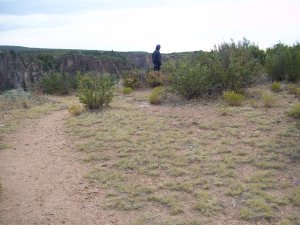
He is gone out of my life now, and so are the interminable laps on the short road. I left that place of constraints and came to this desert community to take care of my 95-year-old father. When I first got here, I walked the long straight roads in the nearby desert. They seemed indicative of my new life — emptiness and desolation and loneliness stretching endlessly before me. More recently, I’ve taken to hiking a narrow path up and over the knolls. This too is indicative of my life. The desolation isn’t as pronounced, but the challenges are becoming greater as it sinks it that I will always live with his absence, that I will be growing old alone. The true challenge, though, is to make room for joy along with the continued sadness.

I’ve come to see that this is the true purpose of grief — to stretch our minds, souls, psyches so that we can encompass all that life has to offer. At first I thought I could get over my grief. Then I thought I could bury it with new activities. Now I see that sorrow will always be a part of me, but that doesn’t mean it will be the only part of me. Nor will I always be here in the desert. There will be new places to walk, places that reflect the changing me at the same time as I reflect the places.

How are your characters (or you) integral to the setting?

“Golly gee what have you done to me?”

As part of my quest to refigure the pathways in my mind and open myself up to more light, I’ve been doing my version of dance therapy — dancing to a peppy song or two every day. I hop a bit, wave my arms around, and surrender to the rhythm. It generally works to lighten my mood, but today, Saturday, my sadder day, the song had the opposite effect and I ended up pummeling the air instead of bopping to the beat.

The song? Buddy Holly’s “It Doesn’t Matter Any More.

Cripes. As if I really needed to hear Buddy singing, “There you go and baby here am I / Well you left me here so I could sit and cry / Golly gee what have you done to me?”

Someone told me that grief over the death of a mate is like a relationship gone bad, and sometimes it does feel that way. I talk to him, and he says nothing in return. I beg for a hug, and he ignores me. I yearn for him, and he remains remote. I ask what happened to us, what did I do that was so terrible he had to leave me, and he doesn’t answer.

And then I remember — he didn’t leave me, he died. Now he is there and I am here with no way to bridge the gap. We don’t even have the opportunity to get together to fight about who gets what — I ended up with everything by default. If he were here, he could have everything. I’d even let him have the silly dishes we argued about that last year. (I received a set of Melmac dishes for Christmas when I was young. It was some sort of giveaway, and my mother got the whole set and saved them for my hope chest — though it wasn’t a chest, just a shelf in the kitchen cabinet. I still use those dishes occasionally — they are a wonderful size, and so very light.)

He and I shared everything during our years together, but for some reason I got very protective of those vintage dishes the last year of his dying. We’d started cutting up beets and other colorful vegetables for salads and I asked him not to use those plates — they were white and the beet juice stained them — but he kept using them anyway. (I should have known something was dreadfully wrong with him — he was the most considerate person I’d ever met.) I don’t know why my frustration over his continued decline focused on those dishes, but it did. I don’t even know why it  mattered. It sure doesn’t matter any more.

The song (“It Doesn’t Matter Anymore” written by Paul Anka) continues, “Now you go your way baby and I’ll go mine / Now and forever till the end of time.” Yeah. A real spirit lightener.

The song ends with the words, “baby / We’ll say we’re through / And you won’t matter any more.”

We might be through — my life mate and I — and I wish I could say he doesn’t matter any more, but he does. And he always will.

Facebook Makes Us … (Fill In the Blank)

Facebook has become an icon, a symbol for our times. We are lonelier than ever — disconnected from family and friends in offline life — yet at the same time we are more connected online. Various recent articles have suggested that Facebook makes us sick, narcissistic, depressed, lonely, and anxious, partly because of the shallowness of Facebook relationships. But honestly, does anyone consider “liking” a comment an actual relationship? I doubt it.

Facebook is good or bad depending on how you use it. An article in The Atlantic that suggested Facebook makes us lonely used Yvette Vickers, a former Playboy playmate and B-movie star (best known for her role in Attack of the 50 Foot Woman) as an example. Apparently, the actress had been dead for almost a year before anyone realized she was gone. (This is hard for me to believe. Perhaps all her bills were automatically paid out of her bank account every month, but what about taxes? Wouldn’t someone from any of the various tax collecting bureaucracies have noticed her delinquency?)

Still, the story goes that a neighbor found her and was so concerned about Yvette’s ignominious end that she scanned Yvette’s phone records and discovered that the former actress’s last calls were to old fans who found her via Facebook. Ignoring the neighbor’s decided lack of concern for the actress while the woman was alive, what business was it of hers how Yvette spent her last days? What business is it of ours? There is no way of knowing how Yvette felt. Perhaps it made her happy to connect with her past, to remember that she once had a life, to know that she once touched people. Perhaps everyone she knew and loved had died, and she needed to reach out and connect somehow. We don’t know the truth. We can never know another’s truth. The story is only pathetic because of our own fears of ending up alone.

Facebook doesn’t create loneliness. It might exacerbate a loneliness that already exists, (and face it, if we really had full offline lives, would we be spending so much time online?), but it also gives us the opportunity to connect with our past and maybe our future. I know several people who fell in love online, and the connection continues offline even now.

Facebook makes us informed. If it weren’t for Facebook, I would never have seen the above-mentioned articles, hence I would never have known about the deleterious effects of Facebook. Nor would I have seen these incredible before and after photos of Nagasaki.

Facebook makes us humble. You’re feeling thrilled that you sold ten books that day and then someone boasts they sold 10,000. Brings you down a peg, that’s for sure. Is humility such a bad thing? In a world that seems to revere aggrandizement, a bit of modesty is good for one’s soul.

Facebook makes us grateful. Mixed in with all the brags and too-cute animal photos are the heartbreaking posts. People talking about how their chemo is going, sharing their angst at the death of a loved one, giving updates on their hospital stays, telling us about the traumas their children and aged parents are facing. Such posts make us realize that no matter how bad things are for us, someone has it worse.

Facebook makes us aware of community. Or at least that’s the goal of my various groups. In the Suspense/Thriller Writers Group, I’m trying to keep writers focused on the craft of writing, on helping each other attain our writing goals. Perhaps together we can do what each of us can’t do alone.

In other words, Facebook doesn’t make us do anything. We make of it whatever we can.

There Really Is Life Offline — If You’re a Goose

It seems as if my entire life is lived online now,  and as enticing as it is to visit friends on facebook, talk about writing in one of my discussion groups, check my various email addresses for the hundredth time, even I need a break. So, yesterday I went for a picnic at a nearby lake.

This lake seems to be sort of an unofficial wildlife preserve. It’s one of the few bodies of water in the vicinity and it is a popular spot for waterfowl to stop by and rest during their migrations. For us humans, there is always something new to see (or feed). I’ve seen lots of coots, mallards, a few wood ducks, a blue-billed duck, egrets, swans, herons, and geese.

I counted at least six different geese families yesterday, but this particular family (blelow) stood out because of the blonde baby. Maybe geese aren’t as monogamous as they are made out to be!

Seems like an ideal life, doesn’t it? A summer home, a winter home, and swimming in between. There is only one drawback to beeing a goose — no internet.

The Necessity For Grief

People keep telling me I’m courageous to write about my grief, and perhaps it does take courage to let people see me at my most vulnerable, especially when I remember that the grieving me will be living forever in cyberspace. Even if I find peace or new meaning or happiness, that vulnerable part will still be accessible to anyone with a connection to the internet. But that is a small price to pay to be able to get my message across.

I never had a message to impart, but after the death of my life mate/soul mate, I found I did have something to say, and it is this: it’s okay to grief. Such a simple message, really, and not just meant for the bereft, but also those connected to the bereft. Too often family and friends urge their bereft loved one to “move on,” “get over it,” “stop thinking about it.” And they need to know that it’s okay for the bereft to grieve. If they can’t handle their loved one’s grief, imagine how much harder it is for the bereft to handle the pain.

We live in a society that values cheerfulness at all costs, and sometimes, when it comes to grief, the cost of putting on a cheery mien to make others feel better is simply too high. Despite what people seem to think, happiness and joy are not the only allowable emotions. Grief is important, too. If the bereft shows no danger signs, such as drinking too much, blocking out family and friends for many months, suicidal impulses such as stockpiling pills, then it’s better to let grief take its course.

Grief is how we learn how to adapt to a world without — without our loved ones’ presence, without their friendship, without their support, without their love —and it is possible to learn how adapt well enough so that we can live, laugh, love again. Grief digs deep into our psyche, allowing us to ask the important questions that get lost in the activity of daily life: who am I, why am I here, and what’s it all about? Even more important, perhaps, grief helps us to grow in courage, strength, wisdom. It would be nice if happiness and easy living gave us such attributes, and sometimes they do, but more often growth comes with adversity.

Although we bereft often wish to be done with our grief, we would resist anyone who tried to take it away from us. It is ours. Its lessons are ours to learn. Its power to reshape us into people who can deal with anything is ours to grasp.

Apparently, as I’ve been writing this bloggerie, I’ve amended my message. Not only is it important to grieve, it is necessary.

A Different Level of Sadness

I reached a different level of sadness today, both better and worse. For twenty-five months now, I’ve grieved the loss of my life mate/soul mate. As much as I hate the word “loss” when it refers to death, it was an unbearable loss to me when he died. All my hopes were lost along with our shared life and too many collateral losses to enumerate here. At times I could barely breathe for the pain. But somehow, I have managed to survive.

I truly never expected to grieve — he’d been sick so long and had suffered so much, that I was relieved when he died. In fact, I wished that he would. I’ve had a hard time these past months remembering that his death was actually a good thing — all I could think was that he should never have suffered in the first place. And he shouldn’t have. No one should have to deal with such pain for so many years. He stayed away from drugs as long as he could, suffering unbearably, because he knew the truth: the same drugs that would relieve his pain would addle his mind and disorient him. He wanted to be himself as long as he could (though he already was drifting from himself — the cancer had invaded his brain, and the poor man could barely hold two thoughts in his head.)

I wrote once about grief and our lizard brain. That feral part of us eventually adapts to the different reality, and the effects of new grief pass — the nausea, dizziness, inability to sleep or the inability to stay awake, the inability to eat or the inability to stop eating, the loss of one’s grip, the loss of balance and equilibrium, the hormonal storms. And finally, even some of the emotional storms pass, and there are times when we can see a bit clearer.

As I’m learning to face my new truth — that I’m going to have to find a new way of life, a new focus and new meaning — I’m recalling how relieved I was that he died. I feel selfish and self-indulgent for wanting him back, for yearning for him, for begging one more word or smile from him. Even the thought that he might have stayed a while longer if he could to satisfy my selfish longings makes me weep for him and for me. He was terrified of lingering as a helpless invalid, and if he hadn’t died, if he had remained here with me, he would have been helpless. I’m glad he didn’t have to deal with that, glad he’s safe from further indignities, glad he’s spared pain and a reliance on drugs. (He was taking so many drugs that he feared becoming a drug addict but, knowing how little time he had left, I could tearfully promise him he would never become a drug addict.)

Can you tell that I’m crying as I write this? As I said, this is a new level of sadness — better because I am learning to be at peace with his death and the need for it, worse because I feel as if I’ve lost him yet again. Every step away from grief seems to bring with it a new and different grief. Not as breathtaking, perhaps, but still sorrowful.

I will continue to yearn for him, of course — that is the nature of grief — but perhaps (at least some of the time) I will remember that he deserves to be at peace, even if it’s the serenity that only death will bring.

Gather ‘Round and You Shall Hear . . . The Story of My Online Life

In October 2007, I entered a contest on gather.com — Court TV Search for the Next Great Crime Writer contest. The winner of the contest would win a $5,000 advance and a publishing contract. My entry, More Deaths Than One, was not a detective story, and it certainly is not a cozy mystery, but it is the story of a crime: identity theft. This theft is an actual theft of a man’s identity, not a paper one. So it did fit with the contest, though from reading the first chapter (all that was posted online for the contest), many people assumed it was a supernatural tale — as the blurb says, When Bob Stark returns home after spending eighteen years in Southeast Asia, he discovers that his mother Lydia Loretta Stark is dead again. When he attends her second funeral, he sees his brother, his college girlfriend, and . . . himself.

I did very well in that contest, too. As of November 17, 2007, I was ranked number one, but I finished up about sixth or seventh. (I could tell you it was because my mother died and I had to go to California for her funeral and I broke my ankle while there and was off the internet for a week so I couldn’t solicit votes, but the truth is . . . come to think of it, I don’t know what the truth is.)

The contest started out being great fun but devolved into all sorts of infighting, faked votes, and terrible reviews that were posted for no other reason than meanness. Still, it turned out to be a pivotal point in my online life and my writing career.

I became friends with many of the contestants, and casual acquaintances with others. (As Jeffrey Siger, one of the contestants said, it’s “sort of like the camaraderie born of battle or surviving a natural disaster: never to be taken as an endorsement of the event that engendered such strong ties among the the participants.”)

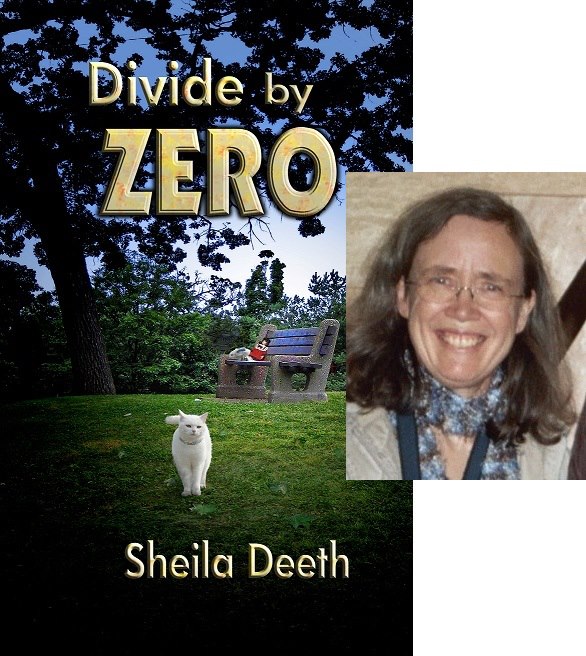
I met the group The Writin’ Wombats on Gather because of the contest, and ended up hanging around with them for all these years. Because of the contest, I eventually found a publisher. The link to the publisher’s website was posted on a Wombat thread, and since I was in querying mode, I immediately shot off a query letter. He loved my book A Spark of Heavenly Fire, and sent me a contract. Turns out, I already knew him through the contest, and he asked if More Deaths Than One was still available. It was. Second Wind Publishing has now published five of my books — four novels and one non-fiction book, Grief: The Great Yearning.

Until the crime writer contest, my online presence had been confined to my blog (I’d only had a computer and the internet a few months) but after the contest I posted articles on Gather, and I also migrated to other sites, such as Facebook, Goodreads, and Twitter. I mostly hang around Facebook now because of my discussion groups there, but I always return to Gather, especially on Thursday evening when I do a live chat with my No Whine, Just Champagne discussion group. I started out knowing only a few people online, now I know hundreds.

And all because of a contest.

So, what was the pivotal point of your online life?

Grief Update — Two Years and One Month

Grief continues to confound me. It is now two years and one month after the death of my life mate/soul mate. I would have thought I’d have moved beyond grief’s ability to disquiet me, but I still have times where tears rush in to fill the void he left behind.

Some of my grief now is the poking-at-a-sore-tooth-to-see-the-extent-of-the-pain kind rather than the overwhelming agony and angst of the first year. There are still sore spots, most notably the obvious one — that he is dead. I cannot fathom death. My mind just cannot work itself around the conundrum of a once living person being so very gone from this earth. And there is the corollary murmuring deep in my psyche, “and someday you will be gone, too.” But . . . gone where?

When my grief was new, I often wandered in the desert crying out in desperation, “Where are you? Can you hear me?” I don’t call out any more, though I still wonder where he is, if he is, what he is. I envy those who believe without a doubt that their deceased loved ones still exist and that they will see them again because I have no such constant belief, though I do have flickers.

One of the many paradoxes of my grief is that I hope he still exists somewhere, but for myself, I’d be okay with oblivion. Is his death worse for me if he still exists somewhere beyond my ability to connect with him? Or is it worse if he is completely deleted except for a spark of indestructible non-conscious energy? Either way, he is gone out of my life. Either way, I have to deal with the mysteries of death, love, grief, and what the heck am I going to do with the rest of my life?

I met my life mate when I was young and believed in fate and destiny and a mystical connection with the universe. I subscribed to the belief that when the student is ready, the master will appear. And he appeared. He was so radiant, it seemed to me he was a higher being come to earth to help me on my life’s quest. In the few ups and many downs of our shared life, I forgot that feeling. And no wonder — as he got sicker and sicker, his radiance dimmed and all but went out.

During that last year, when he could no longer carry on a two-sided conversation, he would lecture me on what I should do after he was gone. He kept saying, “Listen to me. I won’t always be here to teach you.” I didn’t accept that his dying was imminent, so these lectures aggravated me, as if he thought I was so stupid I couldn’t live on my own. (I’d give anything to hear one of those “lectures” again. How could I not have treasured every word?) But the point is, apparently, deep in his subconscious, he believed what I had once believed, that he came here to be my teacher.

There is not a single question (except the unanswerable ones such where he is and if he is) that has arisen in the past twenty-five months that I didn’t know the answer to. We had discussed everything, sometimes all day, day after day, year after year. He took me as far as he could, imparted his wisdom, and left.

If there is any truth to this scenario, rather than being the rather romantic idea created by a bereft woman grasping hold of life any way she can, then the question of what I am going to do with the rest of my life takes on even greater significance. What is so important about me and my life that this radiant creature would share half his lifetime and all of his long and painful dying with me? I suppose that is what I am left to find out.