Saddened

It seems sort of silly to be sad at the loss of a single tree when so many trees are being burned in the wildfires all across the west, but this was my tree. Well, no, it wasn’t my tree since trees belong to themselves, but the tree was my responsibility. And it saddens me that I had to destroy it. (I was going to be clever and say I euthanized it, but that would indicate a humane death, and killing something with a chain saw cannot be called humane.)

Although the tree looked pretty and healthy, it was diseased. Apparently, at one time, it had been hit by lightning, and the core and the far side of the tree was dying. I could have kept it awhile longer, but it was a danger in high winds, and I didn’t want to be responsible for someone getting hurt by a falling branch. (And I certainly didn’t want to have to compensate the someone who was injured.)

It was the last tree on this property, and now it’s gone. I was always disdainful of people who bought a house and then immediately cut down all the trees, and yet, that’s what I did. A couple of the trees were diseased and dying. One needed to be cut way back to protect the roof and the tree cutter thought it would be too lopsided to be healthy, so they took the whole thing. Another was a danger because it was entwined with electrical wires.

And so I became one of the disdained. Even worse, I’ve never considered myself a killer, but from my actions regarding trees, I have to revise that assessment.

In my defense, we (the tree guy and me) are planning on planting new trees — perhaps a red maple in the front yard and three along the parkway strip between the street and the sidewalk where this tree was removed, and two greengage plum trees in the back yard. These will be real trees, not the half-dead sticks (now, completely dead sticks) that I got from an arbor society, so I’m hoping they will have a chance to survive.

Meantime, my property looks naked, and that, too, saddens me.

***

Pat Bertram is the author of Grief: The Inside Story – A Guide to Surviving the Loss of a Loved One. “Grief: The Inside Story is perfect and that is not hyperbole! It is exactly what folk who are grieving need to read.” –Leesa Healy, RN, GDAS GDAT, Emotional/Mental Health Therapist & Educator

Keeping The Faith

I’m one of those who keeps the faith with language. I say what I mean and I try to live by what I say, though sometimes it’s hard because the inner voice of truth that comes out when I am speaking or writing is often wiser than I am.

I prefer other people to use correct language too, though I realize that’s an old-fashioned concept.

I just read an article that talked about Trump supporters spreading hate because they were getting in altercations with the protestors. So we’re supposed to believe that only Trumpers hate? That the self-proclaimed Marxist protestors who are burning and looting are doing it out of love? Oh, for cripes sake. Has the world lost its mind?

Words no longer mean what they once did. Peaceful once meant . . . peaceful. Free from disturbance. Tranquil. Not burning and looting, not screaming, not blocking emergency entrances at hospitals and chanting: “We hope they die.”

Words have always been plastic, meaning that they can be easily molded or shaped, not the way the word is now used, meaning something hard and indestructible. It seems words are even more plastic than I realized in this gaslighting era, where what we are told is the exact opposite of what we are seeing. For example, I had the misfortune to watch a television news broadcast the other day. They showed someone saying something, and then immediately afterward the newscaster told us the person had said something completely different.

In many cases, I’m one of last to keep the faith when it comes certain words. I say vegetables instead of . . . gag . . . veggies. I never use the outdated and so very sexist term “co-ed.” I don’t use permuted words like “styling,” whatever that means. (I assume it’s good because the other day someone told me my hat was “stylin.” Though with the plasticity of words nowadays, for all I know it could mean that I was wearing the ugliest hat the young woman had ever seen.)

I especially don’t say “love” when I mean “hate.” And I don’t say “peaceful demonstrations,” when I mean that people are rioting. I don’t say “taking what they need,” “expropriating property,” or “reparations” when I mean stealing. (Looting is stealing. To a person with a passing acquaintance with a dictionary, looting means to steal during a riot, and it’s a crime no matter how many people defend the act.)

It’s possible my adherence to words in their proper form and proper meaning is due to the intransigency of age, but it still doesn’t make the actions hidden in these plastic words palatable to me.

I think it’s time for me to pull in my head and channel my inner turtle for a while.

***

Pat Bertram is the author of Grief: The Inside Story – A Guide to Surviving the Loss of a Loved One. “Grief: The Inside Story is perfect and that is not hyperbole! It is exactly what folk who are grieving need to read.” –Leesa Healy, RN, GDAS GDAT, Emotional/Mental Health Therapist & Educator

Questions About Grief

A friend’s husband died a few months ago, and during this time, she’s been asking me questions about grief. Since some of them are things I haven’t talked about, with her permission, I am posting her questions (in bold letters) and my answers.

I just got back from a visit with a relative. The emptiness is horrible!

Yes, the emptiness is horrible. I wasn’t sure if I should warn you about how awful it would be when you got back to the empty house, but I figured you’d find out soon enough and I didn’t want to ruin your visit. It’s really hard living with grief.

Did you ever have a weekend where you couldn’t stop crying for more than an hour?

Yes, many, many. I cried for twenty-four hours straight once.

How long did it take before you didn’t cry every day?

A long time. Years. Sometimes it was for just a few minutes. Other times it felt as if he had just died, and I cried as I did at the beginning.

I thought it would start to back off by now.

No. Maybe after six months, the time between crying bouts will get a lot longer, but the tears come back. It’s kind of a shock when the tears return after a period of relative peace because we’d begun to believe it was all over. When the tears come and stay too long, about all you can do is distract yourself by going to the store or a museum, but then you often have the problem of DWC (Driving While Crying). Or crying at the grocery store. It’s not fun.

Did you ever see a grief counselor?

Not a grief counselor, but I did go to a support group for about a year. A support group is good because it helps being around people who are going through the same thing you are and who understand. In my case, it also helped because I was new in town and didn’t know anyone.

What did you have the most trouble with the first year?

It was all horrific. I couldn’t breathe. Couldn’t stand the pain and loneliness.

What sort of things helped during really bad episodes?

Walking. Working helped – housework, cleaning, clearing out stuff. Screaming helped. I did a lot of screaming. Writing letters to Jeff helped a lot. It made me feel as if we were still connected somehow.

How do you make yourself not cry for things like doctor’s appointments?

That’s a good question. I don’t know. Sometimes my tears stopped when I was with other people. Sometimes not. If they didn’t, I just told people to ignore them. Also, being at the doctor’s office rather than at home might be a big enough change to stop the tears.

Is nausea one of the signs of grief?

Yes. I was often too sick to my stomach to eat. But pay attention. The nausea could have other causes.

Did you have different food choices the first year?

Oh, my yes! It took me over a year to be able to eat meals Jeff and I fixed. In some cases, it took longer. In fact, there are some foods I still haven’t eaten.

Did you have any trouble with hair, skin, and nails the first year?

Absolutely. My hair turned to straw, my skin dried out, and my nails got soft. It’s because of the stress. Studies have shown that losing a spouse is the most stressful experience a persona has, by a large margin.

Are you ever scared?

Sometimes. At the beginning, I was often terrified. And for a long, long time I was scared of growing old alone. I still am, but having a house helps. Also, I’m to the point where, if I do get afraid of living alone or anything else, I can turn my mind to other things. But yeah, fear does niggle at me.

Living after the death of a husband is really, really, really hard. Don’t let anyone tell you otherwise. It’s not just the pain and horror of grief that’s hard, but having to find a whole new way of living because your old way of life died when he did.

I don’t feel strong enough.

You might not be strong now, but you will find the strength to get through this. I promise.

I’m glad you are so sure.

I am. I know. It’s the way of with all of us who are left behind. We have no other choice but to live one minute at a time. As time passes, we look back and see all the minutes and pain we have survived, which gives us strength to continue. You’re still at the start, so you can’t see yet all you have done since he died.

***

Pat Bertram is the author of Grief: The Inside Story – A Guide to Surviving the Loss of a Loved One. “Grief: The Inside Story is perfect and that is not hyperbole! It is exactly what folk who are grieving need to read.” –Leesa Healy, RN, GDAS GDAT, Emotional/Mental Health Therapist & Educator

Signposts of Time

Last year sped by so fast that by the middle of January, I was already seeing the end, and within another month, the year was done. Or so it felt.

Not so this year. Slow. Slow. Slow. The year is progressing so slowly that something as unseasonable as an early snowstorm — not uncommon in Colorado — has thrown me off track. We went from almost a hundred degrees to almost freezing in a single night, and the rain turned to snow. Although it’s supposed to heat up to the eighties and nineties starting tomorrow, for now the dreary days are continuing.

I have an urge to dig out my Christmas decorations, especially my bowls of light and other lighted things like my small tree, because I keep thinking Christmas is almost here.

What a shock to realize that particular holiday is still one hundred and five days away! Halloween and Thanksgiving haven’t even come, and it’s too early to decorate for those days, too. Not that I celebrate any of these holidays — since I’m alone, one day is much like another. It’s more that they are signposts that time is moving along. (I did celebrate Christmas last year, or more accurately, I celebrated having my own kitchen and oven, but I doubt I will do the same this year — although I have been especially careful with my diet the past several months, I still haven’t been able to lose the cookie weight from last Christmas.)

Luckily, the sun will come out again, and though the brightness will dispel my feelings of an imminent Christmas, it won’t do much to speed up this interminable year.

My only choice then, is to take the days as they come. To look at the small picture and focus on the short term (even though my tarot card today told me to look at the big picture and focus on the long term). To enjoy the respite from the heat, and when the heat returns, enjoy the respite from the cold. Because truly, does it matter if last year passed in a flash and this year is moving at slow speed? What does another year get me except another year older and a completely different number for my age?

Come to think of it, that’s the number I don’t particularly want because it’s the one where a person can no longer pretend not to be old. So perhaps, after all, I’ll keep the Christmas things packed away. No sense in hurrying things along.

***

Pat Bertram is the author of Grief: The Inside Story – A Guide to Surviving the Loss of a Loved One. “Grief: The Inside Story is perfect and that is not hyperbole! It is exactly what folk who are grieving need to read.” –Leesa Healy, RN, GDAS GDAT, Emotional/Mental Health Therapist & Educator

You Can’t Imagine

A friend is reading my grief book — Grief: The Inside Story – a Guide to Surviving the Loss of a Loved One — not for herself so much because she is still happily and healthily married, but for those she knows who have had to deal with the death of a spouse or child.

I am impressed with her willingness to try to understand what others have to go through in dealing with such a horrendous loss. Most people don’t want to know. Not that I blame them — I would have preferred not knowing, would have preferred to continue believing I was immune to such wild emotions, would have preferred . . . well, I would have preferred a lot of things. Or rather, I would have preferred them back then. I’ve gotten so used to the way my life now is, I can no longer imagine a different life. I can barely remember, at times, what my life used to be.

My friend and I talked about the book for a few minutes, then, as people often do, she said, “I can’t even imagine . . .” And as I often do, I responded, “You can’t imagine it, so there’s no reason to even try. It truly is an unimaginable experience.”

I was going to offer further words of comfort by mentioning that she is still way to young to have to worry about being a widow. Even though I know people of all ages who have had to deal with the experience, the widows I’ve been meeting since my move here are usually much older, and had long years with their spouse. Not that the length of time with a spouse mitigates the pain, but it seems more . . . fitting? understandable? . . . than the death of a someone still in their middle years.

It wasn’t until much later that I realized this woman friend is only four years younger than I was when Jeff died. I tend to forget how relatively young I was (though I never forget how young Jeff was), probably because by the time I reared my head and looked around after all those dark years of pain and sorrow, I was way older.

I think it was my relative youth that made me so determined to live and thrive, not just survive, after Jeff’s death. Perhaps if I had been older, nearing my own expiration date, I might not have thrown myself into the whole grief experience but just . . . waited. Back then, I figured it was better to experience grief as it came rather than try to fight it off because I didn’t want to have to be dealing with the problems unlived and unresolved grief can cause in later years. (Buried grief can find its way to the surface through illness and emotional problems even decades later.) I wanted to be sure that I would be whole (except for that eternal void deep inside that still remains), that I would be able to experience to the full any happiness I could find. I also wanted to see where grief would take me.

Although I’m glad the pain and sorrow are gone (except for a residual sadness and nostalgia), I am grateful I gave myself over the experience. I never knew, couldn’t even have imagined that a person could experience such a depth of emotion, could experience something so . . . primal.

Now that I am through with that particular experience, I have no idea what I am going to do with my remaining years except continue to apply the lessons grief taught me, such as live each day the best I can, enjoy the good times, endure the bad, and be thankful for any blessings that come my way.

***

Pat Bertram is the author of Grief: The Inside Story – A Guide to Surviving the Loss of a Loved One. “Grief: The Inside Story is perfect and that is not hyperbole! It is exactly what folk who are grieving need to read.” –Leesa Healy, RN, GDAS GDAT, Emotional/Mental Health Therapist & Educator

A Relative State of Ignorance

A friend texted me yesterday after reading my blog post. She seemed to take exception to my final sentence (Besides, nothing in this new world is more redundant than an old woman, no matter how perspicacious her thoughts might be) and sent me information about Maggie Kuhn, the woman who started the Gray Panthers, as an example of how important an old woman’s ideas can be.

My response? “And yet here we are, still redundant.”

I went on to say, “Actually, I should have qualified my half-facetious closing remark to refer to what’s going on today. In a war for the hearts and minds of the young, the old don’t matter. By the time their brave new world is operational, I’ll be dead.” Though, come to think of it, with the way things are changing so rapidly, I might still be alive enough to be affected by that world. Not a pleasant thought!

I also told my friend: “I have a hard time dealing with things today that I thought were taken care of in my youth, like civil rights, women’s rights, elder rights, environmental issues, and Russian conflicts. It was really a shock after living in the cocoon of Jeff’s illness and death and my grief to come out of it into a world that seems to have regressed tremendously. Russia an enemy? Really? What happened to Glasnost? And civil rights riots? Really? I thought that things had improved, but according to some sources, it’s even worse now than in our younger days.”

She responded: “I couldn’t agree more. The cultural information is not being passed down, I have felt for some time. And each newly read or watched program feels like another piece of who I thought we were as a country and any good memories I do have are taken away. So very hard to put it into words. And never have so many marched for so long in my memory and then I realize they can — because of the pandemic they are unemployed.”

My response: “Funny. I just came to that very same realization yesterday about protests and the pandemic. It’s hard for me to try to refrain from putting a conspiratorial slant on things.”

Her brilliant comment: “Isn’t it? The only thing that saves me is the thought that if we could work together to put on a worldwide pandemic successfully, SURELY we would have made a better world.”

Me again: “What worries me is that this is exactly the world we (they) want.”

The more I think about it, the more some sort of conspiracy seems to be a real possibility, and that the riots (oh, excuse me, the “mostly peaceful protests”) were spontaneously on purpose scheduled for this very time.

Beyond that, it’s not just about the information not being handed down or being unheeded. It’s not just that we thought things were progressing on all the various “rights” fronts and so we forgot about it.

There’s something more at work, and the only thing I can think of is that social progress was not just stalled but undone. Apparently, it’s hard to keep building a power base on the backs of the oppressed if the oppressed are no longer oppressed. So the plan seems to have been to re-oppress people so they can be re-unoppressed. Hence the déjà vu times we are living in. (Déjà vu to us older folks. Something brand new and radical to younger ones.)

Whether I’m right or way, way wrong, I’m beginning to see a bigger picture, big enough maybe, that I can stop thinking about all this, put it to rest in my mind, and go back to my relative state of ignorance, which isn’t as bad as it sounds.

Benjamin Hardy PhD believes that selective ignorance is a good thing. “It’s not the avoidance of learning. It’s also not the avoidance of getting feedback. It’s simply the intelligence of knowing that with certain things and people, the juice will never be worth the squeeze. It’s knowing what to avoid.”

And to me, a lot of what is going on the world today is best avoided even in my thoughts.

I just hope I can act on this resolve for ignorance!

***

Pat Bertram is the author of Grief: The Inside Story – A Guide to Surviving the Loss of a Loved One. “Grief: The Inside Story is perfect and that is not hyperbole! It is exactly what folk who are grieving need to read.” –Leesa Healy, RN, GDAS GDAT, Emotional/Mental Health Therapist & Educator

Does It Matter to Anyone What I Think?

I’ve been thinking about what I wrote yesterday, my being afraid to say what I think. I’m not sure it’s fear, like hiding-under-the-bed fear, that keeps me from talking about the things that worry me. It’s a healthy sense of self-preservation, but even more than that, it’s that I don’t think it matters what I think. It is interesting to talk to people, to get other points of view, to broaden one’s outlook, but when such a discourse is not available, when all people want is to propound their own point of view (emphasis on “pound”), talking doesn’t advance any cause. (Nor does burning buildings, or even oneself, but that’s a discussion for a more benign and less uncivil era.)

In a gale force wind, a puff of breath is not noticed, and certainly won’t help to calm the forces creating the wind. In a ship violently crashing from side to side because of insanely high waves, nothing one can say will rock the boat any further, and certainly won’t help to steady the craft or the people in it.

If what I said (or wrote) really mattered, I might be courageous enough to tell my truth, but when so many people have already made up their minds, locked their mental door behind them, and pulled up the drawbridge against critical thought, a single word or a thousand will not batter down those fortifications.

A greater problem than closed minds is that people hear what they want to hear, filtered through their own value system. They hear a slogan, process what it means to them, and then head out to defend that slogan without ever finding out what that slogan means to the people who wrote it and what their agenda really is. Which means sometimes well-intentioned people fight against their own interests without knowing it.

This is a relatively short blog. I’d written a lot more, even going so far, despite my reservations, as to talk about many of the issues at stake, but in the end, I deleted all that because I realized it truly doesn’t matter what I think. I’m not sure it even matters to me. Nothing I think will change anything. Nothing I say will change anyone’s actions, so is there any point in even thinking about the current situation? It’s not as if I’m young and still have a whole lot of ideological formation ahead of me. I’m pretty much a done deal. I’ve mostly lived my life in my own head, and a lifetime of thinking and reading and researching and studying and writing and being can’t be undone by new/old emotionally-charged slogans or radical groupthink.

Besides, nothing in this new world is more redundant than an old woman, no matter how perspicacious her thoughts might be.

***

Pat Bertram is the author of Grief: The Inside Story – A Guide to Surviving the Loss of a Loved One. “Grief: The Inside Story is perfect and that is not hyperbole! It is exactly what folk who are grieving need to read.” –Leesa Healy, RN, GDAS GDAT, Emotional/Mental Health Therapist & Educator

Being Afraid to Say What I Think

Malcolm R. Campbell, author and fellow blogger, posted an article yesterday entitled, Are you afraid to say what you think?

He mentioned, among other things, penalties imposed on people for exercising their right to free speech, the lack of civility, allowing violence under threat of more violence, and mob-enforced political correctness. He was also brave enough to say that most of us see and hear enough stuff daily to know how and why the problem is larger than what can be put in single blog. And he admitted that he no longer felt safe enough to say how much larger the problem is.

I responded to his blog: I’m certainly afraid to say what I think. I study everything, including both sides of an issue, and often my views end up being on the quiet end of the spectrum rather than the burning-down-buildings end. When I was on FB and shared something interesting that a conservative non-white said, people accused me of being racist rather than seeing that I had just found an alternative point of view interesting especially since it didn’t follow the official narrative. Some people don’t mind causing conflagrations, either real or virtual, but I don’t have the stomach for it. I brood too much. In fact, I’ve been wanting to write a blog mentioning some of the ironies of the current situation, and I simply don’t want to have to deal with the backlash. Or even worse, the quiet condemnations that I don’t hear about until much later. Even more than that, mobs scare the hell out of me, and I certainly don’t want to bring myself to the attention of a flame-wielding, rock-throwing, gun toting mob with but a single mind.

This being loath to speak my mind started long before the current volatile situation, and was a direct result of Jeff’s death.

Jeff was the only person I ever met who I could talk to without censoring myself in some way. No matter how outrageous my opinion might have been, no matter how much it went against the current belief and what we were taught, he always treated my remarks with respect and in fact could come back at me with a clarifying point, a different way of looking at the situation, perhaps even the title of a book I could read that would take my points a step further.

I hadn’t realized how spoiled I was being able to say anything, think out loud, express what to others might be unpopular opinions. It was a freedom I hadn’t found before Jeff and certainly have never found after him.

Some of the things I want to say to people I am conversing with aren’t full-fledged ideas, but rather the beginning of a complex thought buried somewhere in the back of my mind, but even the most intelligent person seldom can get beyond my inciting comment, so we end up arguing a point I didn’t even wish to make until I finally tell them to forget it, to ignore what I said, and let’s agree to disagree. This makes them uncomfortable and leaves me with a nest-full of half-formed ideas with no place to fly.

After a few such misunderstandings during the first years of being without Jeff, I’ve gotten good at gauging what ideas people will accept or not accept. Sometimes, I put a toe (or a claw if I want to keep up with the bird metaphor) in the conversational waters, and quickly draw it back if I find resistance, so generally, I end up listening to people way more than I speak. Because of this, not only can I gauge what people might be willing to accept, I also learn how they think. And all too often how they think is an indication that they don’t think at all; they simply react.

If people today can get killed by doing nothing but wearing the wrong hat or the wrong tee shirt or the wrong smile, then it’s no wonder so many of us are afraid to tell the truth even in our personal online spaces. (Because when it comes to an online space, there is no personal space with unbounded freedom from rancor to say what one wills.)

If I weren’t fearful of hurting people’s feelings or having hatred rained down on my head, I really would like to write a blog discussing some of the ironies of the minority rights issue, such as the way successful minorities, especially conservatives, are called “Uncle Tom”s, as if a person can’t be anything other than the color of their skin, which itself is the basis of racism, right? Adding to the irony, the original Uncle Tom wasn’t an Uncle Tom in the sense it’s used today, meaning a racial sellout, but was instead based on a real life heroic character who died to protect two runaway slaves.

There are many such instances where anti-racists turn out to be more racist than proclaimed racists, sometimes by infantilizing minorities as if they can’t think or do for themselves, which makes it even harder to say anything about the melanin issue without being tarred with the “r” word.

But oops. I’m straying from the point, and perhaps disproving my point in the process, which is being afraid to say what I think.

***

Pat Bertram is the author of Grief: The Inside Story – A Guide to Surviving the Loss of a Loved One. “Grief: The Inside Story is perfect and that is not hyperbole! It is exactly what folk who are grieving need to read.” –Leesa Healy, RN, GDAS GDAT, Emotional/Mental Health Therapist & Educator

Imagined Future

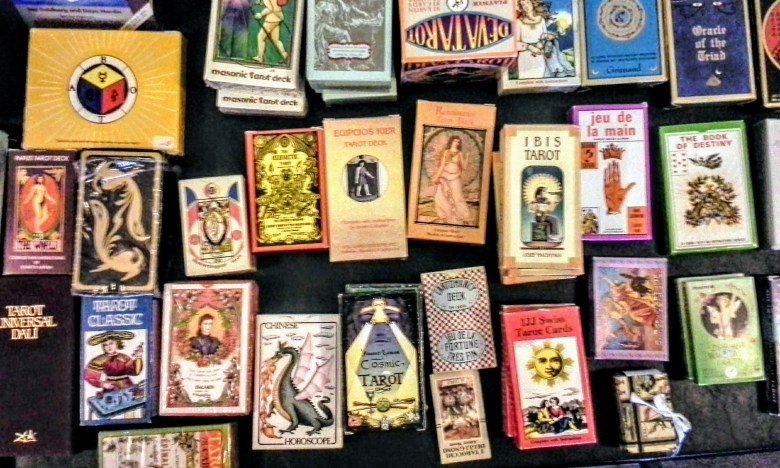
I’ve been continuing my practice of picking one tarot card every day, not so much to learn what is in store for me in the future or to delve into the secret places of my soul, but simply to get familiar with the idea of the tarot. I mean, I have all those decks of cards that my deceased brother collected, so I should do something with them, right? Besides, it’s a way of honoring him and all he wanted but was never able to accomplish.

The most interesting thing I’ve found while doing this exercise is how often I get one of the dire cards one day, such as the nine or ten of swords, and one of the most fortunate cards the next day, such as The Sun.

So far, I haven’t learned much about the cards themselves or myself, just that I refuse to see bad in the bad cards, though I do enjoy seeing good in the good cards. If I get a card that seems to spell disaster, then I keep searching for meanings until I find an interpretation that portends something better. For example, the ten of swords can mean violent accident or death or misfortune on a grand scale, which I won’t accept. It also means that no matter how much we try, we cannot control everything, which I will accept. Not being able to control everything is a truth that can be applied to any situation and a lesson that behooves us all to learn.

Beyond that, I hadn’t realized why I objected to anything to do with foretelling the future until I read this quote:

People didn’t want to know their real future. They wanted to know their imagined future, the one they cherished instead of fearing. — “The True Secret of Magic,” a short story by Joe Edwards

I realized then that foretelling the future is like writing a story. Every story, taken to its logical conclusion leads to death because we all die. If we write the story all the way to that end, the story is a sad one. To make a happier story, we end at a pleasant time in the character’s life. Perhaps a wedding and a belief in happy ever after. Or the solution to a crime and justice for a victim.

Telling the future would be the same. Almost any fortune that doesn’t include specifics, such as telling someone they will be divorced within the year, will fit practically any situation. Almost any future will include happiness and sorrow, success and failure, sickness and health, betrayal and forgiveness. And every future, no matter how sunny and felicitous, ends in death. At least an earthly future does, and that’s what concerns us: how our life will be.

We want the pretty story, a belief that no matter how bad things are, things will work out to some sort of satisfying conclusion. (Isn’t that what we want from fiction, too? A satisfying end to a story, a belief that all the horror the character went through was worth it in the end?)

I know my end, perhaps not the specifics of my expiration date, but that there will in fact be an end to me. Meantime, I try to create my fortune — my future — every day. Even knowing that I can’t control everything, I try to control something — my attitude, my actions, my interactions with people — in such a way that I will have a felicitous fortune.

I don’t need to be told a bright future, and I certainly don’t need to be told a bleak one. Both will happen. Both will affect me. Both will be processed and I will move on to another day, another future.

I suppose if I were young, I would want to know if I’d be pretty, if I’d be rich, if I’d find love and happiness, but those wishful, youthful days are long gone. I once loved greatly, once was loved. I once felt immense joy and experienced vast sorrow. I once shared my life with someone. And now I don’t.

But just as I shy away from foretelling, I shy away from backtelling. In the first case, whatever will be, will be, though my actions today can affect what will be. In the second case, whatever was, was, and my actions today won’t change any of it.

But neither case really matters. What matters is . . .

What matters is . . .

Hmm. I’m not really sure what matters. That I am determined to cherish whatever my future might be rather than fearing it? That right now I am living a future I could never have imagined even a couple of years ago? That I am trying to imagine a comfortable future for myself? (Though if a great present came from nothing I ever imagined in the past, would anything I imagine in the present affect the future?)

Maybe what matters is that I am living as fully as I can, which, apparently includes picking and learning about one tarot card every day.

***

Pat Bertram is the author of Grief: The Inside Story – A Guide to Surviving the Loss of a Loved One. “Grief: The Inside Story is perfect and that is not hyperbole! It is exactly what folk who are grieving need to read.” –Leesa Healy, RN, GDAS GDAT, Emotional/Mental Health Therapist & Educator
Playing with the New WordPress Block Editor

WordPress is planning on getting rid of their classic editor box, the one I used from the first time I posted a blog. It was easy for a neophyte-blogger me to learn because it was so much like an email editor box, with everything right there that I would need.

I’ve been hesitant about using the new block editor, which is what they call the new blog editor, because it’s based on various blocks or boxes, for example, a box for images, one for text, one that combines both, one that uses a collage format for images, an embedded calendar, and all sorts of other “blocks” I will probably never use. The new format isn’t as intuitive as the old way, so I thought for the first few days of blogging with the new editor, all I’d be able to post is a few words with bizarre formatting, especially since, like most new applications and programs, the directions leave a lot to be desired. To be honest, even the original editor didn’t explain things very well, so I had developed my own tutorial to teach people how to blog.

For the past couple of days, I’ve been playing around with the new format, trying to figure out how to do things so I can keep my current and future blogs more or less in line with my previous posts. There’s virtually no help from any site that claims to explain how to do things (mostly they just say that the block editor is easy to use, all you have to do is pick the block you want to use), but that didn’t work for my basic needs.

But yay! I figured it out, as you can see from my past few posts. Today, I even learned how to use a couple of the blocks, such as this tiled image gallery:

And this block for recent posts:

Latest Posts

A Very Readable Hoot

Before I moved back to Colorado, I was living in California and taking dance classes. When one classmate discovered I was a writer, she suggested I write a murder mystery about our class, and she volunteered to be the victim. I wasn’t sure I wanted to kill off someone I knew — words have power,…

What My Life Is Like Today

Today is the sixteenth anniversary of Jeff’s death. I’m sitting here mindlessly playing a game and scrolling through a few articles, trying to decide if I want to write about this anniversary. I will remember him, of course, and think of him and all he brought to my life, but I’m not sure it’s something…

Feeling Like a Poseur

For a long time, I’ve felt like a poseur, embarrassed to admit I had written books. I’ve hesitated to even look at any of my published works lest I find out how mediocre they are, and proving that yes, I am a poseur. I don’t know when the embarrassment at calling myself a writer took…

Something went wrong. Please refresh the page and/or try again.

I would have preferred smaller images, but the gallery is dependent on the width of the blog itself, and apparently, I have a wider blog than most. (For now. I dread the day when they retire this theme, which they do occasionally.)

As fun as all this learning was, the new way seems too distracting for a simple blog post.

Eventually, I’m sure, I’ll find this new blog experience as satisfying as the old one, but for now, it feels clunky. Even worse, it feels as if my words don’t count — that the look of the thing is more important than what is said. But that seems to be the way of the world.

Still, it’s something new for me to play with, so that has to count for something!

***

Pat Bertram is the author of Grief: The Inside Story – A Guide to Surviving the Loss of a Loved One. “Grief: The Inside Story is perfect and that is not hyperbole! It is exactly what folk who are grieving need to read.” –Leesa Healy, RN, GDAS GDAT, Emotional/Mental Health Therapist & Educator