The One and Only 35,000-Day Celebration

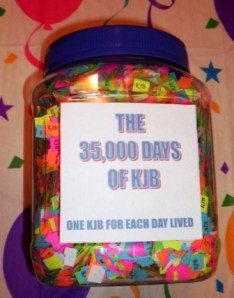
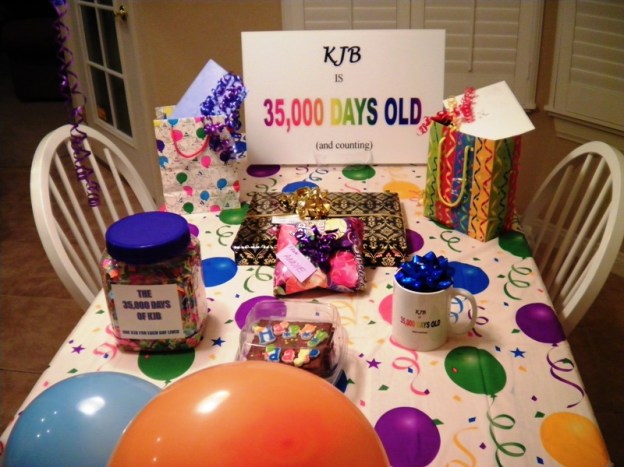
In a previous post, I talked what I could do to celebrate my father’s 35,000th day because truly, such an astonishing number should not go unacknowledged. I finally decided on 35,000 KJBs (his initials), one to represent each of his days. Took me twelve hours to cut them out, but it was worth it to see a visual representation of all those days.

S

Other gifts were 35,000 “I love you”s from my sister, and 35,000 sequins to add sparkle to the day from my brother. (I covet those sequins. They are all different shapes and sizes, such as butterflies, flowers, stars, and teardrops, and definitely should add plenty of sparkle to . . . whatever. Any suggestions?)

More than anything, I got a kick out of making a deal over the day. I mean, really . . . how many 35,000-day celebrations have you attended? I have a hunch this was the one and only such party.

party


If you’d like to know how many days old you are, you can calculate it here: Decimal Birthday.

***

Pat Bertram is the author of the suspense novels Light Bringer, More Deaths Than One, A Spark of Heavenly Fire, and Daughter Am I. Bertram is also the author of Grief: The Great Yearning, “an exquisite book, wrenching to read, and at the same time full of profound truths.” Connect with Pat on Google+

Living Each Day We Are Given

SI’m noticing a change in my attitude lately — more cynical perhaps, and at the same time more optimistic about the future. This change showed itself to me in my reaction to a news story that is going around about a couple who holds the record for the longest marriage — 86 years. The story purported to tell the secrets of how they stayed together for so long, and my first thought was, “Because one of them didn’t die.” No matter how much they love each other, no matter how well they get along, if one of them had died, that would have been the end of their being together.
Immediately following my cynical thought was a moment of horror at the idea of being stuck in the same sort of life for all those years. She married very young, so what did she know of life (or herself) before making her vows? And she’ll never have a chance of exploring what she could have been on her own. The universal reaction to the story seemed to be “Oh, how sweet,” so the horror I felt must not reflect their situation but my own changing attitude.

My soul mate and I always thought we would die together since our bond was so strong, and yet, here I am and he is not. The pain of our separation was almost more than I could bear at times, and in fact, sometimes the only way I could get through another minute of continued life was to scream my pain into the wind.

Now, as I pass through to the other side of grief, continuing to process all the various emotions, fears, regrets, guilts, I sense that a new life awaits me, a life of possibilities, maybe even adventure. I don’t know what form this life will take, whether it will entail geographical travels or spiritual travels, new activities or new perspectives, broadening my horizons or only broadening my mind. But a new life is surely coming, and sometimes my heart leaps ahead of me at the thought of such freedom.

I’m not yet at that place of freedom. I still have many concerns to deal with first. Since I am looking after my 96-year-old father, that is my prime concern, but there are also personal concerns such as my continued awareness of my mate’s death. I know he would be the first to applaud my coming adventures — he felt bad that the constraints of his illness and the life we were forced to live destroyed my spontaneity, but the truth is, he gave me the courage to be spontaneous in the first place. And now I’ll have to find the courage to be spontaneous on my own.

It’s a difficult line to walk — being glad of a chance at a different sort of life while at the same time not being glad of the death that will allow such a life, being glad of one more day of life while being aware that such a day was denied him. But I will find a way to handle it as I have handled every step of this grief journey.

Maybe the secret isn’t how to stay together, but how we live each day we are given, whether with someone or alone.

***

Pat Bertram is the author of the conspiracy novels Light Bringer, More Deaths Than One, A Spark of Heavenly Fire, and Daughter Am I. Bertram is also the author of Grief: The Great Yearning, “an exquisite book, wrenching to read, and at the same time full of profound truths.” Connect with Pat on Google+

Death and Dying: Good-bye Experiences

70During the past thirty-two months since the death of my life mate/soul mate, I have shared my grief, and in turn others have shared their grief with me, telling me stories they never told anyone else. I have heard incredible tales of signs and dreams and feelings of connection to the one who has left earthly life behind, which makes me realize that something is going on beneath the surface of earthly life, though I don’t know what.

Although I concede that near death experiences exist, I do not believe that NDEs are necessarily an encounter with those who are dead. We humans are so incredibly complex, that these experiences could be an as yet unknown state of consciousness, such as a dream state, or maybe even a dip into the collective consciousness. I’ve heard of too many people who saw the white light, saw their loved ones begin to draw near and then immediately recede as the nearly dead person returned to consciousness. It seems peculiar to me that the dead have nothing better to do than wait for someone to begin to die, to hurry and don their earthly bodies to rally round on the off chance that the person will die, and then shrug off their earthly personas and go back to doing whatever their disembodied selves were doing before being called to reception duty.

On the other hand, there have been an incredible number of instances of people saying good-bye before they left the earth for good.

Sometimes the good-byes were said while the people were still alive. I’ve heard many stories of perfectly healthy people who visited and called family and friends they hadn’t seen in a while, and then a few days later they had an accident or a heart attack and died. It was as if part of them knew they were going to leave this earth, and they were saying good-bye even though they didn’t consciously realize that is what they were doing.

Sometimes the good-byes were said after the people were dead. A boy’s grandmother stopped by to tell him that she would be okay and not to spend his life in sadness. A woman whose husband died in an accident never got a chance to say good-bye before the hospital removed his body, but that night, she felt a kiss on her cheek and his whispered words that it didn’t matter, that he’d already been dead when he reached the hospital. A woman who swam too far out into the ocean and was floundering in panic heard her mother tell her to relax, that she would be okay, and later found that her mother had died at that very moment. A woman who lost her husband had incredibly rich and coincidental experiences every Monday during the first six months after he died. She could even feel his anger, but now, eighteen months later, he is finally leaving her alone to find her own way.

And sometimes the messages come in dreams. One daughter planned to move in with her mother, and that night her father visited her in a dream and said he was glad, that her mother needed her. (The daughter told her mother to tell her father to stay out of her dreams.)

Even I had a good-bye experience. Two of them, actually.

For the last year of his life, my love and I argued about what I would do afterward. He thought I should go stay with my father where I would be safe and warm and fed, but I could not bear the thought of doing so. I’d just finished caring for one dying man, and I didn’t want to look after another. While he was in a coma during his last days, however, I finally decided to follow his wishes and come stay with my dad, and I told him so. Just a few hours later, he died.

At the moment of his death (or rather, when his breathing and his heart stopped), I did not feel anything except a moment of relief that his suffering was over. I watched the nurses clean his body and shroud it in a blanket, then I waited numbly for the funeral director. After she took away his body (in a black SUV, not a hearse), I left. The highway was dry, but about halfway home, my car suddenly went careening, around and around, back and forth, totally out of control. (I assumed I hit a patch of black ice, but that was such a peculiar night, I can’t say for sure.) I thought I was going to die, but oddly, I never left the road. The car finally came to a halt facing the wrong way on the highway. I was fine. So was the car. As I sat there gripping the wheel, I wondered if he had stopped by on his way out of this world to save me, to leave me a final reminder to be careful, or maybe give a shake of his ghostly head at this evidence of my carelessness. (He always worried that I wasn’t careful enough.) I remember feeling him leaving this earth — like a breath passing over head — but to be honest, I don’t know if I really felt his leaving at the time or if the impression was something my mind created later to explain the bewildering event. It was after this particular near death experience (as out of control as the car was, it truly is amazing that I survived intact), that the feeling of his goneness slammed into me, and I never again have had any sense of his presence in my life.

What was he doing for those hours before he left this earth? Finishing his dying, possibly. Closing down systems of the body and brain that have yet to be discovered. From grief, I have learned the power of our lizard brain, learned that there is way more to the brain — and human biology, psychology, and consciousness — than is in our textbooks.

So what does all this mean? I don’t know, and that’s the truth of it.

***

Pat Bertram is the author of the conspiracy novels Light Bringer, More Deaths Than One, A Spark of Heavenly Fire, and Daughter Am I. Bertram is also the author of Grief: The Great Yearning, “an exquisite book, wrenching to read, and at the same time full of profound truths.” Connect with Pat on Google+

UnSocial Networking

I’m starting to play rough with Facebook, unfriending people with the same abandon I once friended them — sort of reverse social networking. (Would this be called Unsocial Networking or Social UnNetworking?) Start with 5000 people at random, and then one by one, remove the annoying ones. You know the people I mean:


1. The authors who send you one message after another asking you to like their FB page, download their book, check out their website, read their blog. I’m not talking about notifications or the posts that show up in your feed, but repeated private messages. I now have a new policy: if you spam me once, I might let it go if I know you or if I’m in a good mood, but if you send the same spam message a second time, I will unfriend you. Friends don’t spam friends.

2. The rabid political lobbyists, those who are always lobbying for their party, their agendas, their preferred candidates, their right or left wing propaganda. These people aren’t interested in being friends. They want power, even if at one remove.

3. The uncompromising religious folk, those who never acknowledge that another person’s religious beliefs might be as sacred as their own. These people remind me of the folk in Emo Phillips joke. This joke was voted the best God joke ever, but was not credited to Emo Phillips, and truly, it’s such a classic, he needs to be acknowledged as the author. I don’t remember many comedians, but I do remember the delightfully waifish Emo telling this story:

Once I saw this guy on a bridge about to jump. I said, “Don’t do it!” He said, “Nobody loves me.” I said, “God loves you. Do you believe in God?”

He said, “Yes.” I said, “Are you a Christian or a Jew?” He said, “A Christian.” I said, “Me, too! Protestant or Catholic?” He said, “Protestant.” I said, “Me, too! What franchise?” He said, “Baptist.” I said, “Me, too! Northern Baptist or Southern Baptist?” He said, “Northern Baptist.” I said, “Me, too! Northern Conservative Baptist or Northern Liberal Baptist?”

He said, “Northern Conservative Baptist.” I said, “Me, too! Northern Conservative Baptist Great Lakes Region, or Northern Conservative Baptist Eastern Region?” He said, “Northern Conservative Baptist Great Lakes Region.” I said, “Me, too!”

Northern Conservative†Baptist Great Lakes Region Council of 1879, or Northern Conservative Baptist Great Lakes Region Council of 1912?” He said, “Northern Conservative Baptist Great Lakes Region Council of 1912.” I said, “Die, heretic!” And I pushed him over.

I’m now down to about 1650 friends on Facebook, and who knows, at the rate I’m pushing people off the bridge, I might end up with only one or two hundred connections, but those will be real friends — people I enjoy following, whose blogs I read, and whose opinions I respect. And never, ever, do they spam me or lobby me or disrespect my beliefs or unbeliefs.

***

Pat Bertram is the author of the conspiracy novels Light Bringer, More Deaths Than One, A Spark of Heavenly Fire, and Daughter Am I. Bertram is also the author of Grief: The Great Yearning, “an exquisite book, wrenching to read, and at the same time full of profound truths.” Connect with Pat on Google+

Thirty-Two Months of Grief

I haven’t been writing much about grief lately. It’s been thirty-two months — 977 days — since my life mate/soul mate died. In that time, many others have suffered grievous losses, and to continue mentioning my grief seems like all I’m doing is whining. Still, this is my loss, and what other people experience, no matter how horrific, doesn’t lessen my sorrow. I don’t have the same sort of raw pain that I did at the beginning, of course, nor do I have the gut-wrenching angst that so often bedeviled me during those first months, but I do experience bouts of sadness and yearning.

My emotions are on a slow Ferris wheel ride, usually sliding down into sadness on Saturdays, the day he died — a day that apparently is etched in my very psyche — and then a gradual climb to hope and possibility on Monday and Tuesday.

Even when Saturday’s sorrow is fleeting, as it often is now, I find that I am at my most vulnerable then, and any hurtful word, thoughtlessness, or setback can send me spiraling down into grief. Without him to talk to, without my being able to casually mention the slights and so slough them off, the unkindnesses take hold and remind me that I am alone. Which reminds me that he is dead. Which makes me grieve.

I can handle being alone. I can even handle his being out of my life. What I can’t handle is his being dead. It’s possible he still exists somewhere, perhaps lolling on the shores of some cosmic sea, a cat purring in his arms, but I have no way of knowing for sure. All I know is that he is out of this earthly life. Gone. Deleted. I still cannot wrap my mind around that. And I still can’t help feeling that he was cheated out of a couple of decades of life.

Sometimes I pretend to believe that he left so that I could experience life in a way we couldn’t experience together, but other times, especially on the day of the month that he died — such as today — I find it impossible to pretend that this new experience of life alone is a positive thing. And even if it is for the best, it comes at the cost of his life, and that is too big of a price to pay.

If I sound discouraged today, the truth is, I am dis-courage-d. Have lost my courage. Sometimes I am strong and forward looking, but on this 977th day of his goneness, I am unable to gather the courage to believe that any good will come from his being dead and my being alone. I’d give anything to see him one more time, to have him smile at me or say an encouraging word, but no matter how much I yearn for such an encounter, it’s not going to happen in this lifetime.

I am used to the ups and downs now, so I know all I have to do is hang on, and in a day or two, when I am less tired perhaps, I’ll find my courage again. And some day I might even come to believe that this new experience of life alone truly is a positive thing.

***

Pat Bertram is the author of the conspiracy novels Light Bringer, More Deaths Than One, A Spark of Heavenly Fire, and Daughter Am I. Bertram is also the author of Grief: The Great Yearning, “an exquisite book, wrenching to read, and at the same time full of profound truths.” Connect with Pat on Google+

If People Are the Same, Why is the World Different?

This world of the early twenty-first century seems completely different from the world of fifty years ago, and for some reason yesterday, that struck me as odd. Except for the accoutrements of our lives, such as computers and clothes, why would things be different? Most people want the same things now as they wanted then — a safe world for their children to grow up in, a degree of comfort and security and happiness, a chance to succeed either in their chosen career or in their daily lives, freedom to live the best way they know how. So why is life today so different from what it used to be?

Admittedly, those were not the halcyon days people remember them as being. There was strong prejudice in certain areas in the United States, though not all people or neighborhoods or cities participated in the prejudice against blacks, woman, gays. There did seem to be restrictions against what women could accomplish, though women who wanted to accomplish big things often managed to succeed anyway. But most women thought they had it good, staying at home, taking care of their husbands and children. Is it any better today when women are forced by circumstances or custom to work?

People are still basically the same, yet now married couples seem to be unable to find a way to stay together. Back then, divorce was rare, and now it is all too common. The number of single parent homes are increasing. Children are being shuffled between parents. Some children have too few parents, and some have too many. You’d think that with the fluidity of life today that people would be more accepting of each other, but our society is still pigeonholing both men and women, forcing them into roles they might not want. We seem to always be categorizing people, foisting labels on them, making them conform to fashionable ideas and attitudes. And we seem to be even more polarized now than ever before, whether religion or politics, with less tolerance for opposing points of view.

Looking back on those long ago days of the mid-twentieth century, it seems a completely different world. Children played in the streets, walked to and from school, rode their bikes to distant neighborhoods, ran errands for their mothers, walked to the park for pick-up games. Were things safer then? Or was it simply that people were not bombarded with images of peril on TV and the internet and so did not know how unsafe they were? No matter how graphic newspaper stories and photos were, no matter how detailed radio news became, they were still static words and images, without the horror that today is thrust into our lives in full color, making us fearful for our safety.

If things were safer then, and it isn’t an illusion of nostalgia, then why were things safer? As I mentioned, people want now what they wanted then. Is it simply that there are more people in the world? Is it that the neighborhood schools have been consolidated into district schools so that the neighborhood is no longer a separate entity? Is it that we move more frequently now so we ever gets to know our neighbors? Are we less trusting, perhaps, and if so, why? Does it make a difference that someone isn’t waiting at home when kids get home from school? Or maybe it’s that no one is home during the day and so whole neighborhoods are deserted, giving us a feeling of being ungrounded? Is it that two salaries or two jobs are necessary to maintain the same level of comfort that one mediocre salary could handle back then? If so, why is that? Is it simply inflation (or perhaps a conspiracy to kill the middle class as some people believe) or is it that more things are necessary now, that a comfortable life today needs more equipment than a comfortable life fifty years ago?

There used to be one car per family, one television, one telephone. (Some families had two of each, of course, but most only had one.) Now each person in each family seems to have their own mode of transportation, their own television, their own telephone, their own computer. Games were simple back then, too — a bat and ball, board games, jigsaw puzzles — and you needed someone to play with. Now expensive game consoles take the place of neighborhood companions.  After school activities seem more structured now, though family life seems less structured — families eating meals together at a set time used to be the norm and now is a special occasion. But then, families themselves are different.

I don’t know if any of this is important or if it means anything. Whatever once was no longer exists, and we can only live in the world of today, but it does seem strange to me that despite people’s goals remaining the same, the world has changed so much.

***

Pat Bertram is the author of the conspiracy novels Light Bringer, More Deaths Than One, A Spark of Heavenly Fire, and Daughter Am I. Bertram is also the author of Grief: The Great Yearning, “an exquisite book, wrenching to read, and at the same time full of profound truths.” Connect with Pat on Google+

Giving Thanks for Words

Every day I find something to be grateful for, even if it’s only that the sun is shining,  that I once had a great love, that I have open spaces to explore (both in my head and in the world). Even when all else seemed bleak these past thirty-one months since the death of my life mate/soul mate, even when I had no hope, there was always something to be grateful for (most often that he was no longer suffering), so I don’t need to set aside a special day of thanksgiving.

Still, during this season of giving thanks, there is something I am especially grateful for, something worth celebrating . . . words.

Words convey thoughts, ideas, hopes from one person to another. They connect us from continent to continent, enabling us to bond with like-minded people all around the world. I have exchanged words — and friendship — with people from New Zealand, Australia, Canada, the Nederlands, India. And for this I am grateful.

Words allow us to read and to write, to find entertainment and enlightenment in worlds created out of nothing but letters strung together. Words allow a story, concocted in one mind, to come to full realization in another. For most of my life, these worlds of words have been my life, or at least a major part of it. Now that I too am a world-creator, I am grateful for the words with which I build my stories.

Words give comfort, especially when distance (either geographic or emotional) does not allow a touch of commiseration. I am especially grateful for all the words of encouragement you (the readers of this blog) have given me during my time of grief, words that touched me. I hope some of my words touched you.

Words mean hope. With words, there is always the hope that we will be able to come to an understanding of each other, and perhaps find peace. (Of course, people would have to shut up long enough to listen to each other’s words; one-way words cause conflict and confusion.)

Words mean community and continuity. Words, both spoken and written, presuppose that there is someone to listen, and that is community. Telling our his-stories and her-stories to each other creates both community and continuity. They tell us who we were, who we are, and who we hope to become.

If there were no one to hear our words, if we existed solely in ourselves, we’d still need words to communicate our feelings and ideas to ourselves. This ability to put our thoughts into words gives us the power to know ourselves and to understand greater truths.

So this week, whether you celebrate the U.S. Thanksgiving or not, stop for a moment to give thanks for words. They are we.

***

Pat Bertram is the author of the conspiracy novels Light Bringer, More Deaths Than One, A Spark of Heavenly Fire, and Daughter Am I. Bertram is also the author of Grief: The Great Yearning, “an exquisite book, wrenching to read, and at the same time full of profound truths.” Connect with Pat on Google+

A Romance with Books

I watched the 1987 movie 84 Charing Cross Road yesterday, and it struck me as particularly poignant considering the current state of the book business. Some people call this movie a romance, though basically, the relationship between Helene Hanff and Frank Doel is little more than a business relationship. The true romance is Helene’s love of books — not just the content of the books, but the volumes themselves.

With the advent of Kindles, Nooks, Palm Pilots, IPads and other reading devices, bound books seem to be valued less and less. Ebook readers sneer at those who profess to love the smell of the book and the feel of the pages, but the truth is, there is a mystique about a printed volume. It exists as a thing separate from its words. You can hold the tome in your hands, riffle the pages, sample a word here and there. There is a tactile connection between reader and story, linking the two parties in a very physical way.

You love your ereader. I get that. I understand you love the ease of being able to cart around an entire library of downloaded stories and novels for a minimal cost. I understand that ereaders, with their ability to zoom in (or do I mean out?) and make the words larger for those with vision problems allow people to keep reading long after their eyes have given up on them. I also understand that such reading devices are the wave of the future.

But . . . here’s my dirty little secret. (Not much in the way of dirty little secrets, I admit, but it’s the only one I have.) I don’t own an ereading device, and I have no intention of getting one until I am forced to. For me, reading has always been a Zen-like experience where I become the book. Not the story. The book. My eyes would be focused on the page. One hand would be grasping the book while the other turned the page, quite mindlessly, I might add. The book might be resting on sternum or stomach, depending on my position. And the story osmosed through my body and into my soul without referencing the words.

For most of my life, I was a constant reader. That’s all I wanted to do, so for several years I did temp work to give myself maximum amount of time to read. To feed my habit, I would take out stacks of books from the library and buy bagfuls of new and used books. Often, I would pass the purchased books on to my mother. One time, I included Oh, God in a stack of books I gave her, and the language appalled her. I shrugged it off, saying I didn’t notice. That really upset her. “I don’t know which is worse,” she said, “that you would be so blasé as not to be bothered by the words, or so naïve as to not know what they mean.”

I tried to explain to her that I didn’t read words, but that upset her even more. I suppose it does sound weird, but it’s the truth. At least, it used to be. As I got older and my eyes weaker, the osmosis didn’t work as well, and I had to start reading words. I did not like that at all! Oddly, my eyesight has changed, and I now have perfect vision about nine inches from my eyes, (though I can’t see beyond that) so I can do the Zen reading thing again, but since I have a hard time finding non-trivial stories to osmose with, I don’t read much any more. (I used to feel guilty at having “wasted” my life reading, but now I’m glad I did.)

Anyway, the point is that while some people love their reading devices, others don’t seem to find the relationship rewarding, and I bet Helene Hanff would have been such a one. All those books she ordered from 84 Charing Cross Road are probably now available free from Google books (because really, who among us except die-hard literature students like Helene would pay to read the unabridged prose of John Dunne), but reading the books on a Kindle wouldn’t be the same for her as reading a leather-bound book with gilt edging. And, although my reading tastes are much more plebian than hers, reading on a device wouldn’t be the same for me, either. I don’t see myself having a Zen-like experience with a Nook or a Kindle.

The lesson of this movie is that it’s important to do things when you can, because one day it will be too late. Helen supposedly carried on a great friendship with Frank — or at least with the bookstore where he worked — but she never once called him, never once sprung for a ticket to London until after the store closed for good. (I’m not giving away any spoilers — the movie begins with her visiting the empty store.) And so it was with me and my romance with books. If I hadn’t wasted my youth reading but waited until now to carry on my romance with books, the romance would have been over before it had even begun.

***

Pat Bertram is the author of the conspiracy novels Light Bringer, More Deaths Than One, A Spark of Heavenly Fire, and Daughter Am I. Bertram is also the author of Grief: The Great Yearning, “an exquisite book, wrenching to read, and at the same time full of profound truths.” Connect with Pat on Google+

35,000 Days and Counting

Just by chance I discovered that in a couple of weeks my father will be 35,000 days old. Such an astonishing number of days should not go unacknowledged, so I’ve been trying to figure out various ways of illustrating that vast number of days.

I thought of giving him a jar of 35,000 bits of confetti in recognition of his days, but confetti comes in ounce packages, and I am not about to count out 35,000 pieces of anything. Can you imagine counting out 34,895 and then losing your place? Admittedly, I could count what was in one package and extrapolate from that how many packages I’d need, but still, there are a lot of pieces in those bags, and anyway, confetti has no significance to his life.

Perhaps give him 35,000 pennies? But 35,000 pennies would be 700 rolls, cost $350.00, and would weigh 210 pounds.

Perhaps licorice jelly beans? Considering that there are approximately 400 Jelly Belly jelly beans in a pound, I would need almost 88 pounds and at 8 dollars per pound, they would cost $704. Freight, however, would be free.

Perhaps personalized M&Ms? But 35,000 of them would cost more than $1,725, excluding freight. And anyway, they would just go to waste. He hates M&Ms.

He does like Snickers bars, so I considered sending him 35,000 calories of the candy, but that would be 125 bars. Since he’s almost 96 years old, it would take him the rest of his life to eat that many candy bars, and they would get stale long before then.

Perhaps 35 1000-piece jigsaw puzzles? But his fingers don’t work that well to manipulate those pieces, his eyesight is bad, and he never liked doing jigsaw puzzles. (Now, if my mother were still alive, I could get them for him and let her work them.)

In the end, I decided to print and cut out 35,000 copies of his initials, each one representing a day on this earth. Will take me about 12 hours to cut all of those bits of paper, but what the heck. It’s a wonderfully symbolic gesture.

I’ll also decorate the house, or at least his breakfast nook, to surprise him. (I haven’t mentioned the 35,000 days date to him, and if any of my siblings ruin the surprise, I will never forgive them.)

***

Pat Bertram is the author of the conspiracy novels Light Bringer, More Deaths Than One, A Spark of Heavenly Fire, and Daughter Am I. Bertram is also the author of Grief: The Great Yearning, “an exquisite book, wrenching to read, and at the same time full of profound truths.” Connect with Pat on Google+

Is it Your Business What Others Think of You?

Occasionally I see a saying that seems to bring a moment of enlightenment, but the more I see it, the murkier its truth becomes. And so it is with this little gem: What others think of you is none of your business.

To a certain extent, the saying is true. You can’t live your live trying to figure out what others think of you and then work your life around their opinions. You have to consider what you think of you and live your life accordingly. This also works in reverse — what you think of someone is none of their business. So often, we feel the need to tell others what we think of them — simply to help them, of course — but if what we think of them is none of their business, we might as well keep our opinions to ourselves. (And perhaps save a friendship in the process.)

But . . . (by now, I’m sure you’ve read enough of my blog to know there is always a but somewhere in my posts.)

What a child thinks of his parents is often a key to his emotional health, so what the child thinks of his parents is definitely the parents’ business. If the child is overly attached to his parents or is angry at them for no apparent reason, the child could be having emotional problems. On the other hand, if the child is embarrassed by his parents (beyond normal bounds) or if the child finds it hard to be around them for some reason, maybe the parents are the ones with the problem.

If you are in a romantic relationship, a marriage, or some other long-term coupling, what your loved one thinks of you is definitely your business. If you think yours is a love match and the other thinks it’s a lust match, you need to know that so you can make informed decisions about your future. If your husband no longer loves you and has developed a roving eye, you certainly need to know how he feels about you so you take appropriate actions, such as getting couple’s therapy. (Unless, of course, you prefer not knowing.) If you’re in a relationship and are ready “for the next level” (whatever that is), and your partner in the relationship wants only your money, you need to know the truth before things go to far.

And of course, if your neighbor hates you enough to want to kill you, that most certainly is your business.

There must be many other examples where this particular saying doesn’t pertain, but you get the point: sometimes a clever message is simply clever and not a great truth.

***

Pat Bertram is the author of the conspiracy novels Light Bringer, More Deaths Than One, A Spark of Heavenly Fire, and Daughter Am I. Bertram is also the author of Grief: The Great Yearning, “an exquisite book, wrenching to read, and at the same time full of profound truths.” Connect with Pat on Google+