Countdown to One Hundred and One Adventures

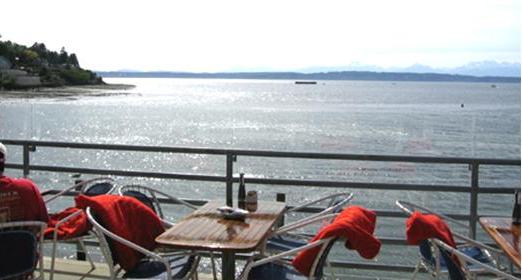
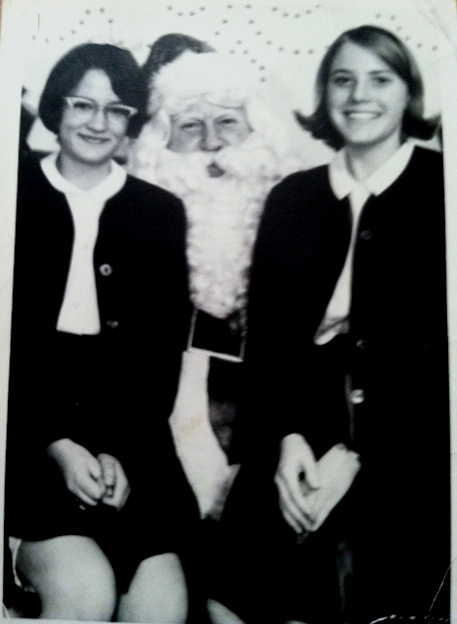
I’m on the left side of the photo

Things are settling down in my life and revving up all at once. My father finally was able to start his breathing treatments and now is more alert, has a bit more energy, and shows more interest in food, so we’re settling back into our quiet life without alarums and excursions. (Hospital excursions, that is.)

My headlong rush into life slowed this past year — I didn’t really do much to embrace life except yoga lessons for a while and walks in the desert. In an effort to revitalize my life, I promised myself to seek one hundred and one adventures, but the promise didn’t give me the push I expected because life got in the way of my embracing life. (I guess, though, as long as I am present even in the unsettling times, I am embracing life, which is an adventure in itself.)

But now I’m on track, at least for this month, with two great adventures planned. Tomorrow night or Thursday morning, depending on when she gets here, I will be meeting my best friend from high school for the first time in decades. The whirlwinds of life flung us in different directions, but now those same winds are bringing us back together. I doubt I will recognize her, but voices seem to be the last things to change, so I should at last recognize the sound of her voice. (Now that I think about it, it seems odd that we’ve only emailed sporadically this past year and never once talked on the phone, so I have an only an assumption that she still sounds the same.) After all this time, will we have anything to say to each other? Will we like each other, or will we take each other in aversion? It should be interesting to find out. (Besides . . . of course she’ll like me. What’s not to like, right?)

Then at the end of the month, I’m heading to Seattle for a gala weekend. My sister and brother-in-law are treating me to a showing of Shen Yun. 5,000 years of Chinese music and dancing, limousines, champagne, a wonderful dinner. Sounds like an adventure fit for Cinderella.

Even if rags and an out of season pumpkin are all that await me at the end of the Seattle trip, well, there is still a matter of the other 99 adventures I promised myself. I wonder what I will do next?

***

Pat Bertram is the author of the suspense novels Light Bringer, More Deaths Than One, A Spark of Heavenly Fire, and Daughter Am I. Bertram is also the author of Grief: The Great Yearning, “an exquisite book, wrenching to read, and at the same time full of profound truths.” Connect with Pat on Google+

Making End of Life Decisions

Some of the hardest decisions to make when taking care of a person who is nearing the end of life are not dire life/death decisions, such as taking him off a respirator, but simple decisions that continue to haunt you long after the person is gone.

The hardest decision I had to make when it came to the end days of my life mate/soul mate was whether to take him to the hospice care center. The nurse suggested the move to give me time to rest (he had what is called “terminal restlessness” and kept getting out of bed; considering how unsteady he was on his feet, I had to get up with him.) He wasn’t ready to go, wasn’t ready to face the ending of his life, and yet knowing the truth of the matter — that he wouldn’t be coming home again — he still agreed to go. I, on the other hand, believed the nurse when she said he would be away just a few days to give me time to rest, but still, I felt horrible about agreeing to take him. Afterward, that decision haunted me. I wished I’d let him stay home one more day, especially since I didn’t sleep anyway.

The decision I face now in taking care of my father is even less dire, but infinitely more complicated. Until about a week ago, my father still answered the phone, eager to talk to anyone who called, but now we’ve unplugged the phone in his room because he doesn’t like to be awakened.

He spends most of his time sleeping, getting up a few times a day to eat something — an egg or a bit of jello or a few canned peach slices. He is willing to talk to his children during those times, so that’s not a problem, but he doesn’t want to see anyone. He is very fragile, and so I have been honoring his wishes. However, some of my siblings want to make sure they see him one last time, and this is where the decision lies.

When is the cut-off point where his wishes become secondary and the wishes of his children come first? When it’s close to the end, I suppose, and I don’t think he’s there quite yet. Although he doesn’t eat much and has developed an aversion to most of his favorite foods, he does still have an interest in eating, which is a good sign. He’s also alert when he’s awake, so he hasn’t quite begun removing himself from life. (He has no interest in reading the newspaper anymore, but I don’t consider the newspaper “life”.)

I hope I’m doing the right thing by continuing to honor my father’s wishes, and that the decision to do so won’t come back to haunt me. I hope, if I make the wrong decision (or make a wrong assessment about how much time my father has left), my siblings will forgive me.

***

Pat Bertram is the author of the suspense novels Light Bringer, More Deaths Than One, A Spark of Heavenly Fire, and Daughter Am I. Bertram is also the author of Grief: The Great Yearning, “an exquisite book, wrenching to read, and at the same time full of profound truths.” Connect with Pat on Google+

A Sweet Tale or a Horror Story?

breadOn Valentine’s Day, a Facebook friend posted an anecdote that I can’t get out of my mind: A man made his wife toast on their anniversary, and she got upset. “For 50 years,” she said, “you have given me the end pieces and I am sick of it. I hate the end piece!” The man was stunned by her outburst and quietly responded, “But that is my favorite piece.”

Everyone who commented on the anecdote thought it was a sweet story, but all I could see was the horror of fifty years of misunderstanding. In fifty years, she never once told him she hated the end piece? Never once, when she got upset at him for some other hurt, did she bring up the matter of the toast? Never once did he bother to find out what she liked? Never once did he watch her make toast and see that she didn’t fix the end piece for herself?

This anecdote does not portray a loving relationship. She is long-suffering and uncommunicative, unable to find a way to express her wants until the frustration overwhelms her and she bursts out in anger. It’s even possible the problem isn’t the end piece at all — if the only thing he does for their anniversary is make her toast, then maybe she is upset at the lack of flowers or gifts or a meal in a nice restaurant, and mentioning the toast was simply a way of letting him know she wasn’t happy. He, on the other hand, is self-absorbed and arrogant, assuming that just because he likes something, so does she. He also seems smug in his belief that by giving her his favorite piece he is doing something loving, when in fact he is disregarding her by not considering her wishes.

Somewhere along the line, every new couple runs into such a situation, where one repeatedly does something the other doesn’t like, and so they compare notes about likes and dislikes and the expectations each has of the other. Something as simple as toast preferences should have been mentioned long before it became an emotional issue. If a couple can’t find a way around this sort of misunderstanding in the first few years of being together, then their problems run much deeper than who likes what piece of toast.

Love is seeing the truth of each other. Love is witnessing each other’s lives. Love is being present to each other. If after fifty years he did not know what she wanted, it shows how little he saw of her. If after fifty years, she did not know why he gave her the end piece, it shows how little she saw of him. It seems like a cold relationship at best.

On the other hand, loving or not, apparently they deserve each other, and maybe that’s what kept them together all those years.

This anecdote illustrates one other thing — the value of showing rather than telling. If this anecdote were developed into a scene as part of a story, it would be a great way of showing the problems of the couple’s relationship rather than simply saying that they misunderstood each other. Or it could be an example of how much he loved her, as the anecdote was meant to be. That’s the beauty of showing — the writer merely presents the story. Readers interpret it through their own experiences, deciding whether it is a horror story or a sweet tale, and hence make the story their own.

***

Pat Bertram is the author of the suspense novels Light Bringer, More Deaths Than One, A Spark of Heavenly Fire, and Daughter Am I. Bertram is also the author of Grief: The Great Yearning, “an exquisite book, wrenching to read, and at the same time full of profound truths.” Connect with Pat on Google+

A Palliative for the Brokenhearted

warriorThree years ago, a yoga teacher and fitness instructor living in Holland got tired of the cold, and so her husband put in a transfer to a warmer climate.

Three years ago, I was living a thousand miles away from the high desert in another state, watching my life mate/soul mate die.

Six months ago, that teacher’s life and mine crossed paths. A friend asked me to accompany her to an introductory therapy yoga class (a class geared toward each person’s abilities and disabilites), and there I met the woman from Holland, who was teaching the class. (She wasn’t from Holland originally. She was actually from California, but she’d living all over the world for the past two decades.)

At that yoga class, I began to come alive. Grief pulls you into yourself, huddling you against the pain, and the thrust of her classes was to open us up to the universe, to new experiences, and to ourselves. My friend dropped out after those introductory classes, but I was hooked. Coincidentally, all the women who remained in the class were in various stages of recovering from the deaths of their husbands, and we formed a bond with each other and with our globetrotting teacher. It was a rare and magical experience, the electric highlight of my week, but magic has a way of dissipating. The teacher was offered a wonderful job in another city that used all of her skills (and paid her a phenomenal amount of money), and she couldn’t turn it down.

Although I felt devastated when she made her announcement, I am trying to consider the ending of the class as a graduation. When a student is ready, a teacher appears, or so it said, and in my case it was true. So perhaps it is also true that when the student is ready, the teacher disappears. Perhaps I have learned from her what I need to know to continue on to the next stage of my life.

But this is all prelude to what I really want to talk about. Whenever I have mentioned how distressed I was at the loss of this class, the response has universally been, “Find another yoga class.” Ummm. Yeah. Find another confluence of people and events that come together from thousands of miles away to create a magical, electric, and life-affirming moment. Sure, I’ll get right on it.

This seems to be the response for every loss. Get a new class, a new life, a new soul mate. Is it really that easy for people to do? Or is it simply that it’s easy to say, a palliative for the brokenhearted?

I realize that soon I will need to find a new life, but as I’ve mentioned in a previous post, it’s not as if I can go to the mall and search the aisles at Lifes ‘R’ Us until I find a new life that fits properly and looks good. I’ve never really wanted anything or anyone, but out of the blue, my life mate/soul mate dropped into my life, bringing (for a while anyway) radiance and excitement, and then later companionship, but now that he’s out of my life, I’m back to not wanting anything. If I did want something, I’d go after it, but I don’t want what is out there to get. (Or maybe I mean I don’t want what I know is out there to get. For example, I’d never considered doing yoga, had no interest in it whatsoever, and yet out of the blue, the yoga teacher dropped into my life.)

Mostly I’m taking the need for a new life in stride. Whatever happens, happens. Wherever I go, there I go. It doesn’t seem to really matter — something will drop into my life or it won’t. Either way, I’ll deal with it.

The only thing I know (or rather, suspect) is that I will not remain here in the high desert. Because of the yoga teacher and her class, for the first time I’d been contemplating staying in the area so I could continue taking instruction from her, and her getting a new job seems to be a clear sign that my future doesn’t lie here. But then again, I don’t really believe in signs . . .

***

Pat Bertram is the author of the suspense novels Light Bringer, More Deaths Than One, A Spark of Heavenly Fire, and Daughter Am I. Bertram is also the author of Grief: The Great Yearning, “an exquisite book, wrenching to read, and at the same time full of profound truths.” Connect with Pat on Google+

Finding a New Life that Fits Properly and Looks Good

dancingIn a conversation with a friend about my father, who is still going strong at 96, I said, “I take after my mother, which is good because there is no way I want to live to such an advanced age, particularly since I won’t have a widowed daughter to come stay with me. It’s kind of spooky thinking of having to grow old alone.”

She said, “You never know what will happen. Maybe a new love will drop into your life. I can imagine you at some writer’s festival and a distinguished stud with salt and pepper hair and a sweet smile flirts with you. He asks for your number and the next thing the rest of us know, Pat’s out dancing and dining every Saturday night and she’s suddenly submitting romance novels for publication…”

I laughed. “I love the ‘sweet smile’ part. Who knows, with or without a stud, I might go out dancing every Saturday night. I desperately need a new life.”

She responded, “I think you need a new life too. I’m afraid you’re just wilting away. So — how do you get a new life? What do you want your new life to be?”

And that’s where the conversation stalled. How do you get a new life? It’s not as if you can go to the mall and search the aisles at Lifes ‘R’ Us until you find a new life that fits properly and looks good. (Though that does sound like an interesting concept.)

What-we-can-become is dependent on whether what-we-are is an integral part of our genetics, keeping us always “us,” or if we are infinitely mutable and can become whatever we wish to be despite our inborn proclivities. In other words, can we really get a new life or are we always “us”?

For me to go out dancing every Saturday night, I’d need a personality transplant. I’ve always been drawn to quiet activities, such as dinner and conversation that dances from one topic to another. If somehow I did overcome my natural inclination for such sedentary pursuits, where would I go dancing? I’m too old for nightclubs and too young for senior citizens groups.

Still, I will need a new life of some sort. My father will not live forever, and I will need to decide where to go and what to do. And the truth is, I haven’t a clue.

Current research by Harvard psychologist Daniel Gilbert shows that while we can see how much we have changed in the past, we never think we will change in future. (Hence that ill-advised tattoo you got when you were young and now wonder what you were thinking.) But this isn’t always true. I know how much I have changed in the past. I have a photo of me as a baby, and I can see the vast changes between me and that poor befuddled creature. I can also see how different I am today from what I was four years ago when I watched my life mate/soul mate’s slow descent into death, and I can see how different I am from what I was almost three years ago when grief catapulted me out of that shared life into a new one. I can extrapolate from those experiences of change that I will also drastically change in the future.

I always feel the same, of course. — just me. (There must be some sort of mechanism, like an internal gyroscope, that keeps us “us” no matter how we change.)

The point is that I cannot figure out now what I want my life to be when I am free to pursue that life because I don’t know who or what I will be at the time. Maybe by then, I’ll miraculously have developed grace and style, and will have become a dancing queen. Or not.

***

Pat Bertram is the author of the suspense novels Light Bringer, More Deaths Than One, A Spark of Heavenly Fire, and Daughter Am I. Bertram is also the author of Grief: The Great Yearning, “an exquisite book, wrenching to read, and at the same time full of profound truths.” Connect with Pat on Google+

More Incendiary Photos

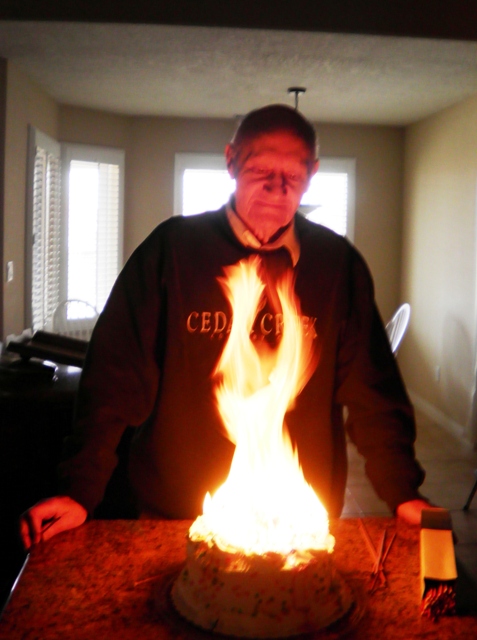
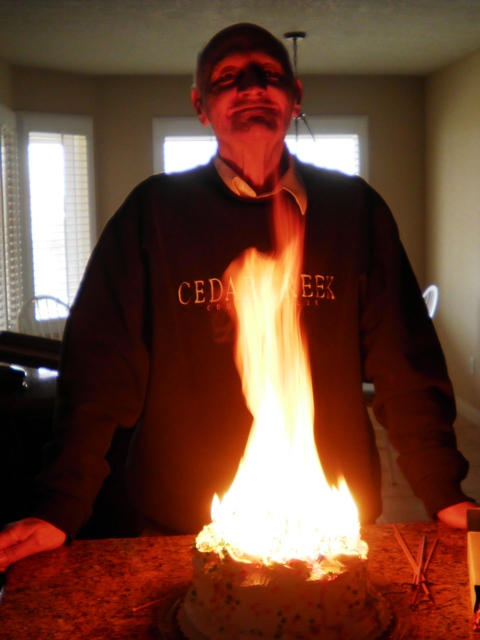
Yesterday I posted a couple of photos from my father’s ninety-sixth birthday party, and here are a couple more where he looks very wizardly. (The second one is actually the unretouched photo I posted for the benefit of Rami Ungar, whom I sure you know through his comments on this blog.)

In retrospect, perhaps lighting 96 candles wasn’t the smartest thing to do. One brother who didn’t make it to the party emailed me and asked if everyone behaved. I responded, “You mean except for the part where we lit 96 candles?” He replied, “No EMTs were called, so that doesn’t count.”

What does count, though is that it was an adventure. My life is too staid and going nowhere fast, so I decided to go in pursuit of 101 adventures. Until the candle incident, the number of adventures I’ve had so far this year is zilch. Zero. Nada. So, now I have only 100 more to go. (The resolve for 101 adventures wasn’t really a New Year’s resolution, though the resolution was made on New Year’s Day, because there is no way I can fit that many adventures into a single year and still look after my father.

***

Pat Bertram is the author of the suspense novels Light Bringer, More Deaths Than One, A Spark of Heavenly Fire, and Daughter Am I. Bertram is also the author of Grief: The Great Yearning, “an exquisite book, wrenching to read, and at the same time full of profound truths.” Connect with Pat on Google+

Who Wants to Live to Be Ninety-Six?

I don’t want to live to be ninety-six, and chances are you don’t either, so who wants to live to be ninety-six? Ninety-five year olds, that’s who!

Today is my father’s ninety-sixth birthday. He’s one of the lucky ones. He is still living in his own house with a daughter (me) helping keep him independent.

We get along well for the most part, but he doesn’t understand my sense of humor. He asked me the other day if it was normal for someone his age to sleep so much. I said, “I don’t know. Most people your age are dead.” In the long drawn-out explanation that followed (I meant only that most people don’t live to such an advanced age), any vestige of humor was lost.

A couple of my brothers will be stopping by for a small party. There will even be cake, but without the candles. Can you imagine the heat generated by 96 candles? Or how long it would take to light them? Besides, blowing them all out would probably kill my father and bring the festivities to an end. And anyway, that whole tradition of having someone blow on a cake before you eat it is unsanitary at best.

In case you’re wondering, 96 years is 35065 days.


***

Pat Bertram is the author of the suspense novels Light Bringer, More Deaths Than One, A Spark of Heavenly Fire, and Daughter Am I. Bertram is also the author of Grief: The Great Yearning, “an exquisite book, wrenching to read, and at the same time full of profound truths.” Connect with Pat on Google+

My New New Year

desert knolls2013  began with tears. I’m still not sure why, though it probably has to do with a deeper acceptance of my life mate/soul mate’s goneness coupled with the slide toward the third anniversary of his death. You’d think with such a sad beginning to the year that things would ony get better, but my life went downhill from there until I felt as if I were drowning in sadness. So, in an effort to change my outlook, I decided to start the year over.

Last night at midnight, I toasted in my new new year. It seemed such a silly thing to do, yet almost profound at the same time, that it made me smile. I have to admit, I did mist up briefly a little later when I put his photos away. Sometimes seeing them bring me comfort, but sometimes they only serve to remind me of what I have lost, and there is no place for the past in this new new year of mine. (At least not yet. I’m sure there will come a point when I need the small bit of comfort those photos can bring and will set them out again.)

I have to focus on what is, and what “is” is me alone. It’s hard to carry on any kind of relationship with someone who is dead. He doesn’t respond when I talk, doesn’t offer comfort when I need it, doesn’t hug me or smile at me. Not a very fulfilling relationship!

I’m not being entirely facetious, just trying to face the truth.

I’ve read that people who manage to have a relationship with their deceased loved ones are happier than those who shut out any memory of those who are gone, but still, it’s a one-sided relationship. And, to be honest, for me it’s better that way. Since I have to find my own path through the rest of my days, I’d just as soon not have a ghost hanging around, hampering whatever fulfillment I might find. (Hmmm. Is there a story in that?)

I started my new new year in an effort to gain a new focus (or do I mean a new new focus?) And so far, this new new year is going great. Not only can I still feel the effects of that midnight smile, but the weather is gorgeous — blue skies, warm air, the faintest of breezes — which was perfect for my long walk in the desert.  Even better, I can feel a slight shift in my outlook, a turning away from the way I wish things were to the way things are and maybe even to the way things are meant to be.

I’m hoping I can continue this new new year the way it has begun, but if I begin drowning in sorrow again, I’ll just start over with a new new new year.

***

Pat Bertram is the author of the suspense novels Light Bringer, More Deaths Than One, A Spark of Heavenly Fire, and Daughter Am I. Bertram is also the author of Grief: The Great Yearning, “an exquisite book, wrenching to read, and at the same time full of profound truths.” Connect with Pat on Google+

Reality and Truth, Fantasy and Lies

untitledvYesterday I proposed the idea that online we are who we say we are, that the truth of us comes out in our writings and postings. This topic is interesting to me because of something else I’ve been thinking about — reality and truth, fantasy and lies. I’ve always wanted to know what is real, but what if nothing really is? Then isn’t fantasy the same as truth?

So many of us still love men or women who are dead. For all practical purposes — since they are not here on Earth and do not respond to our attempts at having a relationship or even just a simple conversation — what is the difference between that and someone creating a fantasy lover for oneself? Or a reader getting immersed in the fantasy of a romance novel? Or a writer falling in love with her hero?

Yes, I know there is a difference on a cosmic level, assuming the person still exists somehow. And even if there is nothing beyond this, there is the difference that they once were real while a fantasy never was. But here, now, in an everyday sense — is there a difference?

The other day I watched the Goldie Hawn/Steve Martin movie Housesitter, and though it gets silly in spots, the story of a woman who created a fantasy life that became real intrigues me.

Hawn’s character changed herself all the time, which made me wonder, do we have to be ourselves, or can we recreate ourselves on whim? And if we do recreate ourselves — recreate the story we tell ourselves of our past, our backgrounds, our way of acting — is it a lie or just a pre-truth?

A corollary to my question is how much truth do we owe people? If we lie to con them or cheat them, of course that is wrong, but is it the lie that is wrong or simply the con that is wrong? If you recreate yourself because it seems like fun or because you’ve come to hate yourself, if the game goes beyond a certain point, do you owe people the truth? But by that time, what is the truth? What if you’ve become the person you were pretending to be?

Sometimes I get the impression that life is eternally elastic, a kaleidoscope of ever dizzying permutations that we rein back with our collective fantasy of life here on earth. If it were possible to break out of that collective fantasy, what then can we become?

***

Pat Bertram is the author of the suspense novels Light Bringer, More Deaths Than One, A Spark of Heavenly Fire, and Daughter Am I. Bertram is also the author of Grief: The Great Yearning, “an exquisite book, wrenching to read, and at the same time full of profound truths.” All Bertram’s books are published by Second Wind Publishing. Connect with Pat on Google+

30 Second Book Trailer For GRIEF: THE GREAT YEARNING

Grief: The Great Yearning is a finalist in the memoir category for the Sharp Writ Book Awards, and they asked me for a 30 second introduction to the book for their “awards ceremony” video. A couple of days ago I posted a draft of this video and here’s the finished video blurb.

After I put this video together, I realized an interesting coincidence: All the photos were taken in August, around the 15th.

The first photo might look like the desert, but it’s a photo of him in Colorado at the Black Canyon of the Gunnison, a few months before he died. I didn’t even know I had the photo, but I found it in a computer file after he was gone, and it shattered what was left of my heart. It looked as if he’d already been moving away from me toward eternity. Oddly, though I didn’t plan it, the three photos I used in the video were all taken within a few minutes of each other on that excursion. The gnarled tree with the stormy clouds, the profound depth of the canyon, the photo of him looking to eternity all now seem to be signs of my unconscious grief.

The photo on the cover of the book is taken in the very same place, exactly a year earlier. The photo of the two of us together (the only photo ever taken of the two of us together) was taken exactly thirteen years earlier than the three photos. And we met exactly thirty-two years before that last trip to the Black Canyon. I had no idea August was such a significant month for me.

***

Pat Bertram is the author of the suspense novels Light Bringer, More Deaths Than One, A Spark of Heavenly Fire, and Daughter Am I. Bertram is also the author of Grief: The Great Yearning, “an exquisite book, wrenching to read, and at the same time full of profound truths.” Connect with Pat on Google+