35,000 Days and Counting

Just by chance I discovered that in a couple of weeks my father will be 35,000 days old. Such an astonishing number of days should not go unacknowledged, so I’ve been trying to figure out various ways of illustrating that vast number of days.

I thought of giving him a jar of 35,000 bits of confetti in recognition of his days, but confetti comes in ounce packages, and I am not about to count out 35,000 pieces of anything. Can you imagine counting out 34,895 and then losing your place? Admittedly, I could count what was in one package and extrapolate from that how many packages I’d need, but still, there are a lot of pieces in those bags, and anyway, confetti has no significance to his life.

Perhaps give him 35,000 pennies? But 35,000 pennies would be 700 rolls, cost $350.00, and would weigh 210 pounds.

Perhaps licorice jelly beans? Considering that there are approximately 400 Jelly Belly jelly beans in a pound, I would need almost 88 pounds and at 8 dollars per pound, they would cost $704. Freight, however, would be free.

Perhaps personalized M&Ms? But 35,000 of them would cost more than $1,725, excluding freight. And anyway, they would just go to waste. He hates M&Ms.

He does like Snickers bars, so I considered sending him 35,000 calories of the candy, but that would be 125 bars. Since he’s almost 96 years old, it would take him the rest of his life to eat that many candy bars, and they would get stale long before then.

Perhaps 35 1000-piece jigsaw puzzles? But his fingers don’t work that well to manipulate those pieces, his eyesight is bad, and he never liked doing jigsaw puzzles. (Now, if my mother were still alive, I could get them for him and let her work them.)

In the end, I decided to print and cut out 35,000 copies of his initials, each one representing a day on this earth. Will take me about 12 hours to cut all of those bits of paper, but what the heck. It’s a wonderfully symbolic gesture.

I’ll also decorate the house, or at least his breakfast nook, to surprise him. (I haven’t mentioned the 35,000 days date to him, and if any of my siblings ruin the surprise, I will never forgive them.)

***

Pat Bertram is the author of the conspiracy novels Light Bringer, More Deaths Than One, A Spark of Heavenly Fire, and Daughter Am I. Bertram is also the author of Grief: The Great Yearning, “an exquisite book, wrenching to read, and at the same time full of profound truths.” Connect with Pat on Google+

Is it Your Business What Others Think of You?

Occasionally I see a saying that seems to bring a moment of enlightenment, but the more I see it, the murkier its truth becomes. And so it is with this little gem: What others think of you is none of your business.

To a certain extent, the saying is true. You can’t live your live trying to figure out what others think of you and then work your life around their opinions. You have to consider what you think of you and live your life accordingly. This also works in reverse — what you think of someone is none of their business. So often, we feel the need to tell others what we think of them — simply to help them, of course — but if what we think of them is none of their business, we might as well keep our opinions to ourselves. (And perhaps save a friendship in the process.)

But . . . (by now, I’m sure you’ve read enough of my blog to know there is always a but somewhere in my posts.)

What a child thinks of his parents is often a key to his emotional health, so what the child thinks of his parents is definitely the parents’ business. If the child is overly attached to his parents or is angry at them for no apparent reason, the child could be having emotional problems. On the other hand, if the child is embarrassed by his parents (beyond normal bounds) or if the child finds it hard to be around them for some reason, maybe the parents are the ones with the problem.

If you are in a romantic relationship, a marriage, or some other long-term coupling, what your loved one thinks of you is definitely your business. If you think yours is a love match and the other thinks it’s a lust match, you need to know that so you can make informed decisions about your future. If your husband no longer loves you and has developed a roving eye, you certainly need to know how he feels about you so you take appropriate actions, such as getting couple’s therapy. (Unless, of course, you prefer not knowing.) If you’re in a relationship and are ready “for the next level” (whatever that is), and your partner in the relationship wants only your money, you need to know the truth before things go to far.

And of course, if your neighbor hates you enough to want to kill you, that most certainly is your business.

There must be many other examples where this particular saying doesn’t pertain, but you get the point: sometimes a clever message is simply clever and not a great truth.

***

Pat Bertram is the author of the conspiracy novels Light Bringer, More Deaths Than One, A Spark of Heavenly Fire, and Daughter Am I. Bertram is also the author of Grief: The Great Yearning, “an exquisite book, wrenching to read, and at the same time full of profound truths.” Connect with Pat on Google+

The Wonder of Us

A friend told me that she almost died in her early twenties. She said she thought she had been spared because one of her as yet unborn offspring (my word, not hers) or their offspring would do something vital. Perhaps, for example, her young granddaughter will grow up to be president. (Frankly, I think she shouldn’t set her sights so low.) It made me sad that she thought her importance to the world lay not in herself, but in her grandchildren, and it got me to thinking about what makes us important.

Most of us will never be known outside of our circle of family and friends, will never even have fifteen minutes of fame. Most of us will never change the world or make an earthshaking discovery. Most of us will never be wildly successful, though many of us will be quietly successful — at living, if nothing else. Most of us will never satisfy all our dreams, though we will be mostly satisfied with the dreams that do come true. In other words, in the eyes of the world, most of us will never be important.

And yet . . .

We unimportant folks are people of peace. We don’t start wars, don’t start fights, and seldom start arguments. We give more than we take. We nurture more than we smother, help more than hinder, solve more problems than we generate. We create more than we destroy. We try to do the right thing, though we don’t always know what that might be. We appreciate more than we denigrate. We are often kind and seldom mean. We usually give credit where credit is due and don’t demand more credit than we deserve. We are seldom prejudiced, and if we are, we never let our bias get in the way of how we treat others. We are grateful more than we are regretful.

We value a rich life more than we value a life of riches. We care for this world and for the creatures that depend on it. We feast on beauty, though we might not always agree on what is beautiful. (Besides sunsets. We all see the beauty in sunsets. Not one of us has ever looked at a sunset and said, “oh, how hideous.”)

We love more than we hate.

So, even though most of us will never be considered important, we are probably more important to the world than those who are considered important. And that is the wonder of us.

***

Pat Bertram is the author of the conspiracy novels Light Bringer, More Deaths Than One, A Spark of Heavenly Fire, and Daughter Am I. Bertram is also the author of Grief: The Great Yearning, “an exquisite book, wrenching to read, and at the same time full of profound truths.”

No One to Do Nothing With

When my life mate/soul mate/best friend died two and a half years ago, people often compared my loss to the death of a pet or an aged grandparent or a sibling (all the while snug in the comfort of their own marriages). Some people compared my loss to their divorce. A couple of people even mystified me by comparing my loss to their struggles with alcoholism. Although these comparisons seemed insensitive at the time (I had previously lost both a sibling and my mother, and those losses in no way resembled what I felt after my soul mate died), I now understand people were reaching out to me, trying to comprehend my grief and to put it into a context they could understand.

The wound where his presence was ripped from my soul no longer gapes as widely; the feeling of his total goneness doesn’t haunt me quite so much; the anguish and physical distress has ebbed to an underlying sadness. This easing of grief has unmasked more subtle feelings of loss, and suddenly I can see how this itch to see him once more is comparable to the struggles of an alcoholic. We both  have to live — forever —with a deep craving that can never be satisfied, both have an empty feeling that can never be filled, and we both live in a world where others routinely enjoy what we can’t. (Like all comparisons, this one falls short since those who give up drink have to do so from sheer force of will, while my lack is simply a result of fate.)

I hadn’t realized until after he was gone how much I counted on his very presence.

The sound of his voice filled my ears and my mind. From the moment we met until the cancer metastasized into his brain, we talked and talked and talked. We talked about everything — history, books, health, truth, all the many and various things we researched over the years. Though we said everything we needed to say, I still wish for one more word from him.

During silent times, his smiles nourished my soul. Even at the end, in his moments of lucidity before either the pain or the morphine swept him away, he still managed to smile at me. And oh, how I wish for one more smile.

A couple of days ago I wrote about my growing soul hunger, an indefinable need his presence had once satisfied, and now I wonder if that need is . . . nothing. Although we worked and played and talked for more than three decades , we often did nothing together. Were just there, a presence in each other’s lives. As his dying became the focus of our lives, and we couldn’t do much of anything together, not even carry on a conversation, we could still do nothing together, and we often did.

Although I am finding others to fill some of the roles he played in my life, this last is the role no one can fill. I have people to do things with, but I have no one to do nothing with. And, like an alcoholic, the one thing I need is the one thing I can’t have. He was a presence in my life first thing in the morning and the last thing at night. He was a presence in the kitchen when we fixed meals together. He was a presence when we watched movies or ran errands or did chores. He was a presence in my thoughts — because we had spent so much time together, discussing history and current events, our ideas developed in tandem. And we didn’t have to explain ourselves or our state of affairs — we were there and saw the effects life had on the other.

I understand that this sort of companionship is rare, and I feel greedy and perhaps insensitive for even mentioning the lack of his presence in my life, but this is my truth, my experience, my sorrow. No matter how much I wish things were different, these circumstances will never change, but I will. I am becoming more accepting of my situation, more respectful of the soul hunger, more grateful for what I once had. It’s possible someday I will even get used to having no one to do nothing with.

Grief: The Great Yearning — Day 197

During the first horrendous months after the death of my life mate/soul mate/best friend, I was so incredibly lost that sometimes the only way I could deal with the confusion was to write a letter to him in an effort to feel connected. I still have episodes of sadness, but I haven’t experienced that total anguish in a long time. Still, I miss him, yearn to go home to him, worry about him. Although this letter was written two years ago, much of it holds true today.

Dear J,

It’s been a while since I’ve written, but I’ve been thinking about you. Are you glad you’re dead? You said you were ready to die, to be done with your suffering, yet at the very end you seemed reluctant to go.

Despite all the problems with your restlessness and the disorientation from the drugs, I wasn’t ready for you to leave me. I still am not. Nor do I want to go back to where we were that last year, waiting for you to die. We were both so miserable, but honestly, this is even worse. I can live without you. The problem is, I don’t want to, and I don’t see why I have to.

I want to come home. Please, can I come home? I have a good place to stay, but without you, I feel homeless. Sometimes I watch movies from your collection and imagine you’re watching with me, but that makes me cry because I know you’re not here. Your ashes are, but you’re not.

I broke a cup today, one more thing gone out of the life we shared. Our stuff is going to break, wear out, get used up. I’ll replace some of it, add new things, write new books, and it will dilute what we shared. Is there going to be anything left of “us”? I feel uncomfortable in this new skin, this new life, as if it’s not mine. As if I’m wearing clothes too big and too small all at the same time.

There’s so much I hate about your being gone — hate it for me and hate it for you. It might be easier if I knew you were glad to be dead, but so far you’ve been mum about your situation. Just one more thing to hate — the silence of the grave. (Well, the silence of the funerary urn.)

Adios, compadre. If you get a chance, let me know you’re okay.

***

Click here to download 20% free at Smashwords or to buy any ebook format, including Kindle.
Click here to buy Grief: The Great Yearning at a discount from Second Wind Publishing, LLC
Click here to find Grief: The Great Yearning in print or on Kindle from Amazon.
Click here to find Grief: The Great Yearning for the Nook

An Incidental Tourist

I’ve watched thousands of movies over the years, but I’ve never considered myself a fan so much as a student. I don’t gush over movie stars, though I have paid attention to how they act, the way they deliver their lines, and the characters they play. I’ve never felt any desire to see places where movies were filmed, such as the field from The Field of Dreams. (In truth, I don’t understand the attraction. The field in Iowa is not a magical field as it was portrayed in the movie. It is simply a prosaic place where the magic of filmmaking once happened.)

Still, quite incidentally during my travels the past couple of years, I’ve seen several places made famous by movies: Monument Valley, Ridgeway (where much of True Grit was filmed), the LaBrea tarpits, Bagdad Cafe, the house where Sam Baldwin lived in Sleepless in Seattle, and the Bradbury Building. I’m sure I’ve passed by dozens of other film-famous settings without being aware of their significance, so it’s amazing to me that I recognized as many places as I did.

One of the hardest things about having lost to death the person connecting me to life is that when I see such places, I can’t tell him what I have seen. He was the one I watched all those movies with, and he would have appreciated seeing those settings way more than I did. The irony is that when he was alive, we couldn’t travel due to his health, so it’s only his death that has brought the world to me (or do I mean me to the world?).

One movie he enjoyed was Wolf, and he was especially taken with the office building where Will Randall worked.  On a recent excursion to downtown LA, I stopped in to see the Bradbury Building, which had been described as an architectural marvel, and there it was — the office building from Wolf.

I thought I’ve been keeping a scrapbook of my excursions to prove to myself that I am real, but the other day it struck me that I’m really keeping it for him — my deceased mate. I can’t tell him in person what I’ve been doing (as I always did), so the photos are a way of sharing my experiences in abstentia. He would have loved seeing the Bradbury Building — it’s even more incredible than in the movie — light-filled, soaring ceilings, ornate iron grillwork, marble stairs, and cage elevators — so I marveled in his stead.

(If you don’t know the name of the building, I’m sure you still recognize it. The place has been featured in many television series, music videos, and movies, most notably, Blade Runner, Chinatown, Murphy’s Law, Lethal Weapon 4, and of course, Wolf.)

A Photo is Not a Living Person (Though Sometimes I Wish it Were)

I only have two photos of my deceased life mate/soul mate. It seems odd in this age of electronic imagery to have so few pictures, but there was no reason to take photos. We were almost always together. We remembered the things we did, the events we participated in, the conversations we had. A camera would have only been an intrusion in our lives.

One of the photos I have is fifteen years old, a formal photo of the two of us, taken at my parents’ 50th wedding anniversary celebration. After he died, his mother wanted a picture, so I took a photo of the picture, cropped me out, and sent it to her. That image of him sat in my computer for over a year without my looking at it. I simply could not bear the pictorial reminder that he was forever gone from this earth. (To be honest, I still cannot bear the thought of his being gone.) Even worse, it didn’t look like him, not the way he looked toward the end (though it had been a perfect likeness at one time), so I barely recognized him. I didn’t want to supplant what images I had of him in my mind with a photo.

About a year ago, however, my memories of him started to fade, and I desperately needed to see him, so I printed out the photo. Somehow, the photo makes him look happy and radiant, as if he were smiling at something only he knew. (Which is odd, because he does not look at all like that in the original photo.)

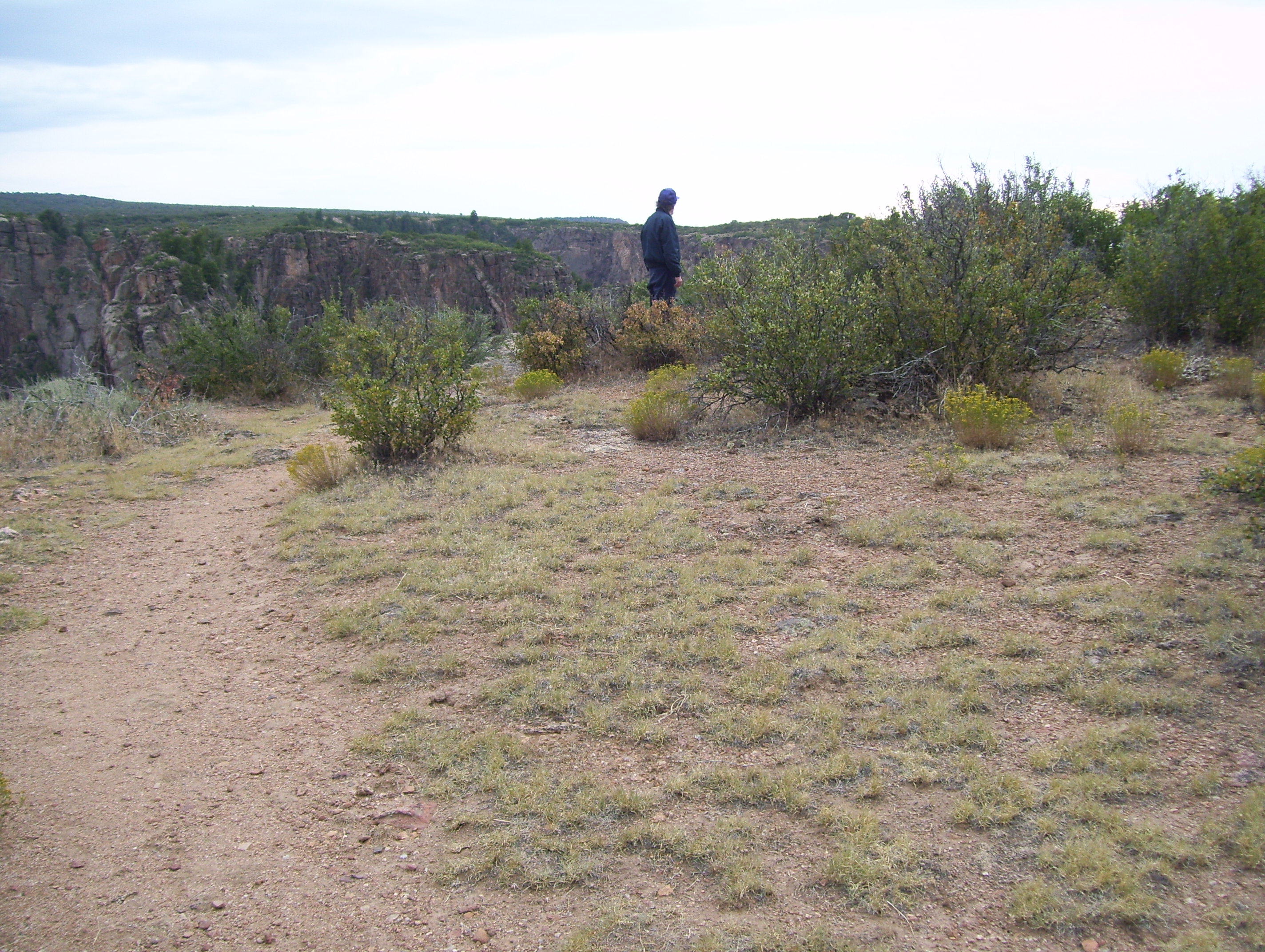
The other photo of him is from a few months before we died. (I can’t believe I made such a typo, but I’m leaving it in because in so many ways, “we” did die.) I’d just come back from a trip in a rental car, and since a rental car is a terrible thing to waste, we took a rutted and sparsely graveled road to the north rim of the Black Canyon of the Gunnison. (Although we lived only twenty miles from there, neither of our old cars could safely make the trip.) I didn’t realize I had a photo of him until months after his death when I went through the pictures I took of the canyon. (By then, I often took photos — seeing life through the lens of a camera was the only way I could deal with his dying and then with his death.) He is standing at the rim of the Black Canyon, his back to me, staring out at . . . eternity? I was able to look at this photo occasionally, for some reason — maybe because I was able to “see” him the way I remembered him.

There is a third photo, one his oncologist took. I’d considered asking for it, but I remember how appalled my mate was when he saw it — he looked old and haggard and gray and very, very ill. I didn’t want to remember him as such, so I never followed through with my inclination.

A few months ago, I put away the photos. I went from not wanting to look at the pictures, to drawing comfort from them, to not wanting the constant reminder he was dead. But yesterday, I set the photos out again. I needed the feeling of connection, no matter how ephemeral. I don’t know how long it will be before I can’t stand to look at them again — perhaps only a day or two. As much as I need to feel connected to him (sometimes that lack of connection is like an itch deep inside), the truth is, a photo is not a living person, and I cannot feel connected to an image on a piece of paper.

Becoming Who I Need to Be

For a long time, I lamented that I hadn’t been changing, and I thought I should have been.

After the death of my life mate/soul mate, I was totally blindsided by grief. I’d lost my mother a couple of years previously, and a brother the year before that, so I thought I understood what grief was. Besides, I knew my mate was dying. We’d spent the last three years of his life disentangling our lives and severing the connection so we could go our separate ways — he to death, me to life alone. I truly thought I’d moved on, yet after he died, I experienced such agony and angst that it shattered me, my identity, my understanding of life . . . everything. An experience like that should change a person, yet month after month I remained . . . just me.

Now, two years and four months after his death, the changes are occurring on an almost daily basis. I’m still just me, but the person I am today is not the same as the one who screamed the pain of her loss to the uncaring winds. Nor am I the one so connected to another human being she still felt broken more than a year after his death. I left those women out in the desert somewhere. I’ve walked about 2,000 miles since he died, and a bit of that me evaporated with every step.

I am stronger than that person was, maybe even wiser, certainly more confident and open to whatever comes, willing to accept life on its own terms.

I no longer fear growing old alone as she did. I might not live to a great age, and if I do, I might not be alone, but even if I am, that woman will not be the me of today. She will older, used to dealing with the infirmities that come with age, perhaps even experienced in the ways of dying. She will have lived her life to the fullest of her ability, and might even be able to wake each morning feeling the joy of living one more day, no matter how painful. Or not. But the point is, I am not in that place today, and the person I am today will never be in that place. So there is no reason to be afraid.

For so long, I’ve been worried about what will happen to me now that I am alone. I worried that I’d become the crazy cat lady (sans cats) or the pathetic, lonely old woman that everyone whispers about (when they remember her at all). If I end up alone and lonely, so be it. I’ll be okay. I am quite comfortable with being alone. (I always was, to be honest. Grief skewed things, made me desperately fearful of loneliness.)

But I am not alone now. I have friends to go to lunch with, online friends to plan trips with, siblings to talk to now and again, an aged father to look after. I thought it would bother me no longer being part of a couple, but the other day at lunch when some women my age were talking about maybe meeting guys and falling in love again, I asked, “Why?” All of a sudden it seemed strange to want such a thing. Three of us had mates with compromised health, and now that they are gone, we are free to simply be. It’s not out of any loyalty to my deceased mate that I find myself unwilling to pursue a hypothetical relationship right now, but out of loyalty to me.

And that brings me to the biggest change of all. It bothered me that no matter what happened, I was always just me. Now I see that as a good thing. No matter what happens in my life, no matter what challenges I face, I will always be there, becoming who I need to be, even if it takes longer than I think it should.

Who Wants to be a Character in a Book?

Grief: The Great Yearning is a compilation of blog posts, letters, and essays I wrote while struggling to survive the first year of grief after the death of my life mate/soul mate. We’d been together almost thirty-four years. I thought I was prepared for his dying, but his death shattered me beyond anything I could ever have imagined. The only way I could survive the agony was to write about it. Although Grief: The Great Yearning is non-fiction (obviously), it has all the elements of great fiction — emotion that weeps off the page, a conflicted character who yearns desperately for something, a love that lives on even after death.

Such is the pendulum swing of life that now, one year and four months after the publication of Grief: The Great Yearning, I would no longer make a good character in a book. I have no real wants or desires; no wishes, dreams, or hopes; no great love (no hate, either). I have nothing to avenge, no strong beliefs, no regrets, no guilt, no fears, no anger.

From the beginning, I’ve been bewildered by my lack of change. Shouldn’t such a soul quake cause ripples of change forever after? I didn’t feel any different, but apparently changes were taking place. All the conflicts of my life seem to be in hiatus, as if the slate of me was wiped clean to make ready for the changes that will be coming to my life. Some of the changes will come because of decisions I make, others changes will simply happen as the rest of my life unfolds.

Character change in itself is not enough either to pilot a story or to plot a book. Change in a character is generally the result of other actions, and shows us how the events of the story affect the character. So, basically, a book needs to begin with a compelling character, and I am missing all the elements that makes a character compelling. On the other hand, since I am not a character in a book, I will enjoy this hiatus from conflict and strong emotion. I mean really, who wants to be a character in a book? Life is hard enough without having to deal with all the torments we put our characters through.

Becoming a Curmudgeon

Are writers as a group less willing to read rules and follow directions than the rest of the populace, or is it that I am mostly connected to writers online who don’t know how to follow directions?

I have a book blog, Dragon My Feet, where I post excerpts from books to help authors with a bit of promotion. I thought it was a good idea, but I’m getting exhausted having to explain over and over again that I cannot post what I do not have. For example, in the instructions for Dragon My Feet, I say:

“Please include a short synopsis (blurb) of the story, short bio, a link where I can find a photo of you and one of your book cover, and whatever links you would like me to add. Post the excerpt along with the rest of the information/links as a comment/reply on this page.”

Despite those clear instuctions. I get bios with no information about the book and no excerpt. I get blurbs without any other information, not even the title. I get excerpts without a title letting me know what book it’s an excerpt from. I get dozens of comments/replies by people who say they can’t figure out how to get their excerpt to me since I didn’t leave an email address.

When I’ve mentioned this lack of communication, I’ve had writers tell me flat out, “I don’t follow directions.” Is this part of the creative process? Make up your own rules and expect the world to follow along? Quite frankly, I don’t care if people follow my instructions or not, but as I said, I cannot post what I do not have.

I’m not the only one with such problems. My publishing company sponsored a short story contest with the winner to be published in an upcoming anthology. Some writers mistook the contest for a call for submissions, though the rules clearly stated it was a contest. Others were upset that their submissions were “published” on the site, though the rules clearly stated the submissions would be posted. (According to the vagaries of the internet, once a story has been posted it’s considered published. It doesn’t make sense to me that just because something was posted for a month and then deleted, it’s considered published for all time, but then, I don’t get to make those particular rules.) There was nothing underhanded about the contest — everything was stated up front — and if people didn’t like the way the contest was run, they didn’t have to submit a story.

Maybe I have it all wrong. Maybe writers can follow directions. Maybe they just can’t read.

(Do I sound curmudgeonly? There is a good reason for that — I’m rapidly turning into a curmudgeon. I no longer have the desire to embrace the absurdities of humanity, and I see no reason why I should, especially if it causes more work for me.)