Grief Update: Going on Alone

A week ago I mentioned that all of a sudden my grief seemed to have changed, and that change appears to be holding true.

After the second anniversary of the death of my life mate/soul mate I didn’t feel any different than I’d felt the previous year. I was still sad and weepy at times, and more recently I had a week-long grief upsurge starting on the fourth of July, but lately, as I’m nearing the two-and-a-third-year mark, I seem to have made some sort of accommodation with his death and my grief.

For most of the past twenty-eight months, I’ve felt bad for him, for the horror of his last years, and for all that he is missing out on, but I don’t feel bad for him any more. I’m glad he’s out of this life, glad he doesn’t have to deal with any of the political, financial, and medical changes that are coming our way, glad he no longer has to contend with growing old or to be fearful of ending up as a helpless invalid.

I’m sorry his life was cut short, but his death doesn’t shatter me any more. I take comfort in knowing that for the most part, he did it his way. He endured incredible pain, but he knew any drugs strong enough to end his suffering would also end him, and that proved to be true. When he finally had to start taking morphine, he became someone else, and I’m glad he didn’t have to endure living as that stranger for very long. I still miss him, will always miss him, but someday I will be dead, too. He just went first. It would have been nice if we’d had more good years together, but because of his illness, the good years were behind us. It would have been nice to have had more of our dreams come true and more of our hopes work out, but they no longer matter since our shared hopes and dreams died when he did.

I still have times of doubt and fears, sorrow and tears, still question the meaning of it all, but I’m getting used to the idea of going on alone, getting used to the idea of being alone.

Tomorrow, of course, I could be back in the depths of grief, feeling shattered beyond repair, but I don’t think so. The tears that come now are more nostalgic than agonizing. When I think about it, I still hate that he’s dead, but I don’t think about it much. I try to focus more on being me, on being here in this day. I still feel a disconnect, as if some of the tendons connecting me to life that ripped when he died have never healed, but I don’t think it’s a bad thing. The disconnect reminds me that everything comes to an end sooner or later, even me.

Getting over the worst of the pain of grief is only the first step. Next comes rebuilding. Although I don’t believe in destiny and signs and things that are meant-to-be, part of me clings to the idea that he wouldn’t have left me if he hadn’t known I’ll be okay. I hold on to that thought because otherwise the idea of growing old alone scares me, as does the idea of creating a whole new life for myself.

I won’t say reconstructing my life will be easy in comparison to the agony and angst of losing the one person who connects me to the world since I don’t know what challenges lie before me. But I will say that after surviving such devastating grief, I have become stronger than I ever thought possible, and I will be able to handle whatever comes my way.


Death Certificate Error

My mother, far right, on her 60th wedding anniversary

I found out something today that shocked the heck out of me, and after the horrendous shock of my grief after the death of my life mate/soul mate, I’m not very shockable any more.

My mother died of lung cancer four and a half years ago. Her cause of death surprised me a bit since she’d never been a smoker, but at 85, one is susceptible to many forms of cancer, so I mostly found it ironic that a woman who’d never even been around second hand smoke (except for my father’s very occasional cigars) should die in such a manner. However, as I found out today, her death certificate says that she’d contributed to her death because she’d been a smoker for thirty years.

What???? How is that possible? She’d never smoked as long as I knew her, so if she’d been a smoker for thirty years, she would have had to start puffing away a couple of years before she was even a glint in her parents’ eyes, found a way to sneak smokes before she could crawl, and keep up the habit while enduring the privations of growing up in a coal mining town.

I hope this mistake on her death certificate was simply that — a mistake — rather than someone’s agenda to prove that smoking causes lung cancer. My sister doesn’t want to take a chance on upsetting my father during his final years, so she’s waiting until after he’s gone to get the death certificate changed. Until then, it’s a wonder my mother isn’t haunting us. My mother was a very exact and truthful woman, who believed in choosing the right words. (I can’t tell you how often we argued with her about “almost exactly.” She insisted things were either almost or exactly, while we were just as insistent that there were gradations of almost.) And this error on her death certificate is a more grievous transgression than a simple misuse of words.

To be honest, I doubt she cares any more what her death certificate says, but it will be good for the rest of us when the record is set straight. It isn’t only smokers who die of lung cancer. Non-smokers die of the disease, too, and their deaths should not be dismissed because of errors on their death certificates. Nor should non-smokers smugly go on about their lives feeling secure in the belief that they will never get lung cancer. They can, and they do.

Pat is Prologue

Yesterday I mentioned a revelation I had in the desert — a question, really. What is the point of being me?

It had suddenly struck me that I am truly part of the unfolding universe. There I stood baking under the sun, my sweat evaporating into the space around me, my feet solidly on the ground, air flowing in and out of my lungs, connected in dozens of ways to the world and, ultimately, to the universe.

When the universe came into being, creating itself in the big bang, everything that ever would be came into being at the same time. The matter of the universe — stardust, to be romantic — has been connecting and disconnecting, rearranging itself in an infinity of shapes and forms, for billions of years. At one moment of such creativity, I was born. I am of the universe, perpetually a part of it. Although my body seems to be a thing in and of itself, it continues to exchange matter with its surroundings. In a quantum sense, my few electrons are indistinguishable from the whole.

Here I am, a creature born of stardust, at once eternal and ephemeral, physical and psychical, emotional and logical, alive yet forever dying.

Everything that ever happened on earth and in the universe since the beginning has culminated in a single person — me. Everything that happened in my life up till now has created the person I am today. So, what is the point of being me?

This is not a religious question. Nor am I looking for simplistic answers or rehashed dogmas. Instead, it’s more of a credo or a different way of looking at the world and my future. What do I want to do while in this body made of stardust? What do I want to feel? What do I want to think? How do I want to live? How do I keep from wasting the miracle that is me? How do I celebrate this connection to the unfolding universe? What is the life that only I can live? In other words, what is the point of being me?

(You, of course, are the culmination of life up to the point of your birth, but it’s up to you to ask your own questions.)

Learning to Deal With the Real World

It seems strange to have to learn to deal with the real world at my age, but for more than half of my life, I didn’t have to deal with the world as it is. My life mate/soul mate and I created our own world of peace and accord. We always wanted the best for each other without ever a hint of envy or resentment. We helped each other. We listened to each other. We cared for each other and took care of each other. We shared values, income, responsibilities without counting the cost or worrying about who got more than their share. In fact, we often worried that we were taking more than we gave.

It wasn’t like that at the end, of course. Long-term illness skews things, so during his last years, there was often tension and frustration as our lives started to diverge — he to death, me to life alone. We could feel the disruption of our world, and though we were under tremendous stress and occasionally gave in to fits of pettiness, we mostly managed to deal peaceably with each other. To others, however, we appeared to be in perfect accord. During one of their visits, the hospice nurse turned to the social worker and said, “I don’t think they have any idea how much they love each other.”

What we had didn’t feel like love, and yet, what else could it be, this creation of a world where we each gave whatever we could without stopping to count the cost? We didn’t have an easy time of it — so often life took disastrous turns, but still, we were always there for each other.

And now we’re not.

He’s . . . somewhere (or nowhere) and I? I’m here, muddling along as best as I can in this alien world. The world is alien in part because his absence has created a black hole into which so much light has disappeared; in part because I am alone without someone listening, caring, helping; in part because it truly is alien. Though people often say, “We’re all in this world together,” they don’t mean it. People want things and they pursue those things with a passion. Isn’t that what most people think life is about? Finding someone or something to be passionate about? But here is the conundrum — passion takes what it wants and doesn’t count the cost to others. (That is why passion is such a great story driver.)

He and I used to play games where the goal was not to win or lose, but to come out evenly matched. We hated games where one person won everything and the other lost everything. It seemed too cruel. Neither of us wanted to lose, but we didn’t want the other to lose, either, because we knew how much losing hurt. (It probably won’t come as any surprise if I tell you we created our own games.)

We never argued. Well, there was that once, six weeks before he died, but I hate thinking of that. I understand now the horrendous pressure of our lives, but for so long all I could think of was how horrible I was for having my first fight with my mate six weeks before his death. (I understand it now, but I still can’t think of it without tearing up. I never wanted to be that woman.) But for more than three decades, if we disagreed, he’d state his position and I’d state mine (or vice versa). If we couldn’t come to a resolution, we’d walk away (sometimes in a huff, sometimes in frustration). The next day, he’d bring up the subject again, conceding that I was right. Of course, by then I’d have mulled over what he said, and I’d concede that he was right. So we were back where we started. The best thing about it is I knew he’d thought about what I said, he hadn’t just blown me off by walking away.

When he died, my world of accord died, too, and now I live in the world everyone else does — a world where some have way too much and some have way too little. A world where passions tear people apart as often as they bring them together. A world where competition is rampant, where it’s not enough just to win, but also to make sure others lose. A world where small disagreements escalate into battles. Admittedly, this is what the world has always been like, but I didn’t have to deal with it.

And now I do.

Grief: Haunted by the Hard Questions

One of the more confusing aspects of grief after the loss of a life mate, a child, or someone we were deeply connected to is that we are haunted by the hard questions. Who are we? Why are here? Is this all there is? Where did our loved ones go? Will we see them again? What is the meaning of life, and probably most haunting of all, what is the meaning of death?

Many of my fellow bereft read everything they can find about such matters of the spirit, but I didn’t — I’d spent years on a quest for truth and reality, and I’d come to believe that God is the spirit of creativity that fuels the universe, and we are each a part of that creativity. I was content believing that our spirit/energy returned to the whole . . . until my life mate/soul mate died. Then all of a sudden, I didn’t want that to be the truth. I wanted him to continue existing as him, as the man he was.

I do think there is a deeper reality, I’m just not sure our conscious selves are a part of it. We are a product of our genetics, our hormones, our brains (anyone who has had to cope with an Alzheimer’s sufferer or a loved one who had cancer in their brains, and found a stranger in that familiar body, knows how much the brain controls who we are). So what  survives, if anything? The part of us we never knew — the un-sub-conscious? If so, how would we know who we were after we were dead? Is it just the energy in our bodies that is released? If so, for sure we would not know who we were.

On the other hand, without some sort of afterlife, life simply does not make sense. What’s the point of it all? To survive? For what — more survival until there is no more survival? To help others? Why? So they can survive? For what?

If there is life after death, what do you do with eternity? You have no ears to hear music, no eyes to read or watch a movie, no legs to walk, no hands to caress another, no mouth to talk, no brain to think. Sounds like a horror movie to me. And what will we do if we meet again? Bask in each other’s light? That would get boring after a minute or two.

When we met — my soul mate and I — I still believed in a cosmic plan, and I had the feeling that he was a higher being come to help me on my quest to the truth. But now? I no longer believe there is a universal truth, and I don’t think he’s waiting for me, though I act as if he is. It’s better than believing that he is gone forever.

And perhaps he does still exist in some form. What do I know? One thing I have learned from my grief is that a human life is a spectrum. You don’t notice it so much when you are both alive, because you are both in the moment, both always the people you have become and not yet the people you are becoming. But when one of you dies, his becoming ceases, and you see his life as a whole. The person he was when you met is every bit as alive in memory as the person he was the minute before he died. The youthful man, the middle-aged one, the healthy one, the sick one are all merely spaces on the spectrum of his life.

It’s possible the spectrum of a human life is the same sort of spectrum as light — beginning long before the visible part appears and ending long after the visible part disappears. Of course, the non-visible parts of the electromagnetic spectrum aren’t light but sound and radiation and other invisible waves, so whatever exists outside of the visible human spectrum might be something completely different from we can ever imagine.

It’s also possible that our bodies are like television channels, receptors for certain wavelengths, so that our “souls” actually reside outside our bodies, but still, the selves that we know are defined by life in our bodies. So, again, we come back to the same question, what of us survives?

Grief is an isolating experience, made more so by our spiritual quest. While our family and friends continue on their same daily path, we find ourselves going in a completely different direction. There are no answers to our questions, but still, they haunt us, and we try to figure out a way for it all to make sense.

But life will never make sense because we are still here and our loved ones are gone. Where is the sense in that?

The Two-Year Anniversary of the Worst Day of My Life

The worst day of my life was not the day my life mate/soul mate died. That particular day was sadly inevitable, one I actually had looked forward to. He’d been sick for so long and in such pain, that I was glad he finally let go and drifted away. After he died, I kissed him goodbye then went to get the nurse, who confirmed that he was gone. She called the funeral home, and I sat there in the room with him for two hours until they finally came for him. (They came in an SUV, not a hearse. And they used a red plush coverlet, not a body bag.) I might have cried. I might have been numb. I don’t really remember. All I know is that I sat there with him until almost dawn. I couldn’t even see his face — they had cleaned him and wrapped him in a blanket — so I just sat there, thinking nothing.

The worst day of my life came fifty-five days later, exactly two years ago. I spent all day cleaning out his closet and drawers, and going through boxes of his “effects.” He had planned to do it himself, but right before he could get started, he was stricken with debilitating pain that lasted to the end of his life, and so he left it for me to do. I would not have undertaken the task so early in my grief, but I had to leave the house where we’d lived for two decades and go stay with my 95-year-old father, who could no longer live alone.

I knew what to do with most things because my mate had rallied enough to tell me, but still, a few items blindsided me, such as photos and business cards from his store To Your Health (where we met). Every single item he owned was emotionally laden, both with his feelings and mine. The day was like a protracted memorial service, a remembrance of his life, a eulogy for “us”.

How do you dismantle someone’s life? How do you dismantle a shared life? With care and tears, apparently. I cried the entire day, huge tears dripping unchecked. I have never felt such soul-wrenching agony. I’ll never be able to do anything else for him, so the work and my pain was my final gift to him. I was glad I could do that one last service, but I sure don’t want to ever go through anything like that again.

The only good thing about living the worst day of your life is that every day afterward, no matter how bad, will be better than that day.

I’m not particularly sad today — the sadness came yesterday. Despite it being Saturday, my sadder day, and a day of sporadic tears, I woke with a smile. I’d dreamt we were cleaning out the house (which is odd considering that I did not remember until afterward that today was the anniversary of when I went through his effects). In the midst of the usual chaotic dream images, there was one short clear moment. We were sitting side-by-side. He smiled at me, kissed me gently, and I rested my head on his shoulder.

This was the first time in almost two years that I’d dreamt about him. It was lovely seeing him again, if only in my dreams.

When You Lose the Person Who Connects You to the World, What do You Become?

“When you find that one person who connects you to the world, and that person is taken from you, what do you become then?” —John Reese (Person of Interest)

John Reese might be fictional (at least I assume so; I had never of Person of Interest until I saw this quote) but his question is one many of us bereft are pondering. When that one person is first taken from us, we wonder how we are going to survive. We never figure it out, but still, the days pass, then the weeks, months and years, and we realize that somehow we did it. We survived. Then the question facing us is what do we become.

I’m still waiting to find out the answer. So far, I seem to be just . . . me. Sadder, but me. I keep hoping that grief will bring some sort of mind/soul expansion that will allow me to become . . . well, something other than the same person I have always been. I hope for wisdom, perhaps a glimpse into the eternal mysteries, maybe a greater understanding. But so far, such experiences remain beyond my grasp.

I am trying to re-establish a connection to the world, though. For a long time, I felt as if I were balanced on one foot, the other suspended above the void. Occasionally I still have that stepping off into nothingness feeling, but mostly I’ve been trying to concentrate on actually being on Earth. To notice my connection to the world. To feel the ground beneath my feet. To be aware of my breath mixing with the air around me. To feel the wind against my face and the sun against my back. All these things connect me to the world whether I feel connected or not.

During the past few days, I’ve noticed that I’m letting go of the past, or at least feeling an easing of its grip. I haven’t wanted to let go of the past because in the past I was loved. I had mate — a life mate, a soul mate, a play mate. In the past I wasn’t alone. Nothing can bring back the past, and to be honest, I don’t want to bring it back. In the past, my mate was miserable, in pain, dying by inches every day. But without the past, or my connection to the past, what will I become?

Or is that the wrong question? Perhaps the important question is not what I will become, but what will I be at any given moment. If I try to live each moment as it comes, whether it comes with tears or a smile, with heartache or peace, then perhaps all these moments of being will lead to becoming.

Grieving the Nothings

I’m gradually moving away from the influence of grief. I’m not moving away grief itself, since there is a good chance that somewhere deep inside I will always be crying (I can feel the gathering tears even when I am not overtly sad), but I am moving away from grief’s influence. I can think clearly again, though the answers to many of my questions about life and death and the meaning of it all remain unanswered. I can focus without being distracted by thoughts of my deceased life mate/soul mate. I am not revved up with anger or guilt or adrenaline. I don’t feel quite as soul-shattered or heart-broken as I did at the beginning, and my yearnings for him are not quite as vast. His absence looms almost as large as his presence once did, but I am getting used to working around the void. I am also getting used to the unwelcome knowledge that I will never see him again in this lifetime, never hear him talk, never be warmed by his smile. (I’m just getting used to the knowledge that I will not see him; I will never get used to the fact.)

But . . . now that the big losses are a bit tamer, the small losses are becoming more apparent. I have no one with whom to share a moment with. You know what I mean — you’re watching a movie and, after a particularly touching scene, you turn to each other and smile. If I turn, no one is there. I sometimes look at his photo at such moments, but there is not much “sharing” when it is between you a piece of tinted paper.

I was also going to say I have no one to share anything with, but that’s not strictly true since I do have people I can share major happenings with. What is true is that there’s no one to share nothing with. There are so many little nothings in a day — miniscule victories or insignificant happenings that aren’t worth talking about, but that you want to mention anyway. And there are times when you’re sad or lonely or restless, and just want a moment’s connection before continuing your daily tasks. You can call someone perhaps, or email, but it’s not the same thing. By the time you make the connection, the moment of nothing has become something.

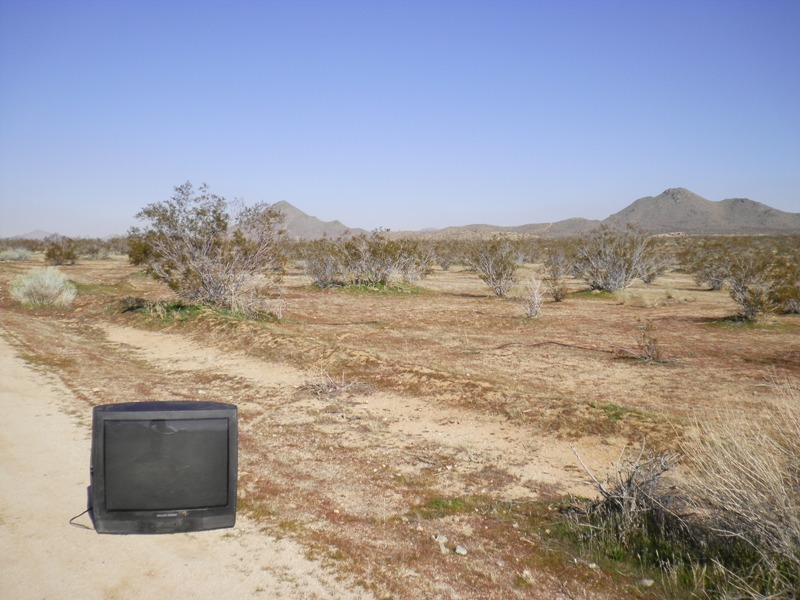
I also have no one to share the small incongruities and ironies of life with. Once walking in the desert, I saw a television on the road. So totally incongruous, it seemed as if it were an art piece in the making, and I had no one to tell about it in passing.  Today I went to the dentist to have him check on a small matter, and he told me to eat lots of sticky candy. The irony of the advice tickled me (I mean, really, when was the last time your dentist told you to eat lots of sticky candy?), and I had no one to tell that to in passing, either.

Come to think of it, there is no “in passing” anymore.

I made it through some of the major traumas of grief. Now I have to try to make it through the nothings.

Facebook Makes Us … (Fill In the Blank)

Facebook has become an icon, a symbol for our times. We are lonelier than ever — disconnected from family and friends in offline life — yet at the same time we are more connected online. Various recent articles have suggested that Facebook makes us sick, narcissistic, depressed, lonely, and anxious, partly because of the shallowness of Facebook relationships. But honestly, does anyone consider “liking” a comment an actual relationship? I doubt it.

Facebook is good or bad depending on how you use it. An article in The Atlantic that suggested Facebook makes us lonely used Yvette Vickers, a former Playboy playmate and B-movie star (best known for her role in Attack of the 50 Foot Woman) as an example. Apparently, the actress had been dead for almost a year before anyone realized she was gone. (This is hard for me to believe. Perhaps all her bills were automatically paid out of her bank account every month, but what about taxes? Wouldn’t someone from any of the various tax collecting bureaucracies have noticed her delinquency?)

Still, the story goes that a neighbor found her and was so concerned about Yvette’s ignominious end that she scanned Yvette’s phone records and discovered that the former actress’s last calls were to old fans who found her via Facebook. Ignoring the neighbor’s decided lack of concern for the actress while the woman was alive, what business was it of hers how Yvette spent her last days? What business is it of ours? There is no way of knowing how Yvette felt. Perhaps it made her happy to connect with her past, to remember that she once had a life, to know that she once touched people. Perhaps everyone she knew and loved had died, and she needed to reach out and connect somehow. We don’t know the truth. We can never know another’s truth. The story is only pathetic because of our own fears of ending up alone.

Facebook doesn’t create loneliness. It might exacerbate a loneliness that already exists, (and face it, if we really had full offline lives, would we be spending so much time online?), but it also gives us the opportunity to connect with our past and maybe our future. I know several people who fell in love online, and the connection continues offline even now.

Facebook makes us informed. If it weren’t for Facebook, I would never have seen the above-mentioned articles, hence I would never have known about the deleterious effects of Facebook. Nor would I have seen these incredible before and after photos of Nagasaki.

Facebook makes us humble. You’re feeling thrilled that you sold ten books that day and then someone boasts they sold 10,000. Brings you down a peg, that’s for sure. Is humility such a bad thing? In a world that seems to revere aggrandizement, a bit of modesty is good for one’s soul.

Facebook makes us grateful. Mixed in with all the brags and too-cute animal photos are the heartbreaking posts. People talking about how their chemo is going, sharing their angst at the death of a loved one, giving updates on their hospital stays, telling us about the traumas their children and aged parents are facing. Such posts make us realize that no matter how bad things are for us, someone has it worse.

Facebook makes us aware of community. Or at least that’s the goal of my various groups. In the Suspense/Thriller Writers Group, I’m trying to keep writers focused on the craft of writing, on helping each other attain our writing goals. Perhaps together we can do what each of us can’t do alone.

In other words, Facebook doesn’t make us do anything. We make of it whatever we can.

Grief Update — Two Years and One Month

Grief continues to confound me. It is now two years and one month after the death of my life mate/soul mate. I would have thought I’d have moved beyond grief’s ability to disquiet me, but I still have times where tears rush in to fill the void he left behind.

Some of my grief now is the poking-at-a-sore-tooth-to-see-the-extent-of-the-pain kind rather than the overwhelming agony and angst of the first year. There are still sore spots, most notably the obvious one — that he is dead. I cannot fathom death. My mind just cannot work itself around the conundrum of a once living person being so very gone from this earth. And there is the corollary murmuring deep in my psyche, “and someday you will be gone, too.” But . . . gone where?

When my grief was new, I often wandered in the desert crying out in desperation, “Where are you? Can you hear me?” I don’t call out any more, though I still wonder where he is, if he is, what he is. I envy those who believe without a doubt that their deceased loved ones still exist and that they will see them again because I have no such constant belief, though I do have flickers.

One of the many paradoxes of my grief is that I hope he still exists somewhere, but for myself, I’d be okay with oblivion. Is his death worse for me if he still exists somewhere beyond my ability to connect with him? Or is it worse if he is completely deleted except for a spark of indestructible non-conscious energy? Either way, he is gone out of my life. Either way, I have to deal with the mysteries of death, love, grief, and what the heck am I going to do with the rest of my life?

I met my life mate when I was young and believed in fate and destiny and a mystical connection with the universe. I subscribed to the belief that when the student is ready, the master will appear. And he appeared. He was so radiant, it seemed to me he was a higher being come to earth to help me on my life’s quest. In the few ups and many downs of our shared life, I forgot that feeling. And no wonder — as he got sicker and sicker, his radiance dimmed and all but went out.

During that last year, when he could no longer carry on a two-sided conversation, he would lecture me on what I should do after he was gone. He kept saying, “Listen to me. I won’t always be here to teach you.” I didn’t accept that his dying was imminent, so these lectures aggravated me, as if he thought I was so stupid I couldn’t live on my own. (I’d give anything to hear one of those “lectures” again. How could I not have treasured every word?) But the point is, apparently, deep in his subconscious, he believed what I had once believed, that he came here to be my teacher.

There is not a single question (except the unanswerable ones such where he is and if he is) that has arisen in the past twenty-five months that I didn’t know the answer to. We had discussed everything, sometimes all day, day after day, year after year. He took me as far as he could, imparted his wisdom, and left.

If there is any truth to this scenario, rather than being the rather romantic idea created by a bereft woman grasping hold of life any way she can, then the question of what I am going to do with the rest of my life takes on even greater significance. What is so important about me and my life that this radiant creature would share half his lifetime and all of his long and painful dying with me? I suppose that is what I am left to find out.