My Brand New Cousin and My Brand New Book

I love the internet. I never know from day to day what will happen, who I will meet, who will become part of my future. I’ve made many new  friends, some I have no doubt who will be in my life for years to come, and I also made a new cousin.

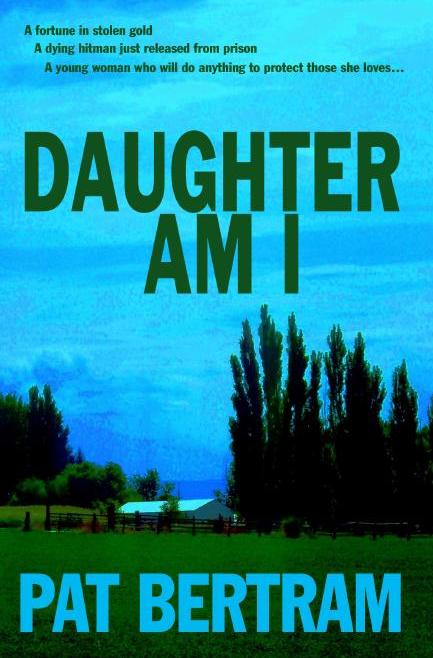
Another Bertram contacted me on Facebook and wanted to know if we were related. Since I have very few Bertram relatives that I know of, I told him regrettably that we probably weren’t related, though we could be. He lives in Hamburg, and my great-grandfather came from Appen, which is nearby. Since Dirk (I hope he doesn’t mind my mentioning his name) also has few Bertram relatives that he knows of, we decided to become each other’s cousin. And who knows, we could be related. We’re both creative — I write novels, he’s a musician who produces book trailers. He says he’ll make the book trailer for my soon-to-be released novel, Daughter Am I. How cool is that!

He wanted an excerpt which shows the spirit of the book, and I finally sent him this one, though I don’t really know how he can make a trailer from it since nothing really happens, but it does show the spirit of the book, or at least the spirit of the characters. 

The old man stopped bouncing and let his arms drop to his sides. Now that he was standing relatively still, Mary could see that he was even skinnier than she had first thought. A gray slouch hat was tilted toward one eye, but the jaunty effect was marred by the baggy pants cinched high above his waist and the bright flowery shirt that was several sizes too large. His hands were shaking uncontrollably. Parkinson’s disease?

“You must be Happy,” she said.

Frowning, Happy patted his torso. “Must I be happy?” His voice deepened to what Mary assumed was his normal tone. “Can I be happy? Can anyone truly be happy?”

“His name is Barry Hapworth,” Kid Rags said, flicking a bit of lint off his navy pinstriped suit jacket. “For several obvious reasons, everyone calls him Happy.”

Mary glanced from the bus to Happy. “Were you driving this thing?”

Happy puffed out his meager chest. “Sure was.”

“And did you almost run over Mrs. Werner’s cat?”

“I’ll take the fifth.” Happy paused for a fraction of a second. “A fifth of bourbon.”

“Did someone say bourbon?” Kid Rags removed his flask from his hip pocket, took a swig, and passed it around.

“Who are all these people?” Bill asked from behind Mary.

Mary turned, wondering how she was going to explain the situation, but Teach saved her the trouble and made the introductions. Arms still folded across his chest, Crunchy nodded to Bill, then stepped close to Mary. Happy punched the air, but stopped when Bill showed no inclination to fight.

Kid Rags shook Bill’s hand. “You’re a lucky man.”

“What are you all doing here?” Mary asked. “I was supposed to pick you up. And why is Happy here?”

“Happy is a friend of Kid Rags,” Teach began, but Kid Rags interrupted him, saying hastily, “Not a friend. Just a fellow I know.”

“Anyway,” Teach continued, “Happy knows someone who knows Iron Sam, and since we knew your car wasn’t big enough for all of us, we took Happy up on his offer to drive us in his bus.”

“Who’s Iron Sam?” Bill asked, sounding plaintive.

“Butcher Boy,” Kid Rags said.

Bill’s eyebrows drew together. “Butcher Boy? Mary, are you sure you know what you’re doing?”

Mary laughed, suddenly feeling lighthearted and carefree. “I haven’t a clue.” 

Daughter Am I will be released in October by Second Wind Publishing.

add to del.icio.us : Add to Blinkslist : add to furl : Digg it : Stumble It! : add to simpy : seed the vine : : : TailRank : post to facebook

The Themes of Our Lives

I’ve been thinking about themes lately — the themes of our lives, the themes of our stories, the themes that permeate our relationships. (Technically, relationships fall under the category of the themes of our lives, but I like to do thing in threes, and I couldn’t think of a third theme category.)

Someone asked me recently if I ever considered writing a novelization of my life, and I just laughed. There is no story in my life — nothing noteworthy ever happened to me, and I never did anything that millions of others didn’t also do. Still, the question niggled, and a couple of days later I saw a theme: sometimes I’ve put aside my dream to try to help someone achieve theirs. Now that would make a good “three bears story.” The first time perhaps my namesake gave too little when she tried to help someone, and the other person didn’t achieve his or her dream either. The second time she might have given too much and still neither of them got their dream. The third time she gets it right, and everyone wins. In real life I haven’t yet gotten it right, but I’m working on it.

I also read a comment that “nothing changes if nothing changes,” which sounds like a good theme for a book. Perhaps an older woman is whining that nothing ever changes in her life, and someone tells her that nothing changes if nothing changes, so she decides to make a simple change — perhaps henna her hair or buy a dress that is out of character or go to a museum. And from that simple change comes a ripple of changes, so at the end, she ends up completely different.

Another comment was “intimacy is so hard and manipulation is so easy,” which kept my mind occupied for days on end. How much of intimacy is manipulation? If someone tells you they love you, is it manipulation, or is it intimacy? I suppose it depends on the intent, the motivation. Intimacy vs. manipulation would be a fun theme to explore in a novel.

Something else I read: “Every crisis creates a new normal.” Every time something happens to a person or a character, he must readjust his thinking to accept the new normal. How far out of the normal does he have to go before he becomes a saint or a monster? The original comment had to do with accepting the crises of age, but as a theme, it can mean any sort of crisis.

So, what are the themes of your stories, the themes of your lives, the themes you’ve written, the themes you’ve read, the themes you’d like to write?

add to del.icio.us : Add to Blinkslist : add to furl : Digg it : Stumble It! : add to simpy : seed the vine : : : TailRank : post to facebook

Lisping Dialogue

I used to read books about writing — dozens of them.  Several mentioned that mispelled words and apostrophes are no longer in style to show speech defects or accents — such dialogue is difficult to read.  To denote dialect, one needs to show speech patterns from the specific area, such as “It’s not far, just down the road a piece.” Tells you a bit about the character, and it’s easy to read. Another suggestion was to use the misspellings and apostrophe’s to set the character’s accent in the reader’s mind, then switch to normal spellings.  I heeded this particular bit of advice in my upcoming novel, Daughter Am I. To get the full meaning of the excerpt, you need to know that the Scourge and Butcher Boy once worked for the Outfit, aka the Mob. 

“Who ith it, my love?” A rotund little old man wearing plaid bermuda shorts and a pink polo shirt appeared at the door beside the woman.

“Hello, Wallace,” Happy said.

Mary bit back a giggle. This was the Scourge? This gnome of a man with twinkling eyes and a lisp?

Wallace peered through the screen at Happy. “Do I know you?”

“Don’t you remember? We used to work for the same outfit.”

The woman’s face lit up. “Oh, how nice. Won’t you come in?”

She made a move to open the door, but Wallace put out a hand to stop her.

“That won’t be necessary. These folks were just leaving.”

“Hey!” Happy protested. “What’s the big deal? All we want is some information about Butcher Boy.”

“The supermarket in town has a nice butcher,” the old woman said, “but you can’t really call him a boy. He has to be at least forty.”

Wallace patted the woman’s arm. “Let me handle this, sweetie.” He opened the door, slipped through, and closed it behind him. Motioning for Mary and her gang to follow, he headed for the road.

“This your bus?” he asked.

A couple of editors mentioned that I was inconsistent, that I should have carried the lisp throughout the scene.  It was only two pages, but still, that’s a lot of th’s.

“That won’t be nethethary. Thethe fokth were jutht leaving.”

“…Thweetie.”

 “Thith your buth?”

So, when you read Daughter Am I (you are going to read when it’s released, right?) and notice the inconsistency, just remember how kind I was being to your eyes.

add to del.icio.us : Add to Blinkslist : add to furl : Digg it : Stumble It! : add to simpy : seed the vine : : : TailRank : post to facebook

Free Ebooks!

Free ebooks! Just stop by the Labor Day GiveAway at the Second Wind blog before September 12, 2009, mention the name of a Scover-mdtosecond Wind book that you’d like to read, and you might win an ecopy. http://secondwindpub.wordpress.com/2009/09/06/labor-day-giveaway/
 
Now is your chance to read More Deaths Than One or A Spark of Heavenly Fire!
 
More Deaths Than One: Bob Stark returns to Denver after 18 years in Southeast Asia to discover that the mother he buried before he left is dead again. He attends her new funeral and sees . . . himself. Is his other self a hoaxer, osparks-coverr is something more sinister going on? And why are two men who appear to be government agents hunting for him? With the help of Kerry Casillas, a baffling young woman Bob meets in a coffee shop, he uncovers the unimaginable truth.

A Spark of Heavenly Fire: In quarantined Colorado, where hundreds of thousands of people are dying from an unstoppable disease called the red death, insomniac Kate Cummings struggles to find the courage to live and to love. Investigative reporter Greg Pullman is determined to discover who unleashed the deadly organism and why they did it, until the cost — Kate’s life — becomes more than he can pay.
 

add to del.icio.us : Add to Blinkslist : add to furl : Digg it : Stumble It! : add to simpy : seed the vine : : : TailRank : post to facebook

Blog Talk Two

I just finished being interviewed on blog talk radio, and all things considered, it went okay. Well,  there was that part where my mind went blank and I couldn’t think of a single disease mentioned in A Spark of Heavenly Fire, couldn’t think of a single biological warfare experiment that I researched. Sheesh. I spent years on the research. You’d think at least some of it would have come easily to mind. I did manage to mention a  connection between swine flu and the novel, but still . . . it would have been nice to sound as knowledgable as I am about the horrors of biological warfare and human experimentation. And I talked about the Hanta River in North Korea, when it’s in South Korea.  In the end, though, it doesn’t matter. The story isn’t about disease, though I kill off hundreds of thousands of Colorado residents with the flu-like epidemic I created. The disease, the deaths, the quarantine are all simply the setting for the story of how insomniac Kate Cummings came alive when all around her people were dying.

What does matter is that I didn’t give the right website address for my publisher, Second Wind Publishing. Aaaarrrggghhhh! You can find them at http://secondwindpublishing.com. Just goes to show that you can’t take anything for granted. Make sure you have website addresses and other pertinent information right in front of you. Don’t rely on your memory!

I had fun, though. I’d met one of the hosts, Steven Clark Bradley, author of Patriot Acts, through Facebook. We’ve had a few interesting email conversations, he’s participated in some of my discussions, and he did a wonderful review of More Deaths Than One. During the blog talk show he mentioned that he stayed up late one night to read my book –Oh, how I enjoy keeping men up late at night! What power!

We talked about how I got the ideas for my books, talked about the characters, and I got in a plug for my novel, Daughter Am I, which will be published next month. All good stuff. The best thing about Blog Talk Radio is that, like all blogs, it’s forever. So stop by whenever you can. I’ll be there.

Blog Talk Two (Today’s interview): Back Story — The Behind the Scenes Look at Writing a Novel

Blog Talk One (My first interview): Talk to Me: Conversations With Creative, Unconventional People

Steven Clark Bradley’s review: More Deaths Than One

More Deaths Than One and A Spark of Heavenly Fire are available from Second Wind Publishing, LLC.

You can also download the first 30% free at Smashwords

add to del.icio.us : Add to Blinkslist : add to furl : Digg it : Stumble It! : add to simpy : seed the vine : : : TailRank : post to facebook

I Need a…Gulp…Outline

I’ve been rereading my work-in-progress, trying to get back into the mindset of the story so I can work on it. Usually by the time I’ve written 37,000 words, my characters help develop the story. No, my characters never take over — they always do what I make them do. It’s more that I know who they are, what they want, and who’s going to stop them from getting what they want. Unfortunately, during the first part of my WIP, my hero mostly contended with the ever-changing world, and the people he met were simply passing through his life. So now I have to create a whole cast of characters.

I’m thinking of having a contest — let people suggest characters, and if I use it, they get an acknowledgement in the book along with a copy of the printed book when it’s published next year. Seems a bit of a cheat, but it could be fun.

But I digress. One of the characters I have to create is a group. Sounds odd, but groups have a culture, a dynamic of their own, a character that is different from the sum of the individual members. Groups also develop, just like characters do, and there are several distinct stages:

1. Coming together and finding the individual roles
2. Defining the task.
3. Feeling unrest — disenchantment with the group and each other
4. Cohesion — beginning to feel like a team
5. Interdependence — work as a team, believe in the subculture they have created.

In addition to creating a whole new cast of characters and developing them into a group, I need to figure out how to get my hero to give up the relative security he recently embraced and go back out into the dangerous world and dubious freedom.

When the novel is finished, much of this scaffolding will be invisible to the reader, but I need to be able to see at a glance how all the parts fit together so I can show what’s happening rather than telling it. It sounds to me like a need a . . . gulp . . . outline. I’ve never outlined a novel before. Should be interesting.

add to del.icio.us : Add to Blinkslist : add to furl : Digg it : Stumble It! : add to simpy : seed the vine : : : TailRank : post to facebook

On Writing: Looking Up

When your characters look up, what do they see? Sunsets and sunrises are so prevalent in books as to be clichés, yet every day there is a sunrise and every day there is a sunset, even if it’s too cloudy for us to see either. I suppose mentioning the rising or setting sun makes more sense if there is a reason. For example, tonight there was a gorgeous sunset here because of the fires in California. The smoke drifts to Colorado and is trapped by the mountains.

I try to find different things for my characters to look at, because to a certain extent, a character is what he sees. If a character sees a flock of what looks like hawks, and he or she knows that they are vultures, it tells you a bit about the character. Vultures fly in packs, hawks fly alone. Or so I’ve been told. Both hawks and vultures are equally lovely as they coast on the updrafts, but somehow knowing that the regal bird is a vulture and not a hawk takes away some of the beauty of the scene. 

In A Spark of Heavenly Fire, the characters see helicopters patrolling the skies above quarantined Colorado. In Light Bringer, which will be published next year, the characters see unnatural lights in the sky, they see strange airplanes, and they see an impossibly brilliant rainbow. In my WIP, the characters see a light in the west on Easter morning, and for just a moment, they think it’s the rising sun.

So what do your characters see when they look up? Does the sight have a bearing on the story? Does it tell you a bit about the character?

007a

add to del.icio.us : Add to Blinkslist : add to furl : Digg it : Stumble It! : add to simpy : seed the vine : : : TailRank : post to facebook

Distilling the Essence of a Story

I have an interview on BlogTalkRadio on Saturday, September 5 at 11:30am ET. We’re going to be talking about back story — where I got the ideas for A Spark of Heavenly Fire and More Deaths Than One. Although one of the hosts of the show has read at least one of my books, I’m sure at some point he will ask me, “What are your books about?” And I will give the same answer I give to everyone who asks. A blank stare. Though, being radio, it will come across as blank silence.

How does one encapsulate a three-hundred-page novel with subplots and subtexts, themes and scenes, complexities and ironies into a minute of description? This distillation is commonly called an elevator speech, and after five months of being published, I still haven’t figured mine out.

I can talk around the story — More Deaths Than One is a thriller/mystery/suspense novel that explores what it is that makes us who we are. Is it our memories? Our experiences? Our natures? A Spark of Heavenly Fire is a thriller/suspense novel with a strong romantic element. It tells the story of ordinary people who become extraordinary because of the trauma they must endure. — But neither of those descriptions gives an idea of what the stories are about.

I can relate a bit of the story — More Deaths Than One tells the story of Bob Stark who sees his mother’s obituary in the morning paper, which stuns him because he buried her two decades ago before he the country to live in Southeast Asia. So how can she be dead again? A Spark of Heavenly Fire tells the story of how Kate Cummings, an ordinary woman, gathered her courage and strength to survive the horror of a bioengineered disease let loose on the state of Colorado.

The problem I’m finding is that I don’t know the essence of either story, the emotional triggers. What do the books do for readers? Why should people read them? Perhaps the books will bring romance and adventure to readers’ lives. By showing ordinary people rising to horrific occasions, perhaps readers will feel better about themselves, knowing they too have the potential for heroism. And, in the case of A Spark of Heavenly Fire, people will know what to expect if ever the Swine Flu or any other virulent disease spreads so rapidly that an entire state needs to be quarantined in an effort to curtail the deaths.

So, how do you distill the essence of your book (or any book!) into a few words and make a reader desperate to read it?

More Deaths Than One and A Spark of Heavenly Fire are available from Second Wind Publishing, LLC.
You can also download the first 30% free at Smashwords.

add to del.icio.us : Add to Blinkslist : add to furl : Digg it : Stumble It! : add to simpy : seed the vine : : : TailRank : post to facebook

Why Mistakes Happen

I worked hard to make More Deaths Than One typo-free, but there are at least two errors in the published novel.

        “I’m Kerry. Kerry Casillas.” She eyed the obit-
ary. “How many of those children are yours?
Bob massaged the back of his neck. “None.”

And:

“I thought you were in the jungle of your nightmares.”
Bob laid a had on top of hers. “I was.”
“Then let’s get you out of there. Finish the story.”

Errors in copyediting are easy to make. One website, Regret the Error: Mistakes Happen, capitalizes on this, chronicling the editing mistakes and corrections in newspapers around the world. If professional proofreaders and editors have such a hard time, what hope is there for the rest of us? Perhaps not much. And it’s not due to carelessness so much as the way we are made.

According to Joseph T. Hallinan, author of Why We Make Mistakes, we have a very narrow angle of good vision, perhaps a thumb’s worth, which is why our eyes constantly flicker back and forth — they are trying to focus on a larger area. What this means for us is that we see the beginnings of words, pick up clues, and automatically fill in the rest —  such as the e at the end of the. Hallinan writes, “people were asked to read a text and cross out the letter e every time they saw it. It turned out that the later the e appeared in a word, the more likely it was to remain undetected. Not only that, the e in the word the was very likely to be missed — 32 percent of the time.”

I also know from doing puzzles such as Word Finds that we tend to see the middle of the page more than the top and bottom lines, and we tend not to see the far sides of the text. If ever I can’t find a word, I know to look at the periphery of the puzzle. More often than not, that’s where I find the missing word. (I seldom do such puzzles any more. They’ve lost their allure after all the copyediting I’ve done this past year.) And this is where the typos in More Deaths Than One are. The first error occurs on the periphery of the page, the other error occurs in the second line from the top. (It’s easy to see here, because it occurs in the very middle of the excerpt.)

We also see what we expect to see, and the better we are at something, the more likely we are to skim. Hallinan tells the story of a distinguished piano teacher and sight reader, Boris Goldovsky, who “discovered an misprint in a much-used edition of a Brahms capriccio — but only after a relatively poor pupil played the printed note at a lesson.” Since the kid didn’t know how the piece was supposed to be played, she played it the way it was printed, not the way the experts misread it.

So what does this mean for us amateur copy editors? Go slowly, word by word. Resist the urge to skim. Double-check the first couple of lines on a page and the last couple of lines. Check the far sides of the text. And if all else fails, have your kid proofread the book for you.

***

(Pat Bertram is the author of the suspense novels Light Bringer, More Deaths Than One, A Spark of Heavenly Fire, and Daughter Am I. Bertram is also the author of Grief: The Great Yearning, “an exquisite book, wrenching to read, and at the same time full of profound truths.”)

Whew! Now I Feel Safe?

I’ve been reading a very old book on blogging. For normal purposes, a 2006 copyright isn’t that old, but apparently when it comes to the blogosphere, it’s so old as to be . . . well, not worthless, but outdated. The only mention of WordPress in the book was the .org version. The .com version (the one most of us have come to rely on) wasn’t even mentioned. Is WordPress.com that new? I don’t know — I’ve only been blogging for two years, so anything before September 2007 is prehistoric to me.

Anyway, the author of the book suggests backing up your blog to make sure that your don’t lose your content in case the host’s computer crashes or the host goes out of business, as did someone who hosted 3,000 blogs many, many blogyears ago. (Apparently a blogyear is akin to a dogyear.) So I hied myself to the WordPress forum to find out the best way to back up my 351 posts, 4 pages, 33 categories, 1,350 tags, and 1,865 valuable (and much appreciated) comments. According to WordPress, however, the blogs are already backed up. I found this on a FAQ page:

If your blog is hosted here at WordPress.com, we handle all necessary backups. If a very large meteor were to hit all of the WordPress.com servers and destroy them beyond repair, all of your data would still be safe and we could have your blog online within a couple of days (after the meteor situation dies down, of course).

I also found this in a discussion forum: 

Right now there are 3 copies of your blog in 3 different parts of the USA.

If California drops into the Pacific, your blog is still safe.
If California drops into the Pacific AND Texas gets hit by a meteor storm which destroys it you can still blog all about it.
If all 3 go down then there is something very serious going on …

There isn’t really a need to backup.

Unless, of course, you want to, in which case you go to your dashboard, scroll down to tools, click on export, and send your blog files to . . . wherever.

I feel safe now, don’t you? I won’t think about California dropping into the Pacific, Texas getting hit by a meteor storm, that unspecified meteor situation, or that even more unspecified “something very serious going on”. Not much, anyway.

add to del.icio.us : Add to Blinkslist : add to furl : Digg it : Stumble It! : add to simpy : seed the vine : : : TailRank : post to facebook