MS. CICY’S NIGHTMARE — Chapter 1e

Ms. Cicy's NighmareMs. Cicy’s Nightmare is a fictional work in progress set at a dance studio where I take classes. All the characters have real life counterparts (except perhaps me as the narrator. I’m not sure how real I am). I have everyone’s permission to use their names. Here’s hoping I end up with as many friends at the end of the project as I have now. If you’ve missed any of the story to date, you can find it here: Ms. Cicy’s Nightmare

***

“I don’t have any secrets,” Royann said. Royann is our lady in red — not only does she love the color, she is passionate, simulating, impetuous. Her zest for life keeps her on the move and keeps a huge smile on her animated face. But now, beneath her relentless optimism, I sensed a strain, as if she did indeed, have a secret she was keeping even from herself. Or perhaps the strain came from continued dealings with an ex-husband who had divorced her after forty-two years and seven children. He’d hidden their considerable assets so she ended up with only her social security and small pension, and he was trying to take those from her, too. Royann seems radiantly happy now that she’s remarried, and yet there is that telltale strain.

The exotic notes and strong percussion of Arabic music sounded in the studio. Cicy stretched with us then moved to the center of the floor and led us in a series of steps — figure eights with our hips, common motion, hip lifts, rond de jambes. Afterward, we practiced the dance we knew, the one we’d performed on stage.

As we danced, I thought how much I would miss Jan when she was gone, then I paused midstep. What the hell was wrong with me? I wasn’t going to kill Jan for real. It was a story, a game.

Ms. Cicy stopped the music. “You’re not together. When you dance in a group, Pat, the group has to act like one person. Let’s start again.”

To be continued . . .

***

Pat Bertram is the author of the suspense novels Light Bringer, More Deaths Than One, A Spark of Heavenly Fire, and Daughter Am I. Bertram is also the author of Grief: The Great Yearning, “an exquisite book, wrenching to read, and at the same time full of profound truths.” Connect with Pat on Google+. Like Pat on Facebook.

MS. CICY’S NIGHTMARE — Chapter 1d

Ms. Cicy's NighmareMs. Cicy’s Nightmare is a fictional work in progress set at a dance studio where I take classes. All the characters have real life counterparts (except perhaps me as the narrator. I’m not sure how real I am). I have everyone’s permission to use their names. Here’s hoping I end up with as many friends at the end of the project as I have now. If you’ve missed any of the story to date, you can find it here: Ms. Cicy’s Nightmare

***

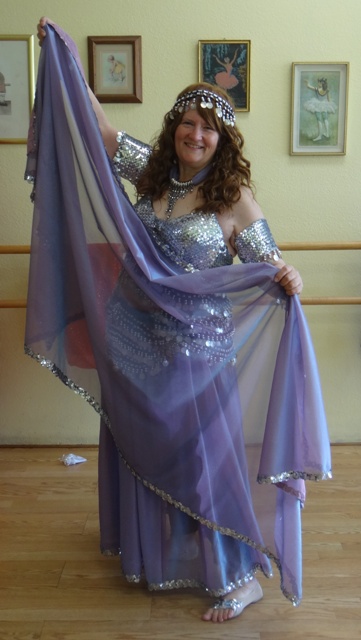
Although I took six classes from Ms. Cicy, I shared only one class with Jan, Arabic dancing. On Tuesday ballet class came first at 10:00am, and Arabic followed immediately after. While some of us were taking ballet, Jan had a different class with a different teacher, and she arrived at Ms. Cicy’s studio right after her other class, already dressed in her belly dance skirt.

Samm usually took ballet, but she missed class occasionally due to other obligations, and the morning I shot Jan’s photo was one of those occasions. A few others whom you have not yet met (I’m trying not to commit the unforgivable authorly sin of introducing too many characters at once, and I am failing miserably) came when their schedules permitted, but I’d never missed a Tuesday class. I don’t know what I hoped for — maybe grace or strength. I was too old to ever become a ballerina and I didn’t have a ballet body or even ballet feet. Ms. Cicy had to keep reminding me to point my toes, and when I stood on the balls of my feet, my heels barely lifted off the ground. Regardless of my shortcomings as a ballerina, I approached the class with all the dedication I could muster. I’d even made myself a black ballet skirt to put myself in the proper frame of mind and body.

After stowing my camera in my dance bag, I unwrapped my ballet skirt from around my waist and donned my orange and turquoise Arabic practice skirt. I stood at the barre and waited for class to begin. Samm found her place at the barre behind me.

“When did all this happen?” she asked.

I turned to face her. “When did what happen?”

“I don’t know how it all started with Jan. Was it your idea?”

Corkey had been silent during the picture taking and the between-class bustle, but now she spoke, sounding surprised at Samm’s question. “You were there. It started a couple of months ago when we all went to see the Trocks.” By “Trocks” she meant Les Ballets Trockadero de Monte Carlo, a glorious and gloriously funny all male ballet troupe. “When we were at lunch before the show, someone mentioned that Pat was a writer. Jan suggested she write a book about us and even volunteered to be the victim.”

“Oh.” Samm slid one slim leg behind her in a deep lunge and stretched her body forward. “I sat at the other end of the table that day, so I didn’t know.”

“I didn’t know either,” Marilyn said. Marilyn was a quietly cheerful woman who seemed to take everything in stride despite the major losses she had suffered. Or maybe the loss of her husband and best friend had taught her to take things as they came. Either way, she was easy to talk to and easy to be around. “My son and grandson met me that day, and I ate with them.” Her greenish eyes twinkled with pixyish delight. “Maybe we should all tell Pat a secret that will come out during the story.”

Samm continued to stretch, and Corkey drew tendus on the floor with her properly pointed feet. Their so obvious non-response to Marilyn’s suggestion made me wonder what secrets they were hiding. Was it my obligation as a writer to pry out those secrets, or did my obligation as a friend demand that I leave them alone?

To be continued here: Chapter 1e

***

Pat Bertram is the author of the suspense novels Light Bringer, More Deaths Than One, A Spark of Heavenly Fire, and Daughter Am I. Bertram is also the author of Grief: The Great Yearning, “an exquisite book, wrenching to read, and at the same time full of profound truths.” Connect with Pat on Google+. Like Pat on Facebook.

MS. CICY’S NIGHTMARE — Chapter 1c

Ms. Cicy's NighmareMs. Cicy’s Nightmare is a fictional work in progress set at a dance studio where I take classes. All the characters have real life counterparts (except perhaps me as the narrator. I’m not sure how real I am). I have everyone’s permission to use their names. Here’s hoping I end up with as many friends at the end of the project as I have now. If you’ve missed any of the story to date, you can find it here: Ms. Cicy’s Nightmare

***

Samm, a lithe woman of unknown years (unknown to me, that is) with wonderfully flawless dark skin, entered the dance studio. She was the type of woman who could randomly pull two or three unmatched items out of her closet and look as if she’d spent hours dressing herself for a Vogue photo shoot. That day she wore her purple practice skirt, which wrapped twice around her hips (mine barely wrapped once, if you must know), a maroon scarf tied into a turban-like affair, and a bluish-purple long-sleeved shirt with the tails tied at her waist. It wasn’t only her age Samm was quiet about, but her earlier years, too. Perhaps she had been a model at one time. Or maybe she had reason to be secretive — a woman with a sordid past.

Samm watched me take the photo of Jan in her death pose below the barre, then asked, “how are you going to get Jan into that exact position when she’s killed?”

“I hadn’t thought of that,” I admitted.

“Maybe she was trying to reach the barre so she could die dancing,” Samm said.

Jan gave a little laugh. “That’s too true to be funny.” Then, more seriously, she added, “Dying while dancing is how I’d like to go out. I just wouldn’t want to die on stage with all those people watching like a friend of mine did.”

Dying to Dance would be a good name for the book,” I said. “Or maybe Sashaying with Death. Or Death en Croix.

“Why does it have to be death.” Cicy said with a moue of distaste. Ms. Cicy is our teacher, a 77-year-old with the body of a woman half her age and the legs of a teenager. When she dances, you can almost see the years melt away, and she is young again.

“Maybe we could call it Ms. Cicy’s something,” I said

Ms. Cicy’s Nightmare.” Cicy giggled, sounding about seventeen. “Maybe you don’t really kill Jan. Maybe I wake up and find that I dreamt the whole thing.”

“Great title,” I said, hoping the teacher wouldn’t notice I didn’t comment on her idea about Jan’s death being a dream. It’s a time honored ending, of course, but I thought if I were going to go through the trouble of killing Jan, it should be for real.

Glee lit Cicy’s beautiful dark eyes. “I could be the murderess. I have experience.”

I felt my jaw drop. Cicy had experience with murder? It seemed impossible that anyone who danced with such expressive moves — moves that spoke of life — could have a history of violence.

“It was a murder weekend,” Cicy explained. “I was the murderess, a princess from a foreign country. I even wore a tiara.”

I blew out a breath of relief, glad I didn’t have to alter my impression of the dance teacher, at least not yet. “But why would you want to murder Jan?”

Cicy exchanged glances with Jan, who had risen and was smoothing her skirt. “Maybe she stole my choreography.”

I understood the need to protect one’s work any way one could, yet in truth, Cicy routinely gave us her choreography. Every step she taught gifted us with her work.

Still, such an irrational theft, as minor as it might seem to the danceless, could be a killing offense, especially if Jan were to give Cicy’s work to a rival instructor. (I’ve lost track of how many dance classes Jan took. Three or four from Ms. Cicy, and at least a couple more from other teachers. In the dance world, such promiscuousness could be motive enough for wanting someone dead.)

I am new to dance, but even I had experienced the deep emotions dredged up by dancing. In just a few short months, dancing had become a need, a pilgrimage, a soul quest.

“Do you know how long it will be before the cops get here,” I asked Jan, thinking how disappointed I would feel if class had to be cancelled.

“A long time. Maybe a couple of hours.”

That seemed excessive to me, but I figured Jan should know since her husband is a retired criminalist.

I looked around the dance studio. The place wasn’t large, perhaps fifteen feet wide by sixty feet long. Mirrors lined one long wall and a barre stretched across the opposite wall. A small nook at the back of the studio had been furnished as a miniscule waiting room, and a corner had been cordoned off with a counter and cabinet for an office. Pictures and posters hung on the walls, but other than that, the studio was empty.

“If we have to stay here for a couple of hours waiting for the cops, we might as well have a class,” I said. “The floor will be mostly bare since Jan’s body won’t take up much room, we’d be dressed for the occasion, and our minds would not yet have processed the truth. I like the idea of a group of aging women dancing in the face of death.”

By this time, the rest of the class had arrived. All eight women stared at me with various shades of disbelief, but I shrugged off their attitude. This was my story, my murder, and I could choreograph it any way I wished.

Jan shook her head with mock sadness. “I am truly hurt that no one will mourn me.”

“Of course, we’ll mourn you,” I told her. “But it will have to wait until after class.”

Jan smiled, but I don’t think she thought my comment funny.

To be continued here: Chapter 1d

***

Pat Bertram is the author of the suspense novels Light Bringer, More Deaths Than One, A Spark of Heavenly Fire, and Daughter Am I. Bertram is also the author of Grief: The Great Yearning, “an exquisite book, wrenching to read, and at the same time full of profound truths.” Connect with Pat on Google+. Like Pat on Facebook.

MS. CICY’S NIGHTMARE — Chapter 1b

Ms. Cicy's NighmareMs. Cicy’s Nightmare is a fictional work in progress. All the characters have real life counterparts (except perhaps me as the narrator. I’m not sure how real I am). I have everyone’s permission to use their names. Here’s hoping I end up with as many friends at the end of the project as I have now. If you’ve missed any of the story to date, you can find it here: Ms. Cicy’s Nightmare

***

Before belly dance class the next week, I asked Jan how she wanted to be killed. Since she’d initiated this lethal game, I thought it only right that she got to choose the means of her demise. So much fairer than the way life works, wouldn’t you say? I mean, few among us get to choose our own end. Life, the greatest murderer of all times, chooses how we expire, whether we will it or not.

Jan laughed at my question and said she didn’t care.

Death is often messy — and smelly — with blood and body wastes polluting the scene, and I did not feel like dealing with such realities. Besides, the murder was to take place at Ms. Cicy’s dance studio, and I didn’t want to be haunted forever after by the scent of a gruesome end for Jan. It would put a damper on the pure joy of dancing, and I couldn’t allow that to happen.

So . . . no blood, body wastes, smells, or any unpleasantness. It would be a nice gentle murder befitting our nice, gentle victim. Poison, perhaps, or a blow on the head. Neither of those means of murder would be particularly gentle on Jan, of course, but then it’s not her sensibilities I’m worried about. After all, she’d be dead and beyond such matters.

I continued to fret over motives. It seemed inconceivable that anyone would want Jan dead, but I kept on with my preparations for her murder. One day I brought my camera to class so I could take a photo of her would-be corpse lying on the studio’s wooden dance floor. When Jan walked into the studio, dressed in her green and beige silk belly dance practice skirt, I asked if she’d play dead for me. I expected to have to take several shots to get the pose I wanted, but she sank to the floor as gracefully as she did everything else, and lay in the ideal pose.

Right then I knew I could kill Jan. She was just too damn perfect.

To be continued here: Chapter 1c

***

Pat Bertram is the author of the suspense novels Light Bringer, More Deaths Than One, A Spark of Heavenly Fire, and Daughter Am I. Bertram is also the author of Grief: The Great Yearning, “an exquisite book, wrenching to read, and at the same time full of profound truths.” Connect with Pat on Google+. Like Pat on Facebook.

If You Like the Movie “Enemy” . . .

If you liked the movie Enemy, you might enjoy my novel, More Deaths Than One. Both stories are about doppelgangers of a sort. In Enemy, Adam sees his other self in “reel life” while In More Deaths Than One, Bob sees himself in real life.

Insomniac Bob Stark has returned from eighteen years in SE Asia and is sitting in a coffee shop in the middle of the night reading the current newspaper when he sees an obituary for his mother, a woman he buried twenty-two years previously. He goes to her funeral and watches the service from the shadows of a lilac bush.

Clustered with their backs to him stood a man, a woman, and six children ranging in age from about two years old to about sixteen. The obituary had mentioned six grandchildren, Bob recalled. Were these six his brother’s offspring, by an ex-wife, perhaps?

One of the children, a pudgy little boy, reached out and yanked the pigtails of the taller, skinnier girl slouching next to him. She slapped him. The next moment they were rolling on the ground and pummeling each other.

The woman turned around. “Stop it, you two.”

Bob sucked in his breath. Lorena Jones, his college girlfriend? What was she doing here? How did she know these people? He certainly hadn’t introduced her to them.

Feeling dizzy, he studied her while she scolded the children. Deep lines and red splotches marred her once satiny smooth face, and her body appeared bloated, as if she had not bothered to lose the extra weight from her last pregnancy or two. Despite those changes, she looked remarkably like her college picture he still carried in his wallet along with the Dear John letter that had ended their relationship.

Lorena nudged the man next to her. “Robert Stark, don’t just stand there. Do something.”

The man she called Robert Stark turned around to admonish the children.

Bob stared. The other Robert Stark seemed to have aged a bit faster than he, seemed more used, but the resemblance could not be denied. He was looking at himself.

Although some of the themes of the movie and my book are similar — identity, individuality, irony — my story is much easier to understand, though still surprising. Best of all, you don’t have to deal with spiders, real or symbolic.

***

Pat Bertram is the author of the suspense novels Light Bringer, More Deaths Than One, A Spark of Heavenly Fire, and Daughter Am I. Bertram is also the author of Grief: The Great Yearning, “an exquisite book, wrenching to read, and at the same time full of profound truths.” Connect with Pat on Google+. Like Pat on Facebook.

MS. CICY’S NIGHTMARE — Chapter 1a

Ms. Cicy's NighmareMs. Cicy’s Nightmare is a fictional work in progress. All the characters have real life counterparts (except perhaps me as the narrator. I’m not sure how real I am). I have everyone’s permission to use their names. Here’s hoping I end up with as many friends at the end of the project as I have now.

***

I didn’t want to kill Jan — it was her idea. I’ve literarily killed hundreds of thousands of people, so it shouldn’t have been difficult to murder one dainty older woman, but the truth is I couldn’t think of a single reason to kill her. She is charming, kind, with a smile for everyone, and the ghost of her youthful beauty is still apparent on her lovely face.

It’s not that I object to killing, you understand. I could easily kill my verbally abusive alcoholic brother, and as a matter of fact, I almost did so today. He broke my bedroom window and screamed obscenities at me while I cleaned up the glass. At one point, I hefted a platter-sized piece of glass and considered Frisbeeing it at his neck, but it seemed like too much trouble. There would not only be the glass to clean up, but all the blood and his dead carcass. So not worth it!

Besides, there’d be no mystery to his death — anyone who heard that relentless verbal assault would understand my need to kill him. The only mystery would be if I could get away with the crime.

Killing someone no one would ever have a reason to kill, like Jan — now, that would be a true mystery. And a challenge.

I blogged about the possibility of murdering Jan, of course. I blog about everything — blogging is my outlet, my support, my discipline. Readers expressed the opinion that killing off one’s friends is a good way of losing those friends, and I had to agree. Alive, Jan is so much sweeter — and sweeter smelling — than she ever would be dead. Besides, I enjoy dancing with Jan, both in the classroom and onstage. (Okay, so our class danced together on stage only once, but it was special for all that.)

The day after I decided not to kill Jan, several of us dancing classmates went to lunch together. When we turned to leave the restaurant after munching on salads and sandwiches, I accidentally swung my dance bag and narrowly missed hitting Corkey, a tanned, elegant blonde a couple of years older and a couple of inches shorter than me.

Corkey deadpanned, “I’m not the one who volunteered to be the murder victim.”

That cracked me up, and right then I decided I had to follow through with the project. I mean, really — how could I not use such a perfect line?

To be continued here: Chapter 1b

***

Pat Bertram is the author of the suspense novels Light Bringer, More Deaths Than One, A Spark of Heavenly Fire, and Daughter Am I. Bertram is also the author of Grief: The Great Yearning, “an exquisite book, wrenching to read, and at the same time full of profound truths.” Connect with Pat on Google+. Like Pat on Facebook.

Doing Things Backward

For all my other books, the story came first, and the cover was a bit of an afterthought, but for my soon-to-be-started writing project — a story of a murder that takes place at a dance studio with all my real life dancing classmates as the characters — I decided I needed the inspiration of seeing the cover. A big thank you to our victim Jan for her so elegant pose (she just sank down to the floor and there she lay in the perfect pose) and to Ms. Cicy for contributing the “Nightmare.”

Ms. Cicy's Nightmare

***

Pat Bertram is the author of the suspense novels Light Bringer, More Deaths Than One, A Spark of Heavenly Fire, and Daughter Am I. Bertram is also the author of Grief: The Great Yearning, “an exquisite book, wrenching to read, and at the same time full of profound truths.” Connect with Pat on Google+. Like Pat on Facebook.

The Science of Creating Creativity

A friend sent me an article This Is Your Brain on Writing, thinking I might get a blog post out of it, and as you can see, I did.

The article explains about research into the neuroscience of creative writing. The experiment, led by Martin Lotze of the University of Greifswald in Germany, showed a broad network of regions in the brain working together as people produced their stories, but they found a big difference between novice and professional writers. According to Lotze, the inner workings of the professionally trained writers showed some similarities to people who are skilled at other complex actions, like music or sports. They also showed more activity in the regions involved with speech, while the novice writers seemed to activate more their visual centers.

Dr. Steven Pinker, a Harvard psychologist, wasn’t convinced that the experiments provided a clear picture of creativity, saying that “creativity is a perversely difficult thing to study.”

I don’t know who is right, but I don’t quite see how this experiment showed anything about how authors write a story.

According to the article, Dr. Lotze wanted to scan people while they were actually writing. But he couldn’t give his subjects a keyboard to write with, because the magnetic field generated by the scanner would have hurled it across the room. So Dr. Lotze ended up making a custom-built writing desk, clipping a piece of paper to a wedge-shaped block as his subjects reclined. They could rest their writing arm on the desk and scribble on the page. A system of mirrors let them see what they were writing while their head remained cocooned inside the scanner.

Um, yeah. That’s exactly how I write — lying on my back with my head wedged into a neuroscanner, my arm reaching up to scribble on papers clamped to a desk I can only see through mirrors.

How could that very process of the experiment not affect the ultimate creativity of a writer? Perhaps the professional writers were more used to working under diverse conditions. Maybe they couldn’t relax enough to visualize their story, and so told it to themselves as they wrote. Maybe the novice writers were able to visualize their stories because they found it harder to actually write under such conditions. Maybe the novice writers were novices because they were involved with a whole slew of other creative mechanisms — etching or sculpting, for example. Maybe professional writers might not have time to indulge in various art forms, so were more linear. Maybe . . . well, as you can see, there are a whole lot of possible maybes not touched on in the article.

The way I see the experiment is that the scientists didn’t learn anything about true creativity in the wild, but only in captivity. Most of us create our own milieus for writing — in perfect silence or with music in the background, writing by hand in bed or sitting at a desk clicking a keyboard, whenever life permits or within strict timeframes.

We generally don’t let others to dictate how we write, and if we did allow such interference, for sure it would change our process in the same way that dancing on a miniscule stage in an informal setting is different from dancing on a vast stage with thousands of people watching, and both are different from dancing in a studio. (If it weren’t different, all dancers would be satisfied with simply dancing in their living rooms.) So obviously, one’s outer space helps determine one’s inner space, which pretty much negates the experiment since they didn’t take environmnet into consideration.

Besides, our brains are only a small part of the creative process. We write with our souls, our bodies, our very beings. And anyway, why do we need to know how our brains create creativity? It won’t make our writing better. Only writing (and living) can make our writing better.

***

Pat Bertram is the author of the suspense novels Light Bringer, More Deaths Than One, A Spark of Heavenly Fire, and Daughter Am I. Bertram is also the author of Grief: The Great Yearning, “an exquisite book, wrenching to read, and at the same time full of profound truths.” Connect with Pat on Google+. Like Pat on Facebook.

A Key to Copyediting and Proofreading

Someone asked me today how long it takes me to write a blog, and I’m sort of embarrassed to admit it takes me about three hours from start to finish. I read once that a blog should take no more than twenty minutes to write, but that doesn’t make sense to me. How can anyone write anything of worth in so short a time, especially if a bit of research is involved? Still, three hours seems excessive, though to be honest, at least half of that time is taken up with editing and proofreading.

Proofreading is a problem for all of us, whatever we write — novels, newsletters, blogs. Our brains are structured to see what isn’t there, to fill in the blanks, to rearrange letters and words to make sense. I’m ssre you hvae seen a demontrasion lkie tihs keybefroe, a clveer gcimmik ot sohw you waht I am takling aoubt — that the brain can read jumbled words as long as the first and last letters are in the right place. (At least to a certain extent — sometimes it takes a while for us to make sense of what we are seeing.) Our brains are trained to see whole words. If we have to read each letter, laboriously spelling out the word, by the time we have finished reading two or three words, we would long since have forgotten what we’d already read.

This ability to read works against us when we write, or rather when we edit or copyedit because it’s so hard to pick out misspelled words even with a spell checker, especially if the misspelling is a real word in itself. Tow and toe, for example. Or point and paint. Even worse, we see the center of things. Our brains fill out the edges, and so often, that’s where we find errors — on the top two lines of a page, the bottom two lines, the first and last word on a line.

I know a few keys to improve your copyediting. The best way, of course, is to get someone else to do it. We know what we want to say, so our text makes sense to us no matter how convoluted it is, but so often fresh eyes find mistakes we missed every time we read it. If you have to do your own copyediting, you can work from the end of the piece to the beginning — that way you don’t get caught up in the brilliance of your own rhetoric. You can pay particular attention to the edges of your text, doing the edges as a separate edit, or you can temporarily make the text a different size. If you normally use 12pt Times New Roman, switch to 14 or 16 point. That way the words that were at the edges of the page have been moved to a different place, which makes it easier to see mistakes. (You have to change the size of the font, not merely zoom to a larger view because zooming doesn’t change the placement of words.)

Using these copyediting suggestions, I can improve my text and make sure there are few errors, but doing the whole thing still takes me three hours. No wonder I don’t have time for working on my novels!

[Click here to find out Why Mistakes Happen]

***

Pat Bertram is the author of the suspense novels Light Bringer, More Deaths Than One, A Spark of Heavenly Fire, and Daughter Am I. Bertram is also the author of Grief: The Great Yearning, “an exquisite book, wrenching to read, and at the same time full of profound truths.” Connect with Pat on Google+. Like Pat on Facebook.

When Life and Writing Overlap

Many writers claim they feel compelled to write. I am not one of them. I either write or don’t write depending on whether there is anything “real” going on in my life or not. Most of the time, real life is going on, so I feel no need to write. (Except for blogging, of course. I do that every day no matter what.)

There is one thing that does compel me to write fiction and that is when a story gets in my head and writing it is the only way to clear it out of my mind.

I’ve been planning to write a story about my exercise group, and I can’t write it until I’ve finished another, non-writerly project. (I am so not a multi-tasker!) Meantime, the story goes round and round in my head as I try to figure out the logistics of the plot. For example, I thought I knew who the murderer is, but he turns out to be a secondary gunman, someone who will writingbe caught up in the police investigation. I did figure out what the victim was doing at the studio, how she got inside, when she was killed, and why she was wearing what she was wearing. The murderer is still up for grabs.

Besides trying to figure out the story, I’ve been researching what will happen to those of us who find the body. Will the cops simply take names and contact information? Will they keep us near the scene? Take us down to the police station? It’s amazing how many mysteries are from the POV of cops or the cozy little old (and sometimes cozy young) woman who is playing amateur detective. Little is written about the moment-to-moment demands on the would-be witnesses. In movies, TV shows, books, you see the witnesses, bystanders, body watchers/catchers/snatchers or whoever already talking to the cops. How did they get to that point?

I know it’s time to write the story to get it out of my head when strange thoughts start ricocheting around in my brain, thoughts like, “I don’t have to do the research to find out what will happen to us witnesses. When the cops come to the studio after the murder, I’ll be able to see first hand what they do to us.”

Yesterday I even heard myself thinking, “I better clean the house. If the cops come here, I don’t want them to know how messy I am.”

I’m sure some of these thoughts are showing up because real life will overlap fiction. The women in my dance class are all part of the story and I . . . well, I am the narrator, a suspect, possibly the amateur detective. (Someone even suggested I should be the killer. It’s a clever twist, but Agatha Christie already used the ploy in The Murder of Roger Akroyd and besides, it felt like a betrayal when she did it, and I don’t like cheating my readers.)

Whatever the reason for the stange thoughts, I’ll be glad when it’s time to start putting the story on paper and out of my head. It’s getting just a bit confusing.

***

Pat Bertram is the author of the suspense novels Light Bringer, More Deaths Than One, A Spark of Heavenly Fire, and Daughter Am I. Bertram is also the author of Grief: The Great Yearning, “an exquisite book, wrenching to read, and at the same time full of profound truths.” Connect with Pat on Google+. Like Pat on Facebook.