No words. Just tears.
In June, I finished my started projects, cleaned house, and did everything I could think of to enable me to dedicate July to writing my new novel. I wrote for five days, then life, with a mocking laugh, stole my free time.
My elderly father developed prostate complications, and while he was in the hospital, his general practitioner decided to use the opportunity to do other tests. And since my father decided he had the right to refuse any treatment, he declined to sit in a chair or walk down the hall. And so he developed pneumonia, which extended his hospitalization.
He is home now, but mostly bedridden by choice. He can still walk, but both my sister, who came to help out, and I insist that one of us be there because he refuses to use the walker. Not a problem, really. He prefers to stay in bed except when he feels the need to empty his bowels, and so often, that feeling comes from his body sending him the wrong signal or perhaps he is simply misinterpreting what he feels.
During the past few years, I’ve seen way too many people in the final stages of life — a brother, my mother, my life mate/soul mate, and now my father. The first three died of cancer, and my father is simply wasting away from old age, his once strong body slowly shutting down.
To be honest, I find the end of life horrific, both for the dying and the tortures they endure(d), and for me as a bystander and future victim. I know this is the cycle of life — conception, birth, growth, decline, death — but something in me cannot grasp (or accept) the idea of decline.
One of my favorite end-of-life scenes is from the movie Soylent Green where the sick and dying are taken to beautiful rooms and treated to a visual and musical montage of forests, wild animals, rivers, and ocean life, scenes that had long disappeared from earth because of human overpopulation. And then the sick folks were gone, peacefully and instantly. That seems a much better and more humane way to die than waiting for the body to eat itself with cancer or to begin decaying while the body is still alive. (In Biblical times, executioners would strap a dead man — the “body of death” — on to the one convicted, and as it began to decay it would begin killing the living man . . . by decomposition. So vastly different from a Soylent Green death!)
In our culture, we basically have no recourse but to let the body do what it will. And rightly so, I suppose. Who among us is wise enough to say who is to live and who is to die? I remember another story I once read where the aged mother had told her daughter she didn’t want to live as a vegetable, and if that ever happened, then she wanted her daughter to end her life. One day the mother did end up paralyzed with no means of communication, but she found a quiet joy in her greatly condensed world. And then her daughter killed her. Ouch.
My sister had a rough time with our father last night, and tonight is my turn to be on call. We got a long-range wireless doorbell and gave him the button to push when he wants us. We women move the doorbell from room to room depending on who is to answer his call. It seems strange to be handmaidens of death, but that is the role we have accepted for now.
Despite all this, I’m still hoping to work on my book a little more this month, though exhaustion — for me, anyway — is not exactly conducive to literary endeavors.
***
Pat Bertram is the author of the suspense novels Light Bringer, More Deaths Than One, A Spark of Heavenly Fire, and Daughter Am I. Bertram is also the author of Grief: The Great Yearning, “an exquisite book, wrenching to read, and at the same time full of profound truths.” Connect with Pat on Google+. Like Pat on Facebook.

After I wrote my I Wish post where I mentioned that it felt as if I were losing control, as if bits of me were floating off into the ether, a friend suggested I go to Tao Road and gather a bit of Dao, the big picture, the harmony of the whole. I couldn’t do it right away, but on Saturday night I went to Tao Road and walked far out into the desert to watch the full moon rise. It was a perigree moon, (more commonly known as a super moon), a full moon rising at its closest point in its orbit around the earth.
It was lovely. Just me, the desert floor, the knolls in the background, an immense and immensely bright yellow moon slowly creeping into view. I lifted my arms in the port de bras I’m learning in ballet, and framed the moon in the circle of my arms. For just a moment, it seemed as if the moon and I were one, and then it drifted up out of my embrace.
As I walked back to town, the moon disappeared behind a knoll, and I stopped and watched it rise again. And ten minutes later, it disappeared behind a higher knoll, and I stopped to watch it rise a third time.
Such a magical evening!
Of course, here I am again, in the hell of my life, but I have the memory of that triple super moonrise to give me light. And hope. And courage.
***
Pat Bertram is the author of the suspense novels Light Bringer, More Deaths Than One, A Spark of Heavenly Fire, and Daughter Am I. Bertram is also the author of Grief: The Great Yearning, “an exquisite book, wrenching to read, and at the same time full of profound truths.” Connect with Pat on Google+. Like Pat on Facebook.
Ms. Cicy’s Nightmare is a fictional work in progress set at a dance studio where I take classes. All the characters have real life counterparts (except perhaps me as the narrator. I’m not sure how real I am). I have everyone’s permission to use their names. Here’s hoping I end up with as many friends at the end of the project as I have now. If you’ve missed any of the story to date, you can find it here: Ms. Cicy’s Nightmare
***
“I don’t have any secrets,” Royann said. Royann is our lady in red — not only does she love the color, she is passionate, simulating, impetuous. Her zest for life keeps her on the move and keeps a huge smile on her animated face. But now, beneath her relentless optimism, I sensed a strain, as if she did indeed, have a secret she was keeping even from herself. Or perhaps the strain came from continued dealings with an ex-husband who had divorced her after forty-two years and seven children. He’d hidden their considerable assets so she ended up with only her social security and small pension, and he was trying to take those from her, too. Royann seems radiantly happy now that she’s remarried, and yet there is that telltale strain.
The exotic notes and strong percussion of Arabic music sounded in the studio. Cicy stretched with us then moved to the center of the floor and led us in a series of steps — figure eights with our hips, common motion, hip lifts, rond de jambes. Afterward, we practiced the dance we knew, the one we’d performed on stage.
As we danced, I thought how much I would miss Jan when she was gone, then I paused midstep. What the hell was wrong with me? I wasn’t going to kill Jan for real. It was a story, a game.
Ms. Cicy stopped the music. “You’re not together. When you dance in a group, Pat, the group has to act like one person. Let’s start again.”
To be continued . . .
***
Pat Bertram is the author of the suspense novels Light Bringer, More Deaths Than One, A Spark of Heavenly Fire, and Daughter Am I. Bertram is also the author of Grief: The Great Yearning, “an exquisite book, wrenching to read, and at the same time full of profound truths.” Connect with Pat on Google+. Like Pat on Facebook.
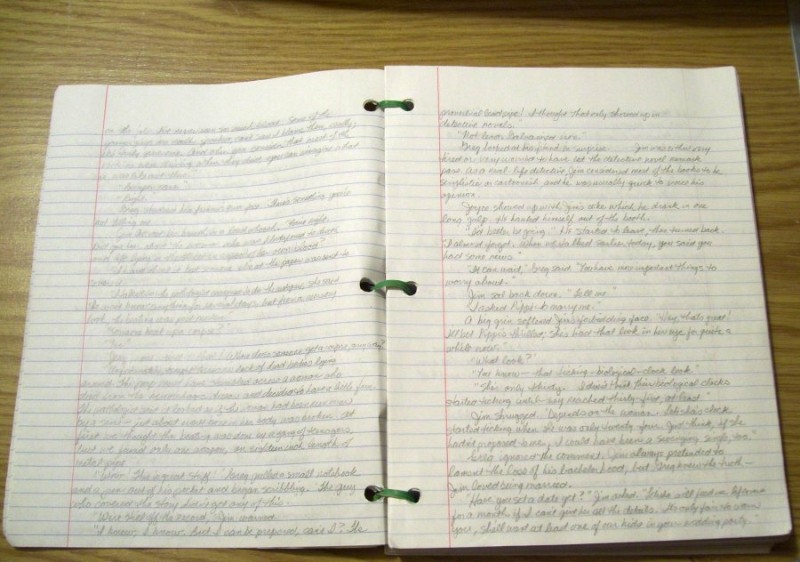
Ms. Cicy’s Nightmare is a fictional work in progress set at a dance studio where I take classes. All the characters have real life counterparts (except perhaps me as the narrator. I’m not sure how real I am). I have everyone’s permission to use their names. Here’s hoping I end up with as many friends at the end of the project as I have now. If you’ve missed any of the story to date, you can find it here: Ms. Cicy’s Nightmare
***
Although I took six classes from Ms. Cicy, I shared only one class with Jan, Arabic dancing. On Tuesday ballet class came first at 10:00am, and Arabic followed immediately after. While some of us were taking ballet, Jan had a different class with a different teacher, and she arrived at Ms. Cicy’s studio right after her other class, already dressed in her belly dance skirt.
Samm usually took ballet, but she missed class occasionally due to other obligations, and the morning I shot Jan’s photo was one of those occasions. A few others whom you have not yet met (I’m trying not to commit the unforgivable authorly sin of introducing too many characters at once, and I am failing miserably) came when their schedules permitted, but I’d never missed a Tuesday class. I don’t know what I hoped for — maybe grace or strength. I was too old to ever become a ballerina and I didn’t have a ballet body or even ballet feet. Ms. Cicy had to keep reminding me to point my toes, and when I stood on the balls of my feet, my heels barely lifted off the ground. Regardless of my shortcomings as a ballerina, I approached the class with all the dedication I could muster. I’d even made myself a black ballet skirt to put myself in the proper frame of mind and body.
After stowing my camera in my dance bag, I unwrapped my ballet skirt from around my waist and donned my orange and turquoise Arabic practice skirt. I stood at the barre and waited for class to begin. Samm found her place at the barre behind me.
“When did all this happen?” she asked.
I turned to face her. “When did what happen?”
“I don’t know how it all started with Jan. Was it your idea?”
Corkey had been silent during the picture taking and the between-class bustle, but now she spoke, sounding surprised at Samm’s question. “You were there. It started a couple of months ago when we all went to see the Trocks.” By “Trocks” she meant Les Ballets Trockadero de Monte Carlo, a glorious and gloriously funny all male ballet troupe. “When we were at lunch before the show, someone mentioned that Pat was a writer. Jan suggested she write a book about us and even volunteered to be the victim.”
“Oh.” Samm slid one slim leg behind her in a deep lunge and stretched her body forward. “I sat at the other end of the table that day, so I didn’t know.”
“I didn’t know either,” Marilyn said. Marilyn was a quietly cheerful woman who seemed to take everything in stride despite the major losses she had suffered. Or maybe the loss of her husband and best friend had taught her to take things as they came. Either way, she was easy to talk to and easy to be around. “My son and grandson met me that day, and I ate with them.” Her greenish eyes twinkled with pixyish delight. “Maybe we should all tell Pat a secret that will come out during the story.”
Samm continued to stretch, and Corkey drew tendus on the floor with her properly pointed feet. Their so obvious non-response to Marilyn’s suggestion made me wonder what secrets they were hiding. Was it my obligation as a writer to pry out those secrets, or did my obligation as a friend demand that I leave them alone?
To be continued here: Chapter 1e
***
Pat Bertram is the author of the suspense novels Light Bringer, More Deaths Than One, A Spark of Heavenly Fire, and Daughter Am I. Bertram is also the author of Grief: The Great Yearning, “an exquisite book, wrenching to read, and at the same time full of profound truths.” Connect with Pat on Google+. Like Pat on Facebook.
Ms. Cicy’s Nightmare is a fictional work in progress set at a dance studio where I take classes. All the characters have real life counterparts (except perhaps me as the narrator. I’m not sure how real I am). I have everyone’s permission to use their names. Here’s hoping I end up with as many friends at the end of the project as I have now. If you’ve missed any of the story to date, you can find it here: Ms. Cicy’s Nightmare
***
Samm, a lithe woman of unknown years (unknown to me, that is) with wonderfully flawless dark skin, entered the dance studio. She was the type of woman who could randomly pull two or three unmatched items out of her closet and look as if she’d spent hours dressing herself for a Vogue photo shoot. That day she wore her purple practice skirt, which wrapped twice around her hips (mine barely wrapped once, if you must know), a maroon scarf tied into a turban-like affair, and a bluish-purple long-sleeved shirt with the tails tied at her waist. It wasn’t only her age Samm was quiet about, but her earlier years, too. Perhaps she had been a model at one time. Or maybe she had reason to be secretive — a woman with a sordid past.
Samm watched me take the photo of Jan in her death pose below the barre, then asked, “how are you going to get Jan into that exact position when she’s killed?”
“I hadn’t thought of that,” I admitted.
“Maybe she was trying to reach the barre so she could die dancing,” Samm said.
Jan gave a little laugh. “That’s too true to be funny.” Then, more seriously, she added, “Dying while dancing is how I’d like to go out. I just wouldn’t want to die on stage with all those people watching like a friend of mine did.”
“Dying to Dance would be a good name for the book,” I said. “Or maybe Sashaying with Death. Or Death en Croix.”
“Why does it have to be death.” Cicy said with a moue of distaste. Ms. Cicy is our teacher, a 77-year-old with the body of a woman half her age and the legs of a teenager. When she dances, you can almost see the years melt away, and she is young again.
“Maybe we could call it Ms. Cicy’s something,” I said
“Ms. Cicy’s Nightmare.” Cicy giggled, sounding about seventeen. “Maybe you don’t really kill Jan. Maybe I wake up and find that I dreamt the whole thing.”
“Great title,” I said, hoping the teacher wouldn’t notice I didn’t comment on her idea about Jan’s death being a dream. It’s a time honored ending, of course, but I thought if I were going to go through the trouble of killing Jan, it should be for real.
Glee lit Cicy’s beautiful dark eyes. “I could be the murderess. I have experience.”
I felt my jaw drop. Cicy had experience with murder? It seemed impossible that anyone who danced with such expressive moves — moves that spoke of life — could have a history of violence.
“It was a murder weekend,” Cicy explained. “I was the murderess, a princess from a foreign country. I even wore a tiara.”
I blew out a breath of relief, glad I didn’t have to alter my impression of the dance teacher, at least not yet. “But why would you want to murder Jan?”
Cicy exchanged glances with Jan, who had risen and was smoothing her skirt. “Maybe she stole my choreography.”
I understood the need to protect one’s work any way one could, yet in truth, Cicy routinely gave us her choreography. Every step she taught gifted us with her work.
Still, such an irrational theft, as minor as it might seem to the danceless, could be a killing offense, especially if Jan were to give Cicy’s work to a rival instructor. (I’ve lost track of how many dance classes Jan took. Three or four from Ms. Cicy, and at least a couple more from other teachers. In the dance world, such promiscuousness could be motive enough for wanting someone dead.)
I am new to dance, but even I had experienced the deep emotions dredged up by dancing. In just a few short months, dancing had become a need, a pilgrimage, a soul quest.
“Do you know how long it will be before the cops get here,” I asked Jan, thinking how disappointed I would feel if class had to be cancelled.
“A long time. Maybe a couple of hours.”
That seemed excessive to me, but I figured Jan should know since her husband is a retired criminalist.
I looked around the dance studio. The place wasn’t large, perhaps fifteen feet wide by sixty feet long. Mirrors lined one long wall and a barre stretched across the opposite wall. A small nook at the back of the studio had been furnished as a miniscule waiting room, and a corner had been cordoned off with a counter and cabinet for an office. Pictures and posters hung on the walls, but other than that, the studio was empty.
“If we have to stay here for a couple of hours waiting for the cops, we might as well have a class,” I said. “The floor will be mostly bare since Jan’s body won’t take up much room, we’d be dressed for the occasion, and our minds would not yet have processed the truth. I like the idea of a group of aging women dancing in the face of death.”
By this time, the rest of the class had arrived. All eight women stared at me with various shades of disbelief, but I shrugged off their attitude. This was my story, my murder, and I could choreograph it any way I wished.
Jan shook her head with mock sadness. “I am truly hurt that no one will mourn me.”
“Of course, we’ll mourn you,” I told her. “But it will have to wait until after class.”
Jan smiled, but I don’t think she thought my comment funny.
To be continued here: Chapter 1d
***
Pat Bertram is the author of the suspense novels Light Bringer, More Deaths Than One, A Spark of Heavenly Fire, and Daughter Am I. Bertram is also the author of Grief: The Great Yearning, “an exquisite book, wrenching to read, and at the same time full of profound truths.” Connect with Pat on Google+. Like Pat on Facebook.

Ms. Cicy’s Nightmare is a fictional work in progress. All the characters have real life counterparts (except perhaps me as the narrator. I’m not sure how real I am). I have everyone’s permission to use their names. Here’s hoping I end up with as many friends at the end of the project as I have now. If you’ve missed any of the story to date, you can find it here: Ms. Cicy’s Nightmare
***
Before belly dance class the next week, I asked Jan how she wanted to be killed. Since she’d initiated this lethal game, I thought it only right that she got to choose the means of her demise. So much fairer than the way life works, wouldn’t you say? I mean, few among us get to choose our own end. Life, the greatest murderer of all times, chooses how we expire, whether we will it or not.
Jan laughed at my question and said she didn’t care.
Death is often messy — and smelly — with blood and body wastes polluting the scene, and I did not feel like dealing with such realities. Besides, the murder was to take place at Ms. Cicy’s dance studio, and I didn’t want to be haunted forever after by the scent of a gruesome end for Jan. It would put a damper on the pure joy of dancing, and I couldn’t allow that to happen.
So . . . no blood, body wastes, smells, or any unpleasantness. It would be a nice gentle murder befitting our nice, gentle victim. Poison, perhaps, or a blow on the head. Neither of those means of murder would be particularly gentle on Jan, of course, but then it’s not her sensibilities I’m worried about. After all, she’d be dead and beyond such matters.
I continued to fret over motives. It seemed inconceivable that anyone would want Jan dead, but I kept on with my preparations for her murder. One day I brought my camera to class so I could take a photo of her would-be corpse lying on the studio’s wooden dance floor. When Jan walked into the studio, dressed in her green and beige silk belly dance practice skirt, I asked if she’d play dead for me. I expected to have to take several shots to get the pose I wanted, but she sank to the floor as gracefully as she did everything else, and lay in the ideal pose.
Right then I knew I could kill Jan. She was just too damn perfect.
To be continued here: Chapter 1c
***
Pat Bertram is the author of the suspense novels Light Bringer, More Deaths Than One, A Spark of Heavenly Fire, and Daughter Am I. Bertram is also the author of Grief: The Great Yearning, “an exquisite book, wrenching to read, and at the same time full of profound truths.” Connect with Pat on Google+. Like Pat on Facebook.

If you liked the movie Enemy, you might enjoy my novel, More Deaths Than One. Both stories are about doppelgangers of a sort. In Enemy, Adam sees his other self in “reel life” while In More Deaths Than One, Bob sees himself in real life.
Insomniac Bob Stark has returned from eighteen years in SE Asia and is sitting in a coffee shop in the middle of the night reading the current newspaper when he sees an obituary for his mother, a woman he buried twenty-two years previously. He goes to her funeral and watches the service from the shadows of a lilac bush.
Clustered with their backs to him stood a man, a woman, and six children ranging in age from about two years old to about sixteen. The obituary had mentioned six grandchildren, Bob recalled. Were these six his brother’s offspring, by an ex-wife, perhaps?
One of the children, a pudgy little boy, reached out and yanked the pigtails of the taller, skinnier girl slouching next to him. She slapped him. The next moment they were rolling on the ground and pummeling each other.
The woman turned around. “Stop it, you two.”
Bob sucked in his breath. Lorena Jones, his college girlfriend? What was she doing here? How did she know these people? He certainly hadn’t introduced her to them.
Feeling dizzy, he studied her while she scolded the children. Deep lines and red splotches marred her once satiny smooth face, and her body appeared bloated, as if she had not bothered to lose the extra weight from her last pregnancy or two. Despite those changes, she looked remarkably like her college picture he still carried in his wallet along with the Dear John letter that had ended their relationship.
Lorena nudged the man next to her. “Robert Stark, don’t just stand there. Do something.”
The man she called Robert Stark turned around to admonish the children.
Bob stared. The other Robert Stark seemed to have aged a bit faster than he, seemed more used, but the resemblance could not be denied. He was looking at himself.
Although some of the themes of the movie and my book are similar — identity, individuality, irony — my story is much easier to understand, though still surprising. Best of all, you don’t have to deal with spiders, real or symbolic.
***
Pat Bertram is the author of the suspense novels Light Bringer, More Deaths Than One, A Spark of Heavenly Fire, and Daughter Am I. Bertram is also the author of Grief: The Great Yearning, “an exquisite book, wrenching to read, and at the same time full of profound truths.” Connect with Pat on Google+. Like Pat on Facebook.