All Is Calm, All Is Bright

All is calm in my world today, and the sun is shining brightly. There have been no storms in my life in the past few days, neither internal nor environmental. There have been no midnight trips to jail to pick up an errant sibling, no recent trips to the hospital to admit my aged father. Nothing has pushed me past my limits to where I wanted to kick someone. I haven’t had any major grief upsurges for a while, not even any minor ones. I’ve been getting enough exercise to keep my stress levels low, and I’ve been catching up on my sleep.

I don’t know how long peace will last in this King of Hearts world of mine, but for now I am enjoying the calm.

It seems strange, though, not to have much to say, especially since the word I chose for my daily resolution is “largiloquent,” meaning “full of words.” (Not a bad thing for a writer to be!) There always seems to be something — or someone — bedeviling me, giving me plenty of fodder for this blog, but at the moment, there are no jumbled thoughts I need to sort out. I have no words of wisdom, either, other than a reminder to myself that the universe is unfolding as it should, and I am where I am supposed to be — dreaming myself into the person I wish to become.
Untitled-2

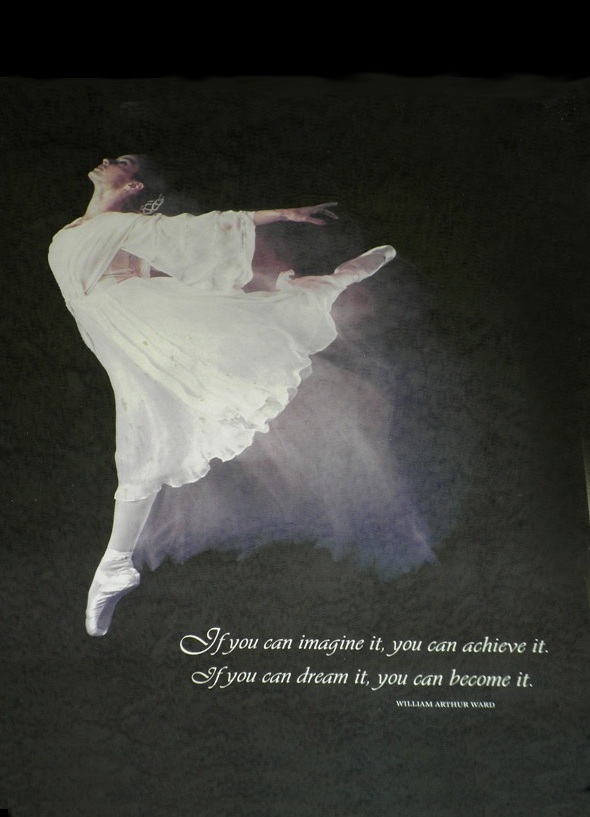
“If you can imagine it, you can achieve it. If you can dream it, you can become it.” William Arthur Ward.

***

Pat Bertram is the author of the suspense novels Light Bringer, More Deaths Than One, A Spark of Heavenly Fire, and Daughter Am I. Bertram is also the author of Grief: The Great Yearning, “an exquisite book, wrenching to read, and at the same time full of profound truths.” Follow Pat on Google+. Like Pat on Facebook.


Excerpt from LIGHT BRINGER by Pat Bertram

Description of Light Bringer:

Becka Johnson had been abandoned on the doorstep of a remote cabin in Chalcedony, Colorado when she was a baby. Now, thirty-seven years later, she has returned to Chalcedony to discover her identity, but she only finds more questions. Who has been looking for her all those years? Why are those same people interested in fellow newcomer Philip Hansen? Who is Philip, and why does her body sing in harmony with his? And what do either of them have to do with a shadow corporation that once operated a secret underground installation in the area?

Excerpt from Light Bringer:

The trail was a gentle decline, hard-packed, and free of rocks, as if it had been well traveled since time out of mind. It ended at a stream so clear its cobbled bed looked like a mosaic of semi-precious stones. On the other side of the stream, the tall meadow grasses, lavender in the mountain’s shadow, whispered softly among themselves.

Laughing, Rena caught Philip’s hand. “They’re inviting us to come play.” She ran the last few steps toward the edge of the water.

He pulled his hand away, hearing in his mind the sickening sound of ripping ligaments and tendons, and feeling the pain.

Walking carefully, he joined her by the stream.

“Too bad there’s not a bridge,” she said, “but the water isn’t deep. We can wade across.”

He put out a foot, drew it back. “You go. I’ll wait here.”

She nodded in understanding, and took his hand again. “That’s okay. I can go another time.”

They sat on the forested slope, listening to the whispering of the grasses increase in pitch as the day came to an end. After the sun set, they headed home in a rich, warm alpenglow that turned the world to gold.

***

Where to buy Light Bringer:

Second Wind Publishing

Amazon

Barnes & Noble Nook

iStore (on iTunes)

Palm Doc (PDB) (for Palm reading devices)

Epub (Apple iPad/iBooks, Nook, Sony Reader, Kobo)

Waiting for Late-Blooming Genius to Flower

I’m not a creative genius by any means, and that’s probably a good thing. A large percentage of such geniuses (77% for novelists and 87% for poets) suffer from some sort of mental disturbance — schizophrenia, cognitive disorders, depression, bipolarism, neuroses, alcoholism. I don’t even have the sort of mental dissociation that many creative non-geniuses have, such as sitting back and letting my characters tell the story, like some form of spirit writing. My characters never do anything that I didn’t intend them to do, they never take on a life of their own, they never appear to me in my dreams. They are a deliberate construct, created by carefully chosen words.

On the other hand, there is still a chance that I will end up as a one of those poor tormented souls. There are two kinds of genius — the wunderkind kind where a person is born with their genius, and the late bloomer kind where a person develops their genius through experience and trial and error. (To the extent that I have a talent for writing, mine is the late blooming kind. I tried to write a novel when I was young, but when I sat down to write, hoping the words would flow, my mind was a complete blank. Throughout the years, though, I did learn how to write.)

There is another possibility for such late-blooming genius to flower in me. Dan Chiasson, writing about poet Marianne Moore who became a star in her seventies, said “Poets often make a sudden advance with the death of their parents, as though a curfew has suddenly been lifted; for some, it happens just at the moment the imagination has stalled.”

If this “curfew” is lifted from other creative types, too, then when I am free from the responsibilities of looking after my father, my creativity could erupt. (And anyway, I used to be a poet once upon a time, so either way, the curfew lifting could be a boon.) I have the stalled imagination, that’s for sure — for several years, I haven’t been able to write much of anything except blog posts with sporadic forays into fiction writing — so who knows what will happen in the coming years. I just hope that if genius decides to descend on me, I get to keep my normalcy. I have no desire to suffer from any sort of mental disturbance. I’ll be satisfied with being just a garden-variety, everyday, creative non-genius who writes magnifient books.

***

Pat Bertram is the author of the suspense novels Light Bringer, More Deaths Than One, A Spark of Heavenly Fire, and Daughter Am I. Bertram is also the author of Grief: The Great Yearning, “an exquisite book, wrenching to read, and at the same time full of profound truths.” Follow Pat on Google+. Like Pat on Facebook.
On Writing: Get Off the Bus!

In a blog post on the Second Wind Publishing blog, author Paul Mohrbacher wrote: “At a writing workshop two years ago I heard this advice: Don’t spend time driving from one place to another in your fictional story. All you can do in a moving car is talk, talk, talk, or if you’re alone, think, think, think. It slows your story down. There is no room in a transit narrative for action. Get off the bus!” (Click here to read the rest of the article.)

trainThis is actually good advice, and yet there are many novels that take place on a trip — on trains mostly, which makes sense. A train trip is leisurely, which gives plenty of scope for both character and plot development, and is much more romantic than a bus ride.

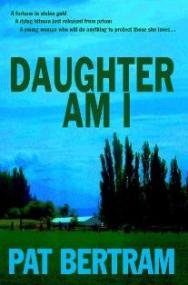
I wrote an entire suspense novel that takes place on a small bus, one that was big enough to fit eight people (because that’s how many characters I had!). In Daughter Am I, my characters are going cross country to find out who Mary’s grandparents were, why someone wanted them dead, and why her father had disowned them. Much of the story is “story time” — the characters telling about their past, and it is in these stories that Mary finds the truth. Of course, they do get off the bus occasionally, but emotion and connection are part of the “action” of a story, so as long as they are present, it’s okay for characters to stay on the bus. Also, in Daughter Am I, the drive makes it seem as if the story itself is going somewhere, not just the characters. Each leg of the trip carries with it the hope of finding the end of the quest, and instead turns them in a different direction. Literally.

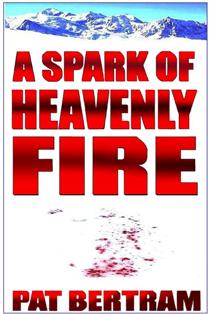
Two of my other novels also involve lengthy trips. In More Deaths Than One, Bob travels halfway around the world on a quest to find out the truth about himself, and in A Spark of Heavenly Fire,, world-famous actor Jeremy King travels to the ends of Colorado in a quest to save himself from the disease that ravaged the state and the quarantine that was supposed to keep the epidemic controlled. During each of these journeys, the characters learned more about themselves or we learned more about them and their quest, so the journeys were important to the plot.

Sometimes, though, a trip was just a place to get the characters from one place to another, in which case, I skipped any narration about the trip, merely saying they are going to a specific place and picking up the story again when they arrive.

And sometimes (though never in my stories) there is a lengthy car chase. Car chases seem to fit more with the visual construct of a movie than with a written story, because viewers see the narrow escapes and so get involved, though such chases also find their way into novels. Either way, I find them boring. In fact, they put me to sleep.

So yes, get off the car, or bus, or train, or airplane . . . except when something important to the story is happening in the vehicle.

***

Pat Bertram is the author of the suspense novels Light Bringer, More Deaths Than One, A Spark of Heavenly Fire, and Daughter Am I. Bertram is also the author of Grief: The Great Yearning, “an exquisite book, wrenching to read, and at the same time full of profound truths.” Follow Pat on Google+. Like Pat on Facebook.

A Photo of My Muse

Rubicon Ranch is a collaborative and innovative crime series set in the fictional desert community of Rubicon Ranch and is being written online by authors of Second Wind Publishing.

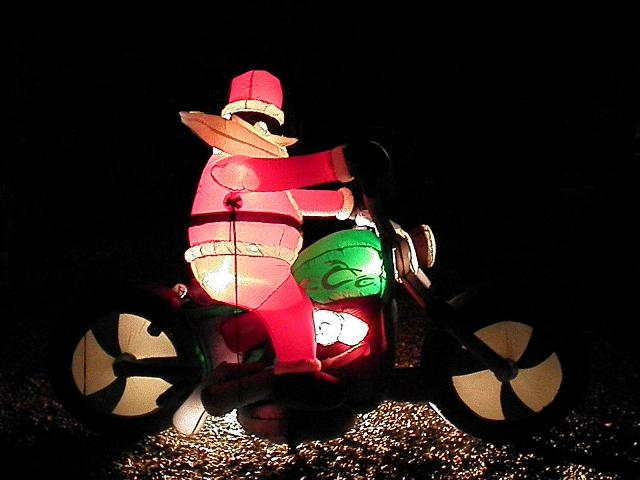
In Rubicon Ranch: Secrets, the third book of the series and our current work in progress, the body of a local realtor is found beneath the wheels of a blow-up figure of a Santa on a motorcycle. The realtor took great delight in ferreting out secrets, and everyone in this upscale housing development is hiding something. Could she have discovered a secret that someone would kill to protect? There are suspects galore, including a psychic, a con man, a woman trying to set up an online call-girl service, and the philandering sheriff himself. Not only is the victim someone he had an affair with, but he also has to contend with an ex-wife who has moved back in with him, and a jilted lover, both with their own reasons for wanting the realtor dead.

I got tired having my character, Melanie Gray, finding bodies in the desert. Since the story time ended up being around Christmas, I remembered seeing this decoration last Christmas and thought it would be an amusing scene. I didn’t have a photo, so this year I made sure to get a photo of the muse who inspired me.

***

Pat Bertram is the author of the suspense novels Light Bringer, More Deaths Than One, A Spark of Heavenly Fire, and Daughter Am I. Bertram is also the author of Grief: The Great Yearning, “an exquisite book, wrenching to read, and at the same time full of profound truths.” Connect with Pat on Google+. Like Pat on Facebook.
Happy 100th Anniversary of the Crossword Puzzle

To honor the 100th anniversary of the crossword puzzle:

crossword

Down
1. Name of Pat Bertram’s blog (2 words)
2. Prose that describes imaginary events and people
5. Author of A Spark of Heavenly Fire, More Deaths Than One, Light Bringer, and Daughter Am I (2 words)
8. Pat Bertram’s publisher (2 words)
10. The country where Bob Stark from More Deaths Than One lived for eighteen years
12. The treasure that Mary Stuart searched for in Daughter Am I
16. A written or printed work consisting of pages glued or sewn together along one side and bound in covers

Across
3. A formal assessment of a work
4. A person who has written a particular work
6. A fictional person
7. Death notice; the piece in the newspaper that catapulted Bob Stark onto his journey for self-discovery in More Deaths Than One
9. The interrelated sequence of events in a work of fiction
11. Category of a novel
13. The state that was quarantined in A Spark of Heavenly Fire
14. Archaic word processing instrument with delete capabilities
15. A book-length work of fiction
17. A person who uses penned or typed words to communicate ideas or tell stories
18. An electronic version of a book
19. Relationship of James Angus Stuart to Mary Stuart in Daughter Am I

Anyone who solves this puzzle will receive a coupon for a free ecopy of one of my books at Smashwords.com. Your choice of title! Send your responses to secondwindpublishing@gmail.com. Offer expires December 31, 2013.

***

Pat Bertram is the author of the suspense novels Light Bringer, More Deaths Than One, A Spark of Heavenly Fire, and Daughter Am I. Bertram is also the author of Grief: The Great Yearning, “an exquisite book, wrenching to read, and at the same time full of profound truths.” Connect with Pat on Google+. Like Pat on Facebook.
Excerpt From More Deaths Than One

More Deaths Than OneYesterday, while searching More Deaths Than One for references to the scent of frangipani for my post Justifying Our Sex Scenes, I happened to find the passage below. It’s been so long since I’ve looked at the book, the story seemed fresh and new, and something I’d be interested in reading. (Which, actually, is why I wrote the book — to write something I’d like to read.) Note: ISI is Information Services, Incorporated, a corporation with ties to US intelligence agencies.

Description: Bob Stark returns to Denver after 18 years in SE Asia to discover that the mother he buried before he left is dead again. At her new funeral, he sees . . . himself. Is his other self a hoaxer, or is something more sinister going on?

Excerpt:

“Here, put this on.” Bob held out a brown two-inch-wide belt.

Kerry lifted her shirt and showed him the waistband of her dark cotton slacks. “It’s elastic, see? I don’t need a belt.”

“It’s a money-belt. I got two of them yesterday, one for me and one for you. There’s ninety-five hundred dollars in each of them—”

“Ninety-five hundred dollars?” Her eyes grew round. “In cash?”

“Yes. I would have liked to get more, but that’s all we’re allowed to bring into the United States without having to fill out forms, and in our situation, that can get sticky.”

“What would happen if we brought in more than that and didn’t declare it?”

“Maybe nothing unless we got caught, but since we’re traveling with fake IDs, I’d prefer not to complicate matters. When the problem with ISI goes away, I can have some of my money wired to an account in Colorado or wherever.”

“Just some? Not all?”

“It’s safe where it is.” When she gave him a narrow-eyed look, he laughed. “I don’t seem to be able to keep anything from you. It’s in a private bank in Chinatown. Hsiang-li sponsored me, otherwise I’d have to use the same banks as everyone else, and ISI would probably have found my account by now.”

“Wouldn’t ISI have already traced the bank through your traveler’s checks?”

“My bank doesn’t offer that service. I paid cash for them at another bank that does, and since they don’t know me, that’s a dead end for ISI.”

Becoming aware he still held out the money-belt, he said, “Well, are you going to put it on?”

She took it from him, fastened it around her waist, and smoothed her shirt over it. Turning sideways to look in the mirror, she asked, “Does it make me look fat?”

“I don’t even notice it.”

She gave him a laughing glance. “Aren’t you afraid I’m going to run off with your money?”

“No. In fact, you can have it.”

She looked at him aghast. “I can’t take your money.” Reaching under her shirt, she started to remove the belt.

He put a hand on her arm. “Keep it for now. If we get separated, or if anything happens to me, you’ll need it to get back home.”

“Nothing’s going to happen to you,” she said fiercely.

He nodded as if he agreed and did not mention the sense of foreboding that made his shoulder blades itch.

***

Pat Bertram is the author of the suspense novels Light Bringer, More Deaths Than One, A Spark of Heavenly Fire, and Daughter Am I. Bertram is also the author of Grief: The Great Yearning, “an exquisite book, wrenching to read, and at the same time full of profound truths.” Connect with Pat on Google+. Like Pat on Facebook.
Justifying Our Sex Scenes

Lazarus Barnhill, a fellow author at Second Wind Publishing, is planning to rerelease his novels to include the sex scenes he removed for the sake of keeping the familial peace. I understand why he wants to include the scenes — he wishes to reclaim his literary perogative and publish the books the way he wrote them, which is as it should be. Besides, with the scenes included, the books will probably go viral.

Though I wouldn’t admit it to him, I like the books the way they are now, with the focus more on the mystery in The Medicine People and the romance in the Lacey Took a Holiday. The truth is, I’ve never been fond of sex scenes. I read for mental titillation — expanding my mind, letting my thoughts wander into the realms of what if — and sex scenes leave little scope for such meanderings.

Despite tMore Deaths Than Onehat, I did write one very graphic sex scene for my first book More Deaths Than One. The scene appalled my father (by then my mother was gone, so I never got to hear her words on the subject. Whew!), but that was an important scene in the book.

The story is about a man who is so ordinary he almost seems invisible. Everyone assumes they know him, seeing him as a reflection of themselves. And yet, he has hidden depths that only one woman, Kerry, managed to see. As Kerry told Bob, trying to explain why he interested her, “I’d like to say it’s because you have hidden depths, but your depths aren’t hidden, they’re obvious.” She chuckled. “Maybe you have hidden shallows.”

The graphic sex scene wasn’t with Kerry, though eventually they did make love. The scene was with Bob and another woman, a woman who taught him about prolonging the pleasure and satisfying a woman. If you didn’t know why Bob had such a talent, it would have been unbelievable when you discovered that such a seemingly weak man would have such discipline. The scene also set up the love scene with Kerry. The scent of frangipani had always reminded him of that first woman, and yet when he and Kerry finally got together, he realized that from now on, whenever he caught a whiff of that scent, it would remind him of Kerry, of the teasing look in her eyes, of the moment he fell in love with her. (But then, don’t we all justify our sex scenes as important to the book?)

Oddly, each of my novels had less sex in that the previous one, and the last one had none. It’s hard to write sex scenes that are consistently new and fresh, and I’d said it all in that first book.

Someone dared me once to write an erotic novel, and I even accepted the dare, at least verbally, but I doubt I will ever write the book. The only reason I can see for writing is to write what only I can write, and it’s hard to bring individuality to sex scenes. (Which is probably why bondage and masochism are so prevalent right now — they are different from what people are used to.) Still, I’m young in author terms. I’ve only written five books. Anything could linger in all those as unwritten books of mine!

As for Lazarus Barnhill’s books, I’m keeping the versions I have for now. When he gets rich and famous, those expurgated copies will be worth a fortune, and I will be set for life!

***

Pat Bertram is the author of the suspense novels Light Bringer, More Deaths Than One, A Spark of Heavenly Fire, and Daughter Am I. Bertram is also the author of Grief: The Great Yearning, “an exquisite book, wrenching to read, and at the same time full of profound truths.” Connect with Pat on Google+. Like Pat on Facebook.
A Gift for a Grief-Stricken Friend

Grief: The Great Yearning by Pat BertramI haven’t really promoted my book Grief: the Great Yearning. It seemed crass and insensitive to capitalize on people’s grief, but the book has been a big help to many who have suffered a significant loss such as a husband or a parent. If you need a gift (or a stocking stuffer) for someone who is grieving, please consider giving them a copy of Grief: the Great Yearning. It might help to bring them comfort knowing that someone else has felt what they are feeling.

The print version of Grief: The Great Yearning is available from Second Wind Publishing, Amazon, Barnes and Noble. You can even give the ebook in any format as a gift. Just go to Smashwords and click on “Give as Gift”.

If there are people on your Christmas list who like to read, please check out my other books. I’m sure they’d like at least one of them!

***

More Deaths Than OneBob Stark returns to Denver after 18 years in SE Asia to discover that the mother he buried before he left is dead again. At her new funeral, he sees . . . himself. Is his other self a hoaxer, or is something more sinister going on?

Click here to read the first chapter: More Deaths Than One

***

A Spark of Heavenly FireIn quarantined Colorado, where hundreds of thousands of people are dying from an unstoppable, bio-engineered disease, investigative reporter Greg Pullman risks everything to discover the truth: Who unleashed the deadly organism? And why?

Click here to read the first chapter of: A Spark of Heavenly Fire

***

DAIWhen twenty-five-year-old Mary Stuart learns she inherited a farm from her recently murdered grandparents — grandparents her father claimed had died before she was born — she becomes obsessed with finding out who they were and why someone wanted them dead.

Click here to read the first chapter of: Daughter Am I

***

Thirty-seven years after being abandoned on the doorstep of a remote cabin in Colorado, Becka Johnson  returns to try to discover her identity, but she only finds more questions. Who has been looking for her all those years? And why are those same people interested in fellow newcomer Philip Hansen? And what do they have to do with a secret underground laboratory?

Click here to read the first chapter of: Light Bringer

***

Pat Bertram is the author of Light Bringer, More Deaths Than One, A Spark of Heavenly Fire, and Daughter Am I.All Bertram’s books are available both in print and in ebook format. You can get them online at Second Wind Publishing, Amazon, B&N and Smashwords.  At Smashwords, the books are available in all ebook formats including palm reading devices, and you can download the first 20-30% free!

“Ordinary People Becoming Extraordinary”

Sometimes we have to laugh at ourselves and our conceits. Yesterday I wrote a blog post Whose Book Is It? about readers who saw something different in my books than I intended. I wrote:

A Spark of Heavenly FireA reader once pointed out that A Spark of Heavenly Fire was about love in all its guises. He was right, that is a major theme, though that hadn’t been my intention. I wanted to write a big book, an important book with ordinary people becoming extraordinary in perilous times. Since I didn’t want to do a war story, I did the next best thing — created an epidemic so deadly that the entire state of Colorado had to be quarantined to prevent the spread of the disease. To “personalize” the catastrophe, I told the story from several points of view, not just character POV, but the various ways the characters viewed the epidemic. And what shone through, by the time all the stories were told, was the theme of love in all its guises.

It wasn’t until this morning that I remembered that I hadn’t intended to write an important book with ordinary people becoming extraordinary in perilous times. Well, the important book part is right — I wanted to write a classic story that most people would be able to identify with. But I never used the phrase about ordinary people becoming ordinary until I received a rejection letter from an agent, in which the agent thanked me for sending them my excerpt since they “were always looking for such stories about ordinary people becoming extraordinary, but . . .”

Oddly, I don’t remember what followed the “but.” There was always a “but.” “We liked the concept of your story but we didn’t fall in love with your characters as we had hoped.” “Your book is excellent, but we only publish literary books and yours is more commercial.” “We loved your book, but we don’t know how to sell it. It has too many science fiction elements to be mainstream fiction and not enough to be science fiction.”

But I digress. The point is, that is where I got the idea of A Spark of Heavenly Fire being a story of ordinary people becoming extraordinary. I figured if I got a personalized rejection letter rather than a badly Xeroxed form letter or even just a “no thanks” scribbled on my query, that maybe I was on to something. So I started using the phrase “ordinary people becoming extraordinary” to describe the book in subsequent query letters. I did it so often that it stuck even after I learned the truth — the rejection letter that had so impressed me had been a form letter after all. (I thought that since they had expressed an interest in my writing, I’d query them about another book and got the exact response as I did the first time.)

The truth of why I wrote A Spark of Heavenly Fire is that I wanted to write about society turned upside down. I wanted to create conditions where the successful folk didn’t have the skills to be successful in the new world, but the unhappy, the failures, and the outcasts were able to find happiness, success, and fulfillment. I mostly achieved that, but one character — a beautiful young woman — turned out to have good coping skills, which gave the book more of a dimension than if she’d ended up in the gutter.

***

Pat Bertram is the author of the suspense novels Light Bringer, More Deaths Than One, A Spark of Heavenly Fire, and Daughter Am I. Bertram is also the author of Grief: The Great Yearning, “an exquisite book, wrenching to read, and at the same time full of profound truths.” All Bertram’s books are published by Second Wind Publishing. Connect with Pat on Google+