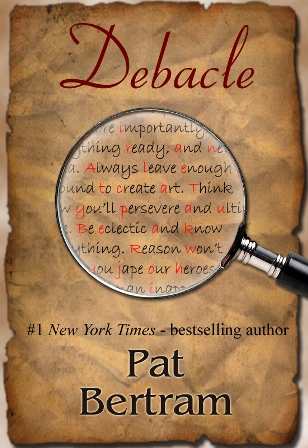
DeBacle (499 Word Contest Entry)

A couple of days ago I wrote Requiem For a Writing Contest to honor the passing of a 499-word Dan Brown tribute contest that used to be sponsored by a writing group I belonged to. Yesterday I posted a previous entry to the contest, and today I’m posting a third entry. This story snippet won a first place prize, and rightly so. The acrostic is made up of all the names of the members of the Writin’ Wombats, the group that sponsored the contest. I had fun doing the acrostic, but it took hours to come up with a message that made at least a little sense.  (FYI — FCR is an acronym for First Chapters Romance, a major writing contest with a book contract as a prize put on by Gather.com. Most of the people in the Wombat writing group met because of that contest, but I didn’t meet them until months later when I entered another first chapters contest on Gather — The Court TV Search for the Next Great Crime Writer contest. I came in about 6th or 7th, but in a round about way, because of that contest, I ended up with a book contract anyway.)

DEBACLE

Robert studied the words on the scorched document.

“Since you say it’s a victory, it’s vital I am not judged unless death intervenes. Just accept my elementary suggestions. Keep everything nice. More importantly, keep everything ready, and never destroy data. Always leave enough people around to create art. Think how you’ll persevere and ultimately live. Be eclectic and know everything. Reason won’t end now. Don’t you jape our heroes nor jail a man inappropriately. Each day and night accept joy in loving liberty.”

Four men, three Alsatians and one stray cat gave their lives to protect this message, and one woman severely burned her hand to save it from a fiery end, yet it seemed to be gibberish — the words, even the sentences made sense, but taken as a whole, they meant nothing.

The legend surrounding this fabled bit of parchment held that it contained the names of some very special people — writers who might make a difference, might even change the world. Why not? Other people had penned words that touched the hearts of millions. Of course, there was that one man whose very initials drew scorn and caused contests to be run in his dishonor, contests known only by the hated initials DB.

But this paper had nothing to do with that DeBacle. It was ancient, extending all the way back to the beginning, back to an era known by the cryptic initials FCR.

Robert sucked in a breath. Cryptic. That meant code, didn’t it? Perhaps the message was encoded. A simple substitution code perhaps. No one but he was intelligent enough to create a code more complex than that. He opened a desk drawer and pulled out a magnifying glass, intending to take a closer look at the matter, but a sound deflected his attention.

Drip. Drip.

Immediately an image formed in his mind of an albino with a severed hand, blood dripping from the stump. Wait. The albino had been in a previous book. And his hand hadn’t been severed; he’d been killed. Sheesh. How was he supposed to keep track of such details? He had more important things to do like . . . like . . . oh, yes, decode this message.

Clump. Clump.

A new sound accompanied the drip. Goosebumps covered his skin as the clumps drew closer. All the more reason to figure out the code quickly. It wouldn’t offer him immunity from a murderer, but it would give him a bargaining chip.

Drip. Drip. Clump. Clump.

No time to decipher the message now. Where could he hide it? He considered eating it — eeyuw — but once the words were digested, the meaning might still elude him.

Too late. The door burst open.

Sophie rushed inside, hair dripping, high heels caked in mud. “It’s raining out there. A day fit only for Wombats. Any luck figuring out the message?”

Heart hammering like an anvil, he managed a single word. “No.”

“Could it be an acrostic?”

“A what?”

“An acrostic. You know — you take the first letters of each word in order and see if they spell anything.”

“I knew that,” Robert said crossly. “Of course I knew that. I am a world-renowned cryptographer.”

He wrote out the first letter of each word, added appropriate spaces, and stared in amazement at the list of names that began with Sy and ended with Jill. Here was the solution! But which would be the next great wordsmith? And which, if any, would be the next DeBacle?

***

Pat Bertram is the author of the conspiracy novels Light Bringer, More Deaths Than One, A Spark of Heavenly Fire, and Daughter Am I. Bertram is also the author of Grief: The Great Yearning, “an exquisite book, wrenching to read, and at the same time full of profound truths.” Connect with Pat on Google+

The Lost Secret (499 Word Contest Entry)

Yesterday I wrote Requiem For a Writing Contest to honor the passing of a 499-word Dan Brown tribute contest that used to be sponsored by a writing group I belonged to. Today I’d like to post a previous entry to the contest. Although the entry was supposed to be a spoof of The Lost Symbol, it now seems as if it would be an interesting story in its own right. I’d have to rewrite it, of course, to lose the similarities between the beginning of this story and the beginning of DB’s, but it might be fun. Someday.

THE LOST SECRET

The secret is how to live.

Since the beginning of time, the secret had always been how to die, or rather, how to make others die — and he’d learned that secret well. Now he needed to learn an even greater secret — how to live . . . forever.

The thirty-four-thousand-year-old Voltari gazed down at the crucible cradled in his palms. It was filled with blood, the blood of all the innocents who had died that he might live.

Drink it, he told himself. You have nothing to fear. Yet he knew the truth — he had everything to fear. Without death, there is no reason to live. Without death, time yawned immeasurably. Without death . . . 

Oh, hell, just drink it.

As was tradition, he’d adorned himself in the latest ritualistic garb — well-tailored white shirt that covered his pale chest and expensive dark suit that made his thin shoulders seem broad. Around his neck hung a noose — a “power-tie” as the brethren called it.

The assembly of brothers encircling him all were adorned in the same funereal regalia. Only the color of their ties varied, from a new-bruise maroon to bright artery-gushing scarlet. Many of these men had powerful stations in life, the rest had powerful stations in death, yet the Voltari knew their ranks meant nothing within these walls. Here all were equals sharing an unearthly bond.

As he surveyed the daunting assembly, the Voltari wondered who in the outside world would ever believe this collection of beings would assemble in one place, much less this place. The room looked like a vault from a great and private banking institution in Switzerland.

The truth, however, was stranger still.

I really am in a Swiss bank vault, with gold stacked everywhere.

The Voltari’s forebears had come to Earth four hundred thousand years ago in search of the gold they needed to granulate like fine sugar and suspend above their world to keep the atmosphere from escaping into space. When the transplanted Voltari workers rebelled at the arduous and unending task of mining, refining, and storing the gold, their leaders had created a race of slave workers, which they facetiously named homo sapiens sapiens, to do the work for them.

And the humans, all unwittingly, had done their job. Most of Earth’s gold now resided in this vault and dozens like it all around the city. In days, weeks at the most, his fellow Voltaris would be arriving for the gold, and he had to make a decision. Now.

He could choose to stay on Earth and rule his financial kingdom forever, or he could choose to return to Votari and be . . . no one.

There was a third choice — not to choose, in which case he would join the ranks of the dead in the netherworld.

The secret is how to live, he reminded himself.

“It is time,” a voice thundered.

***

Pat Bertram is the author of the conspiracy novels Light Bringer, More Deaths Than One, A Spark of Heavenly Fire, and Daughter Am I. Bertram is also the author of Grief: The Great Yearning, “an exquisite book, wrenching to read, and at the same time full of profound truths.” Connect with Pat on Google+

Requiem For a Writing Contest

I entered a 499-word Dan Brown tribute contest — at least, that’s the name of it. It’s not so much a tribute but a contest to see who can present the best spoof of DB. As the Almighty Contest Administrator (ACA) wrote:

What can be said about Dan Brown? He’s one of the most successful commercial authors — not just of our generation — but of all time. He has an English degree and writes very solid sentences. For his short chapters, he is very diligent about making sure there is a hook at the end of every one of them. This makes the pace of his novels very brisk—they are a quick read. For this, he has become an extremely wealthy man. Good for him, he deserves all the comfort and luxury money can buy.

But logic in his scenarios and raw intelligence in his plot twists? Well, I suppose we’re asking too much.

I tied for first place in the DB contest, which wasn’t hard to do since there were only two entries. Two years ago, when I also won, there were thirty or more stories entered, but “everything has its time, which passes all too soon” (as the ACA’s said). The contest was for a writing group called the “Writin’ Wombats,” and so many of the members have moved on to greater glory, either becoming successful authors or publishers, or finding triumph in other businesses, that they no longer have time for such silliness.

Still, I enjoyed the writing exercise, and I’ll be sad to see the end of this contest.

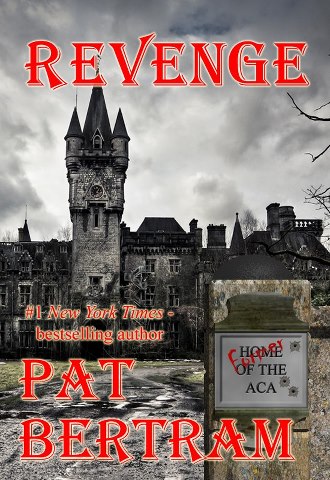
The following story snippet is my entry. (The cover for the story was created by Rand Phares, and is not now or ever will be the cover of a published Pat Bertram book. And, despite what the cover says, I haven’t yet reached New York Times bestselling author status.)

REVENGE

It was a dark and stormy night; the rain fell in torrents on Robert Langdon— except at occasional intervals when he managed to take a shortcut through an art gallery or coffee shop — and violent gusts of wind swept him onward as he struggled to flee the mermaids, rock stars, steam punks, and academics who were chasing him through the scanty streets (for it is in Mt. Vernon that our scene lies), fiercely agitating Robert who had had enough and wished his creator would kill him and put everyone out of their misery.

“Dammit,” ACA screamed. “This is not the Bulwer-Litton Contest. This is the DB Tribute Contest!” He shredded the entry and tossed the bits off his deck. Then, realizing what he had done, he looked around and sighed in relief. No one had seen this contribution to global contamination, so it didn’t count. And anyway, the entry had been written on toilet paper and would soon degrade.

The sound of pounding brought him to his feet. He hurried into the house, yanked open the front door and snarled, “What?”

A thin, bespectacled man stood there, hopping from foot to foot as if he had a full bladder. “Hurry.” The urgency in the man’s voice mirrored his behavior. “We have to leave. Now. I’m Robert Langdon.”

ACA snorted. “You can’t be. You’re so short.”

“Print adds several inches,” Robert said. “Listen. DB says you’re in serious trouble.”

“For what? Running a contest?”

“No, no. Your life is in danger.” Robert held out a hand. A few shreds of suspiciously familiar paper lay on his palm. “This message came to me, like manna from heaven.”

“And you think the message came from DB,” ACA said flatly.

“Yes. DB, the Divine Benefactor—my creator. And yours.” Although the last two words were spoken reverently, the dubious look in Robert’s eye clearly said he could not imagine DB ever being able to create such a colorful character as ACA. “Read this.” He laid the bits of paper end to end to reveal the message: aca-m-ust-flee-or-they-will-kill-him.

ACA rolled his eyes. “Those are isolated bits of a paper I just tore up. The edges of the pieces don’t even match.”

“Who cares about a few minor details? DB sure doesn’t. And you are in danger. There’s a gang of Wyverns waiting for you outside.” Apparently noticing ACA’s look of incomprehension, Robert added, “Wallabies?”

“You mean Wombats?”

“Ah, yes. Wombats. Sorry. I’m a bit dim, but I am what DB made me.”

ACA peeked outside. The Wombats were camped on his front lawn, armed with pens, netbooks, tablets—writing furiously.

“They’re planning a terrible writing accident for you. Come. We must go.”

ACA slipped out the door and followed Robert around the side of the house. He smiled to himself. He’d get even with his erstwhile friends. After this contest, he’d do another. And another. And another.

“There he is,” he heard Kat call out. “Write faster before he gets away.”

***

Pat Bertram is the author of the conspiracy novels Light Bringer, More Deaths Than One, A Spark of Heavenly Fire, and Daughter Am I. Bertram is also the author of Grief: The Great Yearning, “an exquisite book, wrenching to read, and at the same time full of profound truths.” Connect with Pat on Google+
Writing and Research: When in Doubt, Twist Things About

When you have lost your way, either in your writing or researching, twist things around, and perhaps it will help you find what you are seeking.

For example, I had to write a story for Second Helpings, the Second Wind Publishing holiday short story and recipe anthology. (Which, incidentally, has now been published. Hint. Hint.) My idea was to tell the story of a woman with an unromantic and inattentive husband. To show her discontent, she kept “poisoning” him by making his favorite fat and sugar-laden chocolate chip cookies. She had an affair with a man who seldom had time for her, and finding that she was just as unhappy, she decided to stay with the man who was present in her life. She broke off the affair, and at the end, she fed her husband cookies made with applesauce and honey instead of butter and sugar to show her change of heart. It was a nice story, but nothing special until I twisted it around and gave her live-in boyfriend the affair. (Since I was changing things, I demoted the husband to boyfriend — I didn’t want to have to deal with a possible divorce.) And then the story took off.

I always knew twisting things around in writing was a good idea, but research? Apparently twisting works for that, too. I’d spent a couple of days researching “thinking caps” for yesterday’s post, and wasn’t getting anywhere. The term only goes back a couple of hundred years (at least in print), though the term “considering cap” goes back four hundred years (again, in print).

I knew the term had to be older than that, mostly because of a gut feeling that there had actually been such things as “thinking caps” and that the term hadn’t always been rhetorical. So I got to thinking about the opposite of thinking caps, which are dunce caps, and wouldn’t you know — there was the answer I was seeking. As I said yesterday, originally dunce caps were thinking caps. The apex represented knowledge, and that knowledge was funneled through the cap to the brain. Although dunce caps stemmed from the 1200s, they were based on wizard’s caps, and went so far back into the mists of time, that there is no way to ever trace the origin.

It gave me a thrill when I realized that my intuition about the relationship between dunce caps and thinking cap was correct. Now, when I can’t find the answer I want, I will look at the opposite.

So, when in doubt, twist things about.

***

Pat Bertram is the author of the conspiracy novels Light Bringer, More Deaths Than One, A Spark of Heavenly Fire, and Daughter Am I. Bertram is also the author of Grief: The Great Yearning, “an exquisite book, wrenching to read, and at the same time full of profound truths.” Connect with Pat on Google+

Put On a Thinking Cap to Help Increase Creativity

The phrase “thinking cap” or “considering cap” goes back at least 400 years, probably much longer since by the time it first appeared in print, the phrase needed no definition. Most people assume the cap has always been metaphoric, but donning a real cap can help focus one’s thoughts.

In an odd twist, “dunce cap,” which has become synonymous with stupidity and foolishness, started out as a thinking cap. John Duns Scotus, a master philosopher born in 1266 in Duns, Scotland, believed that wearing a high conical cap helped funnel knowledge to the brain. (He’d noted that wizards wore them.) In the 1600’s, when his philosophies were ridiculed as foolish and obtuse, the dunce cap became known not as thinking cap but a fool’s cap.

Scientists today have created a high-tech thinking cap that stimulates the brain and seems to increase creativity, but you don’t need hi-tech devices. If you are dealing with writer’s block, for example, you can use colored caps.

How color vision actually works is still a mystery, but there is no mystery about the profound effect color has on human physiology. Red tends to raise blood pressure, increase pulse rate, and excite brain waves. Blue tends to have the reverse effect, and green tends to be neutral.

So, if you wish to increase your creativity, try a little color therapy. It can’t hurt; at the very least it will give you something besides your computer screen or those same old walls to stare at. And it has the benefit of being exceedingly simple. All you have to do is choose your color from the following list, wear it, hang it on the wall, find a knickknack or a bouquet of flowers that color to put on your desk, then focus on it.

Purple will boost your creativity, and help stimulate your intuitive abilities.

Yellow can help you feel optimistic if your blockage is making you anxious and depressed. It can also induce enlightenment, which is what you are looking for.

Dark blue encourages meditative thinking, so it’s especially helpful if are having difficulty focusing.

Green helps promote harmony if your inability to write is making you irritable.

Red will energize you if you’re too tired to think.

Even if the color therapy doesn’t bring about the effect you wish, playing around with all those colors will give your mind a rest from writing, and perhaps when you return to your keyboard, the problem will have resolved itself.

A couple of other suggestions to cap off this article: you can give your character a thinking cap, such as Sherlock Holmes’ deerstalker cap, which might help you refocus on your story.

Or you can forget writing altogether, put on any hat, go for a walk and let your thoughts wander — that’s what I do.

***

Pat Bertram is the author of the conspiracy novels Light Bringer, More Deaths Than One, A Spark of Heavenly Fire, and Daughter Am I. Bertram is also the author of Grief: The Great Yearning, “an exquisite book, wrenching to read, and at the same time full of profound truths.” Connect with Pat on Google+
A Legacy of Words

Early in the twentieth century, Ivar Kreuger, a match manufacturer, managed to corner the match market. Through various deals, he ended up with the exclusive rights to sell matches in many countries, including most of Europe, but this monopoly was not enough for him. Back then, it was a common practice for two or three people to light their cigarettes from the same match. Ivar realized that if he could somehow keep that third person from using the match, he could greatly increase his sales, so he had his advertising department start the rumor that it was unlucky to light three cigarettes from the same match. Tales were told of dreadful things happening to the third person who used a match, like the bride who had been left at the altar and the soldier who was killed after each had lit a cigarette from a match that two others had already used. Even today, though most people use lighters, the superstition that it’s unlucky to light three cigarettes from the same match persists.

Kreugar’s story shows the power of words, but how many of us use them wisely? We toss out words as if they were as ubiquitous as dandelion fluff and as valueless, yet words have the ability to affect the speaker just as much as they affect the listener. For example, saying “I love you,” not only makes the recipient feel good, it makes the speaker feel good, and it intensifies the bond between the two people. Screaming, “I hate you” effectively disconnects us from ourselves as well as the other person.

The realization that the words can change us as writers as well as others is making me think about my responsibility as writer. If words are so powerful that they can change readers and writers both, then they deserve my best. I don’t think I’ve achieved my best. At least, I hope I haven’t. Once you have achieved your best, you have no place to go but down, and in many respects, I am still at the beginning of my journey as a writer. Supposedly, a writer doesn’t reach maturity until after s/he has written a million words, and I am still far short of that, even including blog words. (Because, though I tend to forget, blogging is writing, too.)

Still, no matter how much better I get at writing, I don’t think I will ever achieve the success with my words that Ivar Kreuger did, and that’s okay. The legacy of his words is a lie. I would prefer the legacy of my words to be a truth.

***

Pat Bertram is the author of the conspiracy novels Light Bringer, More Deaths Than One, A Spark of Heavenly Fire, and Daughter Am I. Bertram is also the author of Grief: The Great Yearning, “an exquisite book, wrenching to read, and at the same time full of profound truths.” Connect with Pat on Google+
Kill Your Darlings or Murder Them

“Kill your darlings,” is a quote by Stephen King. No, it was William Faulkner. No, it was Agatha Christie. No, it was F. Scott Fitzgerald. Well, of course, they all said it, but the first use of the construction appeared in print a hundred years ago by Sir Arthur Quiller-Couch, who urged wannabe writers to murder their darlings. (Quiller-Couch was the inspiration for Rat in “The Wind in the Willows.” It’s amazing the things you can find out with a bit of research!)

By definition, darlings — those parts of our manuscripts that we love even when they serve no purpose — are painful to kill, but some are more painful than others. Originally, More Deaths Than One was designed to be a series of stories told to Bob Stark (so named to remind me that he seems an ordinary fellow, but is stark of speech). It was through listening to the various stories that he was to discover the truth about himself, but though the idea had merit, the first draft was terrible. Bob barely surfaced in his own story, and the storytellers themselves seemed disembodied. I rewrote the book several times, trying to find the right way to tell the story, but it wasn’t until the fourth draft when I gave Bob a love interest, a waitress he met at a coffee shop, that the story took off. He had someone to butt heads with, someone to ooh and aah over his achievements, someone to be horrified at what had been done to him.

After the story took focus, the original idea of Bob learning about himself from tales told to him had to be scrapped, and some of those darlings were so difficult to kill that although I removed them from the book, I couldn’t delete them permanently.

This painfully mudered darling is set it in Vietnam, but the incident it is based on took place during World War Two. The story is being told to Bob (Sarge) by his journalist friend, William Henry Harrison.

***

I heard about this kid, a gentle kid, really. He was tall, broad in the shoulders, good-looking, with reddish-gold hair. But what really made him stand out was his smile. He always smiled.

This kid was so thrilled to be doing something for his country that nothing bothered him, not even the climate. Since he was a swamp rat from Louisiana, he felt right at home.

He came from a very large, very poor family who never had enough food; when he was drafted into the army, he felt as if he had won the lottery. He always had plenty to eat and, compared to the meals he had grown up with, it seemed like haute cuisine. He even loved the c-rations, including the ones that everyone else threw away, like ham and lima beans.

He was delighted with his government issue clothes, too. In his entire life, he had never worn anything new or had boots that fit. He felt like a king. No matter what happened, it was better than his life back in the swamps of Louisiana, and he could not help smiling.

His platoon was stationed near a Vietnamese village. Those people hated the Americans, but for some reason they took a liking to this smiling kid. They called him Wa-ky number one. Wa-ky was what they called the Americans, and number one meant the best. They also called him dinky-dao, which means retarded or mentally ill, because he was always smiling. They thought it was the funniest thing that the best American was dinky-dao.

The one person who hated the kid was his sergeant, a really nasty piece of work, who felt he was being mocked by that constant smile.

One day, in a fit of anger, the sergeant took an empty sandbag, and made a crude mask by cutting holes for the eyes and nose. He yanked it over the kid’s head, and snarled, ‘I never want to see your fucking smile again.’

When the kid removed the hood, he was still smiling — he thought it had been a joke. This really infuriated the sergeant. He slammed the butt of his rifle into the kid’s face, grabbed the hood, and jammed it back on the kid’s head, screaming, ‘I’ll kill you, you motherfucker, if you ever take this fucking bag off again.’

After a few days of wearing the hood, a change came over the kid. He would wade into the center of a battle and just let loose as if he thought he were invincible, or as if he no longer cared whether he lived or died. Afterwards, he would bayonet the dead bodies and mash their faces with the butt of his M-l6.

All of this made the sergeant very nervous. He ordered the kid to take off the hood. The kid refused.

As time went on, the man in the hood — you notice I say man, Sarge? That’s because there was nothing left of the kid he once was — got more and more out of control. He would go off by himself to hunt VC, and would return wearing a necklace of still-warm ears. Everyone was scared of the man in hood, particularly the sergeant, who was certain he would be fragged, but the man just ignored them and went about his job of methodically eliminating the VC.

Finally the time came for the man in the hood to be rotated out. That morning he arose, casually took off the hood, folded it neatly, then packed it with the rest of his gear.

Everyone gasped in shock when they saw him — his face was hideously deformed. When the sergeant had butt-stroked the kid, he had destroyed the kid’s left cheek and orbital bone, and they had never been repaired; no one even knew that he had been badly injured.

He still had a smile on his face, however, but this time it was the rictus of pain, or of death.

And his eyes . . . You’ve heard of the thousand yard stare, Sarge? This was a ten thousand-yard stare, as if the man in the hood had looked too long into hell, and now hell was all he knew.

***

Pat Bertram is the author of the conspiracy novels Light Bringer, More Deaths Than One, A Spark of Heavenly Fire, and Daughter Am I. Bertram is also the author of Grief: The Great Yearning, “an exquisite book, wrenching to read, and at the same time full of profound truths.” Connect with Pat on Google+
When Describing Your Characters, Don’t Forget Their Hands.

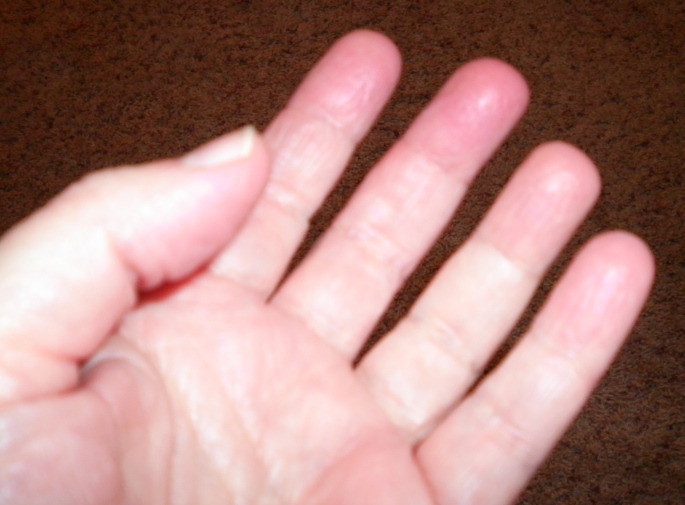
I’m not sure it’s true any more that a picture is worth a thousand words considering that a thousand words takes up only a few kilobytes of computer memory while a good high resolution picture takes up three to four megabytes. And anyway, it doesn’t take a thousand words to describe something so that it becomes real. It takes only a few words, if they are the right words, to create vivid portraits. The secret is to choose significant details — details that mean something, that promote the story, that evoke emotion — rather than to write long passages of trivia.

Take hands for example. By describing a character’s hands, we can describe the character. A man with manicured and buffed fingernails is different from one with grime permanently etched into his cuticles. A woman with bitten fingernails is different from one with dirty, broken nails, and both are different from a woman wearing designer acrylic nails. The color of nail polish a woman chooses tells us about her character. And clear nail polish on a man would tell us about his character.

We can describe hands in many ways: claw-like, thin, scrawny, big-knuckled, blue-veined, plump, fat, chubby, arthritic. Characters can have tattooed hands. They can wear gloves, a simple wedding band, or multiple rings on each finger.

Hands also do things. They wave, point, gesture, touch chins or noses, and each of these gestures and mannerisms tells us about the character. Hands can slap another character or caress a cheek, and such actions tell us about the relationship between the characters.

Here are a few examples of hands and what they do, taken from Light Bringer,.

The kid smoothed his neatly combed hair, swung his callused hands front to back as if he didn’t know what to do with them, then stuck them in his pockets.

Arthur Shillitani took his thin, long-fingered hands off the controls and slicked back his dark hair.

Rena studied her hands. . . . They were paler than usual, making the blue veins seem more prominent, and the nails were in need of a clipping, but otherwise they looked like the hands she’d lived with for the past thirty-seven years. What made them different from anyone else’s? What made her different?

Some examples from More Deaths Than One:

The staff sergeant was only 5’9” or 5’10”, but he had a powerful build with thick wrists, a massive chest, and hands that looked able to crush a larynx without any effort at all.

No one who crossed the threshold had the pampered arrogance of Evans’s men or the soft hands of a corporate drone.

The backs of his hands were crepey and mottled with age spots, but he seemed only about ten years older than Bob.

Kerry folded her hands primly in her lap, but her body seemed to vibrate with suppressed excitement.

And a couple of examples from Daughter Am I:

Mr. Browning shuffled through the papers on his massive black walnut desk. His age-mottled hands moved slowly, as if weighted by the six turquoise rings he wore.

Not hearing Happy, she looked back — he was heading her way, fumbling with his gun. He seemed to be trying to point it at the woods, but his hands shook so badly, the weapon wobbled all over the place.

So, when describing your character, don’t forget their hands. Hands make the character.

***

Pat Bertram is the author of the conspiracy novels Light Bringer, More Deaths Than One, A Spark of Heavenly Fire, and Daughter Am I. Bertram is also the author of Grief: The Great Yearning, “an exquisite book, wrenching to read, and at the same time full of profound truths.” Connect with Pat on Google+
Genre vs. Traditional Fiction

Yesterday I wrote about traditional stories, the kind of untagged, unlabeled, uncategorized and ungenrefied fiction we grew up on. There used to be certain sections for genres in libraries and bookstores, but most books were shelved alphabetically under “fiction.” I read all types of books without discrimination, but I found the most satisfying books not with the genre stories, but in with the general fiction. And that’s the kind of book I tried to write.

I don’t know why genre became the core of the book business rather than the peripheral it once was, but it’s probably because of marketing — as one editor who rejected Light Bringer told me, “I loved the story, and your writing is excellent, but I don’t know how to sell it. It doesn’t have enough science fiction elements to be science fiction, and it has too much science fiction to be anything else.” (The truth is, Light Bringer was never meant to be science fiction. It a traditional story based on both modern conspiracy theory and the Sumerian cosmology, though I admit, it does have elements that are construed as science fiction. Luckily, I eventually found a publisher who publishes traditional fiction as well as genre.)

I don’t know what came first — readers’ need to buy books that fit into certain categories or book marketers’ need to funnel readers into those categories, but it doesn’t really matter. Either way, this genreization of the book business makes me an outsider, both as a reader and a writer. I have a hard time sorting through the 130,000,000 million books available to find ones I want to read, and I have a hard time fitting my books into the available genres. (When I have to give a category, I say “conspiracy fiction.” That’s not a genre, or at least I don’t think it is, but it gives me a pithy and realistic way of labeling my books.)

The hardest of my books to categorize, besides Light Bringer, is More Deaths Than One. It has many of the elements of a thriller, but the story is not about what happened to the main character (Bob) but who is he and how he reacts to what happened to him. In a thriller, there should be some sort of showdown between the hero and villain, but in More Deaths Than One, that showdown is given to an offscreen character, and Bob hears of it second hand. Some readers think the scene is a cheat. Even I think it’s a cheat, or rather I would think so if More Deaths Than One was a thriller. The hero should always be the one who performs the decisive action in the story, but in this case, the decisive action is not the discovery of the truth, but how Bob and Kerry (the woman he loves) deal with that truth.

I could have had the showdown and then Bob and Kerry’s scene afterward, but then their scene becomes anti-climactic. I could have had the two scenes concurrent — the showdown and their reactions, but there is no way Bob would have opened up to her with a dangerous creature in the room. And most of all, he would never have brought her to the attention of the villain since he would have wanted to protect her at all costs.

You’d think that with the emphasis on the two characters that More Deaths Than One is romantic suspense, but it is far more than that (and far less. Those who have read it for romantic suspense don’t like it because the romance isn’t forefront. Nor is the conflict a romantic one — Bob and Kerry get along from the beginning). More Deaths Than One is traditional fiction — a story that demanded to be written in a certain way, regardless of any genre conventions.

As Mickey Hoffman, author of School of Lies and Deadly Traffic, said, “What are you waiting for? Read this book. Now. More Deaths Than One is much better than any ‘bestseller’ out there. The plot is constantly surprising and intricate, the characters draw you into the tale and the overall writing is top notch.”

***

Pat Bertram is the author of the conspiracy novels Light Bringer, More Deaths Than One, A Spark of Heavenly Fire, and Daughter Am I. Bertram is also the author of Grief: The Great Yearning, “an exquisite book, wrenching to read, and at the same time full of profound truths.” Connect with Pat on Google+

The Kind of Fiction I Grew Up On

On Malcom Campbell’s blog post yesterday, BOOK BITS: ‘Black Beauty,’ Plagiarism, Donna Small, Larry McMurtry’s ‘Custer,’ Book stories for the election, he described “traditional fiction” as the kind of fiction we grew up on before novels started getting whittled down to novella-lengths and forced into marketing categories. Dare I say, literary fiction is what’s left after publishers and booksellers have sliced and diced readers and books into every possible pigeonhole, slot and category they can possibly imagine? We are, I think, so scared of making our own decisions about what we read these days, that we cannot pick up a book without knowing how it’s been tagged, labeled, categorized and genrefied.”

Ah! Now I have a term for the sort of fiction I write, and it’s the perfect term — traditional fiction. My novels are not genre fiction in any way, and those who try to fit the stories into such pigeonholes end up not liking them. There is not enough romance for the romance readers, not enough horror for the apocalyptic crowd, not enough villainry for the thriller lovers, not enough grue for the horror aficionados, not enough science or fantasy for the scifi folks.

Each of those elements has a place in my books, of course, since each aspect is part of the story’s big picture (in the same way those elements make up the big picture of our lives), but none overwhelms the basic intent of my stories, which is to tell a satisfying tale with archetypal characters and classic themes that can last beyond the fads of the day. In other words, a traditional novel.

In A Spark of Heavenly Fire, for example, there is plenty of horror, such as the gruesome end of those afflicted with the red death, but generally the horror is more subtle than visceral — empty streets instead of bodies piled everywhere, struggles to maintain a semblance of normality instead of rioting. The experiments done on humans during both the hot wars and the cold wars twentieth century are not experienced first hand by the characters, but the slow reveal of those old horrors affect them deeply nonetheless.

A Spark of Heavenly Fire explores the theme of love in all its guises, not just romance, but friendship, caring, trust. There is love mixed in the villainry, too, because someone had to have lovingly created the organism that caused the red death. Unlike genre stories, there is no hero trying to stop the villain before he can release his “baby.” The deed had been committed before the story even began. We don’t see the story from the villain’s eyes as in a thriller, and it’s only at the end that we realize with what love and glee the villain had set his creation free.

More than horror or history, romance or mystery, A Spark of Heavenly Fire is the story of ordinary women who found only failure in the ordinary world where everyone else seemed to find success, but when the world turned upside down, they found their place and their worth, and they came alive. As Washington Irving wrote, “There is in every true woman’s heart, a spark of heavenly fire, which lies dormant in the broad daylight of prosperity, but which kindles up and beams and blazes in the dark hour of adversity.

This is the kind of fiction I grew up on as a reader, the sort of traditional story that digs deep so that what affects the characters also affects the readers, the sort of ungenrefied story I have always loved. And it’s the kind of fiction I grew up on as a writer. It was halfway through writing A Spark of Heavenly Fire that everything clicked and I became a writer.

***

Pat Bertram is the author of the conspiracy novels Light Bringer, More Deaths Than One, A Spark of Heavenly Fire, and Daughter Am I. Bertram is also the author of Grief: The Great Yearning, “an exquisite book, wrenching to read, and at the same time full of profound truths.” Connect with Pat on Google+




