
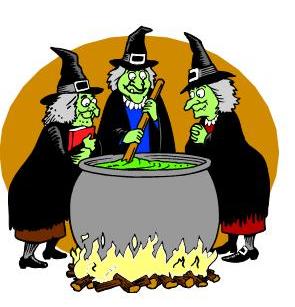
The Queen of the Witches by Pat Bertram — A Halloween Fable Just for Fun

Once upon a time,
Long ago and far away,
Lived the queen of the witches,
Griselda the Gray.
If you think all witches are tall and thin,
You are wrong about that.
Griselda the Gray was short
And extremely fat.
Like everyone else,
Griselda tried to be good.
Griselda never did anything bad
Like normal witches should.
This upset the other witches
Because they had to copy their queen.
They had to be nice
When they wanted to be mean.
So they all got together
And mixed up a brew.
They gave it to Griselda
When they were all through.
The brew was so rotten
Griselda had a fit.
She screamed and yelled
And hollered and bit;
She howled and cackled
And made such a noise
That the other witches were happy
And began to rejoice.
“Griselda is bad
And we are glad.
Griselda is ghastly
So now we can be nasty.
Oh, what a happy, horrible day!
Hurrah for our queen, Griselda the Gray!”

The moral of this story is that witches should
Never try to be very good.

***

Pat Bertram is the author of the conspiracy novels Light Bringer, More Deaths Than One, A Spark of Heavenly Fire, and Daughter Am I. Bertram is also the author of Grief: The Great Yearning, “an exquisite book, wrenching to read, and at the same time full of profound truths.” Connect with Pat on Google+
Have a chilly, scary, rationally-explained Halloween!

Please welcome JJ Dare, friend and fellow Second Wind author. JJ writes thrillers (False Positive and False World), and is one of the collaborators on the Rubicon Ranch serial. Her Rubicon Ranch characters amuse me because they are so unrepentently manipulative and unabashedly malevolent. (How can they not be with such a father as Morris Sinclair?)

Personally, I don’t like to be scared — it’s too . . .  scary — so I invited JJ  to talk what scares us and why we like to be scared:

Along with countless others, I love a good scare and this time of the year is perfect for terror and thrills. Halloween is right around the corner. Ghosts, goblins and zombies reign over the land. Witches, warlocks and evil fairies lurk around sharp corners. That bump-in-the-night sound makes your heart beat faster. The skittering across the floor in a dark room gets the blood pumping. What is that shadow outside flitting across the top of the window?

Why do we love to be scared? It’s a rhetorical question because the answer for one person is probably different for another. For myself, I like the rush of the initial terror followed by a reasonable explanation for the scare. That bump-in-the-night was a cat jumping on a chair that lightly hit the wall. The skittering noise was the dog’s nails clicking on the tile floow when she trotted down the hallway. The shadow was a low-flying owl, circling the window as the two animals took turns taunting him from their inside safety.

It’s a full moon every night for Weredog

Blame the inside animals. That’s what I did the other night. While I like the scares while I’m awake, I’m not so crazy about being abruptly ripped from a deep sleep by noises at night. I don’t like lying in bed for minutes that seem like hours, waiting for that thing under my bed to slowly crawl out and grab me. I don’t dare step onto the floor else I’ll be pulled into the under-the-bed void of my childhood.

As sanity and focus slowly descend, we can laugh at ourselves for our fright. A carryover from childhood, I occasionally have a dream of the purple monster rising in my bedroom window. The fright it gave me at six years old is remarkably the same at my current older age. As it slowly rises up, the malevolence it emanated decades ago is just as strong today. In my nightmares, I know it’s no good but I’m as powerless to stop it now as I was in my single-digit years.

The stories I create in my mind from the scary things happening at night become the roux for some of my written works. While I don’t always keep the story line tight with the dream, I can trace a few of my stories and books to their chilly beginnings from the bumps-in-the-night I experience.

I like to be scared. I love scary movies, thrillers, zombies, flying monkeys, and the like. Shadowy things at night give me delicious chills. The supernatural is delightful – as long as I can explain it away, rationally, in the light of day.

Have a chilly, scary, rationally-explained Halloween!

~~~~~~~~~~~~~~~~~~~~~~~~~~~~~~~~~~~~~

J J Dare is the author of two published books, several short stories and triple digit works-in-progress.

Current enthusiasm is sharpening intangible knives and co-authoring at Rubicon Ranch

***

J J Dare is the author of two published books, several short stories and triple digit works-in-progress.

Current enthusiasm is sharpening intangible knives and co-authoring at Rubicon Ranch

Facebook addiction

If You Don’t Have a Dream, How You Gonna Have a Dream Come True?

Do we need to have a dream? It seems to be the consensus that yes, we do. As Harper’s Bizarre once sang, “You gotta have a dream. If you don’t have a dream, how you gonna have a dream come true?”

A friend is close to achieving her dream of living by the sea and writing the livelong day. She just needs to wait a bit to make sure her sales will remain steady before she quits her day job. She attributes her dream coming true to talking about it, planning it, visualizing it. This is the way many people make their dreams come true, and it seems to work, but what if, like me, you only have vague longings rather than a concrete dream?

I would like to have a dream, to work toward something I am passionate about, but so far such passions elude me. I’d like to make a living off my books, of course. Do you notice I said “off my books” rather than “from writing”? Almost anyone can make a living by writing nowadays if they write sexy romances or mystery series and churn out two to four books a year, but I am a slow writer with few ideas. I average one book every two years, and to increase my output, I’d have to write all day every day and far into the night. Even if I could dredge up all the necessary words, I’d have to contend with the physical hardship of sitting in one place for hours on end. Besides, I don’t like romances or series of any kind. And, unlike my friend, I have no interest in spending all my time writing. There is still real-world living I have to do before I can totally immerse myself in fictional worlds.

Outside of wanting to make a living off my books, I have no real dreams. Never have had. I want, of course, but I want something greater than my imaginings. Something so wonderful or awesome that my life becomes transformed.

As a child, I loved the mystique of presents. There was the possibility of getting the gift I always wanted but didn’t know I wanted. Oddly, the most disappointing gifts were when I received what I asked for. As an adult, I don’t want to limit my dreams to what I know to ask for. I want the perfect dream — the life I always wanted but didn’t know I wanted. The problem is, if I don’t know what that dream is, if I can’t imagine it, how can I make it come true?

All I know is that I need to find a way to open myself up to the possibility of surprises. So far, I’m doing this by exploring my inner and outer worlds — searching for ways to connect more deeply to life, being present here in the now, being me. Perhaps one day, as I continue to grow and develop, I will find the surprises and unknown wonders that I have to believe are waiting for me.

***

Pat Bertram is the author of the conspiracy novels Light Bringer, More Deaths Than One, A Spark of Heavenly Fire, and Daughter Am I. Bertram is also the author of Grief: The Great Yearning, “an exquisite book, wrenching to read, and at the same time full of profound truths.” Connect with Pat on Google+

The Grim Origin of the Grim Reaper

Scholars trace the origin of the Grim Reaper to ancient times where he was known as Cronus to the Greeks and Saturn to the Romans, but the Grim Reaper as he is depicted today comes directly to us from the Middle Ages and the Black Death.

According to William Bramley, author of The Gods of Eden: “In Brandenburg, Germany, there appeared fifteen men with ‘fearful faces and long scythes, with which they cut the oats, so that the swish could be heard at great distance, but the oats remained standing.’ The visit of these men was followed immediately by a severe outbreak of plague in Brandenburg. Were the ‘scythes’ long instruments designed to spray poison or germ-laden gases?

“Strange men in black, demons, and other terrifying figures were observed in other European communities carrying ‘brooms’ or ‘scythes’ or ‘swords’ that were used to sweep or knock at people’s doors. The inhabitants of these houses fell ill with plague afterwards. It is from these reports that people created the popular image of death as a skeleton, a demon, a man in a black robe carrying a scythe.”

The Black Death began in Asia and spread to Europe between 1347 and 1350 where it killed over 25 million people, 1/3 of the population.

Despite the current belief that rats in overcrowded cities spread the plague, many outbreaks occurred during the summer in uncrowded conditions. And not all outbreaks were preceded by rat infestation. In fact, most outbreaks seemed to have nothing to do with an increase in rodent population. Nor were outbreaks confined to urban areas. The plague often struck isolated human populations which had no contact with infected areas.

Many people in stricken areas reported that outbreaks of the plague were caused by evil-smelling mists. Bright lights and unusual activity in the skies frequently accompanied these mists. And sometimes, a mist was seen to be coming from rocket-like airships. Not only did these mists kill people; they killed trees and destroyed the fertility of the land.

People were warned: “If newly baked bread is placed for the night at the end of a pole and in the morning is found to be milewed and internally grown green, yellow, and uneatable, and when thrown to the dogs causes them to die from eating it, then the plague is near at hand.”

Foul mists were blamed for other epidemics. During a plague in ancient Rome, Hippocrates (c.460-337 BC) had people build large public bonfires that he believed would get rid of the bad air. Considering the current belief that the plague was caused by a disease carried on the fleas of rodents, this advice seems ludicrous. But if what is intimated by these reports is true, and the plague was caused by germ-saturated aerosols such as those used in modern biological warfare, then bonfires would be the only defense.

***

Bramley’s descriptions and hypotheses of what happened in the middle ages, and the implications of what it might mean if true, really spooked me. I used this research for the following excert from Light Bringer:

“Alchemy wasn’t merely about the transmutation of metals,” Ernst said. “It was also about the transmutation of the alchemist. Once this mutation took place, the alchemist’s life span increased by hundreds, maybe even thousands of years. Apparently they learned to turn off the death genes.”

How interesting that he should mention alchemists, Teodora thought. Arist Kochavallos had recently told her that one reason for the Black Death in medieval times was that humans were becoming too advanced and had to be retarded. For him, those were not the dark ages, but an age of light. The alchemists, a greater percentage of the population than anyone imagined, were learning about nuclear fusion and fission. The Arabs were learning about rocketry and jet propulsion. Architecture, as manifested in European cathedrals, was unsurpassed. Along with many other technological inventions, a simple binary machine—a computer—had been created.

And the custodians of earth did not like what they saw.

Outbreaks of the plague were accompanied by strange phenomena, such as torpedo-shaped craft emitting noxious mists, and men dressed all in black walking through the streets with long instruments that made a swishing sound like a scythe.

According to Arist, that’s where the image of death as a skeleton in a black robe carrying a scythe originated.

More than anything else, finding out the origins of the plague had convinced Teodora that the tenth planet existed, that at least a small enclave of its inhabitants resided on Earth, and that they had no love of humans.

***

(Pat Bertram is the author of the suspense novels Light Bringer, More Deaths Than One, A Spark of Heavenly Fire, and Daughter Am I. Bertram is also the author of Grief: The Great Yearning, “an exquisite book, wrenching to read, and at the same time full of profound truths.”) Connect with Pat on Google+. Like Pat on Facebook.

Proverbs From Around the World — N to Z

This is part two of Proverbs From Around the World. You can find the A to M proverbs by clicking here.

William Penn wrote, “The wisdom of nations lies in their proverbs, which are brief and pithy. Collect and learn them; they are notable measures of directions for human life; you have much in little; they save time in speaking; and upon occasion may be the fullest and safest answers.”

Anonymous, that prolific pontificator, wrote, “Proverbs are the cream of a nation’s thought.”

These are by no means the only proverbs from around the world, Nor are they the best. They are simply those that I happened to read and like. Feel free to add your own.

Norwegian Proverb

Heroism consists in hanging on one minute longer.

Persian Proverb

Fate: When its time has arrived, the prey comes to the hunter.

Polish Proverbs

The greatest love is a mother’s, then a dog’s, then a sweetheart’s.

When I have money, everyone called me brother.

The woman cries before the wedding, the man afterward.

Portuguese Proverb

An old man in love is like a flower in winter.

Russian Proverbs

If God listened to every shepherd’s curse, our sheep would all be dead.

The eggs do not teach the hen.

Live with the wolves, howl like a wolf.

A sleeping fox counts hens in its dreams.

When money speaks, the truth is silent.

Sicilian Proverb

The less things change, the more they stay the same.

Scottish Proverbs

Better bend than break.

A man is a lion in his own cause

Spanish Proverbs

If you want to make someone laugh, tell them your troubles.

An ounce of mother is worth a ton of priest.

There is no happiness; there are only moments of happiness.

It is better to be a mouse in a cat’s mouth than a man in a lawyer’s hands.

If I die, I forgive you. If I live, we’ll see.

Never advise anyone to go to war or to marry.

Habits are at first cobwebs then cables.

How beautiful it is to do nothing, and then to rest afterward

United States of America Proverbs

The most dangerous food is wedding cake.

Never swap horses crossing a stream

A louse in the cabbage is better than no meat at all. (Pennsylvanian Dutch.)

A people without history is like wind on the buffalo grass. (Sioux)

In the beginning God gave to every people a cup of clay, and from this cup they drank their life. (Northern Paiute)

Don’t talk unless you can improve the silence. (Vermont)

Welsh Proverbs

Heaven defend me from a busy doctor.

He understands badly who listens badly.

Better one word before than two after.

Yiddish Proverb

Small children disturb your sleep, big children your life.

Yugoslavian Proverb

Tell the truth and run.

***

Pat Bertram is the author of the conspiracy novels Light Bringer, More Deaths Than One, A Spark of Heavenly Fire, and Daughter Am I. Bertram is also the author of Grief: The Great Yearning, “an exquisite book, wrenching to read, and at the same time full of profound truths.” Connect with Pat on Google+

Proverbs From Around the World — A to M

This is part one of Proverbs From Around the World. You can find the N to Z proverbs by clicking here.

William Penn wrote, “The wisdom of nations lies in their proverbs, which are brief and pithy. Collect and learn them; they are notable measures of directions for human life; you have much in little; they save time in speaking; and upon occasion may be the fullest and safest answers.”

Anonymous, that prolific pontificator, wrote, “Proverbs are the cream of a nation’s thought.”

These are by no means the only proverbs from around the world, Nor are they the best. They are simply those that I happened to read and like. Feel free to add your own.

Belgian Proverb

Experience is the comb that nature gives us when we are bald.

Chinese Proverbs

Two leaps per chasm is fatal.

One joy scatters a hundred griefs.

Do not use a hatchet to remove a fly from your friend’s forehead.

Behind an able man there are always other able men.

Blessings never come in pairs; misfortunes never come alone

English Proverbs

What can be done at any time is never done at all.

As bad as marrying the devil’s daughter and living with the old folks.

Estonian Proverb

What you are afraid of overtakes you.

French Proverb

Everything passes, everything perishes, everything palls.

German Proverbs

Too clever is dumb.

An old error is always more popular than a new truth.

Indian Proverb

The cobra will bite you whether you call it Cobra or Mr. Cobra.

Irish Proverbs

It is better to be a coward for one minute than dead for the rest of your life.

Patience cures many an old complaint.

When the apple is ripe, it will fall.

Italian Proverbs

The best way to get praise is to die.

There is no thief like a bad book.

By asking for the impossible, we obtain the best possible.

Japanese Proverbs

The reverse side also has a reverse side.

To teach is to learn.

A man in love mistakes a pimple for a dimple.

The nail that sticks up gets hammered down.

A good husand is healthy and absent.

At the first cup man drinks wine; at the second cup wine drinks wine; at the third cup wine drinks man.

Jewish Proverb

If the rich could hire people to die for them, the poor could make a wonderful living

***

Pat Bertram is the author of the conspiracy novels Light Bringer, More Deaths Than One, A Spark of Heavenly Fire, and Daughter Am I. Bertram is also the author of Grief: The Great Yearning, “an exquisite book, wrenching to read, and at the same time full of profound truths.” Connect with Pat on Google+
Recycling Stories

Please welcome JJ Dare, friend and fellow Second Wind author. JJ writes thrillers (False Positive and False World), and is one of the collaborators on the Rubicon Ranch serial. Her Rubicon Ranch characters amuse me because they are so unrepentently manipulative and unabashedly malevolent. (How can they not be with such a father as Morris Sinclair?)

JJ is here to talk about recycling stories and finding a new purpose for them:

I’m in the midst of going through junk in my house and either trashing it, giving it away, or keeping it. I’m classifying junk as those things I have no immediate use for, things I haven’t used in years or have no idea why I kept them to begin with. I gave the cats an escape clause because they’re just too darn cute to put in the junk category. They’re useless, like a number of stories I’ve written, but I can’t seem to toss either the cats or the stories.

I’ve had some very good advice given to me the last time I bemoaned my many unfinished writings. One that kept coming up was for me to toss everything and start fresh. It sounds so good but it’s so hard to trash the stories I’ve given birth to. It’s like getting rid of a half-finished painting or musical score. I don’t have it in me to do it. I keep telling myself, I’ll finish this . . . one day.

I’ve come up with a solution. I was wondering what I could do with some of my incompletes and I hit upon an idea: I’ll quickly finish the stories that are at least halfway completed and combine two or three of these novellas into a novel. Sounds good on paper. A little harder to do in practice.

I started with three unfinished romances. I’m not a romance writer. I wrote these romances because I wanted to try my hand at every genre. I reread what I’d written and it occurred to me that these stories would be better classified as science fiction or horror.

I’m not a comfortable romance writer. Not because I have been denied romance in my own life, but because I’ve always viewed romance as a very private interaction between two people. To put that on paper unnerves me. When things unnerve me, I get weird. Hence, my romances are all off-beat and quirky. For the most part, though, the violence is low level and not too many characters die.

My comfort zone is action and suspense. I like to be on the go in my writing. For me, romance is a lot of faint female hearts, strong rescuing men and pining on both sides. That’s well and fine because fictional romance should be high illusion and a way to escape into a pleasant dream world where the male and female characters end up happily-ever-after after a reasonable amount of conflict.

For my type of writing, though, I pull from the quirky side of life (sometimes, my life). I love weird. I adore off-beat. Bizarre is a close personal friend of mine. Happy endings annoy me because I want to believe what I’m reading and happiness is a fleeting occurrence for all of us. I want a real-life ending.

I identify with strong male characters and equally strong female characters. I like no-nonsense and have a hard time writing fluff. Lately, my short stories and contributions to online collaborations have been my saving grace. I’m able to write quickly and decisively as long as I don’t have to think too hard about it.

But, I always come back to those things I have hanging around on my laptop. Trash them, give them away or keep them – I need to decide something because it’s gotten to the point where seeing them just sitting there accusingly has become depressing. The best hope, I guess, is to salvage what is salvageable and compile them as a collection.

One day I might broaden these novellas into full-length novels. But today, they will have to be Frankensteined into a patchwork monster of a book.

When you get stuck in a story, what do you do? How many unfinished stories do you have taking up space?

***

J J Dare is the author of two published books, several short stories and triple digit works-in-progress.

Current enthusiasm is sharpening intangible knives and co-authoring at Rubicon Ranch

Facebook addiction

Character as Fate and Fate as Character

Heraclitus believed that a person’s character is their fate. Character — the sum total of a person’s traits — influences the choices a person makes, and the consequences of those choices ultimately become that person’s destiny. Or not. Much of life is luck, happenstance, and totally out of our control, though we tend to believe we have much more control over our lives than we really do. But that’s not an issue here because this is a writing discussion, and in our story worlds everything is under our control, and what our characters do determine their own fate.

This is most obvious in a tragedy — a character comes to an unhappy end because of a flaw in his or her own character, though in today’s stories, because readers like a more optimistic ending, that fatal flaw is often balanced by a special strength. But character/fate works for other types of stories, such as a thriller where a character becomes obsessed with finding the truth, and that obsession leads to both the character’s fate and the end of the story.

For example, In Daughter Am I, a young woman is determined to find out the truth of who her grandparents were and why someone wanted them dead. That determination overrides her usual placidity and takes her on a journey that eventually leads her home again, changed forever. She really did find her destiny because of her character.

I wonder if the opposite is more true (if truth has degrees), that destiny is character. Does what happens to us, both the actions under our control and those beyond our control, determine who we are? Determine who our characters are? This was a theme I explored in More Deaths Than One. So much happened to my poor hero Bob that was not under his control, yet what was under his control — how he handled his fate — made him the man he became.

Any discussion about fate and writing would also have to include the question: does the writer’s fate affect the character’s fate? None of my books have totally happy endings. There is always a pinprick of unease in the background, but the book I am now contemplating — the story of a woman going through grief — is going to have even less of a happy ending. Perhaps because I know the ending of my own love story? Not my story, obviously, since I’m still here, but the story I shared with another. Except for my work in progress (the one that’s been stalled all these years) the stories I’m thinking about writing now all end up with the characters alone.

When I wrote the first draft of my novel More Deaths Than One (and the second draft and the third) I had the hero Bob meandering around his world trying to unravel his past all by himself, and it was boring. Did I say boring? It was moribund. The story went nowhere because there was no one for Bob to butt heads with.

In the fourth draft of More Deaths Than One, I gave Bob a love interest, a waitress he met at a coffee shop. (Hey, so it’s been done before. The poor guy spent eighteen years in Southeast Asia, and didn’t know anybody stateside. How else was he supposed to meet someone?) That’s when the story took off. He had someone to butt heads with, someone to ooh and aah over his achievements, someone to be horrified at what had been done to him.

From that, I learned the importance of writing scenes with more than one character. And yet here I am, once more falling into the black hole of writing characters alone because I can’t visualize them ending up with anyone.

Which leads me to my final question: could the fate of the character also influence the writer’s fate? If so, maybe I should decide where I want to go from here, and write my destiny. Or  I could just wing it and see where destiny takes me and my characters.

***

Pat Bertram is the author of the conspiracy novels Light Bringer, More Deaths Than One, A Spark of Heavenly Fire, and Daughter Am I. Bertram is also the author of Grief: The Great Yearning, “an exquisite book, wrenching to read, and at the same time full of profound truths.” Connect with Pat on Google+
You Finished Writing Your Book. Now What?

I recieved an email yesterday from a friend telling me she finished writing her book, and then she asked for advice about how to proceed in getting her book published. She said she is open to all venues — self-publishing, independent presses, agents and major publishers.

If you are in the same situation, the first thing you do is make sure you’ve edited the book, copyedited it, found people to read it to see if there are any obvious lacks, and made it the best book you possibly can.

What you do next depends on your goal. If you want to try to do it on your own without going through agents or  publishers, there are plenty of self-publishing platforms to choose from such as Create Space, Amazon/Kindle, Lulu, Smashwords, Barnes & Noble/Nook. Do a bit of research to find the platform(s) that suits your needs. You don’t need an ISBN number for Amazon/Kindle or Barnes & Noble/Nook, though you do need one for most other venues.

If you want to try for a major publisher, research agents. You can find them at places like Preditors and Editors and Association of Authors’ Representatives. Look for agents who are interested in your genre. Once you have names, check out their websites to find submission requirements, and follow those requirements. If they say query letter only, don’t send samples of the manuscript. If they ask for the first three chapters, don’t send the whole manuscript.

If you decide to go with a small publisher, you can find a listing at Preditors and Editors and similar sites. Generally, you don’t need an agent for such publishers. Follow the same instructions as for agents, checking out their submission requirements and following them.

The query letter is your most important tool. Try to fit your letter to the particular agent or publisher. Always send to a particular person. Never use “Dear Sir” or “To Whom it May Concern.” Send a few letters out at a time (start with agents and publishers who will accept email submissions to save time and money). By doing only a few at a time, you can rewrite your query letter and synopsis as you get rejections. (Keep in mind a rejection at this stage only means they rejected your letter, not your manuscript.) The better your letter is, the better chance you have of getting someone interested in looking at your manuscript.

Click here to find out How to Write a Query Letter.

This is the query letter I wrote for More Deaths Than One. It got me an agent, but the agent couldn’t find a publisher. I found a publisher on my own when the agent’s contract expired.

Dear (Name):

The painting is of a pond with no ripples, surrounded by forest. Very serene. As Bob studies the painting, however, disquiet begins to creep over him, and he can almost see the monstrous thing that lives in the slime deep down at the bottom of the pool.

“I was trying to paint what’s in here,” he says, tapping his chest with a fist. Then he gestures to the painting. “I don’t know how that happened.”

When Bob Stark returns to Denver after almost two decades in Southeast Asia, he finds that, like his painting, nothing is as it seems. Not only does the city of his birth seem alien; the mother he buried years before has died again. Even worse, two men who appear to be government agents are hunting him for no reason that he can fathom.

Set in 1988, this novel, More Deaths Than One, explores what it is that makes us who we are. Is it our memories? Our experiences? Our natures?

Enclosed please find a synopsis and the first three chapters of this suspense novel. The finished manuscript of 80,000 words is available upon request.

Sincerely, 

Pat Bertram

***

Pat Bertram is the author of the conspiracy novels Light Bringer, More Deaths Than One, A Spark of Heavenly Fire, and Daughter Am I. Bertram is also the author of Grief: The Great Yearning, “an exquisite book, wrenching to read, and at the same time full of profound truths.” Connect with Pat on Google+
Does One Have to be a Coffee Drinker to be a Writer?

I do author interviews on my Pat Bertram Introduces . . . blog, I have a constant feed of authors’ status updates in my Facebook feed, and I participate in several online discussion groups for writers. And always, one word seems to come to the fore: coffee. Coffee seems to be part of the writing ritual, and many authors claim to find inspiration in a cup of coffee. Hmmm. I don’t drink coffee. Am I missing a vital part of the writing process?

Here are some responses to the question of what writers drink while writing. The comments are taken from interviews posted at Pat Bertram Introduces . . .

From an interview with: J. Conrad Guest, author of Backstop and One Hot January

My morning sessions start with a pot of coffee and a trip to my humidor to select a cigar.

From an interview with: Coco Ihle, author of She Had to Know

I have a wonderful 16 oz. thermos mug that keeps my coffee hot, so I don’t have to get up so often for a refill. My right hand seems to be permanently crooked into the mug holding position.

From an interview with: P.I. Barrington, Author of Isadora DayStar

Coffee and Diet Coke are my working poisons. If I could get them both via an IV drip I would, lol!

From an interview with: John Paul Allen, Author of “Monkey Love”

Lots of coffee — two or three pots are a must.

From an interview with: Millicent Borges Accardi, Author of Injuring Eternity

I typically drink Peet’s coffee when I am writing or at my computer.

From an interview with: T. C. Isbell, Author of “Southern Cross”

Coffee, I drink vast mounts of coffee while I work.

From an interview with: Dr. Dorothy McCoy, Author of “The Manipulative Man”

I fix a cup of superb, fresh ground coffee (one should not skimp on coffee).

From an interview with: Jetta Stone, Author of “Silver Moon”

Chocolate and a cup of steaming strong brewed coffee.

From an interview with: Tom Rizzo, Author of “Last Stand At Bitter Creek”

Coffee. Is there any other?

From an interview with: Steven Hart, Author of “We All Fall Down”

Coffee. Oh yes — coffee.

See what I mean? Coffee. What about you? Do you have a favorite beverage that you drink while writing?

(If you’d like me to interview you, please check out my author questionnaire http://patbertram.wordpress.com/author-questionnaire/ and follow the instruction.)

***

Pat Bertram is the author of the conspiracy novels Light Bringer, More Deaths Than One, A Spark of Heavenly Fire, and Daughter Am I. Bertram is also the author of Grief: The Great Yearning, “an exquisite book, wrenching to read, and at the same time full of profound truths.” Connect with Pat on Google+




