Searching for New Loves

In the wake of my grief, now that the worst of my pain for my life mate/soul mate has burned itself out, I am left with . . . emptiness.

Most of the things I once cared about are gone. Not just him and our shared life, but completely unrelated matters I once cared about are gone too. I loved reading — it was always the only thing I ever wanted to do — but first the major publishers started the process of killing off my love for reading by producing such mediocre books, and then the indie movement gave my love the fatal blow by outdoing the major publishers in mediocrity. I know there are good book out there, but I no longer have any interest in wading through the muck to find the gems. (To be honest, after reading more than 20,000 books, both non-fiction and fiction of all genres, there isn’t much that is new to me, so I can’t blame the loss of this love totally on the publishing business.)

I’m also losing my love of the language. When people no longer see the beauty of words, when typos and textspeak are the norm, it seems foolish to care. I feel as if I am trying to breathe new life into a creature that is already moribund. Admittedly, language is always changing, and the youth have always been its custodians. Maybe it’s not language that is obsolete but me. I am outdated, outnumbered, and out-of-step.

I will still write, of course, and I will still search for the best word to use to put across my ideas, but I no longer see any reason to rail against the inevitable. There is no reason to pass on what I’ve learned about writing, storytelling and editing because there is no downside for new writers. If they don’t want to hone their craft, they can publish their untutored books on Amazon and the various ebook sites, and make a fortune selling to untutored readers.

My love affair with computers and the internet is also waning. There are only so many cute animal photos one can look at, only so many political commentaries one can read, only so many advertisements one can ignore, only so many inspirational comments one can gag on. Like words, the internet is a tool, so I still log on every day, though not with the glee I once did.

I need something to care about. Too bad I can’t just snap my fingers and voila! There it is, the thing to love. I’ve almost always lived as if each day would be my last, so I followed my enthusiasms. I created the things I wanted to create, learned the things I wanted to learn, opened the businesses I wanted to run. There is no love languishing in the back of my heart, waiting for me to find the time for it.

I can’t go back and redo, relearn, recreate. There is only forward. In many respects, I am a brand new creature let loose on this earth, open to new possibilities and new loves. Maybe someday I will find them. Or maybe they will find me.

My Dirty Little Secret

When my life mate/soul mate died two and a third years ago, something in me broke wide open, leaving me exposed and willing to talk about that great soul quake. As I heal and settle back into being me, I’m not sure I will have the courage to continue exposing myself, so I’m going to tell you my dirty little secret before I wimp out.

Part of me misses my grief.

Bizarre, isn’t it? For two years I’ve screamed my pain into the depths of the blogoshere, totally confused by the vastness of my agony and the enormity of my loss. I don’t miss the pain at all, it truly was almost more than I could handle, and I truly hate that he is gone, but I miss feeling as if I were on the edge of something important, something vital . . . something eternal.

It’s as if for the past few years, during his dying, his death, and my grief, I was on stage in the middle of a great tragedy. That it wasn’t my tragedy didn’t matter — I still had a major role, that of the chief mourner. Now, the curtain is down, the audience is gone, the lights are off, the stage is empty, and I, no longer a tragic figure, just an actor with no role left to play, am heading home alone down the dark empty streets.

If my grief had been supplanted with something else — a new love, a new focus, a new outlook even — I might not feel so
. . . diminished. But the truth is, my grief seems to have burned itself out, and since I have not yet rebuilt my life, I am in a sort of limbo. I still have moments of sadness, still have moments of tears, still miss him, still want to go home to him, but all of this is not the focus of my life as it has been for so long.

I suppose it’s just as well I don’t know what I want to do with my life alone since I still have obligations, and so could not act on any desires, but someday I will need to find a new focus. I am doing what I can to prepare. I take long walks, exercise, try to eat right. I’m even doing a bit of writing. And of course, I’m still doing a lot of thinking, though I’m trying to curtail the mental activity and simply be, and more specifically, simply be me. (I haven’t a clue what that means, but since I am the only me the universe has to offer, I might as well make use of the opportunity, right?)

A lot of the angst and questioning is dissipating along with my pain. Most recently I wondered “why something instead of nothing?” and found an answer I am satisfied with: because something is possible. Maybe in the end, that’s the whole point of life — possibility. When my current obligations come to an end, my whole life opens up into one huge possibility. I have no where to be, no one to be with, no task that needs to be done. Sounds to me as if my life will be opening up to endless possibilities. But until then, it’s just a matter of heading down those dark empty streets and seeing where I end up.

Becoming a Curmudgeon

Are writers as a group less willing to read rules and follow directions than the rest of the populace, or is it that I am mostly connected to writers online who don’t know how to follow directions?

I have a book blog, Dragon My Feet, where I post excerpts from books to help authors with a bit of promotion. I thought it was a good idea, but I’m getting exhausted having to explain over and over again that I cannot post what I do not have. For example, in the instructions for Dragon My Feet, I say:

“Please include a short synopsis (blurb) of the story, short bio, a link where I can find a photo of you and one of your book cover, and whatever links you would like me to add. Post the excerpt along with the rest of the information/links as a comment/reply on this page.”

Despite those clear instuctions. I get bios with no information about the book and no excerpt. I get blurbs without any other information, not even the title. I get excerpts without a title letting me know what book it’s an excerpt from. I get dozens of comments/replies by people who say they can’t figure out how to get their excerpt to me since I didn’t leave an email address.

When I’ve mentioned this lack of communication, I’ve had writers tell me flat out, “I don’t follow directions.” Is this part of the creative process? Make up your own rules and expect the world to follow along? Quite frankly, I don’t care if people follow my instructions or not, but as I said, I cannot post what I do not have.

I’m not the only one with such problems. My publishing company sponsored a short story contest with the winner to be published in an upcoming anthology. Some writers mistook the contest for a call for submissions, though the rules clearly stated it was a contest. Others were upset that their submissions were “published” on the site, though the rules clearly stated the submissions would be posted. (According to the vagaries of the internet, once a story has been posted it’s considered published. It doesn’t make sense to me that just because something was posted for a month and then deleted, it’s considered published for all time, but then, I don’t get to make those particular rules.) There was nothing underhanded about the contest — everything was stated up front — and if people didn’t like the way the contest was run, they didn’t have to submit a story.

Maybe I have it all wrong. Maybe writers can follow directions. Maybe they just can’t read.

(Do I sound curmudgeonly? There is a good reason for that — I’m rapidly turning into a curmudgeon. I no longer have the desire to embrace the absurdities of humanity, and I see no reason why I should, especially if it causes more work for me.)

Grief Update: Going on Alone

A week ago I mentioned that all of a sudden my grief seemed to have changed, and that change appears to be holding true.

After the second anniversary of the death of my life mate/soul mate I didn’t feel any different than I’d felt the previous year. I was still sad and weepy at times, and more recently I had a week-long grief upsurge starting on the fourth of July, but lately, as I’m nearing the two-and-a-third-year mark, I seem to have made some sort of accommodation with his death and my grief.

For most of the past twenty-eight months, I’ve felt bad for him, for the horror of his last years, and for all that he is missing out on, but I don’t feel bad for him any more. I’m glad he’s out of this life, glad he doesn’t have to deal with any of the political, financial, and medical changes that are coming our way, glad he no longer has to contend with growing old or to be fearful of ending up as a helpless invalid.

I’m sorry his life was cut short, but his death doesn’t shatter me any more. I take comfort in knowing that for the most part, he did it his way. He endured incredible pain, but he knew any drugs strong enough to end his suffering would also end him, and that proved to be true. When he finally had to start taking morphine, he became someone else, and I’m glad he didn’t have to endure living as that stranger for very long. I still miss him, will always miss him, but someday I will be dead, too. He just went first. It would have been nice if we’d had more good years together, but because of his illness, the good years were behind us. It would have been nice to have had more of our dreams come true and more of our hopes work out, but they no longer matter since our shared hopes and dreams died when he did.

I still have times of doubt and fears, sorrow and tears, still question the meaning of it all, but I’m getting used to the idea of going on alone, getting used to the idea of being alone.

Tomorrow, of course, I could be back in the depths of grief, feeling shattered beyond repair, but I don’t think so. The tears that come now are more nostalgic than agonizing. When I think about it, I still hate that he’s dead, but I don’t think about it much. I try to focus more on being me, on being here in this day. I still feel a disconnect, as if some of the tendons connecting me to life that ripped when he died have never healed, but I don’t think it’s a bad thing. The disconnect reminds me that everything comes to an end sooner or later, even me.

Getting over the worst of the pain of grief is only the first step. Next comes rebuilding. Although I don’t believe in destiny and signs and things that are meant-to-be, part of me clings to the idea that he wouldn’t have left me if he hadn’t known I’ll be okay. I hold on to that thought because otherwise the idea of growing old alone scares me, as does the idea of creating a whole new life for myself.

I won’t say reconstructing my life will be easy in comparison to the agony and angst of losing the one person who connects me to the world since I don’t know what challenges lie before me. But I will say that after surviving such devastating grief, I have become stronger than I ever thought possible, and I will be able to handle whatever comes my way.

Creating Characters Who Burst From The Page Into Readers’ Hearts

Yesterday I wrote about The Flaw Of Flawed Characters and how the oft repeated advice to create flawed characters is itself flawed. The best characters are not flawed, but are those facing terrible dilemmas who are forced to work against their strengths. If they have a lot of knowledge, they are most compelling when they need to act without being able to use the knowledge, perhaps using logic, intuition, or snap judgments instead. If they have armed services experience or strong physical skills, they are most interesting when forced to use their minds and wits. If they tend to be serious, they are most fun when forced to rely on their humor, or vice versa.

Besides having characters work against their strengths, you can make characters real by taking their positive character traits to the extreme. For example:

Caring about and caring for other is a positive trait, but taken to the extreme, such characters could become bossy, thinking they know what is best for those they care for.

Confidence is a positive trait, but taken to the extreme, the character could have a hard time acknowledging another point of view.

Creativity is a positive trait, but taken to the extreme, the character could be impractical, or the character could be insensitive to others’ needs when they are focused on creation.

Being outgoing is a positive trait, but taken to the extreme, the character could be flighty or superficial.

Being introspective is a positive trait, but taken to extremes, the character can become self-absorbed.

These extremes are not flaws. They are simply different shades of human behavior. What about your characters’ negative traits? Turned on their head, such traits can become positive. For example:

Fear is generally considered to be a negative trait, but fear can be turned into caring if the character is fearful for another.

Anger is generally considered to be a negative trait, but anger can be used to propel a character to accomplish great feats, particularly if the character is trying to right an injustice.

Even if negative traits can’t be turned into positive ones, they can be used to raise the stakes for your character. For example, a timid character who overcomes his timidity to accomplish a daring feat is much more real to us than an adventuresome character who takes such feats in stride.

The important thing to remember when creating characters is that there is a broad spectrum of human behavior to choose from. You do not have to rely on superficial, trite, or boring flaws to create a character who bursts from the page into readers’ hearts.

The Flaw of Flawed Characters

I cringe every time I see authors brag about their “flawed characters” as if that’s a good thing. Apparently, somewhere along the line, writers were told not to write perfect characters but to give them flaws, and so writers everywhere are assiduously flawing their characters. Well, they are wrong.

There is no such thing as a perfect character. If a character can do everything, meet every challenge the first time, and do it all without damaging a single hair on his/her head, the only thing perfect about that character is that it is perfectly boring, which makes it far from a perfect character. Adding flaws to such a character only compounds the problem, making the character not only boring but trite. Aren’t you sick of the cynical detective struggling with a drinking problem? Or the overextended single mother struggling with the rebellious teenager? Or the lonely person struggling to find love but who is too stupid to see the love disguised as a friend or even enemy? Well, you might not be, but I sure am.

The best characters are not flawed characters, but those facing terrible dilemmas who are forced to work against their strengths. If they have a lot of knowledge, they are most compelling when they need to act without being able to use the knowledge, perhaps using logic, intuition, or snap judgments instead. If they have armed services experience or strong physical skills, they are most interesting when forced to use their minds and wits. If they tend to be serious, they are most fun when forced to rely on their humor, or vice versa. Anything else is just cheap.

One thing most people say about my main characters is that they are real. And guess what? There isn’t a flawed character in the bunch. Not a single character drinks too much (okay, Kid Rags in Daughter Am I might tipple, but he never gets drunk or lets his drinking get in the way of business). Not a single character cheats on his or her spouse. Not a single character is mean. Not a single character makes stupid mistakes. Not a single character is self-absorbed. (Well, Jeremy King, the world-renowned actor in A Spark of Heavenly Fire is focused on himself, but that isn’t a flaw but the personality trait that makes him a great actor.) Not a single character gets into fights just for the sake of proving how flawed they are — all the fights are to protect themselves or others. Every character acts to the best of his or her ability at all times, and if the best isn’t good enough, they get better.

Instead of flaws, my characters have character traits. For example, in Daughter Am I, at first the hero Mary Stuart tends be a bit of a pushover, going with the flow because she simply doesn’t care enough about the outcome of any situation to fight over it. When she makes the decision to find out who her grandparents were and why someone wanted them dead, she becomes almost obsessive in her quest, even going so far as arranging a meeting with a notorious hit man and various other shady characters. And when she finds something to care deeply about — the octogenarians who accompanied her on her journey — she becomes steely in her determination to protect them at all costs. Are these traits indications of flaws? Of course not. They are indications of a true-to-life character grabbing her destiny with both hands and going along for the ride. Flaws would only get in the way.

Ah, the Sacrifices We Make for the Sake of Art!

I am writing a short story to be included in the next Second Wind anthology, which is a combination of holiday short stories and recipes. At the end of my story, the wife decides to stop poisoning her husband because she realizes that even though he is not giving her what she wants, he is giving her what she needs. This change in attitude is shown by her change of cookie recipes, from an unhealthy cookie to a healthy one.

The recipes we use are supposed to be uncopyrighted, which means that to be safe, they have to be old family recipes or something we created. Oh, the pressure!!

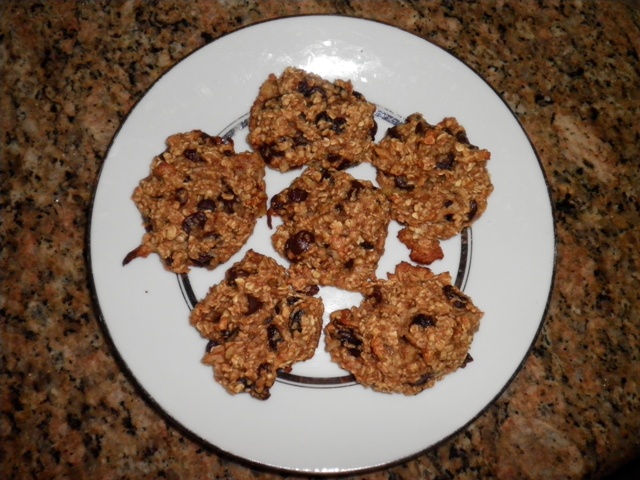
Well, today, I finally got down to the dirty job of creating my recipe. I dragged out oatmeal, honey, applesauce, walnuts, raisins, chocolate chips, coconut, and a few spices, mixed it all together, spooned the concoction out on a cookie sheet, stuck it in the oven, and waited.

When I took the cookies out twelve minutes later, I let them cool and then . . . drum roll, please . . . I took a bite.

Ah, the sacrifices we make for the sake of art!

As it turns out, it wasn’t such a sacrifice. I got the recipe right on the first try. The cookies actually taste great and the texture isn’t bad.

Now I have an even harder job — not eating all the cookies at once. Maybe I’ll save a few for you.

(Second Wind is running a short story contest, and the winner will be included in the anthology with me and other Second Wind authors. Please click here to Vote For Your Favorite Story!)

Which is more important, character or plot?

Some people think character is most important, others think plot is the most important, but you really can’t separate the two. Plot is what happens to a character, what a character does, or both. You cannot have a character without a plot. To show who or what a character is, you need to show the character acting, and that is plot. You also cannot have a plot without a character. If an unknown planet is coming toward earth, that might be newsworthy, but it’s not a story until you have characters reacting to the coming planet. How is it going to change their lives? What do they do to prepare for the coming cataclysm? What happens to them as a consequence of their actions? That’s what makes a story.

Here are some responses from others authors about whether character or plot is more important. The comments are taken from interviews posted at Pat Bertram Introduces . . .

From an interview with J. Conrad Guest, author of Backstop and One Hot January

For me, the most essential quality of a good story is characters with whom I can connect. Finding a good story to write is easy; but writing about characters the reader cares about is more difficult. Hannibal Lecter is one of the most demented characters ever conceived, yet he was fascinating, a train wreck away from which we want to look but can’t.

From an interview with Joylene Nowell Butler, Author of “Broken but not Dead”

You need good characters your reader can relate to almost immediately. They talk about plot-driven vs. character-driven stories, but honestly you can’t have one without the other. Readers want to live vicariously through your characters, but first they need to trust you, trust that you’ll take them on a journey they’ll connect to with characters they care about. Even if what you’re asking them to believe takes place on a foreign planet with outrageous settings and descriptions, if you do your job correctly, it won’t matter how strange the setting or how weird-looking the residing peoples are, human nature can transcend all that weirdness and endear any reader quickly and for the duration of the story. Think “Dune”, “Harry Potter”, or “Wizard of Oz”.

So, in your opinion, which is more important, character or plot? (You can respond as a reader or a writer.)

(If you’d like me to interview you, please check out my author questionnaire http://patbertram.wordpress.com/author-questionnaire/ and follow the instruction.)

What, in your opinion, are the essential qualities of a good story?

The most important quality of a good story is the ability to take readers somewhere else and make them glad they went. It’s also essential to make the writing easy to read, which means the writing must be grammatically correct. Nothing takes an experienced reader out of a story faster than having to decipher convoluted sentences with improper punctuation. Ideally, a story should leave readers a bit better off than they were before, either because of what they learned about the world and themselves, or because of the respite from their everyday lives.

Here are some responses from others authors about the essential qualities of a good story. The comments are taken from interviews posted at Pat Bertram Introduces . . .

From an interview with J J Dare, Author of False Positive and False World

The hook is the essential part of a story; with a good hook, the reader won’t want to put a book down. I try to draw the reader in immediately with a one-two punch.

From an interview with Mickey Hoffman, author of School of Lies

I want the main characters to have a “quest.” The quest can be a real journey or one in their heads and if there’s mystery involved all the better.

From an interview with Michael Murphy, author of Scorpion Bay

In my opinion a good story has conflict throughout and characters the reader will care about. I don’t believe the story, what happens to the characters is nearly as important has how these events impact the character’s lives, how they’ve evolved and grown, or in some instances, how they’ve stuck to their principles and are not changed by events in the story. An example of this type of story would be the movie High Noon.

From an interview with John Grover, Author of “Feminine Wiles”

A good story is about style, the style it is written in makes it unique and second is to make the reader care about your characters. Without empathy for your characters readers won’t care what happens to them. Once they care, you can really rev things up. I think it is all in the way you tell the story and how the characters come to life. Write about what you know, add in touches from your life and real people and it will come to life.

So, what, in your opinion, are the essential qualities of a good story?

(If you’d like me to interview you, please check out my author questionnaire http://patbertram.wordpress.com/author-questionnaire/ and follow the instruction.)

Trying to Fill The Void Of His Absence With Remembered Joy

All of a sudden, it seems, there have been changes in my life pertaining to my grief for my life mate/soul mate. For about a week after the Fourth of July, I endured a heavy upsurge in sorrow, but in its wake, I have found a semblance of peace midst the sadness.

Saturday was his birthday, and I started out the day feeling almost upbeat, gladder that he’d spent so many years with me than sadder that he is gone from my life. I’d never sung Happy Birthday to him when he was alive, so I sang to him out in the desert, where no one could hear. (Believe me, you do not want to hear me sing!) I planned to get a cake, too, but sometime that afternoon, the sadness returned. Next year, perhaps, I’ll bake a cake to celebrate his life.

I’ve also had some stray thoughts that indicate a shift in my perspective. A couple of days before his birthday, I found myself thinking, “He beat the system. He’s out of it now.” I don’t know where that idea came from because he didn’t beat the system. He didn’t have to grow elderly, but he was sick for so long it seemed as if he’d skipped a couple of decades of middle age and went straight to old age. But still, he is out of this life. He won’t have to worry about the coming changes in medical insurance or any other such foolishness, won’t have to watch himself age further, won’t have to continue suffering. Wherever he is (if he is) he is safe. And free.

To a great extent, our life together now seems unreal. I’ve been trying to live in the moment, and in the moment, he is not here. I’m still sad, still want to go home to him, still yearn to talk to him, but wanting such things seems to speak more of longing than of recollection, as if somewhere in the back of my mind I had conjured up a mate and a life and time of togetherness. But the truth is, if I had conjured up such a fantasy out of nothing but loneliness, I would have created happier memories. Too much of our life together was steeped in sickness and failure. Still, there were joys. The astonishing beginning of our relationship when he was radiant with youth and strength and health, the electricity of our long-lasting discussions, the sweetness of our final hug, the beauty of his smile, his wonderful gift of appreciation, his vast courage, and his determination to accomplish something each day despite his waning health.

I came across these words today from “Remembered Joy,” an Irish prayer:

I could not stay another day,
To love, to laugh, to work or play;
Tasks left undone must stay that way.
And if my parting has left a void,
Then fill it with remembered joy.

He stayed as long as he could, and it would pain him to know that his death brought me so much sorrow. I don’t know if I’ll ever be able to fill the void of his absence with only remembered joy, but I’m continuing with my life, filling it with new experiences, and for now that’s the best I can do.