So, you want to know how to tell a weed from a flower. Come to think of it, you probably don’t. If you are a gardener, chances are you already know. If you aren’t a gardener, then you probably don’t care. Still, I came across two foolproof ways of telling the difference that I thought were both funny and apropos.
[Are we still allowed to say “fool” proof? Isn’t “fool” a derogatory term? Something that is foolproof is something that is safe even from the mistakes of a fool. I looked up synonyms — surefire and infallible would probably be better terms, unless, of course, I am talking about myself. And I do admit, I can easily be “fooled” by the various things that grow in my garden.]
Digression aside, one of the infallible ways of telling a weed from a plant is to pull up the plant in question. If it pulls up easily, it’s a flower. If it resists, it’s a weed. I can vouch for this bit of not-funny wisdom. There is a weed that grows copiously in my yard — leafy spurge. With roots that resemble large carrots, it cannot be pulled up. It must be dug up, and even then it’s hard to remove. A spurge weedkiller only partly damages the plant while killing all flowers in the vicinity. Oddly, another impossible-to-pull-up weed is a different plant from the same family. Instead of a carrot-like root, it has roots that spread underground while the leafy part grows above ground in a mat. The stems of this particular spurge are so thin that they cannot hold together enough to pull up the root. Luckily, a spurge killer will get rid of it, though again, the problem is that the poison also destroys all nearby vegetation.
The second way of telling if something is a weed is to cut everything down. What grows back will invariably be a weed.
Ironic, isn’t it, that supposedly the best way to tell if something is a flower rather than a weed is to destroy it.
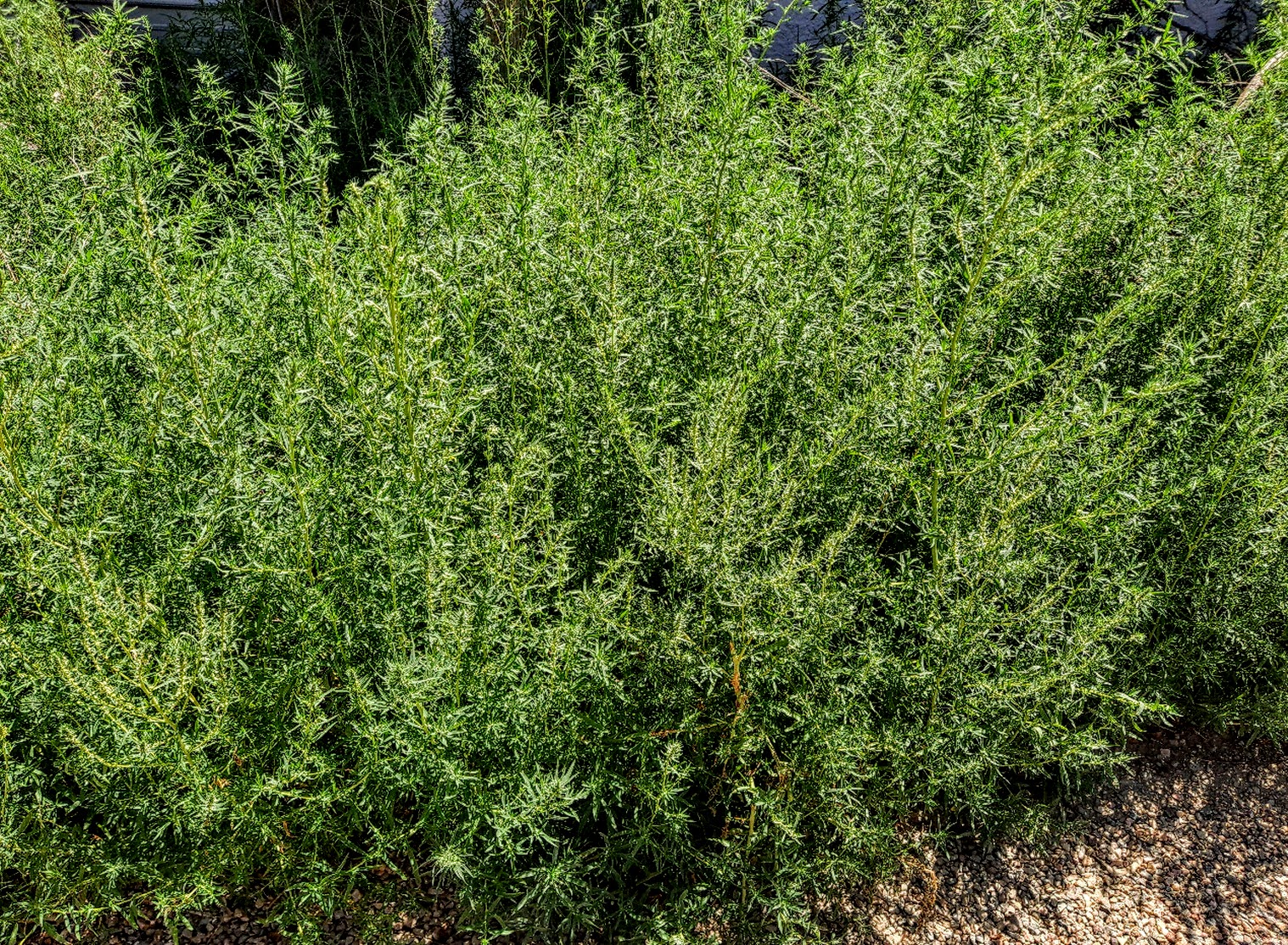
The weeds that grow around here tend to replicate, so after a while, some identification is possible. Even though I can’t get rid of it, I can recognize both the mat-like prostrate spurge and the tall leafy spurge. (There are 2,000 different types of spurge. Yikes! Luckily I only have to deal with two of them.) I can also recognize the yellow wild mustard by its frilly leaves and the purple wild mustard by its horrible sour milk smell. And I know dandelions, of course, as well as a few of its relatives. Then there’s kochia, also known as fireweed and often confused with ragweed, that was brought here from Eurasia as an ornamental plant, but it’s pretty much taking over Colorado. Apparently, it likes our soil and climate (and doesn’t seem to care that the sentiment is not returned). It’s easy enough to recognize and pull up when it’s young, which is necessary because left to itself, it can grow up to seven feet. (The photo accompanying this post shows the kochia that once blocked access to my garage until I managed to dig it all up.) Though there are maybe only a dozen weeds that infect my yard (I got tired of listing them all) they are so ubiquitous, there might as well be thousands of them.
I better stop this — I’m just depressing myself with all this talk of weeds, which is funny since this was supposed to a rather humorous article about telling weeds from flowers. I guess I missed that target!
***
Pat Bertram is the author of Grief: The Inside Story – A Guide to Surviving the Loss of a Loved One









