Telling the Difference Between a Flower and a Weed

So, you want to know how to tell a weed from a flower. Come to think of it, you probably don’t. If you are a gardener, chances are you already know. If you aren’t a gardener, then you probably don’t care. Still, I came across two foolproof ways of telling the difference that I thought were both funny and apropos.

[Are we still allowed to say “fool” proof? Isn’t “fool” a derogatory term? Something that is foolproof is something that is safe even from the mistakes of a fool. I looked up synonyms — surefire and infallible would probably be better terms, unless, of course, I am talking about myself. And I do admit, I can easily be “fooled” by the various things that grow in my garden.]

Digression aside, one of the infallible ways of telling a weed from a plant is to pull up the plant in question. If it pulls up easily, it’s a flower. If it resists, it’s a weed. I can vouch for this bit of not-funny wisdom. There is a weed that grows copiously in my yard — leafy spurge. With roots that resemble large carrots, it cannot be pulled up. It must be dug up, and even then it’s hard to remove. A spurge weedkiller only partly damages the plant while killing all flowers in the vicinity. Oddly, another impossible-to-pull-up weed is a different plant from the same family. Instead of a carrot-like root, it has roots that spread underground while the leafy part grows above ground in a mat. The stems of this particular spurge are so thin that they cannot hold together enough to pull up the root. Luckily, a spurge killer will get rid of it, though again, the problem is that the poison also destroys all nearby vegetation.

The second way of telling if something is a weed is to cut everything down. What grows back will invariably be a weed.

Ironic, isn’t it, that supposedly the best way to tell if something is a flower rather than a weed is to destroy it.

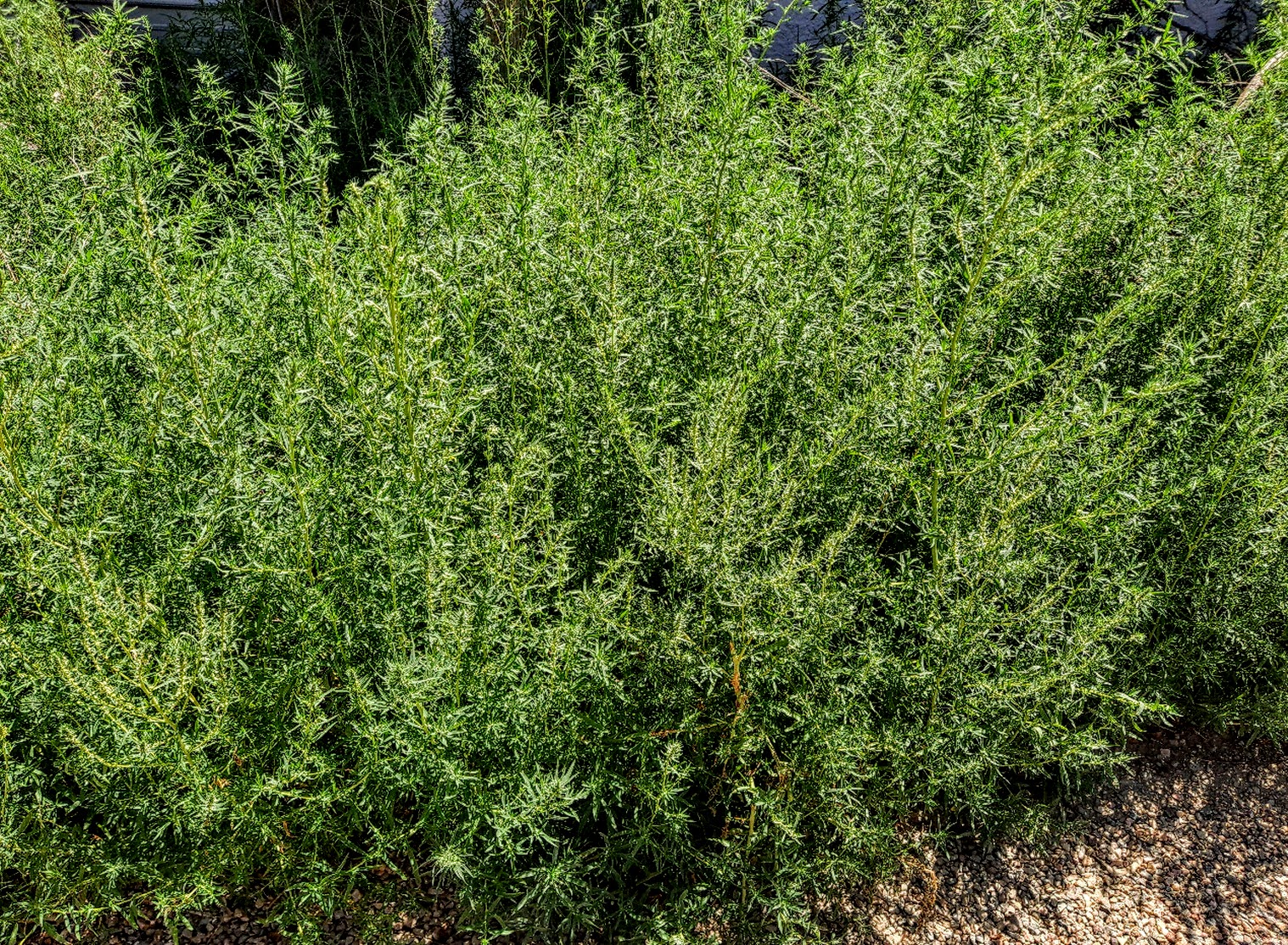
The weeds that grow around here tend to replicate, so after a while, some identification is possible. Even though I can’t get rid of it, I can recognize both the mat-like prostrate spurge and the tall leafy spurge. (There are 2,000 different types of spurge. Yikes! Luckily I only have to deal with two of them.) I can also recognize the yellow wild mustard by its frilly leaves and the purple wild mustard by its horrible sour milk smell. And I know dandelions, of course, as well as a few of its relatives. Then there’s kochia, also known as fireweed and often confused with ragweed, that was brought here from Eurasia as an ornamental plant, but it’s pretty much taking over Colorado. Apparently, it likes our soil and climate (and doesn’t seem to care that the sentiment is not returned). It’s easy enough to recognize and pull up when it’s young, which is necessary because left to itself, it can grow up to seven feet. (The photo accompanying this post shows the kochia that once blocked access to my garage until I managed to dig it all up.) Though there are maybe only a dozen weeds that infect my yard (I got tired of listing them all) they are so ubiquitous, there might as well be thousands of them.

I better stop this — I’m just depressing myself with all this talk of weeds, which is funny since this was supposed to a rather humorous article about telling weeds from flowers. I guess I missed that target!
***

Pat Bertram is the author of Grief: The Inside Story – A Guide to Surviving the Loss of a Loved One

Treasure Hunt

I went on a treasure hunt of a different kind, today. Last fall, I’d planted a few pink echinacea, and that area of my garden, next to the new grass, had become so overgrown with crabgrass and weeds (probably because of all the watering I had to do to keep my new sod alive through the winter), that the echinacea disappeared. I knew vaguely where they were, but the new growth made the area seem so much like foreign territory, that I didn’t know for sure, and I was afraid to just start yanking unwanted vegetation in case I also yanked the wanted plants.

I finally noticed that one plant, a bit farther from the sod than the others, had broken the surface. I figured if the other plants survived the winter, they should also be visible now, so that’s what my hunt was about — looking through all the weeds to find the echinacea. I think I found them all. I carefully dug up the thick clumps of weeds and crabgrass to give the echinacea space, and then drove stakes next to the plants so I wouldn’t have to go searching for them again.

There is still a lot more cleaning up I have to do, but until I can identify more of the baby plants, I don’t want to start digging lest I remove some seedlings I might want. Many plants look alike when they are young, such as larkspur and wild mustard, and it’s too easy to pull up the wrong thing. In fact, the mustard grows among the larkspur, making the whole patch look as if it might be mustard, so when the plants are big enough to differentiate, I have to be very careful to only pull the weeds.

I tend to think most of the small unidentified seedlings are weeds. I don’t see anything that looks as if it might be the beginning of a wildflower field, so either it’s too early or the birds ate the seed. The birds did seem to be inordinately interested in my little garden patch this winter despite a full birdfeeder just a few feet away in my neighbor’s yard, so who knows what, if anything, I will end up with.

What’s nice about having work to do outside is that it gives me an excuse to be out in the open air, especially on nice days. Although today wasn’t particularly warm, it qualified as a nice day because the horrid winds we’ve having took a brief break. I did enjoy that!

If the ten-day forecast is anything to go by, it looks as if we are heading into frost-free weather, so I could start planting if I wished. But I don’t wish. The wind, you know.

After my treasure hunt and the clean-up that followed it, I spent some time wandering my paths, enjoying both the landscape and the hardscape that’s been laid down, and thinking about someday having my own private park, when everywhere I turn, I’ll see a different aspect of the yard. For example, the lilac bushes are all still young (the big plant in the corner of this garden photo is a baby lilac), but when they are grown up, that part of the yard will look completely different.

As with everything else in my life, I’m trying to not look too much to the future, trying to keep my eyes on what is rather than what might be or what will be.

And today, what is, is a garden spot that still looks nice, weeds, and all.

***

Pat Bertram is the author of intriguing fiction and insightful works of grief.

A Promise of Good Things to Come

I had an enjoyable morning, watering my grass, bushes, and other plants. Seeing all the parts of my yard that are greening up made me think that perhaps I can do this gardening thing after all. I can even recognize some of the seedlings, such as the larkspur. Since I let the larkspur go to seed last year, there are large areas that should be covered with purple flowers later this spring.

I was also able to recognize some weeds that are sprouting, such as the wild mustard, which I pulled up. I was going to let it grow a bit thinking it wouldn’t do any harm as long as I didn’t let it flower, but as a neighbor reminded me, if I waited to pull up the mustard, I might pull up the larkspur along with the weed.

A lot of the tulips I planted are coming up, and most even seem to have buds on the way, so perhaps this time I planted them deep enough. A few of the lilies are coming up, too, which is surprising considering that the wrong planting depth was included with the bulbs, so I had to dig up the ones I could find and replant them in deeper holes.

My grass is doing astonishingly well. I have a hunch it’s way to early to mow since we are still way before the last frost, and I’m afraid that cutting the grass too soon would make it vulnerable during those late-season frosts. It’s possible it would do fine, but I don’t want to take a chance.

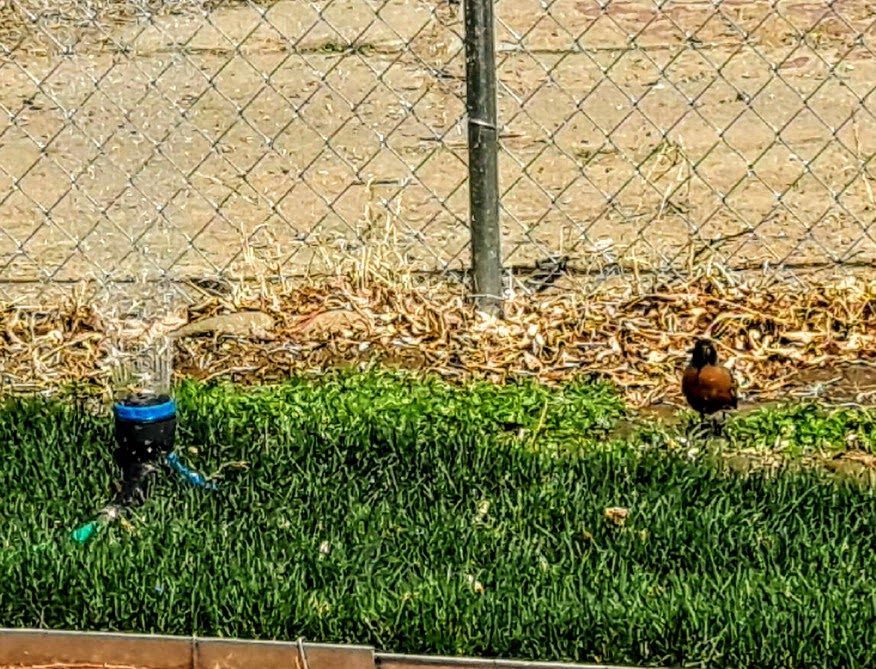
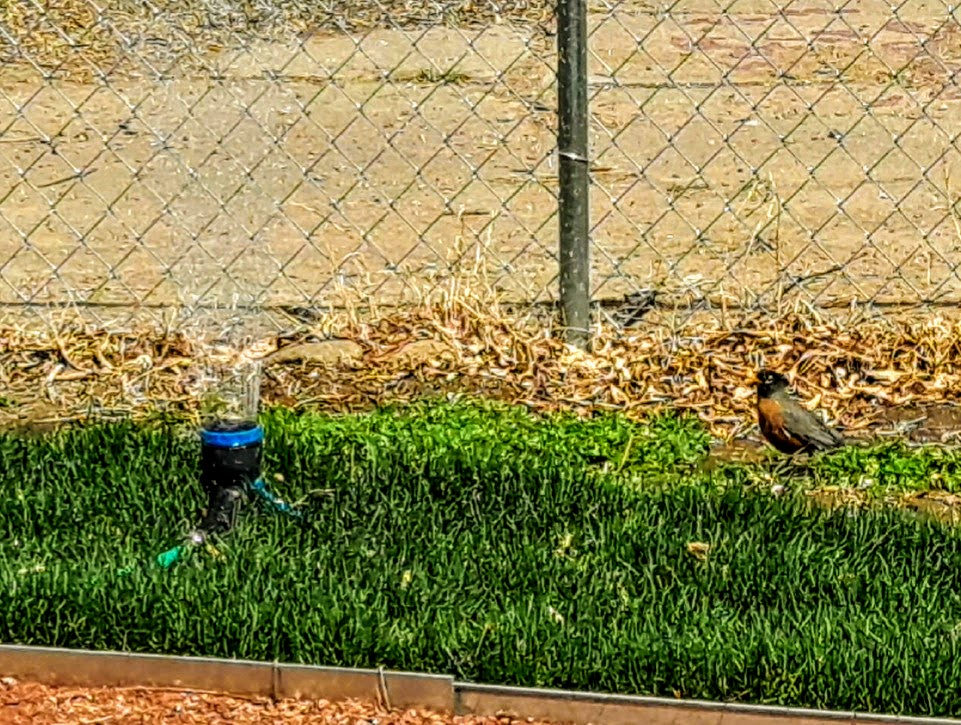
I wasn’t the only one enjoying my watering time this morning. I set the hose in the back yard, went to move the hose in the front, and when I came back, a robin was enjoying a private shower.

Loath to disturb the creature at its ablutions, I kept the water running in that one area way too long. Even after I went into the house for my camera, even after the robin preened a bit for me, I let the water run.

At one time, I’d considered setting up a birdbath because in a dry climate (and today was especially arid), birds appreciate any water they can find. Unfortunately, standing water is too risky in a place where mosquitoes are so much of a problem.

I always liked the idea of spring, but the reality — all that wind — made spring not one of my favorite seasons. Today, though, I got outside before the wind, so the day was all one expects of the spring — new growth, robins, and a promise of good things to come.

***

What if God decided S/He didn’t like how the world turned out, and turned it over to a development company from the planet Xerxes for re-creation? Would you survive? Could you survive?

A fun book for not-so-fun times.

Click here to buy Bob, The Right Hand of God.