Nix on the Happy Face

Daily writing prompt
What are your favorite emojis?

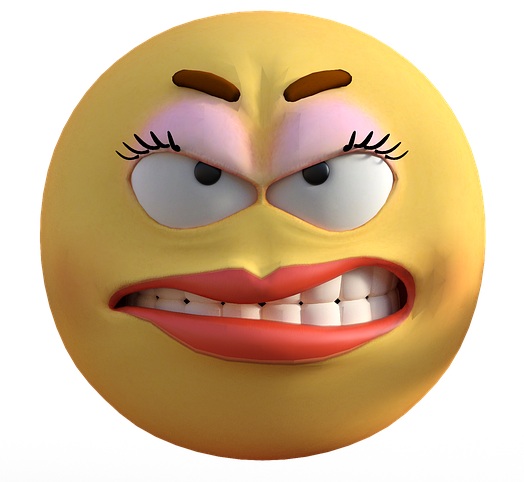
I have never liked any emoji even before they became emojis. Especially the idiotic happy face that began it all.

I wasn’t aware of the smiley face in its infancy because it was an inhouse graphic created for State Mutual Life Assurance Company in 1963 to make their employees happier about a corporate merger. The face quickly moved beyond those bounds, and in Denver, in the late sixties, a jewelry store passed out happy-face stickers for a promotion, so that sappy yellow face was everywhere. I don’t know why — perhaps because it was everywhere — I couldn’t bring myself to like the insipid thing.

Even worse was after Hallmark took over the design in 1971, added “Have a happy day,” and then expected people to . . . I don’t know . . . give Hallmark happy days by buying happy faces, I guess.

I disliked “Have a happy day,” even more when it replaced “thank you,” as a farewell to shoppers who’d completed a purchase. I was depressed a lot back then, which made that whole “have a happy day” thing seem like a slap in the face, but more than that, it was so utterly phony, it depressed me further. Ironically, I’d give anything to have people go back to “Have a happy day” if they’d only get rid of today’s version, “Have a good one.” That sure makes me cringe! “Have a good one what?” I ask when I’m feeling particularly curmudgeonly. I can’t help but think of caregivers asking their elderly constipated patients if they’d had a “good one” that day.

In my life, almost always things I like disappear, most recently the most useful sprinkler I’ve ever found, with several water patterns as well as an ability to convert it to a hand-held sprinkler. But that sappy face? Nope. Now that it’s a global necessity, embedded in almost all computer programs, it will hound me forever.

Admittedly, I’ve used various emojis when trying to elucidate what I thought a witty comment, but that didn’t always work well.

Many years ago, I signed up for a dating site at the instigation of a married friend who wanted the vicarious experience. I eventually ended up communicating with one fellow who mentioned that he loved laughing and humor, and I don’t remember the comment I made, but it was supposed to be a humorous response to his humorous comment, and to emphasize the point, I added a happy face emoji. He took the comment at face value, and got nasty with me. I explained that the emoji was an indicator of it being a joke, and he got even more angry and said he didn’t want to have anything to do with anyone who had to use happy faces to explain what she was saying. Apparently, the only one who was supposed to funny was him. I tried a different site, and there he was again. So, to my friend’s disappointment, that was the end of my efforts.

But not, alas, the end of emojis. If I do grit my teeth and use any emoji to end a text conversation, it’s something simple like a heart or a tree, but mostly, I stick with (gasp!) words. It’s so much better for my peace of mind.
***

Pat Bertram is the author of Grief: The Inside Story – A Guide to Surviving the Loss of a Loved One

A Good One

When I was young, I had a five-book boxed set of Pollyanna books. Every time I got sick and so couldn’t go to the library for a fresh stack of books, I reread the ones on my shelf. Despite having read the Pollyanna books perhaps a hundred times, the whole “glad game” thing never took hold in my life. I simply could not see the benefit of being glad you didn’t need the crutches you received instead of the doll you wanted. I thought gladness should be effortless rather than a struggle to find something good about bad times.

Ever since Jeff died, though, I tried to play my own version of the game (though I didn’t know that’s what I was doing) by finding something to appreciate every day. I needed a way to ground myself because so often during those first years I felt as if I were teetering on the edge of the abyss, and without a firm footing, I feared I would topple into that bottomless black pit.

The lessons learned back then have served me well. I make sure to appreciate every flower that comes up, every blade of grass that shimmers in the sun. In a glass half full/half empty sort of way, I try to see what’s there rather than what isn’t. For example, to see the plants and sections of grass that are doing well instead of worrying about the areas of the yard that are desiccating no matter what I do.

Some days, however — like today — I find it hard to appreciate much. It’s been too hot for too long; it’s too much work trying to keep the weeds from taking over; and it’s too hard to focus on what is still growing rather than what once was doing well but is no longer thriving.

I took this same curmudgeonly attitude on my walk today to check out how my friend’s roof was coming along. The job site was deserted, but I could easily see why — the roof has been re-sheeted, ready for to be shingled whenever the rest of the roofing materials are delivered. On my way back home, I stopped to pick up an item at the dollar store, and when I checked out, the clerk said, “Have a good one.” Sometimes I can let that idiocy go, but on a day when I cannot even appreciate that I have glass, let alone whether it’s half full, I find it impossible to hold my tongue.

“Have a good one what?” I asked. The clerk had to think about that one for a minute, then said hesitantly, “Day?” The thing is, all the elderly people I have taken care of become fixated on their bowels (mostly because moving them has become a difficult non-daily task for them), so they are always pleased when they “have a good one.” Anyway, the clerk finally said, “Have a good day,” but then as I turned to leave, she said again, “Have a good one.” I just looked at her and shook my head.

Some things are just not worth dealing with.

Although I have temporarily given up on trying to keep the weeds in check, temporarily given up on caring about the less-than-appealing areas of my yard, I still do manage to find something to appreciate if only in passing, such as the lance-leaf coreopsis, pictured below. Now that was something effortless to be glad about — the original seeds were strewn three summers ago, and these perennial plants raise themselves without any help from me.

So maybe the “good one” the clerk told me to have was this flower. In that case, I should have thanked her for the pretty bloom instead of giving her a semi-rough time.

Anyway, have a good one, whatever “one” it is that you want to be good.

***

Pat Bertram is the author of Grief: The Inside Story – A Guide to Surviving the Loss of a Loved One. “Grief: The Inside Story is perfect and that is not hyperbole! It is exactly what folk who are grieving need to read.” –Leesa Healy, RN, GDAS GDAT, Emotional/Mental Health Therapist & Educator.

Where the Day Takes You

The current crop of young clerks seems to be even less gracious than the last couple of generations. Back in the day, it used to be that clerks thanked customers for shopping at the store. Then it got to the point where clerks expected us to thank them for deigning to wait on us. Actually, we’re still to that point. I wish I could break myself of the habit of saying “thank you” to someone I just gave a fistful of dollars. But I was a touch rude today, so perhaps that offset the thanks.

The clerk, as they all do now, told me “Have a good one” in a bored tone as she handed me my change.

What does that even mean, “Have a good one?” So I asked her. She just stared at me as if I were Homo Unsapiens Unsapiens, then finally responded, “Day?”

So why not say “Have a good day”? “One” and “day” each have a single syllable, so these clerks are not saving any time by using “one” instead of the more concrete word. Perhaps it’s that “one” is comprised of soft sounds, and “day” is not, which might make it infinitesimally harder to say.

Oh, well, it’s not my world anymore. My world is one of precise speech, words that mean something, people who care not just about words but about those they come in contact even if only for a moment.

I suppose it’s foolish of me to waste time and words on such trivial matters as to the meaning of a meaningless phrase when the rest of the world is resorting to desperate measures and coping with trauma, but for the most part, you have to go where the day takes you and deal with day you are dealt.

And the hand I’ve been dealt today is a good one. It’s such a beautiful day that even a barely civil clerk couldn’t ruin it.

The day after tomorrow is Memorial Day. If you’re travelling this weekend, please take it easy.

And if you want to play a silly game, count how many movies titles I used in this blog.

***

Pat Bertram is the author of Grief: The Inside Story – A Guide to Surviving the Loss of a Loved One. “Grief: The Inside Story is perfect and that is not hyperbole! It is exactly what folk who are grieving need to read.” –Leesa Healy, RN, GDAS GDAT, Emotional/Mental Health Therapist & Educator.




