Getting Older is Strange

Getting older is strange, to put it mildly. Watching one’s body slowly change and not for the better, feeling one’s energy deplete, wondering if simple memory loss such as not remembering a word is indicative of a more severe decline.

So far, none of those issues is that great a deal for me. I’ve learned to accept my mild infirmities — the joints that don’t always work well, the cough that lingers too long, the words that elude me. One thing I have not yet learned to interpret is what to do when I have no energy — should I take it easy? Or should I . . . not?

When I was younger and had bouts of enervation, I could contribute them to allergies (my allergies were more of an energy thing than typical upper respiratory symptoms), an incipient cold, or laziness. Most times I gave in to the malaise because if I didn’t, I’d usually get sick. And anyway, I was young enough to get back into the swing of things once the feebleness passed, so if I ended up indulging my laziness, it didn’t really matter.

Now there is a fourth possibility to add to the rest: If I lack energy, is it allergies, a low-grade cold, laziness, or is it old age? If it’s one of the first three, I can treat the enervation as I always do — take it easy and indulge my laziness. If, however, the enervation is due to old age feebleness, I certainly don’t want to give in to it. Barring an accident or illness, or any other life-threatening problem, I could possibly live another decade, perhaps even two, and if I give in to sluggishness too soon, that lack of activity would cause additional problems.

I suppose one way to tell would be if the enervation came on quickly or if the energy loss came slowly over a long period of time, but even then, I get used to ignoring discomfort, so perhaps I wouldn’t notice slow moving debilitation. Besides, I’ve always been a low energy person. Throughout my years I’ve often exercised, but it’s been a push rather than a natural inclination. That’s why I read so much — it doesn’t take much energy to sit and hold and book. Even letting my thoughts wander doesn’t take as much energy as letting my body wander.

Speaking of which, the snow is gone, but I still haven’t resumed my intention of walking every day. I’ve been dealing with a low energy time, and don’t want to create additional problems by walking against the very cold wind. Brrr!

In the end, I’ll do what I always do — stop thinking about why I feel lazy and just grab a book.

***

Pat Bertram is the author of Grief: The Inside Story – A Guide to Surviving the Loss of a Loved One.
Laziness, Catness, and Patness

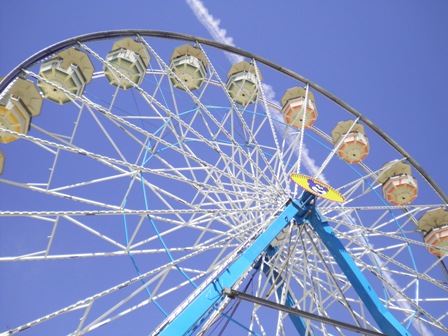
In an effort to add spontaneity, color and vitality to my life, I went to the county fair. Just walked around, ate giant onion rings and funnel cake, rode the Ferris wheel. (Could ride one of those all day. Maybe next time I’ll get a wristband for unlimited rides and just go round and round and round. I wonder if that would wind my life into a higher gear or maybe wind me back to a simpler time?)

I saw a white tiger, visiting from the local zoo, but as much as I would have liked to admire the poor thing, I couldn’t bear to see it in that cage. (Of course, I’d hate even more to see the thing out of the cage, stalking me!) As I passed the cage, I heard the handler tell the gathering crowd that cats were some of the laziest creatures in the world. Huh? Lazy? The poor cat was in a cage, singing for its supper. Okay, so it wasn’t singing, it was yawning, but still, it was the primary advertisement for the zoo, so it was working as hard as the man maligning it. Besides, laziness is a human judgment. A cat can only be a cat. Its nature is to take it easy until it is time not to take it easy. That is not laziness. That is catness.

And anyway, who’s to say laziness is wrong? Most of us have been raised with a work ethic that is almost religious, and who is to say that is the right way? I am not advocating living off other people or shirking one’s responsibilities, but if you’ve worked hard enough to pay your bills with a bit set aside for emergencies, why is it lazy not to put forth more effort?

Years ago, I did the billing for a law office. Worked one week a month. In that one week, earning just a dollar or two above minimum wage, I made enough for all my living expenses, paid for the upkeep of my car, went out to eat when I felt like it. (It was a simpler time, of course, and my needs were simpler than most people’s.) The rest of the time I walked, read, wrote snippets of poetry, and did whatever I felt like. I still remember the looks of incomprehension and disdain I would get from people when they found out what I did. It wasn’t the week I worked for the lawyers that concerned them but the three weeks I didn’t. They couldn’t understand why I didn’t feel the need to work, and they couldn’t understand how I managed to fill all those non-working hours.

Maybe that lifestyle wasn’t laziness, either. Maybe it was Patness.

But, back to the fair . . .

The excursion did what I wanted — gave me something different to eat and do and think. Not bad a bad exchange for a few dollars. And I did it mostly on the spur of the moment, which is one of the things I am trying to relearn — doing things without planning. I woke up with the idea of going to the fair, and as soon as it opened, I went.

Maybe next year I’ll see you at the fair! We’ll meet by the Ferris wheel . . .

***

Pat Bertram is the author of the suspense novels Light Bringer, More Deaths Than One, A Spark of Heavenly Fire, and Daughter Am I. Bertram is also the author of Grief: The Great Yearning, “an exquisite book, wrenching to read, and at the same time full of profound truths.” Follow Pat on Google+. Like Pat on Facebook.




