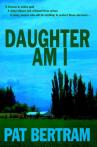
Daughter Am I Is Finished!

DAII received my final proof copy of Daughter Am I, my young woman/old-time gangsters coming of age adventure, and I’ve reluctantly agreed to let it go to the printer.  There is always that moment when you realize this is it — you have to live with any mistakes that end up in the book. If there are any, though, it will be sheer accident. The novel went through several good editings, including a final scrubbing by Deborah J Ledford, fellow Second Wind author and editor extraordinaire. It was also scrupulously copyedited by Donna Russell, (creativemuse1(at)aol(dot)com) a treasure I found on Facebook. So my reluctance is more imaginary than real — the book is as perfect as I can get it.

When I received the final copy edits from Donna, she enclosed a note:

Thank you for the opportunity to edit your book, Daughter Am I.  You certainly put a lot of time and effort into researching all of the historical elements, and did a good job incorporating them into the plot without overwhelming it.  I learned several new things — Hegelian dialect, terms such as “lamster,” and a lot about guns, cars, and the Mafia.  I personally enjoy it when an author sends me to the dictionary or encyclopedia (or Google). There were also many excellent lines in the book. I thought these were especially good:

“The loss of something that never was can be as devastating as any other loss.”

“They thought they could rule by fear, but when fear is around every corner, people lose their fear of the fear.”

“They worked in silence, their excitement so great it seemed to shimmer in the air like a heat mirage.”

“It’s odd—I never used to be aware of old people as real persons. I’m not stupid. I know they weren’t born old, but it didn’t occur to me that heroes and villains, killers and great lovers could be hidden in those feeble bodies.”

I also enjoyed your use of humor, and the way you developed the characters.  It was nice to see Mary grow into a more confident woman, see her influence on the old gangsters, and the way she and they came to genuinely care for one another.  You made me care about the characters.  Have you considered a possible sequel?  I can see the potential for more “adventures.” Anyway, just a thought.

Hmmm. A sequel. Could be interesting, but first I have to sell the original. Luckily, it will be released soon  — maybe in two weeks. Sounds like a good excuse for a party! 

 Daughter Am I will be available soon (!) from Second Wind Publishing, LLC

add to del.icio.us : Add to Blinkslist : add to furl : Digg it : Stumble It! : add to simpy : seed the vine : : : TailRank : post to facebook

Not Exactly a Rave Review, But a Fair Assessment

Well, here it is. The Publishers Weekly review of my Amazon Breakthrough Novel Award entry Daughter Am I:

A group of spunky octogenarians joins a woman on a search to discover the truth about the grandparents she never knew she had. After inheriting the farm of her estranged, murdered grandparents, Mary Louise Stuart discovers photos and an address book in the Colorado farmhouse and becomes obsessed with finding out who her grandparents were and who would want them dead. With each question, another senior citizen joins the quest — former friends and gangsters with names like Crunchy, Iron Sam, Happy, Lila Lorraine. The mystery deepens with each stop in their whirlwind tour of the Midwest: who’s following them? A love interest ensues between Mary and Tim Olsen, whose grandpa was good friends with her great-grandfather. While the author certainly researched the history of the Mafia, too many of the numerous historical asides — and subplots — are tacked on under the guise of story time, making the story drag with detail abut Wyatt Earp, the JFK assassination and bootleggers. But underneath the relentless bouts of story time is a delightful treasure-hunting tale of finding one’s self in a most unlikely way.

Not exactly a rave review, but a fair assessment.

I can understand why the reviewer didn’t like my “relentless bouts of story time,” but the whole purpose of my writing the story was to debunk the myths about the so-called Mafia in this country. The Mafia as we know it is a figment of Hollywood. Teach, a con man and the storyteller in my novel, says, “People talk as if the Mafia and the Syndicate are still active today, but the Syndicate phased out the American Mafia, wealth phased out the Syndicate, and now new gangs of all races and nationalities have taken their place.”

I wanted a framework for telling the history of gangsterism in this country, and I decided on a mythic journey using aged gangsters for the archetypal figures. As the hero’s journey progresses, her mentors tell stories of the old days. Listening to the stories and putting all the pieces together, she learns who her grandparents were and who she is.

I suppose I could take out some of the stories to make the novel more publishable (which I will do if an agent or editor ever requests it) but for now they stay. Until I read this review, I hadn’t realized how much I miss the all those novelists who did tack on historical asides. In fact, I used to seek out books by authors such as Taylor Caldwell and Noel Barber for that very reason.

So, if that’s the only thing the reviewer objected to, I have no objection to the review.

You can take a look at my entry here: http://www.amazon.com/dp/B00121WDKQ

Mafia Cat Rejects Hilter. Hitler Breaks Off German-Italian Alliance. War Ends.

I once read that certain topics were guaranteed attention getters. The only four from that list I remember are Hitler, the Mafia, war, and cats, to which I would add rejection. My post “A Rejection So Pleasant It Was Almost an Acceptance” attracted more attention than the last four combined. The title of this post is a 12-word short story based on those five attention getters (it got you here, didn’t it?) but the one I will be focusing on is rejection.

Rejection is hard to deal with because we feel so . . . rejected. Writers aspiring to be published, however, need to learn how to deal with it. There are hundreds of thousands of books written each year by unpublished novelists, and only a couple of hundred will be accepted by major publishers. Rejection, then, is part of the game.

A fellow writer pointed out that my great rejection letter scored high on the etiquette scale, but it was very likely a form letter. He could be right. I once got a rejection letter from an agent that was printed out on a computer and addressed to me personally. The letter spoke of my writing ability, mentioned the name of my book and how they had considered taking it on but had to pass because the subject matter was not quite right for their agency. Pleased with the personal touch and believing I was close to finding representation, I checked to see which of my novels would be a better fit, shot off another query, and received the same basic rejection letter in return. Definitely a case of a form letter that scored high on the etiquette scale.

If it is possible to write rejection letters that make the recipient feel good, why do agents and editors send letters that are cold, almost cruel? Because, despite what they say, they do not want to be queried. They get thousands of queries a year, and each of those queries mean unpaid work.

My advice? Briefly glance at any letter you receive to make sure it is a rejection, then shred it. Get it out of your sight. Send out more queries; to a certain extent, the more you are rejected, the more you become inured to it. Also, learn to see rejection letters for what they are: an attempt at keeping you from bothering that agent or editor again.

And hope that one day you will become so well known that those agents will seek you out, and then you can send them rejection letters.




