Subverting Stereotypes in The Wheel of Time

Last night, I spent a considerable amount of what should have been sleeping time looking for bad reviews of the last three books of The Wheel of Time series. After the death of the real author, the series was finished by a stand-in author, who did an execrable job, and I wondered why none of those books rated less than a three-star review on Amazon.

One reason, I discovered, is that a lot of people give him kudos for doing a thankless job, but it wasn’t thankless. He got paid for his work, and those books helped catapult him into the fantasy-writer stratosphere.

Another reason is that he writes in a simplistic style that appeals to today’s readers — short sentences; quick scene changes; lots of action; little real character development; not a lot of depth, emotional or otherwise. All of which is antithetical to Robert Jordan’s writing.

I also tend to think a lot of the acclaim he gets for his Wheel of Time books is because they are in direct contrast to Jordan’s books. There is no doubt that Jordan’s last few books could have used some heavy editing (though oddly, one of the substitute author’s acclaimed books is more or less a replay of the Jordan book that people tend to hate) but much of what people seem to object to in Jordan’s writing are things that shouldn’t be an issue.

For example, when Jordan started writing The Wheel of Time books, there were few female protagonists in that genre. This lack makes sense in a way because the writers of high fantasy tended to be male. Also, the genre seemed to attract more males than females in the beginning (or at least it was assumed to be so). Writing a male protagonist was safe — females will read books written by and for males more often than the reverse.

Jordan tried to turn this assumption on its head, writing both male and female protagonists. He tried to balance the power between males and females, and he tried to subvert stereotypes. It surprised me to discover that so many people think his writing is sexist, though in a world of his own making, with sexual dynamics of his own making in that world , how can he possibly be considered sexist?

One of the problems is that his readers are so young. (I have yet to discover a group of readers my age, online or off, who have any interest in reading the books let alone discussing them in any depth.) These younger generations don’t realize there was a time not that long ago when women were considered gossipy, flighty, unable to handle finances, and needed to be looked after as if they were children. In fact, it wasn’t until 1974 that women could obtain credit cards in their own name without a male co-signer. At the same time, it became illegal for mortgage companies to refuse loans to unmarried women as had been common.

It was only a handful of years after these major real-world changes that Jordan started thinking about his series. In his attempt to subvert stereotypes, he reversed things — women in his series consider men to be gossipy children who don’t have any sense, so the women think nothing of bullying the men to get them to do what the women think is right. Making things more complicated, in Jordan’s world, men are raised to be chivalrous, putting women’s safety first, and protecting them even if they don’t want the protection. This leads to an underlying theme of the story — men don’t understand women, though they try to. Women don’t understand men, though they think they do.

Adding further to this complicated dynamic, the “magic” system had become one-sided. It used to be that both men and women could tap into the power that drove the universe, so they were equals. But during the time of the story, only women were able to use the power, so it threw the balance off.

And yet readers try to fit today’s mores into Jordan’s world.

What really made me stop and think during my research last night is that most of the people in the United States today became adults after those life-changing laws governing women’s financial autonomy came into play. If only 20% of people were born before 1964, then that means 80% never had to deal with (and probably never had to learn about) a fairly recent time when things were so terribly unbalanced in the real world. No wonder so many Wheel of Time readers haven’t a clue what that particular theme of Jordan’s was all about.

In the end, I suppose it doesn’t really matter why the substitute author gets lauded for his awful writing. In my world, those books no longer exist, so unless I can come up with my own ending, the series ends with the real author’s death.

***

Pat Bertram is the author of Grief: The Inside Story – A Guide to Surviving the Loss of a Loved One.

Occupying My Mind

This March seems interminably long, though I don’t really know why. I’ve had spurts of activity, such as the celebrations for my house anniversary (six years!) as well as an occasional visit with friends. I haven’t spent much time outside, and there really hasn’t been any reason to. After the first shy crocuses showed their faces, there hasn’t been much change in my yard. Some of my grass is greening up, some looks dead, though I hope it’s just slow coming out of dormancy. In any case, I threw out some grass seed, but it looks as if the birds are eating it despite the feast the neighbors provide for them. And then there’s the wind. The least said about that the better! Coincidentally, today’s blog prompt from WordPress is “What is your favorite kind of weather?” One thing I can tell you, it’s not wind!

You’d think as slowly as this month is passing, I’d be more aware of the days as they come, but the first day of spring passed me by. It’s possible the upcoming fifteenth anniversary of Jeff’s death might pass me by, too, though I doubt it. Even if it does, the actually date no longer makes a difference. He’s still a factor in my life, as is his absence, but not as much as either used to be. Surprisingly, I still sometimes feel a tightening behind my eyes, but it never gets to the point of tears or even sadness. Just an acknowledgment that once he was a big part of my life and now he’s not. I still talk to him occasionally, mostly about things I can’t really talk to anyone else about. Silly things, like my thoughts about The Wheel of Time books.

Yep, still rereading those dang books. I’m on my second reread this year. It’s gone beyond reading to studying, since for every page I read, I spend twice as much time online finding out about the books, such as the real-life influences of the story. Lots of myths, legends, religions, philosophies come into play. Lots of very obvious King Arthur references. It amazes me how long it takes some people to make those correlations, if they ever do. In fact, the author’s wife/editor supposedly didn’t even realize the connection between the book’s mystical sword in the Stone (the Stone in the story is a fort) with Excalibur until she was writing the blurb for one of the books.

I’m also trying to figure out the real ending. Robert Jordan died before he could finish, and the guy they got to write the last books wrote something — I don’t really know what it is that he wrote. Despite the use of the characters and setting of Jordan’s world, those last books bear little relationship to Jordan’s cosmology. The savior character was supposed to be more of an Arthurian savior rather than a Christian one, but we got a Christian one that completely subverted the premise laid out in the first eleven books. What shocked me is that on none of those last three execrable books is there a rating below three stars on Amazon. There are some one- and two-star ratings on Goodreads, but those ratings are for the entire series. (Which makes me wonder, if those raters hated the books that much, why did they bother to read them? Four million words is a huge commitment, and not something you undertake if you hate the books.)

Another thing I don’t understand — Jordan had a team working on the books: his wife/editor, a continuity editor/research assistant, and a keeper of the timeline. Why didn’t all these people prepare a synopsis for the replacement author reminding him of each character’s arc and a brief compendium of what forces are ready to face the last battle, and where they all were on the timeline? One of the very many problems with those last books is they completely ignore any character growth and start over from scratch. Another problem is they ignore the fact that Jordan had already maneuvered the major forces into place for the last battle. I suppose I wouldn’t be as challenged to find the real ending if at least those books had some sort of internal consistency, but they don’t. Thousands of words are spent on one character deciding — yet again — to be a leader. Along the way, he forged a hammer (borrowing one of the pseudo-author’s gimmicks from his own books.) But then the character never leads in the last battle. He took his followers to the battlefield and then went off and did his own thing. Nor did he use that ridiculous hammer in the last battle. Huh? And readers never even noticed? That in itself should get a rating demotion. Quite frankly, I have never been able to read anything by that author, and he lives down to my expectations.

Somewhere in all those words Jordan wrote, there must be clues to the real ending. I suppose finding that ending is as good a use of my time — and brain power — as any. I’m thinking of using one of my defunct blogs for setting out the clues as I find them rather than bore you with the saga, but who knows. I could always tag the posts with The Wheel of Time moniker so you can ignore them if you wish. And anyway, the winds might die down, spring might come, my grass might grow, my flowers might bloom, and so other things will occupy my mind.

***

Pat Bertram is the author of Grief: The Inside Story – A Guide to Surviving the Loss of a Loved One.

Such an Adventure!

I haven’t been to the library in months. Even though it’s been closed because of The Bob, for a awhile I was able to get books by appointment. That was an interesting experience — they’d come to the door and hand the requested books to me, then quickly pull back inside as if we were doing some sort of undercover deal. Real spy stuff.

Then, even though we still hadn’t had a single case of The Bob in town, they completely closed the library. So I read all my emergency books — a hundred or so paperbacks I’d collected that I wasn’t particularly interested in reading — and then I started in on my emergency emergency stash. First I got caught in the spokes of The Wheel of Time, reading and rereading and rerereading all fourteen volumes comprising four million words. More recently, I’ve been reading books I had on my Nook, including a whole bunch of Clive Cussler books, Lemony Snicket’s A Series of Unfortunate Events, and aother books I had been eschewing.

The library has been open for about a month now. The hours were shortened considerably, and the number of patrons severely limited, so I kept up with my Nook stash so as not to add to the confusion. Besides, there was that wonky knee thing.

Today I ran an errand (walked, actually), which was rare for me this year. Although I’ve been doing well walking just to walk, I’ve been hesitant about carrying things. I had come out of the store with my few items and was thinking that it was about time I checked in with the library when I heard, “We miss you at the library.” There stood one of the smiling librarians. We talked for a few minutes, then, considering that a sign, I teased her that she’d shamed me into it, and I headed for the library.

Oh, so amazing! Books! A building full of books! A place where you can walk in empty-handed and walk out with a satchel full of books. Wow! What an experience!

They told me about an upcoming reading contest. I reminded them — jokingly — that I’d won the last contest, but The Bob had kept me from my prize. This contest will be fairer. For every five books read, your name is put in a pot, and at the end of the contest, they will draw a name. It’s the only way to give someone else a chance. Otherwise they might just as well forget the contest and simply hand me a prize. I’m being a bit facetious here with my tone, though this really is the truth of the matter.

I have no idea if any of the books I lugged home will be worth reading, but they are BOOKS! Real books made with real paper.

Such an adventure!

I might have to try this again sometime.

***

Pat Bertram is the author of Grief: The Inside Story – A Guide to Surviving the Loss of a Loved One. “Grief: The Inside Story is perfect and that is not hyperbole! It is exactly what folk who are grieving need to read.” –Leesa Healy, RN, GDAS GDAT, Emotional/Mental Health Therapist & Educator

What Happened to May?

April seemed to linger forever. The days themselves passed at a normal rate, but when I woke each the morning, I thought for sure several days had passed rather than just one. It could be due to waking several times extra each night because of pain in my knee, or it could be the dozes I fell into while reading. (As interesting as it is to study a work, such as I am doing with The Wheel of Time series, the passages I remember clearly, especially the dreary ones, tend to get boring so I skip them or fall asleep, which negates the purpose of deconstructing the story.)

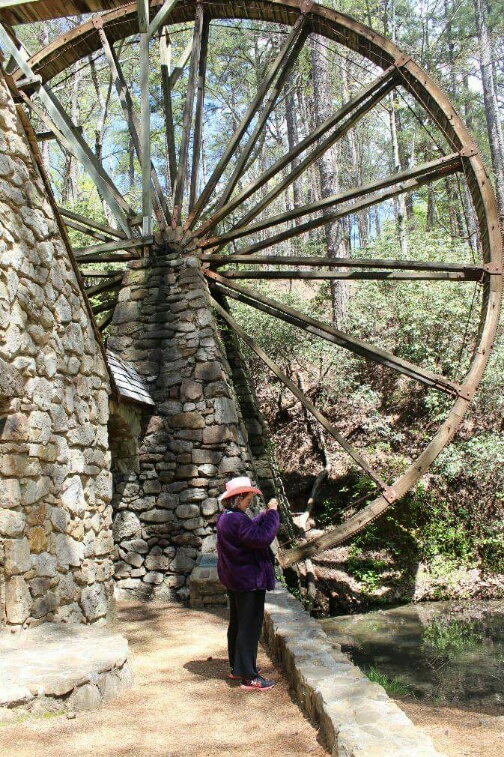
For whatever reason, April did pass, and now suddenly it’s the middle of June. Huh? What happened to May? I don’t remember May at all. It must have gotten subsumed into The Wheel of Time, either the story or the Tibetan wheel that gave the series its name.

More probably, though, I was concentrating on moving things along that didn’t want to move — a knee that didn’t want to heal quickly, plants that didn’t want to grow (there aren’t many living things that can deal with a drought, freezing temperatures one day and ninety degrees the next, and an ignorant caregiver through it all), as well as a garage that is being built at an equally slow pace. Which made for a strangely unmoving experience where every day was the same as every other day.

But now it’s June and somehow things did change during May. The knee is better, the transplanted bushes are alive even if they’re not exactly thriving, the flowers that wanted to bloom did and the rest are resting in peace. And the garage is much further along than it had been. (We’re past the stage of needing an inspector, so my worries of needing to get a second building permit never came to fruition.)

I need a new plan for planting, though. The bulbs did not do well at all, so sadly, I glance at the catalogs full of spring blooms that decorate my otherwise empty mailbox, and toss them aside. It’s possible the bulbs would grow despite the clay soil if I dug deep holes, filled them with potting soil, and then . . . what? Water them? It’s hard to know what to do in a drought, so it’s best if I wait for the wheel to turn to a more propitious time (or for me to learn way more than I know now about taking care of the poor things).

So now here’s June, but it might as well still be May for all the changes that are occurring. The knee still is not well enough to take walks (though well enough to do whatever I need to do around the house without exorbitant pain.) The bushes aren’t growing in this horrible heat and wind. The garage still needs to be finished. And I’m still reading (or rather rereading) the same fantasy series.

I do know it’s June, though it feels more like July, so that’s something. At the very least, another month won’t slip into the same black hole that May did.

Not that it really matters what month it is. April, May, June — they are all just names for that which flows beneath the wheel of time.

***

Pat Bertram is the author of Grief: The Inside Story – A Guide to Surviving the Loss of a Loved One. “Grief: The Inside Story is perfect and that is not hyperbole! It is exactly what folk who are grieving need to read.” –Leesa Healy, RN, GDAS GDAT, Emotional/Mental Health Therapist & Educator.

Saving the World

I finished rereading The Wheel of Time, and since the library isn’t open yet, I’ve begun re-rereading the series. It’s not that it’s such great writing — with over four million words spread out over fifteen books, there really should have been a huge amount of culling to make it less of a sprawl. Some of the meanderings off the main track are unimportant and inane and downright aggravating — a reader does not need to see every savage side of the lesser antagonists to get the point that they have sold their souls to The Dark One. Nor does a reader need to see certain characters doing the same thing over and over and over again. Nor does a reader need to see author mistakes, such as his forgetting what his characters are like and have them acting brainless for no reason whatsoever.

The series was originally proposed as a trilogy, though the scope of the story demands more than that. TOR Books, knowing how wordy Robert Jordan was, turned it into a six-book deal, which they should have enforced. The Wheel of Time is a perfect example of an author falling in love with his creation. He spent ten years planning the work, doing research, and taking copious notes before he started writing, and apparently, he couldn’t bear to give up any bit of his creation even if it would have made a much stronger story to do so. As to why his publisher didn’t rein him in — there is a whole lot more money to be made by fifteen bestselling books (fourteen plus a prequel) than six. Since the fantasy market is predominately younger folk, I guess they figured they had a non-critical readership, and every time a new book came out, a new crop of readers came of age, which prompted sales of the earlier books in the series.

Luckily, it’s easy enough to skip over the many sidetracks and dead ends to keep to the essence of the work, though that doesn’t help dealing with the parts of the story that aren’t there. Jordan delighted in writing ad nauseum about trivial matters but mentioned important points almost as an aside and brought in mysterious characters for cameo spots without any elucidation of who they were or why they were important. Despite myriad interviews, he refused to explain some of his seemingly pointless points, saying he wanted people to think about them. A bit of a god complex, there, but then, I guess that’s understandable when one has created such a massive world to play with.

There is also too much war for my taste, but after all, Jordan is a military historian, and ultimately, this series is about the battle between the forces of light and dark, so all the military hoopla has a place.

Despite the many drawbacks of the series, it’s compelling because of the eternal themes of honor and duty, loyalty and integrity, steadfastness and kindness and friendship, doing what’s right no matter the cost, standing by one’s word, rising above the baseness of one’s life to grasp nobility, accepting one’s fate and becoming a hero. Those are the nuggets of purity that drive the (sometimes appalling) story. And it’s those same nuggets that perhaps make the work worth reading and even rereading.

It’s funny — each time I reread the series, I tell myself that this time I will read every word, and each time I get bored by the trivial chapters and inane characters and become aghast (re-aghast?) at the sadism, and end up skipping vast sections to get to better parts. Some of the horror is necessary, of course, to help forge the rather ordinary characters into the heroes (reluctant or not) they will become. I mean, you don’t simply wake up one morning with the power and resolve and ability to fight the overwhelming darkness that might be threatening to consume us all.

Jordon has created an incredibly complex kaleidoscope of a world, taking all the bits and pieces of our cultures, customs, costumes, mythologies, legends, religions, histories, and shaken them up and spread them out in a new and vibrant pattern. One of the fun things about rereading the book is picking up elements that one missed the first time through. (Despite that, there are whole storylines that add nothing to the whole — the Seanchans, Slayer, Perrin and Faile to name just a few.)

Since this is the quintessential hero’s journey, with each character on his or her own path to greatness, there is homage to the legend of King Arthur as well as to lesser known legends.

There are the archetypal characters, such as shapeshifters and tricksters, mentors and allies. And underlying it all is the savior tale, both the Christian story and the pre-Christian ones.

What would you do if you’re going about your ordinary life, doing what you’ve always done, and then discover you’ve been chosen to save mankind, chosen to give up your life to save the world?

I wonder — as I sit in safe isolation while many folks around the world are dying of a novel virus — if I would have the courage, the stamina, the will, to undertake such a task. In my heart of hearts, though I would wish I did have such a heroic character, I know I would not be able to do it. Could not do it — I’m too old, too tired, too powerless. But when I immerse myself in this legendary world, I think . . . maybe.

Just maybe . . .

***

Pat Bertram is the author of Grief: The Inside Story – A Guide to Surviving the Loss of a Loved One. “Grief: The Inside Story is perfect and that is not hyperbole! It is exactly what folk who are grieving need to read.” –Leesa Healy, RN, GDAS GDAT, Emotional/Mental Health Therapist & Educator.