For Want of a Nail

I’ve been thinking about that old saying about for the want of a nail the kingdom was lost. The full proverb is:

“For the want of a nail the shoe was lost,
For the want of a shoe the horse was lost,
For the want of a horse the rider was lost,
For the want of a rider the battle was lost,
For the want of a battle the kingdom was lost,
And all for the want of a horseshoe-nail.”

What made me think of this proverb is my attempt to get my brakes fixed. The four brake cylinders were replaced, but the parts store sent a master cylinder with the wrong clocking, so that part never got replaced. The brakes worked fine for a few months, but the last time I drove and put on the brake, the pedal went all the way to the floor. The car stopped, but it spooked me, so I went back to the mechanic to get him to order the correct part. I checked on Friday to see what’s going on, and apparently, he hasn’t been able to find the right part.

And that’s when the saying, “for want of a nail,” started going through my head. A master cylinder isn’t that expensive, around fifty dollars, maybe, and because of not being able to get that part, my car is suddenly defunct. Although I seldom drive, I’ve been worrying all weekend about being permanently without a car since it’s so important to have for emergencies. And then suddenly it dawned on me: if I had to sell the car because the brakes didn’t work, you can darn well bet that whoever ended up with it would figure out how to get a master cylinder. So I am going to keep after my mechanic to make sure he finds a part. I plan on talking to him tomorrow to see if taking a picture of the part will help him locate the correct one, because I am not going to let this go. I’ve spent too much on the car in the past few years restoring it and making sure it runs perfectly to give up on it now.

As if that isn’t problem enough, I had a hard time dealing with my lawn mower today. Although I hadn’t planned on mowing the grass for a while, I noticed that a lot of people were mowing their lawns today — the people whose lawns had greened up — and one fellow I talked to said this was the right time. I contacted my contractor, and he agreed that it wasn’t too early to mow.

So, I got out the mower, found the battery, and dug out the instruction manual. I don’t use the mower enough for the practice to become second nature, so I have to relearn how to use it every spring. I got it started, it went a few feet, beeped, then stopped. I had no idea what was going on because the battery was full, but I went ahead and plugged the battery in the charger while I cleaned the mower of any possible clogs.

Eventually I got it to work. Apparently, the grass was too tall and too thick for the available power, so I raised the mower to the highest level, replaced the battery, and all was fine. The grass is still too tall, though if I don’t let it get much longer, perhaps the next time I try mowing I can cut it a bit shorter.

By the time all that was done, I didn’t have the energy to deal with the string edger (it’s actually a weed whacker, but it can be set to trim the edge of the grass). I don’t remember ever using it, so I have to start from scratch learning how to wrap the string and attach it and all the rest of it. That will be a project for another day.

I used to think I was good with mechanical objects, but apparently not. Still, this is just the beginning of the mowing season, so I will have plenty of time to get familiar with my tools. Perhaps this time the instructions will sink in so next year there won’t be all these problems.

Hopefully, long before then, the mechanic will find the right part to get my car running. Or rather, get it stopping.

***

Pat Bertram is the author of intriguing fiction and insightful works of grief.

A Promise of Good Things to Come

I had an enjoyable morning, watering my grass, bushes, and other plants. Seeing all the parts of my yard that are greening up made me think that perhaps I can do this gardening thing after all. I can even recognize some of the seedlings, such as the larkspur. Since I let the larkspur go to seed last year, there are large areas that should be covered with purple flowers later this spring.

I was also able to recognize some weeds that are sprouting, such as the wild mustard, which I pulled up. I was going to let it grow a bit thinking it wouldn’t do any harm as long as I didn’t let it flower, but as a neighbor reminded me, if I waited to pull up the mustard, I might pull up the larkspur along with the weed.

A lot of the tulips I planted are coming up, and most even seem to have buds on the way, so perhaps this time I planted them deep enough. A few of the lilies are coming up, too, which is surprising considering that the wrong planting depth was included with the bulbs, so I had to dig up the ones I could find and replant them in deeper holes.

My grass is doing astonishingly well. I have a hunch it’s way to early to mow since we are still way before the last frost, and I’m afraid that cutting the grass too soon would make it vulnerable during those late-season frosts. It’s possible it would do fine, but I don’t want to take a chance.

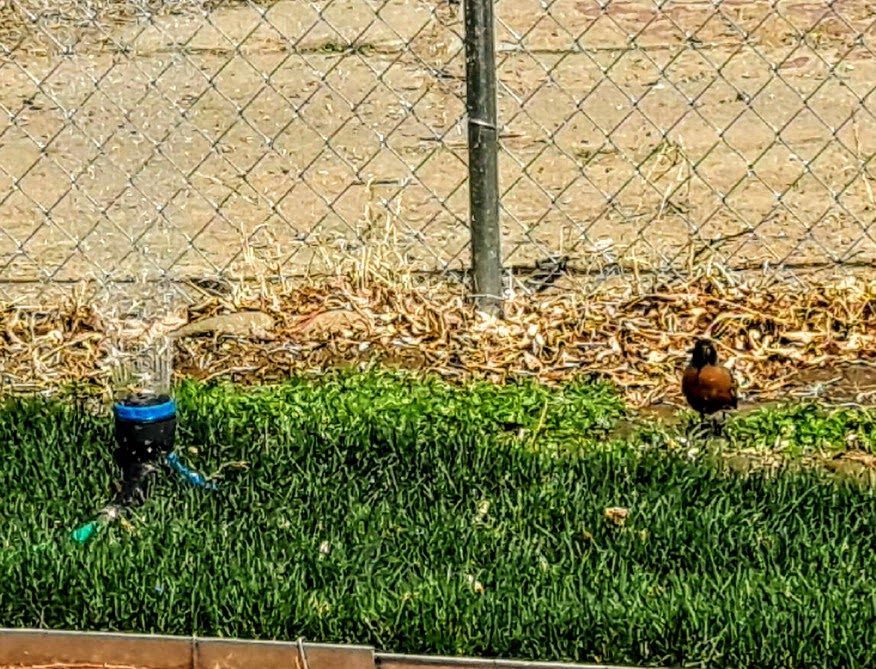
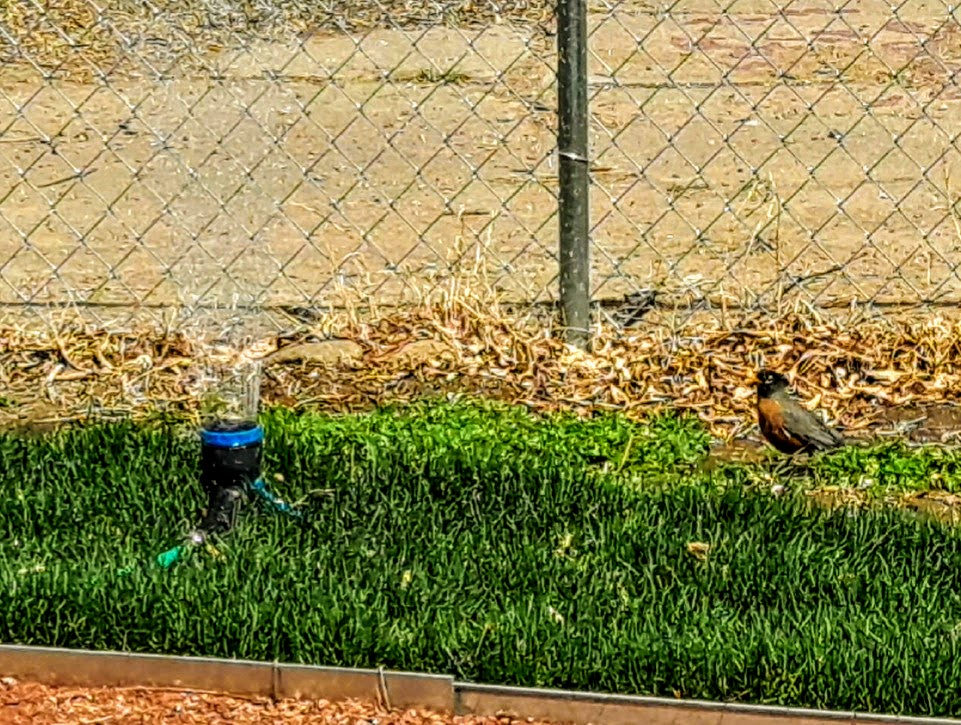
I wasn’t the only one enjoying my watering time this morning. I set the hose in the back yard, went to move the hose in the front, and when I came back, a robin was enjoying a private shower.

Loath to disturb the creature at its ablutions, I kept the water running in that one area way too long. Even after I went into the house for my camera, even after the robin preened a bit for me, I let the water run.

At one time, I’d considered setting up a birdbath because in a dry climate (and today was especially arid), birds appreciate any water they can find. Unfortunately, standing water is too risky in a place where mosquitoes are so much of a problem.

I always liked the idea of spring, but the reality — all that wind — made spring not one of my favorite seasons. Today, though, I got outside before the wind, so the day was all one expects of the spring — new growth, robins, and a promise of good things to come.

***

What if God decided S/He didn’t like how the world turned out, and turned it over to a development company from the planet Xerxes for re-creation? Would you survive? Could you survive?

A fun book for not-so-fun times.

Click here to buy Bob, The Right Hand of God.

Something to Celebrate

For many years after Jeff died, I was conflicted about life. If life mattered, why wasn’t he still here? And if life didn’t matter, why am I still here? I’m still conflicted when I think about it, so I don’t. At least I try not to. Instead, I try to focus on living, on making living a purposeful, active act rather than passively going about my days.

To that end, I try to find something to celebrate every day, perhaps a nice meal, an unexpected visit with a friend, a smile exchanged with someone I have business dealings with, or even just that the sun is shining.

Today I have something special to celebrate: the first tulip of the season!

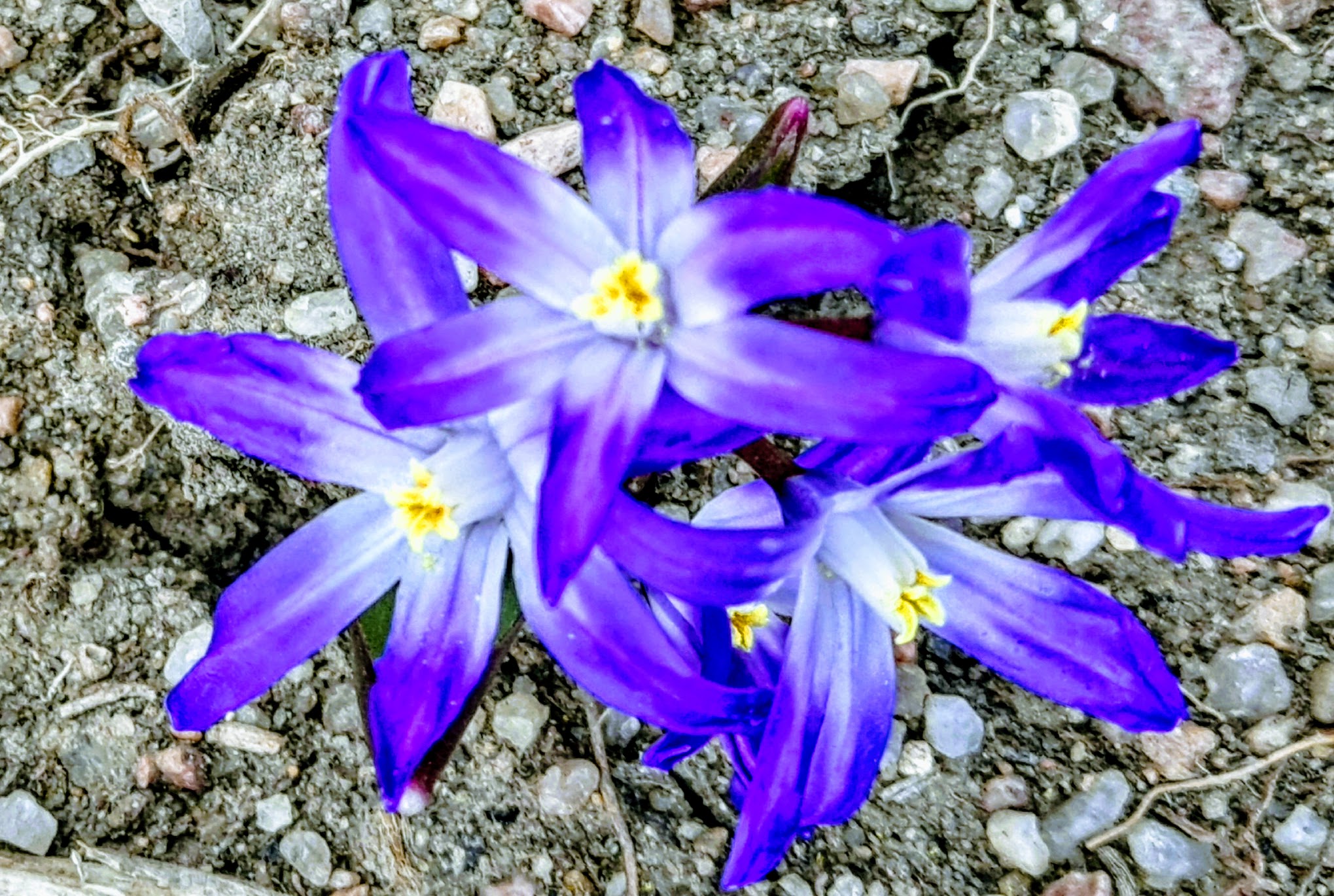
Although not as spectacular, I also have a tiny clump of a bulbous perennial called Glory of the Snow that bloomed a day or two earlier.

There are still several weeks of possible frosts before planting. The weather seems to be taking that schedule to heart because most nights are getting down below freezing. I wouldn’t be surprised if this year the frost deadline is extended a week or two further into May, though it is warming up, and tomorrow will be downright balmy — in the eighties! Still, until the warmth and gardening weather is here to stay, it’s good to see — and celebrate — whatever decides to show its beautiful face.

And today it was the tulip.

***

Pat Bertram is the author of Grief: The Inside Story – A Guide to Surviving the Loss of a Loved One. “Grief: The Inside Story is perfect and that is not hyperbole! It is exactly what folk who are grieving need to read.” –Leesa Healy, RN, GDAS GDAT, Emotional/Mental Health Therapist & Educator.

Breezy Day

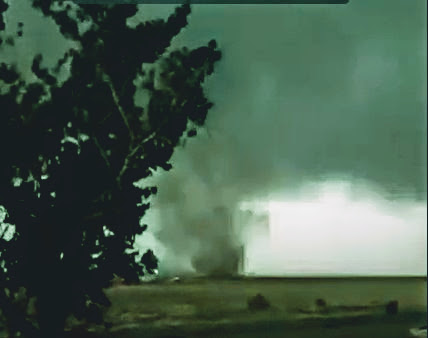
It’s a bit breezy today, with winds up to thirty mph and possible gusts up to 60 mph. Surprisingly, despite the high-speed air movement (and if we don’t take into consideration any potential gusts), we are well within the “breeze” category.

Winds with speeds of 4 to 31 miles per hour are considered to be breezes, so a thirty-mile an hour wind, even if it comes with a high wind warning, is still considered a breeze. I always thought the term “gentle breeze” was redundant, but apparently not. What I considered to be a gentle breeze — anything less than winds of 4 miles per hour — is not even a breeze. It’s just light air movement. A gentle breeze is a wind with a speed of 8 to 12 miles per hour. A fresh breeze is a wind with a speed of 19 to 24 miles per hour. A strong breeze is a wind with a speed of 24 to 31 miles per hour. A gale is a wind with a wind speed of 32 to 63 miles per hour. My dictionary defines a gale as a strong current of air. Who knew Webster had such a sense of understatement! (In case you’re interested, a storm is stronger than a gale, and a hurricane strongest of all.)

I understand how important wind is — without wind, there would be no seed dispersal, no pollination, no long-awaited rain in dry regions. There would be few livable climates on the earth since winds help diffuse the air and moisture, making more of the earth habitable. Without wind, the ocean currents would die down. Entire ecosystems would disappear. Weather extremes would be huge, either intensely hot or penetratingly cold, either totally arid or mainly rainy.

Despite my knowing the importance of wind, wind is still my least favorite weather. It makes every other type of weather, be it snow or rain, sleet or heat, so difficult. Besides which, it’s dangerous, causing damage to people, animals, and property. Although I love trees, I am glad there are no trees nearby to cause potential damage. A tree limb fell straight down during a windstorm where Jeff and I lived, and the crash, just outside my bedroom window, sounded like an explosion. Felt like one, too. A couple of feet closer, and that would have been the end of me, so I am especially leery of trees in the wind. (A neighbor has a tree with a creaking branch, so I had a tree guy come and look at it to make sure that if it fell, it would be nowhere near me or my house.)

With any luck, later today the wind will finish its job — moving air around — and it will be calmer tomorrow. My frazzled nerves can use the rest.

***

Pat Bertram is the author of Grief: The Inside Story – A Guide to Surviving the Loss of a Loved One. “Grief: The Inside Story is perfect and that is not hyperbole! It is exactly what folk who are grieving need to read.” –Leesa Healy, RN, GDAS GDAT, Emotional/Mental Health Therapist & Educator.

Aphantasia

Ever since I became an author and interacted with other authors, I have been fascinated by the different ways peoples’ brains work when it comes to writing. Some people sit down and start writing, and the words appear on the page almost without their volition. Some people envision whole scenes, and interact with those scenes. Some people see a movie in their head, and simply write down what they see.

I have never experienced any of those things. For me, writing has always been a puzzle, putting together words to create characters and conflicts, scenes and scenery, plots and passions. But I have never once seen an image in my mind’s eye of anything I have cooked up in my brain pan. I simply don’t think in images, and never have.

I remember once telling my mother about a girl who clerked at the local Safeway. This pretty girl was kind and thoughtful, and never seemed to think the work a burden. My mother said she’d look for the girl. Weeks later, she told me she finally met the girl, and she shook her head at me. “It would have been easier if you had told me she was black.” I was taken aback because I didn’t remember that particular detail. I only had an impression of her, a vague idea of what she looked like. I took this to mean I was color blind as to race, when it really meant I was mentally blind.

Another time a friend mentioned a fellow we worked with who had a full beard. I thought the friend was joking because I was sure we didn’t work with anyone like that. The friend pointed out the fellow, and sure enough, there he sat, a few feet away from me, full beard and all. That time I took my lack of attention to this detail as a general lack of attention, when it was really another example of where I was mentally blind.

I’ve never understood how people could utilize visualizing techniques, because I can’t visualize. I can remember, of course, but my memories don’t take the form of images. They depend more on a sense of . . . essence. Needless to say, I would be a terrible witness if it ever came to that. I do notice things, and I do pay attention, but I don’t have the detailed visual recall necessary to a be good witness.

It turns out there is actually a word for the inability to see mental pictures: aphantasia. For some reason, aphantasics tend to be introverted, while hyperphantasics (those with well-developed mental imagery capabilities) tend to be extroverted, though what one condition has to do with the other, I don’t know.

Supposedly, there are techniques that can help “cure” me of this ailment, if in fact I have it. I do see vague images at times, which some researchers say means I am not aphantasic, though other researchers say that some aphantasics have visual memory recall. Either way, it makes no difference to me. After so many decades of not seeing pictures in my head, I’m fine with my lack of visual imagery, no matter what the condition is called. And anyway, at this advanced stage in my life, strong imagery could only confuse me.

***

What if God decided S/He didn’t like how the world turned out, and turned it over to a development company from the planet Xerxes for re-creation? Would you survive? Could you survive?

A fun book for not-so-fun times.

Click here to buy Bob, The Right Hand of God.

An Egregious Error

In a book I read the other day, a 1929 speakeasy waitress (a flapper) was trying to solve the mystery of why a patron had been murdered. She went into a hardware store that one of the suspects owned, and started out her investigation by innocuously asking to see a Black and Decker electric drill.

That stopped me cold. It’s hard on me as a reader when anachronistic elements show up in a novel; it takes me out of the story, and makes me wonder what the author was thinking.

The worst example of such a literary crime was in a best-selling (or so she claimed) novel by a self-published writer who wrote racy regency romances. That’s so not my thing (though I did enjoy the books by Georgette Heyer, who has been credited as the creator of the modern regency romance genre). Still, at the behest of my publisher, I took a look at the books to see what the big deal was, and just about the first thing in the first chapter was a breakfast of chocolate chip pancakes with maple syrup. What? How could anyone have made such a ridiculous error?

Maple syrup wasn’t served on pancakes until after the regency era, and who knows if it would have arrived in England by then, and even more doubtful if it was used on pancakes. In addition, although pancakes have been around for hundreds perhaps thousands of years, they were not a common breakfast food in regency England. But I will give the author the benefit of the doubt since I can’t for sure say that rich people wouldn’t have eaten pancakes with maple syrup back then.

Also, although chocolate was known and favored during those times and served in the morning, it was in the form of a hot chocolate drink. Chocolate chips, however, were not invented until a hundred and fifty years later. Created in 1938, chocolate chips were called “morsels” until sometime in the 1940s when “chocolate chips” became the more common term, though “morsels” is still used by the first company who sold them.

Needless to say, I never read more than the first few pages of that book.

The flapper book turned out not to contain this sort of error. In fact, Black and Decker was in business in 1929; it had been founded in 1910. And they were selling an electric hand-held drill by 1917.

I had no idea that electric tools went back so far! It makes sense, though, that power tools would have been one of the first uses of electricity after lighting since electric tools make work so much easier.

As for the flapper book — after time out to research Black and Decker and power tools, I went back and finished the story. Apparently, it wasn’t that great because I can’t remember a thing about the story, but at least it didn’t suffer from an egregious error like the chocolate-chips-in-the-regency-era novel.

***

Pat Bertram is the author of intriguing fiction and insightful works of grief.
Decisive Action

I find it interesting how often, when I do a two-card tarot reading, that the keyword in the meaning of first card is repeated in the second card. For example, the first card of today’s reading was the Seven of Sceptres. (In this deck, the Ibis Tarot, the sceptres replace the wands.) The meaning of this card as set out by Josef Machynka (the Austrian artist who designed the Ibis Tarot) is “a victory” brought about by a person with “the necessary discernment and intelligence. Obstacles, arguments, and resistance are overcome by decisive action.”

The meaning of the second card I drew today, The Magician, is “a mature, spiritually developed person with sharp intelligence and great insight” who is “capable of acting decisively and correctly.”

So I acted decisively, and made plans to take a walk. I also took decisive action by calling a friend to see if she wanted to go with me. Later, I took decisive action and determined the route. It was no big deal — we had just naturally continued along the street where we met, and using my sharp intelligence, I noticed that there was a lot of traffic on the road, so I suggested we walk along an adjacent street.

When I returned home, I took more decisive action by fixing myself a meal, and then decisively reading on the couch while I ate. And then I took a nap. There was no decisiveness involved in that particular action, nor was there any intelligence involved. I simply drifted off. I suppose you could say it was the correct thing to do since apparently, I was tired after my time in the sun and wind.

And now here I am, poking around on the keyboard, being neither decisive nor particularly intelligent, though I am managing to do the correct thing and get today’s blog written.

Facetiousness aside, the Ibis Tarot is an interesting deck. It is about the width of a deck of playing cards, but a little longer, which makes an attractive deck, though the size feels awkward. It’s also the remaking of a much older deck, one that has been around since the nineteenth century. The original Ibis Tarot was the creation (or perhaps recreation of an even earlier deck) of Edgar de Valcourt-Vermont. The poor design of those cards kept them from being widely appreciated. Josef Machynka spent years researching ancient Egyptian culture and tarot-related topics so this Tarot is a combination of old Egyptian and modern forms as well as the commonly accepted elements of traditional Tarot.

The Ibis Tarot is certainly visually appealing, and the tiny handbook that comes with the deck is as detailed as the bigger companion books that are often sold with other Tarots. (That sort of book irritates me. They seem as if they should be chock full of interesting information or mystical insights, but mostly they include long descriptions of the cards that anyone can see at a glance, with only a brief guide as to the card’s meaning.)

I still haven’t found “my tarot,” the one that will talk to me and tell me things not included in the handbooks, but this one seems closer than most.

***

Pat Bertram is the author of intriguing fiction and insightful works of grief.
Traveling Books

Although you might think this post concerns books about traveling, it’s actually about books that travel. I’d never given much thought to how far books travel, and probably never would have if it weren’t for the confluence of two events. First, my friend who returned to Thailand to be with his ailing wife, took my book Bob, The Right Hand of God with him, which, according to him, makes me an international author. Sounds good, doesn’t it, being an international author? More accurately, it makes the book itself an international book because the author — me — is definitely not international since I’ve never been out of the USA. But my book is now out of the country, having gone by way of car, plane, bus, and perhaps even train, so that makes it a traveling book.

The second event concerns the book I am currently reading. It was written by a Spanish author and translated and published in the U.K. And somehow a copy of that book, printed so very far away, ended up in the local library in the ongoing book sale section. It looks like a well-read and much-loved book, so who knows what sort of roundabout journey that book made to get here. And now it’s in my hands.

This made me think of other traveling books I have known. For example, a friend sent me a trio of books about trees for a house anniversary gift, and those books also came from the U.K. Actually, they came from Amazon in Las Vegas, which is mystifying because she ordered the books from a business located in U.K. Still, since those books were published in London, they had to have traveled to Las Vegas somehow, before they ended up here.

I’ve also been an agent a couple of times for someone overseas who needed out-of-print books that were not available where he was living, and if I remember correctly, at least one of those books originated over there.

Most books don’t travel that far, at least I don’t think they do, but still, they rack up the miles going from the printer to the distributor to the seller to the buyer and then to the reader if the buyer and reader aren’t the same person. Eventually, books travel to a secondhand store and then continue their journey to another home. I ordered one such book from a used book outlet in Oklahoma, and the gift card inserted into that obviously unread book showed that it had been gifted to someone in New York. It was delivered to me in California, and then I myself brought it to Colorado.

But that was a simple journey. Some books travel in a more convoluted fashion. I heard of a woman who had donated her childhood books, then later in life found one of those very same books in a used book store far from where she grew up. She bought it, of course, because obviously it wanted to go back home to her. One can only imagine the secret life of that book — where it had traveled, who had read it, who loved it, and how it ended up back in the hands of its original owner.

A huge percentage of books don’t enjoy that kind of far-reaching journey. 77,000,000 unsold and unread books are pulped — destroyed — each year by the major publishers. (Print-on-demand, where only books that are already sold are printed, hasn’t changed things much because bookstores need the product on hand even though they return up to 40% of those books to the publisher, and up to 95% of those books are sent to landfills or recycled into paper pulp.)

But that’s too depressing to think about. I’d rather imagine the journeys books go on. It’s only fitting that they get their own journeys since so many of them take us on mental journeys and allow us flights of fancy such as this blog post.

***

What if God decided S/He didn’t like how the world turned out, and turned it over to a development company from the planet Xerxes for re-creation? Would you survive? Could you survive?

A fun book for not-so-fun times.

Click here to buy Bob, The Right Hand of God.

Perfect Spring Day

Today was a perfect spring day — warm, slight breeze, clear skies. It’s been a while since the last rain, so I took the opportunity to water my grass and other plants. In retrospect, it would probably have been a good idea not to walk to the grocery store first, but I needed to get a few things, and besides, it hadn’t yet warmed up yet enough to water when I left to do my errand. (It has to be warm because I tend to drench myself, and I don’t particularly relish the idea of catching a chill.)

Now — ouch — I am sore all over. I’m not used to being on my feet that long, nor am I used to all the walking, not just to the store but around my yard. Because of the configuration of the greenery, with long swaths of grass rather than one huge lawn, I have to keep moving the hoses. I set one in the front and one in the back, and by the time I get back to the front, it’s time to move the hose. So then I return to the back yard and move that hose and head to the front again. A soaker hose would be a good idea, but that’s all it is — a good idea. I’ve never found one that does the job. And anyway, it irritates me having to set a hose, come inside until it’s time to move it, and then just when I’m getting involved in doing something, having to go back outside. It’s far easier, though perhaps more painful, just to stay outside and enjoy the day until the task is finished.

When it heats up enough to where I have to water more frequently, it would probably be a good idea if I did the grass one day and the flowers and bushes the next. Doing it all in one day is what set my poor feet on fire. But it’s worth it. The yard is looking good!

I never particularly cared for grass; it seemed rather a frivolous plant, so I find the pride — and joy — I take in my lawn amusing. And I do take joy in it. Although the grass had faded somewhat during the winter, it’s greening up again, and oh, is it bright! Gemstone bright.

Also sprouting up are the larkspur that planted themselves last year after I let the flowers go to seed. The wild mustard is sprouting, too. I will eventually have to pull up the mustard, since it’s a weed that takes over, but now, when it is young and ferny, it is so pretty. The lilacs are coming alive, too, and it looks as if a few of those young bushes might even have flowers this year.

So perfect weather. Lots of green. Signs of growth. All that adds up to such a perfect spring day, I don’t even mind how sore I am. Well, not much.

***

What if God decided S/He didn’t like how the world turned out, and turned it over to a development company from the planet Xerxes for re-creation? Would you survive? Could you survive?

A fun book for not-so-fun times.

Click here to buy Bob, The Right Hand of God.

Cost Conscious

I got in a bit of a verbal tussle the other day with a friend who complained that the current gas prices were the highest ever. I disagreed, of course, because prices have been higher.

To be honest, it wasn’t much of a tussle, falling short of an argument and ending quickly when I realized the person simply didn’t remember times when gas was higher. You can’t cajole people to the side of truth when they firmly believe — when they know — they are right, even when they are wrong. And I wasn’t arguing, anyway, about the truth of it. I simply wanted to put today’s prices in historical context. Unlike his shock at the price, it seemed normal to me because despite his belief, I remember times when I paid over $4.00 a gallon (2008) and other times (2011-2014) when prices were similar to what is being charged now.

In case it was I who had the faulty memory, I looked up gas prices in those years, and yes, in July of 2008, the average price of gas at the pump was over $4.00, and if you adjust that price for inflation, it would be over $5.00 by today’s prices. And though the average price of gas in 2011 through 2014 was just under $4.00, I was in California during those years, and since they are notorious for their insane gas prices, I paid over $4.00 then, too. It didn’t help that I switched from regular to premium around that same time. (It took me forty years to discover that my car needs premium, and it does seem to work better, but the only reason it works better is that the ethanol that is added to gas makes it run worse. The old regular leaded gas was best.)

To me, the real cost consciousness comes when I compare gas prices today to what I paid when I first started driving — $0.19 — though when adjusted for inflation, that $0.19 comes out to be $1.82 in today’s dollars and doesn’t seem quite so ridiculously cheap. But I don’t compare. Gas is up, gas is down. That’s the way it’s always been. For the last decade or so, gas pretty much remained the same price for me — when I go to the pump, I buy $20.00 worth of gas. I don’t pay attention to how far that $20.00 takes me, so in that sense, gas is always the same price. Admittedly, I don’t drive much and won’t until the mechanic can find a master brake cylinder with the correct clocking, but still, I don’t worry. I remember when they were predicting that gas would go up to $6.00 per gallon, so anything less is to the good.

I’m also not worried about wheat prices because I try to stay away from wheat. (People tell me they stay away from wheat too, without realizing that almost all baked goods and fried foods and all sorts of things are dependent on wheat.)

Despite my laissez-faire attitude, I do notice the price of myriad things going sky high. Lettuce $4.00 for a tiny head? Ouch. Good thing I tend to stay away from iceberg lettuce too, since it’s not highly nutritious. But there will always be something that comes with a shocking price tag, so it’s not worth getting het up over. Buy or not. It’s all basically the same.

Of course, there are times when even I am appalled at prices I have to pay — my water bill from a couple of months ago, for example. But that was a meter problem where they overcharged me, and since they still say the meter is working fine, they never gave me a refund for the 19,000 gallons they insist that I so impossibly used. (I just got my bill today, and it’s back to normal, so I think my surmise that the meter doesn’t like below zero temperatures is correct.)

Still, no matter what the price of gas and wheat and water and whatever else, I am glad those things are still available.

***

Pat Bertram is the author of intriguing fiction and insightful works of grief.