i Tarocchi di Robot

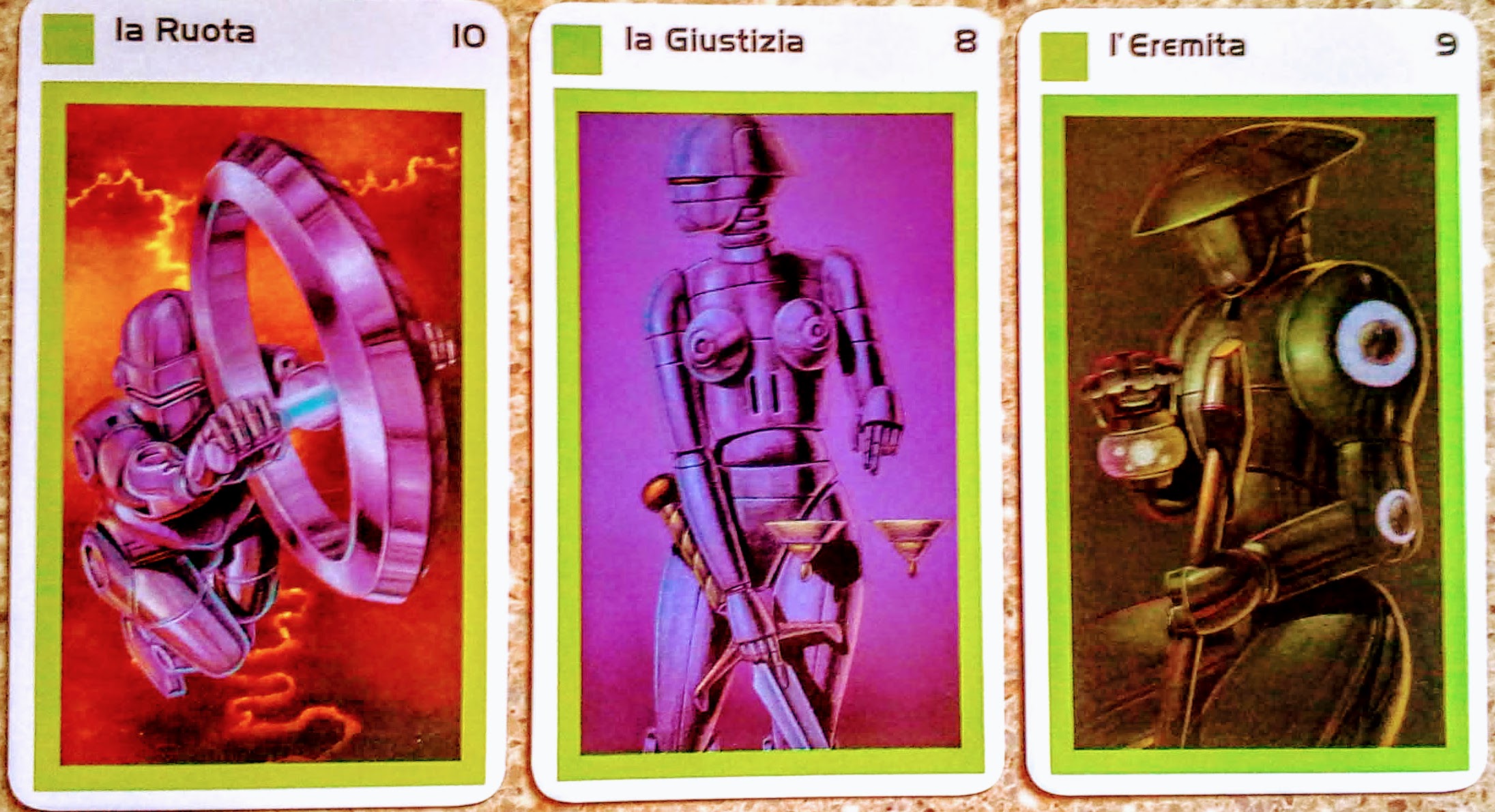
I’ve been translating a booklet written in Italian that came with a deck of tarot cards, I Tarocchi di Robot. I thought it would be easy using MS Word translator and Google translator — just type in the text. And it was easy. Mostly. There were places of disagreement between the two translations, and even some words that seemed wrong in both translations. I’m pretty sure the writer meant suit of cups and suit of wands rather than seed of cups and seed of wands as presented in both translations, though who knows. When it comes to the tarot, people seem to like being mysterious simply for the sake of being mysterious. So I had to do some translation of the translation, if you know what I mean.
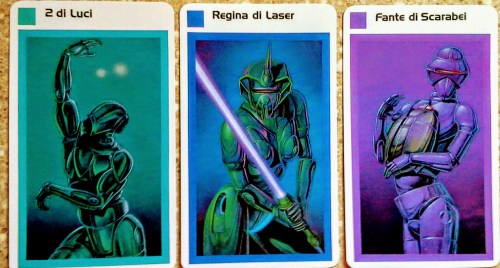
Most of the booklet was about the history of the tarot, which I didn’t bother with — I have several histories in English, which should be enough for anyone, and what was left seemed to be more about the philosophy of this particular deck rather than a practical application or practical information about the individual cards. According to what I could translate:

Robot is a word of Czech origin which means work. It was the playwright Karel Capek who invented the term robot in a novel, Rezon’s Universal Robots, which illustrated a utopian society governed by thinking machines. Later the word robot was used to designate automatons of various shapes and attitudes, and provided the inspiration for an infinite number of literary works, films, and comic books. But in the science fiction strands dedicated to the relationship between men and machines, Robot Tarot is an absolute novelty for the theme itself and for the way it has been developed.

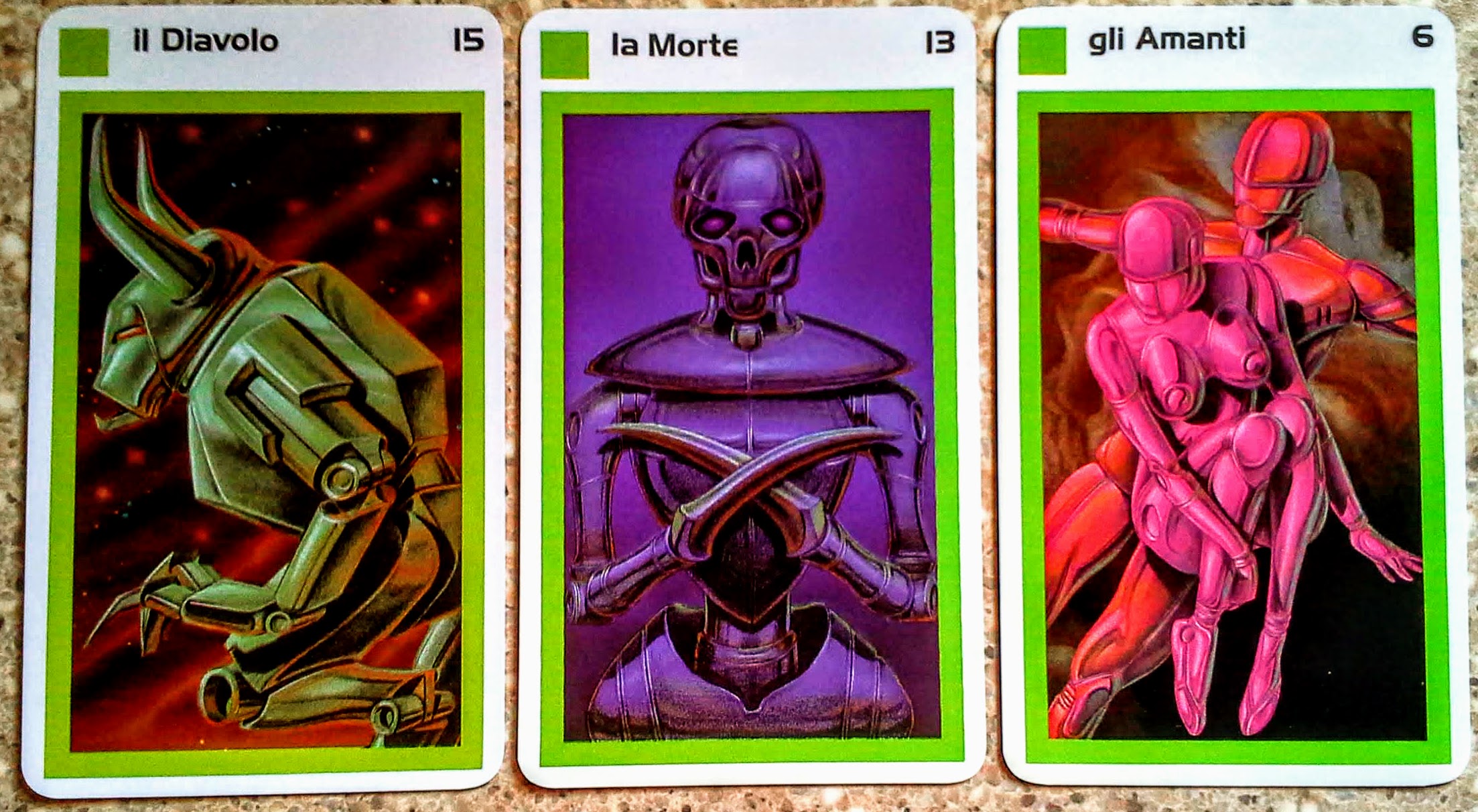
Looking at the triumphal cards, or the Major Arcana, you immediately see that the characters represented, although they are obviously automatons, do not express the insensitive coldness of machines. On the contrary, they seem to be inhabitants of a world parallel to ours, or perhaps later than it. An extremely evolved world, where cyber science has been able to transfer human qualities to androids. Thus, the merits and defects carved into the genetic code of humans are found in the Robot Tarot. Among these automatons there can be love, madness, courage and lies. They too are divided by a social hierarchy, they know suffering and aspire to perfection, to that Paradise that only metaphysical thought is able to touch. There is undoubtedly a hint of poetry in these cards and also a lot of irony if the virtues of the tarot cards, which are difficult for humans to use, can be attributed to thinking machines. So, to be fully ironic about these figures, we want to give them even deeper meanings by imagining that metaphysics, the most sublime or most illusory science (since it tries to explain the meaning of things and life) finds itself projected into this world of steel, plastic and silicon where the soul would seem to be governed by capacitors and transistors and the spirit sacrificed to ideals of pure efficiency and productivity.

There’s definitely poetry in these cards — even without knowing what the images mean (in a tarot sort of way) and even without liking robots (I have no real interest in robots of any kind or in any medium) it’s easy to feel . . . something. The cards are truly stunning and unique, and yes, it delights me to think of automatons — creatures far from human thought — bringing us a deeper understanding of human life.
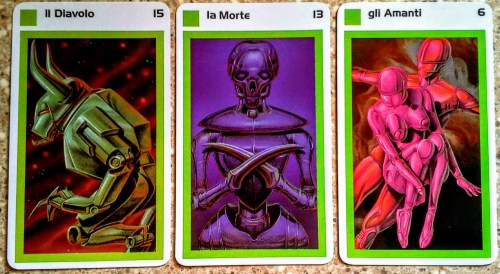
The main thing I learned from my efforts at studying the Italian prose was how the various suits translated into more traditional terms.

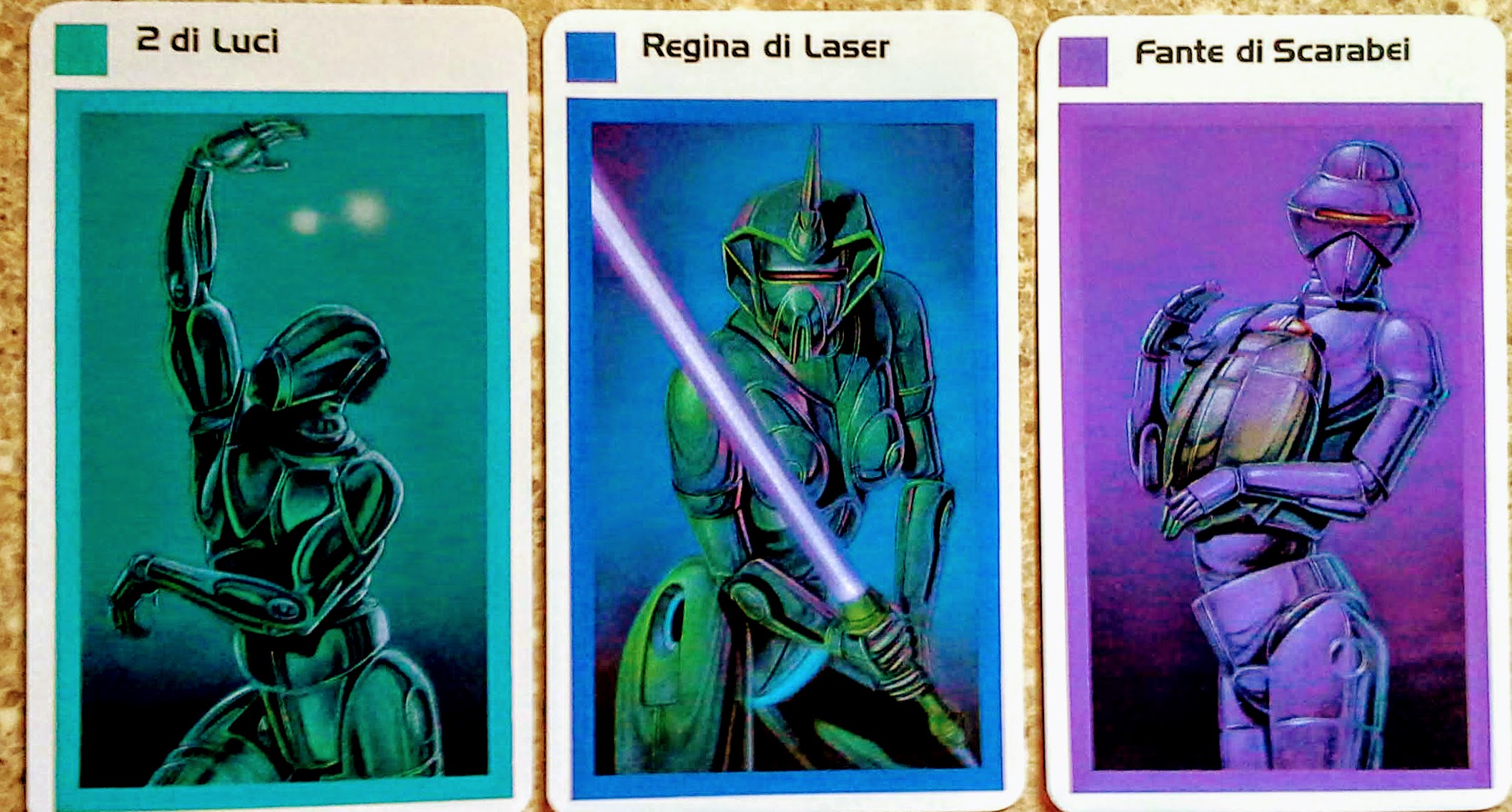
On the basis of what hidden logic have the coins turned into lights, the cups into scarabs, the swords into lasers, and the wands even into the suit of nothing? The answer to this question allows us to enter the philosophy of the Robot Tarot, thus tearing the veil of mystery that lingers on their fantasy world.

We have said that robot means work, and the Minor Arcana refers to work, not to manual and intellectual work but rather to natural work, that is, to those laws which, permeating the Cosmos in every direction, also dominate machines and inert bodies. We know that the creator of this deck knows the symbolic value of the beetle, a sacred animal not only among the Egyptians, because it is considered capable of being reborn from its own decomposition. In the Robot Tarot this figure replaces the Cup, another symbol of regeneration linked to the drink of immortality (think of the Grail Cup containing the blood of Christ, or the cup of the Hindu soma). The Scarab thus expresses the perpetual movement of life in the Universe, and in this movement three phases are distinguishable: one creative, one destructive, and a third one balancing.

The destructive energy, which does not necessarily have a negative meaning, and symbolized by the suit of Laser, replaces the symbol of the Sword (think of the Cherubim sword of fire, the Hindu vajira, or the lightning of Zeus). The creative energy, on the other hand, is represented by the suit of Light. This symbol, which replaces the Coin, is complementary to the Laser or, if you will, the other side of the same coin: as there is a light that destroys, there is another that gives life. The interdependence between these two energies was summed up by alchemists with the symbols of Mars and Venus, by the Taoists with the yin and yang image, and by the Hindus with the symbols of lingam and yoni.

The last pole, that of the permanent balance (equilibrium) and represented by the Nothing that replaces the suit of Wands, symbol of agriculture, of the seasonal balances and of the eternal fluctuation of the Galaxies (the Cosmic Tree). A thought of Heraclitus expresses the properties of this symbol: “Nothing is born and nothing dies, but everything becomes,” formula similar to the modern law on energy conservation.

And that’s all the booklet said about these cards in particular. Unfortunately, the very next part negated this information:

Playing with the analogies between Minor Arcana, symbols of esoteric traditions and universal principles of physics (motion, stillness, creation and destruction), we have proposed a logical structure capable of explaining the contents of the Robot Tarot. In any case, completely different structures could be built and other values and formulas discovered in them. But we prefer that it is the very reader who seeks, between the reflections of the plates (illustrations?) and the flashes of the lasers, the laws that link thought to forms, the relationships between the science of bodies and that of souls (i.e. among the Minor Arcana and the Major Arcana). After all, even this quest can turn into a game, as the history of tarot cards shows.

So in other words, the cards can mean anything a person wants them to mean. In a way, that does make sense since the tarot is not supposed to tell fortunes but help people gain a greater understanding of themselves and their relationship to life, as well as to help the reader of the cards develop a greater intuition.

But that doesn’t help with understanding the meaning behind the cards. I suppose, if I were to do a study of this deck, I’d have to check to see the traditional meaning of all the cards, and then interpret them in a robotically metaphysical way. (A metaphysically robotic way?)

Or I could just enjoy looking at the evocative images as I have been doing.

***

Pat Bertram is the author of Grief: The Inside Story – A Guide to Surviving the Loss of a Loved One. “Grief: The Inside Story is perfect and that is not hyperbole! It is exactly what folk who are grieving need to read.” –Leesa Healy, RN, GDAS GDAT, Emotional/Mental Health Therapist & Educator.
Life, Death, and Tarot

According to what I’ve been reading about the tarot, there are infinite meanings to each deck, each spread, even each card depending on how it falls and how the reader reads it and what s/he reads into it. Such a lack of logic and unpermutability offends my sense of rightness (though it shouldn’t since in my own life I rebel against absolutes and allow myself to live however my personal wind blows).

If I ever do learn to use any of the decks, especially as they are supposed to be used — as a way to look inside oneself (at least that’s the impression I get for their true use) — I will need that intuition because some of the instruction booklets that come with a few of the more esoteric decks are written in Italian. Online translation programs help, but not when, as in one case, the booklet is written in an archaic version of the language that no one seems able to interpret. Too bad — it’s a lovely deck, with beautiful imagery, and all sorts of mystical symbols on the cards that are missing from other such decks. In another deck with an Italian instruction book, the suits are completely unfamiliar (lasers and scarabs. light and the void.) And one deck has an additional suit, which makes for an unwieldy stack of cards.

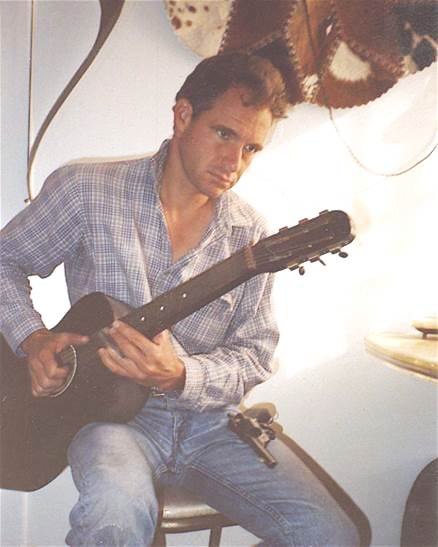
I’ve been spreading out the decks themselves, instead of the individual cards, to see if I can learn anything about the brother who collected them. I know he was interested in a world of things, both practical and mystical, and yet, since he was homeless, I have to wonder if he ever got a chance to use any of the things he collected, or if they were all for a future he never got to live.

The timing is right to be thinking about him — next month, it will be two years since he died. It’s not just his death that gives me pause, but that the death of this homeless man was instrumental in my gaining a home. (A change in my attitude, perhaps, from never wanting to own a house to thinking it would be a good idea, from believing it was impossible, to finding a way to make it work.) And then there is the age difference I mentioned a few days ago: growing up, he was always older and more knowledgeable, and no matter how old I got, there he was . . . a year older, too.

Well, he’s not getting any older, and I am. I’ve now lived a year longer than he did, and knowing that I caught up to him and beyond brings me no comfort.

Oddly, though, he does. Bring me comfort, I mean. Despite my being ambivalent about what if anything besides energy survives after death, I sometimes sense that he is watching out for me as he wanted to do in life but never quite managed. Obviously, I have no way of knowing whether it’s true or not, but this feeling allows me to live fearlessly in a house by myself.

It’s hard to know the truth of oneself, let alone another person, but here I am, moving the tarot decks around, trying to see . . . something. This is the second time I’ve done this — the first time was a couple of years ago when I first got the cards. Maybe this time — or the next — will bring enlightenment. I hope so. It would certainly be easier than actually learning how to use the cards.

***

Pat Bertram is the author of Grief: The Inside Story – A Guide to Surviving the Loss of a Loved One. “Grief: The Inside Story is perfect and that is not hyperbole! It is exactly what folk who are grieving need to read.” –Leesa Healy, RN, GDAS GDAT, Emotional/Mental Health Therapist & Educator.
 

The Tarot and The Wheel of Time

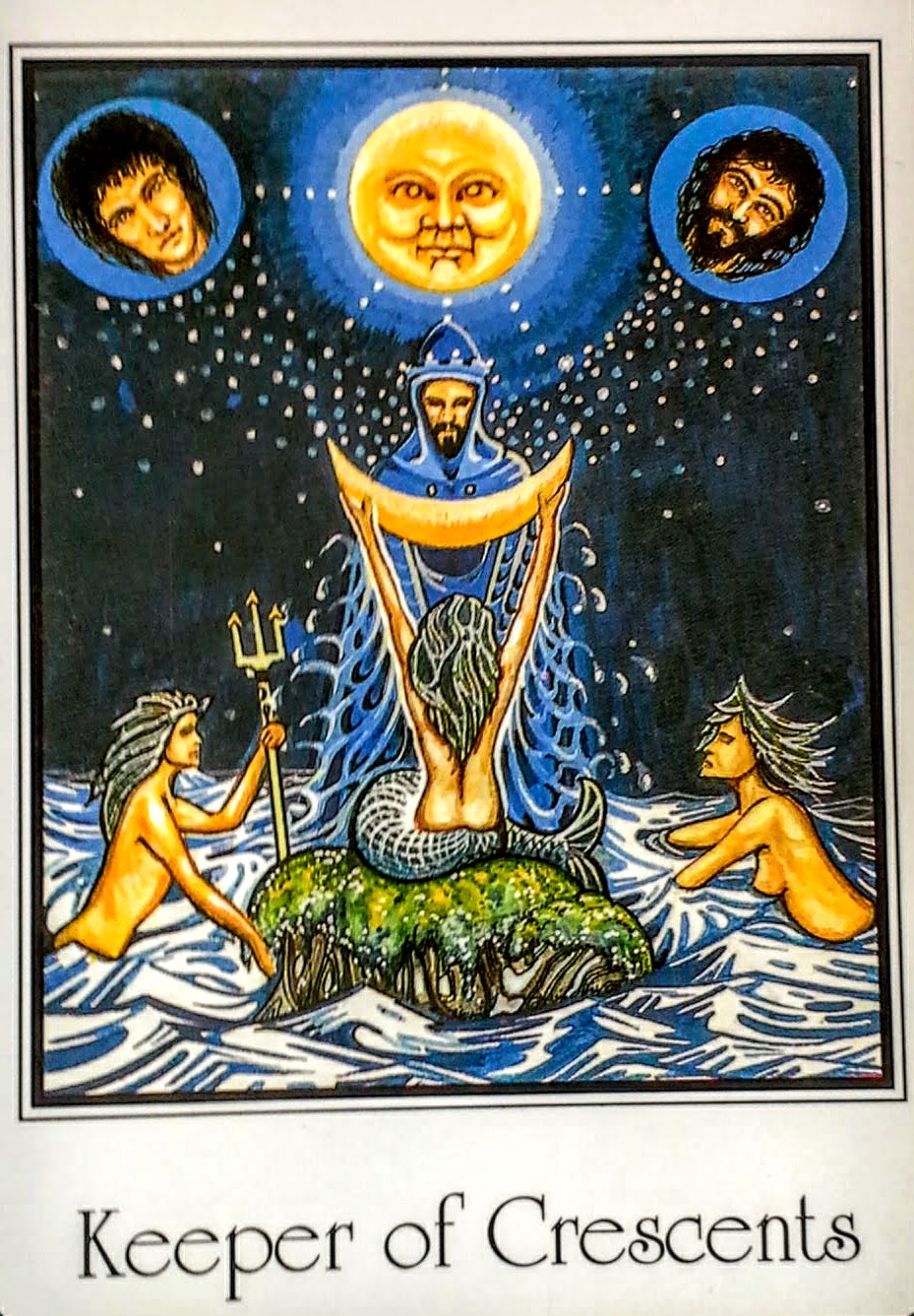
A hot lazy day, today. With nothing better to do, I unpacked my tarot cards and sorted out my tarot books. Some of the books match a specific deck, and I like to keep the matched sets together. Other books seem more generic, or it could be I simply don’t have the decks the books mention. I also set aside the duplicates, the unopened packs, and those that might be collector’s items, such as the Dali tarot. I’ve never opened either the Salvador Dali tarot (supposedly a deck he was creating for the James Bond movie Live or Let Die), or the Tarocco di Sissi (from artist Amerigo Folchi and based on the life of Austrian Empress Elisabeth) thinking these might have more value still in their factory seal, but things only have monetary worth according to what people will pay, and I don’t know how to find people who want such things. I could keep them as part of my collection, of course, but when one has more than three dozen decks (and doesn’t use any of them), another one or two, especially one by an artist you don’t admire or one about a person you don’t know, doesn’t seem that important.

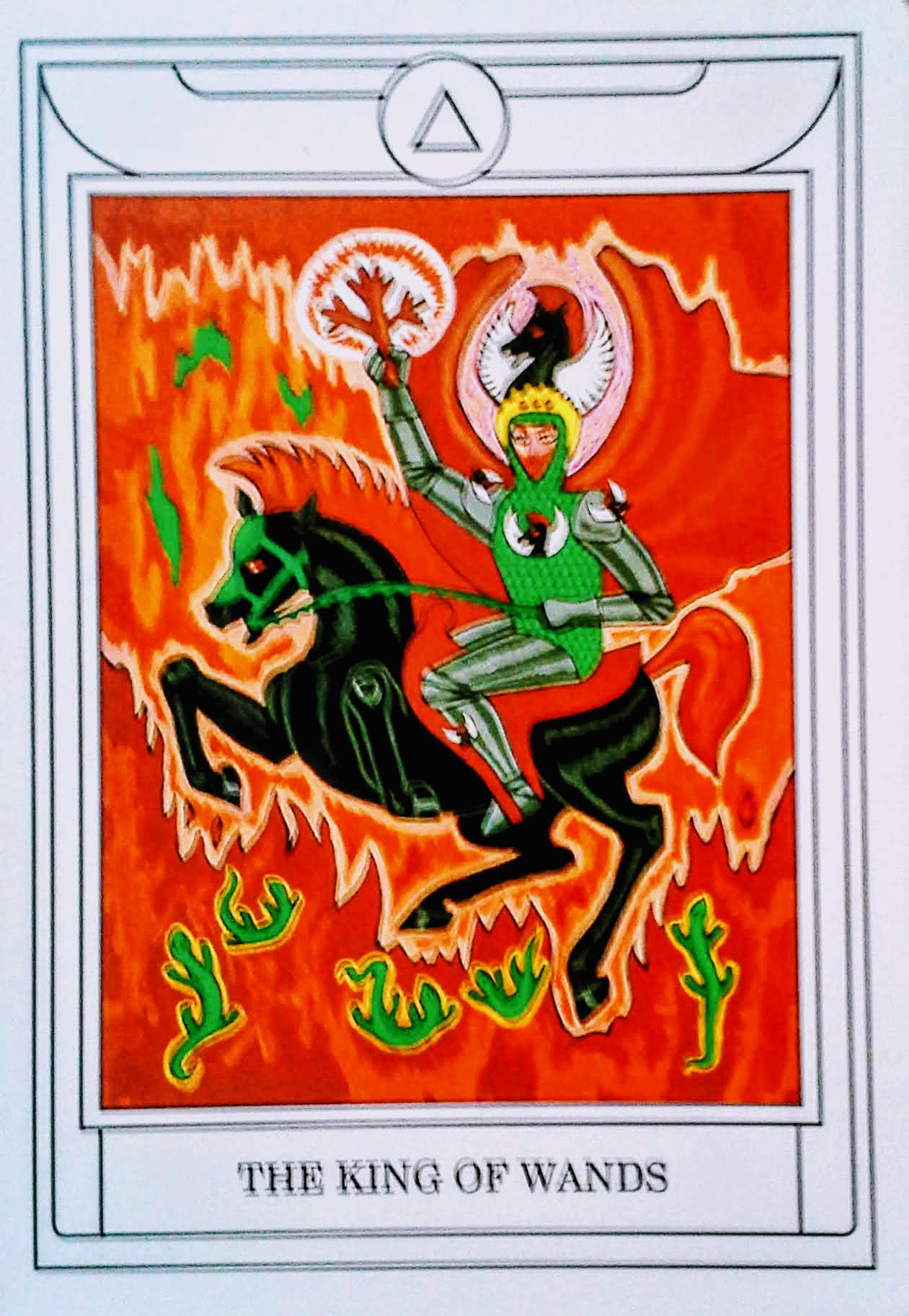
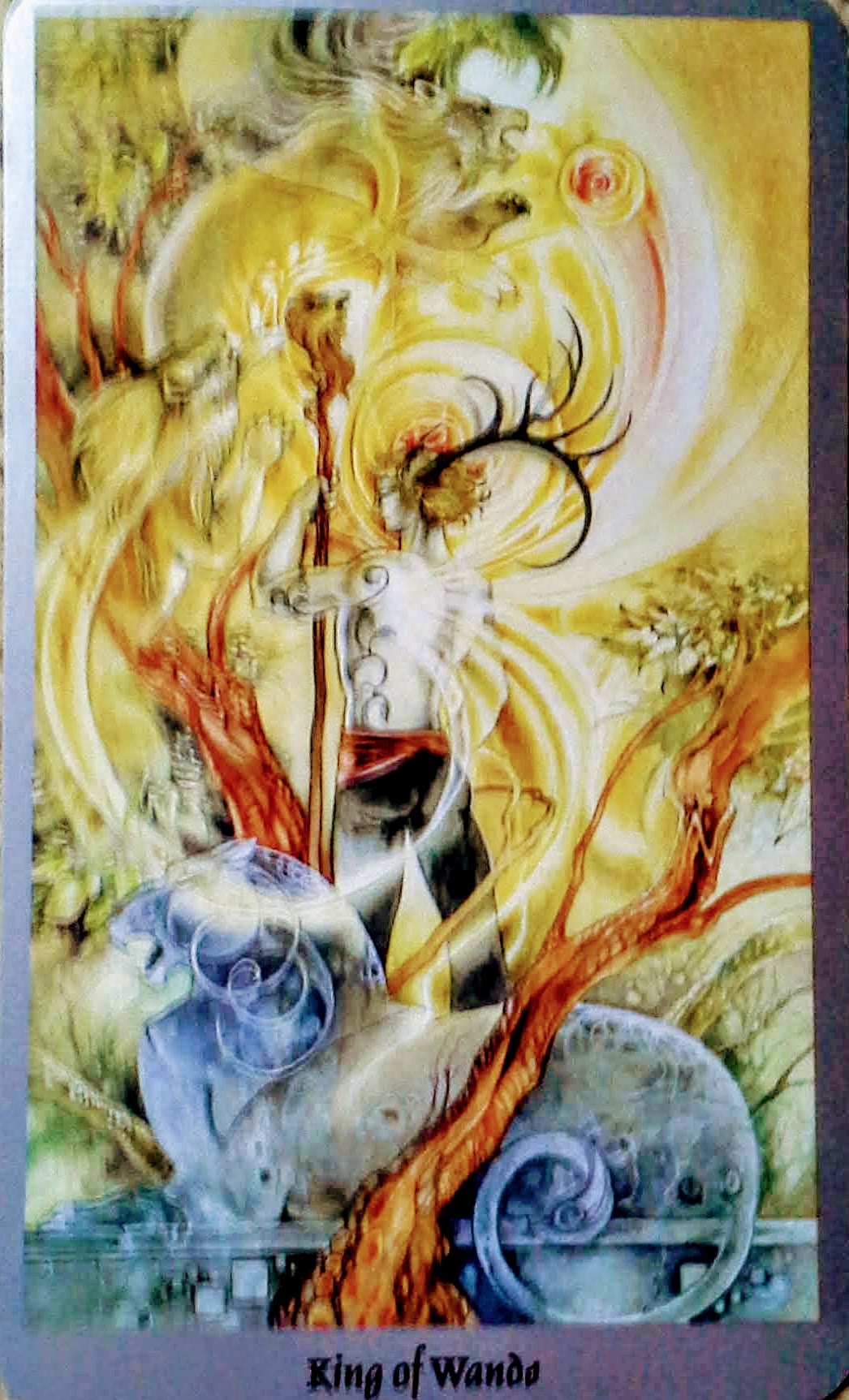
Just for an experiment, I attempted a one-card tarot reading for a friend who is trying to figure out whether to move or not, and I drew the King of Wands. To be honest, I have no idea how this card answers the question (apparently, it’s best to do a spread and see how the cards relate to one another, but maybe he can figure out if the card means anything to him), but I was struck by a coincidence having to do with The Wheel of Time. Coincidence? Considering the ten years that Robert Jordon put into researching, constructing his world, and developing the story before he started writing, I would have to say that it’s a good bet there’s no coincidence here.

In the book The New Golden Dawn Ritual Tarot, the King of Wands is described as “a red-haired man with blue eyes riding upon a fiery black stallion. The horse and rider both seem wild and warlike, but this is due to raw, unleashed power. The overall feeling that the card gives is one of great uncontrollable energy which erupts with volcanic force.” Another passage says “He is extremely dynamic. He is the Fire of Fire, the volatile igniting spark of the Father Force.”

In the Sadowscapes Companion, the King of Wands strides forward and “The trees part before him, lifting their branches to make way for his passage. The environment shifts to his will and obeys his unspoken desires and commands.” Also, he is charismatic, and is “a source of inspiration and bears his mantle of authority with ease as if he were born to it.”

If you know anything about The Wheel of Time, you will recognize The Dragon Reborn. Although sometimes his eyes are described as gray rather than blue, this is the savior character in the series, a clueless country boy who attempts to control the raw power of the universe at his command. Eventually he controls the power and develops into a fire-wielding king who rides a black horse. He becomes a charismatic leader who changes the very lives of those he meets, who molds the world around him however he wills. Also, the salamanders in the red tarot card are more like the dragons in the book than what we consider to be dragons.

At one time I thought it would be interesting to use the tarot to create a story, basing the story on cards chosen at random, as well as by a spread, but apparently, Robert Jordan has already done it.

Many of characters in The Wheel of Time are typical archetypes, such as the trickster, nurse, queen, shapeshifter, but now I suspect there’s a completely different element to the book, a tarot element, for me to deconstruct.

***

Pat Bertram is the author of Grief: The Inside Story – A Guide to Surviving the Loss of a Loved One. “Grief: The Inside Story is perfect and that is not hyperbole! It is exactly what folk who are grieving need to read.” –Leesa Healy, RN, GDAS GDAT, Emotional/Mental Health Therapist & Educator.

What Happened to May?

April seemed to linger forever. The days themselves passed at a normal rate, but when I woke each the morning, I thought for sure several days had passed rather than just one. It could be due to waking several times extra each night because of pain in my knee, or it could be the dozes I fell into while reading. (As interesting as it is to study a work, such as I am doing with The Wheel of Time series, the passages I remember clearly, especially the dreary ones, tend to get boring so I skip them or fall asleep, which negates the purpose of deconstructing the story.)

For whatever reason, April did pass, and now suddenly it’s the middle of June. Huh? What happened to May? I don’t remember May at all. It must have gotten subsumed into The Wheel of Time, either the story or the Tibetan wheel that gave the series its name.

More probably, though, I was concentrating on moving things along that didn’t want to move — a knee that didn’t want to heal quickly, plants that didn’t want to grow (there aren’t many living things that can deal with a drought, freezing temperatures one day and ninety degrees the next, and an ignorant caregiver through it all), as well as a garage that is being built at an equally slow pace. Which made for a strangely unmoving experience where every day was the same as every other day.

But now it’s June and somehow things did change during May. The knee is better, the transplanted bushes are alive even if they’re not exactly thriving, the flowers that wanted to bloom did and the rest are resting in peace. And the garage is much further along than it had been. (We’re past the stage of needing an inspector, so my worries of needing to get a second building permit never came to fruition.)

I need a new plan for planting, though. The bulbs did not do well at all, so sadly, I glance at the catalogs full of spring blooms that decorate my otherwise empty mailbox, and toss them aside. It’s possible the bulbs would grow despite the clay soil if I dug deep holes, filled them with potting soil, and then . . . what? Water them? It’s hard to know what to do in a drought, so it’s best if I wait for the wheel to turn to a more propitious time (or for me to learn way more than I know now about taking care of the poor things).

So now here’s June, but it might as well still be May for all the changes that are occurring. The knee still is not well enough to take walks (though well enough to do whatever I need to do around the house without exorbitant pain.) The bushes aren’t growing in this horrible heat and wind. The garage still needs to be finished. And I’m still reading (or rather rereading) the same fantasy series.

I do know it’s June, though it feels more like July, so that’s something. At the very least, another month won’t slip into the same black hole that May did.

Not that it really matters what month it is. April, May, June — they are all just names for that which flows beneath the wheel of time.

***

Pat Bertram is the author of Grief: The Inside Story – A Guide to Surviving the Loss of a Loved One. “Grief: The Inside Story is perfect and that is not hyperbole! It is exactly what folk who are grieving need to read.” –Leesa Healy, RN, GDAS GDAT, Emotional/Mental Health Therapist & Educator.

Elusive Knowledge

The Dunning-Kruger effect is a term for our inability to step back and objectively look at our aptitudes and behaviors. This is especially obvious when it comes to bombastic folk who act as if they know it all. These windbags talk incessantly about their own world view, but refuse to acknowledge the validity of any other. It makes sense, of course, because they’ve boxed themselves in with their pomposity, so that whatever is in the box is all that is real, and they know everything in their box.

Many people are touched by this effect in a small way, so that even if they are open-minded about some things, other ideas are boxed off, and they simply will not entertain different possibilities, especially in areas such as politics, current issues, religion. Which is why I try to stay away from such topics. I don’t mind people disagreeing with my own views if they extend to me the same courtesy I extend to them of listening to what they have to say, but too often, they have to have the last word. Or rather, the only word. And so I’ve learned to let them have that word early on to save a whole lot of aggravation later.

I hope I’m not one of those who are closed off without being aware of it. I do have pet ideas, of course — we all do — but I tend to think the way this Dunning-Kruger effect rules my life lies in a different direction, either by my underestimating my intellectual capability (some people think I’m smarter and more knowledgeable than I feel I am) or, as I so often fear, by my overestimating my capability and thinking I’m smarter than I really am. I have no way of knowing which is the truth because of the above stated inability for us to observe ourselves objectively.

I don’t think I have locked myself into a narrow box, though. I’ve always been aware that there is so much more out there than what I know. (Which is perhaps why I sometimes think I’m not all that smart or knowledgeable — I can sense how little I know, how little I can know.)

From what my mother told me, as a baby and as a toddler, and even into my early schoolgirl days, I idolized my older brother. It seemed to me he could do anything, and that year of life experience he had over me made him seem . . . omniscient. Each year, I could hardly wait until my birthday so I could catch up to him, and it always came as a shock that he was still a year older, still a year wiser.

Having bad eyesight at an early age added to the awareness of all that I didn’t know. It also created a sort of cognitive dissonance where I knew I was smart enough to get good grades but was too ignorant to know what everyone else seemed to know intuitively, such as what the names of streets were and how to tell the different trees apart. Even when I got my glasses and realized how everyone knew such things — they could see street signs! They could see individual leaves! — the dissonance remained.

My father didn’t believe in television for children. He wanted to raise his kids to be independent thinkers (as long as we thought the way he did), and that lack of cultural conditioning added to the feeling of not knowing. I remember a group of girls giggling about double-barreled slingshots, and they laughed at me when I asked what those were. It wasn’t until many years later when I happened to see a Beverly Hillbillies show that I got the joke. Way too little, way too late!

This idea of elusive knowledge, of knowledge waiting for me made me excited about school every year. For a week or two. Then I realized that whatever knowledge I wanted was still out of reach (I was one of those kids who read the school books during the first days of school, so I knew exactly what I would and wouldn’t be taught). I especially remember senior year in high school. “This is the year I will get to learn,” I thought. I was going to finally have a great teacher. (At least that’s what her previous students said.) On the first day of class, the teacher gave us an assignment: “Write an essay about what you expect to get from your senior year, and don’t give me any sycophantic nonsense about wanting to learn.” I just stared at her. This was the teacher who would finally teach me? As it turned out, no. Too many seniors wanted to take her class, and even though I had been one of the first to sign up, I was kicked out. (The only time my name was ever drawn out of a hat.)

Luckily, there were books. A lifetime of books. And just when I got to thinking I had a grip on some of what life had to teach, Jeff died, and the realization of how little I knew started all over again. If something as immense as grief had been hiding from me all my life, what else has been hidden? That question haunted me for many years, and in fact helped drive me through the worst of my pain. I thought perhaps something wonderful was waiting for me on the other side, but the only thing wonderful that happened was that I survived. And I gained a lot of knowledge about grief that has been of benefit to many people.

The sense of impending . . . something . . . has pretty much dissipated over the years since Jeff died, and I now let life offer me what it will.

Well, except for bombastic folks. Those I walk away from whenever I can.

***

Pat Bertram is the author of Grief: The Inside Story – A Guide to Surviving the Loss of a Loved One. “Grief: The Inside Story is perfect and that is not hyperbole! It is exactly what folk who are grieving need to read.” –Leesa Healy, RN, GDAS GDAT, Emotional/Mental Health Therapist & Educator.

Isolation in an Isolating Time

Isolation is never so isolating as when one is isolating oneself from online social activities during a time of quarantine, while trying to recover from a bum knee as well as enduring fierce winds and driving drizzle. (Like a driving rain, only with drizzle.)

Yep. Complete isolation. Alone with only my thoughts (and the characters in The Wheel of Time) to keep me company. Some of these thoughts are being dredged from deeply buried memories — buried not from trauma but by time since they happened so very long ago.

Because of the current state of unrest (my own as well as the world’s), many of those thoughts are of my dealings with people of various colors and are both divisive and unifying.

I remember standing on the sidewalk in front of the house cater corner from where my family lived, talking with the girl my age who lived there as we watched our baby brothers play together. We were friends of a sort, but all we really had in common were proximity, our ages, and those two little boys. I have a hunch I was more enamored with having a black friend than I was with the girl herself, but at least I tried. At least we both tried. This was in the early sixties, I think, when blacks were “colorizing” previously all white neighborhoods. The main street we lived on was the border between the black neighborhood and the white, and looking back, it seems a rather nice image, those two young girls and those two toddlers straddling the dividing line.

What really made me remember some of this stuff was that one of the people who left a scathing remark on that video I shared on Facebook was a woman I had gone to high school with. I’d never been friends with her, but somehow I got connected via Facebook because of a high school reunion some years ago (that I did not attend). Ironically, it seems to me she was one of the faction of girls who hated me all those years ago because I took a black kid as my date to a high school dance. I am amazed, in retrospect, how much he seemed to enjoy the dance, but then, I think as many girls were enamored of him and his dancing style as were disdainful of his being there. And now years later, I am considered the racist, and she the “tolerant” one. Life is strange, that’s for sure.

Except for a few such instances, though, when skin color was a factor, I really was skin-color blind. I remember once telling my mother about a girl I really liked who clerked at the local Safeway, and my mother said she’d look for her. Weeks later, my mother said she’d finally met the girl, and then said wryly, “It would have helped if you’d told me she’s black.” I stared blankly at my mother and said, “She is?”

To be honest, even though I was proud of that colorblindness (which nowadays is considered proof of racism), I tend to think it had more to do with my being unobservant of physical traits, remembering people instead by my “feel” of them. I remember once working in an office with mostly men and for some reason I had reason to mention a certain fellow who had the same name as a couple of other workers. “You mean the guy with beard?” the man talking to me asked. I said, no he didn’t have a beard. The man laughed at me. “You wanna bet?” I turned around to look at the guy in question, and sure enough he had a beard. An immense one.

Yep. That’s me. Oh, so observant!

(To this day, I don’t remember what Jeff looked like when I met him; all I remember is a radiant being, shining with kindness, as if he had just recently come down from some spirit realm into my life.)

I remember a woman I once was friends with. We had things in common because we’d both lost our life mates. Although she was a lovely woman (inside, I mean, but outside, too), she had darkness in her past she only hinted at, horrors that rose because of her skin color. And somehow, I felt guilty because of what she had suffered. (And then I felt guilty for the guilt because I worried my guilt was negating her reality.)

It’s funny how for so much of my life I’ve shouldered guilt for things that weren’t my fault. A sort of cultural guilt, I guess. Guilt over concentration and relocation camps, over the Sand Creek Massacre, over slavery, over so many things. Now that I am having this guilt foisted on me, as if I really were personally responsible for all the world’s ills, current and historic, the guilt is sliding off my back, receding from my spirit.

I am responsible only for what I personally did, can only change that which I can control (and it’s amazing how little control we have over even the things we think we control).

My “crimes” have always been small ones — a bit of smugness, perhaps. A touch of pettiness. An occasional lapse into thoughtlessness. And worst of all, a tendency to look behind the curtain for the real truth, not the “truth” that’s paraded on the world stage.

Not much guilt in any of that to expiate.

Which is good. I don’t need one more thing to close me in and add to the isolation of this isolating time. Luckily, the winds and rain will pass (late tonight, supposedly). My thoughts will drift back from whence they came. My knee will heal. The Bob will retreat. My re-re-reading of The Wheel of Time will be finished. I will get used to curtailed online activity.

And then?

I don’t know, but the possibilities of life after isolation will give me something new to think about rather than rehashing all these old thoughts.

***

Pat Bertram is the author of Grief: The Inside Story – A Guide to Surviving the Loss of a Loved One. “Grief: The Inside Story is perfect and that is not hyperbole! It is exactly what folk who are grieving need to read.” –Leesa Healy, RN, GDAS GDAT, Emotional/Mental Health Therapist & Educator.
Ceding

I don’t like living in a world of almost total regimentation of thought, a world of double think and thought crimes. I wish this horror would go back to live in the pages of the book these terms came from. Alas, it’s not going to happen, so I will concede or recede, or some sort of cede anyway, and hide myself in the pages of a book. And in the rooms of my house and in my yard, too, of course.

The world out there, whether online or offline is just too volatile for a truthseeker, especially when the seeking itself goes against the narrative we are all supposed to accept.

I don’t know the truth, obviously, or I wouldn’t have to look for it. I’m not sure anyone knows all the truth about the virus, the protests, or the riots. As Bernie LaPlante (Dustin Hoffman) says to his son at the end of the movie Hero: “You remember when I said how I was gonna explain about life, buddy? Well the thing about life is, it gets weird. People are always talking ya about truth. Everybody always knows what the truth is, like it was toilet paper or somethin’, and they got a supply in the closet. But what you learn, as you get older, is there ain’t no truth. All there is is bullshit, pardon my vulgarity here. Layers of it. One layer of bullshit on top of another. And what you do in life like when you get older is, you pick the layer of bullshit that you prefer and that’s your bullshit, so to speak.”

The difference is, today we’re not allowed to choose our own layer — it’s chosen for us. Which might be okay if the layer made sense. I’d rather be thinking about other things, anyway. But believing two contradictory ideas — double think — drives me nuts. For an example, we’re supposed to believe that The Bob came accidentally from a wet market in China, and yet we’re not allowed to call it the Chinese flu or the Wuflu or anything like that because it’s racist. And we’re supposed to believe that only whites can be racist, though why that is, I don’t know. I just know that it is because that’s what we’re told over and over again. And yet, the thing I posted on Facebook that caused such a ruckus was a video I shared about a black woman attempting to tell the truth (or at least her truth) about the not-so-angelic victim of the inciting incident of the protests and riots as well as the truth of police brutality when it comes to different skin colors. Because it didn’t follow what everyone believes or are supposed to believe, this “racist propaganda” garnered anger and hatred from my “friends”.

I’m sorry, folks, you can’t have it both ways. Either only whites are racist or the black woman was racist. The two ideas are mutually exclusive. And, of course, I am racist for sharing the video.

Thomas Sowell, a black economist, pretty much sums up my confusion: “If you have always believed that everyone should play by the same rules and be judged by the same standards, that would have gotten you labeled a radical 60 years ago, a liberal 30 years ago and a racist today.”

It feels so very odd to go from being a radical thinker or a liberal to a . . . well, not radical thinker, and definitely not a liberal by today’s standards. And I definitely am not buying into the current story we are all supposed to believe. I can’t. It’s too contradictory.

Besides, even though it seems to be required to pay obeisance to the black community, to take a knee, to apologize for “white privilege,” I can’t do that, either. To do so means that every bad thing a person of color did to me, I have to accept as being deserved. As being my due. Believe me, I did nothing to invite sexual assault. Nothing to invite intimidation and harassment. (Sure, I cross the street to avoid gangs high on drugs, but there is no way in hell I would ever elbow my way through such a crowd.) There was nothing my brothers ever did to invite all the beatings they got in our interracial neighborhood, nor did we request to have our bikes stolen. And for sure there was nothing I ever did worth having my car wrecked, being pulled out of the vehicle at gunpoint, and having my bag stolen.

Oops. I didn’t mean to let all that out. Still, those things happened, though at none of those times did it really register that the perpetrators were people of a different color. They simply were.

But see? Shades of gray when we are supposed to only see one stark shade of maybe-truth.

Since there is no room for a truthseeker nowadays, I am retreating. I haven’t deleted my social network accounts since I might need them when my new book is published next year, but I have removed all bookmarks so that I am not tempted to go back and accede to their narrative. (Don’t worry — I’ll be keeping up with this blog. I need some way to keep in contact with my inner self and the outer world.)

Once I get past all the insults and unpleasantness (and at my age, it’s a bit foolish of me to let those sorts of things still sting), I’ll be happier.

I must admit, all this makes me miss Jeff so very much. He, too, was a truthseeker, and it would be comforting right now to have the company of someone who didn’t vilify me for trying to see what others want to keep hidden.

Since he’s not around, I’ll be mostly hermitting. Luckily, this is the time of year for a different sort of seeding, so I’ll have things to do to keep me occupied in my secession.

***

Pat Bertram is the author of Grief: The Inside Story – A Guide to Surviving the Loss of a Loved One. “Grief: The Inside Story is perfect and that is not hyperbole! It is exactly what folk who are grieving need to read.” –Leesa Healy, RN, GDAS GDAT, Emotional/Mental Health Therapist & Educator.
Feeling Incredibly Old

I haven’t admitted to being old, only to growing older. The way I figure, the “elderly” moniker comes next birthday when I reach that age when I can no longer fudge the demographics to convince myself I’m not old, that I’m just in late, late, late middle age.

But now I’m feeling incredibly old. And disheartened. And vulnerable. Admittedly, the vulnerability comes from a slowly-heeling bum knee that has nothing to do with anything that is going on in the world, but all the rhetoric about protecting the elderly (of whom, apparently, I am one, at least according to The Bob statistics) has put me firmly in the old age category, and not being able to easily get around offers additional proof.

Even worse than all that is the truth — I’ve lived through pandemics, large outbreaks of terrifying and highly infectious diseases, horrendous flu seasons, wide-scale disseminations of dubious vaccinations that came close to being mandated. Comparatively speaking, The Bob is just another over-exploited, would-be end of the world scenario that was conveniently forgotten when a more immediate (and more obvious) threat came into being.

I’ve lived through violent times, too. Protests, both political and racial; civil unrest; fathers fighting sons; riots; burning; looting; terrorist tactics perpetrated by US citizens on US citizens. I’ve also seen men with criminal records upheld as heroes because of cop brutality, as if being beaten up or killed suddenly erases their unsavory past. (Oddly, both men at the heart of two of the worst race riots were substance abusers who perpetrated crimes on women — one was a wife beater and abuser, the other a man who once held a knife to a pregnant woman’s belly while his friends ransacked and looted her house.)

Too much, too much, too much.

It’s hard to remember that for many people, all of this — The Bob and the riots (and yes, a riot by any other name is still a riot) — is new.

A young man waited on me the other day when I went to the store, a new employee, who I hadn’t yet met. I didn’t know the etiquette of the situation —I wasn’t sure if I should reach out because of what was going on or simply ignore our skin color differences and pretend all was well in the world — so I did what I always do: err on the side of connection.

I asked if he was okay, and made a gesture indicating the world at large. He gave me a closed-off look and turned away from me. Then, apparently deciding to answer in kind, he looked at me and smiled and said, “Thank you for asking. I’m okay here in this bubble.” (And it does seem as if this area is a protective bubble.) Then, with tears in his eyes, he admitted that he was worried because even though he was safe, he had family in big cities. I offered words of sympathy, and he responded, “But everything will be better after this.”

That’s when I realized I really am old, not just in years, but in experience. Things might be better after this — I suppose it’s possible. But I’ve seen too much, been around too long, been pulled this way and that by too many power struggles of all kinds (including those in the volatile interracial neighborhood I grew up in) — to believe in easy answers and simple words.

One good thing about being old — I don’t have to pretend to have any answers. I can leave the world to the young, and maybe that’s as it should be.

***

Pat Bertram is the author of Grief: The Inside Story – A Guide to Surviving the Loss of a Loved One. “Grief: The Inside Story is perfect and that is not hyperbole! It is exactly what folk who are grieving need to read.” –Leesa Healy, RN, GDAS GDAT, Emotional/Mental Health Therapist & Educator.
The Best of Social Networking

Although I have always been a fan of social networking on a personal basis — getting to know people, making friends, feeling connected even when I am alone — I am also aware that it is a platform for the dissemination of a particular brand of ideas. Anything that doesn’t fit the narrative of that brand is labeled “fake news.” That most people don’t see they are being herded by this one-sidedness shows the efficacy of the brand. That those same people heap shame on those who don’t agree with the stated beliefs shows how deeply entrenched the brand is.

And yet . . .

During this past week, I have been enormously pleased to see so many posts by black people decrying the current narrative, ie: downtrodden blacks, liberal saviors, white racists (and according to this narrative, all whites are by definition racists).

I understand that the black/immigrant/minority experience is different from mine, but that does not negate my life. Does not make me better. Does not make me a racist. It makes me . . . me.

Whatever anyone experiences makes them who they are. The current narrative defines certain people by their race, not who they are individually. The posts I’ve been reading and the videos I’ve been seeing are not from blacks living the “black experience,” whatever that might be. They are individuals living their lives, refusing to claim the victimhood the narrative foists on them, refusing to be seen as anything other than as themselves, as a member of the human race, as an American.

These people don’t want reparations, don’t want to be identified with the rioters and looters, don’t want to be limited by what other people are doing and saying. They want to grab whatever opportunity (legal opportunity) they can to create good lives for themselves. They want to take responsibility for what they do without the mitigating (and oh, so paternalistic) factor of needing special compensations because of their skin color.

Normally, we don’t get to hear what these people have to say because it doesn’t fit with the point of view the media forces down our throats. And we need to hear their voices. We need to see these folks as they see themselves — not victims, not un-“privileged.” But people dealing with life as best as they can.

This — getting to hear different voices, getting to listen to people tell a different story than what we expect — this is the best of social networking.

***

Pat Bertram is the author of Grief: The Inside Story – A Guide to Surviving the Loss of a Loved One. “Grief: The Inside Story is perfect and that is not hyperbole! It is exactly what folk who are grieving need to read.” –Leesa Healy, RN, GDAS GDAT, Emotional/Mental Health Therapist & Educator.
Protesting the Protesting

Really, people? Protesting? Rioting? Looting? What the heck are you doing? How do think this is going to change anything? It’s not as if the instigating event was a case of social or systematic injustice — it was a single case of a one man committing a crime that everyone seems to agree was egregious. He has been arrested and charged. So what’s the point of protest? It’s done.

If the protests were focused on the use of a particular means of subduing a person, then that makes sense. Kneeling on someone’s neck should never have been acceptable police procedure.

But that isn’t what people are protesting.

I can see that people want to express their overwhelming feelings toward the event, so why not a candlelight memorial for the victim to show they care? Why not some sort of benefit to offer support? But a protest? Someone needs to rewrite the narrative. Cops kill as many unarmed whites as black. (According to FBI statistics, of all the unarmed folks cops have killed, only 6% involved a white cop/unarmed black.) So what’s to protest? All deaths by cop? That makes sense since there really shouldn’t be any at all.

But that isn’t what people are protesting. If it were, race wouldn’t be an issue in this current conflagration.

Still, a quiet protest, no matter how illogical is one thing. Rioting is another.

People are still not allowed in church in groups of more than fifty in order to stop the spread of a disease, but apparently, if huge numbers are going on a spree of violence, the disease can’t catch up with them, so mobs are okay. (Does anyone else see the irony of rioters and looters wearing surgical masks to keep from accidentally spreading a disease when they are purposely doing harm to others? It sure boggles my mind.)

It seems that people are taking for granted that peaceful protests can spontaneously combust into violence. Fisticuffs, sure, but more than that is simply not possible. If one is planning on going to a peaceful gathering, one does not fill a backpack with spray paint cans, weapons, bricks, large rocks, incendiary devices. (The chance of a simple match or lighter burning down a building without any sort of flammable materials being involved is just about nil.) So if people are carrying such things, then the protest almost by definition, can’t be peaceful. And if people aren’t carrying such things, they had to come from somewhere. Which means that someone purposely instigated the riots. They didn’t just “happen.”

And looting? Oh, yeah, nothing says “solidarity” like destroying the businesses in one’s neighborhood, and nothing shows one’s sterling character like theft. To say nothing of the irony of stealing liquor and televisions and Huggies to protest crime.

Silly me. I really thought we were better than this.

***

Pat Bertram is the author of Grief: The Inside Story – A Guide to Surviving the Loss of a Loved One. “Grief: The Inside Story is perfect and that is not hyperbole! It is exactly what folk who are grieving need to read.” –Leesa Healy, RN, GDAS GDAT, Emotional/Mental Health Therapist & Educator.