Betrayer of Hope

Daily writing prompt
What villain actually had a good point?

In The Wheel of Time books, there are several villains, all with their own reasons for turning to the Shadow aka the Dark One. A music lover wanted to be able to make and listen to music forever, so he figured it was a good bargain. Some turned because they wanted immortality and power beyond imagining. A few turned because they were simply evil. And then there is Ishamael, also called the Betrayal of Hope.

In the prologue of the very first book, after a horrendous ten-year war, Ishamael tells “The Dragon,” (the defender of the light and the hero of the story):

“This war has not lasted ten years, but since the beginning of time. You and I have fought a thousand battles with the turning of the Wheel, a thousand times a thousand, and we will fight until time dies and the Shadow is triumphant!”

The Dragon is a man who was created to fight this eternal battle, though he doesn’t remember his previous lives. (Ishamael apparently does remember.) And since The Dragon never had a choice in the matter, he was just reborn at the proper time to fight the Shadow, I can only presume (on this reading, anyway), that Ishamael himself has no real choice in the matter, either, and was always born to fight the Light.

That’s assuming, of course, that Ishmael is telling the truth. One of the interesting aspects of the books is that each point of view character isn’t privy to the whole of the story, and sometimes they mistake what is going on. Another interesting aspect is how that world runs — the wheel of time keeps turning, and ages come and go and then come around again. Although there might be small variations each time, I get the impression that each age is pretty much the same as it was before.

Which means that these two men are fated to fight forever.

That is why Ishamael turned to the dark — the only way for him to get off the wheel, to end this terrible and terribly meaningless cycle, is to destroy the wheel, which, in his mind, means that the Dark One must be the winner of this eternal battle. Whether he saw this destruction as the ultimate act of mercy for the world or only for himself, isn’t clear. But still, to be stuck forever in a life he sees as futile, remembering fighting the same battle over and over again seems so very tragic.

Although some of the other minions try to kill the current Dragon Reborn at various times, Ishmael sometimes helps him stay alive because if the Dragon Reborn dies before the final battle, then Ishmael continues to be stuck forever in the endless cycle.

It makes me so very glad we live in a linear world, or at least we presume we do, where the past stays in the past and doesn’t come again. There is a fatalism to the books stemming from the wheel, where each age will be repeated when the wheel comes around again to that age again. Which also gives them their belief that you can change your life in small ways, but not large ones. Not an easy philosophy to live under.

Ishamael sees that fatalism, too, so unlike the other minions of the Dark One, he doesn’t seem evil, just driven to end the interminable cycle. And, in the world of The Wheel of Time, he has a good point.

***

Pat Bertram is the author of Grief: The Inside Story – A Guide to Surviving the Loss of a Loved One
The Tarot and The Wheel of Time

A hot lazy day, today. With nothing better to do, I unpacked my tarot cards and sorted out my tarot books. Some of the books match a specific deck, and I like to keep the matched sets together. Other books seem more generic, or it could be I simply don’t have the decks the books mention. I also set aside the duplicates, the unopened packs, and those that might be collector’s items, such as the Dali tarot. I’ve never opened either the Salvador Dali tarot (supposedly a deck he was creating for the James Bond movie Live or Let Die), or the Tarocco di Sissi (from artist Amerigo Folchi and based on the life of Austrian Empress Elisabeth) thinking these might have more value still in their factory seal, but things only have monetary worth according to what people will pay, and I don’t know how to find people who want such things. I could keep them as part of my collection, of course, but when one has more than three dozen decks (and doesn’t use any of them), another one or two, especially one by an artist you don’t admire or one about a person you don’t know, doesn’t seem that important.

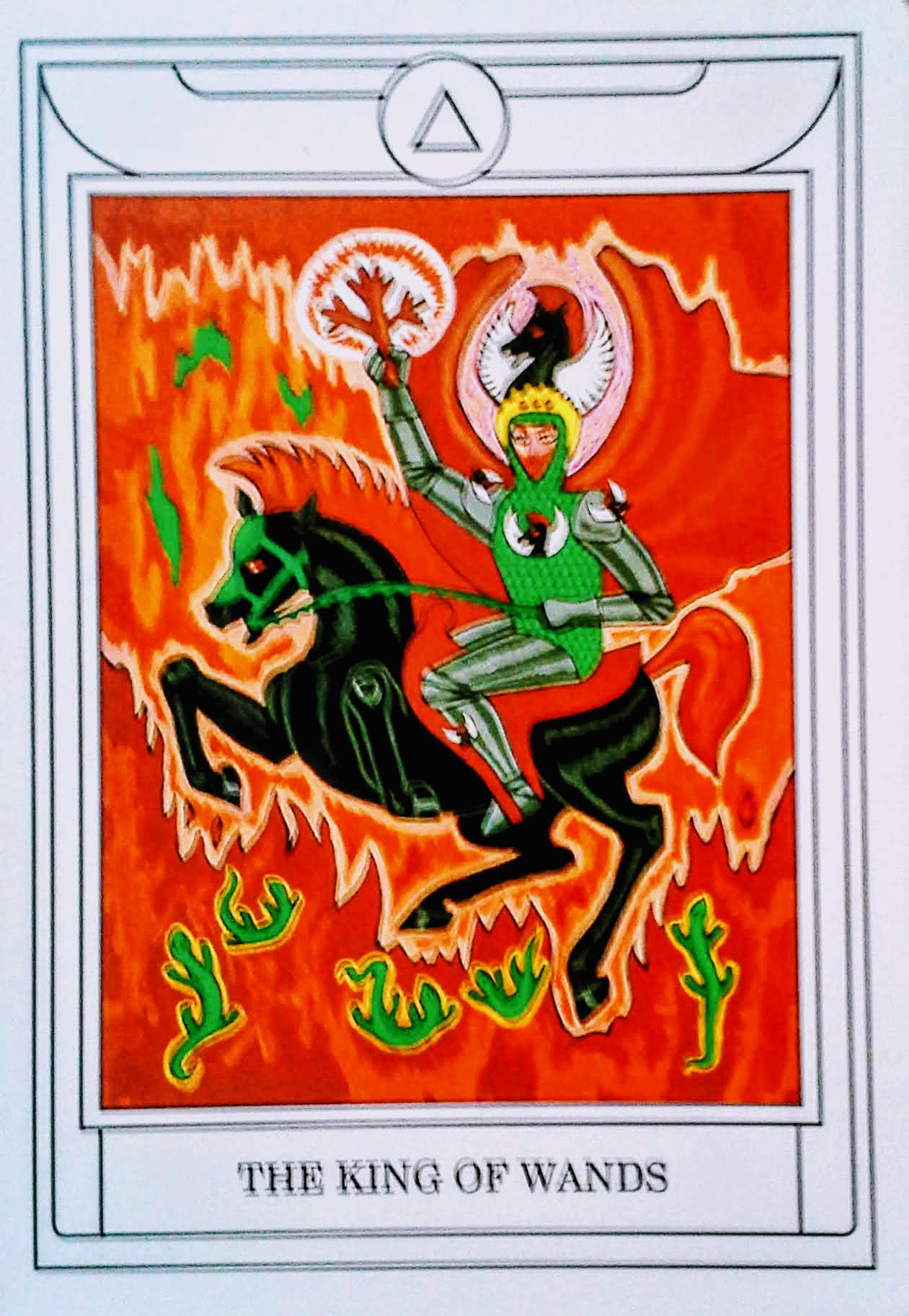
Just for an experiment, I attempted a one-card tarot reading for a friend who is trying to figure out whether to move or not, and I drew the King of Wands. To be honest, I have no idea how this card answers the question (apparently, it’s best to do a spread and see how the cards relate to one another, but maybe he can figure out if the card means anything to him), but I was struck by a coincidence having to do with The Wheel of Time. Coincidence? Considering the ten years that Robert Jordon put into researching, constructing his world, and developing the story before he started writing, I would have to say that it’s a good bet there’s no coincidence here.

In the book The New Golden Dawn Ritual Tarot, the King of Wands is described as “a red-haired man with blue eyes riding upon a fiery black stallion. The horse and rider both seem wild and warlike, but this is due to raw, unleashed power. The overall feeling that the card gives is one of great uncontrollable energy which erupts with volcanic force.” Another passage says “He is extremely dynamic. He is the Fire of Fire, the volatile igniting spark of the Father Force.”

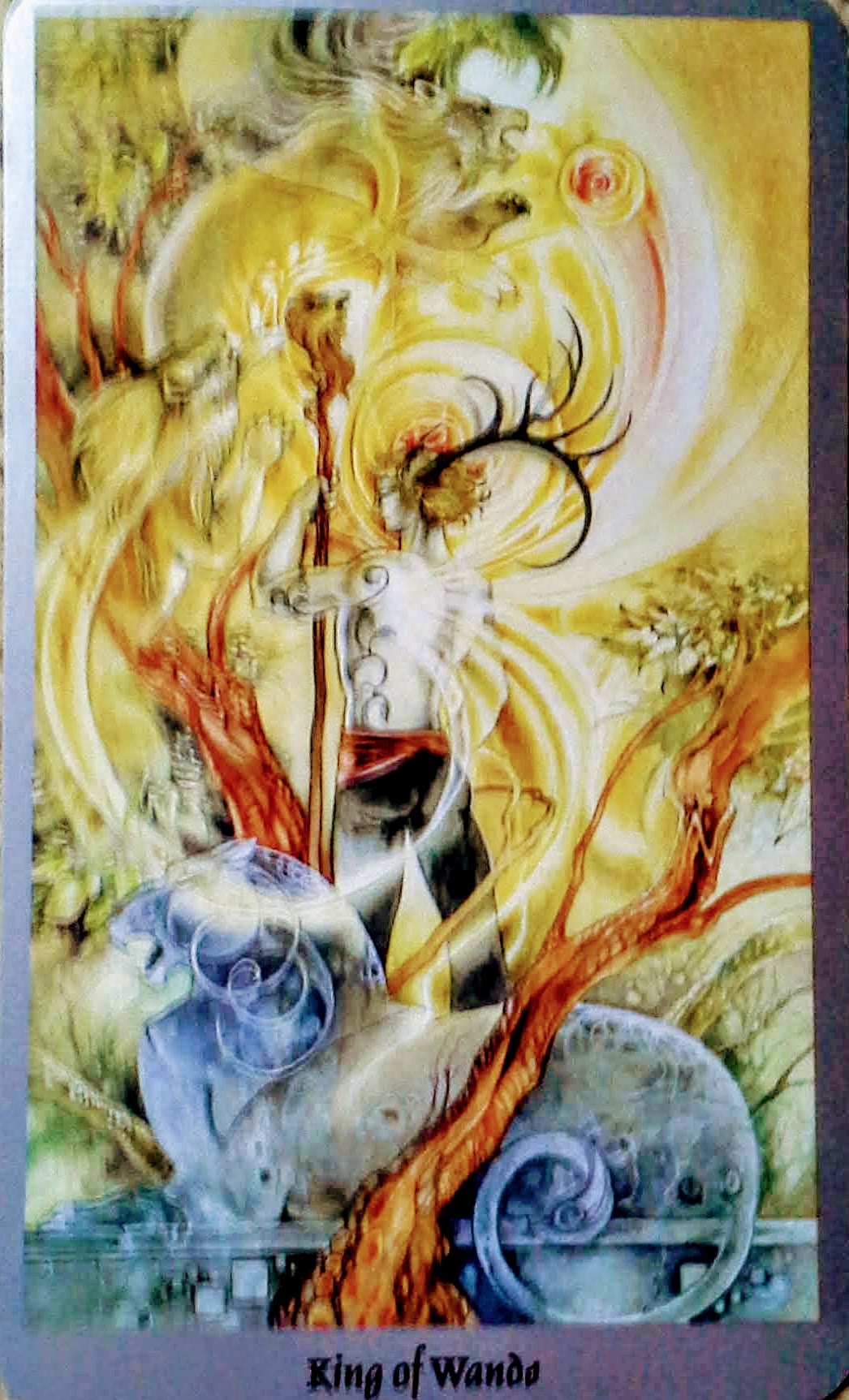
In the Sadowscapes Companion, the King of Wands strides forward and “The trees part before him, lifting their branches to make way for his passage. The environment shifts to his will and obeys his unspoken desires and commands.” Also, he is charismatic, and is “a source of inspiration and bears his mantle of authority with ease as if he were born to it.”

If you know anything about The Wheel of Time, you will recognize The Dragon Reborn. Although sometimes his eyes are described as gray rather than blue, this is the savior character in the series, a clueless country boy who attempts to control the raw power of the universe at his command. Eventually he controls the power and develops into a fire-wielding king who rides a black horse. He becomes a charismatic leader who changes the very lives of those he meets, who molds the world around him however he wills. Also, the salamanders in the red tarot card are more like the dragons in the book than what we consider to be dragons.

At one time I thought it would be interesting to use the tarot to create a story, basing the story on cards chosen at random, as well as by a spread, but apparently, Robert Jordan has already done it.

Many of characters in The Wheel of Time are typical archetypes, such as the trickster, nurse, queen, shapeshifter, but now I suspect there’s a completely different element to the book, a tarot element, for me to deconstruct.

***

Pat Bertram is the author of Grief: The Inside Story – A Guide to Surviving the Loss of a Loved One. “Grief: The Inside Story is perfect and that is not hyperbole! It is exactly what folk who are grieving need to read.” –Leesa Healy, RN, GDAS GDAT, Emotional/Mental Health Therapist & Educator.