The Most Compelling Images

The most compelling images seem to be those that somehow mirror ourselves, or at least our image of ourselves. At it’s most basic, this mirroring is why humans buy magazines with other humans on the cover, and why the animals we most bond with have the cuteness of a human baby, with wide-set, round eyes, and generally a round face.

I didn’t realize that I was prey to such subconscious mimicry, but of course I should have known since, although I don’t always like to admit it, I am just a human. I was reminded of our subconscious fascination with ourselves when I was gazing at the tarot card I chose during a one-card self-reading, a painting by Stephanie Pui-Mun Law. This three of wands card shows a woman standing at the edge of a land bridge, far above a mountainous scene with a river running through it.

I was suddenly struck by the familiarity of the image, and then I remember this photo of me on the north rim of the Black Canyon of the Gunnison, which I used for the cover of Grief: The Great Yearning:

There I am, standing at the edge of the world, though the altar-like rock in front of me masks that reality. If the photo had been taken from the same perspective as that of the tarot card image, you would see I what I am seeing — a mountainous scene with a river running through it.

No wonder the image of the woman standing above it all struck such a familiar chord.  She is I, or maybe I am she.

***

Pat Bertram is the author of the suspense novels Light Bringer, More Deaths Than One, A Spark of Heavenly Fire, and Daughter Am I. Bertram is also the author of Grief: The Great Yearning, “an exquisite book, wrenching to read, and at the same time full of profound truths.” Connect with Pat on Google+. Like Pat on Facebook.
Earth Houses

I went on a field trip today to see houses made of dirt and to get an idea of how they were made. It’s not so much that I was interested in the houses, but a friend invited me, and I make a point of not turning down invitations — I never know where such an invitation could lead. And today the invitation led to a place where they teach people to make sustainable houses out of local materials, mostly dirt.

The guides claimed the houses were cheap to make, and they were, but of course, you have to buy the rolls of sandbag material to stuff the dirt into (the only purveyor of the stuff is this particular company — surprise, surprise), and if you want more than a temporary shelter, you have to add concrete to the mixture, which adds to the cost. One such house, a three-bedroom, three-bath house with an adobe look and feel, cost $138,000. That did not include land or labor costs, which would have upped the cost to more than $500,000. Unless you particularly wanted to live in a dirt house, you’d be better off buying a ready-made traditional home.

The tour was fun — I saw many interesting shapes of houses — but the lecture not so much. I get bored easily with droners and repeaters, and the speakers both droned and repeated so I kept wandering off to look at various houses and structures. Each time I returned to the lecture arena, I heard the same thing, “You can build these houses anywhere in the world.” And so I would wander off again, shaking my head. No, you can’t build these houses anywhere in the world. Maybe the low-technology is available anywhere there is dirt, but most places in the United States and in other “advanced” countries, you have to deal with zoning laws, health codes, building permits, and various other matters that make it impossible to build such a house. And of course, you can’t build an earth house in the middle of the ocean. Since 71% of the world’s surface is water, that leaves a rather small percentage of the world available for building the houses. But I’m being too picky and literal, especially since living in a non-traditional house might suit me.

My favorite structure was a dome built of straw bales with a stucco-ish finish. Mostly what interested me was the dome shape. I could live in such an airy space, as high as it is wide. I don’t have furniture, and don’t particularly like the stuff. I once had a wonderfully comfortable couch that was simply a mattress on the floor covered with a dark sheet and dozens and dozens of pillows stuffed into matching and contrasting pillowcases. Oh, the luxury! Added benefits of that couch was the ability to change the décor at whim, it could be used as a bed. That kind of non-traditional furniture would be perfect for a single-room doomed house. I don’t like hanging things on wall, so curving walls wouldn’t present a problem, either. I’d just need to make sure I had the amenities like a working kitchen and bathroom, and wi-fi capabilities.

But would I really want to live in a room that calls attention to itself? I don’t know. Though I live in clutter (a symptom of too many simultaneous projects), I prefer an austere living space where my mind can roam free, unsnagged by my surroundings. I also don’t know if I would ever want the permanence that owning such a house would suggest. Still, a domed earth house is an interesting concept, and so is being able to build one’s own house from whatever is at hand. Something to add to the stew pot I call my mind.

***

Pat Bertram is the author of the suspense novels Light Bringer, More Deaths Than One, A Spark of Heavenly Fire, and Daughter Am I. Bertram is also the author of Grief: The Great Yearning, “an exquisite book, wrenching to read, and at the same time full of profound truths.” Connect with Pat on Google+. Like Pat on Facebook.

Floral Carnage

I’m not much of a gardener, never have been. My last attempt to plant anything was a couple of years ago when someone gifted me with a Bonsai kit (planter, soil, seeds), and that result was typical — seedlings that poked their head above the soil, looked around, saw who they would be dependent on for their very lives, and promptly gave up their ghosts. I planted lights after that, and we’re all happy. Nothing to kill, just a bit of beauty when I’m feeling down.

I love flowers, and sometimes when I see bouquets in the grocery store, I’m tempted to buy the blooms to add a bit of life to my life, but I’ve never been able to bring myself to make the purchase. Even though the flowers were grown for such a use, I can’t help feeling I’d be buying death. I’ve only received flowers as a gift a couple of times, and I treasured them, but I’ve never been able to return the favor. Death, death, my soul cries out, and so the flowers remain unpurchased.

Now that I know the truth about flowers as a commodity (or part of the truth), I’m doubly glad I never participated in floral carnage.

In The World Without Us, Alan Wiesman explores the problems Kenya’s Lake Naivasha is experiencing after Kenya bypassed Israel to become Europe’s biggest provider of cut flowers. Weisman writes:

A flower, like a human, is two thirds water. The amount of a typical exporter therefore ships to Europe each year annual needs of the town of 20,000 people. During droughts flower factory production quotas stick siphons into Lake Naivasha, a papyrus-lined freshwater bird and hippo sanctuary just downstream from the Aberdares. Along with water they suck up entire generations of fish eggs. What trickles back whiff of the chemical trade-off the keeps the bloom on a rose flawless all the way to Paris.

Lake Naivasha, however doesn’t look quite so alluring. Phosphates and nitrites leached from flower greenhouses have spread mats of oxygen-choking water hyacinth across its surface. Water hyacinth — a South American perennial invaded Africa as a potted plant — crawls ashore beating back the papyrus. The rotting tissues of hippo carcasses reveal the secret to perfect bouquets: DDT and, 40 times more toxic, Dieldrin — pesticides banned in countries whose markets have made Kenya the world’s number-one rose exporter.

I doubt the flowers I see in grocery stores and in the hands street corner sellers come from Kenya, but wherever they come from, many of the problems would be the same. As any gardener knows, perfect roses and carnations, orchids and lilies, don’t grow all by themselves. They have become addicted to the chemicals that make them marketable.

For now, I’ll find my flower enjoyment in the blooms I see in gardens or in my potted lights. At least I know I’m not contributing to mass murder.

***

Pat Bertram is the author of the suspense novels Light Bringer, More Deaths Than One, A Spark of Heavenly Fire, and Daughter Am I. Bertram is also the author of Grief: The Great Yearning, “an exquisite book, wrenching to read, and at the same time full of profound truths.” Connect with Pat on Google+. Like Pat on Facebook.

Standing on an Unbuilt Bridge to the Future

It’s not often a picture speaks to me. I’m not particularly visual, which is why I write and dance rather than paint. Still, I keep thinking of the Three of Wands tarot image painted by Stephanie Pui-Mun Law. The picture is of a woman accompanied only by a cat, standing on the end of an uncompleted bridge arcing out over a river far below. The meaning of the card is about seeking what is uncharted, expanding one’s horizons, taking a long view, moving fearlessly into new areas, trusting that the bridge will form beneath our feet as we tread beyond what we know. (The symbolism of the cat wasn’t explained, but traditionally, cats tend to give us messages of change, flexibility, adaptability, beckoning us to realize that when we turn within to our own hearts, minds and souls, and trust in ourselves, we will always be shown the truth of matters.)

I’ve been researching various other interpretations of the Three of Wands card, and though there is some difference of opinion, generally the card means, besides just expanding one’s horizons, looking away from the past to an unknown future, dreaming beyond current limitations, trusting in oneself (when there is no one else to help, we can always look to ourselves and never be let down), and new opportunities for financial success. This card often is about traveling to actual places, but it also refers to other travels such as fresh starts, new insights, and even dance. (Bruce Chatwin wrote: “To dance is to go on pilgrimage.”)

This was the first tarot card I ever drew for myself (actually, I didn’t draw it, it fell out of the deck when I was shuffling the cards), and it will probably be the last because I wouldn’t want to dilute its power. The card hints at a visionary and creative future for me, and gives me a image of myself that I’d like to believe — strong and fearless, embracing the unknown, willing to go beyond the ordinary even if I have to go alone.

Perhaps that image of me isn’t true now, but as I continue to change, continue to be open to whatever happens, continue to believe that something awesome (in the sense of causing both fear and wonder) lies ahead, then the world will lie open at my feet.

Now that I think about it, isn’t this true of all of us? We’re standing on an unbuilt bridge to the future, the past behind us, the bridge growing beneath our feet when we walk. There’s nothing really to be gained by looking back, especially since looking back could cause us to lose our balance. So, like the woman in Stephanie Pui-Mun Law’s lovely painting, we go forward, trusting, hoping, believing . . .

***

Pat Bertram is the author of the suspense novels Light Bringer, More Deaths Than One, A Spark of Heavenly Fire, and Daughter Am I. Bertram is also the author of Grief: The Great Yearning, “an exquisite book, wrenching to read, and at the same time full of profound truths.” Connect with Pat on Google+. Like Pat on Facebook.

Inviting Myself to Dream, Explore, Believe

Yesterday I moved energy around. Today I moved two carloads of stuff around. Took the things to a friend who has a use for them. At least I hope she does, otherwise I’ve just used her as a dump. Of course, she’s also free to move the stuff around. It’s hers now.

Someone used me as a means of moving energy/stuff around — she gave me her tarot cards and the book to help me interpret the meanings of my readings. I’m not really into tarot or any sort of divination for that matter. If we can change the future, then it doesn’t matter what the predicted future is, and if we can’t change it, it doesn’t matter either.

Still, out of curiosity, I did a one-card tarot reading where you ask a question and the cards give you some sort of answer.

Right before Jeff died, he told me things would come together for me. And recently, my publisher said he has a strong feeling things will work out for me. Of course, I’d like to know how they will work out. I mean, personal and financial successes are ways of things working out, but so is death. (That is how things work out for all of us in the end.) But I gave the cards a break and simply asked if things will come together for me.

I dealt myself a fantastic card, the Three of Wands, painted by Stephanie Pui-Mun Law. The picture is of a woman accompanied only by a cat, standing on the end of a bridge to the edge of the world. It arcs out across the sky, and ends abruptly, a shimmering river far below. She is obviously standing on the edge of the precipice, wondering where to go. (Sounds familiar, doesn’t it? That seems to be a recurring theme in my wonderings on this blog.)

Knowing that sparkling potential waits for her, she takes a step. And it is not emptiness that meets her unhesitating foot, but sturdy rock and shale. She continues to walk, the bridge growing beneath her feet with every step.

Wooo. Seems apropos, doesn’t it? And so much like an answer to my question. Just go, believe in the journey, and everything will come together when I need it.

The section about the Three of Wands in Shadowscapes Companion by Stephanie Pui-Mun Law and Barbara Moore ends with, “The Three of Wands invites you to explore, seek out the uncharted, expand your horizons. Take a long view of situations and express leadership.”

I’m not sure how much leadership one can express when one is alone at the end of bridge that is being dreamed into existence as one walks upon it, but otherwise, it’s exactly what I’ve been inviting myself to do — dream, explore, believe.

***

Pat Bertram is the author of the suspense novels Light Bringer, More Deaths Than One, A Spark of Heavenly Fire, and Daughter Am I. Bertram is also the author of Grief: The Great Yearning, “an exquisite book, wrenching to read, and at the same time full of profound truths.” Connect with Pat on Google+. Like Pat on Facebook.

Hypnotism and Hocus-Pocus

I must be getting old.

I just got back from what was supposed to be a comedic show — it was billed as hilarious hypnotism and hilarious hocus-pocus. I appreciated the invitation and the treat. I liked having an excuse to get out of the house, and I especially enjoyed being with my friends, but the show was not particularly to my taste. The magician was okay, though a bit childish. But the hypnotist . . .

The hypnotist himself was not funny at all, though the audience seemed to find the antics he put his subjects through humorous. I found the whole thing more appalling than amusing. I realize the subjects were eager to be hypnotizestaged — they ran up the stage steps to make sure they were chosen, and avidly did everything they were asked. (I also closed my eyes and tried to follow along with his hypnotic instructions, but I have to admit my nodding off was more boredom than relaxation.) Still, watching people being played with like puppets wasn’t thrilling for me, especially when they had to act if they’d smelled people passing gas, felt as if they were afflicted with hemorrhoids, or were made to think they saw something obscene or terrifying.

I am way past the age where body humor or sadism holds any fascination. (To be honest, it never did — I’ve never been able to understand the attraction of the Three Stooges, Laurel and Hardy, and most comic books.) Even the innocuous things the hypnotist did like leaning his subjects against or on top of each other didn’t sit well with me. All I could think of was the danger of such propinquity among strangers and the diseases they could be catching.

Yep, too old.

One of the women I went with is a hypnotherapist, so if I ever want to know what it’s like to be hypnotized, or if I want to explore my past lives, I could do so. Since I don’t believe in reincarnation, it might be interesting to see what, if anything, my mind could conjure as a past. On the other hand, I’m not sure I care. I’m having a hard enough time with this life, learning whatever lessons come my way. In fact, I will be truly disappointed if I find out that reincarnation is real and I have to keep coming back — I’d just as soon be done with it all. (Which is probably why I don’t believe it reincarnation or any sort of consciousness after life — I don’t want it to be so. Oblivion sounds fine to me because obviously I wouldn’t be around to know that I’m oblivious. But I digress . . .)

Still, I’m glad I went. It was a unique experience for me since I’d never gone to a show like that before. And I do feel relaxed.

Very relaxed.

***

Pat Bertram is the author of the suspense novels Light Bringer, More Deaths Than One, A Spark of Heavenly Fire, and Daughter Am I. Bertram is also the author of Grief: The Great Yearning, “an exquisite book, wrenching to read, and at the same time full of profound truths.” Connect with Pat on Google+. Like Pat on Facebook.

Finding the Courage to Blog about Personal Matters

People often ask me where I get the courage to blog about the personal aspects of my life — first my grief over the death of my long time life mate/soul mate, then my efforts to deal with my schizoaffective brother, now the problems with my aged father.

To be honest, I do find myself a bit ashamed at having to admit my frustrations with my father. Although he is ambulatory and still strong, he refuses to do much of anything for himself. Even the home health aide from the nursing service that had been temporarily prescribed for him by his doctor has admitted he doesn’t need her. He is perfectly capable of taking care of himself. He just doesn’t want to. He claims that doing the least little thing tires him, which I do understand, but so what? Life is exhausting. Being old is exhausting. People in worse shape than he is live alone and have no choice but to do things for themselves.

windNone of this is a problem except that I am generally the one who gets stuck catering to his whims, and it’s especially a problem when he wakes me up in the middle of the night because he is frantic he doesn’t have something close at hand he won’t need until the following afternoon. (As I mentioned yesterday, this sort of behavior is teaching me to stop fretting. To live in the moment. If I don’t have what I might need tomorrow afternoon, then I tell myself to get a good night’s sleep and deal with the matter tomorrow. Although I don’t much like Scarlet O’Hara, she did have a good point in her decisions to worry about things tomorrow. Even better is Rhett Butler’s rejoinder to her, “Frankly, my dear . . . Like Rhett, I just don’t want to give a damn about things that cannot be changed or do not need to be changed at this very minute.)

Other than admitting my frustrations and leaving myself open to accusations of harshness or hardheartedness — particularly since I don’t believe the aged have the right to use their infirmities as a club to control their families — I don’t find that writing about such matters takes much courage. Because I share my stories, others who are in the same dead end situations tell me about their plights, which is encouraging for all of us. Grief for a deceased soul mate, heartbreak of dealing with mentally ill alcoholics, frustrations with taking care of the aged are things so many of us have to deal with. It’s nice to be able to break the ice of aloneness and find encouragement in knowing we are not the only ones with such problems.

***

Pat Bertram is the author of the suspense novels Light Bringer, More Deaths Than One, A Spark of Heavenly Fire, and Daughter Am I. Bertram is also the author of Grief: The Great Yearning, “an exquisite book, wrenching to read, and at the same time full of profound truths.” Connect with Pat on Google+. Like Pat on Facebook.

Life’s Little Lessons

If one is aware of one’s surroundings, life lessons abound.

A long time ago, I used to be sort of a Kelly girl. (I was actually a Welley girl — the independent temp agency was run by the Welley’s, a husband and wife team.) In those days, the economy was such that I could work one or two weeks a month at a few cents above minimum wage, pay all my bills for my own apartment and car and have money left over for fun. (Or for saving.) Those days, of course, are long gone — you can’t have much of a life if you make only slightly above minimum wage — but the lessons I learned are still with me.

jugglingFor example, one time I started a temporary job the same time a newly hired employee began a permanent job. She was nice, attractive, competent, but people didn’t particular cotton to her because she tried to fit in. Makes sense — that was going to be her life, and she wanted to make friends, and they weren’t ready for changes to the status quo. On the other hand, I had no stake in the job. I put in my time, was pleasant to everyone, but didn’t try to be friends with anyone. After a month or so, she was not accepted (wouldn’t be accepted for another few weeks), but amoeba-like, the group had absorbed me, the non-threatening one. Ever since, when joining a new group, I don’t try to insinuate myself into the group, but simply be there, be pleasant, and enjoy whatever fellowship comes my way.

I’ve been taking dance classes occasionally with a more advanced group at the studio, one that has been together a long time. I expected a bit of resistance when I was first invited to practice the dances I knew with them, but it didn’t happen. I never tried to be more than I was — a neophyte delighted to be dancing with more advanced students — and they seemed to accept me as such without even a hint of unwelcome. I’m sure if I had tried to push my weight around, things would have been different, but since all I want to do is dance, we’re doing fine.

The same thing happened with group I go walking with. I walked with different people at different times, sometimes talked, sometimes asked questions, listened, and somehow I ended up making a lot of friends.

Other lessons are harder to learn. I’ve always been a bit of a worrier. This tendency might be a genetic pre-disposition since my parents were both worriers and fidgeters, it might be learned behavior, or it might simply be . . . whatever. I’m trying to overcome that tendency to worry, though I will always be aware of potential snags in order to avoid them if possible, but I no longer wish to waste time fretting.

People worry about me and my future, which I appreciate, but I’m not too concerned. I’ll find a way to make money, or maybe money will find a way to me. More importantly, I’m preparing the best I can by learning not to worry. I see how my 97-year-old father frets about the most trivial things, and I don’t want to be like that when I get old. Don’t want to be like that now!

For example, last night he rang his emergency bell, and both my sister and I went running to see what the problem was. The emergency? He had two bottles of Ensure by his bed, one for 1:00 am and one for 7:00 am, but he didn’t have the one he would need sixteen hours later at l:00 pm. Apparently, he’d been lying awake stewing about it, and so in his mind, it became an emergency.

The whole Ensure thing is ridiculous anyway. There is no reason for him to be drinking so much Ensure at night, though he refuses to listen to my sister and me when we tell him that those extra hundreds of sugar calories are what’s keeping him awake. Still, since he is insistent on following his self-imposed schedule, I solved the problem. I now store all his Ensure in his room instead of in the pantry. (He can walk to the pantry, just refuses to do so.) He can set as many bottles as he wants by the side of his bed, and if by chance a bottle is not by his bed when he wants it, he only needs to walk across the room to get it. But it will be by the side of his bed. He will “ensure” that.

When I find myself fretting, I stop and take a deep breath. My worries are for the future, not this minute. And this very minute, I have nothing to fret about.

Lesson learned, perhaps.

***

Pat Bertram is the author of the suspense novels Light Bringer, More Deaths Than One, A Spark of Heavenly Fire, and Daughter Am I. Bertram is also the author of Grief: The Great Yearning, “an exquisite book, wrenching to read, and at the same time full of profound truths.” Connect with Pat on Google+. Like Pat on Facebook.

The Joy of Dancing

While doing our routines in jazz class today, I could feel a huge smile stretching my face, and I thought, “I’m dancing!” Of course, since the realization that I was actually dancing made me lose my focus, I immediately missed a step. Still, it didn’t stop the enjoyment because after all, I’ve only been taking classes for a year, and that makes me very much a neophyte when it comes to dancing.

Dancing.

Even now, simply typing the word, I can feel glee welling up inside me.

Of all the strangenesses in my life during the past few years, falling in love with dance has to be the strangest, though in the nicest possible way.

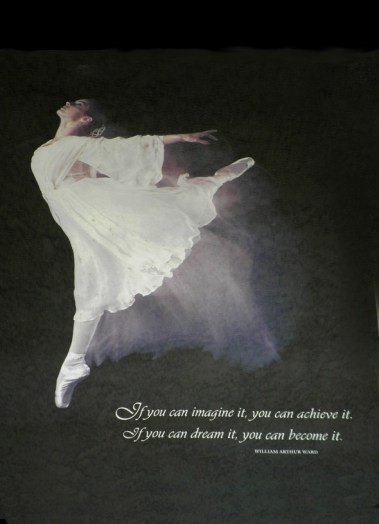
The poster that hangs above the door of the dance studio

Dancing isn’t something I have ever had much interest in, especially classical dance, partly because I don’t have a good sense of rhythm and am not exactly graceful, so I never thought I could do any sort of choreographed dance. It seemed too complicated, not just learning the steps, but remembering the sequence of those steps and performing them with style. And yet, now I am dancing. Fortunately, a lot of dancing is about counting out the beat, generally counts of eight. . . . five, six, seven, eight. And I can count.

(I was one of those strange children who didn’t daydream, but who counted in her head whenever nothing else was going on up there. Don’t ask me why I counted. I’ve never figured it out, except perhaps there was something comforting about streams of numbers.)

But now I have many reasons to count. Ballet. Jazz. Egyptian Classical Belly Dance. Hawaiian. Tahitian. Tap. And soon, maybe even lyrical jazz. Such magical words!

During all the years of grief, when I had nothing to live for, nothing to bring me ripples of happiness no matter where I traveled or what I tried, I somehow knew only falling in love again could bring me back to life. For some bereft, falling in love with a person is the key. For others, falling in love with life is what brings them a sense of renewal.

I fell in love with dance.

I tell my teacher I owe her more than I can ever repay, and it’s true. She is teaching me not only the steps, but is imparting her own love of dancing, and dancing has brought me more joy than I could ever have imagined. (Even during the horrific months of dealing with my father’s decline and my brother’s mental problems, dance brought me a safe haven of happiness.)

Today I took a jazz class. Tomorrow, I have Hawaiian, Tahitian, and tap classes. Oh, lucky me!!

***

Pat Bertram is the author of the suspense novels Light Bringer, More Deaths Than One, A Spark of Heavenly Fire, and Daughter Am I. Bertram is also the author of Grief: The Great Yearning, “an exquisite book, wrenching to read, and at the same time full of profound truths.” Connect with Pat on Google+. Like Pat on Facebook.

The Challenges of Looking After an Aged Parent

Taking care of an aged parent is a challenge, with new tests — and testiness — arising every day. The biggest problem, of course, is that the parents want to be babied while giving up none of their parental authority. (They seem to forget that such authority had expired decades previously when we grew up, left home, and developed our own life with our own unique responsibilities.)

rainA friend cautioned me against coming to take care of my father — she knew first hand the challenges I would face. But for the most part, he and I have managed to deal together okay, mostly because I adopted a policy of doing whatever he needed but nothing that he could do for himself. (He wanted me to wait on him like some unpaid servant, or like my mother did for the sixty years they were married.) After his recent hospitalization and an ensuing bout with pneumonia (he refused to sit in a chair or take walks while hospitalized, saying he had patients’ rights, and he had the right to refuse any treatment, so the pneumonia came as no surprise), I’m having a hard time resetting those parameters. He simply won’t do anything for himself, even though he is still strong and reasonably healthy for his age. (He says it tires him. I want to say “get over it,” though I don’t.)

And then there is the problem of the household finances. When he lost his ability to think clearly and keep enough numbers in his head to reconcile his accounts, he turned the household finances over to me.

Sort of.

When he is unwell, everything goes smoothly. He says he trusts me, and that I have permission to arrange matters (and papers) most convenient for me. When he is well, he forgets that trust, rummages around in his desk, puts everything back the way he had it, disarranges my work and makes my to-do list disappear.

Yikes. What a balancing act — letting him think he is still in control while making sure the bills get paid and balky appliances get fixed.

I figure if he’s well enough to mess around with such matters, he’s well enough to get his own meager meals, but he doesn’t see it that way. I try to be patient, realizing it must be hard to be ninety-seven years old and dependent on a daughter, but I also can’t forget that I am that daughter, with a life of my own. I never took a vow of obedience to him. Never signed on to be a servant. I’m just the designated daughter, the unattached one who got stuck with the awkward situation.

I’m hoping in the next week or so things smooth out and I can stop being at his beck and call. Well, I will stop — that’s a given. I just don’t know how that will sit with him.

And so it continues, my paying the wages of daughterhood.

***

Pat Bertram is the author of the suspense novels Light Bringer, More Deaths Than One, A Spark of Heavenly Fire, and Daughter Am I. Bertram is also the author of Grief: The Great Yearning, “an exquisite book, wrenching to read, and at the same time full of profound truths.” Connect with Pat on Google+. Like Pat on Facebook.