We Know Everything

We all think we know everything because we know everything we know. The corollary to that statement, of course, is that we don’t know what we don’t know, and often we don’t even know we don’t know what we don’t know.

Whew! That’s a convoluted thought! But I come by it honestly. Honestly, I do.

I happened to fall down a dark hole of baby boomer hatred, not in real life, but on the internet. It astonished me that so many people hate “boomers,” even though their reasons don’t apply to any boomer I know. I was going to enumerate each of those reasons with a rebuttal, but decided that was a waste of my time and yours. No one can know a generation. Despite the names so arbitrarily given to the alleged generations, generations are made up of individuals, not generic beings. In fact, I have a hunch most of those who dislike certain older generations have no idea what years truly comprised those generations; the epithet “boomer” seems to be a derogatory term used to describe a mindset that younger people ascribe to any older person who doesn’t see life the way they do. (Generation gap, anyone?)

Much of what is attributed to “boomers” is really a leftover from the so-called greatest generation. When the boomers came of age, that generation was still in control. It wasn’t the boomers who destroyed the economy, but those older folks. (And it wasn’t even them. They just lived their lives. It was the politicians and global corporations who did and are still doing the damage.) The boomers got caught in a vise — although they were raised in a time of unprecedented economic stability, by the time they were raising families themselves, everything had changed. It was no longer economically feasible for a single salary to support a family. Two-incomes were suddenly necessary. And despite what people believe about the boomer economic well-being, millennials have a higher net worth than baby boomers at the same age. Although the millennials bought their first house later than boomers, and paid more, finances weren’t always the reason for the delay — many prioritized other life experiences over owning a home and starting a family.

Also, I was surprised to find that boomers are no longer the largest generation; millennials are. And the alpha generation is forecast to be the largest generation in history.

But all of that is beside the point, which is that we don’t know what we don’t know. What some people don’t like about boomers is that they aren’t grateful for the unprecedented economic and educational time they lived in, but how can they be grateful for something they didn’t know was something to be grateful for, especially since each of them was struggling in their own way? As I said, generations are made up of individuals, and each individual, no matter what generation they belong to (or don’t belong to: the generations, after all, are just marketing designations) lives their life as best as they can under the conditions they are given.

I have a hunch that, since “generation” isn’t really an intrinsic thing (we aren’t born with the name of our generation tattooed on our foreheads), most people who dislike a particular generation simply dislike certain people they have met from that generation (and if the disliked generations are older, those people are most often parents, grandparents, teachers, and other authority figures.)

But whatever the reason, “boomer” hatred does seem to be a thing. Luckily, I don’t know any generations, only people. I have never blamed younger people for the hardships they find themselves dealing with. And I don’t blame older people for the hardships they find themselves dealing with. All any of us can do is deal with is what we know, not what we don’t know.

Still, I am utterly grateful to be on the downward slope of my life. I wouldn’t want to live in the world that is shaping up around the younger generations.

(Just out of curiosity, since I’ve been thinking about all of this: has any other generation had to deal with so much change as the boomers? Especially technological change. To young boomers, television was a brand-new thing. Phones were wired into the wall. Vinyl records and radio were the sole sources for listening to music. Only girls learned typing — on manual typewriters, no less. And yet look at those people today: most are proficient on their various electronics. Those still working are as proficient as anyone.)

***

Pat Bertram is the author of Grief: The Inside Story – A Guide to Surviving the Loss of a Loved One.

What I Am Doing

Obviously, what I am doing right now is working on this blog post, but beyond this moment, I am sure you can guess what I am doing — working on my yard! And beyond that, I am sure you can guess what else I am doing — recuperating from all the work. I never realize how old I am until I start aching, and then, it’s hard to believe I was ever foolish enough to think that just because I could do some physical work, I wasn’t that elderly. (As an interesting aside, interesting to me, that is, elderly used to mean not yet old, whereas now it means old, frail old, decrepit old.)

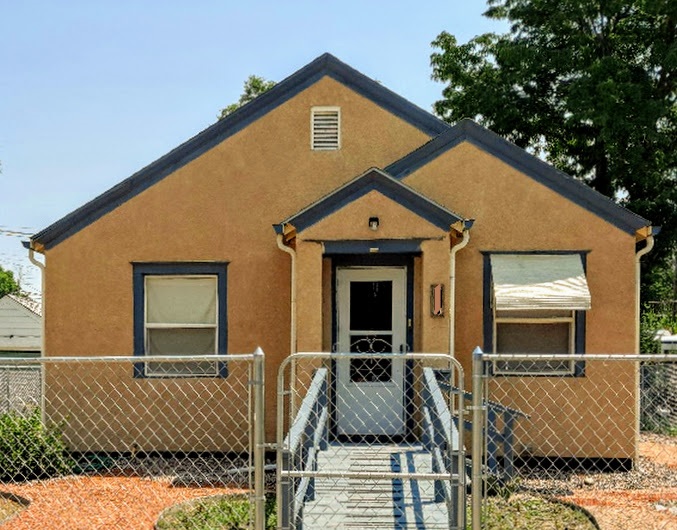
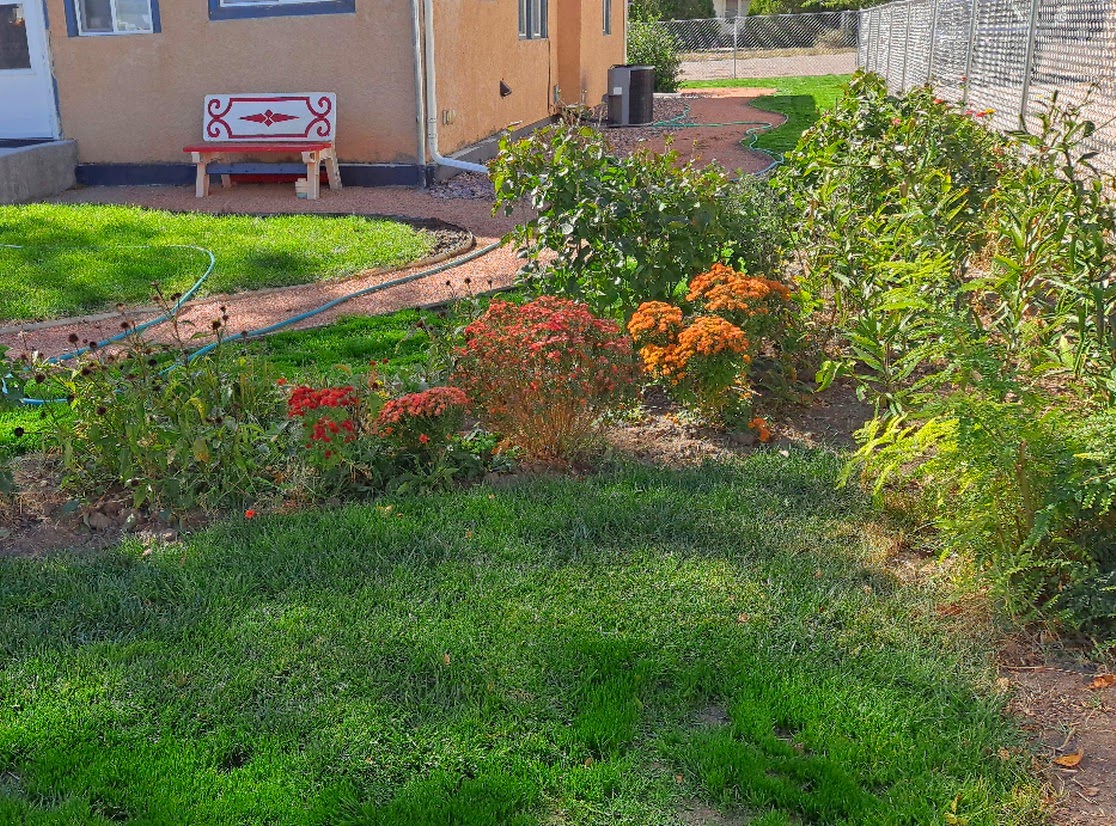
In previous years, I would post photos of my yard, specific images that showed the few flowers that were blooming, and let you extrapolate from that how gorgeous my yard was. Or was not, which I often had to admit. This year, however, my yard truly is stunning.

The grass I planted last fall looks great. I’m keeping my fingers crossed that come summer and the enormous heat, the grass will survive. To that extent, I am trying not to water even when the grass looks dry and faded, hoping the roots will dig down deep enough that it will survive the heat blast.

Even though I thought I’d harvested all the larkspur seeds last year, enough blew around that any weedy area became a larkspur field this year.

No matter where the larkspur are, even invading a poppy field, they bring joy to all who see them.

Finally, after all these years, my raised garden is not only built, but filled with dirt. And plants! Flowers and vegetables mixed together in harmony. At least, that’s the hope.

The wild roses are doing well.

I have always loved the look of red and yellow bushes mixed together, but my yellow and red bushes got separated. I’ve been trying to buy yellow roses to plant among the red, but never found any. I have come to believe that the yellow is an aberration. One of my red bushes ended up with a stem of yellow flowers. I also found some yellow flowers on a red branch. And in one case, the red rose had yellow petals, too.

And that’s not all! The columbine I planted last year survived the winter and are now thriving.

Cottage pinks that were planted years ago decided to bloom profusely.

The ice plant is forming a carpet of shimmering beauty.

And petunias. What can I say? Petunias always do well here.

It’s funny, but despite the way the yard looks, I still don’t really know what I am doing. I’ve been told that there is an expiration date for that claim, but it certainly hasn’t arrived yet. The beauty of gardening (in addition to the beauty the eyes can see) is that plants that do well thrive and those that don’t, don’t. Any mistakes simply disappear, so what’s left looks as if it comes from heart of a master gardener even though I am strictly a trial-and-error dilettante.

I am learning, however, to take what comes. Last year, one garden area shone with the golden aura of wallflowers. This year, wallflowers are decidedly absent. Some plants that were supposed to be perennials turned out to be biennials. Some wildflower seeds that should have come up this spring never showed even a touch of green. The tulips that started out so hopefully ended up giving up before spring got underway.

I am going to try to take it easy physically for a couple of weeks so that when the larkspur go to seed, I will have the energy to pull up the plants to harvest the seeds and see what plants that wall of blooms is hiding. And then . . .

But “then” isn’t here yet.

Meantime, I am enjoying the surprises I find every day.

***

Pat Bertram is the author of Grief: The Inside Story – A Guide to Surviving the Loss of a Loved One. “Grief: The Inside Story is perfect and that is not hyperbole! It is exactly what folk who are grieving need to read.” –Leesa Healy, RN, GDAS GDAT, Emotional/Mental Health Therapist & Educator.

To Dig and To Dream

It seems odd to me that for so many years I blogged every day, and yet now I barely make it once a month. I suppose that’s a good thing — it means I’m not conflicted or obsessing or outraged about anything. What unpleasantries that assail me are noted and forgotten as much as possible. Mosquito bites, obviously, are not forgotten because that dang itch is always there as a reminder, but even that, for the most part, I’m able to note and then let go.

It’s good not to have something on my mind that I need to write about to clear my head, but on the other hand, nothing to blog about means nothing noteworthy is happening. Just life as it comes.

It’s been hot, of course, but while other places have been dealing with record-breaking heat, we’ve been five to ten degrees cooler than normal. No major forays into the 100-degree range, luckily, though high nineties is plenty hot enough. In fact, what grass was left is slowly succumbing to the unrelenting heat. I certainly never expected for the grass to continue to die — not only has it been a bit cooler than last year, we’ve been getting twice as much rain as normal.

That’s just life as it comes, I guess.

My gardening stint each morning is spent digging up the old grass in preparation for planting seed next month. This seed is supposed to be extreme heat tolerant, and it might be so. The patch I planted last fall has survived so far, and looks good. The patch I planted in the spring never did well — weeds grew faster than whatever seeds were left after the birds feasted, and now the devil grass is taking over.

Sometimes I wonder why I’m doing all this work. It seems silly to be spending so much time on the yard, and silliest to be digging up a lawn that was sodded only a couple of years ago, but if the grass can’t survive, it’s no good to me. I considered other options for a ground cover, but what it comes down to is a proper grass for the area is still the best bet. Seed is relatively cheap, can be walked on without damage, and once established needs no more work than the rest of the yard. (Surprisingly, the supposedly care-free ornamental rock and gravel areas are the hardest to take care of — there is always tree detritus clogging the rocks such as leaves and seeds and tiny twigs that can’t be cleaned off with a leaf blower. Even worse, with all the rain we’ve been having, weeds grow rampantly among the rocks and in the pathways.)

There will come a time when I can’t do the work I am doing in now. In fact, I’m surprised I can work as hard as I do — just a couple of years ago, it took me forever to get things done because my knees weren’t cooperating. So, silly or not, I’m grateful to be able to do anything physical. Besides, working in the yard gives me something different to focus on. And — sometimes — it seems worth it. So many of my flowers had been decimated by the hailstorms we had as well as by grasshopper hordes, but the annuals seem to be recuperating, the perennials are hanging in there, and the lilac bushes are doing well.

Because of my concentration on the grass, other parts of the yard might have to wait until next year to be taken care of, but who knows. I do manage to sneak in other chores between the digging. One thing I discovered quite by accident is that any part of the ice plant can be planted. (I’d picked a flower to show a neighbor, and then stuck it back in the ground to see what would happen, and it grew!) So any of plant that gets pulled up as I weed gets pushed back into the ground. Because of this, and some transplanting, I’m able to get the ice plant to spread out even more.

Someday, perhaps, I will have a gorgeous yard that’s easy to take care of, but for now, it’s enough just to dig and to dream.

***

Pat Bertram is the author of Grief: The Inside Story – A Guide to Surviving the Loss of a Loved One. “Grief: The Inside Story is perfect and that is not hyperbole! It is exactly what folk who are grieving need to read.” –Leesa Healy, RN, GDAS GDAT, Emotional/Mental Health Therapist & Educator.

Bad Feeling

Have you ever had a bad feeling about something and acted on it? I’m not talking about things like tests or job interviews or doctor’s appointments or first day at work or any of those things we have to do at some time or other despite a feeling of uneasiness. I’m not even talking about a premonition. Just an all-around bad feeling.

That happened to me yesterday. Just an all-around bad feeling about a meeting I was supposed to attend. I have no idea where the bad feeling came from. It’s possible I’ve been around people too much lately. Actually, that’s not just possible, but a fact. I have been around people too much lately, but still that’s no reason for the bad feeling. I’m a bit uneasy about having been exposed to The Bob, and although I’m sure the person who exposed me is past the contagious stage, it could still be something that set off the bad feeling. I’m also having my general winter coughing spells, which I prefer to have at home rather than in public. Luckily, I’m discovering that a cool mister helps. (Cool Mister? Sounds nickname for a romance hero!)

Now that I think about it, it’s all too probable the bad feeling comes from a falling barometer since I do tend to be affected by changes in atmospheric pressure. For example, when the barometric pressure drops, it creates a difference between the outside pressure and sinus pressure. Considering how problematic my sinuses are, the difference can, at the least, give me a bad feeling — not exactly sick, but not exactly tip top, either. Lower air pressure also exerts less pressure against the body, allowing tissues to expand, causing pain around joints. I’m not to that point yet, though I’m sure in the coming years I’ll become as much of a human barometer as anyone with aging joints.

Also, the falling barometric pressure indicates a coming storm, though there is no need for a barometer yesterday — I woke to sunny skies and still air, and by noon, dark clouds and high winds were the norm. I don’t like driving or being driven in storms, so I went with the bad feeling and backed out of my meeting.

As it turns out, the storm was overrated, just a sprinkling of snow, and nothing happened to the people who went to the meeting, though if I believed I’d had a premonition (which I don’t) and had a more mystical bent, I would think that my staying away was the equivalent of the flap of a butterfly wing that changed everyone’s fate from dire to favorable.

Still, whatever the reason for the bad feeling yesterday, for the first time ever, I went with my instincts and stayed home, reading and napping and enjoying a pleasant afternoon despite the low pressure outside and the higher pressure inside my head.

***

Pat Bertram is the author of Grief: The Inside Story – A Guide to Surviving the Loss of a Loved One. “Grief: The Inside Story is perfect and that is not hyperbole! It is exactly what folk who are grieving need to read.” –Leesa Healy, RN, GDAS GDAT, Emotional/Mental Health Therapist & Educator.

Daily Tarot Reading

In yesterday’s blog post, I mentioned what I hoped to gain by a daily tarot reading, and it was only afterwards I remembered that the only thing I hoped to gain was a feeling for and a knowledge of the cards. Although I made it sound as if I was looking for a deeper understanding of myself and my life, that isn’t the case. Or at least, it wasn’t. I have no idea now what I’m doing it for.

At the beginning, of course, I did a daily reading more as an homage to my deceased older brother because he was the one who collected the cards. I figured he did so in an effort to understand his life (which was confusing at best, and often horrific). As I’ve become more familiar with the cards, any true reading has to reflect me, my hopes, my life otherwise they are just playing cards.

Still, despite this disavowal, I am looking to them for something since my daily question is “What do I need to know today?” and more often now, “What do I need to focus on?”

I certainly didn’t get into this daily practice to find ways to improve me or to understand more about my life. At this late stage, I’m not sure it matters all that much. So much of what was to be has already been. The past is a long tail on the mote that is today, and today is a mere shadow indicating perhaps what is to come. If I look too far into the future, the end is obvious, so the secret is (perhaps) taking a short long-term view. Or not look into the future at all. And I certainly have no interest in rehashing the past. I’ve done that and have laid it to rest. So to a certain extent, I am a static being suspended in the crucible of today.

I hesitated about inserting “static” in the previous sentence since no one is truly static — we are all changing even if in small ways — but it feels as if I am a done deal. If I could have been smarter, or wiser, or more intuitive, or more radiant, or whatever, I would have thought I would have accomplished that already. Now I so often find myself tired and feeling the weight of my years. It’s hard to find enthusiasm for anything (though I do try, especially when I am posting a commentary here). I’m probably more interested in finding acceptance in myself that in instigating any big change in attitude or attribute.

And yet, there is that daily tarot reading. It’s become such an established procedure of my day that it’s gone long beyond being merely an homage to my brother. Maybe someday I’ll figure out why I continue to do it. Perhaps someday I will even become smarter or wiser or more intuitive. Or not. Who can say? So far, the tarot is remaining mum.

***

Pat Bertram is the author of Grief: The Inside Story – A Guide to Surviving the Loss of a Loved One. “Grief: The Inside Story is perfect and that is not hyperbole! It is exactly what folk who are grieving need to read.” –Leesa Healy, RN, GDAS GDAT, Emotional/Mental Health Therapist & Educator.

It’s Weird Being the Same Age as Old People

I saw a saying on a tee shirt that made me laugh: It’s weird being the same age as old people. Because . . . oh, how true that is!

So often now when a character in a book is described as old, the character’s acquaintances go on and on about being worried about the old person, or the character’s children wonder how they are going to take care of their aged parent, or the detectives discount what an old witness might have seen because of the unreliability of an elderly person’s eyesight or hearing. I find myself nodding in agreement, because elderly people can be frail, fraught with ailments, have the beginnings of age-related dementia, or any number of issues.

Then, like a static electricity shock directly to my brain, it hits me that I’m the same age or even older than the character. When did “elderly” characters in books get so young? Or maybe they have always been young. (At least from the point of view of someone my age.) For example, although Miss Marple’s age is never stated in any of Agatha Christie’s stories, various clues make her out to be in her mid-seventies, so that’s the age she’s generally portrayed in movies. But Agatha Christie’s great-grandson thinks the “elderly spinster” was meant to be much younger — perhaps in her 60s.

Either way, these “elderly” characters are a lot younger than I imagine them to be, so perhaps a better question than “when did elderly characters get so young?” is “when did I get so old?” Either way, it really is weird being the same age as old people.

Although I have often written about getting older and have mentioned some of my age-related debilities, such as my wonky knees, for the most part, I don’t see myself as old. I don’t see myself as young, either. I’m just . . . me. Admittedly, I do worry about growing old alone, but even that shows my age ambiguity — “getting old,” you see, rather than “being old.” I have a hunch if Jeff and I were still together, age wouldn’t be a factor at all — we’d continue to deal with whatever life hands us without putting labels on it, but since I’m alone, and have only myself to rely on, it’s important for me to prepare now as much as possible for whatever old age might bring.

And it’s not just me. Other people in my situation — women who lost their mates and have been left to live alone — also think about the same things. One friend told me she had to be careful because what if she fell and knocked herself out and no one knew? This happened to one woman I know, but luckily for her, it was her cleaning lady’s day to work. I try not to think about such things, because there’s not much I can do about it but be as careful as I can (and I do have a neighbor who pays attention to my window shades and gets concerned if I don’t raise them each morning, so that’s a comfort) but this is simply concern for the coming elderliness, not for now. Still, if I were a character in a book, I’d be worried.

In real life, though, I don’t have to worry about being elderly. From what I’ve been able to gather, most of us consider an elderly person to be anyone who is ten or more years older than we are, so from that standpoint, none of us is ever really elderly until there’s no one that much older than us left alive.

So perhaps it’s not being the same age as old people that’s weird. Maybe it’s just age in general that’s weird.

***

Pat Bertram is the author of Grief: The Inside Story – A Guide to Surviving the Loss of a Loved One. “Grief: The Inside Story is perfect and that is not hyperbole! It is exactly what folk who are grieving need to read.” –Leesa Healy, RN, GDAS GDAT, Emotional/Mental Health Therapist & Educator.
A Spring in My Step

My step has lost its bounce, as if the balls of my feet have become underinflated. At best, I tend to plod; at worst, I lumber. Of course, a lot of this has to do with tiring myself — and especially my legs — working in the yard, but there is so much to do out there before winter that I tend to work more than I should. Still, I thought I’d check online to see what — if anything — would help put the spring back in my step.

I had to laugh. The first few articles I found had advice like think positively, eat right, drink right, work in a garden, go shopping, visit with friends, have some fun. Good advice, but not exactly what I was looking for. I did eventually find some exercises to help improve strength and balance in the lower body and enable elderly people to walk better and be safer.

After more research, I came across an interesting explanation of why older people lose the spring in their step: a difference in joint and muscle redistribution. For younger people, a normal gait is powered 1/3 by the hips, 1/3 by the knees, and 1/3 by the ankles. For elderly folks, the gait distribution is 3/4 by the hips, 1/8 by the knees and 1/8 by the ankles.

Because of this, you’d think that ankle and knee strengthening exercise would help redistribute the propulsion ratios, but although those exercises are valuable and help with many problems, exercise itself does little to put the spring back in a person’s walking gait. I can attest to that — I am doing various ankle/hip/knee exercises, and although they are helping my knees, they aren’t doing much to help with the spring in my step.

What does help? Paying attention to your gait when walking, standing tall as if peeping over a crowd, and actively engaging the ankles — land on the heel, roll the foot to the ball of the foot and push off.

Of course, as with everything I research, there is controversy. Some physical therapists and exercise trainers say this is entirely the wrong way to walk, and each offers their advice to walk correctly, such as landing on the outside of the heel and slightly move it inward to land flat. Or don’t land on the heel at all but walk toe to heel. Or land on the ball of the foot and use your hips to propel you forward because your hips are the bigger muscles and hence have more power. (I wonder if this is why elderly use their hips more than ankles or knees — since it is the biggest muscle group, it would retain muscle mass longer than other muscles.)

To me, the correct way of walking is whatever is most comfortable, least painful, and lightest on the feet, so I suppose almost all ways of walking are correct for someone.

There’s not much I can do about trying to propel myself forward when I’ve spent myself — I’m lucky to be able to move at all at those times — but I have noticed the rest of the time that if I pay attention and actively engage my ankles, I do seem to have more of a spring in my step.

***

Pat Bertram is the author of Grief: The Inside Story – A Guide to Surviving the Loss of a Loved One. “Grief: The Inside Story is perfect and that is not hyperbole! It is exactly what folk who are grieving need to read.” –Leesa Healy, RN, GDAS GDAT, Emotional/Mental Health Therapist & Educator.
A Good One

When I was young, I had a five-book boxed set of Pollyanna books. Every time I got sick and so couldn’t go to the library for a fresh stack of books, I reread the ones on my shelf. Despite having read the Pollyanna books perhaps a hundred times, the whole “glad game” thing never took hold in my life. I simply could not see the benefit of being glad you didn’t need the crutches you received instead of the doll you wanted. I thought gladness should be effortless rather than a struggle to find something good about bad times.

Ever since Jeff died, though, I tried to play my own version of the game (though I didn’t know that’s what I was doing) by finding something to appreciate every day. I needed a way to ground myself because so often during those first years I felt as if I were teetering on the edge of the abyss, and without a firm footing, I feared I would topple into that bottomless black pit.

The lessons learned back then have served me well. I make sure to appreciate every flower that comes up, every blade of grass that shimmers in the sun. In a glass half full/half empty sort of way, I try to see what’s there rather than what isn’t. For example, to see the plants and sections of grass that are doing well instead of worrying about the areas of the yard that are desiccating no matter what I do.

Some days, however — like today — I find it hard to appreciate much. It’s been too hot for too long; it’s too much work trying to keep the weeds from taking over; and it’s too hard to focus on what is still growing rather than what once was doing well but is no longer thriving.

I took this same curmudgeonly attitude on my walk today to check out how my friend’s roof was coming along. The job site was deserted, but I could easily see why — the roof has been re-sheeted, ready for to be shingled whenever the rest of the roofing materials are delivered. On my way back home, I stopped to pick up an item at the dollar store, and when I checked out, the clerk said, “Have a good one.” Sometimes I can let that idiocy go, but on a day when I cannot even appreciate that I have glass, let alone whether it’s half full, I find it impossible to hold my tongue.

“Have a good one what?” I asked. The clerk had to think about that one for a minute, then said hesitantly, “Day?” The thing is, all the elderly people I have taken care of become fixated on their bowels (mostly because moving them has become a difficult non-daily task for them), so they are always pleased when they “have a good one.” Anyway, the clerk finally said, “Have a good day,” but then as I turned to leave, she said again, “Have a good one.” I just looked at her and shook my head.

Some things are just not worth dealing with.

Although I have temporarily given up on trying to keep the weeds in check, temporarily given up on caring about the less-than-appealing areas of my yard, I still do manage to find something to appreciate if only in passing, such as the lance-leaf coreopsis, pictured below. Now that was something effortless to be glad about — the original seeds were strewn three summers ago, and these perennial plants raise themselves without any help from me.

So maybe the “good one” the clerk told me to have was this flower. In that case, I should have thanked her for the pretty bloom instead of giving her a semi-rough time.

Anyway, have a good one, whatever “one” it is that you want to be good.

***

Pat Bertram is the author of Grief: The Inside Story – A Guide to Surviving the Loss of a Loved One. “Grief: The Inside Story is perfect and that is not hyperbole! It is exactly what folk who are grieving need to read.” –Leesa Healy, RN, GDAS GDAT, Emotional/Mental Health Therapist & Educator.

Apprenticeship

Sometimes I feel as if I am serving an alchemical apprenticeship as I continue my transformation into an old woman. You notice I said “old woman” rather than a “wise old woman,” because I’m not sure wisdom is something that can be apprenticed. Neither can old age, actually — we get there or we don’t — and yet there are things we can do to make aging easier.

My apprenticeship is about learning the art of living when it doesn’t seem as if life is worth living anymore. So many frail elders are beset by an existential crisis, especially when they are the last ones left of their family. (Or even if it only feels as if they are the last ones left.) It is a valid point — is life worth living when everyone you have loved has died? When you have little control over your life and yourself? When your body continually fails you? When it’s hard to see, hear, feel? When your days extent too far behind you and —even though you know you have an expiration date — seem to extend too far ahead? When all anyone cares about is how old you are, not about you and how you are dealing with your great age?

A vast old age (or even a frail younger old age) leaves elderly people feeling as if they have outlived their usefulness, as if there is nothing left to live for, as if they don’t belong here. I’m hoping, in this apprenticeship I have apparently taken on, that the lessons I learn now will become habit, so if (when?) I go through my own age-prompted existential crisis, the tools for continuing to live as full a life as possible will be at hand.

I have no idea what I will be feeling in those hopefully still-distant years. My experience with grief has taught me that we cannot imagine how we will feel about anything until we get there. I do look to the elderly people I know and have known in recent years, see how they are feeling and acting (or not acting), and try to extrapolate from them what I might need to know. One advantage I have is that existential crises are not uncommon for me, the big ones being when I hit adolescence, when allergies (and the prescribed allergy medication) tossed me into a black hole of depression, and when Jeff died. Too often, people sail along fine their entire life until they become physically incapacitated in some way, and then . . . wham! Along come all problems and thoughts that were held at bay by activity.

To this end, I celebrate the small beauties of the day — a flower, a pretty stone, a smile. I look for something to care about and to focus on — for now, it’s my yard, but when that becomes too much for me, I hope something else will come along to give my life focus. I look for something to be grateful about every day. Admittedly, it’s hard to think about one’s life here (especially if that life feels insignificant) when a person is focused on what comes next after this life. So along with the gratitude, I look for something to ground me, to connect me to life and to Earth. Right now, as with so much else, that grounding comes from my garden, from dealing with the literal ground rather than a mental one.

I am also paying attention to the ways my body works and doesn’t work to try to figure out what muscles I might need to exercise to make sure I can do for as long as possible the simple things we take for granted — stand, sit, walk, swallow. Yep, swallow. About a month ago, I was downing a vitamin when it slipped straight past my esophagus into my lungs. Yikes! Scared the heck out of me. So I researched the mechanisms of swallowing and learned that in order for the windpipe to be blocked off, it’s necessary to swallow with the tongue pressed onto the roof of the mouth. The only thing I can think of is that day I forgot how to swallow and relaxed my tongue and throat, and then . . . oops. I’m very lucky that it wasn’t worse. The pill (a capsule) was innocuous and eventually, it dissolved with no lasting effects. Now I am mindful of where my tongue is when I swallow anything. And if I don’t feel like taking the vitamins, I don’t. Even though I do feel as if they are helping me, they can’t help if I can’t swallow them.

It’s all part of the apprenticeship. There is no grade to this apprenticeship, nor is there any reward except that I get to live another day. When I feel more as if I “have to” live rather than I “get to” live, I remind myself that today is not given to everyone, and I find a way to mark the occasion. I hope I can continue to do so. If nothing else, having such a tool at my disposal will help make all the coming years worth living.

***

Pat Bertram is the author of Grief: The Inside Story – A Guide to Surviving the Loss of a Loved One. “Grief: The Inside Story is perfect and that is not hyperbole! It is exactly what folk who are grieving need to read.” –Leesa Healy, RN, GDAS GDAT, Emotional/Mental Health Therapist & Educator.

Adorable

A woman saw me getting out of my vintage Beetle today and told me, in a distinctive southern accent, that I was adorable. Or maybe it was the hat she thought was adorable, or the car, or both. (I get a lot of admiring comments for both of those accessories.) It does come as a surprise at times that I have reached the “adorable” age, though why older women with a different sense of style (such as it is) are considered adorable, I don’t know.

I smiled, of course, and thanked her, because what I else could I do? Shortly afterward, I thought of her comment when I acted considerably less than adorable. I was waiting in line for a checkout clerk, but the clerk kept looking around and seemed to be interested in everything but me, as if I were invisible, and I know I’m not. Invisible, that is. I finally said that if she weren’t going to help me, I was going to leave. She did approach me then, but there was something about her lackadaisical attitude that rubbed me the wrong way, so I said rather irritably, “Forget it. I’m going to leave anyway.” And I did.

It was the right thing to do because by that time, I didn’t want to have anything to do with her or the business that employed her, but I would have preferred leaving the irritation out of my voice and adding in a bit of the “adorableness” that the woman from the first encounter had seen.

Ah, well. Who wants to be adorable, anyway? I’d rather be known for a razor-sharp wit (which, unfortunately, I don’t have) or . . . hmm. I can’t think of anything else I’d rather be known for. I certainly wouldn’t want to be known as an irritable old grump (which, unfortunately, I was for a moment today.)

On second thought, maybe it’s not so bad being thought of as an adorable old woman wearing an adorable old hat and driving an adorable old car.

***

Pat Bertram is the author of intriguing fiction and insightful works of grief.