A Tale of Two Authors

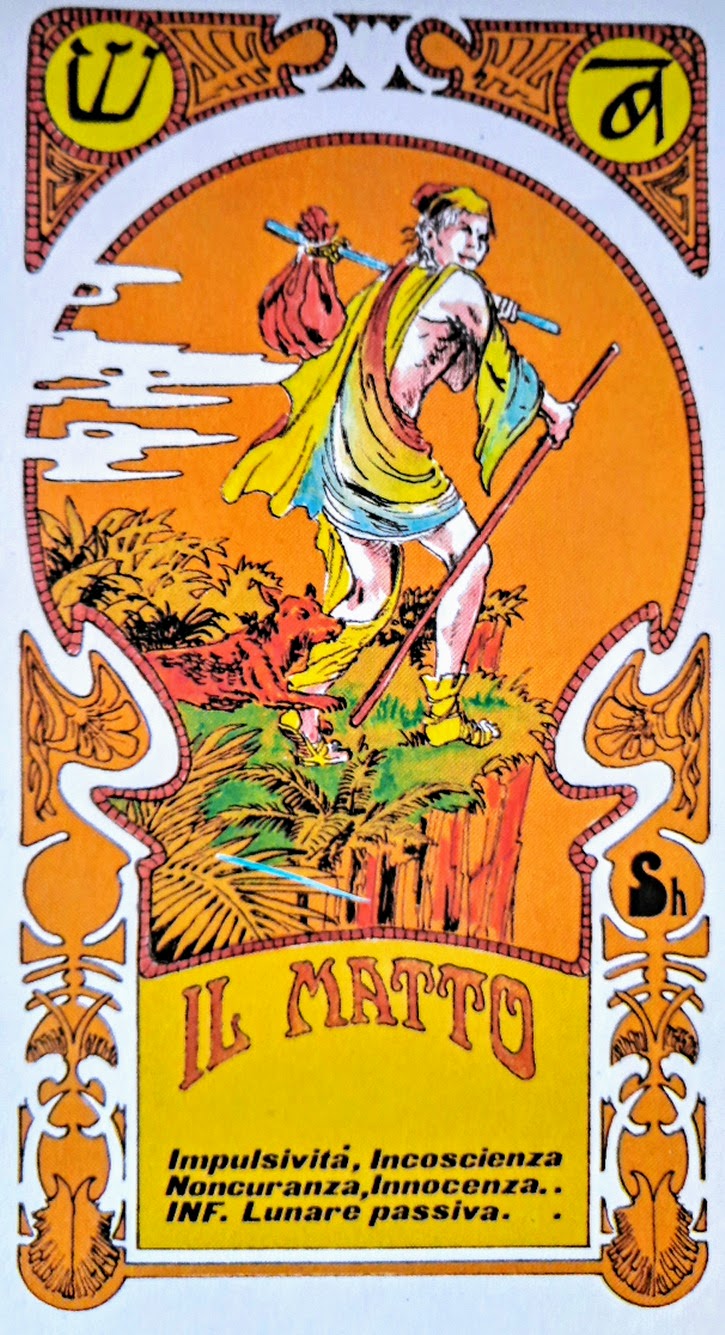
The Fool, one of the major arcana cards in the tarot, symbolizes wanderings, unawareness, naivete, spontaneity, transition, vitality, the beginning of an adventure, the ability to embrace new opportunities. At times, it can also mean recklessness in the face of danger.

The Fool is often depicted as a young man with a stick, a dog at his heels. (In some tarots, this dog is replaced by a fox, which fits because the fool is often “crazy like a fox.”) He is walking blithely toward a precipice, apparently caring nothing for the possible dangers that lie in his path. He’s almost childish in his approach, believing that there are many opportunities in the world just waiting for him to explore and develop.

In Italian versions of the tarot, the fool card goes by “Il Matto.” In French versions, the card goes by the name of “Le Mat” or simply “Mat.” These versions give the name the connotation of “madman,” though in Arabic it means “a dead person.”

In The Wheel of Time, one of the major characters is named “Mat.” Everyone who meets him thinks he is a fool, and in fact, all through the books, that is the word most used to describe him. I thought he was simply an archetype, but when I studied the tarot, I realized he is definitely based on the Fool card. (And if not, it’s too much of a coincidence to ignore. Since the major characters in The Wheel of Time have tarot equivalents, either Jordan succeeded in writing the “all stories” epic he intended — a reimagining all our myths, legends, cultures — or the tarot itself is representative of “all stories.”) Not only is his name “Mat,” not only is his character based on all that the card symbolizes, not only does his character arc follow that which is outlined above, but he represents the Arabic definition of his name. As he once said, “I’m usually pretty good at staying alive. I only failed one time that I remember.”

The Fool supposedly goes in stages from a naïve country boy to a mentally ill outcast (and because of a cursed dagger, Mat truly did become insane for a while), to becoming one who has greatness riding on his shoulder, which Mat does. And through it all, even while Mat is helping save existence from evil cosmic forces, the other characters continue to see him as a fool.

And perhaps he is a fool. He’s the sort of person who will rush into a burning building to save people, cursing himself the whole time, while others just stand and watch. Most often, he rescues women, but as he has come to learn, “even if a woman needed help, if she did not want it, she made you pay for giving it.”

He’s also a character who has no sense of what he really is. Even as he’s breaking into a dungeon to rescue women who can’t rescue themselves, he insists he’s no kind of hero. He thinks he is selfish, though he is not. He’s a bit of a womanizer, but he only goes after women who want him. Though many women are charmed by him, he sometimes overestimates his charm. In one case, a woman was affronted at a slight given by one of Mat’s companions. “Mat offered her a smile. He knew he could smile most women into feeling soothed.” The woman sniffed at him and turned away, not soothed at all. “Most women, he thought sourly.”

Mat is a special character in the Wheel of Time. He only wants to drink, gamble, and cuddle with women, but instead almost always does what is right even if it lands him in more trouble. That trouble, in certain cases, means becoming a battle commander who garners immense loyalty from his men. He almost never loses a fight though he hates killing; he hates even more getting his men killed.

The humor of this character is subtly created by the disparity between who he thinks he is and what he actually does. This is utterly engaging, making Mat one of the few characters who’s fun to read.

Until . . .

Yep, until the substitute author. That writer has no idea what subtlety is. Has no idea what Mat’s appeal is. Has no idea where the character was headed. By the end of the last book Jordan wrote, poor Mat has grown up, accepts the responsibility he has fought against through all the first eleven volumes, and is truly poised to be the hero he was always meant to be. In fact, we begin to see beneath the “fool” to the tragic figure he is hiding behind that lighthearted mask. As he mused: “Taking responsibility drained all the joy out of life and dried a man to dust. What he wanted right then was a great deal of mulled wine in a snug common room full of music, and a plump, pretty serving maid on his knee, somewhere far from Ebou Dar. Very far. What he had were obligations he could not walk away from and a future he did not fancy.”

But the substitute erased Mat’s entire character arc, turned him back into that naïve fool, dressed him like a county bumpkin rather than the sophisticate he had become. Even worse, the author turned him into a clown without the underlying sadness that made him more than one dimensional. Apparently, the author knew Mat was supposed to be a bit of comic relief but had no idea why. And so poor Mat was set up in situations where he tried to be witty but made puerile jokes, got involved in clownish behavior where he played for laughs, was flippant for the sake of flippancy rather than to hide his true feelings, and often acted boorishly silly. 

The interesting thing is, Mat himself as Jordan wrote him was never funny, not even at the beginning when he was known as the town prankster. He took himself seriously, took life seriously, took his responsibilities seriously (even if he complained all the while), but never cracked a single joke, at least none that appeared on the page. Yet, for all that, he brought some lightheartedness to a series of books that could otherwise be rather dismal.

This is one of the reasons I keep up with my studies of the books even though (as you might have guessed) there is a lot I don’t like and cannot bring myself to reread. Not only is this series a masterclass in creating characters and archetypes with a few bold slashes of words, it’s also a study of the contrast between two authors. Though they are developing the same universe, they have two different writing styles, two different ways of presenting material (one is subtle in the storytelling, one hits you over the head with explanations), two different ways of looking at that world, two different senses of what humor is, two different real-world views that color their writing. (One was a soldier who understood the traumas of war and how soldiers dealt with the horror. The other was simply a writer.)

But the main difference? One, at his best, is brilliant. The other . . . never. Though oddly, (oddly to me, that is), most readers seem to prefer the substitute author.

P.S. Influences Jordan admitted he used to create Mat’s character are the Norse war deity Odin; the trickster gods — Loki, Coyote, and the Monkey king; Math fab Mathonwy, a Welsh figure of good fortune; Rommel, the desert fox; Francis Marion, the swamp fox. These last two reflect the “fox” part of the tarot card.
***

Pat Bertram is the author of Grief: The Inside Story – A Guide to Surviving the Loss of a Loved One.


Jordan’s Women

One common complaint about Robert Jordan and his Wheel of Time saga is that he didn’t know how to write women and that all his women characters are interchangeable. They aren’t interchangeable, and each has their place in the story, but because of the way Jordan inverted traditional gender roles, I can see why people think it’s true. Fans also say the characters don’t act like any woman they know, but the characters aren’t supposed to act like women we know.

In the Wheel of Time world, women have the assumption of power (in our world, boys and men used to have the assumption of power and the rest of us, no matter our age, were “just girls”). It was one of Jordan’s themes — turning gender assumptions on end. Those of us who grew up in his era understand why all his women characters treat men as if they are naive boys and why they never bothered to see things from their point of view — because that’s how boys and men treated us “girls.” As if we had no sense. As if we had no point of view worth seeing. As if we were so empty-headed we needed to leave all thinking to them.

But the world today is different from the one that existed when Jordan began developing his saga 50 years ago. (The first book was published almost forty years ago, but before the first word was written, he spent ten years researching and developing his ideas.) To younger generations, gender assumptions are . . . fluid, to say the least, so they can’t relate to that particular theme of Jordan’s. Still, the saga is a fantasy, a creation of a different world, so it should be read only from the point of view of Jordan’s world and not judged by current beliefs in our world.

Admittedly, I don’t like one of his major women characters, and don’t read her point-of-view chapters on rereads. Fans of this teenage character complain that other readers don’t like her because she’s a woman, that if she was a man, there would be no problem with her. (Which sort of illustrates Jordan’s theme, that she was acting like a man from an earlier generation.) But the thing is, people — men or women — who will walk all over anyone, lie, do anything to garner power, might be compelling characters, but will never be someone I like in real life and definitely not in fiction. This woman did not have a character arc — it’s a straight shot upward.

Whenever she saw someone with power, she did all she could to be like them, to become one of their group, use them, and then move on to the next group who could further her objectives. This is the most divisive character among fans — some women think this character is the real hero of the story (which isn’t surprising, since that’s what the character herself believes), while some (like me) see her as evil. The only reason as far as I can see that she doesn’t go over to the Dark One is that she’d have to swear fealty and be second-in-command at best. If she isn’t evil, she certainly portrays the dark triad of personality traits: narcissism, Machiavellianism, and psychopathy. She never changed, never had a moment of self-discovery or reckoning. Anything heroic she did was a side effect of her power grab. And she never stopped grabbing.

A second major character isn’t unreadable so much as she is the young heir to a throne, raised to believe in her right to rule and that she was superior to everyone else, always “sticking her nose in the air,” as one character described her. Despite that, of the three main women characters, she tended to be the most considerate (which isn’t saying a whole lot) and also sometimes acted as peacemaker between the other two. But even that isn’t as much of a problem as that a large portion of a couple of books are devoted to her claiming her throne, a story line that is way out of balance to the rest of the books and one, moreover, that does nothing to move any of the many plots forward. I have a hunch that Jordan planned to go somewhere with that whole subplot to make it less of an add on and more intrinsic to the story, but since the substitute author killed off her realm first thing when he took over, it became even more of a waste of words. As it is, her character arc is meandering, sometimes up, sometimes down, but never going anywhere since she doesn’t really change, just goes from being heir to the throne to being queen, simply becoming more of who she always was.

I started out liking the third one of his major women characters. She was a bit older than the other two, a healer and moral caretaker in the small town most of the heroes came from. Because of her youth, she had to bully people to make them see her authority, but still, she did her best to take care of everyone. She joined with the other heroes so she could look out for them but ended up dealing with a quest of her own. She became more and more of a bully as she tried to keep her place in the world, which irritated me until I saw her character arc. One by one, those she once had authority over turned the tables and she ended up subservient to each until there was only one left for her to bully. When she finally realized she had to give in to his authority too, she cried. That was the end of who she’d been. From there, though, she gradually built up her power base, starting with herself, until she became a true hero, the only one of the three women who did. An actual character arc.

(I wonder if Jordan planned that — one was too much, one too little, and one just right.)

There is another female triumvirate in the saga based on the legend of the three wives of King Arthur, who in Jordan’s books also represent the three aspects of the goddess — maid, mother, crone. (The maid is not a child but rather a warrior, a Maiden of the Spear. The mother is the queen mentioned above, who will have the hero’s children. The crone, though almost as young as the other two, represents the “truth teller” aspect of the crone archetype.) This “three wives” subplot is an unsettling part of the story for many readers (me, included), though it does make sense since Jordan is playing with our myths and legends, imagining what the sources might have been. The maid and crone have similar character trajectories to the queen/mother — ups and downs, with minor changes and an acceptance of their place, but mostly just becoming more of what they’d always been with no major arc that I can see.

Readers often point to the women’s annoying characteristics, such as straightening their clothes, messing with their hair, crossing arms, sniffing loudly, as proof that these characters are written badly, but these are tics, something every writer has. I can’t imagine writing four million words and having to constantly come up with different ways to show vexation or nervousness or disdain. The characters also spend a lot of time describing clothes, but the clothes give hints as to where they are and what they are thinking. It does make me wonder about his wife, though. Jordan says he gave every one of his women characters one of his wife’s characteristics, though he’d never tell her which ones.

In writing this, I developed a better sense of who these characters are, so I might decide someday to read every word of the whole series, including the parts that annoy me.

But maybe not. Since I know their arcs, such as they are, I don’t need to know anything beyond that. At least, I don’t think I do.

***

Pat Bertram is the author of Grief: The Inside Story – A Guide to Surviving the Loss of a Loved One.
Stringing Stories Together

I happened to read an old review of the Wheel of Time book saga, where the reviewer dismissed the massive work by saying all Jordan did was string together stories like The Lord of the Rings and Dune.

That made me laugh because that was sort of the point — an iteration of previous tales, stringing them together to create his world. No, Jordan didn’t copy those books. He simply paid homage to writers he loved, though there could be more similarity than maybe he intended because he used a lot of same sources as did those authors. What he did do, during the ten years he spent researching his world before writing one single word of the first book, was . . . well, research. He researched world myths, legends like King Arthur, folklore, history, costume, culture, war. Then he broke all that up into little pieces and rebuilt his world from those fragments of our past and an imagined future. There are few if any direct parallels to our word but instead there are multiple parallels for each character and culture.

For example, a lot of people think Jordan’s warrior culture, the Aiel, is based on the Fremen from Frank Herbert’s Dune since both are desert-dwelling warrior cultures, and perhaps Jordan did give a nod to Dune, but Jordan’s warrior culture is an amalgam of Zulu, Bedouin, Apache and Japanese cultures, and maybe some others. Their looks (pale skin, light hair, and light eyes) and their system of clan and sept is a parallel of old Scottish and Irish clans and septs. The Aiel are further connected to the Irish through the Tuatha’an, a Wheel of Time culture named after The Tuatha Dé Danann. And something I just discovered — their system of ownership, where women own the houses and everything in them, comes from the Cherokees. (In case you’re wondering, this puzzle aspect of the books is one of the reasons I keep rereading. It’s fun for me to dig out all the references.)

Jordan said over and over again that he wanted his world to be both our past and our future. As he pointed out, “You can look two ways along a wheel.” Also in his world, what goes around, comes around so that the characters in the books are the source of many of our myths and legends and we are the source of many of theirs. He said he wanted to explore what the nature and sources of our myths might be.

His explanation for why the myths and even the histories that the characters experience in The Wheel of Time are so different from ours is that what is remembered and how it’s remembered changes throughout the ages, like the game of Whisper, or Telephone, or Gossip, where someone passes a secret to the next person, who passes on what they heard to the next person, and in the end, what results is generally unlike what was originally said. His point was that things change over time, that stories change, that names change.

He points this out at the beginning of the first chapter of every book: “The Wheel of Time turns, and Ages come and pass, leaving memories that become legend. Legend fades to myth, and even myth is long forgotten when the Age that gave it birth comes again.”

When asked where he got the idea of a wheel, he said, “The name comes out of Hindu mythology, where there is a belief that time is a wheel. Many older cultures believe that time is cyclic, that it repeats. In fact, I believe the best thing the ancient Greeks gave us was (the idea) that time was linear and change was possible.”

That’s for sure! There is a fatalism to the books stemming from the wheel, where everything will be repeated when the wheel comes around again, though perhaps with minor differences. Which also gives them their belief that you can change your life in small ways, but not large ones. Not an easy philosophy to live under.

But I’m getting away from my original point: to say that Jordan strung a bunch of stories together is true. Sort of. But it completely negates the brilliance of the world he created — our distant past and perhaps our distant future.

***

Pat Bertram is the author of Grief: The Inside Story – A Guide to Surviving the Loss of a Loved One.
So Turns the Wheel

So here’s something I don’t understand about the publishing decisions for the end of the Wheel of Time.

They chose an author based on a memorial he wrote for Robert Jordan, but that piece was more about how Jordan had been a big influence on him in his own writing career rather than about Jordan’s books. Admittedly, the memorial was a paean to Jordan’s writing and to the saga as a whole, but though he called himself a big fan, he barely knew the books. And he certainly didn’t seem to comprehend the characters or where they were going.

I do understand they wanted a proven author yet one who wasn’t so big that he couldn’t take the time to work on the ending of Jordan’s books, but even so, the writer they chose didn’t have the time to spend rereading the books or going through the notes that had been gathered for him because he had his other deadlines to meet.

Still, a major factor with the Wheel of Time, is that the books and the internet were more or less born at the same time and attracted the same age group. So there were many thousands of people who’d lived with the books their whole lives. While waiting for a new book to be published, they spent millions of words on hundreds of sites discussing the books and their theories of what they thought would happen. Some of these people gave brilliant analyses of the characters and the culture. One fellow in particular, a college student who was majoring in comparative religions, wrote reams of essays and had insights that gave him a major following.

So getting to what I don’t understand — with that amazing resource at their fingertips (literally at their fingertips since they’d be typing on a keyboard), why didn’t they use it?

They could have started discussions asking what loose ends there were in the myriad plots, asking about where they thought the characters should go and what they should do, asking what they’d most like to see at the end, asking about what needed clarification, asking what things that were foreshadowed still needed to happen, asking . . . well, asking just about anything. With all those thousands of people ready to discuss everything to do with the Wheel of Time, there’d be no need for the substitute to reread the books or go through notes that made sense only to Jordan himself. If nothing else, it would have been a good starting place. And the books would actually have been a continuation of Jordan’s story instead of filled with new characters and revamped long-standing characters because the substitute wanted to . . . actually, I don’t know what he wanted to do. Make the books his own, perhaps.

It’s funny that almost no one will criticize any of those last three books. I have no idea why they are so sacrosanct except that maybe people were glad to have any ending. Oddly, the bits of criticism that are let through the barrier of protection are blamed on Jordan, even though the points in question were completely the creation of the substitute author. Also, in one book of Jordan’s, the timeline wasn’t kept straight (the story for each POV character started at the same place, giving the book a feeling of repetition), which he later said he regretted. And so did his fans. They sure dumped on him for that! Yet when the substitute skewed his own timeline in one book so badly that he had a character in two places at once and another who was in a different timeline than the characters he met up with, no one said a single word.

I suppose, in the end it doesn’t matter. No one else cares, obviously. Nor will I once I forget those books completely. As it is now, I feel an itch every time I see something in Jordan’s work that was mangled by the substitute. For example, Jordan explained how one magical machine worked on its own to project a character into scenarios based on the character’s fears, and yet the substitute had people working the machine to create horrific scenarios for the one being tested in the machine. Nothing major. Just itchable.

It’s possible no one could have finished the series properly. The more I see all the foreshadowing that appears in Jordan’s work several books before the foreshadowed event, or find hints of wry humor and ironies that won’t be understood until later, or see minor characters that are threaded throughout the saga, or marvel at the subtleties as well as all that goes on beneath the surface, or understand that something that seemed to be a win for the side of Light was actually a win for the Dark, the more I am astounded by what Jordan was able to keep in his head. I had a hard enough time keeping the 100,000 words in each of my own books straight. (In one case, I had to use a bulletin board and hundreds of tiny pieces of paper each containing a bit of information to figure out the timeline.) I can’t imagine keeping millions of words and thousands of characters and hundreds of plotlines in my head. Nor can I imagine doing all this in a world of my own creation. (Long before I’d ever heard of the Wheel of Time, I considered creating my own fantasy world for a book or series of books, but I gave it up since I have a hard enough time imagining the real world, let alone a fake one.)

His writing technique probably precluded any other author, too, since he was both what is known as a pantster (one who writes by the seat of his pants, who creates and discovers the story as he is writing) and a plotter (one who outlines, who knows the story before he writes).

It amuses me to think we had that in common — that we both had major points we wanted to hit as well as an end to aim for, but the journey to get there wasn’t plotted out. But the rest of it? Keeping all those words and characters and worlds in one’s head? That’s not me, for sure!

Just one more thing for me to puzzle out when it comes to these books — not just what he wrote, but how he wrote.

None of this, of course, helps me with my own writing because I’m pretty sure I don’t have another book in me, nor does it help me to understand . . . much of anything, actually.

Which brings me full circle to the beginning of this article where I mention that there’s something I don’t understand.

And so turns the wheel . . .

***

Pat Bertram is the author of Grief: The Inside Story – A Guide to Surviving the Loss of a Loved One.
What Makes a Good Writer?

What makes a good writer? Is good writing subjective, or is there a standard? Is a good writer necessarily a good storyteller?

I thought I was finished with such questions when I stopped writing books, but I don’t remember if I ever thought of these questions from a reader’s point of view. As a reader, either I found a book readable, or I didn’t. Either the story engaged me, or it didn’t. If I was okay with the book, I read it. If not, I read the ending, and if the ending seemed to be fitting (or a fitting reward for slogging through the book), I’d go back and finish the book. If not, that was the end of it.

For the past couple of years, I found myself not finishing most newer books, so I reread a lot of older books, many of which weren’t really worth reading again. Now, I figure if I’m going to reread books, I might as well continue my studies of The Wheel of Time saga, which brings me back to the questions I put forth above.

I’ve come across a lot of reviews and discussions where people say Robert Jordan is a terrible writer, which amuses me to think I’m immersed in the words of someone who is becoming so excoriated. (The substitute writer who finished the series is held up to be the epitome of a good writer, but no. Just no. I struggled through the books he wrote to finish The Wheel of Time, and I’ve not been able to read a single one of his own books. His writing is plebian at best and his stories boring.)

Years ago, I read in a book called The Practical Stylist by Sheridan Baker: “Clarity is the first aim; economy the second; grace the third; dignity the fourth. Our writing should be a little strange, a little out of the ordinary, a little beautiful with words and phrases not met every day, but seeming as right and natural as grass.”

That quote seemed to me to be the definition of a good writer, and I tried to write like that. Robert Jordan does. Some of his writing is truly classic and beautiful. The substitute author does not fulfill any of those requirements, but he does write in the preferred style of today, which is lots of dialogue, short sentences, short paragraphs, quick changes of point of view, with little that is elegant or dignified or graceful, and nothing out of the ordinary.

Like all authors, Jordan has tics (overworked words and phrases), and he does at times let his world building get in the way of the story, but that doesn’t make him a bad writer, just an unedited one. (That’s what an editor is for — to scrub unwanted words and meanderings from the text. Or at least point them out. But he married his editor, and though she continued to be his editor, he wouldn’t let her change a single word. Apparently, she and his publisher let him run with his books the way he wanted because he made them a fortune. Also, come to think of it, any rewrites would put him way past deadline.)

It is interesting to me that he wrote books that appealed to preteen boys as well as old women (well, one old woman). It also amuses me how often those boys say they outgrew the books when they tried to read the books years later. And yet, here I am, still growing into the books.

I do admit, though, that my interest in the books has less to do with entertainment and more to do with deconstructing his world, finding the puzzles and clues and references to our world, seeing how he wrote what he did, and to better understand his subtleties.

My latest find changes the books for me, or changes at least one character.

In the saga, the power of the universe can only be used by women because the men’s half is tainted, which makes them go insane if they use it. Despite this, the hero uses the men’s power out of necessity. Over time he begins to hear a voice in his head — the voice of the man he’d been thousands of years before. The way Jordan wrote this voice, it seemed to be an entirely different person. The voice knew things that the hero didn’t, and the voice seemed insane and totally at odds with the hero.

I don’t know how many rereads it took for me to realize that the voice was the hero. Because of the taint, memories were slipping beyond the barrier of forgetfulness that kept people from remembering previous lives. The voice created out of madness seemed to the hero to be the source of the memories. And the reason the voice was totally at odds with the hero is that the voice carried all the emotions that the hero couldn’t allow himself to feel. For example, he had to be hard to do all that he had to do. (The poor guy was barely twenty years old, prophesied to save the entire world from the Dark One, guaranteed to go insane, fated to die during the last battle, and everyone in the world wanted to use him or torture him or imprison him.) So while he’s being hard, trying to be what he thinks he needs to be to prepare for the last battle, the voice in his head is gibbering in fear, weeping, trying to run away, and sometimes laughing madly — feeling all the emotions he can’t afford to feel. And the conflicts he so often has with the voice are a reflection of his own internal struggles, having to be what he so does not want to be.

My knowing that the voice is in fact the hero, not a separate entity, makes him even more of a tragic figure, a human dealing with almost insurmountable pressures from both within and without.

Does this sort of duality and layering make Jordan a good writer? And a good story teller? I tend to think that it does. I’d really like to think that good writing is not subjective, that there are standards to meet. Storytelling, however, is subjective. Even constant readers have genres and authors they stay away from, regardless of how good or bad the writing is.

Still, I guess, it doesn’t matter. I’ll continue to read what I read, and to eschew what does not interest me.

***

Pat Bertram is the author of Grief: The Inside Story – A Guide to Surviving the Loss of a Loved One.

 

Skimming

I have the terrible habit of ingesting books whole without actually reading the words. I’ve never been able to explain how I read — it’s not skimming exactly, but if I read every single word individually as if reading aloud, the meaning of what I’m reading gets lost in the words themselves. Maybe the way I read is a form of meditation. Or daydreaming without visuals. (I have aphantasia — the inability to form images in my mind.) Despite having said that, I do occasionally skim, especially scenes of violence or sections that don’t keep my interest, and considering that I have read more than 25,000 books of all genres, unless the writing is better than merely competent, most books have huge sections that don’t keep my attention. Also, when it comes to fiction, there are few plots or characters that don’t echo in my head — some because I’ve read those very books before; some because they are similar to those books.

Which is why it surprises me that the Wheel of Time saga has caught my imagination enough to allow for rereads. Though there are chunks of the middle books that I can’t bring myself to read again, or even just to skim, I find myself trying to slow down and savor the rest of Jordan’s words. (Even subtracting out the last three unreadable books written by the substitute author as well as the chunky parts of Jordan’s books, there are still approximately three million words that I do read. And if half of those are used for prosaic storytelling, there are still one and a half million of Jordan’s words to savor.) A lot of his writing is truly beautiful. The subtleties are beguiling. And there is much to puzzle out as I deconstruct Robert Jordan’s world and his writing.

Sometimes I miss little things if I get to skimming a section I remember well, until something draws me back. For example, in a passage I read today, a character noticed the hero’s guards/ guardians/ personal army outside the hero’s room quietly playing a finger game: knife, paper, stone. A little later, three of those people entered the hero’s room to deal with his latest infraction of their “honor.” As they left him, one said they’d won the right to punish him and warned him not to dishonor them again. Written out like this, it’s obvious that their game (their version of rock, scissors, paper) was to choose those three, but when these elements are separated by several pages, the association becomes so obscured I missed it in previous rereads.

Admittedly, the situation wasn’t important to the overall story, but it tickles me to find such correlations. Because of this, I’m training myself not to skim, but that will work against me in the long run — without skimming, most books are not worth my time to read.

When I was young, I often read as a way of expanding my mental horizons — a way to work out in advance how I would deal with the circumstances the characters are faced with — but that’s no longer an issue with me since most fictional situations are now either somewhere in my past or will never be in my future. A choice between love and a career? No longer applicable. What to do with an unexpected pregnancy? Definitely not applicable! Taking revenge on someone? Not something I would ever do. Save the world from the forces of evil? Only applicable if that evil appears in my own backyard and even then it’s not something I want to contemplate. (I’m wary enough of thoughts to think that thinking itself can bring down upon my head whatever it is I am thinking of.)

Without any necessity for reading myself into the story, most novels become ho-hum, especially if the writer can’t make me care for the characters. Without skimming at least a part of the book and skipping other sections completely, I’d probably never have read most of the books that I did. Not finding other books of interest to me could be why I’m caught in the spokes of the Wheel of Time.

I’m not sure where I’m going with this, and since you’re probably skimming this essay anyway, I doubt it matters.

***

Pat Bertram is the author of Grief: The Inside Story – A Guide to Surviving the Loss of a Loved One.
Figuring Out the End of The Wheel of Time

Yesterday I wrote about parts of the Wheel of Time that should have been edited out or at least shortened considerably.

One of those story lines involved the hero rescuing a nation from an evil king who’d usurped the throne while the daughter heir was off doing other things. In addition, the hero twice conquered another nation. He intended both countries to be ruled by the daughter heir who would have been the rightful heir under normal circumstances. But because he said he was “giving” her those thrones, there was a huge furor since she claimed they were hers by right. Except they weren’t hers by right any longer. He’d conquered both nations. He could have put anyone in charge as he did with other nations where he defeated the evil rulers. But she was angry at him because of that word: give. Sure, she didn’t want people to think she was his puppet and so she needed to gain the crown on her own by having the ladies and lords vote for her. But there they were, on the brink of a cosmic catastrophe, and she worried about them thinking she was a puppet? It seems to me that if all existence were at stake, that would be a minor issue. Certainly not one worth tens of thousands of words.

What makes the whole thing even sillier is that the city, Caemlyn, was a Camelot equivalent. (In the King Arthur Legend, The Battle of Camlaan was the climax to his rule.) So it might have made sense, perhaps, to waste time on a plotline that went nowhere if only to establish the importance of that city, except that the very first casualty of the cosmic battle was Caemlyn. So at that point it mattered not who ruled.

It surprises me that I ever bothered to read these books in the first place, and I probably never would have if I hadn’t been laid up at the time and desperately needed something to read. Then, when I realized what the books were with all their real-world references, not just homages to previous series, like The Lord of the Rings, but a retelling of the King Arthur tale as well as dozens of other myths and legends from around the world, I got interested in finding all the subtext. Then, when I found out how terrible the ending was, I decided to try to figure out the real ending. Which is where I am now. But sheesh. All that verbiage! Luckily, I know how to skim, and I am not at all adverse to skipping huge sections. (The seventh book took me two or three days to read. The eighth took me two or three hours.)

I am finding bits, though, that would have made the ending more interesting. The most obvious would be to have accepted that most of the characters had already reached the end of their arc and were ready for the last battle. In one case, the substitute author repeated an entire character arc. In another case, he simply undid the arc, erased the character’s growth and his acceptance of responsibility, and returned him back to his immature ways with no further development.

Another thing that should have been addressed is that at one point, the kings and queens of the northern nations all decided to head south with their armies. They did not like what the hero was doing to the southern nations, not realizing he was rescuing those nations from the forces of the Dark One, and they didn’t want the same thing to happen to them. So they decided to do something about it. The subtext (and even Robert Jordan alluded to it) was that this displacement was part of the dark side’s plan, and was helping to further disrupt the forces of the light. This coalition was going after the hero, and the whole thing was so hush-hush, that they were ready to kill anyone who found out or who got in their way. Not exactly a peaceful mission. By this time in the books, it’s obvious that nothing happens by coincidence, and yet combined, this northern coalition ended up with thirteen Aes Sedai (the women power wielders, who some called witches). And thirteen Aes Sedai, when linked could destroy the hero, no matter how strong he was against them individually.

And yet, despite this, the rather weak reason given during the substitute ending was that they were there to test the hero to see if it was okay for him to fight the Last Battle. Um, yeah. If this were true, all they’d have to do was send an envoy, asking for an audience. Instead, they took a force of 200,000 as well as all those Aes Sedai to deal with him. And if they found him unworthy and killed him, they would have doomed the entire cosmos to the dark side. Definitely sounds like a plan made by the evil ones.

Even sillier, they were acting on a so-called prophesy that had been handed down by word of mouth for 3,000 years, negating one of Robert Jordan’s themes, which is based on the game of Whisper, or Telephone, or Gossip, whatever it was called in your part of the country. In the game, someone passes a secret to the next person, who passes on what they heard to the next person, and in the end, what results is generally nothing much like what was originally said. His point was that things change over the centuries, that stories change, that names change. So the chance that this prophesy, passed down orally through the millennium, would be the same at the end as at the beginning isn’t that great.

Even worse, though this army that had been manipulated by the dark side to leave their lands could have become a great disrupter at the last battle, instead the substitute author brought in a devil-ex-machina — an entire hitherto unknown army of dark friends.

I’m thinking I’ll eventually give up my idea of figuring out the real ending (for me just to decipher, not to write). Until then, it is rather an interesting puzzle. If I can get through all the scenes that should have been edited out, that is.

***

Pat Bertram is the author of Grief: The Inside Story – A Guide to Surviving the Loss of a Loved One.

When Editors Don’t Edit

Too often, novels that start out good and end with a satisfying twist, lose traction somewhere in the second half. The best that can be said of those parts is that “stuff happens.” Nothing important to the story, nothing important about the character, nothing that propels the plot forward. Just stuff happening. Ho hum. This seems especially true of authors who are extremely profitable. I don’t know if the editors just give a cursory look before passing the manuscript on to be published, if they are too intimidated to ask for rewrites, if deadlines proscribe rewrites, or if it’s simply that no one cares because no matter how good or bad the book is, it will still make a fortune.

The Wheel of Time books are a good example of this. The first seven are generally good, sometimes great, and sometimes truly brilliant, but after those books, the brilliance fades, the lovely writing gets lost in the muddle, and the best that can be said is that “stuff happens.” There are still remarkable parts, but those parts are surrounded by hundreds of pages where things happen, but they don’t seem to have anything to do with the thrust of the book, don’t seem to move anyone closer to the last cosmic battle that will determine if life and even the universe will continue as it is.

I understand that Robert Jordan liked turning fantasy tropes on their end, for example, making women major players (in most fantasy written before him, women had bit parts if that). He also was playing against the lone hero concept, not just with three interconnected heroes, but also with the idea that the entire world had to cooperate to make it possible for the forces of light to win against the darkness. But, as I pointed out before, what an author intends and what ends up in readers minds is not always the same thing.

Some people like those parts, where tens of thousands of words are devoted to the women characters setting up their power bases, and I sort of understand the necessity, but not the huge portions of books devoted to their power grabs. A lot could be simply skipped, later showing that they achieved their goals, because as the books stand, two of major heroes mostly disappeared, one for an entire book. The third one’s story could be vastly truncated, especially since the same basic story (his fight with himself about whether or not he is a leader) plays out again and again. Even after he accepts leadership, there is a whole other book that repeats that entire character arc. Admittedly, this repeated arc is not Jordan’s fault, but the fault of the author who finished the series, since the substitute apparently didn’t pay attention to the fact that the characters had almost all become who they needed to be to go to battle, and so made a hash of it.

Still, I can understand why people don’t care that those final books didn’t make sense. His editor didn’t care. Since she was also Jordan’s wife, I imagine ending the series in any way possible was her way of honoring him and his last wishes. The publisher certainly didn’t care. A barrelful of money rested on those books. And most readers didn’t care because there was an ending to a series they had lived with for most of their lives. Besides, after all those books where stuff just happened without any sense that the story was moving forward, people were thrilled that the story finally pushed toward to an ending. (Not THE ending, but an ending.)

In the last books that Jordan wrote, there are still flashes of brilliance, still parts where exciting events took place, but yikes. The rest of it should have cut considerably by a few hundred thousand words or more, but apparently no one dared suggest such a thing to such a popular author.

***

Pat Bertram is the author of Grief: The Inside Story – A Guide to Surviving the Loss of a Loved One.
Would-Be Fantasy Writer

The Wheel of Time book series has apparently inspired as well as created a couple of generations of fantasy writers. Although I have never been able to get into any of those other stories (the books may have been inspired by Robert Jordan, but their worlds and their writing styles fall vastly short of his example), I can understand the urge to create one’s own world. I’ve thought about it myself, perhaps continuing the story I began in Bob: The Right Hand of God. Although Bob: The Right Hand of God is a stand-alone novel, it does seem to lend itself to a sequel since anyone born into that re-made world would have to start developing a new civilization (or not), but I don’t have any interest in writing the sequel. To me, the interesting part of the story was the de-creation of life on Earth as we know it. Anything further seems as if it would be just a ho-hum book. A been there, read that sort of thing.

So, if not Bob: The Right Hand of God, then what? Create a whole new world and culture as so many fantasy writers do? I considered that possibility, thinking a world of my own would be a place to escape to in my own head if not in fact but, though I hate to admit any failing, I don’t have the imagination for such an undertaking. (Although I’ve written two novels that could be considered fantasy, both took place more or less in our own world.) Nor do I need to live any more in my head than I already do. Besides, the truth is, so-called real life is fantasy enough for me.

There are theories that all time exists at once, so we are living our past and our future at the same time we are living in the present. My very first book, the terribly written one that no one will ever see (mostly because a few months ago, in a fit of decluttering, I threw away the only copy of the manuscript), was the story of two people who meet and fall instantly into if not love, then an incredibly deep connection, only to find out that they are reincarnations of each other. My question (and hence the premise of the book) was that if everything exists at once and if there is any validity to reincarnation, could this happen? There is an obscure theory that we are all reincarnations of one another. That not only is there a single electron that moves so fast and through so many dimensions and quantum processes that it creates the entire universe (or even multiple universes), but that there is also a single soul that we are all part of. (Yeah, I read weird stuff, which is inevitable when one reads almost anything almost all the time.)

Other theories say we are creating the world as we live it, that nothing exists yet but possibilities we haven’t yet encountered or envisioned. Other theories suggest that everything exists in our thoughts, that we are thinking into reality the world we live in. The reason we are such a mess is that everyone is thinking of different things and wanting different things. If everyone thought of the same thing at the same time, then that thing would come into fruition. Of course, the chances of that happening are nil since whenever you have even just three people together, one will always be thinking of something else, daydreaming or disagreeing or whatever goes on in people’s heads, and the other two will be saying they are thinking of the same thing, but that thing could be completely different for each of them. (For example, if they are trying to envision an apple, one might see a green apple, another red.)

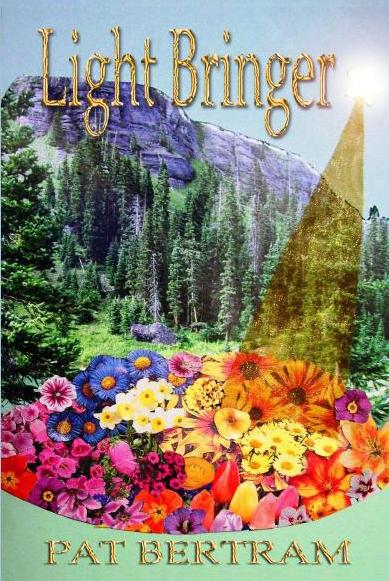
Am I getting too silly here? Well, not too silly for a fantasy writer, but except for Bob: The Right Hand of God and Light Bringer, I probably will never be a fantasy writer. Probably will never write another book, either, but who knows. I could get bored with the books that currently exist and need to occupy my mind another way.


***

Pat Bertram is the author of Grief: The Inside Story – A Guide to Surviving the Loss of a Loved One.

 

Point of View

The Wheel of Time culture shows me exactly why people can’t agree politically on . . . well, on anything.

By Wheel of Time culture, I don’t mean the various cultures in the books, though there are many, but the real-life culture surrounding the books. There are hundreds of websites devoted to discussions of the books, many websites that offer encyclopedias of Jordan’s world, other sites that offer snippets from Robert Jordan’s notes showing the development of his ideas and that sometimes include answers to questions fans ask (his answer most often is, “read and find out,” though sometimes he does elucidate). There are also companion books to the series that offer more information on characters, motivations, glossaries, a dictionary of his made-up language, explanations of things that don’t show up in the books like outlying cultures that have little to do with the story and things that Jordan never wanted people to know.

His subtlety (which it seems he prided himself on) is such that often there is no way to find the truth in the books themselves. In one case, we don’t find out who killed a particular bad guy until we see it in the glossary of the following book. I understand that he wants people to think about the issues and the happenings in the books, tries to get them involved in his world, and accords them the intelligence to be able to fill in vague lines. (The person who finished the series after the death of Jordan had no subtlety, no granting readers a modicum of intelligence, and explained every little detail.) I can also understand an author wanting people to figure things out on their own, such as Frank R. Stockton did in his 1882 story, “The Lady or the Tiger,” but at times it also feels a bit like a cheat. If it’s important, it should be in the books somewhere. If it’s not important, it shouldn’t be treated as if it’s some sort of mystery. (Though as Jordan admitted once in an interview, he was surprised when these — to him — throwaway incidents garnered much discussion.)

Still, as long as I can find out the information I want by checking online sources, I don’t really care that much if such particulars aren’t in the books since I certainly can’t remember every single detail of a 4,000,000 word story. I often end up checking on characters who showed up again after 1,000,000 words and I needed a refresher on who they were and what they had done. Sometimes if I can’t find an explanation for a certain minor point in any of the encyclopedias, I end up reading various discussions to see if any reader had figured it out.

All this to explain why I get caught up in other people’s opinions of the various aspects of the books.

It makes sense, of course, that people would have disparate opinions about the unsaid bits, but what’s really interesting to me is even when the story is explicitly laid out, when the characters’ actions are visible to everyone, when the motivations are obvious, that readers all see something different and are vocal about defending their point of view.

And this is just a story. The words are static. There are no edited versions of the sentences making them seem to say what they didn’t say, no edited videos making us see a different version of the action. It’s all right there in the books. And yet, the interpretations are wildly different. Some people hate a couple of the characters because their plot line goes on and on and seems to accomplish nothing. Other people love those characters and hate other characters. That makes sense to me. Some people even hate the main hero while loving the books, which doesn’t make sense to me, but it doesn’t have to make sense. It’s about preference.

But misinterpreting the story? Seeing what isn’t there? Not seeing what is there? That doesn’t make sense to me since we all have access to the exact same words. I suppose it’s possible that it is I who is misinterpreting the story, since after all, I am totally the wrong demographic (older by decades!) but even that would prove my point, which is . . .

Hmm. What is my point? I suppose it’s that if people can’t even agree on what they are seeing in a book series, can’t agree on what is right and what is wrong when it matters little, it’s easy to see why there is no agreement about what is best for us individually and ultimately the country.

***

Pat Bertram is the author of Grief: The Inside Story – A Guide to Surviving the Loss of a Loved One.