An Alternative to The Alternative Ending to The Wheel of Time

In yesterday’s blog, I postulated an alternative ending to The Wheel of Time that I thought more fitting than the published one, but in my own “wheel” universe, I only reread the first eleven books, so there is no ending, which leaves two possibilities for an alternative to that alternative ending.

The first possibility is foreshadowed in The Great Hunt where the main hero gets trapped in a time loop by one of the bad guys. He keeps living the same few minutes over and over again. He’d been determined never to use the power of the universe since the male half is tainted and ends up making men go mad. He doesn’t know how to use the power, anyway, since the power users who could teach him are three thousand years dead. Still, frantic, needing a way out of the time loop, he finally manages to reach the power and save himself.

So, one ending is that evil doers, who are told by some of their evil masters that they can’t kill the hero and told by others that they must kill him, end up trapping him in a time loop because they don’t know what else to do. Hence, the hero keeps repeating the same eleven books without ever finding a way out. He doesn’t even know he’s caught in a trap since it’s a loop of a couple of years duration rather than a couple of minutes, so he has no memory of what has gone before. But it’s a wheel, right? So what goes around comes around. Maybe forever. Or at least until I finish playing my own private Wheel of Time game.

The second possibility is foreshadowed in Lord of Chaos, where the Dark One asks one of his minions if he’d use balefire in his service. He also tells him to let the lords of chaos rule. In The Wheel of Time, balefire is an immensely powerful magic weapon that destroys targets by burning them backward in time, so the target, anything they’d done, and anything resulting from their actions is erased. In a previous age, both sides used so much balefire that it practically unraveled existence, so the use has been banned except, apparently, in service to the Dark One.

So, the second ending is that the minion, who was mostly offscreen where we never really saw what he did, follows the Dark One’s dictates and creates chaos using balefire, but he uses so much and for so long, that he erases everything that happened back to the moment where the first book began. Hence, as in the scenario above, the wheel keeps turning, replaying those eleven books over and over again. Sort of a takeoff on Dorothy’s dream where she ends up back in the same place she started but without the hero knowing it was a dream and without having learned anything.

It’s funny that I forget so much of what I read as soon as a book is closed, but I can’t forget those last three cringeworthy books by the substitute author. Perhaps someday, as the wheel turns, I will, but for now I purposely try to put any memory out of mind as it arises. And anyway, this current preoccupation with the books will eventually pass so none of it will matter. Except that I do own those last three books. I keep wanting to get rid of them, but I don’t. I don’t know why.

***

Pat Bertram is the author of Grief: The Inside Story – A Guide to Surviving the Loss of a Loved One.
Fool’s Game

I spent a lot of time researching the final books of the Wheel of Time saga, trying to figure out what parts Robert Jordan wrote and what parts the substitute wrote. Since there was no one place for the information, I had to comb through hundreds of sites and interviews until I came as close as possible to knowing who wrote what.

It was all suspect, of course, because even the parts that Jordan himself wrote were added to by the substitute. Occasionally, the substitute added just a few words, but those few words sometimes changed the thrust of the scene or at least diluted it. And even when the substitute hadn’t changed parts that were written by Jordan, they would have been subject to change if Jordan been able to write the entire ending himself.

Jordan was both a pantster (one who writes by the seat of his pants, who creates and discovers the story as he is writing) and a plotter (one who outlines, who knows the story before he writes). He knew the major points he wanted to hit as well as the end to aim for, but the journey to get there wasn’t plotted out. Which means that even if he had written a significant scene ahead of time to give himself something to aim for, by the time he got to that scene in the writing, things might have changed. In the books he finished, that was often the case, so it would probably have been the same with the finale.

He had supposedly written the final scene while writing the first book, which is why the end seems somewhat sketchy (both in the meaning of not being fully drawn and of not being totally true). The woman who helped the hero at the end was never named, had never appeared previously in the story, and was someone the hero didn’t know because I think at the time he wrote that, Jordan himself didn’t know. And yet, through several of the last books Jordan did write, he was developing a character who was foretold as someone who would help, so I have a hunch by the time he reached the end, this woman would have replaced the unnamed one. And if not, it would have been a grievously misplaced use of Chekhov’s gun. (Chekhov’s gun is a principle where every element in a story should be necessary. As Chekhov pointed out, “One must not put a loaded rifle on the stage if no one is thinking of firing it.”)

Jordan did seem to delight in turning assumptions on end, and even though he said that not every prophecy needed to have a major resolution, still, to have a character who was fated to help the hero and who was central to other characters’ actions (they thought she would kill him), to end up simply having her place a pile of clothes and money aside for him to use if he happened to survive the last battle is not a big enough payoff for all the drama instigated by that prophecy, especially since the hero could have done that himself.

The point I’m trying to make, at least to myself, is that even the parts Jordan wrote are not canonical.

So, basically, for me, the entirety of the final three books are not worth the paper they’re written on.

I am beginning to see, however, why people revere the substitute so much. Not only do they prefer his style of writing (though why people would slog through millions of words of a saga if they didn’t like Jordan’s style, I don’t know), but otherwise they’d be left with the utter sadness of Jordan never being able to finish his epic. Sad for him, of course, and sad for us. I have a hunch his ending would have been visionary if not spectacular — all the issues readers had with his getting sidetracked had pretty much been resolved, and he was again focused on getting the characters to the last battle. Most readers, I’m sure, are just as glad not to have to contemplate what could have been and are willing to settle for what they were given.

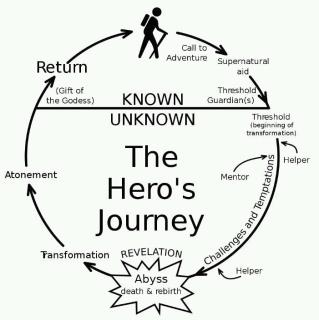
Most. Not all. Not me. I keep thinking I should be able to figure out what the ending would have been because of all the clues Jordan had laced into the saga with foreshadowing and prophecies. The “hero’s journey” concept could be a clue, too, since that was a big part of the origin of the books, but in the end, it’s a fool’s game since there’s no way of knowing what would have come out of Jordan’s subconscious and what he would have discovered as he wrote.

Still, as a person who gets caught up in literary mysteries, I’m sure I’ll continue to do what I can to puzzle out the end, fool’s game or not.


***

Pat Bertram is the author of Grief: The Inside Story – A Guide to Surviving the Loss of a Loved One.




