Do You Know That for Sure?

When I was chatting with my friends this weekend during our day trip, the conversation segued into a discussion of “made in USA” products. Although I do look for that label, I also understand that just because it says “made in USA” it doesn’t mean it’s made in this country by non-sweatshop workers. In fact, there is an island not far from China that is a commonwealth of the USA, and despite its gorgeous weather and scenery, it was a horror for the workers from China and the Philippines who had been lured there with promises of higher wages (higher than mainland China, though significantly less than USA minimum wage) and living on American soil. Despite the horrendous lie and deception (not only deceiving the workers but deceiving those of us who prefer to buy products made here by people who are paid at least minimum wage) many well-known companies with well-known brands utilized those poor workers, while boasting that their designer-label clothes were made in the USA.

My companions had never heard of such a place, and one asked me, “Do you know this for sure?”

I had to admit that I didn’t. I do know for sure that I read about this island, and I do know for sure that it had been documented and well-researched because when I first heard about this travesty (long before the internet and Google) that’s all the non-fiction I was reading — books with pedigrees.

Still, what do I know? What do any of us know? Besides what we have seen or felt or experienced ourselves, we don’t know anything for sure. In my case, I have to trust my sources, and back then, it was easy — in the back of the books I read were indexes of the research involved and sources for further reading — but now, with the internet and the easy spread of . . . non-truths, let’s say . . . it’s hard to know what is or is not true.

Curious, I set about looking for this island. Not surprisingly, I couldn’t find anything on Google, but surprisingly, it was easy to find via Bing.

And yes, there is an island — Saipan — in the Northern Marianas. And yes, American garment manufacturers did utilize what amounts to slave labor. Luckily, after the scam and abuses were exposed in the early 1990s, and after millions of dollars in settlements from the apparel brands, things changed. But that’s not the end — a few years ago, the same scam was re-instigated, but this time the abused workers were construction workers.

Because of earlier scams and deceptions, even though I look for the “made in USA” label, I am leery of it. I tend to believe manufacturing shenanigans and sleight of hand still exist, but that is merely supposition gleaned from my knowledge of the corporate race to rake in as much profit as possible. But as with so much else I think I know, there’s no way to know for sure.

***

Pat Bertram is the author of Grief: The Inside Story – A Guide to Surviving the Loss of a Loved One. “Grief: The Inside Story is perfect and that is not hyperbole! It is exactly what folk who are grieving need to read.” –Leesa Healy, RN, GDAS GDAT, Emotional/Mental Health Therapist & Educator.

Happy Saturday the 14th!

cat

Whew! We made it through another Friday the thirteenth! I hope you managed to hide from bad luck and dire deeds. I sure did.

To tell the truth, I have no particular opinion or fear about thirteen or Friday or Friday the thirteenth, though I do find a lot of irony associated with the avoidance of thirteen. For example, buildings with more than 13 floors don’t call the 13th floor the 13th floor, but instead skip the number and go directly to the 14th floor or call it 12A. It’s still the 13th floor, right? So do people simply fear the number rather than the actual floor? And if they fear the number, do they refuse to buy baker’s dozens of donuts or cookies? (Though perhaps that is dating me — I don’t think I’ve come across a baker’s dozen of anything in a long time.) And if it’s the number thirteen they fear, why is only Friday the thirteeth a fearful day? I realize it’s the conjunction of fateful Friday and the ominous number that causes friggatriskaidekaphobia, but still, for those with the simpler case of triskaidekaphobia, wouldn’t any thirteenth day of the month be cause for concern?

(Interesting side note — in many Spanish speaking countries, Tuesday the thirteenth is the unlucky day, so for them, the movie Friday the Thirteenth was renamed Tuesday the Thirteenth.)

If Friday the thirteenth were really an unlucky day as more than 20 million Americans believe, to be on the safe side, shouldn’t the calendar makers follow the example of builders and change all 13s that fall on a Friday to 14 or maybe even 12A? And speaking of calendars, our current calendar was not universally adopted in Europe until the eighteenth century. So is our current Friday the thirteenth the real Friday the thirteenth? Wouldn’t the day fall on other dates using other calendars?

Whether or not you believe that Friday the thirteenth is bad luck (and if you do, please forgive my levity), I hope you had a fearlessly wonderful day.

***

Pat Bertram is the author of Grief: The Inside Story – A Guide to Surviving the Loss of a Loved One. “Grief: The Inside Story is perfect and that is not hyperbole! It is exactly what folk who are grieving need to read.” –Leesa Healy, RN, GDAS GDAT, Emotional/Mental Health Therapist & Educator.

Do You Want to Live Forever?

I sure as heck don’t want to live forever! In fact, I so much don’t want to live forever that I don’t think about it. The only reason it’s on my mind now is that the title of this post was the blog prompt for today.

To be honest, I can’t think of anyone granted immortality who was pleased with the dubious gift. Of course, these “anyone”s who were granted such a gift are by nature fictitious, since as far as I know, there is no living creature who lives forever. Well, this is a certain jellyfish that can revert to an earlier stage of their lifecycle, which can keep them going forever. Amoebas are considered immortal because they divide in two and so the parent doesn’t die but exists as two daughter cells. And then there are prions . . .

Okay, so there are living things that live forever, but except for the case of a stray alchemist or two (such as the Count of St. Germaine who supposedly found the philosopher’s stone and so attained immortality) the only humans who have become immortal on Earth are fictional ones. And those stories seldom end well.

For example, a long time ago I heard a theory that humans were a sort of preternatural ape embryo that managed to continue developing without ever turning into an ape. To support their supposition, theorists pointed to such human characteristics as hairless bodies, wide-spaced eyes, large heads, and a tendency to play that extends far beyond childhood. A short story based on this theory featured a scientist who found a way to become immortal, and instead of having a great life, he was eventually discovered living as an aged ape in his basement. Apparently, he lived long enough so that he grew out of his embryonic state. Not a pleasant way to live forever!

Vampires live forever, but those fangs, red lips and pallid skin are so not a good look. Sleeping in a coffin and never seeing the sun seems like a recipe for a massive year-round case of Seasonal Affective Disorder. And that lust for blood? Let’s not even go there.

One of the biggest cautionary tales for not living forever is the movie Death Becomes Her. After being granted immortal life, both Goldie Hawn and Meryl Streep do not heed the advice to take care of themselves, so they spend the rest of eternity trying to put themselves together. That’s enough to make a person shudder! (Except not really. This is the only role Meryl Streep ever did that I enjoyed.)

From a reader’s point of view, living forever would be untenable. Can you imagine reading a book that never ends? That goes on and on long after you got tired of what would soon become nothing but a series of insipid events? What a horrendously boring book that would be! Living an earthly life forever would be the same. Assuming, of course, that you could remain young and healthy and rich enough to keep yourself going century after century after century. Unless you were like the immortal jellyfish and could reset your cells back to an earlier time, you would grow older. And older. And older. And older. Ad infinitum. Eventually you would be too old to appreciate anything, would be ready to be shucked of your worthless body and decaying mind and would still find no surcease. And chances are, you’d get sick or break bones or get some sort of debilitating disease, and there would be no blessed release to your pain. Who knows, you might even end up in jail with a life sentence, and then, what a horror story that would be!

Even assuming that you managed to stay free and young and healthy and rich forever, then what? There would be no reason to do anything. As writers, we know how important a ticking clock is. Without a ticking clock to impel a character to solve the mystery or reach the end of a quest or whatever, there wouldn’t be much of a story. I imagine life without a ticking clock would be much the same. There’d be no reason to do anything. Of course, perhaps even for centuries, you could travel and learn and try all sorts of new experiences, and once that’s all done, then what? Eternal boredom?

Luckily, this is merely a rhetorical question, though millions, perhaps billions of dollars are being spent every year to unlock the mystery of mortality. Some scientists theorize that immortality was once the default state, and that death was “naturally selected for,” as they say, because apparently death conferred some sort of benefit on a species where individuals could die. (After all, evolution is not about a single organism but a species.)

Anyway, all that being said, would you want to live forever?

***

Pat Bertram is the author of Grief: The Inside Story – A Guide to Surviving the Loss of a Loved One. “Grief: The Inside Story is perfect and that is not hyperbole! It is exactly what folk who are grieving need to read.” –Leesa Healy, RN, GDAS GDAT, Emotional/Mental Health Therapist & Educator.

Wolf Moon

The full moon we experienced on Friday is called the Wolf Moon because traditionally wolves howl at the moon at this time of year. As romantic as that sounds, the supposed reason for the howling is rather sad — they howl at the moon because they are hungry. Actually, they howl at other full moons, too, though perhaps they are not actually howling at any moon. They are crepuscular creatures, meaning they are most active at dawn and dusk, and the Wolf Moon in January (at least it did this January) rises in the dusk. The howl is a social cry to rally other wolves to hunt; it’s also a territorial call. Because raising their heads makes the sound travel further, it makes it seem as if they are howling at the moon.

Whatever the truth of wolves and the moon, this full moon was supposed to be a powerful one. According to astrologists and spiritualists, the wolf moon is an emotionally charged one, signaling a time of change and introspection, a time to face our fears and trust our instincts, a time to use our inner strength and wisdom. It’s also a time to connect with the earth.

Whether the Wolf Moon means anything beyond its astronomic meaning — that it’s a micromoon, appearing smaller than a normal full moon because it takes place at the moon’s furthest point from the earth (252,146 miles away) — I decided to take action as a sign of female empowerment. So, as I walked home under the bright light of the moon, I howled.

Why howling at the full moon is supposed to be an empowering thing for women to do, I have no idea. I certainly didn’t feel any different yesterday or today. What was different is that as I walked home Friday evening, I was accompanied all the way by the howling of dogs. Apparently, I did make some sort of connection, with those dogs if not the earth.

***

Pat Bertram is the author of Grief: The Inside Story – A Guide to Surviving the Loss of a Loved One. “Grief: The Inside Story is perfect and that is not hyperbole! It is exactly what folk who are grieving need to read.” –Leesa Healy, RN, GDAS GDAT, Emotional/Mental Health Therapist & Educator.

Statistics That Seem to Speak for Themselves

I came across an interesting statistic the other day: between 2000 and 2019, the number of students in the USA increased by 7.6 percent, the number of teachers increased by 8.7 percent, and the number of district administrators increased by 87.6 percent. In case you think that’s a typo . . . well, it isn’t.

It goes go to show where the problem with our education system lies — in the bureaucracy. It explains the politicization of the schools and why students are being taught so many topics parents think are their purview, such as sex education, gender identification, political leanings, and a whole slew of other subjects that don’t really belong in schools. Or maybe they do. I do know that, as many totalitarian political leaders discovered, if you want to change the social fabric of a country or a world, you start with the youngest. (I hesitate to use the dreaded term “indoctrination,” but that’s what anything beyond the basics — reading, writing, arithmetic — comes down to.) Such changes aren’t made immediately — it takes generations and whole lot of political hacks to force those changes.

Not surprisingly, the blue states have a greater growth in the number of administrators, since it seems that what is being taught in schools is more of a liberal agenda, but in all states, education funds and authority are flowing away from schools and toward the bureaucracy.

Do I sound outraged? Well, I’m not. I’m all out of outrage. During my life, I’ve dealt with a vast number of outrageous matters — systemic injustice, torture, genocide, terrorism, horrors galore. Not that I experienced much myself, though I was alive for many such instances and beyond that, I learned of some ghastly occurrences from history classes, and the rest came from my years of reading. (It’s why I stick with mostly fiction nowadays — if there’s an issue I don’t want to deal with, I close the book or skip to a more felicitous chapter.)

Still, these statistics do surprise me, though they shouldn’t. There is a war going on this country between two completely different ideologies. In my younger years, it didn’t matter too much what one’s politics were — we all basically wanted the same thing: a safe place to live and to raise families, freedom to believe what we believe, a chance of financial success or at least a living wage. Nowadays it seems as if the ways of getting those things are vastly different depending on one’s politics, so much so that it’s hard to believe people still want the same thing. In fact, how one defines those things are different from person to person and party to party. One side wants a heck of lot more government intervention, the other side wants less.

Admittedly, this division hasn’t simply sprung up in the past few years. It started generations ago — long before I went to school. And now this war is taking place in the classrooms to a greater extent than any time previously.

And oops. I can’t believe I wrote this. I try to stay away from anything that smacks of politics because nothing I say really matters and only makes people argumentative, but oh, well. The statistics seem to speak for themselves.

***

Pat Bertram is the author of Grief: The Inside Story – A Guide to Surviving the Loss of a Loved One. “Grief: The Inside Story is perfect and that is not hyperbole! It is exactly what folk who are grieving need to read.” –Leesa Healy, RN, GDAS GDAT, Emotional/Mental Health Therapist & Educator.
Something Scary for Halloween

Real life can be a whole lot scarier than the fictional monsters and situations that are created to entertain us. For example, a scold’s bridle. Admittedly, such torture devices aren’t part of our everyday life unless you’re into the furthest reaches of sado-masochistic games, and since I’m not, I’d never heard of them. Or more probably, I’d forgotten what I knew since that’s not the sort of thing I want to remember.

Anyway, if you don’t know, a scold’s bridle is an iron facemask with a bit for the mouth, often with a spike that rests on the tongue so that any mouth movement causes terrible pain. (Some even had a spike on both the bottom and the top of the mouthpiece, which pierced the tongue.) Theses iron masks were created to tame shrews and to punish “scolds,” women who had a vicious tongue or nagged their husbands or were a general nuisance, especially to authority. The bridles were illegal in many places, but still commonly used for hundreds of years to humiliate and control rebellious women (the last known public punishment using such a device was about 1840). When bridled, the women were often subject to jeering, lewd comments, and even sexual assault, apparently because the perceived immodesty of those women titillated the people they encountered.

Women who rebelled against any of the strictures of their life were subject to laws of a scold and punished by this medieval device, as were woman who spoke out against abuse, religious woman who preached in public, women who wanted a say in their own lives, women accused of witchcraft, and women who didn’t act demurely. Even widows and poverty-stricken women were punished with the scold’s bridle, not because they were unruly or did anything wrong but simply because they weren’t under the control of a man and so were considered a threat.

Yikes. How’s that for scary?

It’s amazing to me that with all that’s been done to women (as well as to anyone considered inferior), that docility wasn’t bred out of women. Or maybe it’s because of the torture women endured that it wasn’t bred out; perhaps the torture created even more rebellion. I don’t really know. I do know that things like this — the way so-called moral people acted against those they feared (and apparently a woman not under the strict control of a man was someone to be feared greatly) — scare me more than any made-up Halloween monster.

***

Pat Bertram is the author of Grief: The Inside Story – A Guide to Surviving the Loss of a Loved One. “Grief: The Inside Story is perfect and that is not hyperbole! It is exactly what folk who are grieving need to read.” –Leesa Healy, RN, GDAS GDAT, Emotional/Mental Health Therapist & Educator.

Grassland Adventure

My sisters were here a few days ago, and it was an especially great visit. Besides getting to see them, I also got to go to the national grasslands, an area I’ve been wanting to explore ever since I moved here. I have driven through the grasslands and saw . . . ta da! Yep, you guessed it — grass! Miles and miles of grasses.

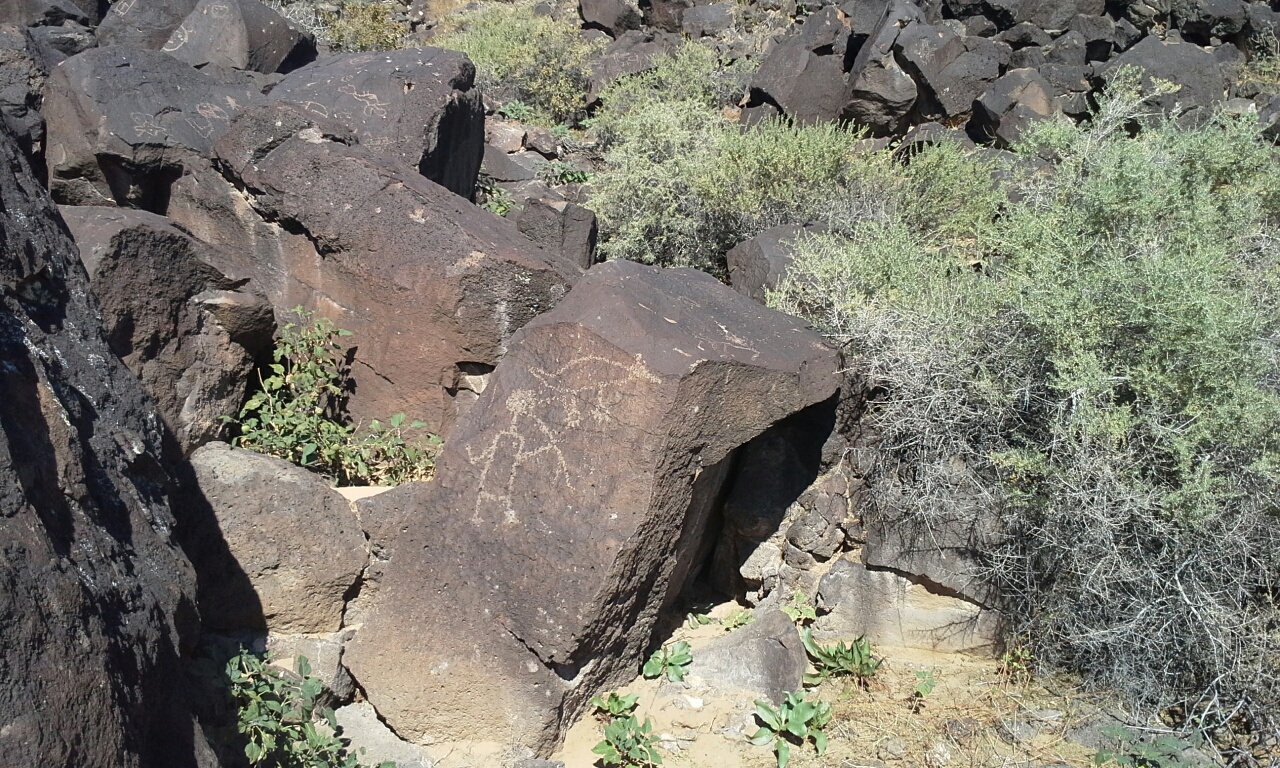
In the back country of those grasslands are all sorts of interesting things such as canyons, petroglyphs, dinosaur tracks, and tarantulas. There are hiking trails back there, too, but they are not the easiest, nor are they the easiest to get to — miles of dirt and gravel roads, and I have no interest in shaking my car apart just to satisfy my curiosity. (Do you remember those cartoons where some character is driving a jalopy, the car hits a bump, and the thing falls to pieces? That’s what I always envision when I have to drive a bit on unpaved roads.)

We headed out late in the afternoon, so by the time we got to the grasslands, we were only able to explore and hike for a short time before the sun starting setting. Still, even without seeing petroglyphs and dinosaur tracks, we were able to get a sense of the area.

Huge slabs of sedimentary rock looked like a river in the fading light. It was easy to believe that these slabs once formed the muddy floor of a prehistoric lake.

The sun shining on the canyon wall peeping over the rim made it look as if the canyon were on fire.

Vast swaths of grass gleamed with autumn colors.

It was hard to imagine how the folks traveling the Santa Fe Trail we able to traverse such areas in their primitive vehicles. (Though I’m sure at the time, those wagons were considered modern conveyances.)

But best of all, to my delight (and to my sister’s screeching horror) I finally got to see a tarantula! Ever since I heard of the tarantula migration in this area, I’ve been on the lookout for tarantulas. I even set out at dusk a couple of times to see if I could find any tarantulas on the move, but they’ve proven to be illusive creatures.

There’s still so much to explore out in the grasslands, but I won’t be able to return until I can find someone with a proper vehicle and a sense of adventure to go with me. Although I used to hike alone in remote areas, that was when I was younger. Admittedly, I was only four or five years younger, but back then, I didn’t feel as if I had anything to lose. And too, my knees were in great condition. But that’s not something I want to dwell on. The truth is, I am very grateful to have been able to see (and experience) what I got to see. Such an adventure!

***

Pat Bertram is the author of Grief: The Inside Story – A Guide to Surviving the Loss of a Loved One. “Grief: The Inside Story is perfect and that is not hyperbole! It is exactly what folk who are grieving need to read.” –Leesa Healy, RN, GDAS GDAT, Emotional/Mental Health Therapist & Educator.

The Cosquer Caves

In a book I’m reading, the prehistoric art in the Cosquer Caves plays a major part, which is fun since I’d never heard of them, though in my defense, my last research into cave paintings preceded the discovery of the caves.

The Cosquer Caves are an underground — and undersea — treasure of cave art. Carbon dating shows two distinct timeframes for the art — around 19,000 BP and 27,000 BP.

[I looked up the definition of BP so you don’t have to. It means “Before the Present,” but since the date of the “present” changes every year, they have chosen the rather arbitrary-seeming date of 1950 to mean the present, which seems silly to me because they exchanged one rather arbitrary date for another. I understand why people don’t like the previous designation of BC because of the mention of Christ, but since he was not born in the year 0, the year itself didn’t mean anything. “They” did try to change the BC to BCE — Before the Common Era — but apparently, 1950 makes better sense to them for a starting date, even though it doesn’t to me.]

The caves weren’t discovered until 1985 when Henri Cosquer, a diver who was exploring the Calanques (a series of cliffs and bays not far from Marseilles), happened to notice a hole in the side of a cliff wall, 36 meters (118 feet) below the surface. And so he discovered the caves, which soon bore his name. Although the caves were made known almost immediately, the first mention of the cave art (all sorts of animals as well as hand tracings) came in 1991 when three divers got lost in the cave and subsequently died.

Before the sea began to rise after the last ice age ended, the Cosquer Caves were located several miles inland. The waters are still rising, slowly submerging the caves, and now the entrance to the caves has been closed off. If you wish to experience the caves, you don’t need to make the dangerous journey under water and through perilous tunnels (even if they were still open) — a replica of the caves has been recreated. Oddly, they have been recreated as they were found — underwater — rather than on land where they originated.

I find this story interesting for several reasons.

One: that such an important discovery wasn’t made public until the three divers died. I’m not exactly sure what that says about us as a species, but it does seem rather true to form.

Two: That the cave paintings came from two such distant eras. Generally, the art found in paleolithic sites seems to be done all in the same era and then is forgotten or just left alone as people move on. It’s been postulated that this was a site visited by nomadic peoples or world travelers, which could be true or just a guess to explain the diversity.

Three: Proof of how climates always change.

There are many terms that really get on my nerves: veggies, 110%, intestinal fortitude, to name a few. But my current most unfavorite is “climate change” because it’s redundant. Climate is change. Climate is always changing. We tend to think we live in a bubble, where what is always was, but this long period of rather temperate weather we’ve been experiencing since the little ice age, is a rather a rarity in the vast history of the earth. (The little ice age was a cold interval from the mid-fourteenth century through the mid nineteenth century. There were even colder intervals of cold between the main interval, the final one from 1840 to 1880.)

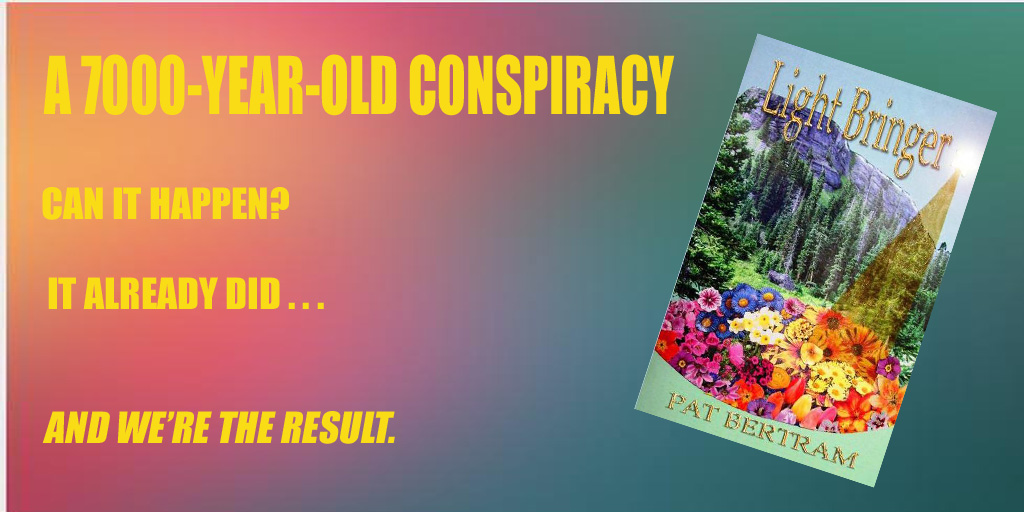
Although I am not disagreeing that humans have an effect of the climate, and in a bubble where outside things don’t affect what is in the bubble and where the bubble itself never changes, what we are seeing would definitely be human-caused. But other factors could be at work — sun spots and solar discharges are one hypothesis to account for some of the current climate. Others hypothesize that we are still coming out of the last ice age, and that our activities may or may not be aggravating that warming trend. Or it could be something completely different, perhaps even another planet in our solar system as the Sumerians believed (a belief I made use of in my novel Light Bringer), and the planet’s return from its remote journey into space is playing havoc with our climate.

We tend to think we know all there is to know about the earth and climate and human history, but the rather recent discovery of these caves and the art that was so important to humans back in those far distant days, shows us that we don’t know everything, shows us that we don’t live in a bubble, shows us that there are still surprises.

***

Pat Bertram is the author of intriguing fiction and insightful works of grief.

Science Says

A physicist at École Centrale Paris posted a detailed photo of a distant world that had supposedly been captured through the world’s most powerful space telescope. After the image got thousands of likes and oohs and aahs, he admitted the image was not a celestial body but a slice of chorizo sausage. He claims he perpetrated this hoax to make a point about fake news and how easily things were misinterpreted. He wanted people to proceed with caution and to be wary of studies and experts that support a particular point of view.

It seems to me that if he really wanted people to be wary, it would have made more sense to simply tell people to be wary, but where’s the fun in that? This fellow seems to like practical jokes — apparently, he’d posted the same photo online four years ago, claiming it was the blood moon as seen in Spain. (It makes sense in a whimsical sort of way since a slice of chorizo is a full-moon shaped, blood-colored product from Spain.)

Whether this particular usage of the photo was an actual hoax that he tried to backtrack from, a joke, or a timely warning as he claims, what I found interesting was not that people fell for his trickery (because truly, there’s no way we ordinary folk can tell if a photo is of a distant world or is simply a piece of pork) but that people want to believe in something bigger than they are. Even more, they want to be awed.

According to the dictionary, science is “the intellectual and practical activity encompassing the systematic study of the structure and behavior of the physical and natural world through observation and experiment.” More simply, science is “the observation, identification, description, experimental investigation, and theoretical explanation of natural phenomena,” and “the discovery of general laws or truths that can be tested systematically.”

Despite science being a discipline of shared knowledge that is changed or refined as more observations are made and more experiments are done, many people look to “Science” (with a capital “S”) as an immutable authority, a secular replacement for religion as something both to believe in and to be awed about. Even worse, “Science Says” is often used as an excuse, a not-to-be-argued-with dogmatism, or a justification of one’s beliefs or actions, when in fact, “Science” says nothing. It has no voice. Scientists say things, and as shown above, what scientists say may not be the truth.

We certainly don’t need to turn our attention to scientists for something to believe in or something to “awe” over. We can go outside, look around, and see what we can see. After all, that’s how science as a discipline started, with people simply looking. Admittedly, we won’t see a piece of photo-shopped sausage, but we might see something even more intriguing.

***

Pat Bertram is the author of intriguing fiction and insightful works of grief.

Lilies of the Field

I thought I was being clever when I named this post since I am attaching photos of my lilies. I also thought I was being clever when I Googled “lilies of the field flower” to see what exactly those flowers were so I could astound you with my knowledge.

And that’s where the cleverness ended, mine and everyone else’s. Like with so much else I look up for this blog, there is no definitive answer.

Some people think the lilies of the field are lilies of the valley.

Some think they are the now rare — and spectacular — white Madonna Lily, the lily from which our Easter Lily was derived. Because this wildflower exists only in the high valleys of Galilee and a few other places and not near the shores of the sea of Galilee, other people think the Madonna Lily can’t possibly be the original lily of the field.

Some people think the lily of the field is the scarlet martagon. Even though this flower did exist at the proper time, Swedish naturalist Carl Linnaeus supposedly named this flower “lily of the field” after the biblical reference.

Some people think the lily of the field is the poppy anemone.

So, apparently no one knows what the lilies of the field actually are. All the lilies pictured here are lilies of my own field . . . well, yard . . . though “Lilies of the Yard” doesn’t have the same ring to it as “Lilies of the Field.”

Making things even more confusing, only the first lily adorning this blog is a true lily, hybrid though it might be. The others are daylilies, which aren’t true lilies but are in fact a completely different genus.

But no matter what you call them, these lilies of my yard are lovely even though, as in the bible, my lilies toil not, mostly because I do the toiling — such as watering and weeding — for them.

***

What if God decided S/He didn’t like how the world turned out, and turned it over to a development company from the planet Xerxes for re-creation? Would you survive? Could you survive?

A fun book for not-so-fun times.

Click here to buy Bob, The Right Hand of God.