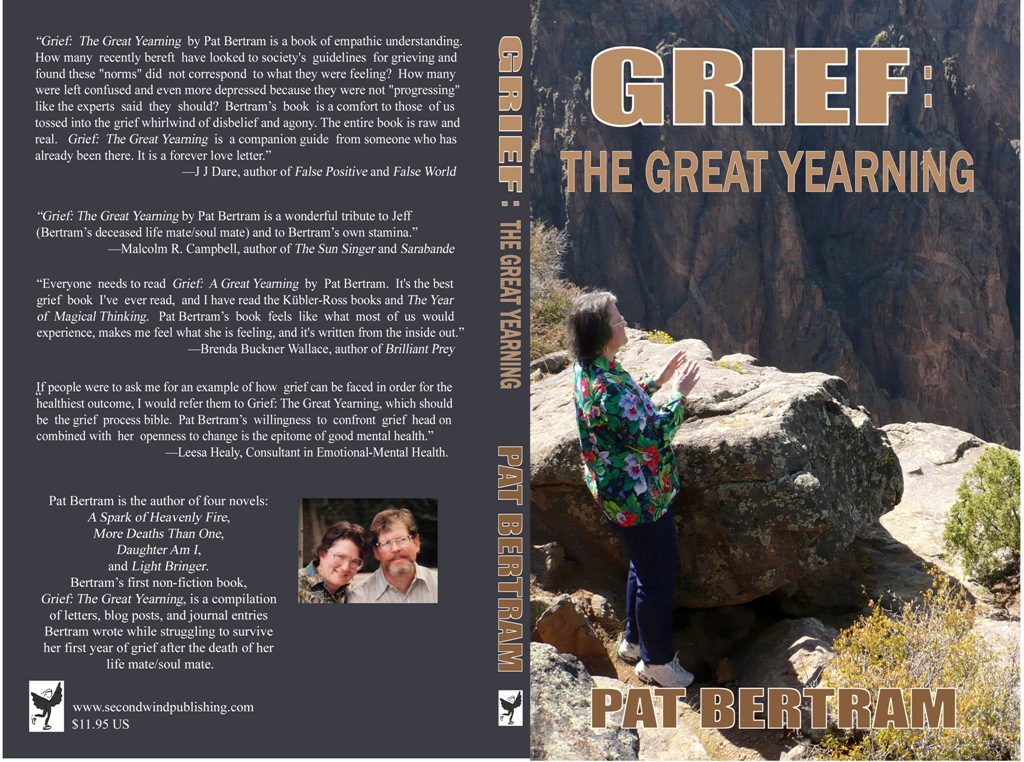
Grief: The Great Yearning

Now that my grief for my lost soul mate is evolving away from a focus on all I’ve lost and the accompanying pain, I can see the process more clearly. Perhaps for some people the stages of grief — denial, guilt, anger, depression, acceptance — hold true, but for me and for most of the bereft I have met on this journey, those stages have little meaning. For most of us, anger and even guilt are more like quickly passing moods than lingering phases. Some of us get depressed, but most of us don’t. We’re just get damn sad, which is not the same thing as depression. I’ve been in that dark pit and I know what it’s like. This sorrow, no matter how intense, is not depression. And acceptance is not the end — in itself acceptance brings no peace. What does bring peace is feeling the grief and letting it evolve into something we can live with because the loss — the yearning — will always be a part of us. Getting to that point can take years, depending on the depth of the relationship.

Grief is an incredibly complex state that constantly changes and constantly brings changes. The underlying emotion of grief is yearning, not guilt or anger. Even after we’ve put our shattered psyches back together as best as we can, even after we’ve come to an acceptance of our new situation, the yearning to see our loved one last time can be overwhelmingly painful at times. The yearning (such a mild word for the ache or craving or hunger that tears at us) is often manageable, other times it shoots through us like a geyser bursting out of calm waters. Even decades after losing a spouse, or so I’ve been told, we bereft still feel the loss, still yearn for our mates.

A friend who lost her life mate four months after I lost mine, told me how much she hates people telling her to “move on”. She’s not like me, spouting her pain into cyberspace for all to see. If you didn’t know she’d experienced such a soul-shattering loss, you’d never be able to guess it — she’s keeping her grief to herself lest it burden others. She’s taking care of her family. She’s accepting the responsibility for an aging parent. She made the holidays special for those around her. She’s writing. She’s even going out and having fun, or at least as much as is possible considering her situation. In fact, she’s doing all that she ever did, and doing it well. Yet people tell her to move on with her life. What else is there to move on to? Her grief in no way debilitates her. It’s simply a part of her life, this ache to see her mate one more time.

Searching is another major component of grief that is ignored in the “stages” concept. We bereft search for our mates in crowds. We cry out for them, especially at the beginning. We search for them in our dreams. Of course we know we won’t find them. This isn’t a mental aberration, and it certainly isn’t denial. It’s simply a way of coping with the unthinkable. How can our loved ones be gone so completely? It’s the goneness that confuses us, pains us. It destroys everything we always accepted about the world. (Of course we knew all lives end in death, but we didn’t KNOW it.) As the search for our lost one diminishes, we begin searching for ourselves, for our place in this new, unthinkable world.

It would be so much easier to deal with grief if we had a list of stages to go through and to check off as we experience them, but that simply isn’t the case.

So we yearn, and we search, and we go on living.

New Year, New Beginning?

I’ve never put emphasis on the new year because it’s a relatively arbitrary date. The calendar numbers change, but that’s all. It’s not a universal new beginning. The Chinese New Year this year is on February 3, the Jewish New Year is on September 28, and various communities in the Hindu religion have different dates — January 15, March 22, April 14, April 15, August 17, October 27. January 1 is not even the beginning of a new seasonal cycle. Nor is there any personal demarcation — no black line separates the old from the new. You carry the old year with you because you have the same problems, sadnesses, hopes, fears. In other words, you are still you. 

There is a newness to January 1, though, and that is the newness of a new day.  Unlike the year, each day is a new beginning. You wake up, and for a second everything is untouched — like new fallen snow — and you almost believe you can be anyone you want to be, do anything you want to do. Then the truth hits you.

Still, there’s hope, so I make daily resolutions instead of yearly ones. I have a list of a dozen do’s and don’ts that I would follow in a perfect world. I’m lucky to do about half of them each day, but it varies. Two days ago I did only a couple. Yesterday I did all but two. Today, of course, I resolve to follow everything on my list. The list includes such things as weight lifting and stretching, walking, writing, blogging, promoting, eating a big salad, drinking lots of water, staying away from sugar and wheat. As I said, in a perfect world . . .

Despite that, I did toast this new year, more as a symbol of newness than the reality of it. I’ve learned that since nothing seems important any more, I have to make something important every day. And toasting the new year seemed as good as anything to importantize.  (Yeah, I know — there’s no such word as importantize, but just for today —  this new day — there is.)

Building Hopes and Creating Dreams

And so ends the worst year of my life.

Last year was a time of soul-shattering loss, grief, and strange blessings. It was a time of despair and self-realization, transition and adjustment. But of course, you know all that — I’ve made no secret of my ordeal, chronicling every painful stage of my journey. Many people endure worse traumas than the death of a soul mate, and they continue living without whimpering, which has made me feel a bit self-indulgent and whiny with my grief bloggeries, yet that was never my intention. The impact of grief after a major loss seems to be one more thing that has been discounted in our discount culture, and I simply wanted to tell the truth.

Oddly, I still don’t know the truth of it. It seems unreal at times. Was I really that woman? That woman who watched a man slowly die, who wanted the suffering to end, yet whose love was so ineffectual she couldn’t make him well or take away a single moment of his pain? That woman so connected to another human being she still feels broken nine months after his death? That woman who screamed the pain of her loss to the winds?

I’ve always considered myself a passionless woman, so how can that woman be me? During periods when I don’t feel the weight of his absence (I never feel his presence, though sometimes his absence feels normal, as if he’s simply in another room), during periods of emotional calm, my stoic side rules, making my grief feel fake, as if it’s something I’m doing to make myself seem important. Yet other times the desperate need to go home to him, to see him one more time, claws at me, tearing me apart.

Making the situation even more unreal, I can barely remember what he looked like — I do not think in images, so it’s understandable (though distressing) that I have no clear image of him in my mind. Even worse, I don’t have a photo that matches what I remember of him. (The only one I have was taken fifteen years ago.)

Nor do I have a clear sense of time. Sometimes it feels as if he died just a couple of months ago. Sometimes it feels like years. The demarcation between our shared life and my solitary life was once so stark it was like the edge of a cliff. All I could see was the past and what I had lost. The living I have done in the past nine months has blurred that edge, adding to the sense of unreality.

I have learned much this year. I learned the importance of importance. If there is nothing of importance in your life, you have to find something and make it important. I learned the importance of goals, even if it’s only the goal of getting through one more day. I learned the importance of hope, though hope for what I still don’t know, but that is part of the journey – building hopes, creating dreams, finding reasons to live.

And so begins a new year.

I Am a Nine-Month Grief Survivor

Thirty-four years ago, I walked into a health food store, and my world was never the same. It wasn’t love at first sight, this first time I saw the man with whom I would share more than three decades of my life. It was a primal recognition. Something deep inside me, something beneath consciousness, wailed, “But I don’t even like men with blond hair and brown eyes.”

I had no expectation of ever spending my life with this radiantly wise and intelligent man. It was enough to know he was alive. The world, which had seemed so inhospitable, became a place of hope and possibilities simply because he lived. Over the months our connection grew, and gradually our lives became entwined.

It confused us at times, our connection. Neither of us were particularly romantic, and we didn’t bring each other fairy-tale happiness. But we were together, and in the end, as at the beginning, being together was all that mattered.

But we aren’t together any more. Nine months ago, he died. And my world will never be the same.

I am doing okay — can even go for a week or two at a time without a major grief attack — but I still feel as if parts of me are missing. Grief shattered me, and I’ve put the pieces back together as best as I can despite those missing pieces. I now get glimpses of hope, of possibilities, of building a new life for myself. I know  there will be times of overwhelming grief and times of peace, times of sorrow and times of gladness. But he isn’t here to share those times. That I cannot comprehend.

Until I became one of the bereft, I thought grief was self-centered and self-pitying, and there is some truth to that. I do feel sorry for myself at times, but mostly I struggle to comprehend the meaning of our connected lives, his dying, and my continued life. I struggle to accept that while (perhaps) there is a second chance of happiness for me in this life, there is none for him. I struggle to understand his goneness. Sometimes the need to go home to him overwhelms me, and I have to learn — again — that his being gone from this life means I can never go home. He was my home. Someday I might learn to find “home” within myself, but until then, I am adrift in a world that once again feels inhospitable.

During those first days and weeks of struggling to survive grief, I kept screaming to myself, “I can’t do this.” I still feel like screaming those words occasionally, but I have learned that yes, I can survive this, because I have. And I will continue to survive.

A Gift For You!!

Wishing you a warm and safe holiday weekend and a new year filled with possibilities.

 Click on the gift to open. Have fun!

The Gift of Possibilities

I have been given a very special and unwelcome gift this year — the gift of possibilities.

Thirty-eight weeks ago my life mate — my soulmate — died. During the previous few years, the constraints of his illness bound our lives, and it felt as if we were doomed to an eternity of decreasing possibilities. Every day he became weaker, could do less, had fewer options. We could not plan for our future, knowing each day was all he might have. We could not even spend much time together — it took all his strength and concentration just to make it through another hour.

And so we lived. Waited.

His death brought enormous changes to my life, but during these months of grief, I have focused on the  impossibilities. It is impossible for him to come back to me and it’s impossible for me go home to him. It’s impossible for us ever to have another conversation, watch a movie, play a game, take a trip, start over in a new location as we so often did during our decades together. It’s impossible for me to stop missing him, impossible to conceive of living in a world from which he is absent. It’s been impossible, too, to concede that perhaps my life could be easier without him. What difference does that make when our being together was all that ever mattered to me?

And yet, and yet . . .

I am getting glimmers of myself now, myself alone. I no longer have the financial and emotional burden of his illness. I am no longer weighted down by my own grief, though it is still a part of me, and probably always will be.

I still feel as if I am waiting, but I’m beginning to feel as if I’m waiting for something rather than simply waiting, though I don’t know what I am waiting for. I do know that — slowly — the world of possibility is opening up to me again. I might not be able to do whatever I want — people are so wrong when they say anything is possible — but many things are probable when you’ve been given the gift of possibilities.

Win Free Books For A Year!

Everyone who leaves a comment on this post will be entered in Second Wind Publishing’s best contest ever — a chance to win a copy of every title Second Wind will publish in 2011.  (People outside of the United States will win ebooks. Those inside the United States can choose and either ebooks or print books.) This will include a copy of my upcoming novel Light Bringer, which is scheduled to be released in the spring of 2011. (Suzanne Francis, author of The Song of the Arkafina Series, and first person ever to read my new book said Light Bringer is “brilliant.” My favorite word!)

Light Bringer tells the story of  Becka Johnson, who had been abandoned on the doorstep of a remote cabin in Chalcedony, Colorado when she was a baby. Now, thirty-seven years later, she has returned to Chalcedony to discover her identity, but she only finds more questions. Who has been looking for her all those years? Why are those same people interested in fellow newcomer Philip Hansen? Who is Philip, and why does her body sing in harmony with his? And what do either of them have to do with a shadow corporation that once operated a secret underground installation in the area?

So be sure to leave a comment. If you don’t want to receive mailings from Second Wind about other promotions and new releases, let me know. You will still be entered into the contest. Also, three people chosen at random will win an ecopy of one of my published books — your choice! (Pick from the three on the right sidebar of this blog.) Both contests end at midnight on December 30, 2010.

Best of luck to all of you.

Letting It Be

My previous post chronicled my thought processes as I watched the video “Let It Be” that is making the rounds. As I said in that bloggery, At first I thought that perhaps this was the answer to my confusion over the death of my mate of thirty-four years. Just go on with my life and let it be. Forget my grief. Forget the pain of losing him. Forget trying to make sense of it all. Just . . . let it be.

When I first wrote that a few days ago, something in me let loose, and though I claimed I did not want to let it be (whatever it is) I haven’t been the same since. At least not exactly the same. I still had my usual Saturday upsurge of grief (preceded by a late night — I don’t seem to be able to go to sleep until after 1:40 am on Friday night, the time of his death) but I felt sad rather than soul-broken. I’ve even had a few moments when I could actually feel glimmers of life.

I can’t forget my grief or the pain of losing him, though both are slowly diminishing. And I can’t stop trying to make sense of my life. That’s who I am and always will be — a truth seeker. But I can let go of trying to make sense of his life.

It has haunted me all these months — the dual vision of the young radiant man he was when we met and the skin-covered skeleton he’d become. Were all those years of illness worth living? He was often in pain and wanted to be done with life, yet he kept striving to live until the very end. I remember those last years, months, days, and I still cry for him and his doomed efforts. But he doesn’t need those tears. His ordeal only lives in my memory. And that is what I am letting be. It is not for me to make sense of his life or his death. It is not for me to keep suffering for him now that he is gone.

A fortune cookie I read the other day said, “Cleaning up the past will always clear up the future.” Much of my grief has been about cleaning up the past — coming to terms with small every day betrayals, with dreams that never came true, with leftover worries. I have cleaned up the past, gradually worked through those conundrums. What is left is the habit of dwelling on the past, and that I can let be. It does neither of us any good.

Will it clear up the future for me? Perhaps. At the very least, it will help me face the future. Whatever that might be.

Let It Be . . . Me

I know you’ve seen the video, everyone has. It’s been emailed and remailed, Facebooked and Twittered, blogged and Gathered, clogging cyberspace with the message: Let It Be. At first I thought that perhaps this was the answer to my confusion over the death of my mate of thirty-four years. Just go on with my life and let it be. Forget my grief. Forget the pain of losing him. Forget trying to make sense of it all. Just . . . let it be.

My second thought as I continued watching this very looooong and repetitive song (Sheesh! What was Paul McCartney thinking when he wrote it? Not much, apparently) was how my mate would have enjoyed seeing all those faces as they are today. We have so many of them in his movie collection, and they are always that age, the one they’d reached when they made that particular movie (such as a much younger Sherilyn Fenn in The Don’s Analyst or a very young and fit Steve Guttenberg in Surrender).

My third thought was let what be what? And that’s where the thoughts stalled — in a semantics word jam.

I finished watching the video, thinking nothing, just watching the parade of faces, but now I’m wondering if Let it Be is really a philosophy I want to embrace. It seems too accepting of life’s vagaries and not enough of . . . well, embracing.

The whole purpose of going through grief is to process the pain and the loss, to mend your shattered life and heart so that one day you can embrace life in its entirety once again. I haven’t dealt with all these months of tears, anger, frustration, emptiness, loneliness, pain, just to spend the rest of my life letting it be. I want to let it be me —  the one who’s strong enough not to have to simply let it be.

Grief: Loose Cannon on Deck

A loose cannon conjures images of a weapon wildly firing in all directions, but it actually refers to a cannon on the deck of a ship. Cannons needed to be lashed down, but in turbulent waters, cannons sometimes came loose and rolled around the deck. Their great weight (some weighed as much as 1800 lbs!) made those loose cannons a dangerous liability and they could crush a hapless sailor who got in the way.

That’s exactly the way grief feels. Every time you feel as if you’re getting a solid footing despite the turbulence of your new life, whack! That cannon comes loose and crushes you again.

It would be so much easier if the so-called stages of grief were actually stages that you can check off after you’ve experienced it. Denial. Check. Pain. Check. Anger. Check. Depression. Check. Acceptance. Check.

All done, right?

Wrong!

After you’ve gone through the list, there it comes again, the pain or the anger or the disbelief that he is gone, and you have to do it all over again. Add to that the innumerable stages that aren’t commonly known such as isolation, anxiety, low self-esteem, confusion, panic, frustration, hopelessness, loneliness, bitterness, missing the person, fretfulness, hanging on, waiting for you know not what, and dozens of others. Not everyone who has experienced a significant loss goes through all the stages, but no matter what, we’ve all felt that loose cannon and wish we could just tie the dang thing up and get on with our lives.

So we do.

And then, comes another storm, there’s that loose cannon again.

Can you sense the pettishness of my tone? Must be another stage I’ve never heard of. Well, check this one off, too.