Hesitating

The demise of Adobe Flash Player made my old web builder defunct, so I’ve had to create a new website using a more current web builder. Although intimidating at first, the new web builder was actually easy and fun and intuitive. (I prefer intuitive programs because I don’t have to watch boring videos or read long articles of instruction. I can simply . . . do.)

Now, to the best of my knowledge, the new website is finished. I just have to click “publish” for it to go live, but I hesitate to take that final step. I don’t know why. It’s not as if the world as I know it will end. The old site will end, of course, with no way to get it back, but most of what was on there is posted in other places, so I can recover any information I inadvertently leave off the new site. And I can always redo the new site if I need to make changes.

But still, I hesitate.

Partly, I don’t want to have to go through the site once it’s published to make sure I did everything right. I’ve read through everything so many times that I’ve developed a blind spot for those words. Partly (even though this justification of my procrastination is something I just now thought of rather than a real reason for delaying), the longer I wait, the fresher those words will seem and so I’ll be able to read them as they are rather than as I wish them to be. And partly . . . who knows. Stubbornness, maybe, or contrariness. Although I like the new site better than the old one — it’s much more professional and easier for people to use — I’m still being forced to change, and I don’t like the feeling of being herded.

So I hesitate some more.

I’d considered pausing here and hitting the “publish” button so I could brag that I did it, but . . . well, I didn’t.

Maybe this weekend I’ll gather the courage to publish my new site. Or not. We’ll see.

***

“I am Bob, the Right Hand of God. As part of the galactic renewal program, God has accepted an offer from a development company on the planet Xerxes to turn Earth into a theme park. Not even God can stop progress, but to tell the truth, He’s glad of the change. He’s never been satisfied with Earth. For one thing, there are too many humans on it. He’s decided to eliminate anyone who isn’t nice, and because He’s God, He knows who you are; you can’t talk your way out of it as you humans normally do.”

Click here to buy Bob, The Right Hand of God

Note to My Grieving Blog Visitors

During the past ten years and ten months, ever since the death of my life mate/soul mate, I have been writing about my grief. My grief. Not yours, not anyone else’s. Mine. Many people find comfort in reading about my struggles to live with my grievous loss. Others find resonance with what they are feeling. But whether my grief posts strike a chord with you or not, they are ultimately my thoughts, my feelings, my attempts to make sense of my life both before he died and afterward.

I am not a therapist. I am not an expert. I have no degrees. I have only my own experience of grief to guide me through the chaos, and I don’t pretend to anything more.

I don’t object to your reading what I write; after all, that’s why I post my thoughts on a blog rather than in a private journal. I don’t object to your printing out a blog or two to take to your therapist (as many have) so that the therapist can understand more about the grief experience.

I do object to your chastising me. If you don’t like something I write, if it doesn’t make sense to you at your grief age (how long it’s been since your spouse died), it might in later years. Or not at all.

My experience strikes a chord with many people who have lost “the one,” which made me realize how un-unique my grief is. But although grief is universal, how we express it isn’t. Some people get sick. Some get angry. Some scream. Some cry for months on end. Some do all of those and more.

If you’ve lost someone dear to you to death, chances are I know how you feel. And you know how I felt and still sometimes do feel. Empathy works both ways. I don’t castigate you when you disagree. And you shouldn’t castigate me. I am not the voice of your grief. What I say changes nothing about what you are experiencing.

Often over the years when people were less than kind, I wondered if it were time to pack it in, but enough people find my words and my story inspiring that I keep going. But I don’t have to continue to write updates about grief and what I’ve learned. I don’t get paid for this. It’s not a job or even an obligation. I do it because I feel, I think, I empathize, and I write. It’s who I am.

I’ve written close to a million words about grief. I’m sure I’ve shed a pint of tears if not more while doing so. I certainly don’t need anyone to add to my grief. I always apologize for inadvertently wounding people because I am sensitive to people’s feelings, but there really is no need for my apology. I don’t set out to hurt anyone or even to help anyone. I simply feel it’s important to tell what grief is like — my grief, anyway — rather than what the so-called experts think it should be. If you don’t like any of my words, so be it. It’s not a personal affront. I don’t even know you, though if you’ve read many of my posts, you know me.

So think about that before you rail against me. If I had stopped writing about grief the first time someone told me how wrong I was, either by what I wrote or that I continued to write about grief long past the first few months, thousands of people would not have found the comfort they need, the understanding they sought, the courage to continue living another day.

Neither would I. And probably, neither would you, otherwise you wouldn’t have come here to read about my grief.

***

Pat Bertram is the author of Grief: The Inside Story – A Guide to Surviving the Loss of a Loved One. “Grief: The Inside Story is perfect and that is not hyperbole! It is exactly what folk who are grieving need to read.” –Leesa Healy, RN, GDAS GDAT, Emotional/Mental Health Therapist & Educator

Free Samples!

If you’ve been wondering about my novels but have been afraid to take a chance on buying a book, below are the links to all the first chapters.

I hope you will take a peek.

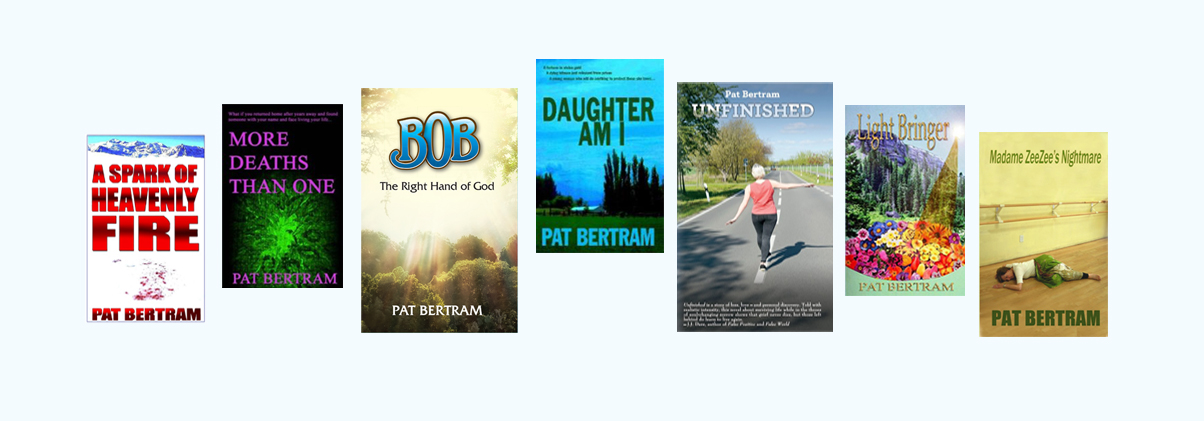
Bob, The Right Hand of God (Absurdist, Urban fantasy)

Unfinished (Drama, mystery)

Madame ZeeZee’s Nightmare  (Mystery, Dance)

Light Bringer (Suspense, Science Fiction)

Daughter Am I (Mystery, Road Trip,)

A Spark of Heavenly Fire (Drama, Suspense)

More Deaths Than One  (Thriller)

All books are available on Amazon: https://www.amazon.com/Pat-Bertram/e/B002BLUHUY/

Searching for a Tagline

I’ve been struggling with my new website, and I’ve mostly learned how to use the website builder, or at least as much as I need to know for right now. I’ve pretty much set up the bones of the site; now it needs to be fleshed out with information about me and my books. The book part, while time-consuming, is easy. It’s just a matter of coping and pasting the blurbs and such that were on the old website.

The “about” needs to be updated. I can no longer brag about being a nomad as I did in the previous bio since I am as unnomadish as a person can get — the furthest I’ve been from home in the past few months is a mere handful of miles. But the bio is really just a matter of finding something to say about me. Whatever it is, it won’t be on the homepage; people will have to go looking for it, so it doesn’t have to be as catchy as some of the other parts of the website, such as the tagline.

Taglines are hard. You have to give the essence of your books or yourself in a matter of a few words. This morning I woke up thinking that “Author of provocative fiction and profound works of grief” would be good, but a few hours later that tagline seemed as if it would be too off putting for people who are simply looking for a bit of information about grief. Of course, search engines wouldn’t be sending them to my website for such information — they’d send grievers to one of the grief posts on my blog. Chances are, the only people who would end up at the website would be those who were specifically looking for information about me.

More importantly (to me anyway), I’m trying not to second guess myself too much and to stick with the first ideas that come to mind. Still, I want to hook people into staying, not push them away with pedantry.

So, what about “Author of intriguing fiction and insightful works about grief”?

Originally, I just used, “Author of fiction and non-fiction,” but that is boring and uninspiring to say the least.

If you have any suggestions for a tagline, I’d be glad to hear it.

***

Pat Bertram is the author of Grief: The Inside Story – A Guide to Surviving the Loss of a Loved One. “Grief: The Inside Story is perfect and that is not hyperbole! It is exactly what folk who are grieving need to read.” –Leesa Healy, RN, GDAS GDAT, Emotional/Mental Health Therapist & Educator

Too Many Days

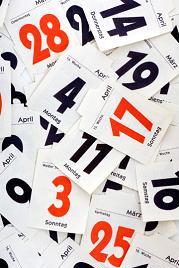
The past couple of years, I couldn’t find a calendar, not even one for sale in the stores I frequented, so I downloaded a calendar template and printed out my own calendar. It was a nice simple calendar with large enough blocks for writing notes. Since it was just plain paper, not glossy, I was able to use a pencil, which I prefer because of its erasability. (My spell check does not like that work and keeps changing it to eras ability, whatever that means.)

I went ahead and printed out a calendar this year, and then I got a couple of calendars in the mail. And then another. And yet another. I’ve lost track of how many calendars I have, but I feel the weight of all those days.

With a single calendar, each year has but 365 days. With a surfeit of calendars, it feels as all those days (365 per calendar) are stacked one on top the other. That’s way too many days for me to deal with!

I’m being a bit facetious here. I know that no matter how many calendars I have for 2021, there will still be only 365 days for the year, but I feel all those calendars reaching out to me, wanting to be filled.

But truly, one day per day is more than enough! Though that thought does lead to a story idea — some poor benighted character burdened with more than one day every day.

Luckily, I am not a character (except in my novel Madame ZeeZee’s Nightmare — I was a character in that book), and once I get rid of all those extra calendars, I’ll do fine living but one day each twenty-four-hour period.

***

Pat Bertram is the author of Grief: The Inside Story – A Guide to Surviving the Loss of a Loved One. “Grief: The Inside Story is perfect and that is not hyperbole! It is exactly what folk who are grieving need to read.” –Leesa Healy, RN, GDAS GDAT, Emotional/Mental Health Therapist & Educator

Moving On

The first time I’d heard the phrase “moving on” was a few months after Jeff died, and thereafter I heard it frequently.

Although people often think they are helping by urging grievers to get over it and move on with their life, they are merely showing that they themselves can’t handle the griever’s grief; showing that they can’t handle the new person the griever is becoming. Friends and family want grievers to be the way they were before their loss, and the griever can’t be. Loss changes you. Grief changes you.

Sometimes when people urge grievers to move on, they are not expressing insensitivity so much as a misplaced understanding of the nature of grief. (Which is why my book Grief: The Inside Story – A Guide to Surviving the Loss of a Loved One was written both for grievers and for anyone who wants to understand this thing we call “grief.”)

The truth is, grieving is how we “move on.” Grieving for a spouse is a process, a process of change from a person with a mate and shared life to someone who can deal with the absence, loss, aloneness.

“Moving on” or “moving forward” isn’t just used about grief. It’s used for almost everything, and one of these phrases frequently shows up in tarot card interpretations, such as the card I picked today that is supposed to be about overcoming fears and boldly moving forward. The phrase also appears frequently in novels and in discussions about writing, such as moving the plot forward, or the characters moving on from . . . whatever.

All of sudden today it struck me that I don’t even know what that means. “Moving forward” seems to connote a linear path, which might work for writing, given that the plot has to go from beginning to a satisfying end, but in life, there truly is no forward movement except that which we impose on our lives, such as time or age or career success or even traveling. We feel like we’re moving forward when we walk or drive somewhere, but that’s mostly an illusion. Unless we are permanently moving to a new house or new property, we eventually return to where we started, so that turns out not to be a forward motion at all.

The universe seems to be built more on circular motion, atomic particles and heavenly bodies are always in motion, orbiting around each other, making their way around empty space, but not really going anywhere because if there is not really a “here,” there can’t be a “there” to move on to. It seems as if motion is important, but not necessarily forward motion. For all I know, we could be moving backward, and it is just the way our brain interprets things to make it seem as if we are moving forward.

A kaleidoscope comes to mind. If all the energy that ever was exists today, then a turn of the scope brings us to what seems a different place, but is really all the same place. Karma and the idea that what goes around comes around also connotes a circular life. As does a gyroscope.

A tarot card I randomly picked twice in the past three days was about fluctuation and change. It suggested that a person who is in harmony with her life is one who can adapt to all the changes that comes her way, and keep on moving, Like a gyroscope that only holds its position when it is spinning,

But not “moving on”. Just “moving”.

Assuming we are supposed to be moving on, moving forward, moving toward something, where are we supposed to be going? Well, death, we are all moving inexorably toward death, since death is our end on this earth, but is that really a forward movement? After a certain age, it seems more as we are being pushed rather than moving on our own initiative. But other than that, what are we supposed to be moving toward? Enlightenment, maybe, though that brings up the issue of what is enlightenment.

In the case of grief, even though I am not actively grieving and haven’t been for a long time — I seldom even feel nostalgic anymore — I never actually “moved on,” never “got over” it. It’s more that the loss became subsumed into the very fabric of my life.

Admittedly, I might simply be sensitive to the phraseology because of all the people who used these words or variations of them to urge me to get over my grief, but they still seem to be rather meaningless terms no matter how they are used.

***

Pat Bertram is the author of Grief: The Inside Story – A Guide to Surviving the Loss of a Loved One. “Grief: The Inside Story is perfect and that is not hyperbole! It is exactly what folk who are grieving need to read.” –Leesa Healy, RN, GDAS GDAT, Emotional/Mental Health Therapist & Educator

Fifty Shades of Black and White

I’m reading Fifty Shades of Black & White: The Anatomy of the Lawsuit behind a Publishing Phenomenon, written by Mike Farris and Jennifer Pedroza, and published by Stairway Press. It took me a few pages to figure out what was going on, because although I knew there was a lawsuit concerning the Shades of Grey trilogy, I was under the impression it was Stephanie Meyers who sued the author of the trilogy for using her characters. But not so.

Fifty Shades of Grey started as fanfiction, taking a couple of Twilight characters and continuing their story. I’d never heard of fanfiction before that, but apparently, it’s a popular thing. I truly don’t understand how it’s legal to steal the characters someone else has created. Isn’t that plagiarism? I suppose it’s one thing to do it online in a group just for fun, but eventually, this particular author changed the names of the characters, published it, and went on to publishing fame. (I was going to say literary fame, but I once read a short excerpt and was appalled at the writing, to say nothing of the porn-ish subject matter.)

The myth surrounding the trilogy is that it was a self-published book that took off all by itself and ending up gleaning a multi-million contract with a big-name publisher. This was frequently talked about in groups where self-published authors hung out, because it gave them hope. After all, if one self-published author could make it big, why not them?

But that wasn’t at all true. She had a publisher. A small independent publisher, to be sure, but still a publisher. And that publisher spent a huge amount of money and time promoting the book.

And that was what the lawsuit was about — one of the publishing partners vs. the others, not between the author who created the characters and the author who also got rich off them. (Apparently, Stephanie Meyers was okay with that particular theft.)

Because these publishers had the book rights, when the book was sold to Random House, the women partners received multiple millions. Well, one of them did, anyway. She managed to keep all those millions for herself by lying and telling the others she was having problems getting the money from Random House. Eventually, a couple of the defrauded women found a lawyer who would take the case.

It’s sort of funny reading this book right now. I’ve been watching Judge Judy with the woman I help care for, and this book seem like an extension of one of those shows where friends ended up being enemies because one cheated the other out of money, but this case went miles beyond a small claims court. All I can do when watching one of Judge Judy’s cases is shake my head, and that’s all I can do reading Fifty Shades of Black & White. It simply stuns me that people can be so utterly without morals, without honesty, without dignity, without any sense of justice. If I were in that situation, I’d be so delighted with the immense riches from my share and glad that my friends also shared in the good fortune, that it would never occur to me to try to take it all.

But that’s what one woman did. And it never even bothered her.

She knew it was wrong because she tried to hide the money, forming a whole pyramid of businesses with her husband to deal with her ill-gotten gains. It shows to me the difference among people: some can do such things, justify it to themselves (or not — maybe they feel no need to justify their actions) and sleep well at night, others of us can’t.

I still remember when I stopped pointing out when a checkout clerk undercharged me. I felt like a thief, but I’d learned that it is even more complicated to right undercharges than it is overcharges, perhaps because they can’t believe anyone would be so honest (or stupid) to bring it to their attention. I can’t imagine what my life would be like if I had committed major larceny. Even if I had gotten away with it, I wouldn’t have gotten away with it, if you know what I mean.

Truthfully, I especially can’t imagine those numbers — the millions that were awarded to the small company for selling the rights to someone else’s work. Although I’d like to make it big and have to try to deal with such magnificent and munificent numbers, I’m really hoping I sell enough of my newest book to keep from embarrassing my publisher, the same Stairway Press that published Fifty Shades of Black & White.

***

“I am Bob, the Right Hand of God. As part of the galactic renewal program, God has accepted an offer from a development company on the planet Xerxes to turn Earth into a theme park. Not even God can stop progress, but to tell the truth, He’s glad of the change. He’s never been satisfied with Earth. For one thing, there are too many humans on it. He’s decided to eliminate anyone who isn’t nice, and because He’s God, He knows who you are; you can’t talk your way out of it as you humans normally do.”

Click here to buy Bob, The Right Hand of God

A SPARK OF HEAVENLY FIRE Embodies the Essence of Christmas

Washington Irving wrote: “There is in every true woman’s heart a spark of heavenly fire, which lies dormant in the broad daylight of prosperity; but which kindles up, and beams and blazes in the dark hour of adversity.” As I read these words several years ago, I could see her, a drab woman, defeated by life, dragging herself through her days in the normal world, but in an abnormal world of strife and danger, she would come alive and inspire others. And so Kate Cummings, the hero of my novel A Spark of Heavenly Fire was born. But born into what world?

ASHF

I didn’t want to write a book about war, which is a common setting for such a character-driven story, so I created the red death, an unstoppable, bio-engineered disease that ravages Colorado. Martial law is declared, rationing is put into effect, and the entire state is quarantined. During this time when so many are dying, Kate comes alive and gradually pulls others into her sphere of kindness and generosity. First enters Dee Allenby, another woman defeated by normal life, then enter the homeless — the group hardest hit by the militated restrictions. Finally, enters Greg Pullman, a movie-star-handsome reporter who is determined to find out who created the red death and why they did it.

Kate and her friends build a new world, a new normal, to help one another survive, but other characters, such as Jeremy King, a world-class actor who gets caught in the quarantine, and Pippi O’Brien, a local weather girl, think of only of their own survival, and they are determined to leave the state even if it kills them.

The world of the red death brings out the worst in some characters while bringing out the best in others. Most of all, the prism of death and survival reflects what each values most. Kate values love. Dee values purpose. Greg values truth. Jeremy values freedom. Pippi, who values nothing, learns to value herself.

Though this book has been classified by some readers as a thriller — and there are plenty of thrills and lots of danger — A Spark of Heavenly Fire is fundamentally a Christmas book. The story starts at the beginning of December, builds to a climax on Christmas, and ends with renewal in the Spring. There are no Santas, no elves, no shopping malls or presents, nothing that resembles a Christmas card holiday, but the story — especially Kate’s story — embodies the essence of Christmas: generosity of spirit.

When you are making out your Christmas lists, I hope you will include A Spark of Heavenly Fire. That should make both of us happy!

You can read the first chapter of A Spark of Heavenly Fire here: https://ptbertram.wordpress.com/free-samples/a-spark-of-heavenly-fire/

You can purchase the print book on Amazon: https://www.amazon.com/Spark-Heavenly-Fire-Pat-Bertram/dp/1630663662/

Did the Macaw Survive?

Someone wrote to me yesterday and said that Bob, The Right Hand of God was a cool book, but he felt bad about Rosemary and the scarlet macaw. Especially the macaw.

There really is no other interpretation of Rosemary’s fate than the one presented in the book, but I thought the macaw had a different end. Looking back, nowhere in the book does it say unequivocally what actually happened to the poor bird, though I had thought it’s fate could be assumed.

Apparently not.

I suppose it depends on if one believes what Bob says, and if one thought there were a stable environment where the bird could be sent, and if Bob were honorable enough to help the poor thing survive. All things that are debatable.

Now I’m curious. Do you think the macaw survived?

None of this, so far, spoils the story since these events took place toward the beginning of the book, so if you respond, I’d appreciate your not mentioning anything that might give away the story.

The book calls out for a sequel, the story of the next generation if nothing else, and your response would help me figure out if (a big if!) I were to write a sequel, whether I should include a mention of the bird or leave the poor thing to its ambiguous fate.

***

“I am Bob, the Right Hand of God. As part of the galactic renewal program, God has accepted an offer from a development company on the planet Xerxes to turn Earth into a theme park. Not even God can stop progress, but to tell the truth, He’s glad of the change. He’s never been satisfied with Earth. For one thing, there are too many humans on it. He’s decided to eliminate anyone who isn’t nice, and because He’s God, He knows who you are; you can’t talk your way out of it as you humans normally do.”

Click here to buy Bob, The Right Hand of God

Conundrums

I’m reading a thriller where several people are hunting for some sort of Jewish treasure that Columbus apparently took with him on his final voyage in an effort to protect the articles from the inquisition. The premise of the story is based on the theory that Columbus was a Jew who converted to Christianity as a way of avoiding being tortured and killed, and that his name was not Columbus. Columbus was his adopted Christian name, not his real name. Supposedly, he did not set out on his journey to prove that the earth was round or even to hunt for an easier route to the Spice Islands. He was actually looking for a place where Jews could live in peace, so his backers were predominately Jewish.

I was already aware of these theories, so that is nothing new. What the book did was make me think of what is going on in the world today with all the fights over statues and renaming of holidays.

Columbus Day was originally a New York holiday to honor Italian-American heritage. Franklin Delano Roosevelt made the day into a national holiday, and therein lies the problem, including that of a nearby city. A statue of Columbus resides in the middle of that city, a century-old memorial to its large Italian-American population, but a vocal element wants to tear down the statue, as if Columbus were personally responsible for all the ills of this country, which is silly. Columbus never even set foot in North America, and in fact, was only one of the many seafaring people who managed to cross the ocean, some even thousands of years previously.

The truth is, there are no Native Americans. All of us, even the American Aborigines, are immigrants from elsewhere. There are signs that people from all over the world, for hundreds, perhaps thousands of years, were enveloped into and contributed to the development of “native culture.”

The problem is not with Columbus but with an overpopulated world — at the time, the arable land in Europe was divided up and owned by the nobility. People with no other options needed a place to go to start a new life, and here was a whole continent (two continents, actually) where few people lived and harsh laws (except for the harsh laws of nature) had yet to take hold.

The wave of Europeans came decades after Columbus’s voyages, so none of that is to his credit or discredit. The times and a dying way of life were the real culprit.

Still, even if you believe the myth that Columbus discovered America, destroying statues of him (which aren’t really of him since no one knows what he looks like) is utterly hypocritical. If people think we are wrong for being here, they can always go back where they came from. Tearing down a statue, renaming a holiday, apologizing for things someone’s ancestors did (not mine — mine were still living in feudal countries and didn’t even come here until the twentieth century) in no way changes the past. No one is seriously considering making reparations and giving the country back to the Indians, and why should they? If the various tribes had been less obsessed with their traditional enemies and had banded together against the new one, they could have halted the population growth at the Mississippi River. At least for a while. But a time that has come, has come. There is no stopping it.

Which brings me to the whole idea of reparations. If the BLM has their way and they are granted reparations, who is to pay them? Those of us whose ancestors were not even here? That’s absurd. So who? England? After all, the slaves were first brought here when the area was still under control of England. And later, the slave area was under the control of the Confederacy. They could be paid with Confederate dollars; I’m sure there are plenty of such dollars in collections. And yet — signs of the Confederacy, such as statues, are being destroyed. If we’re writing history to erase the whole slave era, then who’s to pay? There’s no one left.

Sheesh. Here I’ve been doing so well staying away from the news and local issues and all the conundrums of our times, and an awful book brings me back. (Awful because there are too many separate stories and too much redundancy since each of the stories is basically a repetition — hunting treasure and killing people. Worst of all, huge portions of the book are in Italics, and Italics always tell me that particular portion is not part of the book and so I skip it.)

For my own peace of mind, I might have to give up reading, too.

***

If you haven’t yet read A Spark of Heavenly Fire, my novel of a quarantine that predated this pandemic by more than ten years, you can read the first chapter online here: http://patbertram.com/A_Spark_of_Heavenly_Fire.html

Buy it on Amazon here: https://www.amazon.com/gp/product/B0024FB5H6/

Download the first 30% free on Smashwords: https://www.smashwords.com/books/view/1842