A Breathtaking Piece of Folly

In 1953, a 44-year-old woman set out to walk for peace. She left everything behind, even her name, calling herself “The Peace Pilgrim.” When she hit 25,000 miles in 1964, she stopped keeping track, but she kept going for many more years. She was walking in response to a spiritual awakening, and she’d taken a vow to “remain a wanderer until mankind has learned the way of peace, walking until given shelter and fasting until given food.” A minimalist hiker, she carried only a pen, a comb, a toothbrush, and a map, trusting to those she met to supply what she needed, though she never asked for anything. Her pilgrimage ended with her death in 1981.

The Peace Pilgrim had a mission, one that people responded to (though sometimes the response wasn’t what you might expect. On at least one occasion, she ended up in jail on a vagrancy charge). But what about someone who just sets off without a mission? Would food, water, and shelter appear when needed? And wouldn’t it be a bit presumptuous to expect others to supply one’s needs?

On the home page of The Peacewalker Society, a group that existed to support another peace walker’s mission, is the quote, “Let go, trust and just take the first step. The path will unfold before you.”

Sounds to me like a recipe for death.

When I took my trip to hunt the wild poppy, I paid attention to the miles rolling past as if I were walking instead of driving, and that is when I realized the true foolhardiness of an epic walk. All I saw were miles and miles of windy, dusty, very hot roads with nothing to break the monotony. No water. No stores. No shade. It would have taken me many days of walking across that bleak landscape before I finally found what passes for an oasis in our modern world — a small shopping center with a convenience store, gas station, and fast food place.

That experience along with the reality of water tended to quash my idea of walking long distances.

And yet, and yet . . .

There the idea sits, like a toad in the back of my mind, waiting to leap at the first chance it gets. What would happen if I just took off? No heavy backpacks filled with water, food, and camping gear. No thoughts. No plans. Nothing but me and the next step.

Do I have the trust? Do I have the courage? And more importantly, do I have the mission? It’s that mission, I think, that keeps people going long after good sense tells them to stop. My life has always been about a quest for truth, and I imagine there would be much truth to be found on an epic adventure, but would truth be enough of a mission to fuel resolve?

O. Henry wrote, “The true adventurer goes forth aimless and uncalculating to meet and greet unknown fate.”

Makes me wonder — does a true adventurer take along a computer of some sort? At the beginning, The Peace Pilgrim kept a journal, but it was stolen, so she just wrote her life in the wind. But me, being an inveterate blogger, would need to post my thoughts, experiences, and photos online. Seems foolish — doesn’t it? — but then the whole idea is folly.

Still, as Mrs. Brown said in National Velvet, “I, too, believe that everyone should have a chance at a breathtaking piece of folly once in her life.”

Right now I still have responsibilities, but one day they will end. And then . . . perhaps it will be time for my own breathtaking piece of folly, whatever that might be

***

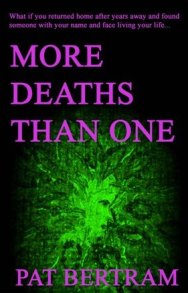
Pat Bertram is the author of the suspense novels Light Bringer, More Deaths Than One, A Spark of Heavenly Fire, and Daughter Am I. Bertram is also the author of Grief: The Great Yearning, “an exquisite book, wrenching to read, and at the same time full of profound truths.” Connect with Pat on Google+. Like Pat on Facebook.

Bad Luck?

I’ve never considered myself especially lucky. I don’t win contests, though occasionally I do come in second or third. (Most recently, I was a runner-up for the Sharp Writ Book awards in the category of science fiction for my novel Light Bringer.) In group gift exchanges, I always get the gift that no one quite seems to be able to identify or figure out what it does. I seldom win a door prize, and I’ve never won a raffle of any kind.

Today I attended a fundraiser witluckh friends. There were a couple of dozen gift baskets being raffled, and we got to choose which basket(s) we would like to win. I found one basket that only one other person had chosen, so I used all of my raffle tickets for that basket, thinking to up the odds. When I didn’t win, I laughed with my friend about my bad luck, but then on the way home I reconsidered.

Bad luck?

I’d driven to the event center in a 42-year-old car that still runs well, spent the day with good friends and other congenial people, shared smiles and laughter, ate a nice lunch, danced a bit, enjoyed playing with the raffle tickets, and on top of all that, got to help support a good cause.

Seems to me as if I’m very lucky!

***

Pat Bertram is the author of the suspense novels Light Bringer, More Deaths Than One, A Spark of Heavenly Fire, and Daughter Am I. Bertram is also the author of Grief: The Great Yearning, “an exquisite book, wrenching to read, and at the same time full of profound truths.” Connect with Pat on Google+. Like Pat on Facebook.

The Problem With Writing About People You Know

A few weeks ago when I was having lunch with friends from my exercise class, someone suggested that I write a book about the class. One lovely woman even volunteered to be a murder victim, and the teacher offered to be the murderer (or rather, she offered a motive for the crime that indicated she was the one who did the dire deed).

I thought it would be fun — write a chapter now and again, print it out, and let everyone read it. If they had suggestions about what they wanted their character to do, I could incorporate their ideas in subsequent chapters.

The more I got to thinking about it, though, the more impossible it seemed. The idiosyncrasies that make people unique, interesting, lovable are not necessarily traits they are proud of. In fact, they might not know they have the traits or if they do know, they might not realize that others see those traits. We always hope people see us as better than we see ourselves, and we certainly don’t want to know that someone might see what we wish no one saw. And even when we do know our floozyshortcomings, such as being overweight, I’m not sure we would take kindly to being immortalized in such a way. (Not that my books are immortal, but you know what I mean.)

Although the characters would be written without judgment, just a simple swish of a literary brush, these women might feel hurt, and I am not interested in hurting anyone, especially not people I’ve grown fond of. Now, if one of them had done me wrong, I would gladly put her in a book and kill her off, but so far the worst offense was . . . hmmm. Can’t think of anything except for perhaps a brief touch of cattiness.

Yesterday one of the women asked me about the project, and when I told her my dilemma, she suggested writing the book but using a different setting for the group. A rowing crew, for example. That way I could write the people as I saw them, and no one would be the wiser. “Except me, of course,” she said, “but you wouldn’t say anything bad about me.” The problem with her scenario is that I know nothing about rowing, and anyway, what is a rowing crew of no-longer-young women doing in the middle of the desert? (Though that could be a story in itself!)

I suppose I could hand out a questionnaire, asking the women if they would like to be part of the project, if I could use their real name and if not what name they would like me to use, and most importantly, how they would like to be described. I’d end up with a cast of wonderfully graceful, talented, brilliant, and beautiful characters of course, but there is truth in that. Despite their idiosyncrasies (or maybe because of them), despite their aging bodies and physical limitations, they are all in their own way, wonderfully graceful, talented, brilliant, and beautiful.

One problem is that each of these wonderfully graceful, talented, brilliant, and beautiful women would have to have larceny in her heart since each would be a suspect with a dark secret she is trying to hide, and that could lead to confusion about how I actually perceived each of them.

The main problem, of course, is that if I figure a way around all the other problems, I might actually have to write the dang thing.

***

Pat Bertram is the author of the suspense novels Light Bringer, More Deaths Than One, A Spark of Heavenly Fire, and Daughter Am I. Bertram is also the author of Grief: The Great Yearning, “an exquisite book, wrenching to read, and at the same time full of profound truths.” Connect with Pat on Google+. Like Pat on Facebook.

Break Time is Edited and De-Widowed!

I wasted all afternoon getting rid of widows in the Break Time manuscript, the steampunk anthology I wrote with several other authors. Well, not all the widows. My character is a widow, and I can’t get rid of her. The widows I tried to get rid of are the printing variety. The problem is, when you get rid of one of those sneaky little things, another one or two pops up.

To be honest, I don’t see that there is a problem with widows. Break TimeWidows are the last couple of words of a paragraph that end up at the top of the next page. Truly — so what? I can see that there is a problem when the last few words of the last paragraph of a chapter end up on a page all by themselves. The words seem so . . . lonely. Besides, it would be be like a stop sign, taking readers out of the story. But if a second paragraph begins immediately after the widowed words, who but a purist would even care? And anyway, with ebooks so prevalent, there are no pages, so there can be no widows. Break Tiime will be published as both a print book and an ebook, however, so apparently, widows are a consideration.

If it were just a matter of fixing one or two such problems, that would be fine, but if you alter the formatting so that the widow disappears, it alters the formatting for the rest of the chapter or story, moving the lines around and creating new widows. So you have to fix the new problems, which creates more widows . . .  and the next thing you know, the entire evening is gone. Wasted.

That’s the problem with editing — ripples. Anything you do ripples through the whole manuscript. Still . . . we have all done the best we can with Break Time. It’s as good as all its editors can make it.

So . . . hallelujah! Break Time should be ready on its scheduled release date — May 1.

***

Pat Bertram is the author of the suspense novels Light Bringer, More Deaths Than One, A Spark of Heavenly Fire, and Daughter Am I. Bertram is also the author of Grief: The Great Yearning, “an exquisite book, wrenching to read, and at the same time full of profound truths.” Connect with Pat on Google+. Like Pat on Facebook.

 

Are You Lazy? Am I?

There are hundreds of laziness tests on the internet that will tell you how lazy you are, that is if you’re not too lazy to take the tests. A Facebook friend recently took one such test and posted it on his profile. He commented, “Some of the choices are disgusting!” And he is right. Some of the choices are disgusting — it’s amazing to me that anyone thought of putting them on a list, let alone considered doing such things. The test seemed more an indication of how much of a slob you are than how slothful you are.

But . . . (you knew there would be a “but”, didn’t you?)

The test made me think about what laziness really means. According to my dictionary, “lazy” means “disliking activity or exertion; not energetic or vigorous.” It comes from the Middle Low German word lasich meaning “feeble.”

To us, laziness has negative connotations. When we say someone is lazy, we are generally referring to an able-bodied person who has the ability do a task but doesn’t. The word itself, however, has no such pejorative meaning. Just because people dislike exerting themselves, it doesn’t mean that they won’t. And just because people like to be involved in activities, it doesn’t mean that they will. And anyway, who is to say that disliking exertion is wrong? You don’t always have a choice in what you like or dislike. Besides, the whole thrust of human invention has always been about making things easier for us rather than harder.

napIf you are in a communal situation, such as a marriage, a family, a job, it is necessary to keep up your end of the work, but failure to do so isn’t necessarily because of laziness — it could be a sense of entitlement, insensitivity, or thoughtlessness. But if no one is depending on you, who is to say what is laziness? If you’re not engaged in any activity, but don’t need to be, what is wrong with lolling around doing nothing? Who says we have to fill our days with activity? I consider myself lazy because I am not currently working on a novel, but why should I write? Just because I can? At the moment, writing won’t improve my life, won’t gain me recognition or riches. It will simply use up time, and for now, I am using my time for more physical pursuits. (Oddly, the idea of my laziness — my lack of energy — is so ingrained, I don’t consider myself unlazy while doing these various physical activities.)

Not everyone has the same level of energy. Some of us are “not energetic or vigorous” by nature. We have to push ourselves through life, one trudge at a time. Others shoot through life like rockets, spewing excess energy to the winds. If the low-energy person is resting from his/her exertions while the high-energy person is still zooming around getting things done, why is the first person considered lazy? Both are doing what their natures dictate.

It seems to me that there isn’t really such a thing as laziness. For example, people who scam the welfare system in the USA are often considered as being too lazy to work, but the system is so laborious that many people who are eligible do not have the energy to deal with the bureaucracy. Those who do know how to work the system in nefarious ways are not lazy — they are awash in a sense of entitlement that borders on fraud.

If we can do something but don’t, if we choose to stay in bed instead, it could be that we aren’t lazy so much as that we need the rest. Despite all the machines that have been invented to make our lives easier, our lives are stressful. If someone repeatedly hits the snooze button in the morning, it might not be a sign of laziness but of exhaustion.

More than that, what we call laziness seems to be lack of motivation rather than a true disinclination to work. We almost always find the time/energy to do the things we love if the rest of life doesn’t get in our way. (To most of us, work is what we don’t want to do. The lucky ones are those who get paid for doing what they want to do. Tests have shown that if people are allowed to work on whatever project they wish when they are at their jobs, they are happier, more productive, and work longer hours. If they have to work on a project that is assigned, that they have no affinity for, then their job suffers.)

We get out of bed on Saturday if the sun is shining and we are going for a run/walk/hike/picnic — anything that’s fun. If only bad weather and detestable chores await us, we have no motivation for getting out of bed, so we stay there. And what is wrong with that? Again, I am not talking about a communal living situation such as a family. In that case, it’s only fair to do your share of the chores. But if no one is depending on you, it makes no difference if you wait a few more days to clean the house or do laundry.

Perhaps I’m wrong in my assessment about laziness, but I’ve decided to strike the word from my vocabulary anyway. No more laziness. If I have no inclination to do a chore, then I’m gathering my strength. If I have no desire to write, then I’m letting my ideas steep. If I have no will to exercise, then I’m giving my muscles a rest.

Works for me.

***

Pat Bertram is the author of the suspense novels Light Bringer, More Deaths Than One, A Spark of Heavenly Fire, and Daughter Am I. Bertram is also the author of Grief: The Great Yearning, “an exquisite book, wrenching to read, and at the same time full of profound truths.” Connect with Pat on Google+. Like Pat on Facebook.

Things That Will Always Make Me Cry

I recently came across an article “100 Things That Will Always Make Us Cry!” The list seemed to be geared for young people (it was on a site for students that included modern translations of Shakespeare and synopses and analyses for various “required reading” books.) Even if the site wasn’t so obviously scholastic, I would have known the list wasn’t meant for me — I didn’t recognize most of the items, and those I did recognize have never made me cry.

The cultural things that do make me cry (as opposed to real life things that make me cry, such as the thought that Jeff, my life mate/soul mate is dead and that is why I will never again see him here on this earth) are meetings and leavings.

When two people get togetheLooking at eternityr in a book or movie, no matter how disparate or desperate the mating, that makes me cry. It reminds me that never again will I get together with Jeff. “The end” has been written on our love story.

What makes me cry even more is a shot of someone walking away. Remember that old TV series, “The Incredible Hulk”? The end of every episode was the same — a shot of Bill Bixby walking away. That always got to me. And now, any scene with someone walking away makes me weep because it reminds me of my loss.

During my first months of grief, I came across a photo of Jeff I didn’t know I had. For a long time, even though it made me cry, it was the only photo of him I could look at, perhaps because it didn’t show his face. (The one photo I have that shows his face doesn’t look at all like he did at the end, which bothered me back then, but now I’d just as soon remember him the way he looks in the photo — handsome, radiant, alive.) What really made me cry over this photo is not just that he seems to be disappearing into the earth but that he’s facing the distance, as if he were already heading away from me to his destiny with eternity.

Yep, walking away.

That always makes me cry.

***

Pat Bertram is the author of the suspense novels Light Bringer, More Deaths Than One, A Spark of Heavenly Fire, and Daughter Am I. Bertram is also the author of Grief: The Great Yearning, “an exquisite book, wrenching to read, and at the same time full of profound truths.” Connect with Pat on Google+. Like Pat on Facebook.

I Do Not Want to Blog About . . .

There are so many things I do not want to blog about today.

I don’t want to write about my father and his continued decline. Anyway, there’s not much to say. He’s doing exceptionally well for 97, but still, he is 97 and has congestive heart failure, hearing problems, and isn’t thinking as clearly as he did just a few months ago.

I don’t want to write about my future plans. (Yeah, I know — “future plans” is redundant since “plans” connotes the future, but in this case I’m talking way in the future, not what I plan to do tomorrow or next week.) The truth is, I have no plans, just dreams. Although I like the idea of roaming the country on foot, the realities are bleak (lack of water sources, possible health issues, inexperience). I also am getting uncomfortable talking about what I’m going to do after my father’s death, as if I’m trying to hurry him out of this life, though the truth is that he could be gone in an instant, and just like that (a snap of my fingers), I’d be homeless. I’d be foolish not to consider my options. But not today.

I don’t want to write about my homeless brother who is camping out in my father’s garage. (It sounds mean, but it’s the best my father can do for him. He is too dysfunctional to live in the house — he creates havoc, and my father wants/needs peace. Besides, if my brother were to live in the house where I had no protection from him, I would leave here.) Said brother is going through one of his manic phases, which means he is intolerable, demanding, insanely vocal, and very needy. I can’t fulfill any of his needs at such times, especially not the one he most wants — awed respect.

I certainly don’t want to write about his legal problems. He was arrested for being intoxicated in public a few months ago, didn’t show up for the court date, and now there is a warrant out for his arrest. When they catch him (because of course he won’t call the courts to get the matter straightened out as the deputy who made the courtesy call suggested), he will expect me or our father to pay his $5,000 bail. I won’t do it, and I sincerely doubt our father will. Besides, as much as I hate the thought of him in jail, I hate even more the thought of him here bedeviling me. I could use the rest. (As I was writing this, I got a phone call from him. He’s been arrested again for being intoxicated in public, but for some reason they waived bail, just gave him anther court date for both charges. I so could not handle being an alcoholic! Way too much work.)

I don’t want to write about grief and the death of my life mate/soul mate that precipitated my move here to look after my father and more recently (and very unwillingly) to do what I can for my brother. I’ve said about all there is to say about grief. It comes. It stays. What else is there to say? Well, I could say I’m mostly happy now which is true, but he’s still gone. I will never be happy about that until I’m gone too.

I don’t want to write about writing, my fallback topic. With self-publishing and we’ll-publish-anything-presses so prevalent, making authors believe they can write however they wish, there’s no reason to discuss right ways to do things. (Despite what most authors seem to believe nowadays, there are right ways. I just don’t feel like fighting about it anymore.)

Nor do I want to write about my aches and pains. I especially don’t want to talk about the gum infection that has me on high doses of antibiotics. (And probably why I’m not exactly overflowing with joy today.) The good news is that if I have any other infections, susunflowerch as strep or pneumonia, those microbes will be killed along with whatever caused my gum infection. The bad news is side effects. At least so far, all I’ve had to deal with is nausea. I haven’t developed a black furry tongue. (Fingers crossed here.)

While trying to think of a suitable ending for this blog post about what I don’t want to write about, I stopped by Facebook and clicked on a link for a test to see what flower I am. The results said: “You are a sunflower. You are the eternal optimist, always looking up. Nothing can shake your sweet, happy spirit. Friends enjoy your company because they find your joy contagious.”

Yep. That’s me today. Sweet, happy spirit. Contagious joy.

Gotta love the irony!

***

Pat Bertram is the author of the suspense novels Light Bringer, More Deaths Than One, A Spark of Heavenly Fire, and Daughter Am I. Bertram is also the author of Grief: The Great Yearning, “an exquisite book, wrenching to read, and at the same time full of profound truths.” Connect with Pat on Google+. Like Pat on Facebook.

To Blog or Not to Blog

Every day we are faced with large decisions and small — decisions that make the difference between life and death, decisions that only make the difference between being lazy or productive. (Though who is to say that being lazy is unproductive. We often get our best ideas when we are lolling around, thinking of nothing.)

My decision each day is to write this blog. Most days, the choice is easy. I generally have no lack of things to say. But some days, like today, I have to coerce myself to write something. I have nothing to say, no new insights, no plans or hopes — just a blank “paper” on my computer, and yet, here I am, filling the blankness.

I could, of course, simply not write anything, but I’m one of those people who by default does what takes the least effort. Once I stop making the effortasking to write, once I break the infallibility of a daily blog, then it’s all over.

You dieters know what I’m talking about. When you go on a diet and then “accidentally” nibble on a cookie, you figure the whole day is a waste since you broke your diet, and so one by one those cookies disappear. If you’d never sampled the cookie, you’d still be on that diet. Or if you’d done the logical thing you’d still be on the diet — you’d have enjoyed the nibble and continued on as if you’re still on your diet, because you are. One nibble does not break a diet. It’s all those subsequent cookies that do the dirty deed. Even worse, once the diet is broken, it’s almost impossible to get back on it.

It’s the same thing with blogging. As long as I make an effort to write every day, I will continue to write every day. But if once I slack off, then it’s all over. First one day will pass, then another, because why not? The world wouldn’t end if I neglected to post my words. In fact, the world might even be a better place. But after not writing one day, then the next, I’d begin to think about it, wondering if I wanted to write. As the days passed, I’d even forget to ask if I want to blog, and gradually I’ll sink into wordlessness.

I’m sure that will happen someday. Just not today.

***

Pat Bertram is the author of the suspense novels Light Bringer, More Deaths Than One, A Spark of Heavenly Fire, and Daughter Am I. Bertram is also the author of Grief: The Great Yearning, “an exquisite book, wrenching to read, and at the same time full of profound truths.” Connect with Pat on Google+. Like Pat on Facebook.

Rubicon Ranch: Riley’s Story — Review by Sheila Deeth

Rubicon Ranch is a collaborative trilogy that was written online by me and several other authors from Second Wind Publishing. We started out with the murder of a little girl, and though we never knew where we were going (the murderer wasn’t chosen until the very end) or what the other writers were doing, we actually ended up with a book that seemed as if it had been planned from the beginning.

Sheila Deeth, inveterate reviewer (she’s rapidly becoming one of Amazon’s top reviewers) and author in her own right (Divide by Zero, Infinite Sum, and Imaginary Numbers, are all coming soon from Second Wind Publishing) had this to say about Rubicon Ranch: Riley’s Story:

Rubicon RanchI read occasional chapters of this novel online while it was being written. But now, at last, I’ve been able to read the whole thing in one setting, and I thoroughly enjoyed it. Different authors pen chapters from the points of view of different characters. But the end of each tale meshes perfectly with the next, and the story progresses, through twists and turns (and death), to its mysterious, perfectly logical conclusion, while the reader is left to guess, imagine, wonder, and reflect.

The inhabitants of Rubicon Ranch are a mixed bunch, with accidental killers, accused pedophile, angry son, angry widow, and singularly dubious strangers staying at the local B&B. In classic Agatha Christie style, they might all have reasons to kill, and to hide, in a desert development where even the sheriff has his secrets. But which one, or ones, did the deed?

Feisty widow Melanie teams up, reluctantly, with the handsome sheriff. Seeing the world through a camera’s eye, and describing it with a writer’s sense of detail, she’s either the best at hiding her motives, or else she just hasn’t looked in the right place yet. Their tense relationship is fun, filled with promise for future books in a series that’s most un-traditionally written, but classically cool and enticing.

The desert’s pretty cool too—seriously hot, beautifully described, thoroughly genuine, and with snakes in the grass. I really enjoyed this delightfully traditional, thoroughly modern mystery.

Disclosure: I bought this when it was free and can hardly believe it took me so long to get around to reading it. —Sheila Deeth

You too can download a copy of Rubicon Ranch: Riley’s Story. Just click here: Rubicon Ranch on Smashwords to download in the ebook in the format of your choice. Or you can read it online here: Rubicon Ranch: Riley’s Story.

Or you can sample the first chapter here: Melanie Gray. Melanie Gray is my character, and is the character who connects all the books.

Gossip: Healthy or Destructive?

For more than three decades, I didn’t spend much time in the company of women. I didn’t plan it, it just sort of worked out that way. My life mate/soul mate and I did most things together, including work — trying to build our business. He was also my best friend, the person I most wanted to be with. We had wide-ranging interests, and we talked about life, books, movies, history, philosophy, ideas.

I knew some women, of course, but not well, and I never participated in any group activities. After his death, though, I got afternoon teainvolved with many people. I joined a grief support group, and we had plenty to talk about — our deceased loved ones, our many losses (we lost not just the person, but the life we shared, our hopes, plans, and a feeling of “home”), our pain, our slow rewakening to life, and ourselves.

It wasn’t until recently, when I started taking exercise classes and came in close regular contact with a group of women that I ended up in a situation I wasn’t prepared to deal with. Idle chitchat. Gossip. Talking about each other, especially about those who weren’t present.

At first, I didn’t think anything of it since the remarks weren’t malicious, but when I found myself making comments (nothing bad, just things another person had done or said to me) I began to feel uneasy. I’m no paragon, but I do like to do the right thing. Eventually I came to the conclusion that we’re women. We talk about people. It’s who we are. (Though studies have shown that men gossip just as much as women do.) I have no delusions of being exempt as a topic of gossip — I always figured that in my absence they talked about me, but it didn’t matter. It’s not my business what other people think of me. (Strange. I just realized that once I took the opposite tack, that it is my business.) In fact, after one lunch — yep, we often exercised then went to lunch afterward to replace more than the calories we burned — I had to leave before everyone else, and when I got up to go, I gave them a big smile and said, “Now you can talk about me.”

To be honest, we talk mostly about ourselves (though food is a strong second topic). The comments about others were quite remarkably sparse, perhaps because we spent most of our time togther concentrating on our movements. Talking about our families and absent friends was simply a way of passing inactive moments.

But the truth is, even if I thought there was anything wrong with the remarks, I would not have walked away. I found such talk compelling. Intriguing. Connecting. Privileged.

After coming to an accommodation with gossiping, I didn’t think anything more about it until a few days ago when one of the women called to let off steam about a reprimand she’d gotten that day, which she felt was uncalled for. Since I too was upset about something that happened in that class, we commiserated with each other at great length. I thought it was over and done with until today when she called to ask if I’d repeated a specific, totally innocuous remark she’d made during our commiseration. I hadn’t repeated her remark, but she was so upset, the call ended on a bad note.

As a result, I am rethinking my position. I want to try to stay away from any remarks about others, which sort of leaves a void in the conversation. Most people after or even during exercise have no interest in deep discussions of important ideas or significant events, (not even me, though at other times I’m all for such discussions), but I’m used to being quiet, so it shouldn’t be too much of a problem.

The idea of not being privy to insider remarks, however, has left me feeling bereft. Such conversations were so compelling, I can still feel the pull — a sort of magnetism — when I think of the exchanges (though to be honest, I can’t remember many of the actual remarks. They truly were innocuous and not at all malicious.)

I’ve spent the past few hours doing what I always do when faced with a conundrum — research, in this case, researching why gossip is so fascinating. (Not celebrity gossip — I have zero interest in such unimportant folk. Unimportant to me, anyway.)

According to an article in Psychologies Magazine, Gossip builds social bonds because shared dislikes create stronger bonds than shared positives. Two people who don’t know each other will feel closer if they share something mean about a third person than if they say nice things about them. It’s a way of demonstrating their shared values and sense of humour. Add to that the thrill of transgression, since we’re supposed to be nice and positive.

However much we may disapprove of gossip in theory, it’s very common behavior, says social psychologist Laurent Bègue. “About 60 per cent of conversations between adults are about someone who isn’t present, and most of these are passing judgement.”

Anthropologist Robin Dunbar has suggested that gossip is a vital evolutionary factor in the development of our brains; language came about because of the need to spread gossip, and not the other way round.

Participants in a one study were asked “to gossip with a friend about a mutual acquaintance, as the researcher filmed the exchanges. Those who rated their self-esteem highly showed a clear pattern: they spread good gossip when they felt accepted and a more derogatory brand when they felt marginalized. The gossip may involve putting someone else down to feel better by comparison. Or it may simply be a way to connect with someone else and share insecurities. But the end result is often a healthy relief of social and professional anxiety.

Other studies show that gossip is a way of defining group behavior and keeping the group intact, which is a survival skill left from our tribal days. Even today, talking about what others have done is a way of defining group values. If you talk about someone who disrupted a class or who slacked off at work, it’s an object lesson, showing the rest of the group what actions are acceptable. (Do what the teacher says, don’t play around in class, make sure you shoulder your share of the burden.) Talking also helps prevent problems from getting out of hand by letting members of the group vent their frustrations with other members.

So, according to an article in C. Health “We shouldn’t think about gossip as just a time-wasting, tacky habit. It can actually be a valuable social tool to help us understand and get along better with those around us.”

Whether gossip has a healthy role or merely a destructive one, we are infinitely fascinated by other human beings, and gossip tells us not only about the gossipee but also the gossiper.

Still, I think I’d feel better if I stop making comments about what other people said or did to me. At least most of the time. Anne Lamott said of writing, and the same might be true of talking: “You own everything that happened to you. Tell your stories. If people wanted you to write warmly about them, they should’ve behaved better.”

***

Pat Bertram is the author of the suspense novels Light Bringer, More Deaths Than One, A Spark of Heavenly Fire, and Daughter Am I. Bertram is also the author of Grief: The Great Yearning, “an exquisite book, wrenching to read, and at the same time full of profound truths.” Connect with Pat on Google+. Like Pat on Facebook.