Want. Not Want.

At lunch with friends today, the topic of “wanting” came up. I said I didn’t want anything. “You have no ambition,” one woman remarked. Ambition is defined as an earnest desire for some type of achievement or distinction, as power, honor, fame, or wealth, and the willingness to strive for its attainment. So yes, she’s right. I have no ambition. Since I have no earnest desire for anything, I have no particular willingness to strive for its attainment. I would like to be renowned as a writer, of course, but that’s not really an earnest desire, more of a wistful longing. Still, some people love my writing, so that’s renown of a sort, maybe even more so than being recognized by an admiring (or unadmiring) bog.

I do want to dance yinyangbetter, and I am willing to strive for that goal by doing my best at as many classes as I can take, but dancing is not really a “want,” maybe more of a need. Learning is what I do — the ability to learn is the one true talent I have — and at the moment, I am focused on dancing.

I softened the blow of my non-ambition by admitting that I did want to want something. My family, my life mate/soul mate, my various loves — both human and inanimate — have defined my life at different times, but now there is only me. Wanting something would help set a path, create a passion, establish a goal. Wanting something would define my life for me.

And yet . . . I am just mystical enough to not want to want anything — to simply go with the flow of life and see where it takes me, to be open to possibilities of all kinds, to be spontaneous and follow my instincts of the moment, to experience the world in a more intimate way than through the shutters of a familiar room. (Besides, the very act of definition imposes limits, and I am trying to open up my life, not limit it.)

Taking dance classes came from a spontaneous flowing when I noticed a nearby dance studio. I never had any desire to dance, never even conceived of such a possibility, in great part because I am not limber, disciplined, or musical. (To show how non-musical I am, for the past seventeen months in Hawaiian class, we’ve been doing two different types of warm-up exercises to the same piece of music, and I never even noticed that the music was the same until someone pointed it out to me a couple of days ago. Eek. How is that possible?)

I also want an epic adventure, and to that end, I consider such foreign ideas (foreign to my nature, that is) as walking across the country, hiking a national trail, stealth camping wherever I might find myself, and whatever else my magpie mind fancies at the moment. But whether I physically set out on such a journey or just live as fully as I can, there will always be epic adventures. Dancing is such an adventure for me. Leaving my father’s house after it is sold, will be another adventure since I have no idea where I am going or what I will do (except continue to take dance classes).

So . . . Want. Not want. Either way, it doesn’t make much difference to me. Seems as if that’s an adventure in itself.

***

Pat Bertram is the author of the suspense novels Light Bringer, More Deaths Than One, A Spark of Heavenly Fireand Daughter Am I. Bertram is also the author of Grief: The Great Yearning, “an exquisite book, wrenching to read, and at the same time full of profound truths.” Connect with Pat on Google+. Like Pat on Facebook.
I Am So Romantic!

sleeping bearNichole Bennett, author of Ghost Mountain and Sleeping Bear, wrote a blog post in honor of Valentine’s Day next month, entitled Are you romantic? Or romantic? She admits that she’s not romantic, “at least not in the “wine me, dine me, we live happily ever after” way. Then again, if you mean “romantic” in the Edgar Allen Poe, basing your writing on the Supernatural, I’m so romantic it’s not even funny.”

I can relate to that. I used to enjoy a bit of traditionally defined romance in movies, books, and in my own writing, but I’ve noticed lately that I’ve become something of a romance-phobe. I think it has to do with dealing with my loneliness, getting on with my single life, and accepting aloneness as my current normal.

I first noticed a change about a year ago. I could no longer handle books with a happy ending for the romance subplot (I don’t read romances per se; the romance always has to come as an adjunct to a more compelling story.) I didn’t like that the character got to have a romance when I no longer could. (It made me cry, if you must know.) On the other hand, if there was no happy ending to the romantic subplot, well, that made me cry too, and quite frankly, I’m sick of crying. So . . . no more reading.

Lately I’ve noticed that the romantic subplot in movies makes me itchy. Not only does secondhand romance seem pathetic, it makes me feel lonely, and I certainly don’t need anything to a) remind me that I don’t have a romantic relationship and b) make me feel lonelier than I already am.

Which brings me to writing. I’ve been thinking about writing fiction again. I want to find time and space (mental space, that is) to write the dance murder mystery that was once suggested to me, but beyond that, I haven’t a clue what to write. My work-in-progress features a necessary romance (necessary because they have to have a baby. Although that baby doesn’t show up until the very end of the book, he is the crux of the story). But I begrudge those poor characters their romance and so the book remains a work-in-pause. In two other WIPs, the poor girl goes off into the sunset by herself, which at one time fit my idea of romance, but now just seems . . . lonely.

So . . . no books, no movies, no writing. No coupling of any kind. If that’s romance, then yes, like Nichole, I am so romantic it’s not even funny.

Click here to read Nichole’s post: Are you romantic? Or romantic?

Click here to read an interview with Nichole R. Bennett, Author of “Ghost Mountain”

***

Pat Bertram is the author of the suspense novels Light Bringer, More Deaths Than One, A Spark of Heavenly Fireand Daughter Am I. Bertram is also the author of Grief: The Great Yearning, “an exquisite book, wrenching to read, and at the same time full of profound truths.” Connect with Pat on Google+. Like Pat on Facebook.

Grief: The Great Learning, Day 445

I’ve saved the letters I wrote to my life mate/soul mate after he died, thinking that one day I would write a sequel to Grief: The Great Yearning, the story of my first year of grief. I’d planned to call the sequel Grief: The Great Learning, and detail the lessons gleaned from the second and third years of my grief. Because I no longer want to keep revisiting such angst, there will be no sequel, so I’m publishing the letters here on this blog as a way of safeguarding (and sharing) them.

Although this letter was written three and a half years ago, it reflects much of what I am thinking about now. My father recently died, and now I am facing what I could only think about back then — the vast open plain of the future before me.

I am packing to leave this house and go . . . I know not where. I’ll probably stay around here for a while. I have made new friends after those referred to in this letter disappeared out of my life, and it just occurred to me that I can speak about all of my concerns to at least one of those women. It’s nice and helps offset the loneliness that still hits me every evening.

And oh, yes. I still keep hoping for major changes — good changes.

###

Day 445, Hi, Jeff.

I’ve been going through an upsurge of grief, missing you so damn much. It stuns me, like a snake stunned by a rock thrown at it, to think I’ll never see you again. You’d think I’d have come to an accommodation with that, but such ”acceptance” of that fact does not bring acceptance of what it means — death for you, loneliness for me.

Life involves people, doesn’t it? I’m trying to “people” my life, but it’s not the same thing as being connected to one specific person. We were often lonely even when we were together, but this loneliness is incomprehensible. I’m considering staying here after my father dies because at least I know people here, but so many of the people I have met, especially those from my grief group, have already faded from my life. And if the rest disappear, then what?

It should be exciting to have the vast open plain of the future before me, but all I see is bleakness and aloneness. I have no one to talk to about my concerns. I don’t know how to cope with that. I keep hoping for major changes (good changes), but all that seems to be happening is a slow descent into inevitability.

I hope you’re not lonely. I couldn’t bear that.

***

Pat Bertram is the author of the suspense novels Light Bringer, More Deaths Than One, A Spark of Heavenly Fireand Daughter Am I. Bertram is also the author of Grief: The Great Yearning, “an exquisite book, wrenching to read, and at the same time full of profound truths.” Connect with Pat on Google+. Like Pat on Facebook.
Wishing . . .

waterlilyfrontI just read a lovely blog by Sherrie Hansen, author of Love Notes, Wild Rose, Water Lily, and whole lot of other romances. In her post Give Me a Kiss to Build a Dream on…And My Imagination Will Make that Moment Live, Sherrie talks about her life, the wild times interspersed with times of drawing back and being the one taking the pictures instead of the one in the center of the photo.

I envy Sherrie’s self-proclaimed wild times — at least she has that to look back on. I was never wild. I was responsible from the time I was five, always doing the right thing (or trying to) and I was sensible, always weighing the payoff against the pain or pleasure. I acted silly at times, both as a child and as an adult, and I often felt lighthearted and even carefree, but never wild. (My adventures were the literary kind. All I ever wanted to do was read.) Now, however, I’m learning to be bold, to embrace my untamed soul, which is a good alternative for me — fearlessness without recklessness. (Though some people are appalled by my recklessness in thinking of traveling alone, either on foot or in a vehicle. I guess one person’s recklessness is another person’s deliberateness.)

What really struck me about Sherrie’s piece, however, was her cry: It’s time to start wishing again, to go to the places I dream of seeing and – more importantly – experiencing. It’s time to live life to the fullest and seize every opportunity – because a kiss to build a dream on is fine, and I do have a great imagination, but sometimes a kiss isn’t enough. Sometimes, I want wild, passionate lovemaking all night long. I want to live. I want to fly – to be the one in the picture instead of the one holding the camera.

Oh, my, yes.

I’m trying to teach myself to wish. Whether by nature or nurture, my wishbone seems to be missing, but I can see that wishes are important. Wishes can help us fly (even if only on an airplane), can help us find a way into an unimaginably wonderful future, can be the impetus to find the wild woman within.

Still, for me, for now, there’s dancing. In a way, dancing is about wishing, about big dreams, about taking us a step further than is comfortable, about being bold, about just . . . dancing.

Click here to read Sherrie’s article:

Click here to read interviews with Sherrie Hansen.

***

Pat Bertram is the author of the suspense novels Light Bringer, More Deaths Than One, A Spark of Heavenly Fireand Daughter Am I. Bertram is also the author of Grief: The Great Yearning, “an exquisite book, wrenching to read, and at the same time full of profound truths.” Connect with Pat on Google+. Like Pat on Facebook.
 

Decluttering

In between bouts of sorting and packing my stuff (which in many cases entails finishing started projects so I can store the equipment and supplies in their appropriate boxes), I’ve been clearing out my father’s stuff. I’m leaving the furniture in the house for now because supposedly it’s harder to sell completely empty houses, but even though my father lived sparsely, there are still many things to be sorted through and given away or boxed up for donation— medical and first aid items, bedding, towels, office supplies, dishes and kitchen tools, books, and on and on. And then there are the personal and household cleaning products that can only be tossed away. (I donated his clothes to a rescue mission a couple of months ago.)

I’m making procleangress on clearing out the house. In fact, most of the rooms except the linen closet and the kitchen (and my rooms, of course) have been decluttered. Nothing personal remains to destroy the fictive dream of prospective buyers. (Apparently, house hunters need to see themselves in the house, and other people’s possessions keep them from doing so.)

Strangely, after all these years, I’m falling in love with the house. I’ve appreciated the shelter, but never had any fondness for the house itself. It has been a sad place for me, the place I came to nurse my grief, to look after and then nurse my father, to deal with my abusive/alcoholic/schizophrenic brother. But as I am cleaning out the stuff in house, I am also cleaning out my “stuff” — my grief for my deceased life mate/soul mate, my despair over my brother, my complicated dealings with my father.

When my dysfunctional brother was here and banned from the house, he often expressed outrage that I lived like a millionaire and never felt grateful for the great gift I’d been given. I used to think, “No millionaire has ever had to look after both an abusive brother and a dying father, being torn between the two of them.” But what do I know. Maybe that’s what being a millionaire is all about.

Now however, I am living like a millionaire, reigning over a house full of empty rooms that speak to me of peace and comfort, of expansiveness, of new possibilities. (It is ironic that I so love empty rooms because I live in a clutter of projects-in-progress.)

Although the house is more than ten years old, there has never been a fire in either fireplace, nothing has been cut on the cutting board, the Jacuzzi has only been used a couple of times, there has never been more than one car in the three-car grease-free garage. Someone, somewhere, will be getting a lovely barely-used house to turn into a home.

And me? Well, I’ll be . . . somewhere. But I’ll always be grateful I had this time to declutter.

***

Pat Bertram is the author of the suspense novels Light Bringer, More Deaths Than One, A Spark of Heavenly Fireand Daughter Am I. Bertram is also the author of Grief: The Great Yearning, “an exquisite book, wrenching to read, and at the same time full of profound truths.” Connect with Pat on Google+. Like Pat on Facebook.

A Forty-Three-Year-Old Lemon

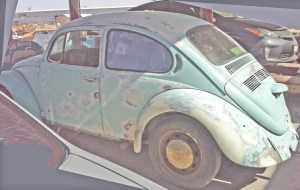
When I bought my VW forty-three years ago, there were so many problems, I thought for sure it was a lemon. For one thing, it wouldn’t always start, and for another, the gears would grind when I shifted. I kept taking the bug back to the dealership, and the men would patronize me, telling me in their superior tones that I didn’t know how to drive, that I just had to get used to the new car. One time, the jerk took my instruction manual out of the glove compartment and scribbled all over the page about how to start the car to emphasize his point.

lemonIt wasn’t until months later that a friend of a friend who loved to argue took the car into the dealership and got them to take it for a drive. And then, oh, my. What a backtracking. “Why is she driving this car?” they asked. “There’s no syncromesh.”

Yep. My fault. (Is the mystery of why I still have the same car becoming clearer? I never wanted to deal with such folks again.)

Eventually, I got all the original problems straightened out, and then the secondary problems (such as a clutch cable that broke at about 1000 miles). That set the pattern of my dealings with the bug. Things would go wrong, and I got them fixed.

When the car was working, I liked it just fine, but when it wasn’t working, I hated it.

Somewhere along the line I began collecting articles about shopping for a new car (new to me, that is). One article is called, “The Smart Way to Car Shop,” and another is, “Lots of Used Lemons.” The tagline on the second article is “There’s a whole new generation of secondhand cars out there. One in ten is a disaster waiting to happen.” (Apparently, a lot of cars that were totaled end up being fixed and sold illegally without a warning about the accident.)

I figured if there was a chance of ending up with a disaster, I might as well stick with the disaster I knew. And somehow, my “disaster” has managed to survive for 43 years. (To show you how old it is, I just found the license plate renewal for when the car was four years old. The tags and license fee were $2.50.)

I’ve been trying to figure out what sort of vehicle to replace this one with, but all of a sudden today it struck me that I wasn’t the one who decided I needed a new car. The men in my life and one or two women seem to think this vehicle should be disposed of and I went along with their assessment because there is no getting around the fact that the bug is old, decrepit even.

The truth is, I don’t really care what car I drive. For me, a car is simply a car. A car wouldn’t make me feel special or young or safe or . . . whatever it is that a car is supposed to make me feel. I have no need of a new car smell (would probably aggravate my allergies, to tell the truth). I do have to admit that for a while, I was embarrassed to be driving such an ancient thing, as if it said something about me, but it doesn’t say anything. The bug is simply a means of transportation. I don’t even care that it is temporarily unreliable. I don’t need to be anywhere that I can’t get to on foot, at least for now, and I don’t particularly like driving anyway.

Although it would be nice to have a “stealth camper” that I can park anywhere without anyone knowing I was camped inside, I probably wouldn’t be able to afford a long trip for another year, and such a vehicle would be impractical for city driving.

So, as with everything else in my life, I’m taking the stance that things will work out or they won’t. It’s as simple as that.

And how lovely not to feel as if I need to make a decision!

***

Pat Bertram is the author of the suspense novels Light Bringer, More Deaths Than One, A Spark of Heavenly Fireand Daughter Am I. Bertram is also the author of Grief: The Great Yearning, “an exquisite book, wrenching to read, and at the same time full of profound truths.” Connect with Pat on Google+. Like Pat on Facebook.

My Problem With Men

Lately I’ve been noticing a strange thing about men. If I get upset by something they say, even if they are simply imparting information and not saying anything to purposely hurt me, they respond, “I shouldn’t have told you.”

Huh? Just because I don’t like the news doesn’t mean they shouldn’t have told me. Just because I get upset is no reason to keep me in the dark. Are men so fragile they can’t handle anger, tears, heartbreak, even if it’s not directed at them? Or even if it is directed at them? (To tell the truth, I’m not sure I could handle anger or tears if they were directed at me, but if I did something to provoke those reactions, I sure would do something to try smooth things over.)

I seem to have lost the ability to deal with men, assuming I eCowboyver had the ability to begin with. I’ve lost a friend who was dear to me because he couldn’t handle my emotional reactions. He didn’t seem to think I had the right to be angry or feel hurt by anything he did, or maybe it was just that he didn’t like my show of emotion. For a while, I thought my problems with him were more of a personal nature, but now I see that the problems stemmed from a basic conflict — he is a man and I am a woman. We might not be from Venus or Mars or whatever planets we are supposed to be from, but there is a distinct difference in the way we see things.

Today, another man told me that my neighbors were hurt by my not telling them about my father’s funeral, though I had done so. They had been shunning me, turning around and walking the other way when they saw me or when I spoke to them, and even though I was upset by what he said, I needed to know because his words explained their actions. When I made the comment that it was my father who died, I got tearful as I always do now at the reminder of death. He immediately said, “I shouldn’t have told you.”

So what if I was upset? So what if I cried a bit? So what if I was momentarily angry at the unfairness of it? It’s not like I’m going to spend the rest of my life agonizing over the neighbor’s snubbery. (My word processor doesn’t like my making up words. It keeps changing snubbery to snobbery.) Luckily, my emotional reaction passed as quickly as it came, and luckily he was reasonable so we were able to get beyond our differences.

My real problem with men and emotions comes when I interject my emotions into the middle of a story or explanation. I don’t know whether it’s the interruption that upsets men or that the interruption is emotional. (I never notice this with women.) I don’t deny that my emotions are close to the surface now, and they pop up when and where they will without waiting for the end of a tale. I suppose I should try to cap my emotional responses, but I’m not sure I want to. It’s easier to get beyond life’s sad/bad parts if I can emote a minute (or a lot of minutes) and then let go.

There is a lesson in all this, though I’m not sure what.

***

Pat Bertram is the author of the suspense novels Light Bringer, More Deaths Than One, A Spark of Heavenly Fireand Daughter Am I. Bertram is also the author of Grief: The Great Yearning, “an exquisite book, wrenching to read, and at the same time full of profound truths.” Connect with Pat on Google+. Like Pat on Facebook.
Letter to Jeff, Day 435


Day 435, Hi, Jeff.

Another Saturday. I’m tearing up again, though I’m not sure why. Loneliness, I guess. Feeling sorry for myself. I need to get on with my life, concentrate on myself. But how lonely is that? Perhaps it’s better to have no hope. Just try to take the days as they come. It sounds a lot easier than it is. The damn emotions get in the way.

Will this sorrow ever end? Will anything good ever happen to me? Do you miss me? Do you still exist? Will I ever love again? Will anyone ever love me? Is this all there is — this emptiness? I can fill the emptiness with doing things — reading, writing, walking, whatever comes my way — but as soon as I stop concentrating on the “fill,” the emptiness shows up again.

I need something to hold on to. I need something concrete to build my life on, but there isn’t anything but maybe survival. Survival — that’s what your life ended up being about. Is that all there is? Survival until there is no more survival?

How did you manage to survive as well as you did? Was it worth it living with such pain? I guess, in the end, there isn’t really a choice. You have to play out the hand you’re given. Damn. I wish I weren’t so lonely. I might be able to deal with your being gone if not for that. And I really should be able to deal with it. For cripes sake, I am not a child.

What a mess my life is, well, if emptiness can be called a mess. I wish I cared about something. I wish I could talk to you. I wish you weren’t dead. I wish you hadn’t been so sick for so long.

Maybe I’m being insensitive, whining about my life when you no longer have a life. But then, maybe you got the better end of the deal. I hope so.

I love you.

***

Pat Bertram is the author of the suspense novels UnfinishedMadame ZeeZee’s Nightmare, Light BringerMore Deaths Than OneA Spark of Heavenly Fireand Daughter Am IBertram is also the author of Grief: The Great Yearning, “an exquisite book, wrenching to read, and at the same time full of profound truths.” Connect with Pat on Google+. Like Pat on Facebook.
Truth and Literature

A World Without MusicJ. Conrad Guest, author of A Retrospect In Death and A World Without Music (plus several other books) just posted a blog about truth and its importance to literature. Like J. Conrad, I believe that fiction should impart “Truth” with a capital letter or even just “truth” with a small letter. If there is no truth in fiction, it is merely entertainment, and that seems a waste of both the human mind and human potential. For sure, it is a waste of my time.

J. Conrad quoted Susan Sontag as saying, “In my view, a fiction writer whose adherence is to literature is, necessarily, someone who thinks about moral problems: about what is just and unjust, what is better or worse, what is repulsive and admirable, what is lamentable and what inspires joy and approbation. This doesn’t entail moralizing in any direct or crude sense. Serious fiction writers think about moral problems practically. They tell stories. They narrate. They evoke our common humanity in narratives with which we can identify, even though the lives may be remote from our own. They stimulate our imagination. The stories they tell enlarge and complicate — and, therefore, improve — our sympathies.”

Then J. Conrad asks, “How many writers today seek truth in their work, and how many simply identify an audience — for instance, unhappy housewives, or fanatics of vampires or werewolves — and simply write to that audience? The mercenary who writes for a paycheck is really saying that sales are more important than truth.”

It’s interesting to see someone besides me lamenting the lack of truth in fiction — I thought I was the only one who thought fiction should help us see the truth of the world, to see the truth of what is beyond the world, to see the truth of our place in the world. One does not need big words, convoluted sentences, and ponderous tomes to show truth. Simple words and engaging stories can make truth more readily accessible to even someone like me who has spent a lifetime searching for truth.

Literature can take us beyond ourselves, take us deeper into ourselves, take us into the minds and hearts of others to help us understand a greater truth or to see the world in a fresh manner. Good stories are like the first pair of eyeglasses to someone with poor vision. I still remember as a child being bewildered by other people’s uncanny ability to know what even unfamiliar streets were called, but then I got my first pair of glasses, and oh! I understood! They weren’t somehow superior to me in their understanding of the world. They had simply been able to see that which I couldn’t. And that is what fiction should do — enable us to see that which we couldn’t.

Truth seems to be something writers and readers shy away from, especially since so many people believe that truth is relative and so there is no point in discussing it or showing it or even alluding to it. But the truth is, Truth is never relative. Truth is Truth. Only our perception varies. At rock bottom, there is immutable truth. I couldn’t even begin to tell you what that immutable truth is — no one can. It’s bigger than any of us, and yet we all add to and reflect the truth in what we do, and especially what we write. In addition, we each have our own immutable truth. Whether we know ourselves or not, there is truth in us, and perhaps this individual truth is what people mean when they say truth is relative. (Some people do not accept my assessment of myself as being true, for example, and their perception could be right for all I know, but neither their opinion nor mine changes who or what I am.)

I seldom read any more. When writers don’t bother to show me Truth or even their own truth, then the writing seems trivial to me. I’d rather do something more truthful. Dance, perhaps. Executing a perfect triple time step is truth, too.

J. Conrad Guest ends his post with: “In today’s book industry, if it doesn’t sell, it isn’t relevant. But if truth isn’t relevant, what’s that say about the world around us?”

Good question.

***

Click here to read: What Is Truth? by J. Conrad Guest

***

Pat Bertram is the author of the suspense novels Light Bringer, More Deaths Than One, A Spark of Heavenly Fireand Daughter Am I. Bertram is also the author of Grief: The Great Yearning, “an exquisite book, wrenching to read, and at the same time full of profound truths.” Connect with Pat on Google+. Like Pat on Facebook.
We Are Not All Created Equal

Despite what the U.S. Declaration of Independence states, all men are not created equal. Nor are all women. Ideally, people are equal under the law, but even that is a specious claim since so often rich folk who can hire high-priced attorneys with dozens of partners and associates are more equal than those who have to make do with overworked public defenders.

But this bloggery isn’t about such grand matters. It’s more about the little things that makes us so very different from one another.

People who love Mexican food are often perplexed by my dislike of cilantro. “How can you not like cilantro?” a friend asked me in accusatory tones, as if she thought I were being contrary by choosing to dislike something most people loved. I retaliated by asking her what cilantro tasted like to her. She said it tasted citrusy, slightly bitter and very refreshing. But that is not how it tastes to me. To me, it tastes like soap. Cilantro contains chemical compounds called aldehydes, which are also present in soaps and other cleaning agents, and apparently I don’t have the enzyme that breaks down the soap-like compounds of the herb into a tasty seasoning, so I get the full soap taste.

Regardless of what she seemed to think, I was not being contrary. Just unequal.

A similar situation happened when I drove a friend to her mountain home this weekend. In a couple of instances, I had to drive down very steep roads that made me feel as if I were free falling down an elevator shaft. She made a few comments about my nervousness, and she didn’t seem to believe me when I told her I wasn’t nervous, that it was a physical reaction. I explained it using the example of a level. Some people are born with something similar to the bubble in their center, so they always know where they are in relation to the earth. These people can turn cartwheels, ride roller coasters, descend steep slopes, and never lose their equilibrium. I on the other hand, have no bubble, so I never know where I am in relation to the earth. (It’s an inner ear thing, or so I have heard.) I remember once as a very small child, maybe 5 or 6, I took tumbling lessons, and I couldn’t do what the other kids did. I got too disoriented, and feared I would break my neck. (They always say kids that young don’t know there is such a thing as necks breaking, but I bet others who lack an inborn plumb bubble also were aware of the possibility.)

Again, I wasn’t being contrary by repudiating her calling me nervous, I was simply explaining our inequalities. Some things I can do, others can’t, and some things others can do, I can’t. It’s that simple.

I’m not sure that being equal is an important matter, anyway. We all wish to be treated the same as others in similar circumstances, and we should be. But other than that, it’s the ways we are unequal that make us who we are, and that is something to celebrate.

***

Pat Bertram is the author of the suspense novels Light Bringer, More Deaths Than One, A Spark of Heavenly Fireand Daughter Am I. Bertram is also the author of Grief: The Great Yearning, “an exquisite book, wrenching to read, and at the same time full of profound truths.” Connect with Pat on Google+. Like Pat on Facebook.